This 1658 Geneva collection of Paracelsus’s medical, surgical, alchemical and magical works has its three parts bound in a single thick folio. The portrait after Tintoretto, engraved by François Chauveau, is present opposite the red-and-black title. An old spine label reads GENEVA 1680, which is wrong by twenty-two years and has been wrong on this spine for a very long time.
We also offer this edition in two leather-bound volumes from the Steiner Memorial Collection, at $8,750. That set lacks the engraved portrait. Compare the two-volume Steiner set.
Paracelsus (1493/94–1541) was a physician and alchemist who challenged the medicine taught in the universities. At Basel in 1527 he threw Avicenna’s Canon, a standard medical textbook, onto the students’ St. John’s Day bonfire. He lectured in German and admitted barber-surgeons to his lectures. Medicine, he insisted, had to be learned from nature and from the sick body, with alchemy supplying the means to prepare remedies. Much of his writing was still unpublished when he died.
Johannes Huser’s Basel edition of 1589–1591 gathered the scattered medical and philosophical works. Friedrich Bitiskius prepared this later Latin collection for Jean Antoine and Samuel de Tournes. Its range is substantial: the Paragranum and Paramirum on the physician’s art, the major and minor surgical works, and treatises on mining sickness, mineral waters and the invisible diseases. Salt, sulfur and mercury recur as the three principles of matter in Paracelsus’s account of nature.
The magical writings include the Archidoxis magica, with planetary seals and talismans for particular diseases and particular hours. Several of these works are of disputed authenticity and may be the work of followers using his name. They remain part of the history of what readers expected Paracelsian medicine to accomplish. The collection brings surgery and planetary magic within the covers of the same folio.
The portrait carries the motto Alterius non sit qui suus esse potest, “let no man belong to another who can belong to himself.” The contemporary parchment binding has a cracked front joint and wear at the head of the spine; the title leaf is chipped and creased in the margins. An unidentified armorial bookplate and a bookplate of Kenneth Edwin McMullen remain inside. At nearly fourteen inches tall, the volume is substantial in the hand, and we do not recommend lifting it casually.
Provenance: (1) An unidentified eighteenth-century engraved armorial bookplate, with coronet and monogram cipher, inside the front board. (2) Bookseller's ticket of Libreria Antiquaria Bourlot, Turin, founded 1848. (3) Bookplate of Kenneth Edwin McMullen. (4) The psychiatry collection of Dr. Michael H. Stone (1933–2023), Columbia University.
PARACELSUS (Theophrastus Bombastus von Hohenheim, 1493/94–1541); Friedrich BITISKIUS, editor. Aur. Philip. Theoph. Paracelsi Bombast ab Hohenheim, medici et philosophi celeberrimi, chemicorumque principis, Opera omnia medico-chemico-chirurgica, tribus voluminibus comprehensa. Editio novissima et emendatissima, ad Germanica & Latina exemplaria accuratissime collata. Geneva: sumptibus Ioan. Antonii & Samuelis de Tournes, 1658.
Physical Description: Thick folio, approximately 35 x 21 cm (13 3/4 x 8 1/4 inches). Collation: a blank leaf, then 17 unnumbered preliminary leaves; Volume I, 828 pp. followed by 20 leaves of index; Volume II, 718 pp. followed by 16 leaves of index; Volume III in two sections, the Chirurgia Magna 212 pp. followed by 14 leaves of index and the Chirurgia Minor or Bertheonea 119 pp. followed by 4 leaves of index; and at the end the Dictionariolum Paracelsicum, 18 pp., without index. Complete, each volume and section carrying its own divisional title page and its own contents list. Engraved portrait frontispiece after Tintoretto, engraved by François Chauveau, bound opposite the general title; general title printed in red and black with a large engraved device; woodcut and engraved diagrams, tables and sigils throughout, most densely in the Archidoxis magica.
Binding: Contemporary full parchment over boards, blind-tooled with a center ornament, spine on five raised bands with a black gilt-lettered morocco label reading PARACELSI OPERA OMNIA and a second label lettered GENEVA 1680.
Condition: Front joint cracked. Parchment dry, with lifting and splitting at the head of the spine and rubbing to the board edges. Title leaf chipped and creased in the margins. Scattered light browning and marginal soiling; text and plates clean and legible throughout.
References: Sudhoff 381–383. Caillet 8283. Ferguson II, 169. Krivatsy 8560. Bibliotheca Osleriana 528. Verginelli, Bibliotheca Hermetica, 243–244.
This 1658 Geneva collection of Paracelsus’s medical, surgical, alchemical and magical works has its three parts bound in a single thick folio. The portrait after Tintoretto, engraved by François Chauveau, is present opposite the red-and-black title. An old spine label reads GENEVA 1680, which is wrong by twenty-two years and has been wrong on this spine for a very long time.
We also offer this edition in two leather-bound volumes from the Steiner Memorial Collection, at $8,750. That set lacks the engraved portrait. Compare the two-volume Steiner set.
Paracelsus (1493/94–1541) was a physician and alchemist who challenged the medicine taught in the universities. At Basel in 1527 he threw Avicenna’s Canon, a standard medical textbook, onto the students’ St. John’s Day bonfire. He lectured in German and admitted barber-surgeons to his lectures. Medicine, he insisted, had to be learned from nature and from the sick body, with alchemy supplying the means to prepare remedies. Much of his writing was still unpublished when he died.
Johannes Huser’s Basel edition of 1589–1591 gathered the scattered medical and philosophical works. Friedrich Bitiskius prepared this later Latin collection for Jean Antoine and Samuel de Tournes. Its range is substantial: the Paragranum and Paramirum on the physician’s art, the major and minor surgical works, and treatises on mining sickness, mineral waters and the invisible diseases. Salt, sulfur and mercury recur as the three principles of matter in Paracelsus’s account of nature.
The magical writings include the Archidoxis magica, with planetary seals and talismans for particular diseases and particular hours. Several of these works are of disputed authenticity and may be the work of followers using his name. They remain part of the history of what readers expected Paracelsian medicine to accomplish. The collection brings surgery and planetary magic within the covers of the same folio.
The portrait carries the motto Alterius non sit qui suus esse potest, “let no man belong to another who can belong to himself.” The contemporary parchment binding has a cracked front joint and wear at the head of the spine; the title leaf is chipped and creased in the margins. An unidentified armorial bookplate and a bookplate of Kenneth Edwin McMullen remain inside. At nearly fourteen inches tall, the volume is substantial in the hand, and we do not recommend lifting it casually.
Provenance: (1) An unidentified eighteenth-century engraved armorial bookplate, with coronet and monogram cipher, inside the front board. (2) Bookseller's ticket of Libreria Antiquaria Bourlot, Turin, founded 1848. (3) Bookplate of Kenneth Edwin McMullen. (4) The psychiatry collection of Dr. Michael H. Stone (1933–2023), Columbia University.
PARACELSUS (Theophrastus Bombastus von Hohenheim, 1493/94–1541); Friedrich BITISKIUS, editor. Aur. Philip. Theoph. Paracelsi Bombast ab Hohenheim, medici et philosophi celeberrimi, chemicorumque principis, Opera omnia medico-chemico-chirurgica, tribus voluminibus comprehensa. Editio novissima et emendatissima, ad Germanica & Latina exemplaria accuratissime collata. Geneva: sumptibus Ioan. Antonii & Samuelis de Tournes, 1658.
Physical Description: Thick folio, approximately 35 x 21 cm (13 3/4 x 8 1/4 inches). Collation: a blank leaf, then 17 unnumbered preliminary leaves; Volume I, 828 pp. followed by 20 leaves of index; Volume II, 718 pp. followed by 16 leaves of index; Volume III in two sections, the Chirurgia Magna 212 pp. followed by 14 leaves of index and the Chirurgia Minor or Bertheonea 119 pp. followed by 4 leaves of index; and at the end the Dictionariolum Paracelsicum, 18 pp., without index. Complete, each volume and section carrying its own divisional title page and its own contents list. Engraved portrait frontispiece after Tintoretto, engraved by François Chauveau, bound opposite the general title; general title printed in red and black with a large engraved device; woodcut and engraved diagrams, tables and sigils throughout, most densely in the Archidoxis magica.
Binding: Contemporary full parchment over boards, blind-tooled with a center ornament, spine on five raised bands with a black gilt-lettered morocco label reading PARACELSI OPERA OMNIA and a second label lettered GENEVA 1680.
Condition: Front joint cracked. Parchment dry, with lifting and splitting at the head of the spine and rubbing to the board edges. Title leaf chipped and creased in the margins. Scattered light browning and marginal soiling; text and plates clean and legible throughout.
References: Sudhoff 381–383. Caillet 8283. Ferguson II, 169. Krivatsy 8560. Bibliotheca Osleriana 528. Verginelli, Bibliotheca Hermetica, 243–244.

 Image 1 of 32
 Image 2 of 32
 Image 3 of 32
 Image 4 of 32
 Image 5 of 32
 Image 6 of 32
 Image 7 of 32
 Image 8 of 32
 Image 9 of 32
 Image 10 of 32
 Image 11 of 32
 Image 12 of 32
 Image 13 of 32
 Image 14 of 32
 Image 15 of 32
 Image 16 of 32
 Image 17 of 32
 Image 18 of 32
 Image 19 of 32
 Image 20 of 32
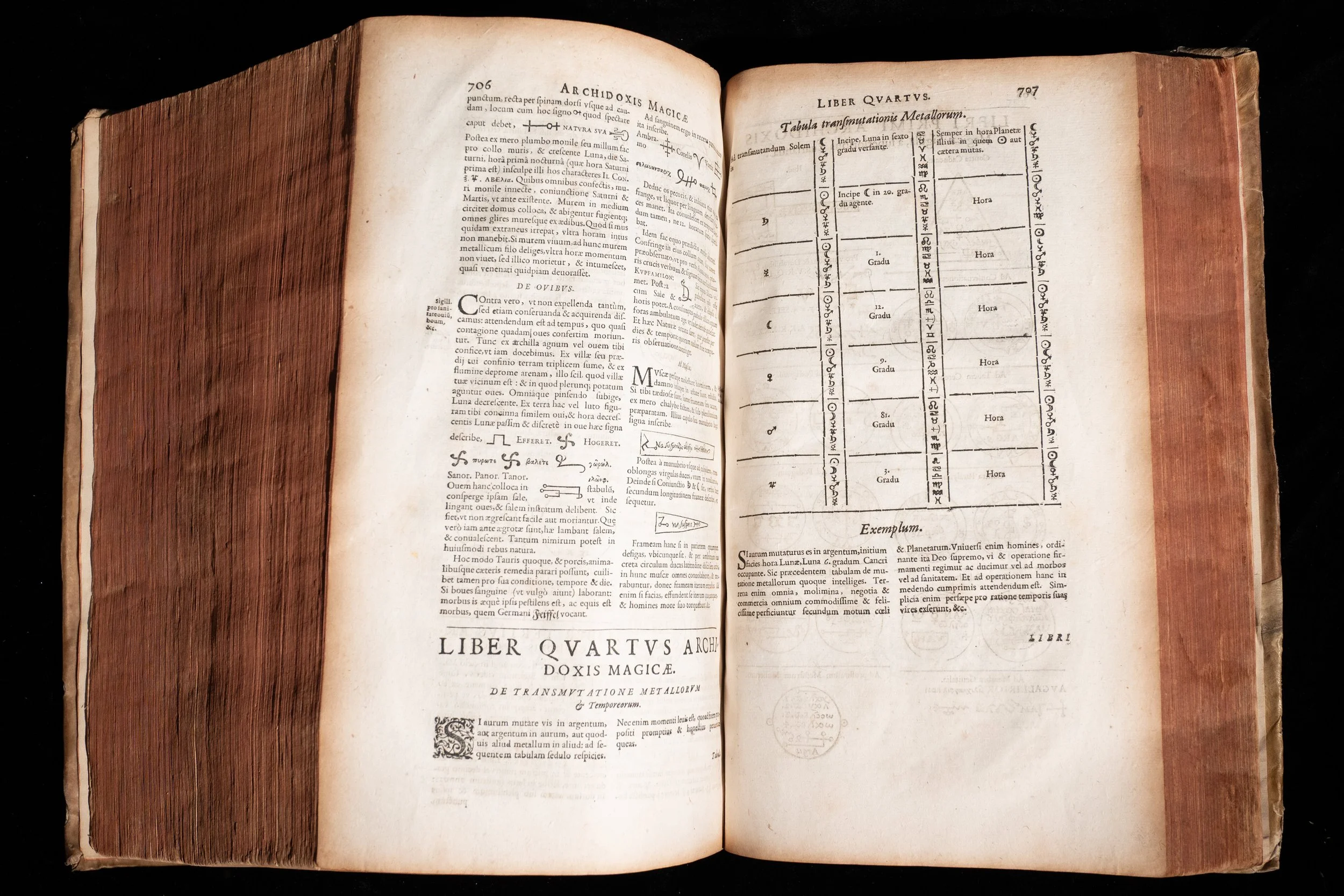 Image 21 of 32
 Image 22 of 32
 Image 23 of 32
 Image 24 of 32
 Image 25 of 32
 Image 26 of 32
 Image 27 of 32
 Image 28 of 32
 Image 29 of 32
 Image 30 of 32
 Image 31 of 32
 Image 32 of 32