First edition.
Open the buff cloth covers of this little book and you are handed a parlor oracle. Stamped in blue on the front board, and printed again on the title page, sits a four-by-four grid of numbers ringed about with sonorous names, Elohim, Elohi, Zebaoth, Adonai: the “Tablet of Jupiter.” The motto opposite the title sets the tone exactly, a line borrowed from George Meredith: “But, could I buy in this city a book of magic, that were my purchase.” Here, for one shilling and sixpence, was a book of magic for the Edwardian drawing room. The mechanism is a fortune-telling game. The reader chooses from a hundred numbered questions, most of them tilted firmly toward the heart, “Shall I be engaged soon?”, “Will my husband be jealous?”, “Shall I marry where money is?”, and is then directed, by a system keyed to the symbols of the sun, moon and planets, to a page where the answer waits beside its planetary sign. The replies are clipped, knowing and a little fatalistic, the voice of a clever fortune-teller who has seen it all before. Ask whether you can win the love you desire and you may be told, “Someone bars the way. Possibly, it is yourself.” It is an entertainment, but a shrewd one, and it reads as well today as it did across a hundred years of teatables.
What lifts the book above the ordinary novelty is the occult furniture it borrows. The Tablet of Jupiter is the planet’s kamea, the magic square in which every row, column and diagonal sums to thirty-four, framed by the divine names and by the spirit and intelligence of Jupiter, exactly as the tradition was codified in Agrippa’s Three Books of Occult Philosophy. The text proper marches down the page beside the old planetary glyphs, ♃ ♄ ☿ ♀ , so that a light drawing-room ☉ ☽ amusement is dressed throughout in the ornament of learned ceremonial magic. That blend of music-hall fun and grimoire decoration is the popular occult moment that Pearson, with its whole shelf of fortune-telling handbooks, was selling to a mass readership after the First World War. The authorship is its own small mystery. “Mrs. John Le Breton” is a pen-name, and “John Le Breton” was itself a pseudonym, one long associated with the prolific writer Thomas Murray Ford; the woman who actually compiled this oracle has never been securely identified, and hides, as so many did, behind a husband’s borrowed name. First issued by C. Arthur Pearson in 1919, the book proved popular enough to be reprinted for decades and revived again in our own time, so it is uncommon rather than rare in early state.
This copy has the happiest of associations: a pencil gift inscription on the flyleaf, “With love from Margaret. May you get what you want!”, which is, for a wish-asking book of white magic, about as fitting a sentiment as one could hope to find.
LE BRETON, Mrs. John (pseudonym). The White-Magic Book. London: C. Arthur Pearson, Ltd., 18 Henrietta Street, W.C. [1919]. First edition. Physical Description: Small 8vo. pp. xxx, 100, [2]. Title page printed in blue and black with the “Tablet of Jupiter” magic-square device and a George Meredith epigraph; the oracle keyed throughout to the planetary symbols; publisher’s advertisements for the Pearson “Character Reading and Fortune Telling” and “Etiquette” handbooks at the rear. Printed in Great Britain by Butler & Tanner, Frome and London.
Binding: Publisher’s buff/tan cloth, front board and spine lettered in blue, the Tablet of Jupiter device stamped in blue to the front board; “Pearson” at the spine foot.
Condition: Cloth tanned and lightly soiled, spine and extremities rubbed, a faint mark to the front board; internally toned, with scattered foxing and an age tidemark to the front endleaves; a few leaves chipped at the fore-edge; text block sound. A good, honest copy.
Provenance: Pencil gift inscription to the front free endpaper, “With love from Margaret. May you get what you want!”; later booksellers’ pencil notes to the preceding blank.
First edition.
Open the buff cloth covers of this little book and you are handed a parlor oracle. Stamped in blue on the front board, and printed again on the title page, sits a four-by-four grid of numbers ringed about with sonorous names, Elohim, Elohi, Zebaoth, Adonai: the “Tablet of Jupiter.” The motto opposite the title sets the tone exactly, a line borrowed from George Meredith: “But, could I buy in this city a book of magic, that were my purchase.” Here, for one shilling and sixpence, was a book of magic for the Edwardian drawing room. The mechanism is a fortune-telling game. The reader chooses from a hundred numbered questions, most of them tilted firmly toward the heart, “Shall I be engaged soon?”, “Will my husband be jealous?”, “Shall I marry where money is?”, and is then directed, by a system keyed to the symbols of the sun, moon and planets, to a page where the answer waits beside its planetary sign. The replies are clipped, knowing and a little fatalistic, the voice of a clever fortune-teller who has seen it all before. Ask whether you can win the love you desire and you may be told, “Someone bars the way. Possibly, it is yourself.” It is an entertainment, but a shrewd one, and it reads as well today as it did across a hundred years of teatables.
What lifts the book above the ordinary novelty is the occult furniture it borrows. The Tablet of Jupiter is the planet’s kamea, the magic square in which every row, column and diagonal sums to thirty-four, framed by the divine names and by the spirit and intelligence of Jupiter, exactly as the tradition was codified in Agrippa’s Three Books of Occult Philosophy. The text proper marches down the page beside the old planetary glyphs, ♃ ♄ ☿ ♀ , so that a light drawing-room ☉ ☽ amusement is dressed throughout in the ornament of learned ceremonial magic. That blend of music-hall fun and grimoire decoration is the popular occult moment that Pearson, with its whole shelf of fortune-telling handbooks, was selling to a mass readership after the First World War. The authorship is its own small mystery. “Mrs. John Le Breton” is a pen-name, and “John Le Breton” was itself a pseudonym, one long associated with the prolific writer Thomas Murray Ford; the woman who actually compiled this oracle has never been securely identified, and hides, as so many did, behind a husband’s borrowed name. First issued by C. Arthur Pearson in 1919, the book proved popular enough to be reprinted for decades and revived again in our own time, so it is uncommon rather than rare in early state.
This copy has the happiest of associations: a pencil gift inscription on the flyleaf, “With love from Margaret. May you get what you want!”, which is, for a wish-asking book of white magic, about as fitting a sentiment as one could hope to find.
LE BRETON, Mrs. John (pseudonym). The White-Magic Book. London: C. Arthur Pearson, Ltd., 18 Henrietta Street, W.C. [1919]. First edition. Physical Description: Small 8vo. pp. xxx, 100, [2]. Title page printed in blue and black with the “Tablet of Jupiter” magic-square device and a George Meredith epigraph; the oracle keyed throughout to the planetary symbols; publisher’s advertisements for the Pearson “Character Reading and Fortune Telling” and “Etiquette” handbooks at the rear. Printed in Great Britain by Butler & Tanner, Frome and London.
Binding: Publisher’s buff/tan cloth, front board and spine lettered in blue, the Tablet of Jupiter device stamped in blue to the front board; “Pearson” at the spine foot.
Condition: Cloth tanned and lightly soiled, spine and extremities rubbed, a faint mark to the front board; internally toned, with scattered foxing and an age tidemark to the front endleaves; a few leaves chipped at the fore-edge; text block sound. A good, honest copy.
Provenance: Pencil gift inscription to the front free endpaper, “With love from Margaret. May you get what you want!”; later booksellers’ pencil notes to the preceding blank.

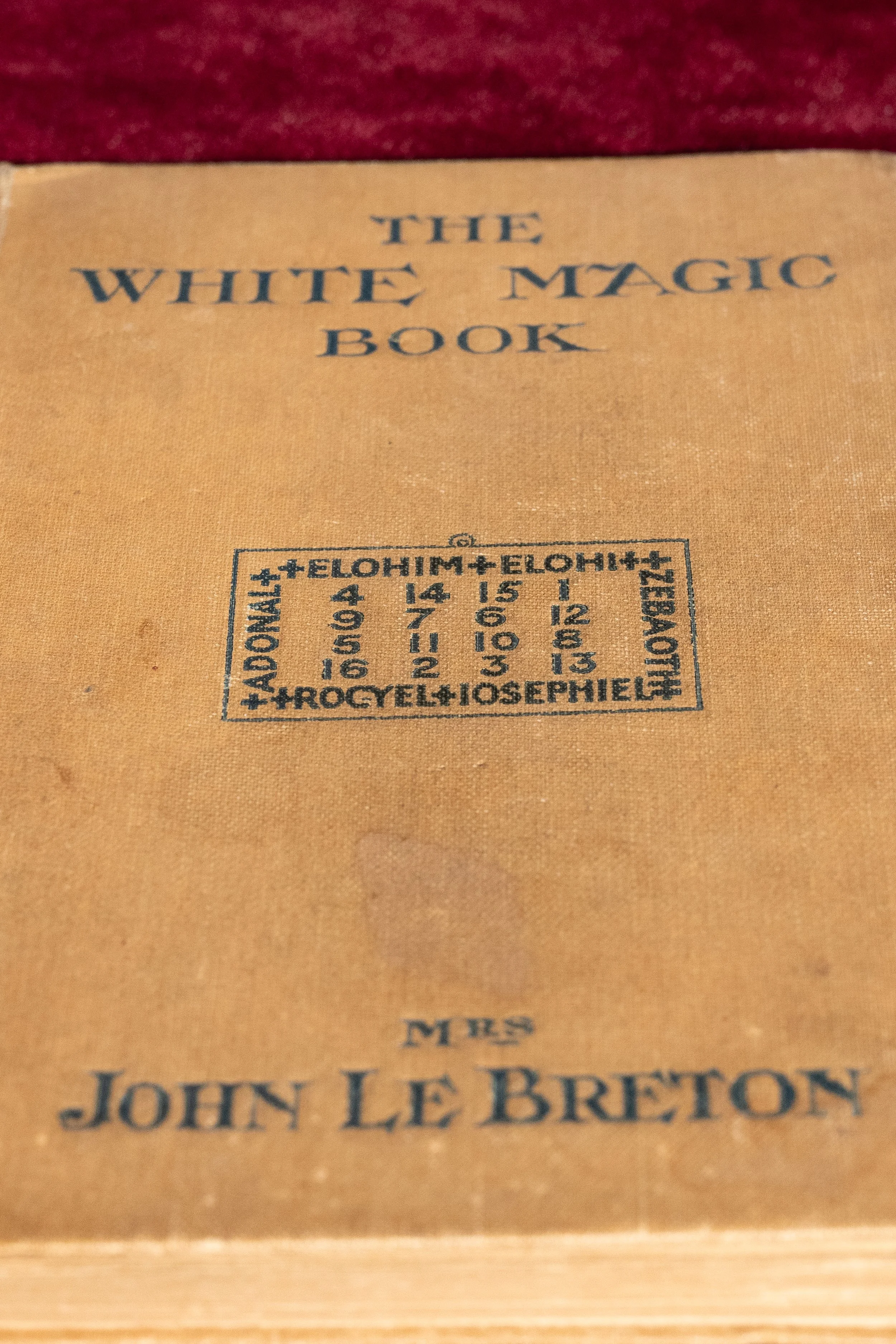 Image 1 of 10
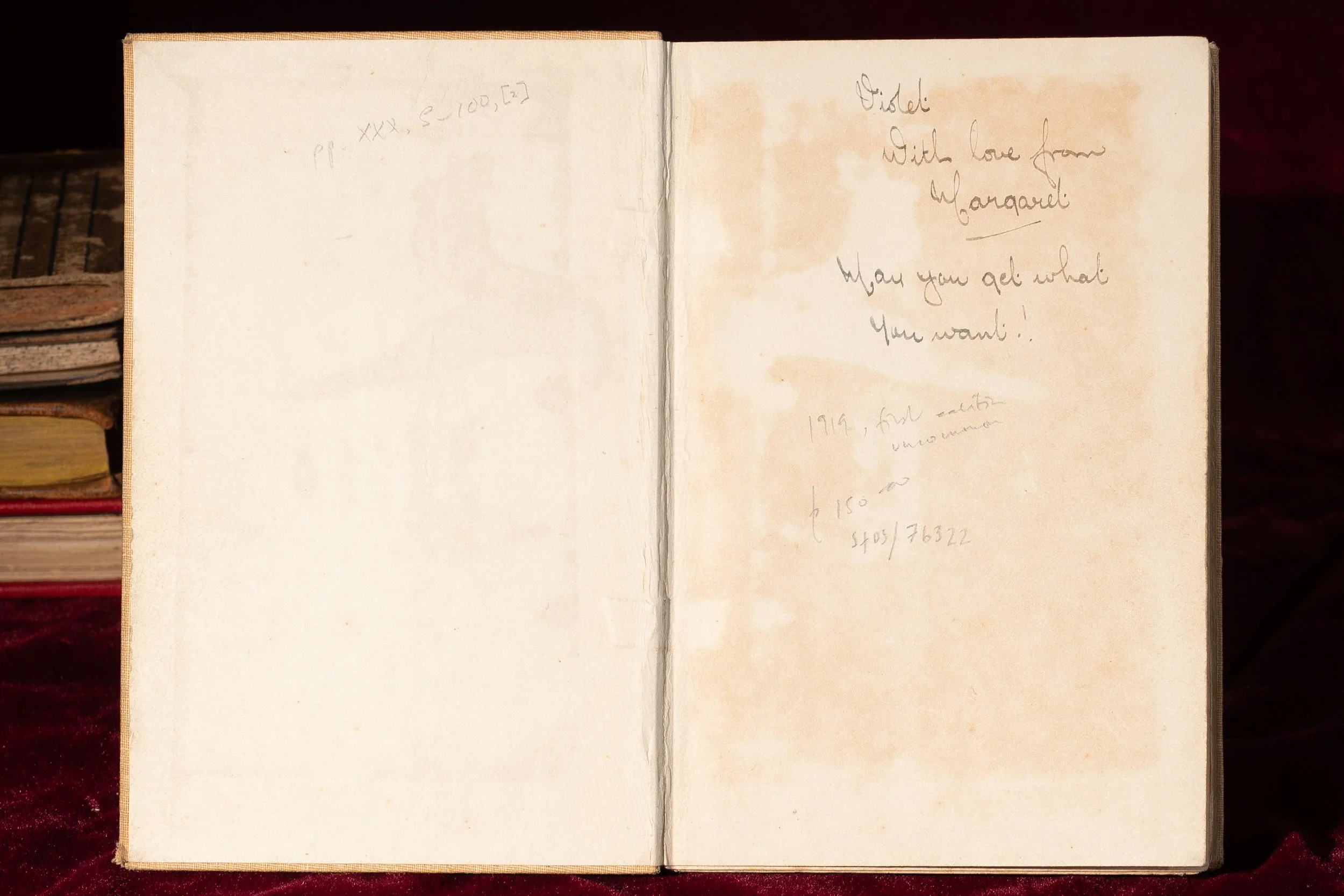 Image 2 of 10
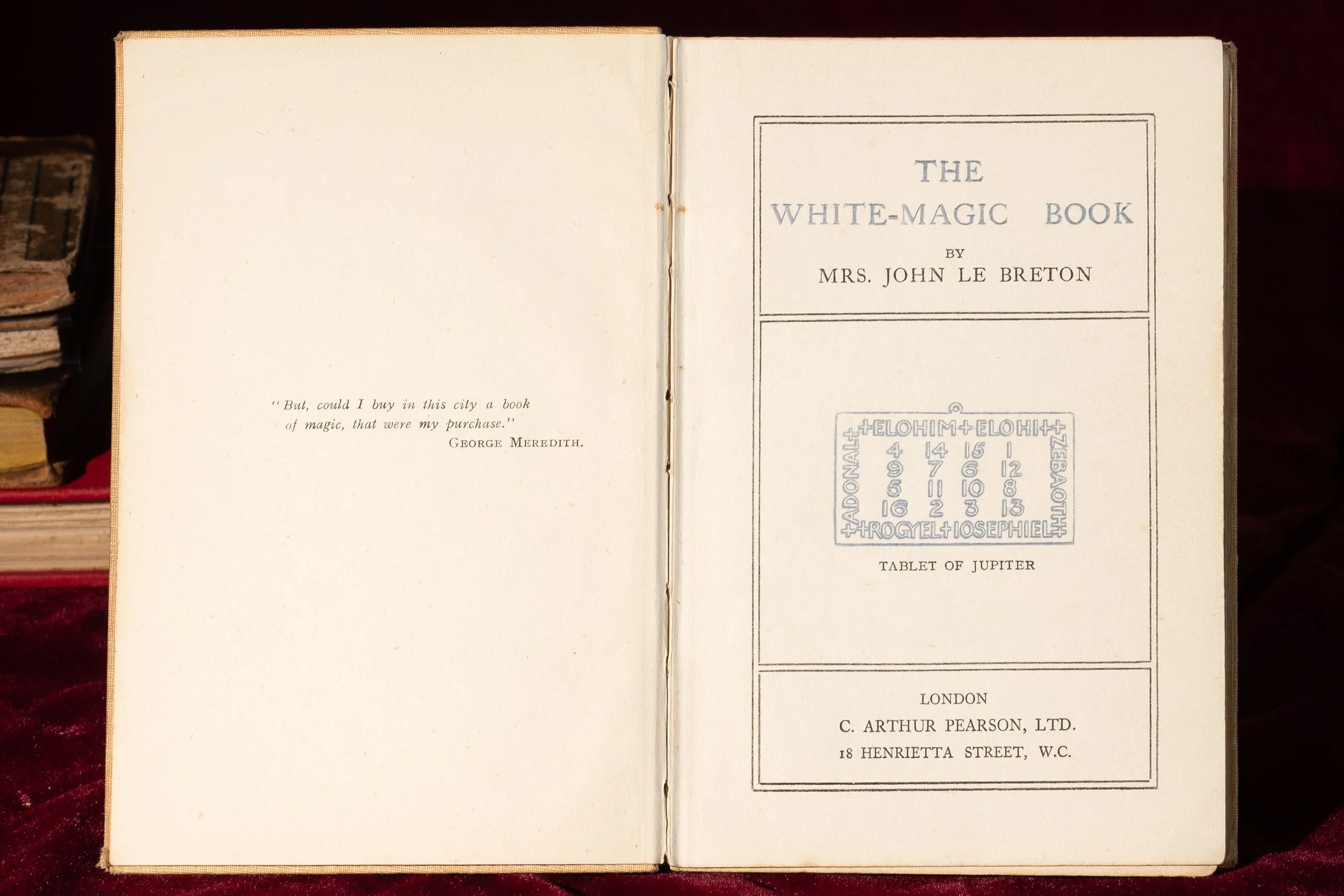 Image 3 of 10
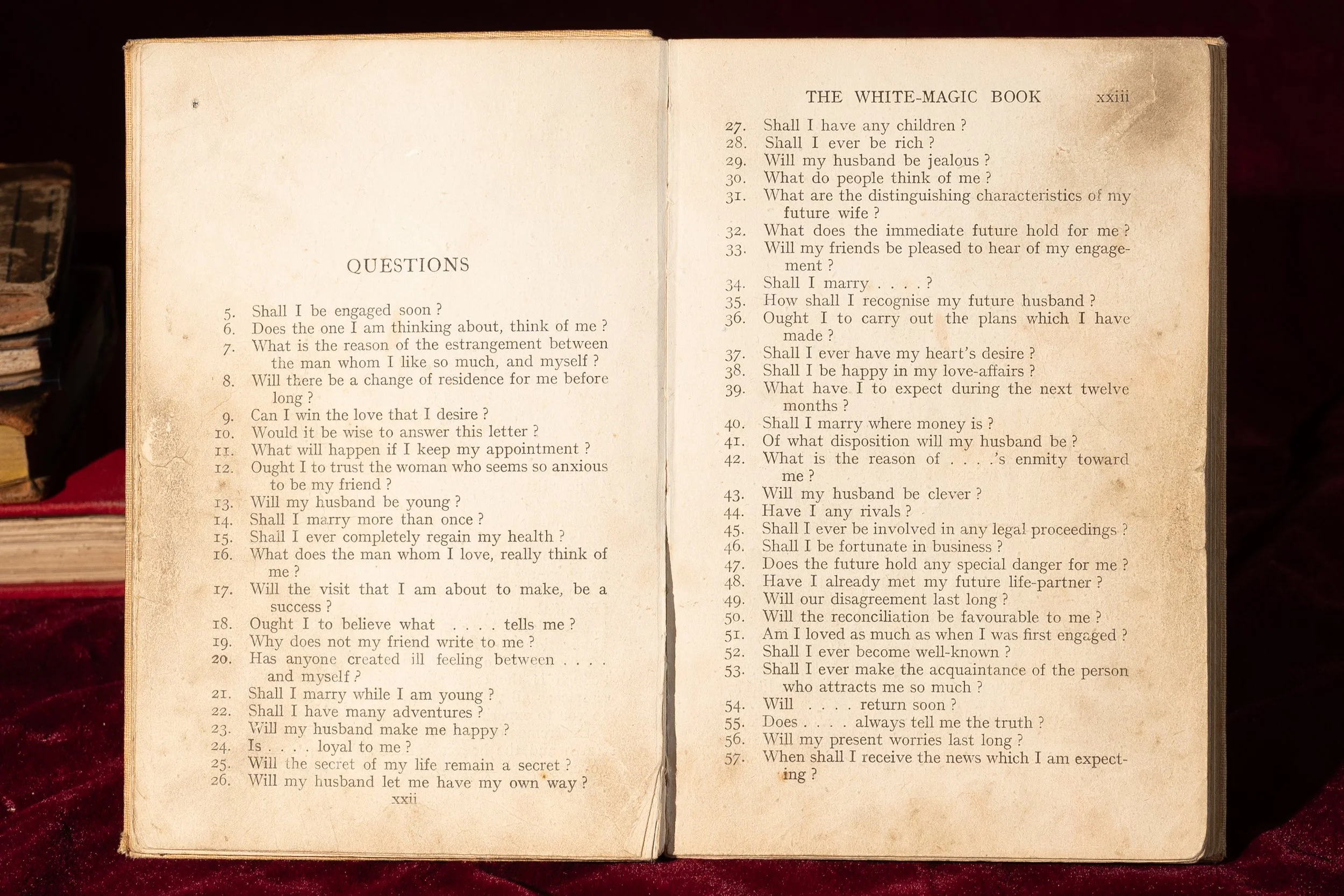 Image 4 of 10
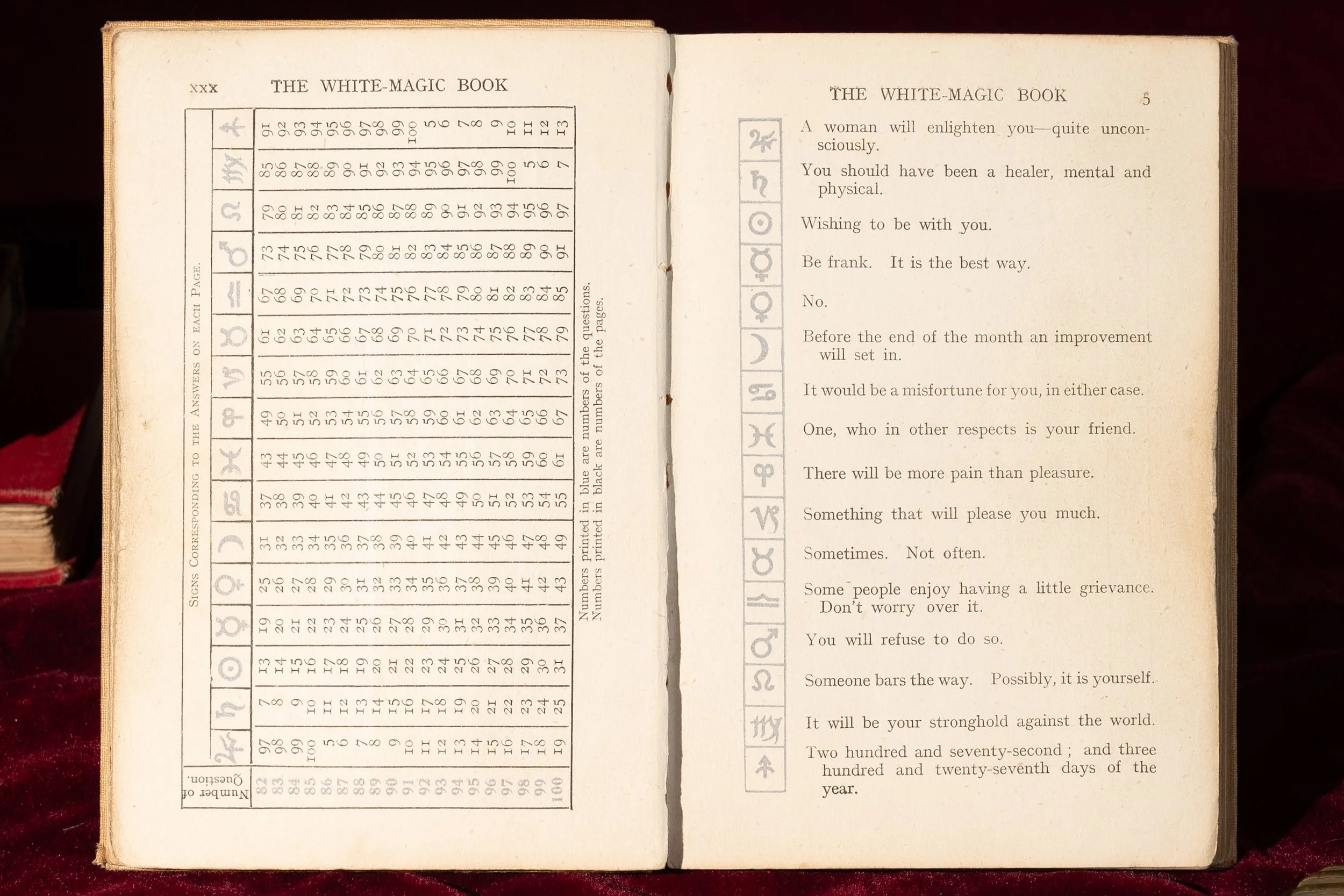 Image 5 of 10
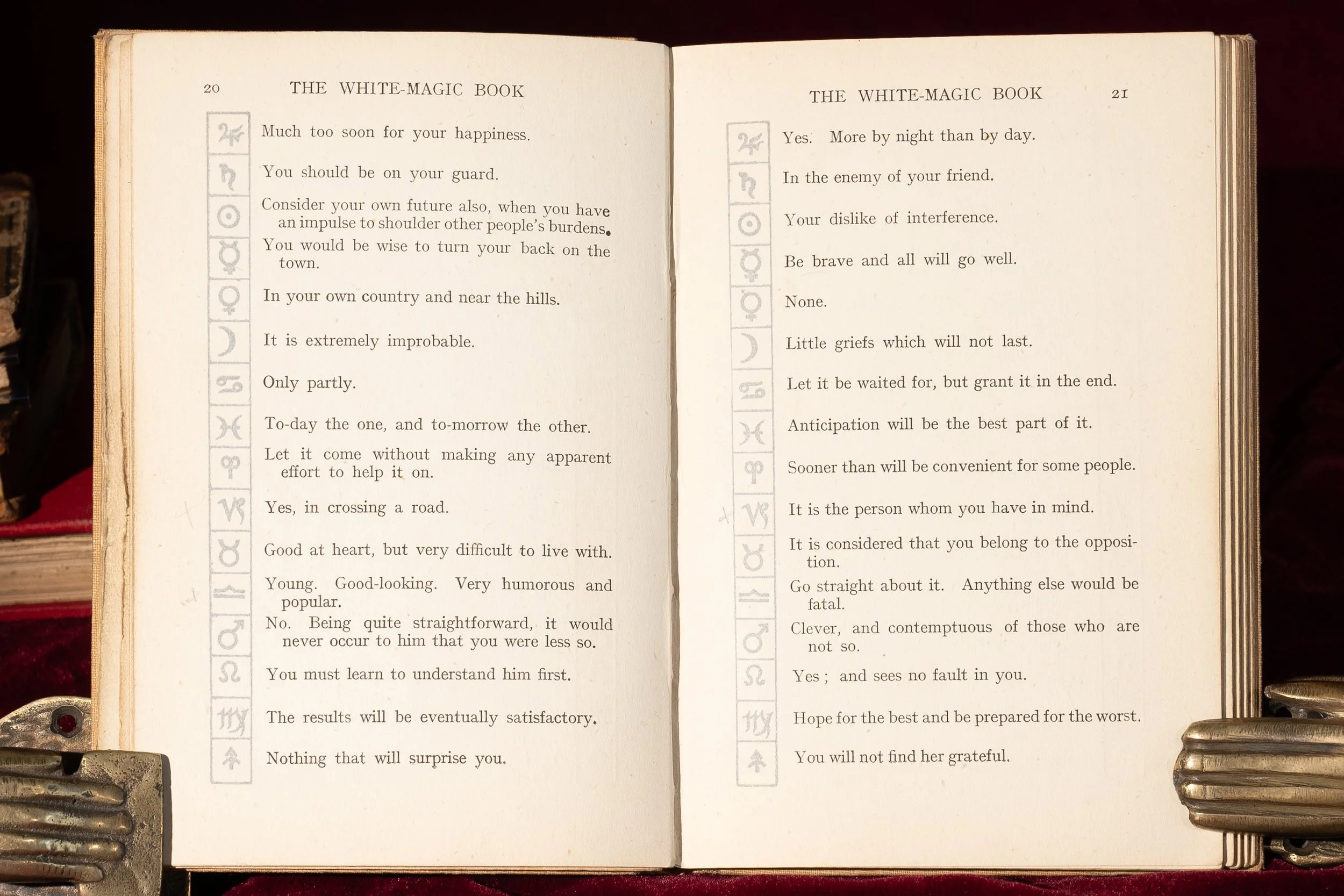 Image 6 of 10
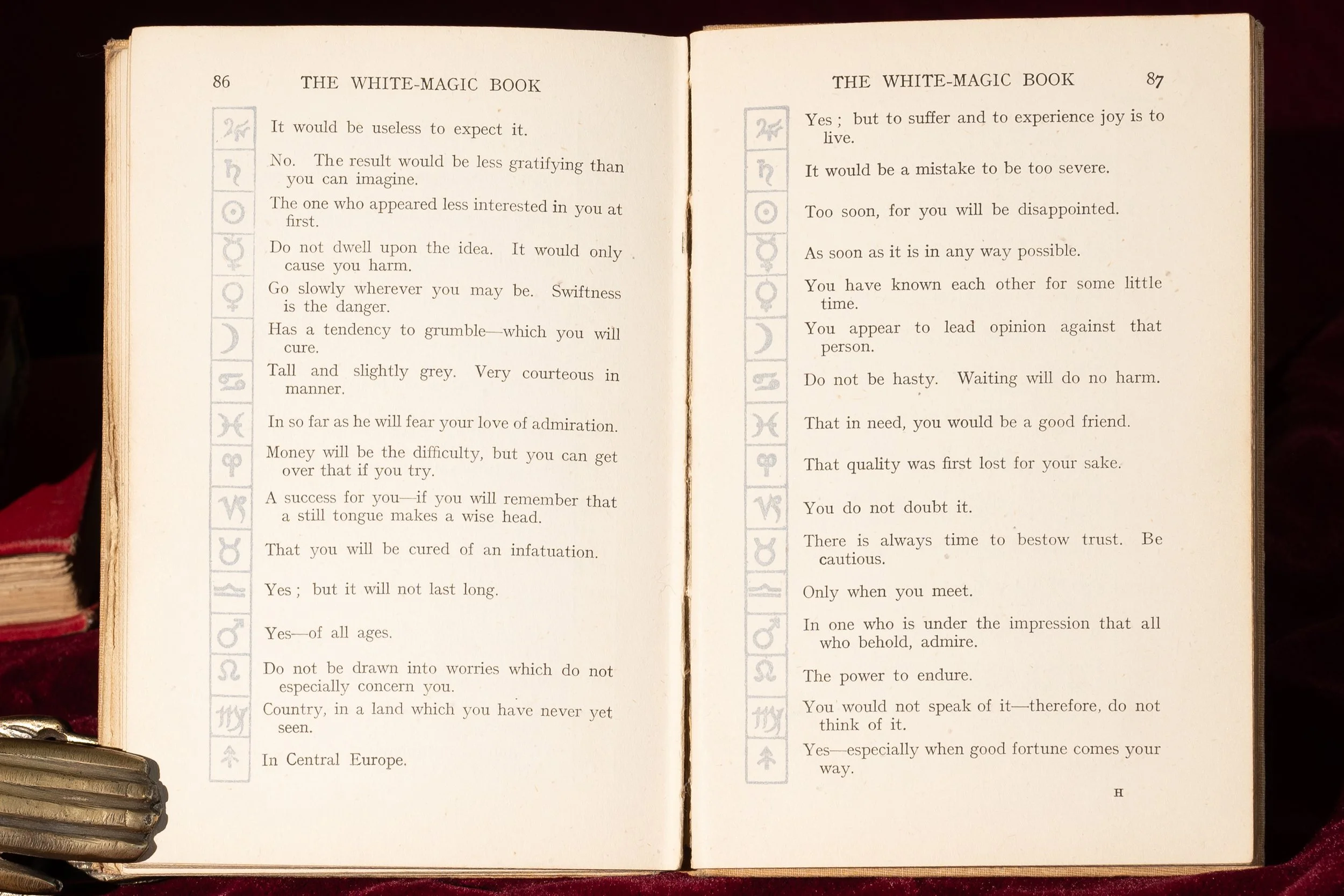 Image 7 of 10
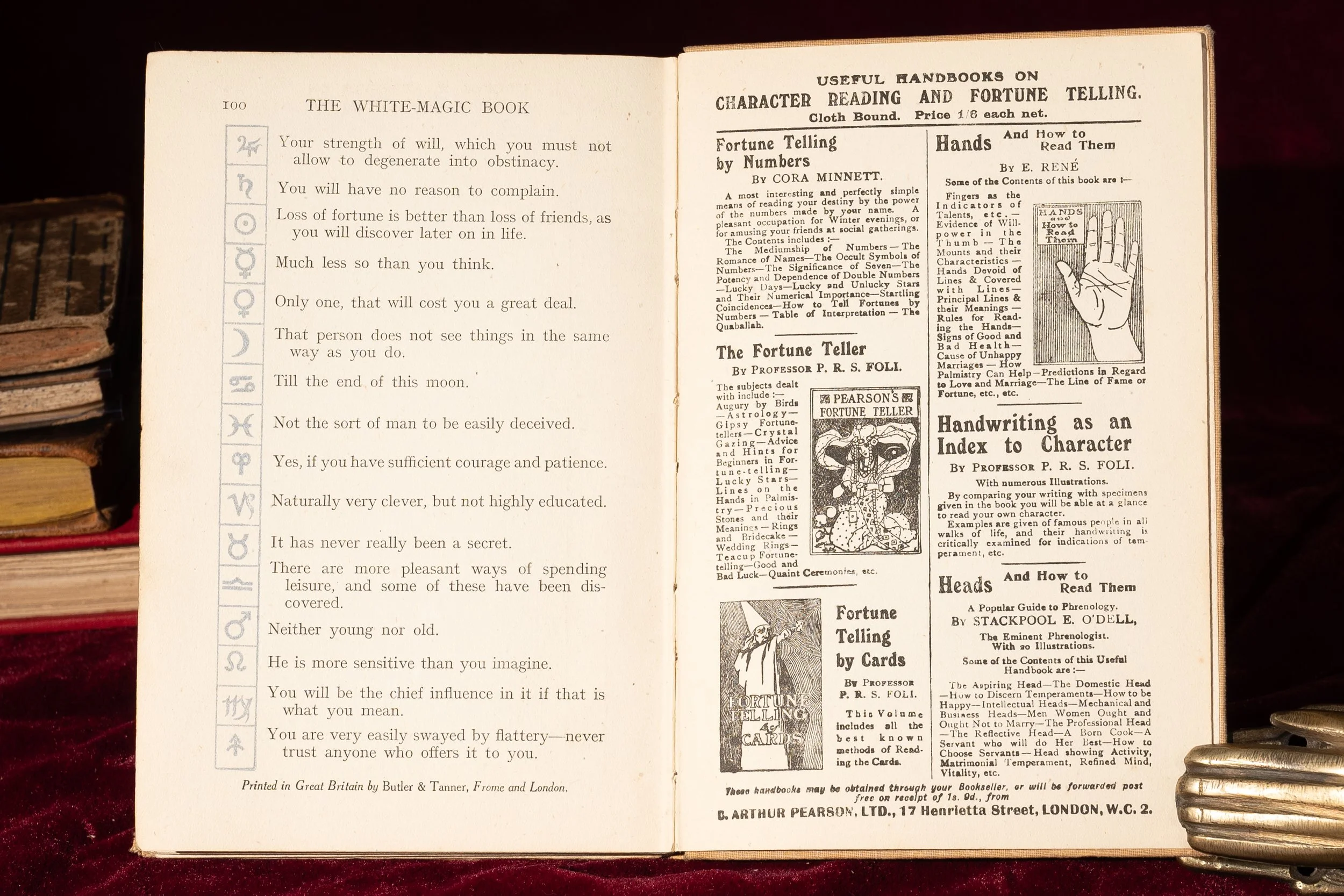 Image 8 of 10
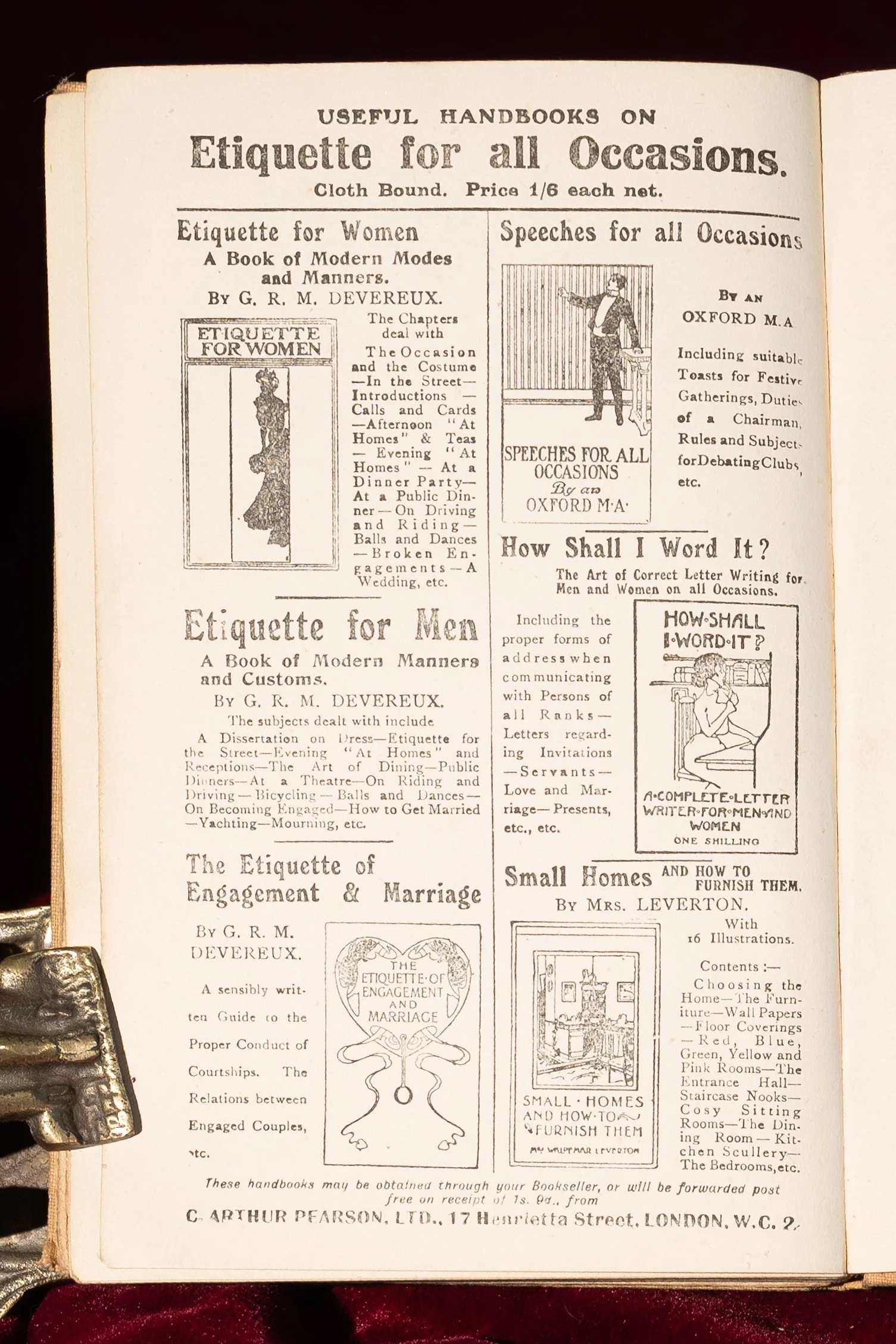 Image 9 of 10
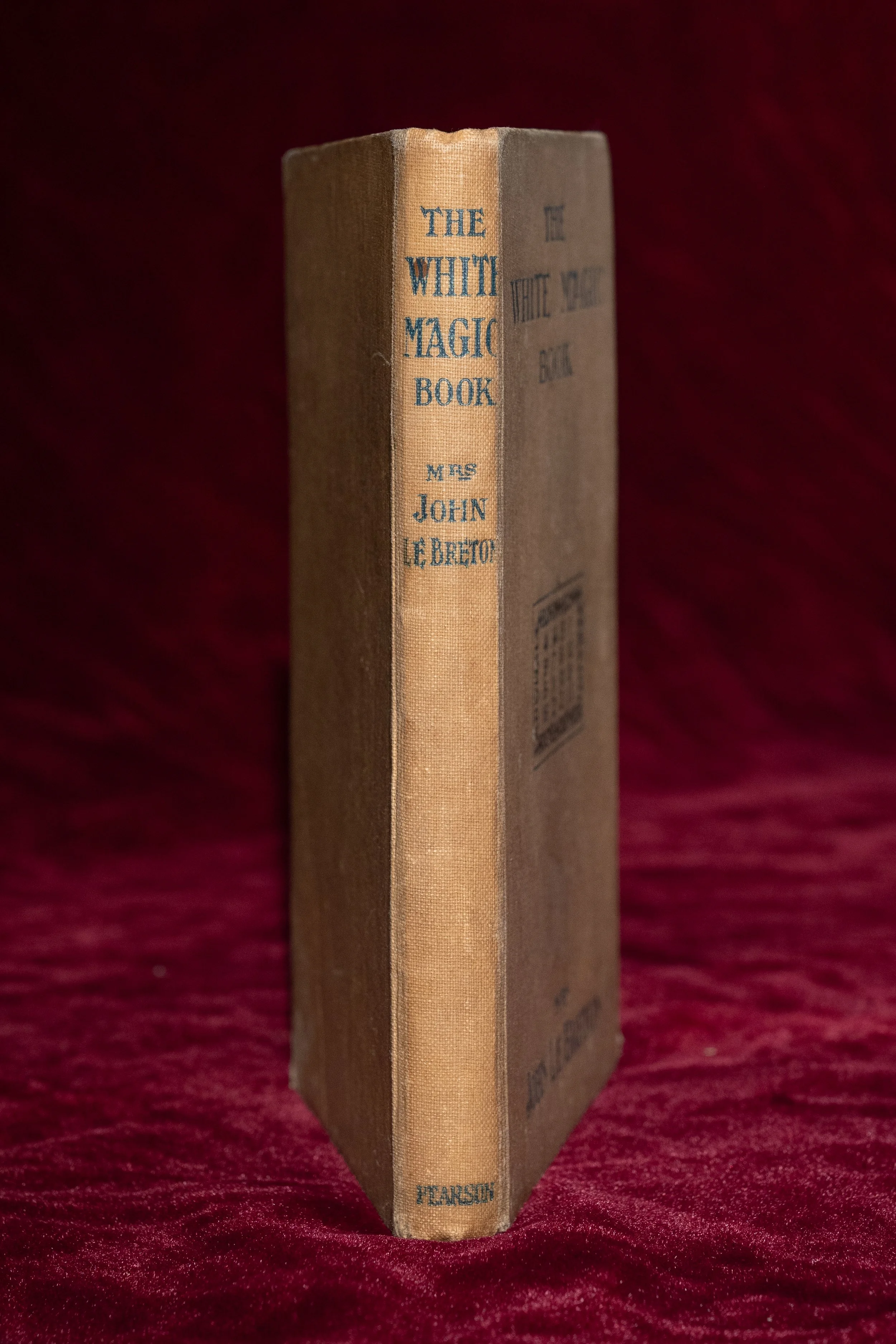 Image 10 of 10