
 Image 1 of 3
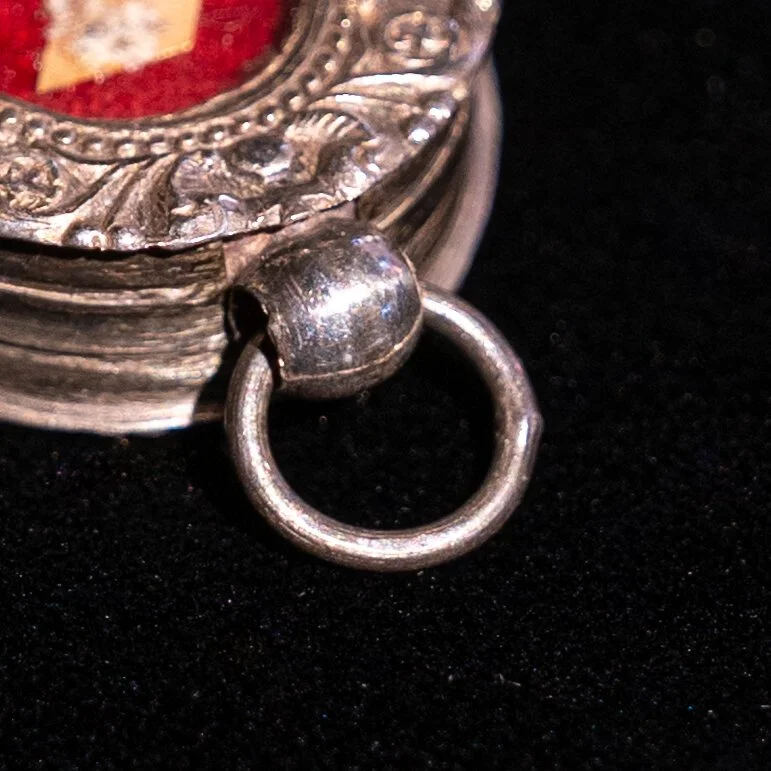 Image 2 of 3
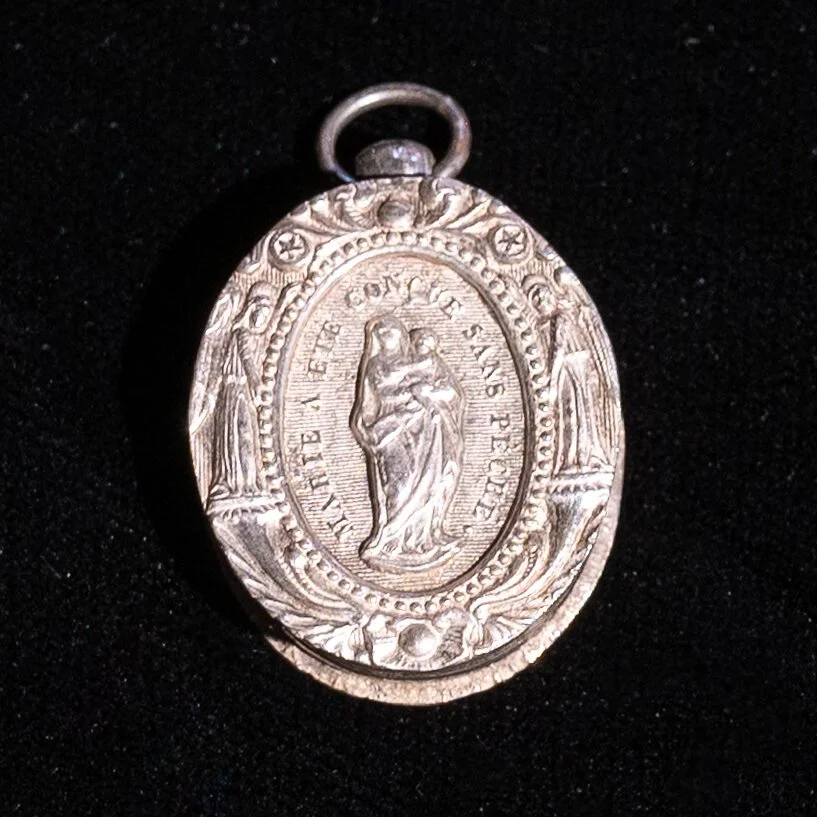 Image 3 of 3
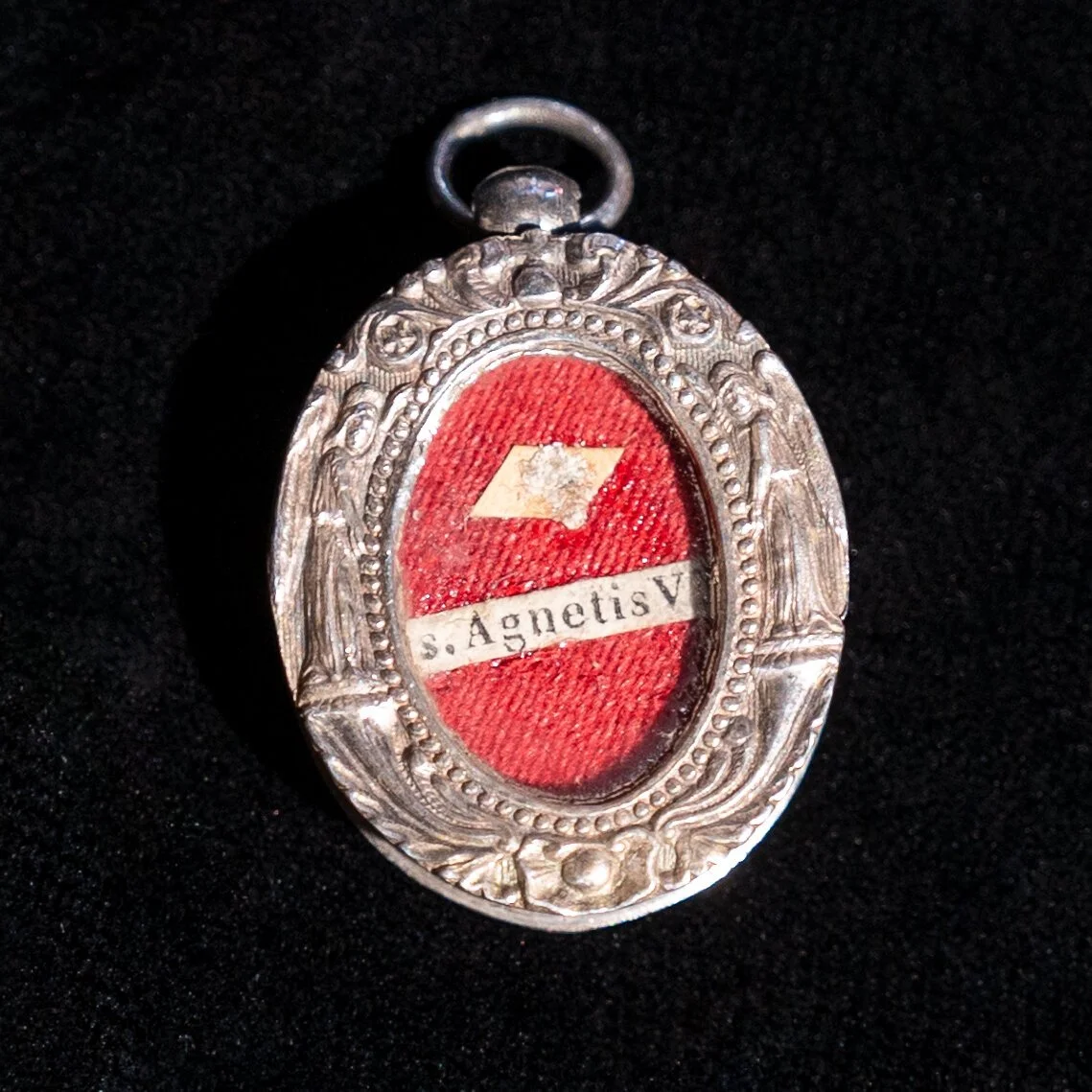
This pendant holds a small fragment identified by its paper label as a relic of Saint Agnes. A theca is a small case for a relic, here glazed and fitted with a ring so it can be worn on a chain. The fragment rests against a red cloth ground; the printed label reads “s. Agnetis V M,” “of Saint Agnes, virgin and martyr.”
Agnes was a young Roman Christian, traditionally said to have been twelve or thirteen when she was put to death in 304. Ambrose of Milan wrote about her later in the same century, praising her youth and her steadiness. Later legends supplied the harsher details: a brothel in which no man could touch her, a fire that would not burn her, and death by the sword.
She also had a place in English folk magic. On St. Agnes’ Eve, the night of January 20, a girl who went to bed fasting could hope to see her future husband in a dream. The seventeenth-century antiquary John Aubrey recorded a ritual involving a row of pins, removed one by one while saying the Lord’s Prayer. Keats drew on the belief in The Eve of St. Agnes, written in 1819.
On her feast day two lambs are blessed in Rome, a play on her name: agnus is Latin for lamb. On this pendant two praying angels flank the glass. The reverse holds a medal of the Virgin and Child with a French inscription meaning “Mary was conceived without sin,” referring to the Immaculate Conception.
The price is for the pendant case; the enclosed relic accompanies it as a gift for preservation and study.
SAINT AGNES OF ROME (d. 304). Reliquary pendant containing a relic of Saint Agnes, virgin and martyr, with a printed cedula, in a silver-colored metal case with a medal of the Immaculate Conception on the reverse. Probably French, nineteenth century.
Physical Description: Oval pendant reliquary, 2.5 x 2 cm, with a ball finial and suspension ring. Front: stamped frame with two praying angels on consoles, star roundels, a shell-and-leaf crest and foot, and a beaded border around a glazed oval window. Inside, a small white relic fragment on a paper lozenge, on a red cloth ground, with a printed paper cedula reading “s. Agnetis V M”, the last letter partly hidden under the frame. Reverse: the same frame around a medal of the Virgin standing with the Child on her left arm, on a ruled ground, with the legend “MARIE A ETE CONÇUE SANS PECHE”. Front and back are joined by a reeded band.
Condition: Glass intact. Light wear and tarnish to the high points of the frame and to the band. No exterior wax seal.