Did Cornelius Agrippa keep a demon in the shape of a black dog? Did Albert the Great build a brass head that talked? In 1625 a twenty-five-year-old Parisian named Gabriel Naudé sat down to answer every one of these stories, and his answer was no. The Apologie pour tous les grands personnages qui ont esté faussement soupçonnez de magie is a defense of the wise men of history against the charge of witchcraft. It runs to more than six hundred pages, and it is one of the strangest and most readable books of the early seventeenth century.
For some context, Naudé was writing at the height of the witch panic. The Loudun possessions were a few years off. Demonologists like Delrio and Bodin were widely read, and the learned consensus held that magic was real and damnable. Naudé took the other side. He went figure by figure, from Zoroaster and Pythagoras through Socrates, Plotinus and Virgil, then the medieval popes, Albert the Great, Roger Bacon and Thomas Aquinas, and on to Agrippa, Paracelsus and Savonarola, and showed that each accusation rested on gossip or on a misunderstanding of what the man had actually been doing. He sorts magic into four kinds along the way (divine, theurgic, goetic and natural) and argues that most of what passed for sorcery was simply mathematics or medicine practiced in front of people who couldn't tell the difference. The book's index reads like a guest list for the occult tradition, and Naudé defended all of them.
He closes the book with a warning that sounds very modern. When you look closely at these accusations, he writes, "one usually finds that they are nothing but pure calumnies, ill-founded suspicions, and vain, light and thoughtless words, which the Devil slips imperceptibly onto the good name of the innocent." The Devil, in other words, is on the side of the accusers. The motto on the title page, borrowed from Seneca, says the same thing more briefly: we would acquit many people if we began to judge before we got angry.
Naudé went on to a remarkable career. Two years later he wrote the Advis pour dresser une bibliothèque, the first modern manual of library science, and he spent the 1640s building Cardinal Mazarin's library into a collection of some forty thousand volumes, the first in France completely open to the public. The Apologie was his first big book, and it stayed in print for a century: a second edition at The Hague in 1653, an English translation as The History of Magick in 1657, and further French editions in 1669 and 1712. Collectors of the occult sciences will find the book useful in a particular way. It is the seventeenth century's own catalog of who was suspected of magic and why, written by a skeptic who had read all the accusers. For the story of Agrippa's dog and the arguments against it, this is an important early source.
This is the first edition, in a worn but sound period calf binding that has been repaired and now holds well. The copy spent the twentieth century in the library of the General Theological Seminary in New York, bought on the fund left by its great dean Eugene Augustus Hoffman, and it still carries the seminary's bookplate and shelf card. Details below.
NAUDÉ, Gabriel (1600–1653). Apologie pour tous les grands personnages qui ont esté faussement soupçonnez de magie. Paris: François Targa, 1625. First edition.
Physical Description: Octavo. Twelve preliminary leaves, 615 [i.e. 649] pages, and 23 unnumbered pages of errata (Fautes à corriger) and index (Table des matières), the text ending with FIN on page 615. Collated complete. Printer's ornament on the title page.
Binding: Period calf over boards, spine with five raised bands, edges stained red, marbled pastedowns and endpapers in a curl pattern.
Condition: The binding has had a hard life. The leather is worn through to the boards at the corners and along much of the front board, the spine leather is cracked and chipped at both ends, and the joints have been glued and reinforced by a conservator. The repair holds: the book opens comfortably to the middle and feels solid in the hand. Internally the text is toned in places, with some browning to gatherings, but clean and complete. Pencil note "Edition originale, rare" on the front flyleaf and "Collat. Complet" on the rear.
Provenance: General Theological Seminary Library, Chelsea Square, New York: printed bookplate on the front pastedown ("Purchased from the fund bequeathed to the Seminary by Eugene Augustus Hoffman, D.D., Dean 1879–1902"), with the seminary's class mark 133.4 N221 and its manuscript shelf card and pocket on the rear pastedown.
Did Cornelius Agrippa keep a demon in the shape of a black dog? Did Albert the Great build a brass head that talked? In 1625 a twenty-five-year-old Parisian named Gabriel Naudé sat down to answer every one of these stories, and his answer was no. The Apologie pour tous les grands personnages qui ont esté faussement soupçonnez de magie is a defense of the wise men of history against the charge of witchcraft. It runs to more than six hundred pages, and it is one of the strangest and most readable books of the early seventeenth century.
For some context, Naudé was writing at the height of the witch panic. The Loudun possessions were a few years off. Demonologists like Delrio and Bodin were widely read, and the learned consensus held that magic was real and damnable. Naudé took the other side. He went figure by figure, from Zoroaster and Pythagoras through Socrates, Plotinus and Virgil, then the medieval popes, Albert the Great, Roger Bacon and Thomas Aquinas, and on to Agrippa, Paracelsus and Savonarola, and showed that each accusation rested on gossip or on a misunderstanding of what the man had actually been doing. He sorts magic into four kinds along the way (divine, theurgic, goetic and natural) and argues that most of what passed for sorcery was simply mathematics or medicine practiced in front of people who couldn't tell the difference. The book's index reads like a guest list for the occult tradition, and Naudé defended all of them.
He closes the book with a warning that sounds very modern. When you look closely at these accusations, he writes, "one usually finds that they are nothing but pure calumnies, ill-founded suspicions, and vain, light and thoughtless words, which the Devil slips imperceptibly onto the good name of the innocent." The Devil, in other words, is on the side of the accusers. The motto on the title page, borrowed from Seneca, says the same thing more briefly: we would acquit many people if we began to judge before we got angry.
Naudé went on to a remarkable career. Two years later he wrote the Advis pour dresser une bibliothèque, the first modern manual of library science, and he spent the 1640s building Cardinal Mazarin's library into a collection of some forty thousand volumes, the first in France completely open to the public. The Apologie was his first big book, and it stayed in print for a century: a second edition at The Hague in 1653, an English translation as The History of Magick in 1657, and further French editions in 1669 and 1712. Collectors of the occult sciences will find the book useful in a particular way. It is the seventeenth century's own catalog of who was suspected of magic and why, written by a skeptic who had read all the accusers. For the story of Agrippa's dog and the arguments against it, this is an important early source.
This is the first edition, in a worn but sound period calf binding that has been repaired and now holds well. The copy spent the twentieth century in the library of the General Theological Seminary in New York, bought on the fund left by its great dean Eugene Augustus Hoffman, and it still carries the seminary's bookplate and shelf card. Details below.
NAUDÉ, Gabriel (1600–1653). Apologie pour tous les grands personnages qui ont esté faussement soupçonnez de magie. Paris: François Targa, 1625. First edition.
Physical Description: Octavo. Twelve preliminary leaves, 615 [i.e. 649] pages, and 23 unnumbered pages of errata (Fautes à corriger) and index (Table des matières), the text ending with FIN on page 615. Collated complete. Printer's ornament on the title page.
Binding: Period calf over boards, spine with five raised bands, edges stained red, marbled pastedowns and endpapers in a curl pattern.
Condition: The binding has had a hard life. The leather is worn through to the boards at the corners and along much of the front board, the spine leather is cracked and chipped at both ends, and the joints have been glued and reinforced by a conservator. The repair holds: the book opens comfortably to the middle and feels solid in the hand. Internally the text is toned in places, with some browning to gatherings, but clean and complete. Pencil note "Edition originale, rare" on the front flyleaf and "Collat. Complet" on the rear.
Provenance: General Theological Seminary Library, Chelsea Square, New York: printed bookplate on the front pastedown ("Purchased from the fund bequeathed to the Seminary by Eugene Augustus Hoffman, D.D., Dean 1879–1902"), with the seminary's class mark 133.4 N221 and its manuscript shelf card and pocket on the rear pastedown.

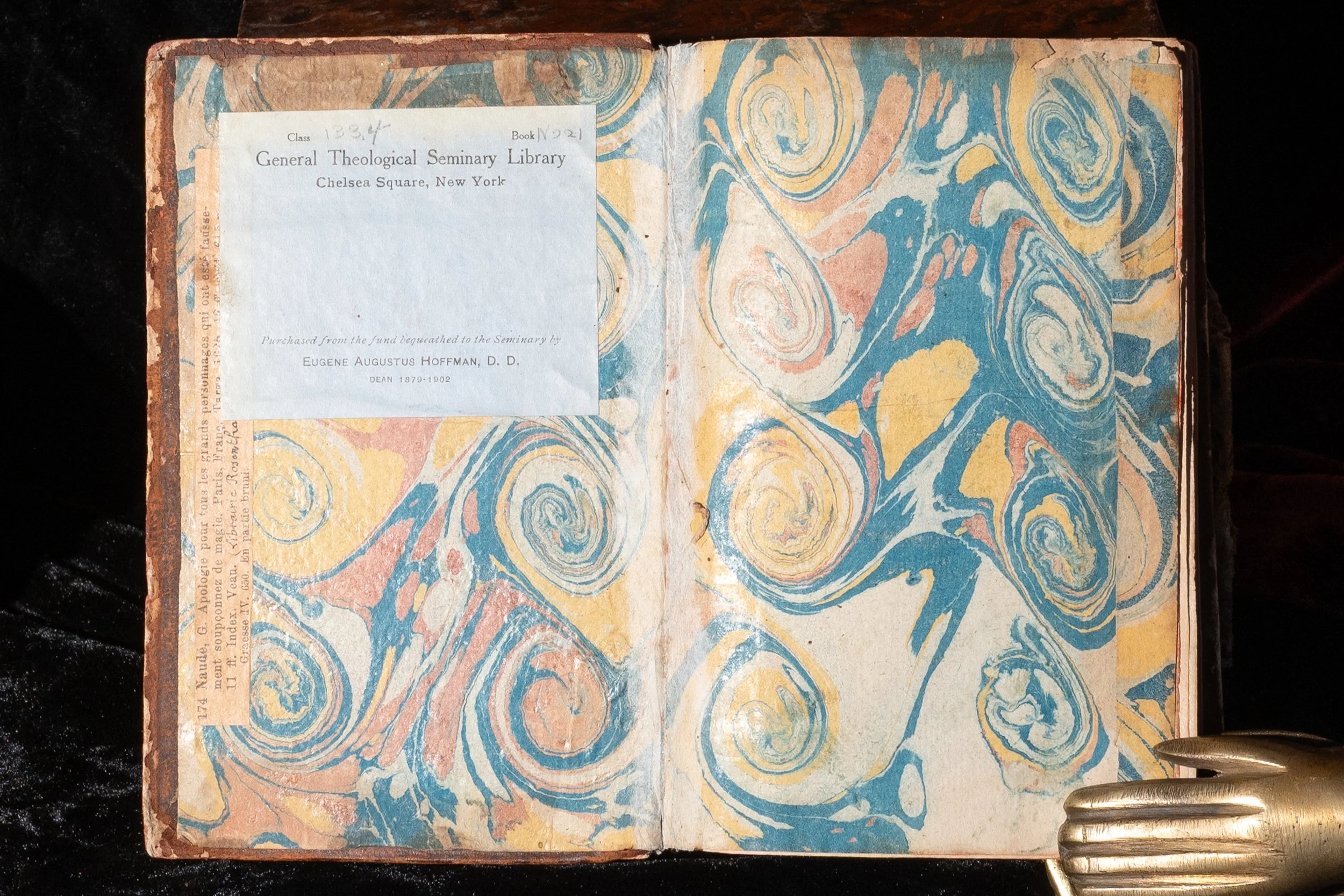 Image 1 of 18
 Image 2 of 18
 Image 3 of 18
 Image 4 of 18
 Image 5 of 18
 Image 6 of 18
 Image 7 of 18
 Image 8 of 18
 Image 9 of 18
 Image 10 of 18
 Image 11 of 18
 Image 12 of 18
 Image 13 of 18
 Image 14 of 18
 Image 15 of 18
 Image 16 of 18
 Image 17 of 18
 Image 18 of 18