One of the plates shows a head ruled with lines across the forehead, a planet set on each and Saturn nearest the hairline. This is known as metoposcopy, the art of reading a face as an astrologer reads a chart. Girolamo Cardano, the sixteenth-century Milanese physician and mathematician, worked out the system but it didn’t reach print until long after his death.
The Klee-Blat, or cloverleaf, is a Nuremberg publisher's package of three books about how to read the human body. Johann Zieger issued them once, together in 1695. The collection includes a section by “Ronphile,” the pseudonym of Daniel de Rampalle. His Chiromantie naturelle appeared at Lyon in 1653. The Klee-Blat is its first German appearance. The engraved hands show readers how to use the book. They name each finger, and the little finger is the Ohrenfinger, or “ear finger.” The principal lines of the palm are marked as well.
The second section translates the Italian Nicola Spadon’s Studio di curiosità (Venice, 1662), a manual for interpreting the face and hands. The general title page calls it Schauplatz der Curiositäten; its divisional title, 112 pages later, calls it Studium Curiosum.
The third section is Johann Sigismund Elsholtz’s Anthropometria, on measuring the human body. Elsholtz (1623–1688) was chief physician to the Great Elector of Brandenburg and ran the gardens at Berlin, Potsdam and Oranienburg. He spent a good deal of the 1660s figuring out different ways to get fluids into veins. He even proposed transfusing blood between a husband and wife, thinking that the shared blood would settle an unhappy marriage. His Anthropometria first appeared at Padua in 1654. It is the first book ever to be called that, and is the starting place for historians of physical anthropology. The German translation follows his expanded Frankfurt an der Oder text of 1663, down to a literal rendering of its subtitle.
In 1695 a Nuremberg publisher could treat the measuring and divining of bodies as one subject for one customer. Elsholtz's appendix on moles travels with his text. Zieger added the physiognomic tables of Dominicus de Rubeis and a little treatise on moles attributed to Melampus, the Greek seer. By the time it reached Nuremberg, that little text had spent something like two thousand years telling readers what a mark on the left knee meant. The third part runs to 550 pages.
The early limp vellum still overlaps at the fore-edges, and the stained edges have faded from deep blue toward green. Worm has nibbled at the boards. There is some pulling at the frontispiece.
Provenance: An early owner copied four lines of Latin verse in a confident hand onto the front blank, correcting the first word of line two: Aurea Libertas, Ratio bona, praeclara juventus, / Integra vita, potens robur, nisi fata resistant, / Mens hilaris, docilis, audax, et prompta Voluntas / Tempora felicem reddunt, Sincerus Amicus. Golden liberty, good sense, a splendid youth, a whole life, strong health unless the fates object, a mind cheerful, teachable and bold, a ready will: these make the times happy, and so does a sincere friend. This is the sort of list of goods that circulated in friendship albums. It makes a mild joke on the book: everything the palmist promises to find in your hand, written out by hand on the flyleaf.
[I. G. D. T. and S. T. D. N., translators]. Höchstfürtreflichstes Chiromantisch- und Physiognomisches Klee-Blat, Bestehend aus drey herrlichen Tractaten und zwar erstlich Des Kunst-berühmtesten Ronphyle Hand-Wahrsagung; Zum andern: Niclas Spadons Schauplatz der Curiositäten; Und dann drittens D. D. Johann Sigmund Eltzholtzens Anthropometrie oder Meß-Kunst des Menschlichen Cörpers … Nürnberg: In Verlegung Johann Ziegers, 1695. Three parts in one volume, each with its own title page.
Physical Description: Small octavo (16.5 × 10.5 cm). General title printed in red and black; engraved allegorical frontispiece and 20 engraved plates, signed by the Nuremberg engraver J. L. Hönnig. [15] ll.; 112 pp.; 208 pp.; 550 pp., final blank leaf.
Binding: Early limp vellum with overlapping edges, spine unlettered and lightly scuffed, text-block edges stained deep blue.
Condition: Some browning and scattered foxing; slight worming to the boards; small ink spot and a wormhole to the frontispiece, with a little pulling at that leaf; four lines of contemporary Latin verse on the front blank.
Edition and References: The only edition of this compilation ever printed, and the first German appearance of all three texts. VD17 3:606181M; Krivatsy 5755; Graesse, Bibliotheca magica et pneumatica, pp. 101, 107; Sabattini 565, 469; cf. Caillet 9577 (the French Ronphile of 1665).
One of the plates shows a head ruled with lines across the forehead, a planet set on each and Saturn nearest the hairline. This is known as metoposcopy, the art of reading a face as an astrologer reads a chart. Girolamo Cardano, the sixteenth-century Milanese physician and mathematician, worked out the system but it didn’t reach print until long after his death.
The Klee-Blat, or cloverleaf, is a Nuremberg publisher's package of three books about how to read the human body. Johann Zieger issued them once, together in 1695. The collection includes a section by “Ronphile,” the pseudonym of Daniel de Rampalle. His Chiromantie naturelle appeared at Lyon in 1653. The Klee-Blat is its first German appearance. The engraved hands show readers how to use the book. They name each finger, and the little finger is the Ohrenfinger, or “ear finger.” The principal lines of the palm are marked as well.
The second section translates the Italian Nicola Spadon’s Studio di curiosità (Venice, 1662), a manual for interpreting the face and hands. The general title page calls it Schauplatz der Curiositäten; its divisional title, 112 pages later, calls it Studium Curiosum.
The third section is Johann Sigismund Elsholtz’s Anthropometria, on measuring the human body. Elsholtz (1623–1688) was chief physician to the Great Elector of Brandenburg and ran the gardens at Berlin, Potsdam and Oranienburg. He spent a good deal of the 1660s figuring out different ways to get fluids into veins. He even proposed transfusing blood between a husband and wife, thinking that the shared blood would settle an unhappy marriage. His Anthropometria first appeared at Padua in 1654. It is the first book ever to be called that, and is the starting place for historians of physical anthropology. The German translation follows his expanded Frankfurt an der Oder text of 1663, down to a literal rendering of its subtitle.
In 1695 a Nuremberg publisher could treat the measuring and divining of bodies as one subject for one customer. Elsholtz's appendix on moles travels with his text. Zieger added the physiognomic tables of Dominicus de Rubeis and a little treatise on moles attributed to Melampus, the Greek seer. By the time it reached Nuremberg, that little text had spent something like two thousand years telling readers what a mark on the left knee meant. The third part runs to 550 pages.
The early limp vellum still overlaps at the fore-edges, and the stained edges have faded from deep blue toward green. Worm has nibbled at the boards. There is some pulling at the frontispiece.
Provenance: An early owner copied four lines of Latin verse in a confident hand onto the front blank, correcting the first word of line two: Aurea Libertas, Ratio bona, praeclara juventus, / Integra vita, potens robur, nisi fata resistant, / Mens hilaris, docilis, audax, et prompta Voluntas / Tempora felicem reddunt, Sincerus Amicus. Golden liberty, good sense, a splendid youth, a whole life, strong health unless the fates object, a mind cheerful, teachable and bold, a ready will: these make the times happy, and so does a sincere friend. This is the sort of list of goods that circulated in friendship albums. It makes a mild joke on the book: everything the palmist promises to find in your hand, written out by hand on the flyleaf.
[I. G. D. T. and S. T. D. N., translators]. Höchstfürtreflichstes Chiromantisch- und Physiognomisches Klee-Blat, Bestehend aus drey herrlichen Tractaten und zwar erstlich Des Kunst-berühmtesten Ronphyle Hand-Wahrsagung; Zum andern: Niclas Spadons Schauplatz der Curiositäten; Und dann drittens D. D. Johann Sigmund Eltzholtzens Anthropometrie oder Meß-Kunst des Menschlichen Cörpers … Nürnberg: In Verlegung Johann Ziegers, 1695. Three parts in one volume, each with its own title page.
Physical Description: Small octavo (16.5 × 10.5 cm). General title printed in red and black; engraved allegorical frontispiece and 20 engraved plates, signed by the Nuremberg engraver J. L. Hönnig. [15] ll.; 112 pp.; 208 pp.; 550 pp., final blank leaf.
Binding: Early limp vellum with overlapping edges, spine unlettered and lightly scuffed, text-block edges stained deep blue.
Condition: Some browning and scattered foxing; slight worming to the boards; small ink spot and a wormhole to the frontispiece, with a little pulling at that leaf; four lines of contemporary Latin verse on the front blank.
Edition and References: The only edition of this compilation ever printed, and the first German appearance of all three texts. VD17 3:606181M; Krivatsy 5755; Graesse, Bibliotheca magica et pneumatica, pp. 101, 107; Sabattini 565, 469; cf. Caillet 9577 (the French Ronphile of 1665).

 Image 1 of 27
 Image 2 of 27
 Image 3 of 27
 Image 4 of 27
 Image 5 of 27
 Image 6 of 27
 Image 7 of 27
 Image 8 of 27
 Image 9 of 27
 Image 10 of 27
 Image 11 of 27
 Image 12 of 27
 Image 13 of 27
 Image 14 of 27
 Image 15 of 27
 Image 16 of 27
 Image 17 of 27
 Image 18 of 27
 Image 19 of 27
 Image 20 of 27
 Image 21 of 27
 Image 22 of 27
 Image 23 of 27
 Image 24 of 27
 Image 25 of 27
 Image 26 of 27
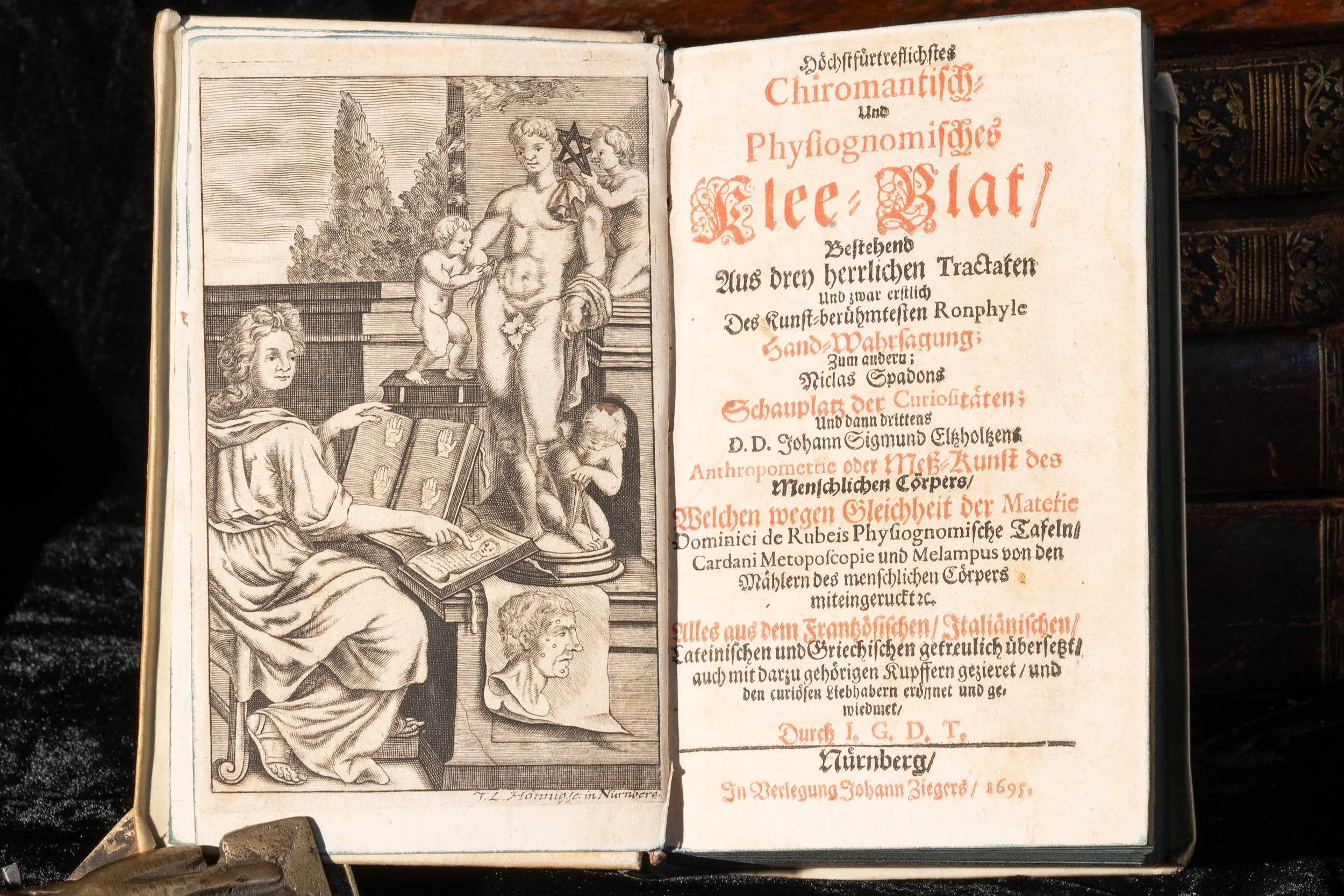 Image 27 of 27