The Livre de Thot holds a singular position in the history of cartomancy: it is the first tarot deck conceived expressly for divination rather than gaming. Jean-Baptiste Alliette (1738–1791), a Parisian seed merchant and print-seller who reversed his surname to produce the occultist persona “Etteilla,” designed the deck in the late 1780s under the spell of Court de Gébelin’s claim, advanced in Le Monde primitif (1781), that the tarot preserved the lost wisdom of ancient Egypt. Engraved by Pierre-François Basan and first issued in 1788–1789, the original Livre de Thot was a radical departure from the Tarot de Marseille tradition: its trumps do not depict the familiar Popess or Wheel of Fortune but instead trace a Hermetic cosmogony from primordial Chaos through the six days of Creation, culminating in Rest. Each card bears dual keywords, upright and reversed, integrating astrology, numerology, and biblical allegory into a coherent divinatory system. It was, in effect, the Enlightenment’s attempt to build a visual scripture from whole cloth, and it arrived in Paris just in time for the Revolution: by July 1789, when the Bastille fell, Parisians were already consulting Etteilla’s cards to divine the fate of France.
Etteilla’s hermeneutic framework proved enormously influential. His insistence on systematic correspondences between cards and celestial bodies, his formalization of upright and reversed readings, and his founding of the Société des Interprètes du Livre de Thot (1788) established the institutional and interpretive scaffolding on which later occultists, Éliphas Lévi, Oswald Wirth, Papus, would build. The cards themselves became a template: historians classify the subsequent tradition into three types, of which the present Grimaud edition belongs to the first (Type I), preserving Etteilla’s original iconography most faithfully. Type II (Blocquel, ca. 1838–1840) and Type III (ca. 1870) introduced progressively greater modifications to the imagery. It is no exaggeration to say that the modern practice of tarot reading, from the Rider-Waite-Smith deck of 1909 to the proliferation of contemporary decks, traces its institutional and interpretive DNA back to Etteilla’s system.
The firm of B.P. Grimaud began issuing the Grand Etteilla around 1890 and continued production well into the twentieth century, making this the standard commercial edition through which most French practitioners encountered the Etteilla tradition. Grimaud’s chromolithographic technique gives the cards a vivid, saturated quality quite distinct from the hand-colored engravings of the original Basan printing, and the stiff pasteboard stock was built to withstand the rigors of actual use. This is a deck manufactured not for the gentleman’s cabinet but for the cartomancer’s table, which makes the excellent survival of the present set all the more notable.
The present example is complete in all its parts: 78 cards, two indicator cards, and the original instruction booklet in its printed wrappers with the Grimaud “Jeux et Jouets” trade label. This last element is worth stressing. The booklet, Manière de tirer le Grand Etteilla, details the 118 tableaux (spreads) that constitute the full Etteilla method, a remarkably elaborate system of layout and interpretation that reveals how seriously the late nineteenth century took cartomantic practice as a structured discipline. Such booklets were typically the first component to be lost or discarded; their absence is the rule rather than the exception in surviving examples. The cards themselves show vivid chromolithographic color with minimal handling wear, the pasteboard unwarped and firm, a degree of preservation that suggests this set was acquired more for study than for nightly consultation.
ETTEILLA [Jean-Baptiste ALLIETTE (1738–1791)]. Tarots Égyptiens – Livre de Thot. Paris: B.P. Grimaud, ca. 1890.
Physical Description: 78/78 cards plus two white indicator cards (120 × 65 mm), chromolithographed on stiff pasteboard. Versos printed with a small repeating green floral pattern. Straight corners. First trump inscribed “ETTEILLA” at upper margin. Arabic numerals throughout. Upright and reversed divinatory meanings printed on each card in French.
[TOGETHER WITH] [MANUAL]. Manière de tirer le Grand Etteilla ou Tarots Égyptiens composé de 78 cartes et de 118 tableaux. Paris: Grimaud, s.d. [ca. 1890]. 8vo, original printed wrappers with Grimaud “Jeux et Jouets” trade label in red.
Classification: Etteilla Type I deck, faithfully reproducing the iconographic tradition established by Jean-Baptise Alliette’s original Livre de Thot of 1788–1789.
Condition: Cards in excellent condition: vivid chromolithographic color throughout, clean surfaces, minimal handling wear, pasteboard stock firm and unwarped. Booklet wrappers somewhat worn at edges and spine, with small dog-ear to upper corner of title page; text block sound. Overall a well-preserved and notably complete set.
Provenance: Ownership inscription “Bernard Bromage” on front wrapper of booklet. Bernard Bromage (fl. 1950s–1970s) was a British occultist and author whose published works range across several of the esoteric traditions that converge in the Etteilla deck: The Occult Arts of Ancient Egypt (1953), Tibetan Yoga (1952), and In Tune with Your Destiny, all published by the Aquarian Press. There is a satisfying congruence in finding a deck premised on Egyptian occult wisdom in the library of a man who devoted a monograph to exactly that subject. Bromage appears to have treated the set with a collector’s care; the condition of the cards is consistent with study rather than active cartomantic practice.
Dating: Tax stamp on card 62 dated Avril 12, 1890, République Française. This stamp type was in use in France from 1890 to 1917, providing a firm terminus post quem of April 1890 for the present set.
References: BnF, Paul Hammer donation, 1966: no. 430 [VERIFY: confirm call number]; Benham, Playing Cards (1931; repr. 2019); Hargrave, A History of Playing Cards (1930; repr. 2021); d’Allemagne, Les cartes à jouer du XIVe au XXe siècle (1906); Depaulis (1984). See also: Decker, Depaulis & Dummett, A Wicked Pack of Cards: The Origins of the Occult Tarot (1996).
Institutional Holdings: Comparable Grimaud Grand Etteilla decks (ca. 1890) held by the Bibliothèque nationale de France; Johns Hopkins University, Special Collections (acquired 2025); Wellcome Collection (framed arrangement of Etteilla cards, earlier printing).
The Livre de Thot holds a singular position in the history of cartomancy: it is the first tarot deck conceived expressly for divination rather than gaming. Jean-Baptiste Alliette (1738–1791), a Parisian seed merchant and print-seller who reversed his surname to produce the occultist persona “Etteilla,” designed the deck in the late 1780s under the spell of Court de Gébelin’s claim, advanced in Le Monde primitif (1781), that the tarot preserved the lost wisdom of ancient Egypt. Engraved by Pierre-François Basan and first issued in 1788–1789, the original Livre de Thot was a radical departure from the Tarot de Marseille tradition: its trumps do not depict the familiar Popess or Wheel of Fortune but instead trace a Hermetic cosmogony from primordial Chaos through the six days of Creation, culminating in Rest. Each card bears dual keywords, upright and reversed, integrating astrology, numerology, and biblical allegory into a coherent divinatory system. It was, in effect, the Enlightenment’s attempt to build a visual scripture from whole cloth, and it arrived in Paris just in time for the Revolution: by July 1789, when the Bastille fell, Parisians were already consulting Etteilla’s cards to divine the fate of France.
Etteilla’s hermeneutic framework proved enormously influential. His insistence on systematic correspondences between cards and celestial bodies, his formalization of upright and reversed readings, and his founding of the Société des Interprètes du Livre de Thot (1788) established the institutional and interpretive scaffolding on which later occultists, Éliphas Lévi, Oswald Wirth, Papus, would build. The cards themselves became a template: historians classify the subsequent tradition into three types, of which the present Grimaud edition belongs to the first (Type I), preserving Etteilla’s original iconography most faithfully. Type II (Blocquel, ca. 1838–1840) and Type III (ca. 1870) introduced progressively greater modifications to the imagery. It is no exaggeration to say that the modern practice of tarot reading, from the Rider-Waite-Smith deck of 1909 to the proliferation of contemporary decks, traces its institutional and interpretive DNA back to Etteilla’s system.
The firm of B.P. Grimaud began issuing the Grand Etteilla around 1890 and continued production well into the twentieth century, making this the standard commercial edition through which most French practitioners encountered the Etteilla tradition. Grimaud’s chromolithographic technique gives the cards a vivid, saturated quality quite distinct from the hand-colored engravings of the original Basan printing, and the stiff pasteboard stock was built to withstand the rigors of actual use. This is a deck manufactured not for the gentleman’s cabinet but for the cartomancer’s table, which makes the excellent survival of the present set all the more notable.
The present example is complete in all its parts: 78 cards, two indicator cards, and the original instruction booklet in its printed wrappers with the Grimaud “Jeux et Jouets” trade label. This last element is worth stressing. The booklet, Manière de tirer le Grand Etteilla, details the 118 tableaux (spreads) that constitute the full Etteilla method, a remarkably elaborate system of layout and interpretation that reveals how seriously the late nineteenth century took cartomantic practice as a structured discipline. Such booklets were typically the first component to be lost or discarded; their absence is the rule rather than the exception in surviving examples. The cards themselves show vivid chromolithographic color with minimal handling wear, the pasteboard unwarped and firm, a degree of preservation that suggests this set was acquired more for study than for nightly consultation.
ETTEILLA [Jean-Baptiste ALLIETTE (1738–1791)]. Tarots Égyptiens – Livre de Thot. Paris: B.P. Grimaud, ca. 1890.
Physical Description: 78/78 cards plus two white indicator cards (120 × 65 mm), chromolithographed on stiff pasteboard. Versos printed with a small repeating green floral pattern. Straight corners. First trump inscribed “ETTEILLA” at upper margin. Arabic numerals throughout. Upright and reversed divinatory meanings printed on each card in French.
[TOGETHER WITH] [MANUAL]. Manière de tirer le Grand Etteilla ou Tarots Égyptiens composé de 78 cartes et de 118 tableaux. Paris: Grimaud, s.d. [ca. 1890]. 8vo, original printed wrappers with Grimaud “Jeux et Jouets” trade label in red.
Classification: Etteilla Type I deck, faithfully reproducing the iconographic tradition established by Jean-Baptise Alliette’s original Livre de Thot of 1788–1789.
Condition: Cards in excellent condition: vivid chromolithographic color throughout, clean surfaces, minimal handling wear, pasteboard stock firm and unwarped. Booklet wrappers somewhat worn at edges and spine, with small dog-ear to upper corner of title page; text block sound. Overall a well-preserved and notably complete set.
Provenance: Ownership inscription “Bernard Bromage” on front wrapper of booklet. Bernard Bromage (fl. 1950s–1970s) was a British occultist and author whose published works range across several of the esoteric traditions that converge in the Etteilla deck: The Occult Arts of Ancient Egypt (1953), Tibetan Yoga (1952), and In Tune with Your Destiny, all published by the Aquarian Press. There is a satisfying congruence in finding a deck premised on Egyptian occult wisdom in the library of a man who devoted a monograph to exactly that subject. Bromage appears to have treated the set with a collector’s care; the condition of the cards is consistent with study rather than active cartomantic practice.
Dating: Tax stamp on card 62 dated Avril 12, 1890, République Française. This stamp type was in use in France from 1890 to 1917, providing a firm terminus post quem of April 1890 for the present set.
References: BnF, Paul Hammer donation, 1966: no. 430 [VERIFY: confirm call number]; Benham, Playing Cards (1931; repr. 2019); Hargrave, A History of Playing Cards (1930; repr. 2021); d’Allemagne, Les cartes à jouer du XIVe au XXe siècle (1906); Depaulis (1984). See also: Decker, Depaulis & Dummett, A Wicked Pack of Cards: The Origins of the Occult Tarot (1996).
Institutional Holdings: Comparable Grimaud Grand Etteilla decks (ca. 1890) held by the Bibliothèque nationale de France; Johns Hopkins University, Special Collections (acquired 2025); Wellcome Collection (framed arrangement of Etteilla cards, earlier printing).

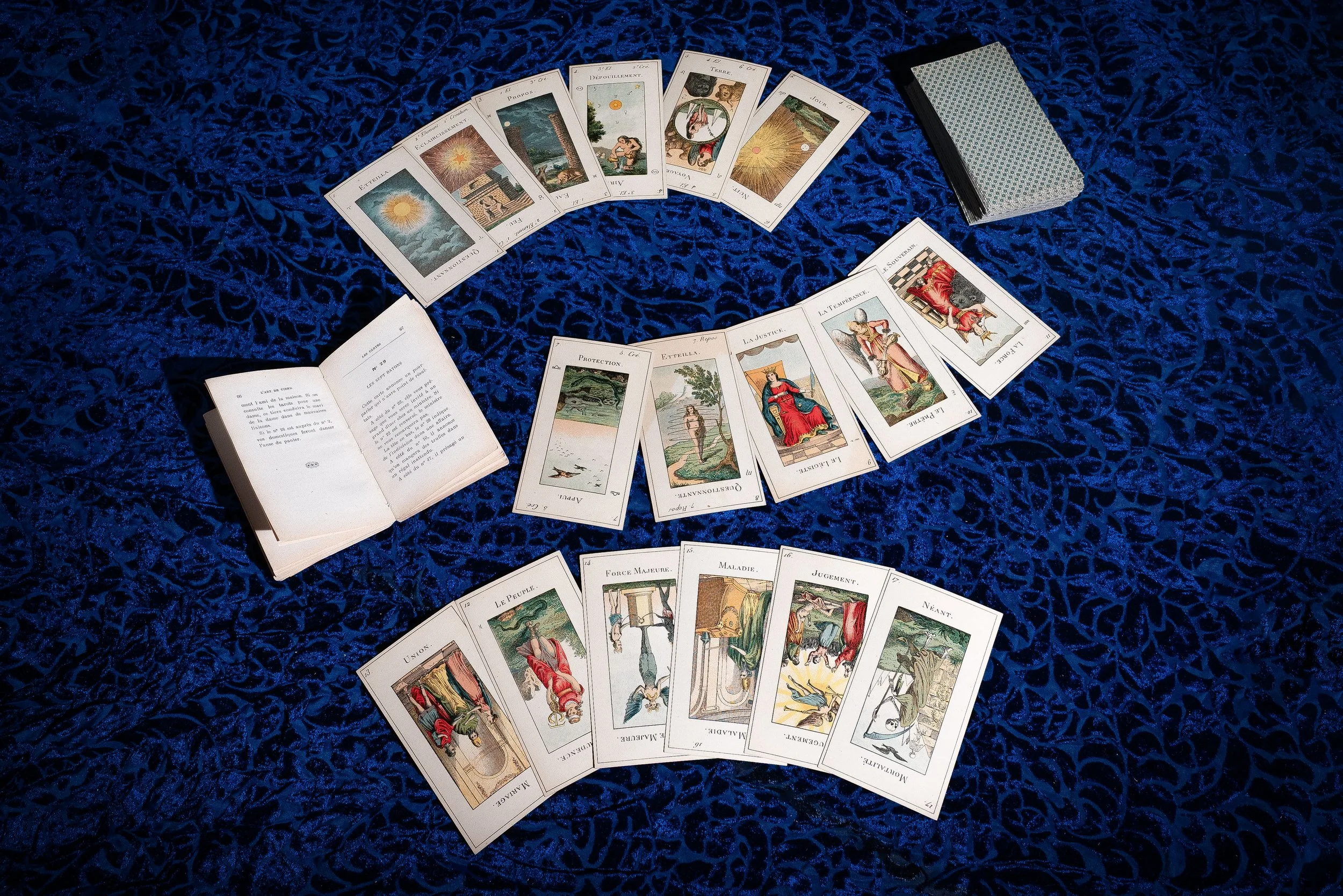 Image 1 of 7
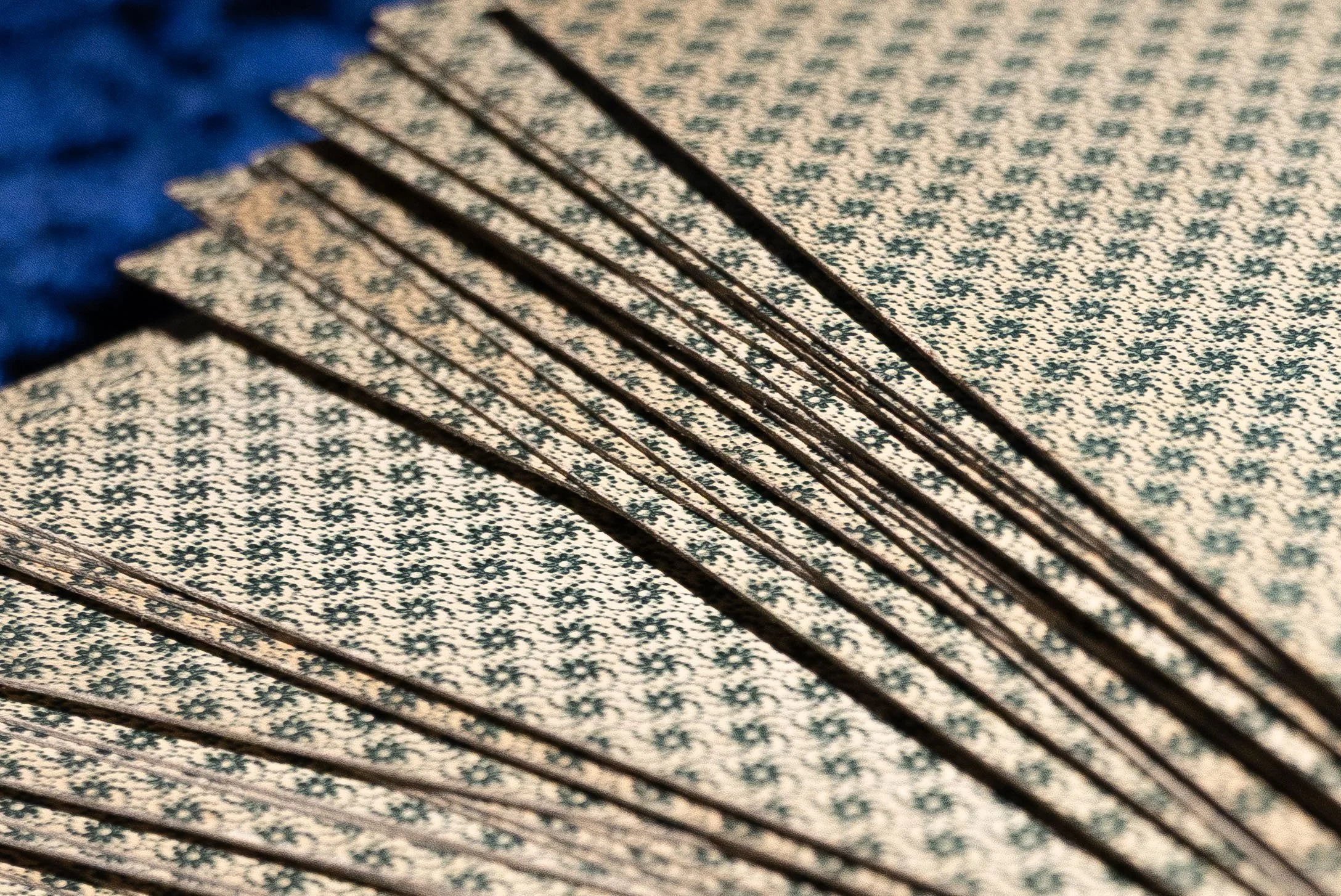 Image 2 of 7
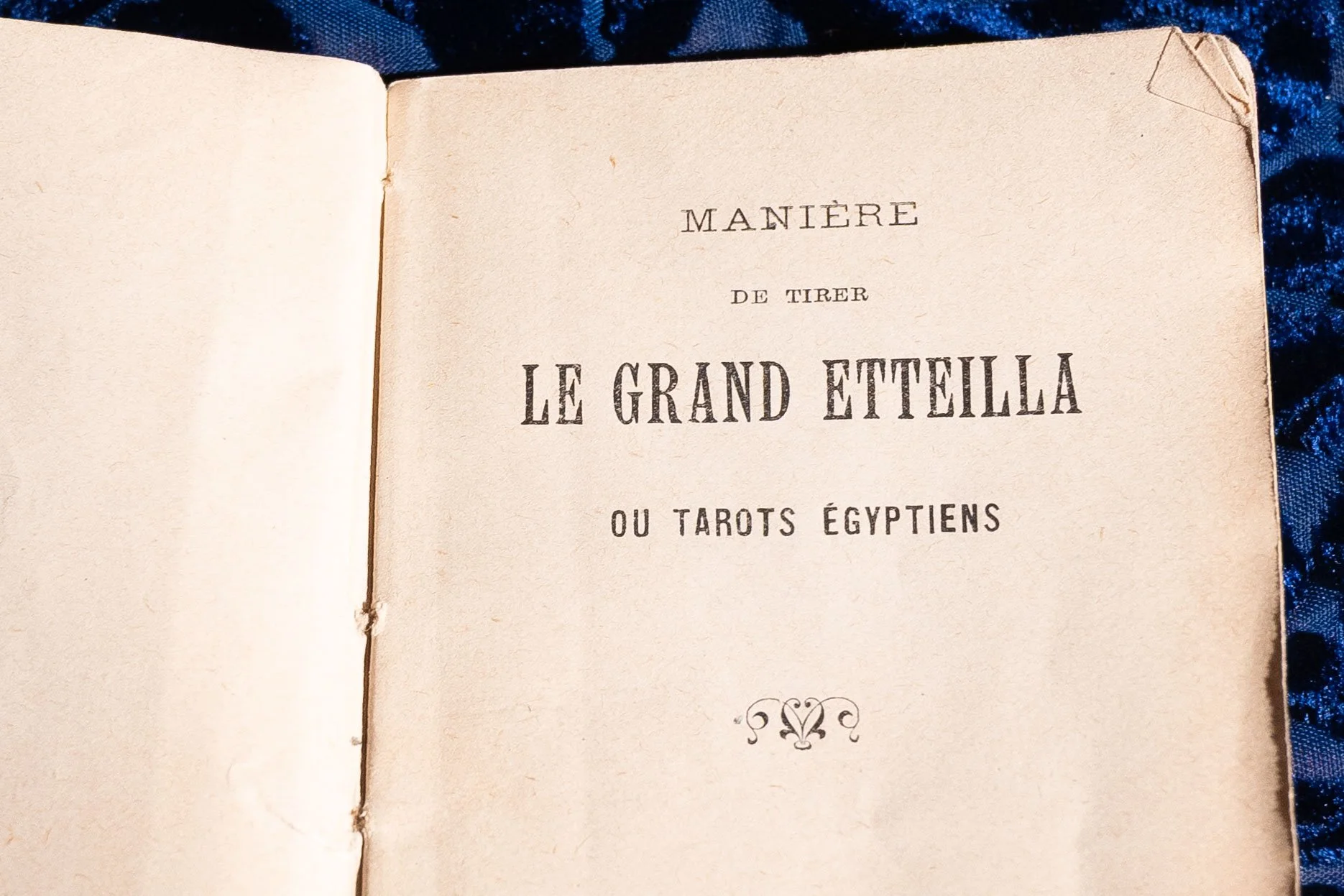 Image 3 of 7
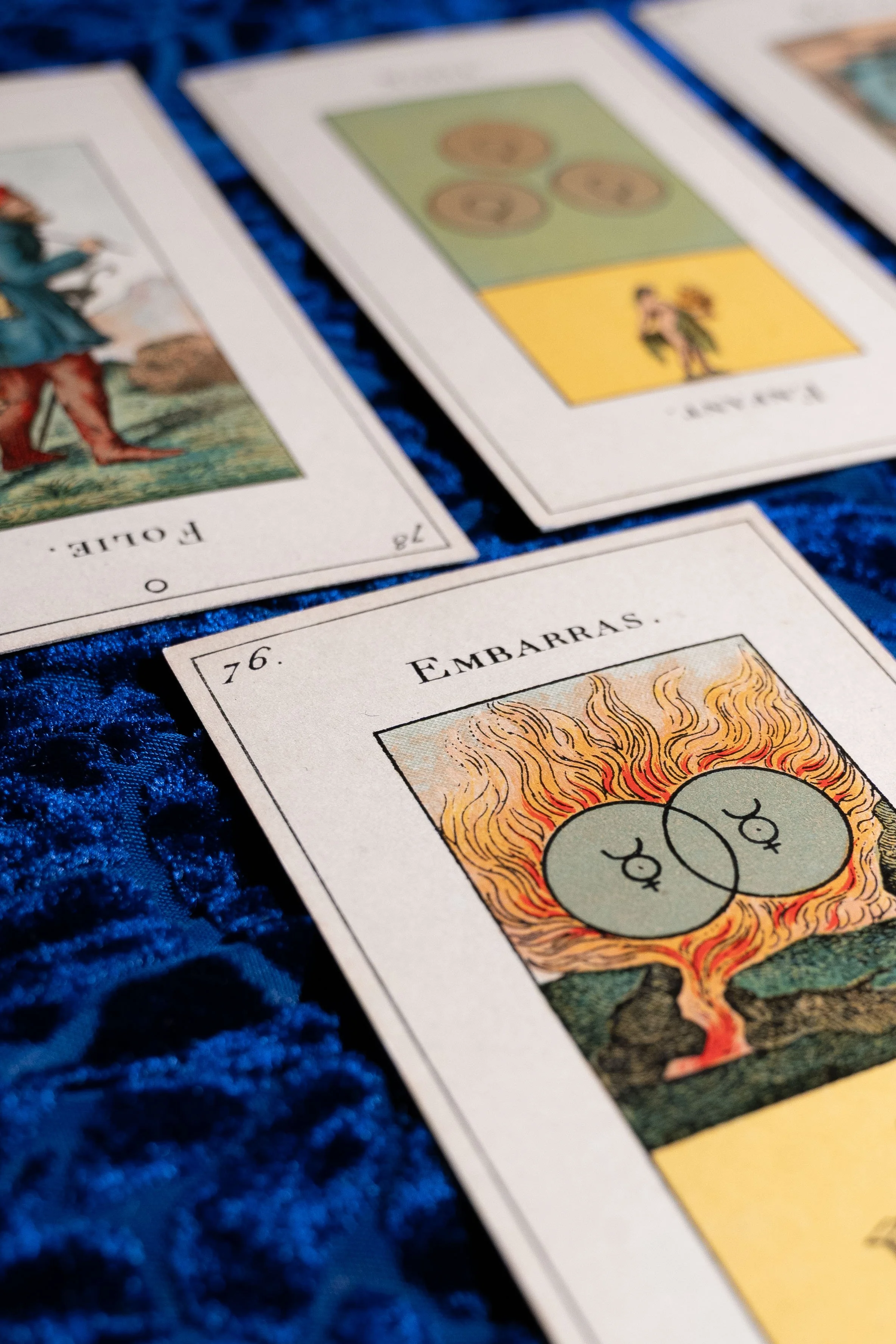 Image 4 of 7
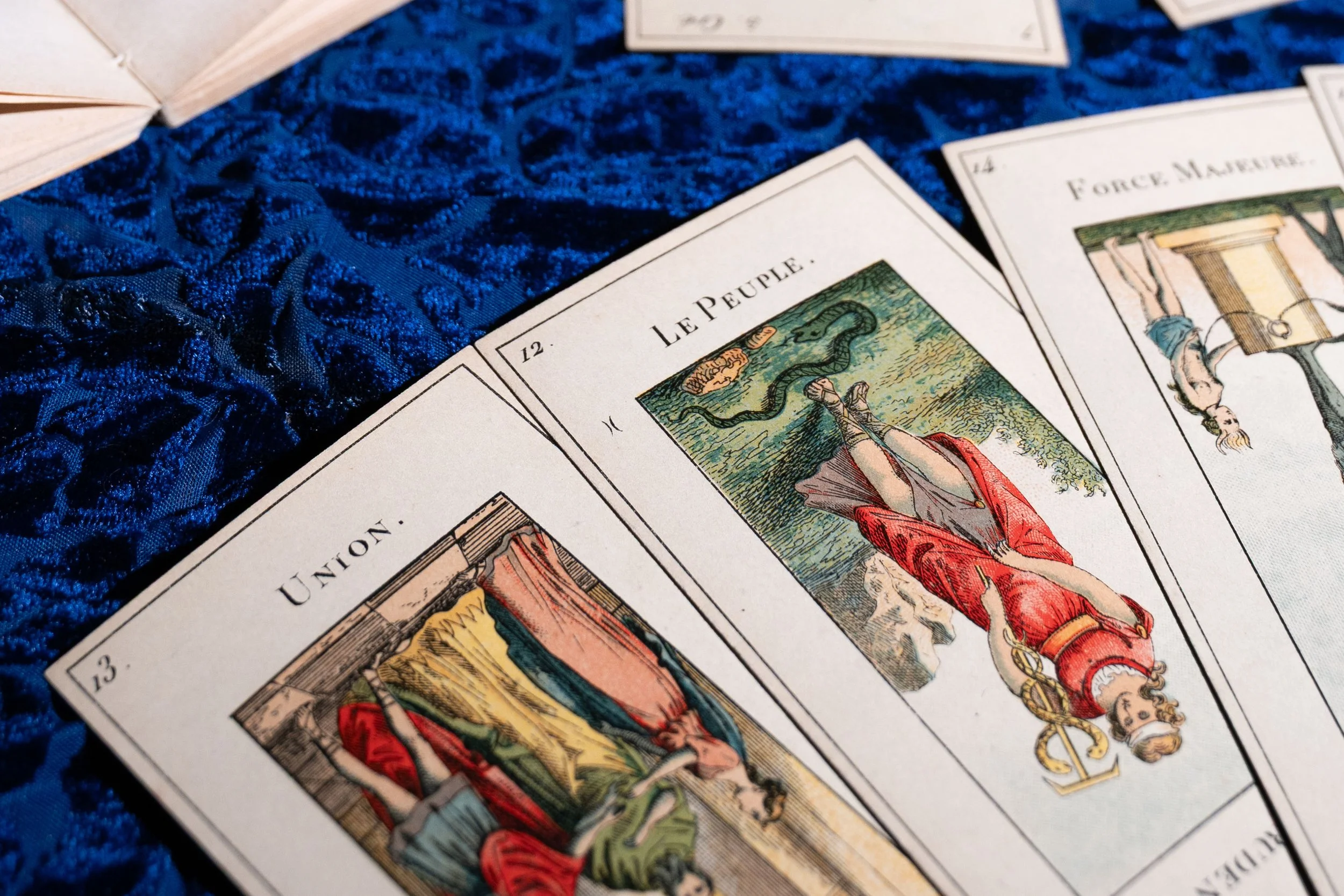 Image 5 of 7
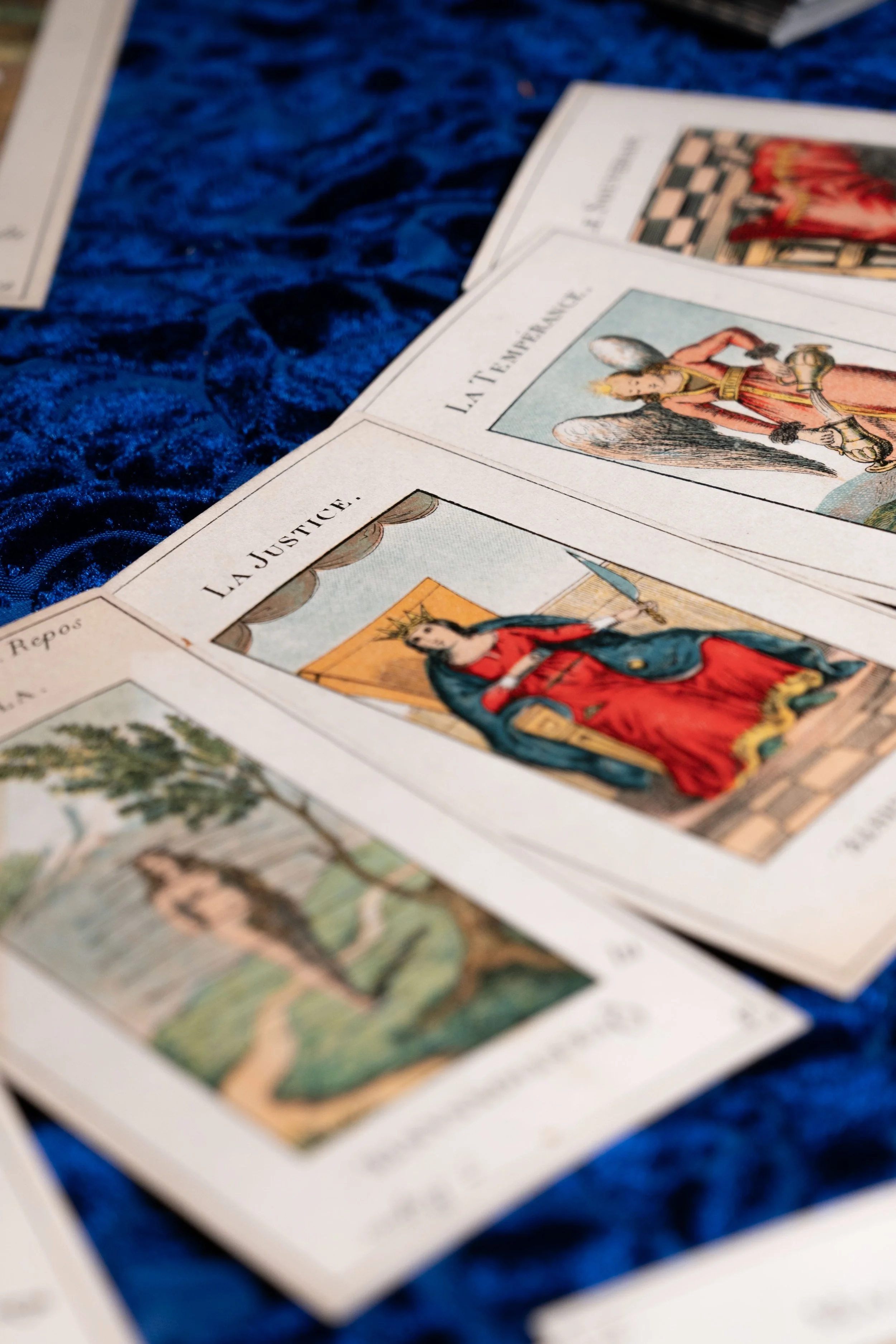 Image 6 of 7
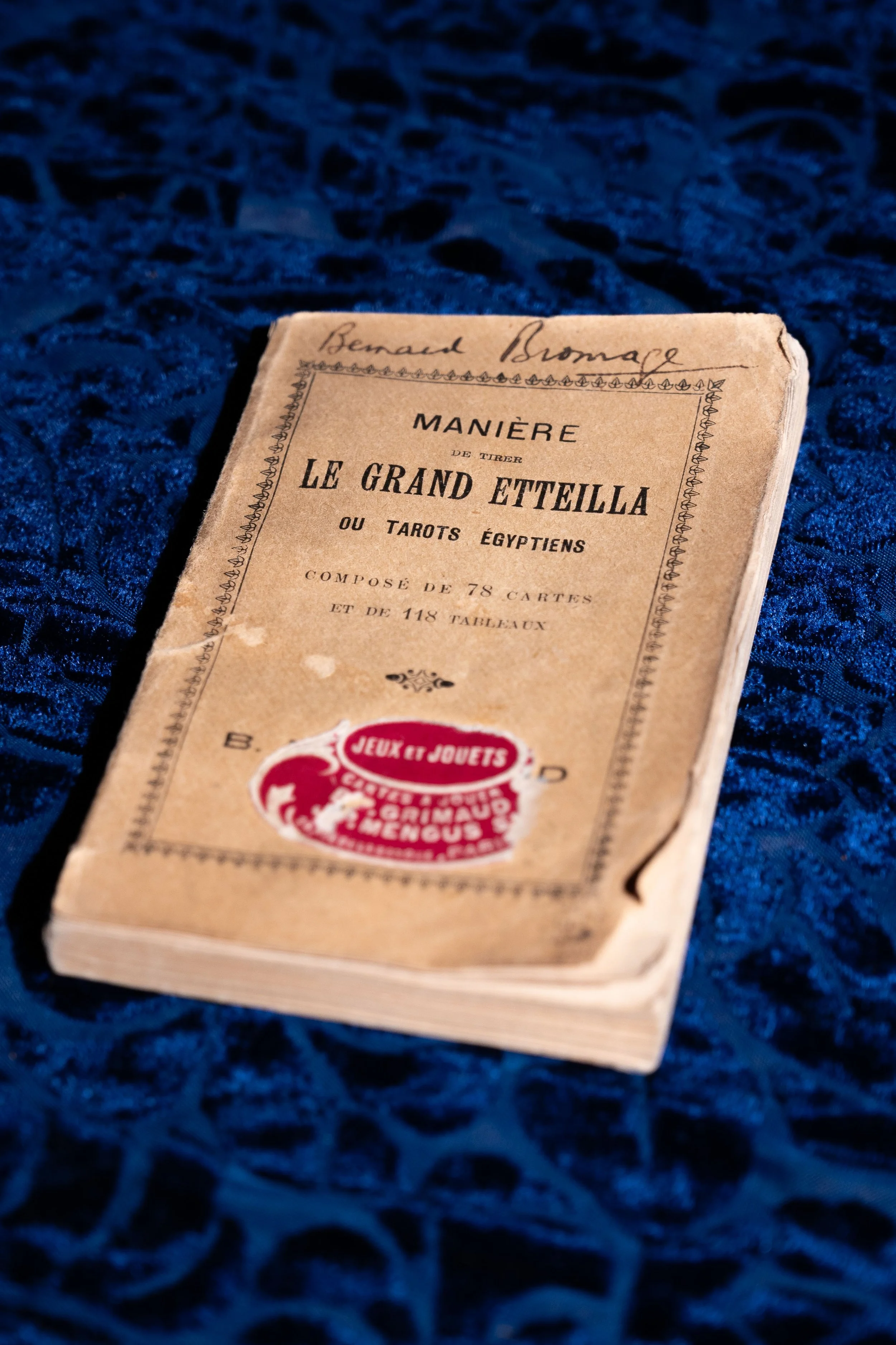 Image 7 of 7