
 Image 1 of 1
Medieval base-metal seal ring. Eastern Mediterranean / Byzantine-medieval world.
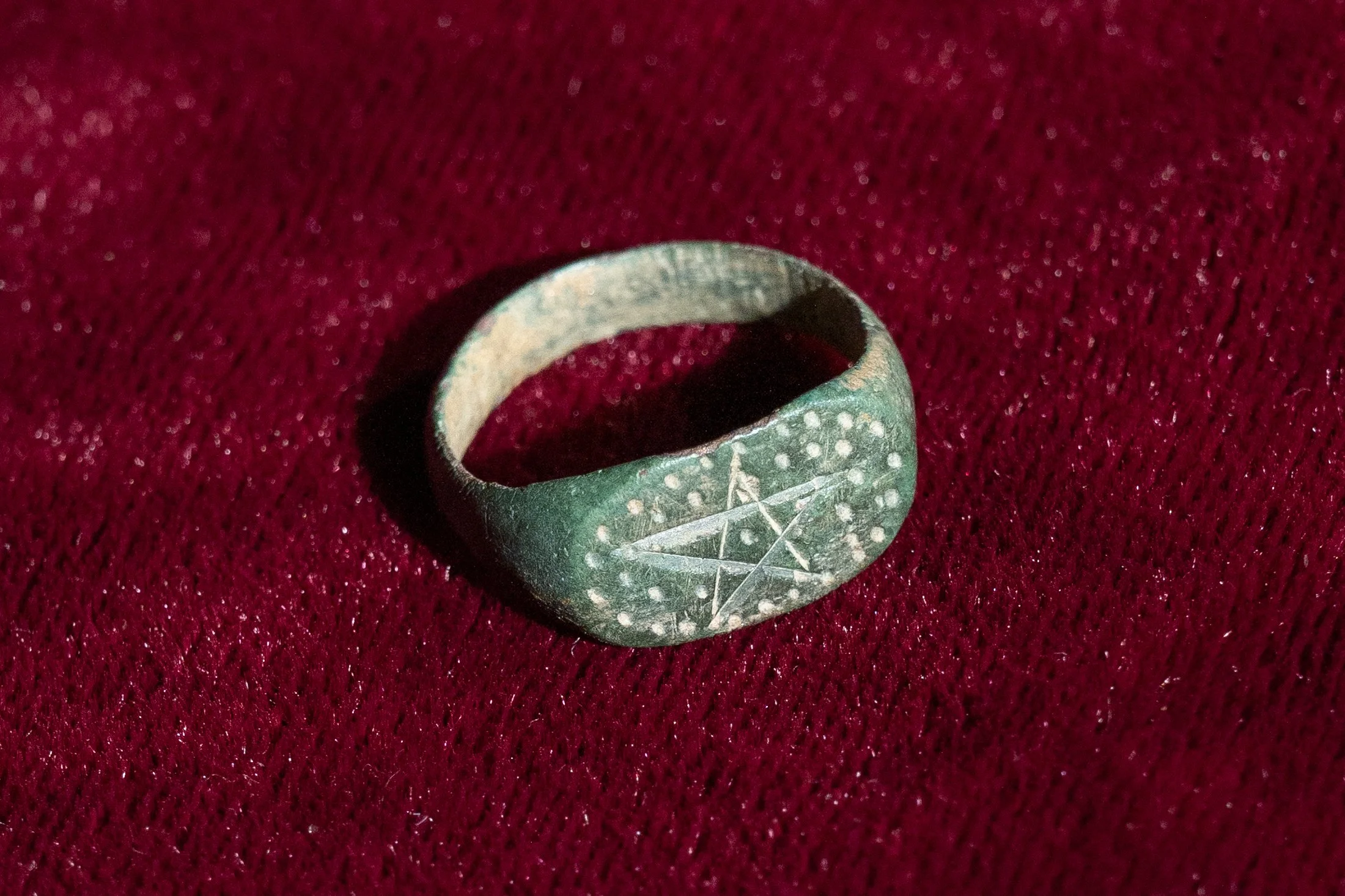
The five-pointed star drawn in a single unbroken line is one of the oldest protective signs in the Western repertoire, and on this small cast-bronze ring a medieval hand cut exactly that figure into the flat oval face and ringed it about with a collar of punched dots. It is a humble object, worn smooth and gone the deep green of longburied copper, but the device it carries is anything but humble: this is the pentagram, the sign that learned and unlearned alike believed could turn away evil and hold the wearer safe. By the Middle Ages the five-pointed star carried a long inheritance. To the Pythagoreans it had been the figure of health; to the later magical tradition it was the Seal of Solomon, the sign by which the wise king was said to command and bind spirits, and it passes under that name through the grimoires and ceremonial magic literature of the medieval and Renaissance world.
It had a thoroughly Christian life too. In Sir Gawain and the Green Knight the pentangle blazoned on Gawain’s shield is called the “endless knot,” its five points read as the five wounds of Christ, the five joys of the Virgin, and the five virtues of the perfect knight. The same figure that a cleric might draw to constrain a demon could therefore sit comfortably on the shield of a Christian hero, and on a ring like this one it would have worked, in its owner’s mind, as a quiet piece of everyday protection. The ring itself is cast in a copper alloy, the D-sectioned hoop swelling to a flattened oval bezel, and across that bezel the star has been incised freehand in clean single strokes, slightly irregular as hand-work always is, then framed by a neat border of ring-punched dots.
There is no gemstone and no gilding; the appeal was never luxury. This is the protective jewellery of an ordinary person, the kind of base-metal ring that goldsmiths’ histories long overlooked and that has only lately been studied in its own right. The surfaces are worn from real wear, the patina stable and even, and the device remains perfectly legible, which is exactly what a collector of amuletic and “magic” rings hopes to find. Plain bronze medieval rings survive in some numbers and turn up regularly in the trade, but examples carrying a clear, well-cut pentagram are decidedly less common and are actively sought by collectors of talismanic and apotropaic material.
OBJECT Medieval finger ring with engraved pentagram (pentalpha) within a punched-dot border. Eastern Mediterranean / Byzantine-medieval world, circa 7th–12th century AD.
Physical Description: Cast copper alloy (bronze). D-section hoop widening to a flat oval bezel; bezel engraved with a five-pointed star of single incised lines, enclosed by a border of punched dots. Overall diameter 20.9 x 20.3 mm; weight 5.26 g. Material: Bronze (copper alloy). Condition: Even, stable green patina overall; surfaces worn smooth from use, with light scratches and minor casting irregularities. The star and dotted border remain clear and legible. Intact and wearable; no breaks or repairs visible.
Medieval base-metal seal ring. Eastern Mediterranean / Byzantine-medieval world.
The five-pointed star drawn in a single unbroken line is one of the oldest protective signs in the Western repertoire, and on this small cast-bronze ring a medieval hand cut exactly that figure into the flat oval face and ringed it about with a collar of punched dots. It is a humble object, worn smooth and gone the deep green of longburied copper, but the device it carries is anything but humble: this is the pentagram, the sign that learned and unlearned alike believed could turn away evil and hold the wearer safe. By the Middle Ages the five-pointed star carried a long inheritance. To the Pythagoreans it had been the figure of health; to the later magical tradition it was the Seal of Solomon, the sign by which the wise king was said to command and bind spirits, and it passes under that name through the grimoires and ceremonial magic literature of the medieval and Renaissance world.
It had a thoroughly Christian life too. In Sir Gawain and the Green Knight the pentangle blazoned on Gawain’s shield is called the “endless knot,” its five points read as the five wounds of Christ, the five joys of the Virgin, and the five virtues of the perfect knight. The same figure that a cleric might draw to constrain a demon could therefore sit comfortably on the shield of a Christian hero, and on a ring like this one it would have worked, in its owner’s mind, as a quiet piece of everyday protection. The ring itself is cast in a copper alloy, the D-sectioned hoop swelling to a flattened oval bezel, and across that bezel the star has been incised freehand in clean single strokes, slightly irregular as hand-work always is, then framed by a neat border of ring-punched dots.
There is no gemstone and no gilding; the appeal was never luxury. This is the protective jewellery of an ordinary person, the kind of base-metal ring that goldsmiths’ histories long overlooked and that has only lately been studied in its own right. The surfaces are worn from real wear, the patina stable and even, and the device remains perfectly legible, which is exactly what a collector of amuletic and “magic” rings hopes to find. Plain bronze medieval rings survive in some numbers and turn up regularly in the trade, but examples carrying a clear, well-cut pentagram are decidedly less common and are actively sought by collectors of talismanic and apotropaic material.
OBJECT Medieval finger ring with engraved pentagram (pentalpha) within a punched-dot border. Eastern Mediterranean / Byzantine-medieval world, circa 7th–12th century AD.
Physical Description: Cast copper alloy (bronze). D-section hoop widening to a flat oval bezel; bezel engraved with a five-pointed star of single incised lines, enclosed by a border of punched dots. Overall diameter 20.9 x 20.3 mm; weight 5.26 g. Material: Bronze (copper alloy). Condition: Even, stable green patina overall; surfaces worn smooth from use, with light scratches and minor casting irregularities. The star and dotted border remain clear and legible. Intact and wearable; no breaks or repairs visible.