
 Image 1 of 5
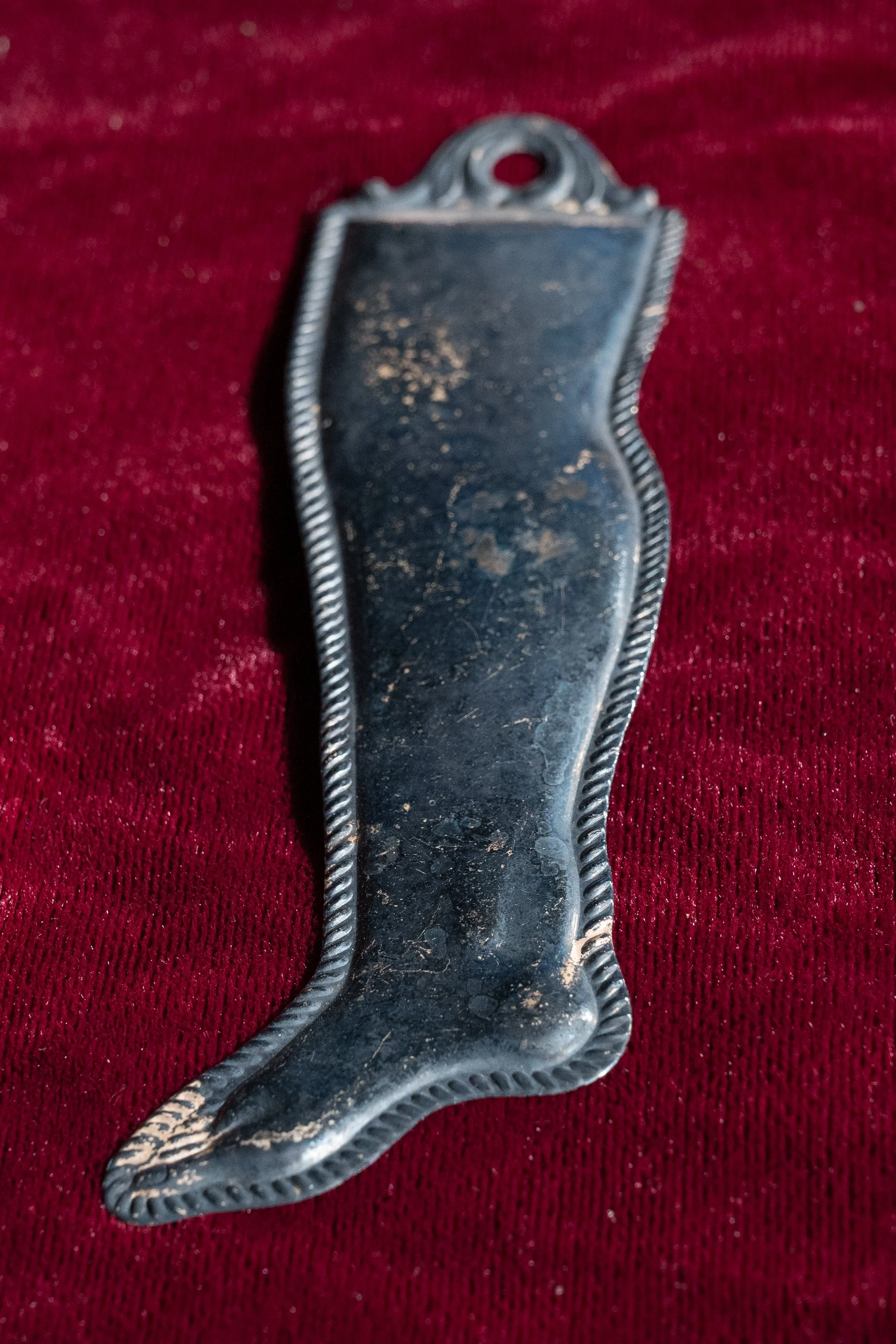 Image 2 of 5
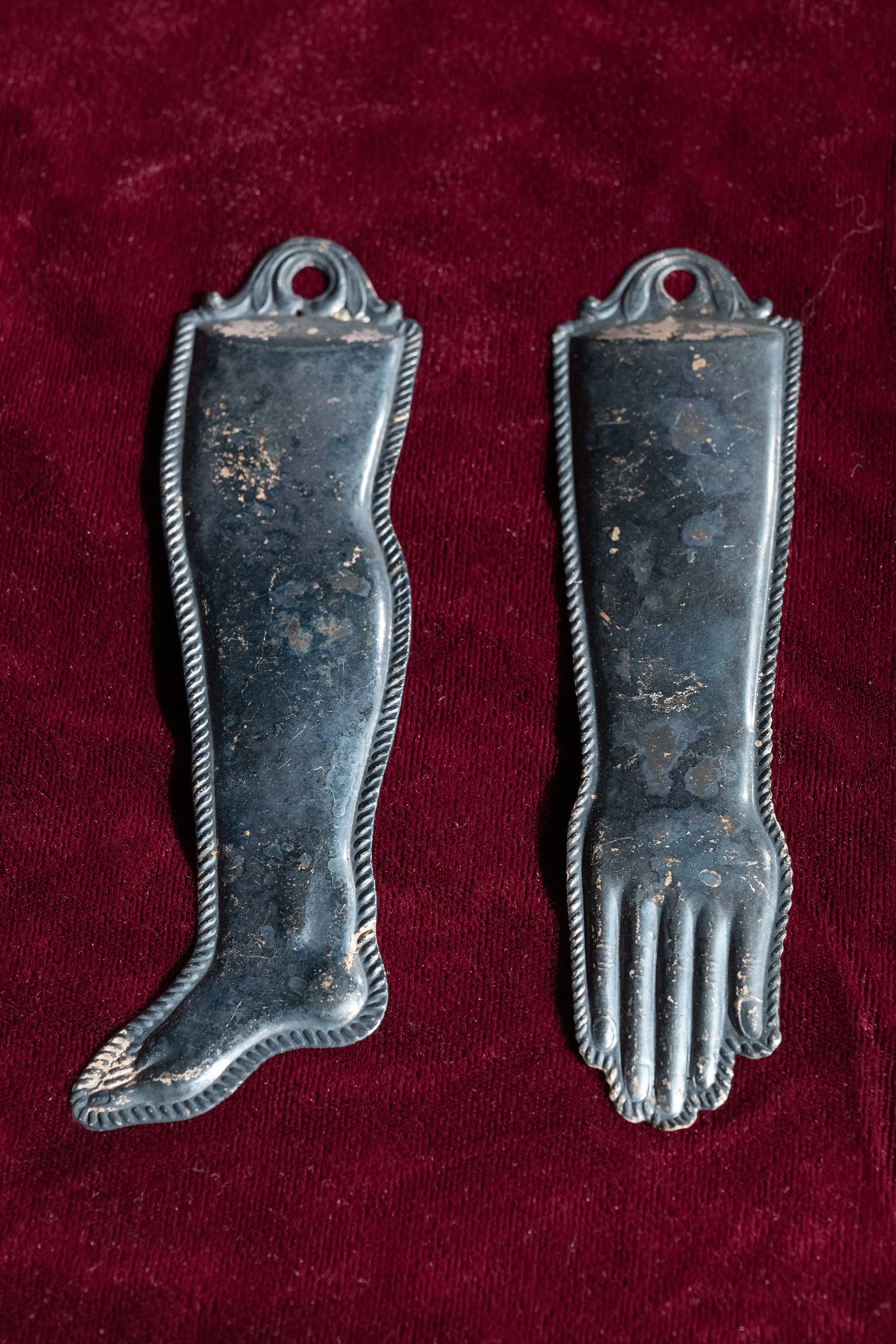 Image 3 of 5
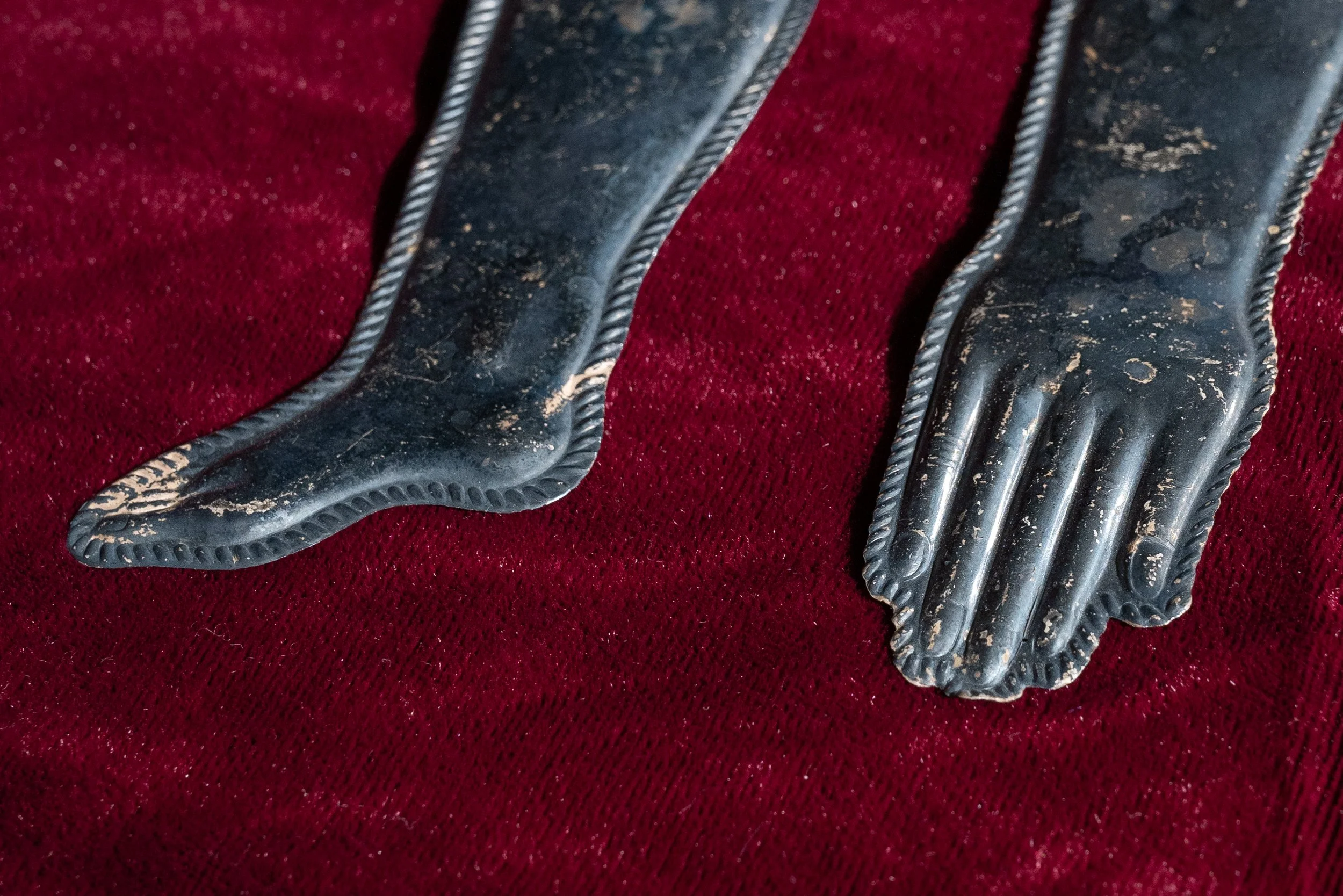 Image 4 of 5
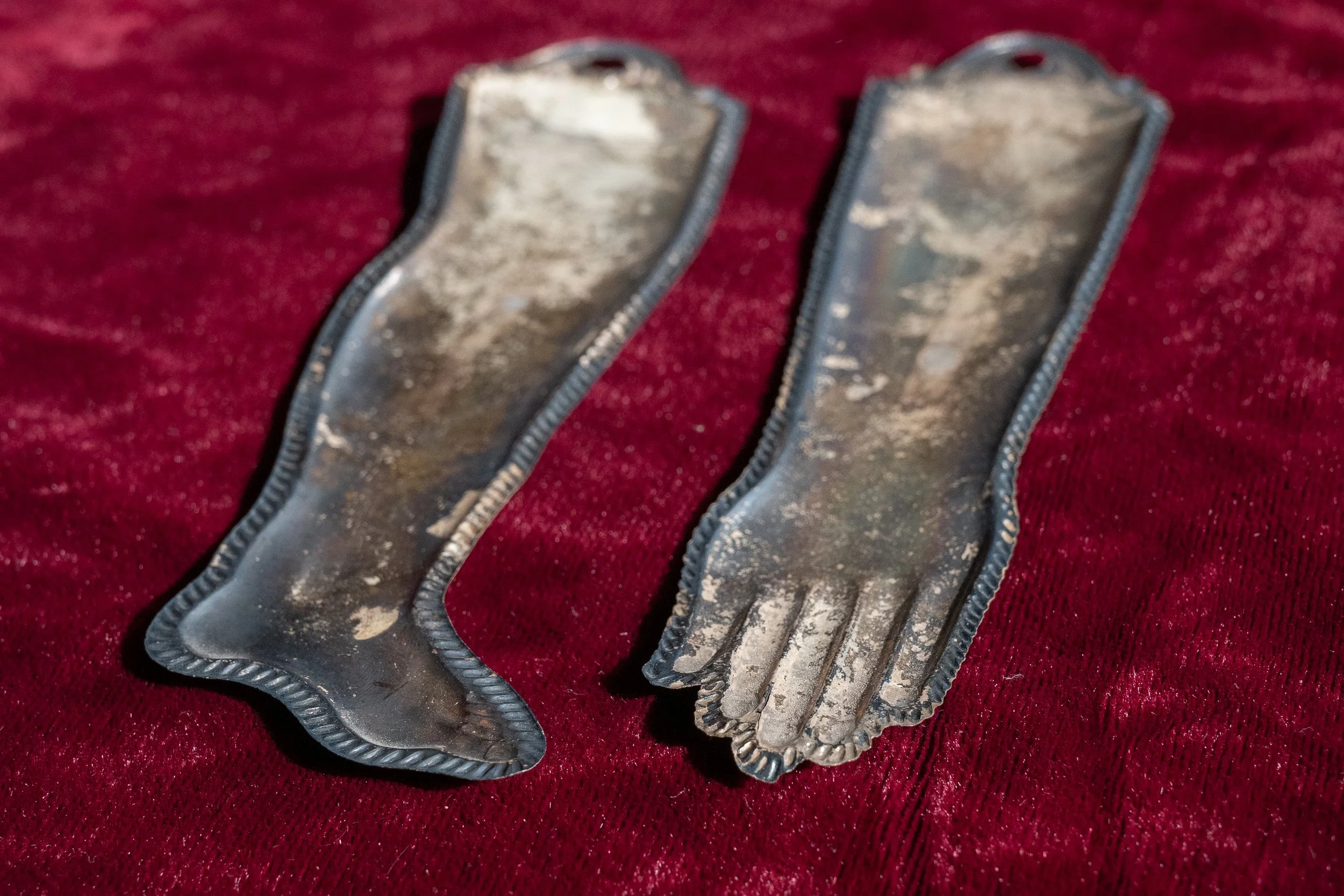 Image 5 of 5
These two slender silver plaques, an arm with its open hand and a stockinged leg, are prayers you can hold. In nineteenth-century Italy, a person whose limb was injured, paralyzed, or wasting would vow an offering to their saint, and when the grace came, they kept the bargain: a silversmith near the sanctuary would emboss the healed member in thin silver lamina, and the votive would be hung by its pierced lug on the church wall beside the saint's altar, among hundreds of others, a permanent public thank-you note. Italians call them ex-votos, "from a vow," and the walls of shimmering silver limbs, hearts, and eyes that accumulated around miracle-working images are among the most moving sights in Italian popular religion. Each one testifies to a specific body and a specific deliverance; this pair records an arm and a leg that someone believed a saint had saved.
The practice is far older than Christianity, and that is much of its fascination. Pilgrims to the healing sanctuaries of the Etruscans and to the temples of Asclepius left terracotta arms, legs, eyes, and ears at the altars of their gods two thousand years before these silver examples were made; the Church inherited the gesture whole, changing the addressee but not the grammar. The logic is that of sympathetic correspondence, the image standing for the member, and the votive tradition runs in an unbroken line from those ancient offering pits through medieval wax limbs to the Mexican milagros still sold outside churches today. For the collector of religious and magical material culture, anatomical ex-votos are the everyday face of that tradition: objects of negotiation between the human body and the unseen.
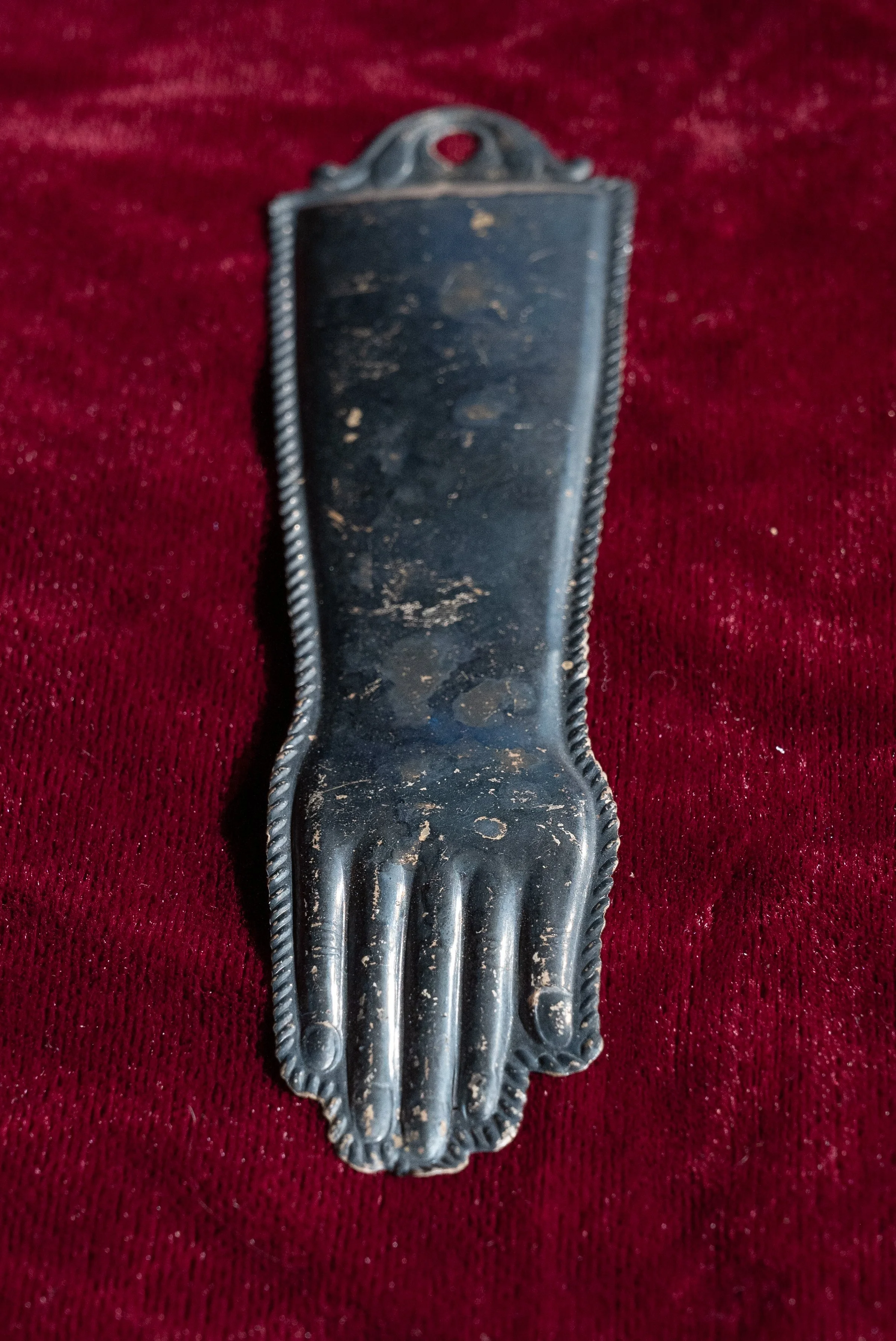
The pair is appealingly matched, clearly of the same region and period, each worked in repoussé within a rope-twist border, each crowned with a scrolled hanging lug pierced for the nail or ribbon that once fixed it near the altar. The hand is rendered palm-down with long parallel fingers and neatly tooled nails; the leg, bare-footed and naturalistic, has the easy curve of a limb at rest. Both carry a deep blue-black tarnish with scattered rubbing and small blemishes with no splits or repairs visible. They were catalogued at auction as silver, mid-nineteenth century, Italian, the pair weighing 19 grams, which is just what these whisper-thin laminae should weigh.
Matched pairs that read together as one person's story, an arm and a leg, are uncommon and display beautifully, whether framed on velvet in the traditional manner or shown loose as sculptural objects. They are an affordable point of entry into one of the oldest continuous practices in Western religion, and they pair naturally with books of saints' cures and astrological medicine: the practical end of the same universe.
[ANATOMICAL EX-VOTOS]. A pair of votive plaques, a right arm with hand and a left leg with foot. Italy, second half of the 19th century (catalogued at auction as 1850-1900). Embossed (repoussé) silver lamina with rope-twist borders and scrolled suspension lugs.
Physical Description: Two pieces, each approx. 16.5 x 4 cm, 0.3 cm deep; combined weight 19 g. Each die-stamped and hand-finished in thin sheet, the reverse hollow, the lug pierced for suspension.
Condition: Good. Deep blue-black tarnish overall with scattered rubbing, small blemishes, and minor surface losses consistent with long devotional display; no splits, holes, or repairs observed.
These two slender silver plaques, an arm with its open hand and a stockinged leg, are prayers you can hold. In nineteenth-century Italy, a person whose limb was injured, paralyzed, or wasting would vow an offering to their saint, and when the grace came, they kept the bargain: a silversmith near the sanctuary would emboss the healed member in thin silver lamina, and the votive would be hung by its pierced lug on the church wall beside the saint's altar, among hundreds of others, a permanent public thank-you note. Italians call them ex-votos, "from a vow," and the walls of shimmering silver limbs, hearts, and eyes that accumulated around miracle-working images are among the most moving sights in Italian popular religion. Each one testifies to a specific body and a specific deliverance; this pair records an arm and a leg that someone believed a saint had saved.
The practice is far older than Christianity, and that is much of its fascination. Pilgrims to the healing sanctuaries of the Etruscans and to the temples of Asclepius left terracotta arms, legs, eyes, and ears at the altars of their gods two thousand years before these silver examples were made; the Church inherited the gesture whole, changing the addressee but not the grammar. The logic is that of sympathetic correspondence, the image standing for the member, and the votive tradition runs in an unbroken line from those ancient offering pits through medieval wax limbs to the Mexican milagros still sold outside churches today. For the collector of religious and magical material culture, anatomical ex-votos are the everyday face of that tradition: objects of negotiation between the human body and the unseen.
The pair is appealingly matched, clearly of the same region and period, each worked in repoussé within a rope-twist border, each crowned with a scrolled hanging lug pierced for the nail or ribbon that once fixed it near the altar. The hand is rendered palm-down with long parallel fingers and neatly tooled nails; the leg, bare-footed and naturalistic, has the easy curve of a limb at rest. Both carry a deep blue-black tarnish with scattered rubbing and small blemishes with no splits or repairs visible. They were catalogued at auction as silver, mid-nineteenth century, Italian, the pair weighing 19 grams, which is just what these whisper-thin laminae should weigh.
Matched pairs that read together as one person's story, an arm and a leg, are uncommon and display beautifully, whether framed on velvet in the traditional manner or shown loose as sculptural objects. They are an affordable point of entry into one of the oldest continuous practices in Western religion, and they pair naturally with books of saints' cures and astrological medicine: the practical end of the same universe.
[ANATOMICAL EX-VOTOS]. A pair of votive plaques, a right arm with hand and a left leg with foot. Italy, second half of the 19th century (catalogued at auction as 1850-1900). Embossed (repoussé) silver lamina with rope-twist borders and scrolled suspension lugs.
Physical Description: Two pieces, each approx. 16.5 x 4 cm, 0.3 cm deep; combined weight 19 g. Each die-stamped and hand-finished in thin sheet, the reverse hollow, the lug pierced for suspension.
Condition: Good. Deep blue-black tarnish overall with scattered rubbing, small blemishes, and minor surface losses consistent with long devotional display; no splits, holes, or repairs observed.