
 Image 1 of 3
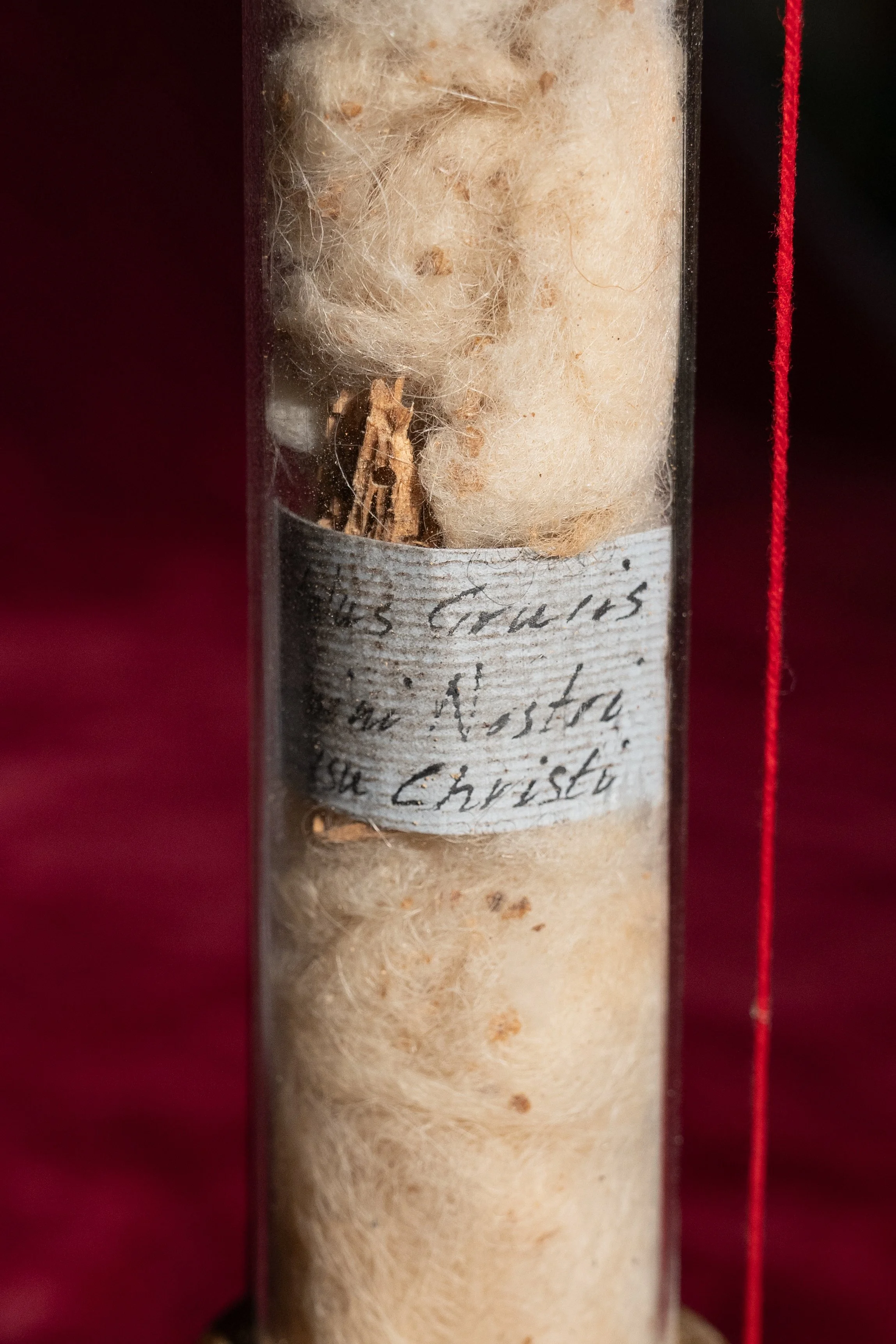 Image 2 of 3
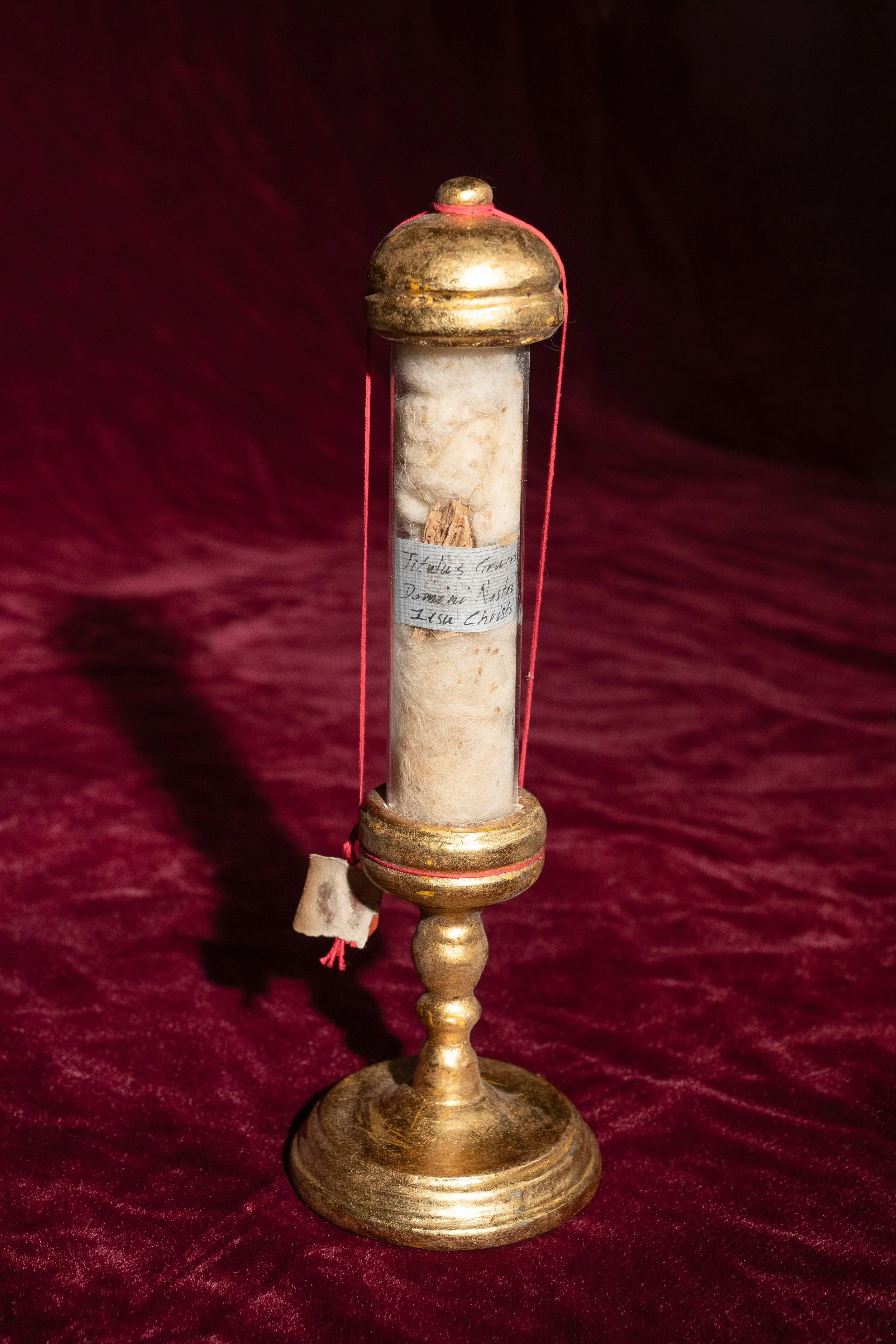 Image 3 of 3
Of all the relics that came out of the medieval and Baroque devotion to the Passion, none reaches for a more particular moment than this one. Where a relic of the True Cross points to the wood Christ was nailed to, a relic of the Titulus points to the board nailed above his head: the placard Pilate ordered, lettered in Hebrew, Greek, and Latin, "Jesus of Nazareth, King of the Jews," which Christian tradition shortened to the four letters INRI. This small Italian reliquary presents a sliver of wood offered in exactly that character, identified on a handwritten slip in a careful clerical cursive as Titulus Crucis Domini Nostri Iesu Christi, "the Title of the Cross of Our Lord Jesus Christ."
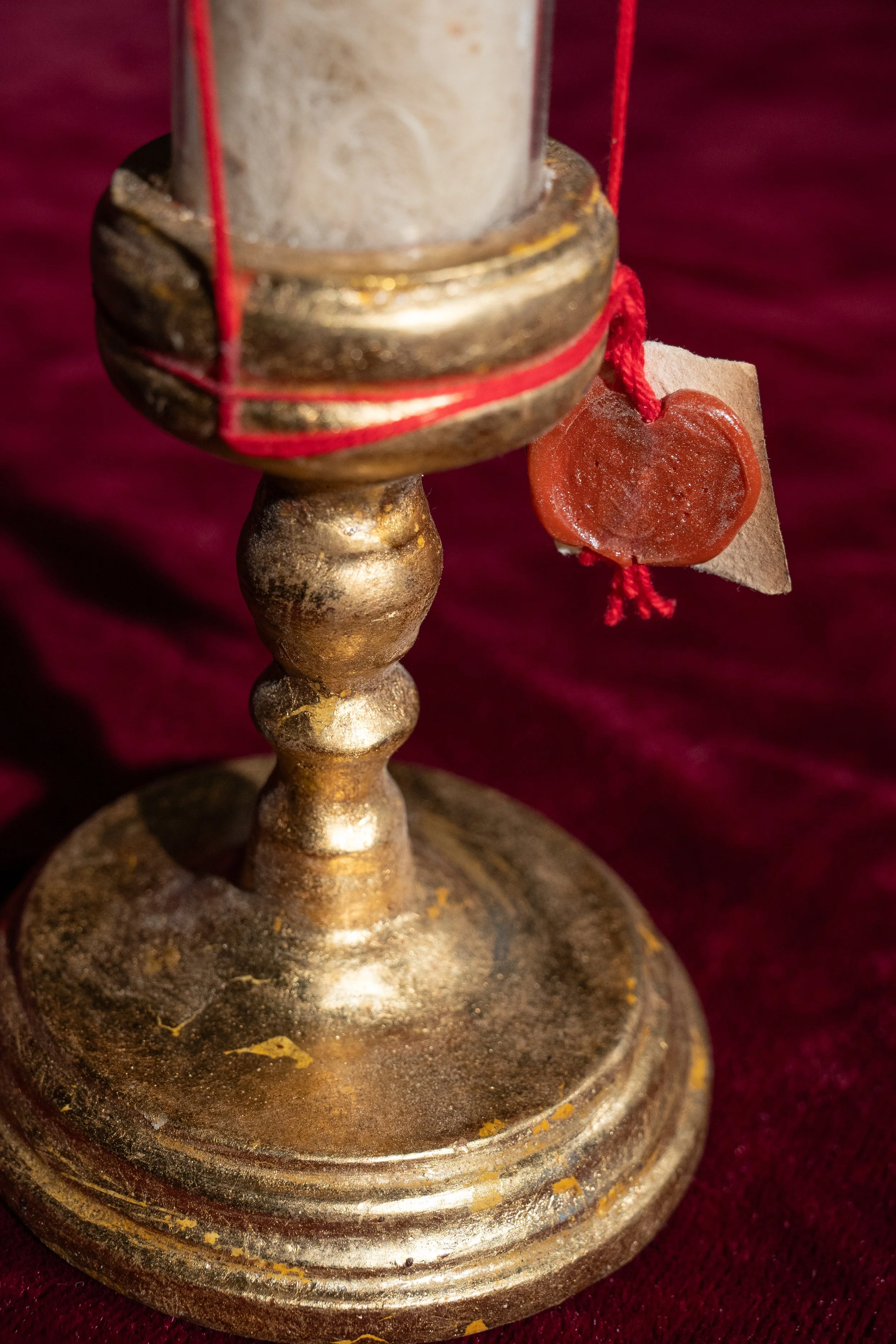
The object is built to be looked into rather than merely looked at. A clear glass cylinder rises like a miniature column between a turned and gilded baluster foot and a domed gilt cap, so that the relic stands upright at eye level and can be turned to the light. Inside, the fragment is cradled in a bed of soft cotton wool, the traditional packing that protected and dignified such particles, with the inked paper label set against the glass so the viewer reads the attribution through the wall of the tube. A red silk cord is wound around the cap and foot and gathered to one side, where it secures a lozenge of red sealing wax pressed with a device. That seal is the heart of the piece in collecting terms: it is the mark of the ecclesiastical authority who closed and authenticated the reliquary, the period's guarantee that the cord had not been lifted and the contents not exchanged.
The relic belongs to the long afterlife of the Titulus venerated at Santa Croce in Gerusalemme in Rome, the basilica founded by the Empress Helena to house what she was said to have brought back from Jerusalem. The Roman board, rediscovered walled up behind a brick inscribed "Titulus Crucis" in 1492, became the source and the warrant for countless small secondary relics distributed across Catholic Europe, and Passion relics of this kind were among the most sought-after a church or a private devotee could hold. It is worth saying plainly that the authenticity of the Santa Croce board itself is debated by scholars, and that a particle such as this one carries the attribution its label and seal assert rather than any independent proof; this is offered as a historical devotional object, valued for what it represents and for the craftsmanship of its presentation.
As a thing to handle and display, it is satisfying out of all proportion to its size. The giltwood is warm and softly worn, the water-gilding rubbed at the high points to show the red clay bole beneath, which is exactly the patina collectors of Italian devotional furniture look for. Standing 23 centimetres tall, it has real presence on a shelf or in a cabinet, and unlike the more common flat brass-and-glass theca it reads as a sculptural object in the round. Reliquaries of the Passion appear in commerce with some regularity but rarely in this columnar glass form, and rarely with the manuscript label and intact wax seal still married to the relic they describe. Condition is good and consistent with age: minor gilt losses and scattered staining, the cotton lightly toned, the seal and cord sound.
This item is offered solely for its historical, cultural, or decorative value. No religious significance is claimed, implied, or supported.
Reliquary (theca) containing a relic labeled ex Titulo Crucis. Italy, estimated c. 1850-1900 (broader range of manufacture 1400-1900 per source). Glass cylinder reliquary on a turned giltwood stand with domed cap; cotton-wool packing; small wood fragment; manuscript paper cedula inscribed in ink Titulus Crucis Domini Nostri Iesu Christi; red silk binding cord with applied red wax authentication seal on a paper tag.
Physical Description: Height 23 cm; width 7.2 cm; depth 7.2 cm. Weight 108 g. Materials: giltwood (turned/carved), glass, textile (cotton wool, silk cord), paper, sealing wax. One reliquary.
Condition: Good; used, with minor signs of age. Gilding rubbed with small losses revealing red bole; light staining/toning to cotton and label; binding cord and wax seal intact.
Of all the relics that came out of the medieval and Baroque devotion to the Passion, none reaches for a more particular moment than this one. Where a relic of the True Cross points to the wood Christ was nailed to, a relic of the Titulus points to the board nailed above his head: the placard Pilate ordered, lettered in Hebrew, Greek, and Latin, "Jesus of Nazareth, King of the Jews," which Christian tradition shortened to the four letters INRI. This small Italian reliquary presents a sliver of wood offered in exactly that character, identified on a handwritten slip in a careful clerical cursive as Titulus Crucis Domini Nostri Iesu Christi, "the Title of the Cross of Our Lord Jesus Christ."
The object is built to be looked into rather than merely looked at. A clear glass cylinder rises like a miniature column between a turned and gilded baluster foot and a domed gilt cap, so that the relic stands upright at eye level and can be turned to the light. Inside, the fragment is cradled in a bed of soft cotton wool, the traditional packing that protected and dignified such particles, with the inked paper label set against the glass so the viewer reads the attribution through the wall of the tube. A red silk cord is wound around the cap and foot and gathered to one side, where it secures a lozenge of red sealing wax pressed with a device. That seal is the heart of the piece in collecting terms: it is the mark of the ecclesiastical authority who closed and authenticated the reliquary, the period's guarantee that the cord had not been lifted and the contents not exchanged.
The relic belongs to the long afterlife of the Titulus venerated at Santa Croce in Gerusalemme in Rome, the basilica founded by the Empress Helena to house what she was said to have brought back from Jerusalem. The Roman board, rediscovered walled up behind a brick inscribed "Titulus Crucis" in 1492, became the source and the warrant for countless small secondary relics distributed across Catholic Europe, and Passion relics of this kind were among the most sought-after a church or a private devotee could hold. It is worth saying plainly that the authenticity of the Santa Croce board itself is debated by scholars, and that a particle such as this one carries the attribution its label and seal assert rather than any independent proof; this is offered as a historical devotional object, valued for what it represents and for the craftsmanship of its presentation.
As a thing to handle and display, it is satisfying out of all proportion to its size. The giltwood is warm and softly worn, the water-gilding rubbed at the high points to show the red clay bole beneath, which is exactly the patina collectors of Italian devotional furniture look for. Standing 23 centimetres tall, it has real presence on a shelf or in a cabinet, and unlike the more common flat brass-and-glass theca it reads as a sculptural object in the round. Reliquaries of the Passion appear in commerce with some regularity but rarely in this columnar glass form, and rarely with the manuscript label and intact wax seal still married to the relic they describe. Condition is good and consistent with age: minor gilt losses and scattered staining, the cotton lightly toned, the seal and cord sound.
This item is offered solely for its historical, cultural, or decorative value. No religious significance is claimed, implied, or supported.
Reliquary (theca) containing a relic labeled ex Titulo Crucis. Italy, estimated c. 1850-1900 (broader range of manufacture 1400-1900 per source). Glass cylinder reliquary on a turned giltwood stand with domed cap; cotton-wool packing; small wood fragment; manuscript paper cedula inscribed in ink Titulus Crucis Domini Nostri Iesu Christi; red silk binding cord with applied red wax authentication seal on a paper tag.
Physical Description: Height 23 cm; width 7.2 cm; depth 7.2 cm. Weight 108 g. Materials: giltwood (turned/carved), glass, textile (cotton wool, silk cord), paper, sealing wax. One reliquary.
Condition: Good; used, with minor signs of age. Gilding rubbed with small losses revealing red bole; light staining/toning to cotton and label; binding cord and wax seal intact.