
 Image 1 of 1
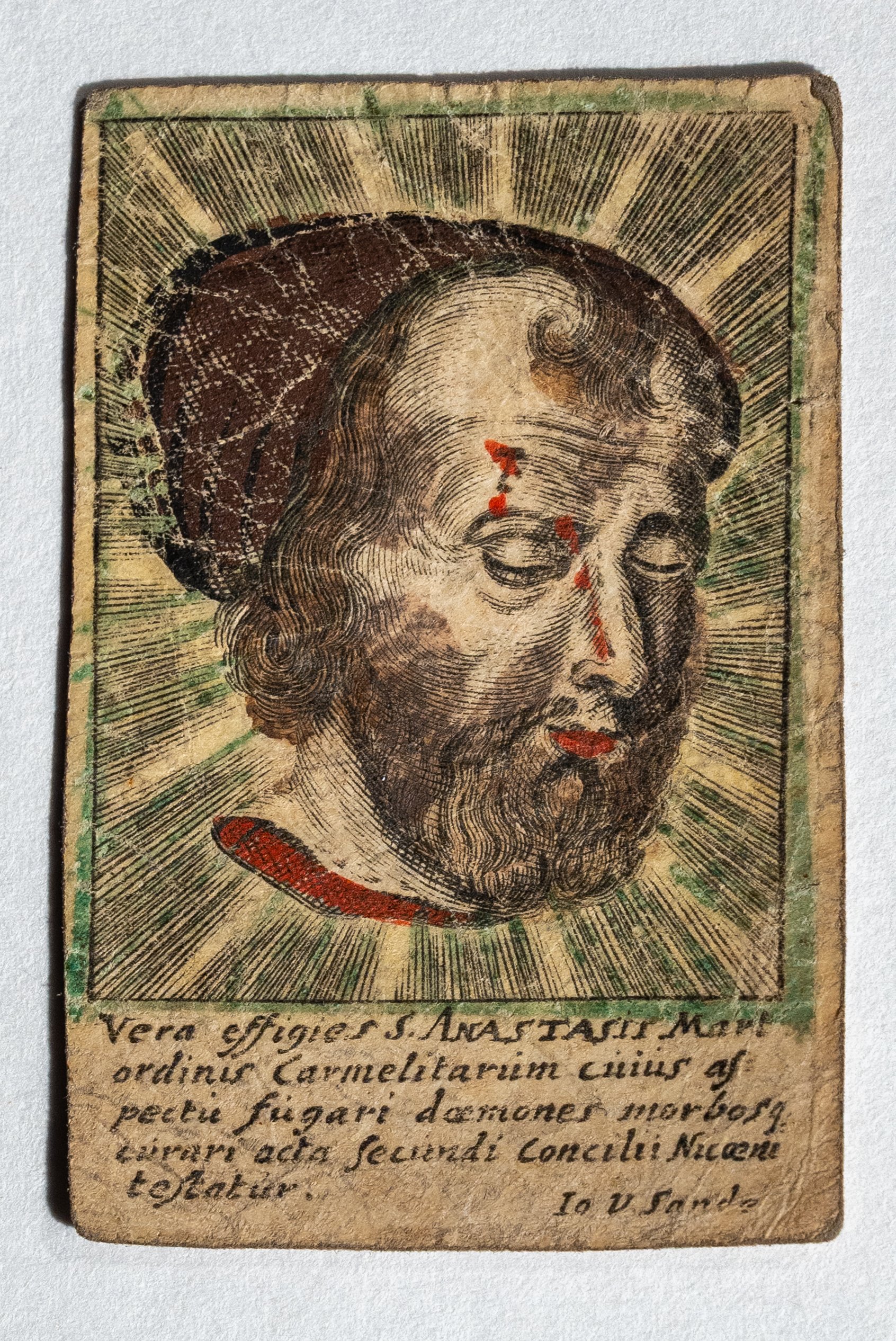
Few objects pack so much power into so small a space. This little engraving on vellum, sized for a pocket or a purse, shows the severed head of Saint Anastasius the Persian, eyes closed in death, blood touched in red at the brow and lip, radiating glory against a green-washed field. The Latin caption below makes its purpose explicit: "The true effigy of St. Anastasius, Martyr, of the Carmelite order, by whose appearance demons are put to flight and diseases cured, as the acts of the Second Council of Nicaea attest." It is, in other words, a demon repellent you could carry on your person, and one with the rarest of credentials: its power is vouched for by an ecumenical council of the Church.
The claim is no printer's invention. Anastasius began life as Magundat, a soldier and, by tradition, a student of magic in the army of the Persian king Khosrow II. The sight of the captured True Cross converted him; he took the name Anastasius, became a monk in Jerusalem, and was strangled and beheaded with his companions in 628. His head became one of the great relics of Christendom, and when the Second Council of Nicaea met in 787 to settle the great battle over religious images, the fathers cited the miracle-working image of Anastasius, which drove out demons and healed the sick, as living proof that holy images deserved veneration. Every devotional print in the Western tradition thus owes something to this saint's effigy, and this card descends directly from the image that helped win the argument. The Carmelites, who traced their order to the hermits of the East, claimed the monk-martyr as their own, hence the inscription's "ordinis Carmelitarum."
The object itself belongs to a fascinating and nearly vanished class. It was engraved at Antwerp, the great factory of Catholic devotional images, by Jan Baptist van den Sande the younger, active from about 1675 to 1713, whose signature appears at lower right. It is printed not on paper but on vellum, and that choice tells you how it was used: in this period vellum was reserved for luxury printing and, at the other end of the social scale, for holy images sold by peddlers to the faithful, because only skin was strong enough to survive years of handling in a pocket against fevers, misfortune, and the Devil. This example was handled exactly so. It carries the rubbing, dustiness, and soft edges of long companionship, and a few old pinholes show where it was once pinned to clothing or a wall, the archaeology of belief written into the object.
It appears to be unrecorded. The source dealer, a careful bibliographer, could locate no other example: not in OCLC or KVK, and not in the Museum Catharijneconvent at Utrecht or the Ruusbroec Institute at Antwerp, the two great repositories of such devotional prints. Printed amulets of this kind were made to be used up, and the survivors are few; an unrecorded one, on vellum, in contemporary hand-color, with its working life still legible upon it, is the kind of small object that serious collections of religious and magical material culture are built around.
[AMULETIC ENGRAVING]. VAN DEN SANDE, Jan Baptist, the younger (active c. 1675-1713), engraver. Vera effigies S. Anastasii Mart. ordinis Carmelitarum cuius aspectu fugari daemones morbosq[ue] curari acta secundi Concilii Nicaeni testatur. [Antwerp]: Jo. V. Sande, [c. 1675-1717].
Physical Description: Single-leaf copperplate engraving printed on vellum, approx. 6.5 x 4.5 (per source description), in contemporary hand-color: green wash to the radiance and border, red to the wounds, lip, and collar, brown to the cap.
Condition: Rubbing, dustiness, and edge wear commensurate with use as a carried amulet; a few old pinholes. An honest, evocative survival.
Few objects pack so much power into so small a space. This little engraving on vellum, sized for a pocket or a purse, shows the severed head of Saint Anastasius the Persian, eyes closed in death, blood touched in red at the brow and lip, radiating glory against a green-washed field. The Latin caption below makes its purpose explicit: "The true effigy of St. Anastasius, Martyr, of the Carmelite order, by whose appearance demons are put to flight and diseases cured, as the acts of the Second Council of Nicaea attest." It is, in other words, a demon repellent you could carry on your person, and one with the rarest of credentials: its power is vouched for by an ecumenical council of the Church.
The claim is no printer's invention. Anastasius began life as Magundat, a soldier and, by tradition, a student of magic in the army of the Persian king Khosrow II. The sight of the captured True Cross converted him; he took the name Anastasius, became a monk in Jerusalem, and was strangled and beheaded with his companions in 628. His head became one of the great relics of Christendom, and when the Second Council of Nicaea met in 787 to settle the great battle over religious images, the fathers cited the miracle-working image of Anastasius, which drove out demons and healed the sick, as living proof that holy images deserved veneration. Every devotional print in the Western tradition thus owes something to this saint's effigy, and this card descends directly from the image that helped win the argument. The Carmelites, who traced their order to the hermits of the East, claimed the monk-martyr as their own, hence the inscription's "ordinis Carmelitarum."
The object itself belongs to a fascinating and nearly vanished class. It was engraved at Antwerp, the great factory of Catholic devotional images, by Jan Baptist van den Sande the younger, active from about 1675 to 1713, whose signature appears at lower right. It is printed not on paper but on vellum, and that choice tells you how it was used: in this period vellum was reserved for luxury printing and, at the other end of the social scale, for holy images sold by peddlers to the faithful, because only skin was strong enough to survive years of handling in a pocket against fevers, misfortune, and the Devil. This example was handled exactly so. It carries the rubbing, dustiness, and soft edges of long companionship, and a few old pinholes show where it was once pinned to clothing or a wall, the archaeology of belief written into the object.
It appears to be unrecorded. The source dealer, a careful bibliographer, could locate no other example: not in OCLC or KVK, and not in the Museum Catharijneconvent at Utrecht or the Ruusbroec Institute at Antwerp, the two great repositories of such devotional prints. Printed amulets of this kind were made to be used up, and the survivors are few; an unrecorded one, on vellum, in contemporary hand-color, with its working life still legible upon it, is the kind of small object that serious collections of religious and magical material culture are built around.
[AMULETIC ENGRAVING]. VAN DEN SANDE, Jan Baptist, the younger (active c. 1675-1713), engraver. Vera effigies S. Anastasii Mart. ordinis Carmelitarum cuius aspectu fugari daemones morbosq[ue] curari acta secundi Concilii Nicaeni testatur. [Antwerp]: Jo. V. Sande, [c. 1675-1717].
Physical Description: Single-leaf copperplate engraving printed on vellum, approx. 6.5 x 4.5 (per source description), in contemporary hand-color: green wash to the radiance and border, red to the wounds, lip, and collar, brown to the cap.
Condition: Rubbing, dustiness, and edge wear commensurate with use as a carried amulet; a few old pinholes. An honest, evocative survival.