This is a single leaf from a great folio choir book, the kind of oversized volume that once lay open on a lectern while a circle of monks sang from it. The pages carry the sung Office of Saint Benedict, the chants and texts for his feast days, with the music set as rows of square notes on four-line staves and the Latin words printed beneath, syllable by syllable, so the singers could follow both at a glance. What you receive is the next leaf from the pile: a real working page of the medieval-style liturgy, not a reproduction.
Alongside the chant are the proper hymns of the saint, verses in the polished classical meters that learned monks loved. One of them salutes Benedict storming the once pagan height of Monte Cassino, throwing down its altars while Erebus roars below, and teaching “barbarian nations to resound with Christ.” It is cloister Latin written in the idiom of Horace, and it is one of the quiet pleasures of the leaf.
As an object it is frankly handsome. The music is printed entirely from type, each square and lozenge note a separate piece of metal locked up with the staff lines and the words, a feat of typesetting as exacting as a page of mathematics. The chants are flagged by their musical mode in the choir’s working shorthand (“Ant. 5,” “3. Ton. in ut,” “8. Ton. in G”). One section opens beneath a decorative printed border, and the Benedict gathering closes with an engraved picture of an allegorical figure of Faith embracing the Cross amid clouds, attended by the radiant Host, an open book, and the papal tiara. Leaves of this size, roughly 46 by 30 centimetres, were made to be read at arm’s length across a choir stall.
These leaves owe both their survival and their scars to the same accident: the volume was broken up after water damage, and only a small number of sheets could be saved, which is why they now circulate one at a time. Expect the marks of that history: tide-lines and halos of old damp, a soft patina, the occasional chip or short tear to the generous untrimmed margins. None of it dims the appeal. For a modest sum this is a genuine piece of the early modern choir, the kind of fragment that frames beautifully and puts real sung music, and a verse or two of unexpectedly elegant Latin, into your hands.
[Officium Sancti Benedicti in utroque festo.] An original leaf from a printed folio antiphonary (monastic choir book), Benedictine use. [Italy or France], later seventeenth or eighteenth century.
Physical Description: A single folio leaf (two printed pages), approx. 460 x 300 mm (sizes vary; some leaves approx. 420 x 270 mm). Letterpress chant in square notation on four-line staves, Latin underlaid, printed in black; chants marked by mode. Many leaves belong to the gathered Office of Saint Benedict (printer’s signatures and pagination present), which closes with an engraved figural vignette. Laid paper, untrimmed edges.
Condition: Halos and tide-lines of old damp, with patina, from historic water damage; creasing and light show-through; chips and short edge-tears to the margins. Type generally bold and legible. Sold as individual leaves; each differs, and condition varies leaf to leaf. Provenance: From a single folio choir book dispersed after water damage. The originating institution is not established
This is a single leaf from a great folio choir book, the kind of oversized volume that once lay open on a lectern while a circle of monks sang from it. The pages carry the sung Office of Saint Benedict, the chants and texts for his feast days, with the music set as rows of square notes on four-line staves and the Latin words printed beneath, syllable by syllable, so the singers could follow both at a glance. What you receive is the next leaf from the pile: a real working page of the medieval-style liturgy, not a reproduction.
Alongside the chant are the proper hymns of the saint, verses in the polished classical meters that learned monks loved. One of them salutes Benedict storming the once pagan height of Monte Cassino, throwing down its altars while Erebus roars below, and teaching “barbarian nations to resound with Christ.” It is cloister Latin written in the idiom of Horace, and it is one of the quiet pleasures of the leaf.
As an object it is frankly handsome. The music is printed entirely from type, each square and lozenge note a separate piece of metal locked up with the staff lines and the words, a feat of typesetting as exacting as a page of mathematics. The chants are flagged by their musical mode in the choir’s working shorthand (“Ant. 5,” “3. Ton. in ut,” “8. Ton. in G”). One section opens beneath a decorative printed border, and the Benedict gathering closes with an engraved picture of an allegorical figure of Faith embracing the Cross amid clouds, attended by the radiant Host, an open book, and the papal tiara. Leaves of this size, roughly 46 by 30 centimetres, were made to be read at arm’s length across a choir stall.
These leaves owe both their survival and their scars to the same accident: the volume was broken up after water damage, and only a small number of sheets could be saved, which is why they now circulate one at a time. Expect the marks of that history: tide-lines and halos of old damp, a soft patina, the occasional chip or short tear to the generous untrimmed margins. None of it dims the appeal. For a modest sum this is a genuine piece of the early modern choir, the kind of fragment that frames beautifully and puts real sung music, and a verse or two of unexpectedly elegant Latin, into your hands.
[Officium Sancti Benedicti in utroque festo.] An original leaf from a printed folio antiphonary (monastic choir book), Benedictine use. [Italy or France], later seventeenth or eighteenth century.
Physical Description: A single folio leaf (two printed pages), approx. 460 x 300 mm (sizes vary; some leaves approx. 420 x 270 mm). Letterpress chant in square notation on four-line staves, Latin underlaid, printed in black; chants marked by mode. Many leaves belong to the gathered Office of Saint Benedict (printer’s signatures and pagination present), which closes with an engraved figural vignette. Laid paper, untrimmed edges.
Condition: Halos and tide-lines of old damp, with patina, from historic water damage; creasing and light show-through; chips and short edge-tears to the margins. Type generally bold and legible. Sold as individual leaves; each differs, and condition varies leaf to leaf. Provenance: From a single folio choir book dispersed after water damage. The originating institution is not established

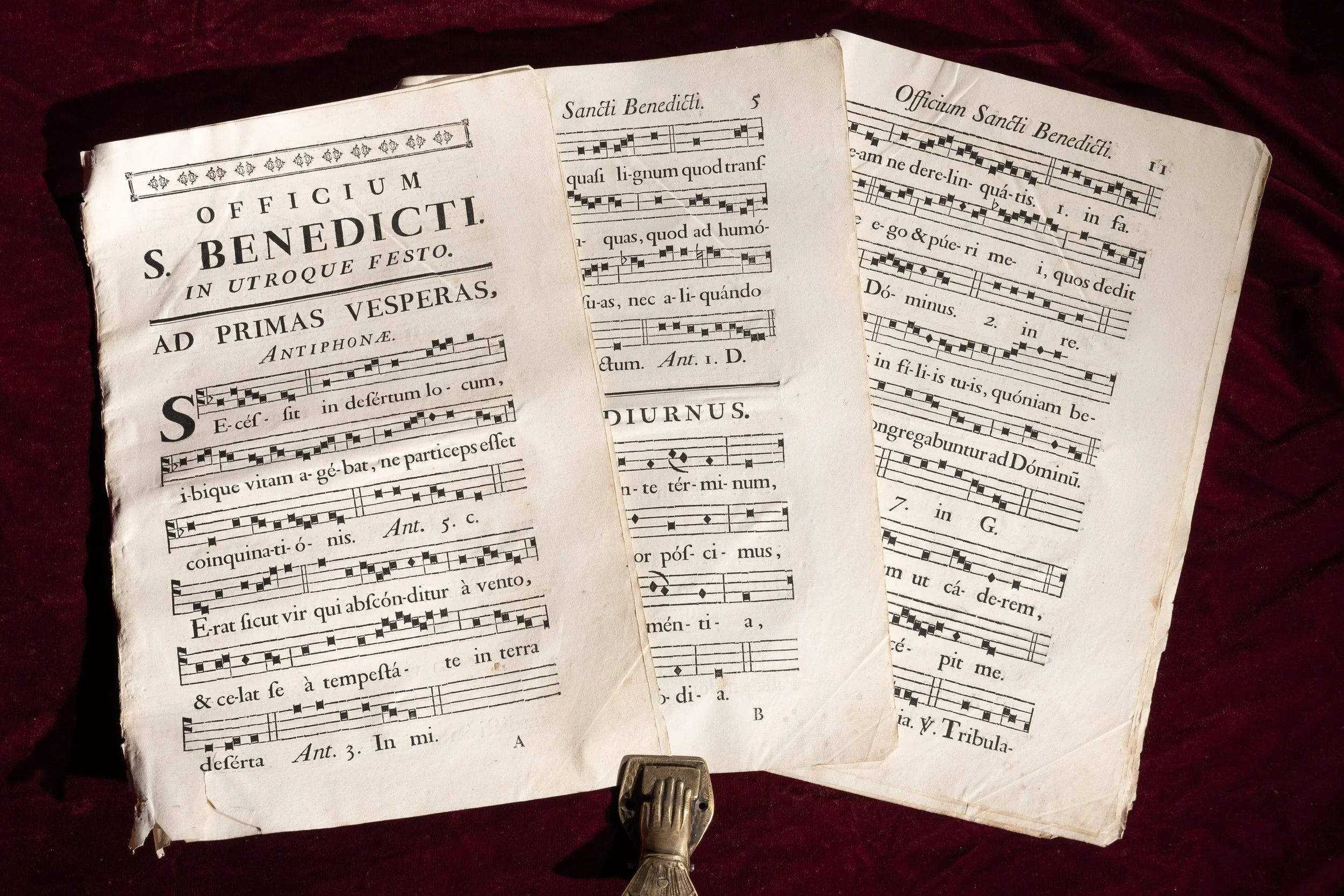 Image 1 of 6
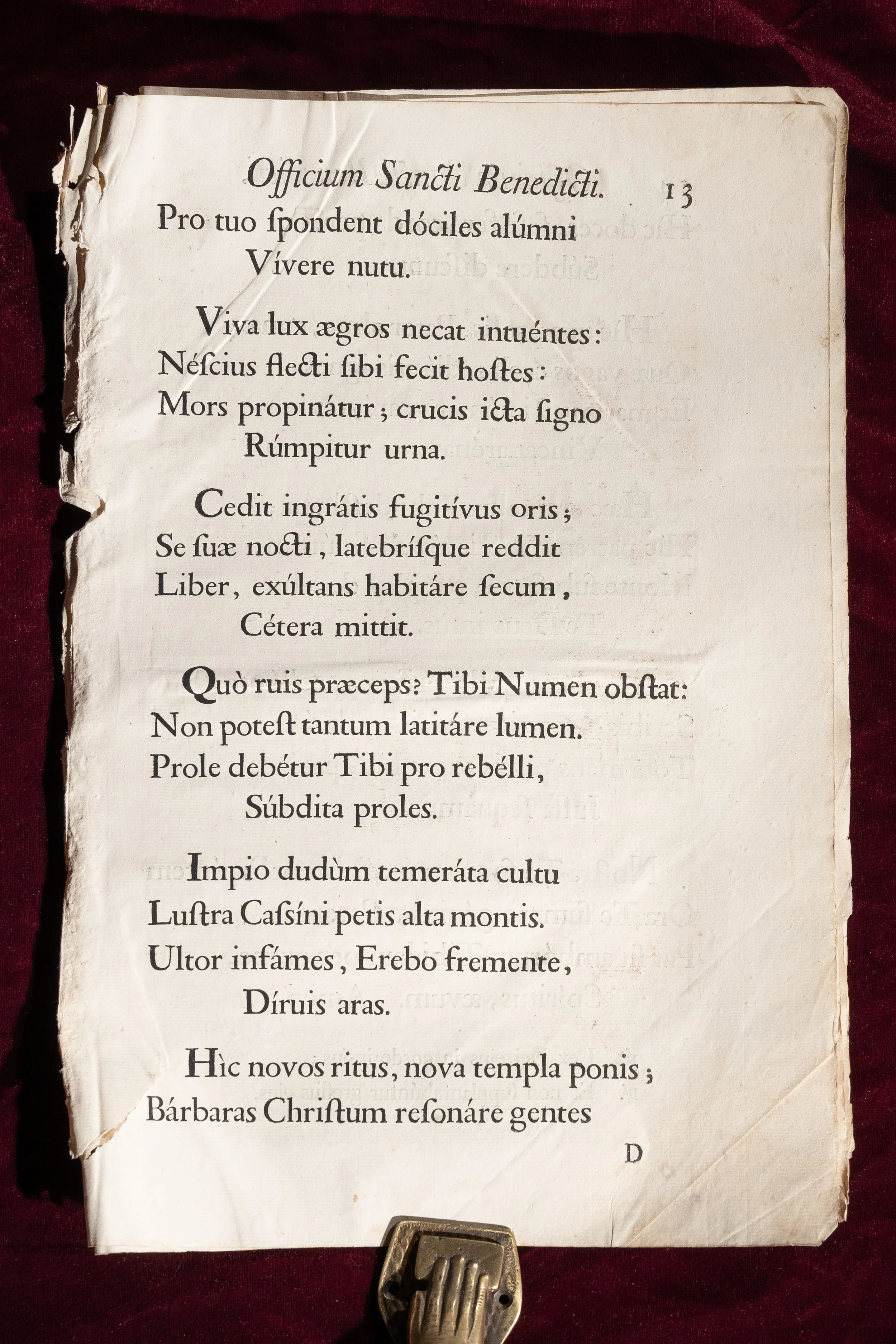 Image 2 of 6
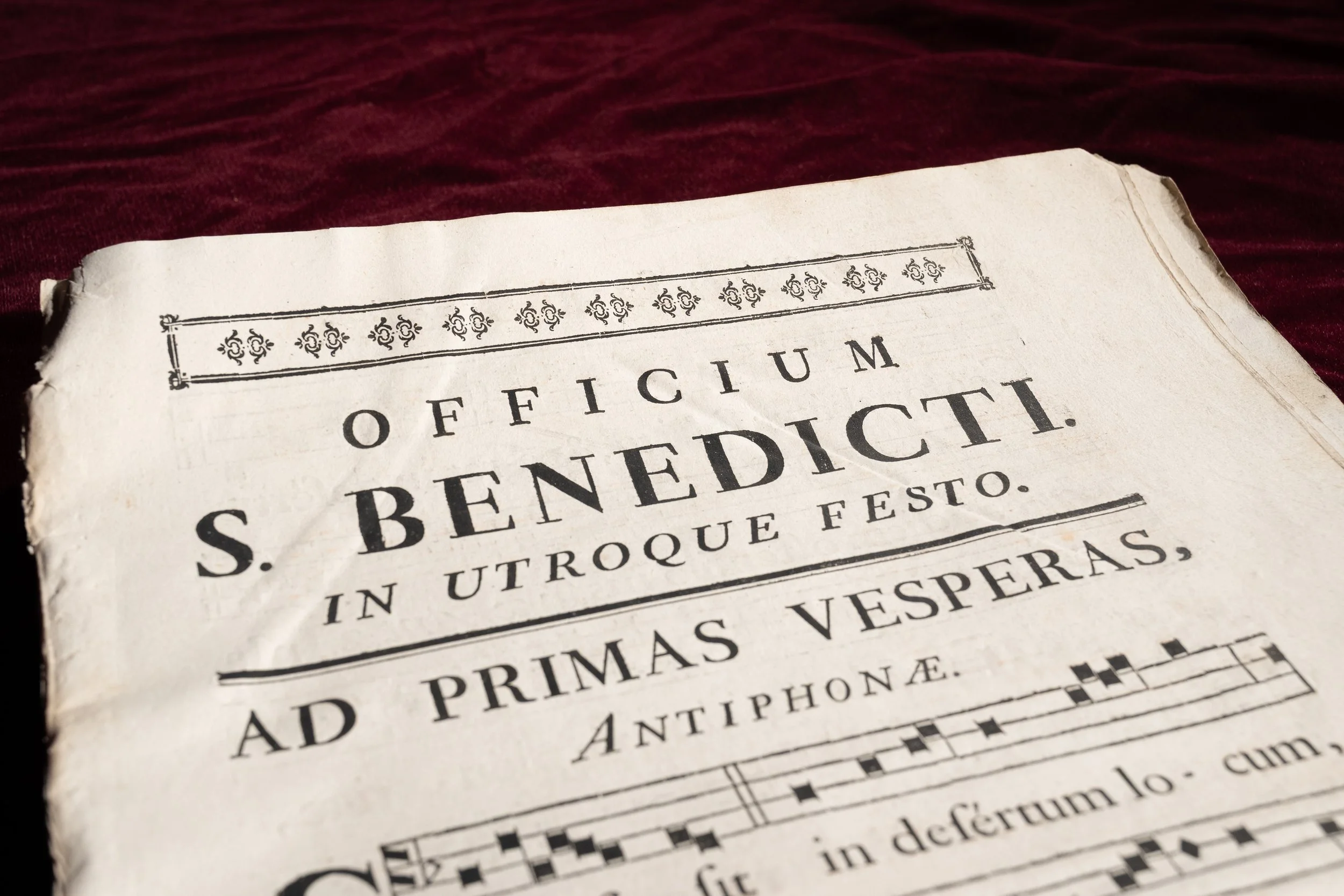 Image 3 of 6
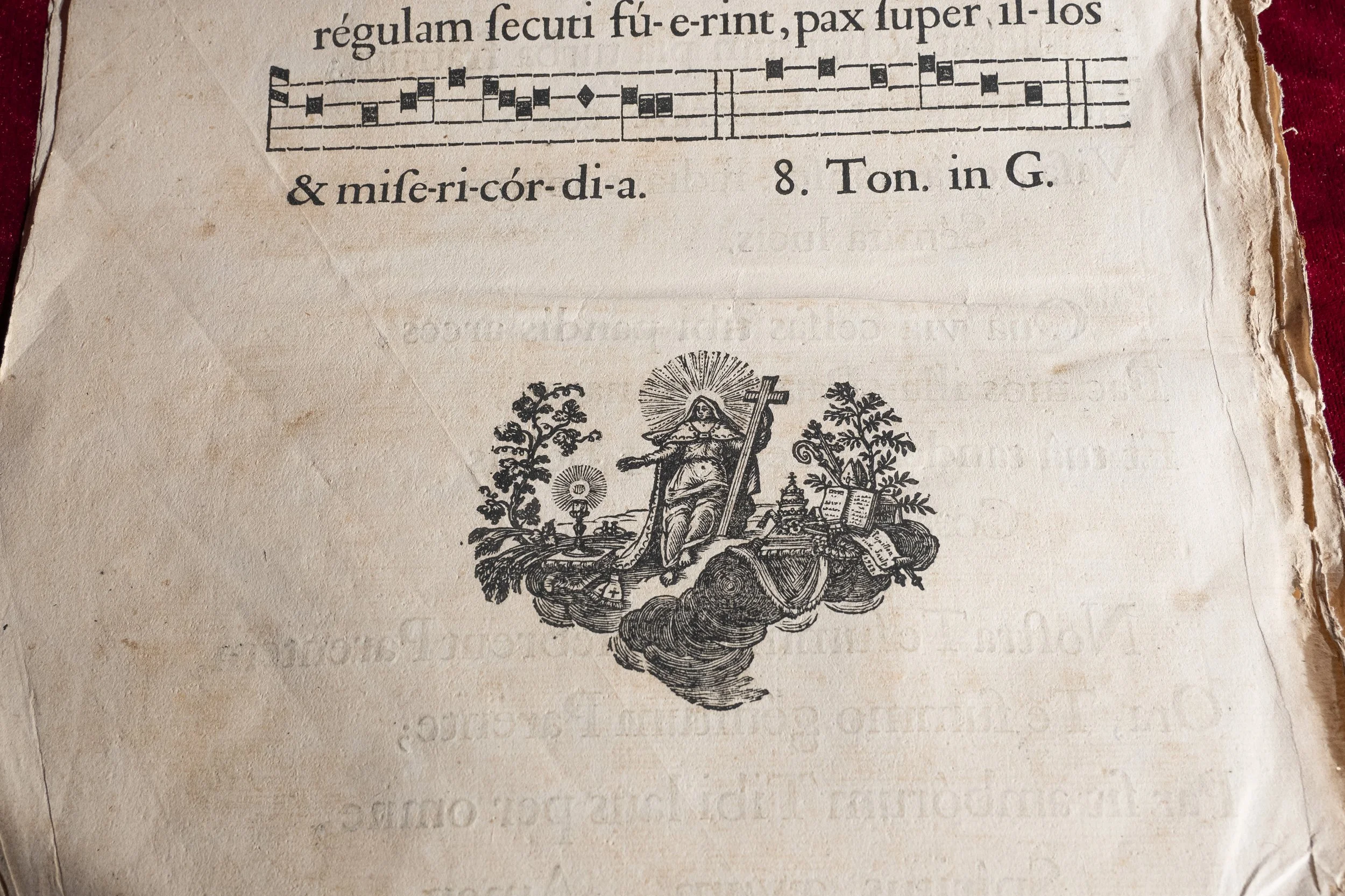 Image 4 of 6
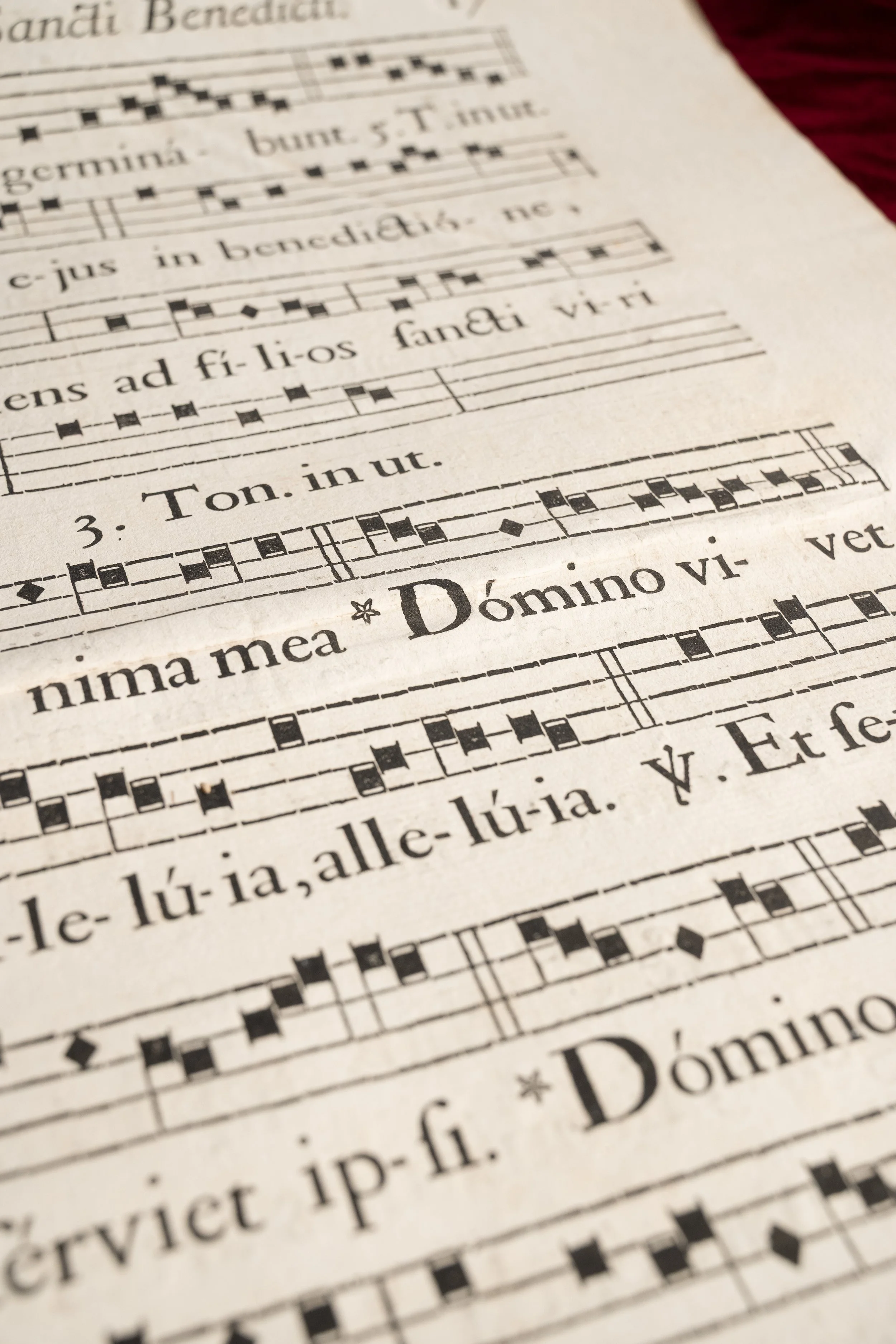 Image 5 of 6
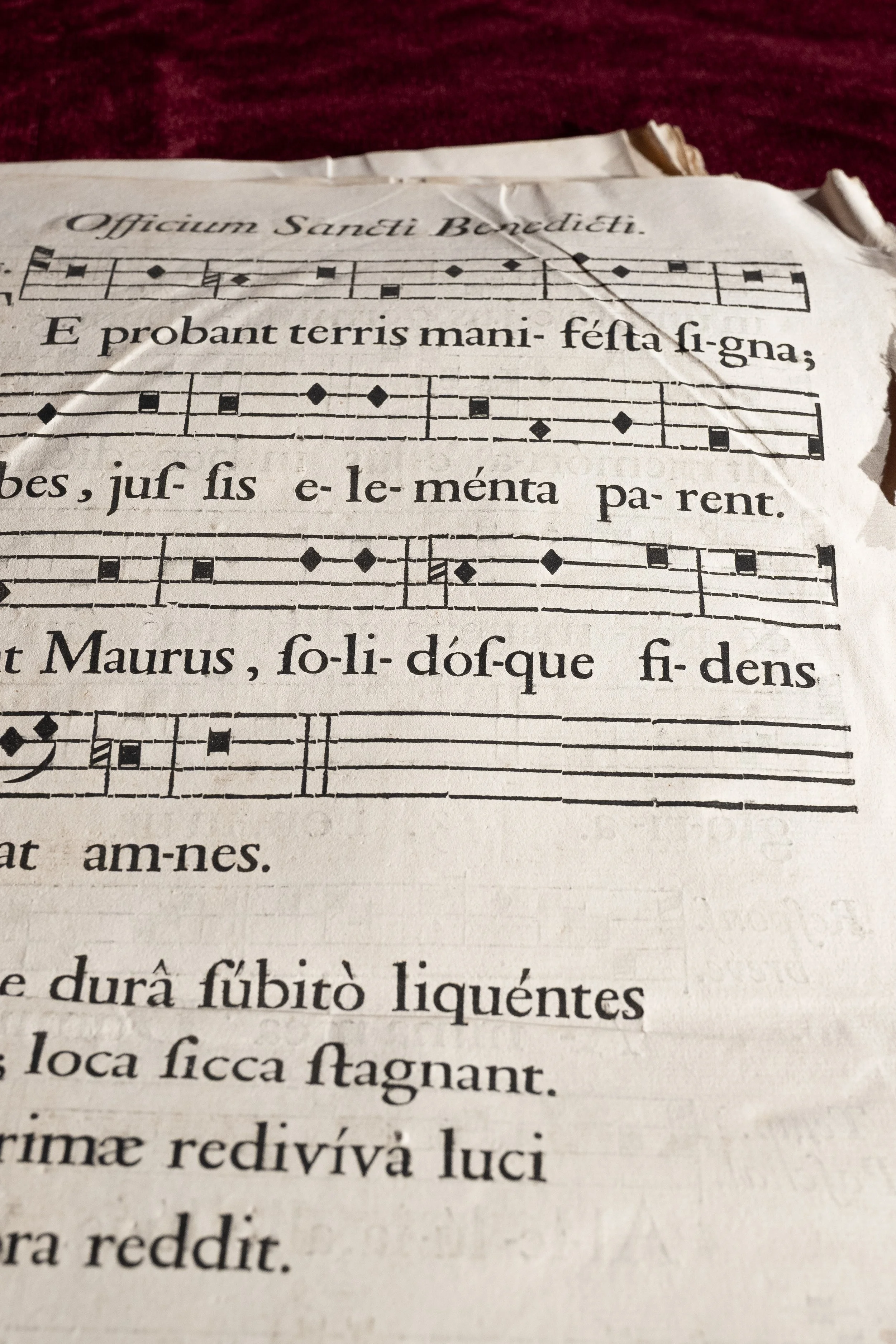 Image 6 of 6