Agrippa opens the book with a threat. In the address to the reader, printed on the first page of this very volume, he warns the idly curious and the malicious: “The door of Acheron is in this book; it speaks stones; let them beware, or it will dash out their brains.” Few books in any tradition open by threatening the reader.
Heinrich Cornelius Agrippa von Nettesheim, soldier, physician, jurist, and theologian, wrote the De occulta philosophia as the summa of Renaissance magic: three books ascending through the natural, celestial, and ceremonial worlds, gathering the sympathies of herbs and stones, the virtues of numbers and planetary seals, and the orders of angels into one system with Neoplatonic and Cabalistic foundations. This omnibus edition gives the reader everything that came to travel under the name Agrippa. Bound with the three genuine books are the spurious Fourth Book of Occult Philosophy, the ritual manual that completes the system with the actual summoning of spirits, and the Heptameron of Peter of Abano, a working handbook of the hours, angels, and conjurations of the seven days. And the printer kept going, packing in a whole library of the forbidden: the Arbatel of magic, the Ars notoria (whose heading boasts that it had never been printed before), Georg Pictorius of Villingen on goetia and on whether witches deserve the fire, Gerard of Cremona’s astronomical geomancy, and Trithemius’s letter in defense of his Steganographia. The second part swings to the other pole of Agrippa’s mind: the Declamation on the Uncertainty and Vanity of the Sciences, his great skeptical demolition of all human learning, magic included, along with seven books of his letters, his orations, a history of the double coronation of Charles V, and the epigrams of his humanist circle, where Erasmus, Reuchlin, and Melanchthon pass in review. The magician and the doubter, bound as one: this is the whole Agrippa, and for three centuries this omnibus was how working occultists encountered him.
The illustration program is the working apparatus of the art. A woodcut portrait of Agrippa in his fur collar and cap fills the verso of the title, facing his preface; the text carries the seals, characters, and number-squares of the planets; and gathered in its own section stands a suite of eight tables, four of them on folding leaves, led by the great table of the Schemhamphoras, the seventy-two angels whose names are drawn letter by letter, in Hebrew type, from three verses of Exodus. Whole grimoire traditions emanate from that one table.
The imprint is also fascinating. The title page claims Lyon, “per Beringos fratres,” a firm whose brothers were decades dead when this book was printed; no date appears anywhere. The typography points to Strasbourg and the house of Zetzner, publishers of the Theatrum chemicum, working in the early seventeenth century. Printing the most notorious book of magic in Europe evidently called for a dead firm’s name on the title page.
The copy belonged to a man well qualified to appreciate it. The front pastedown carries the printed ex libris of J. Maxwell with an autograph presentation, “affectueux souvenir,” to a fellow doctor: Joseph Maxwell (1858-1938), attorney general at the Bordeaux court of appeal and doctor of medicine, and one of France’s leading psychical researchers. Maxwell sat in the séance rooms of the Belle Époque with Eusapia Palladino and Charles Richet, published Les Phénomènes psychiques in 1903, and devoted his later years to the very tradition this volume codifies, in La Magie, La Divination, and Le Tarot. An older French hand at the head of the pastedown had already passed judgment: “Très rare et le plus estimé,” very rare, and the most esteemed. And tucked at the opening of Book One is a small relic of Maxwell’s France, a printed band from the state tobacco monopoly, pressed into service as a bookmark by some reader a century and more ago. We have left it exactly where we found it.
A thick, satisfying object in contemporary calf, the spine richly gilt in compartments, the edges sprinkled red, worn in the typical way of a book that has been owned and used. Complete two-part sets of the Opera in early bindings are keenly sought and seldom in commerce; this one, with its provenance, is the kind of book a collection gets built around.
Henrici Cornelii Agrippae ab Nettesheym Opera, in duos tomos concinne digesta. “Lyon: per Beringos fratres,” undated [Strasbourg: house of Zetzner, about 1620-1630]. Two parts in one thick small octavo, contemporary calf, spine richly gilt. The collected works: the Three Books of Occult Philosophy with the spurious Fourth Book and the Heptameron, together with the letters, orations, and declamations.
AGRIPPA VON NETTESHEIM, Heinrich Cornelius (1486-1535). Opera, in duos tomos concinne digesta. “Lyon: per Beringos fratres,” undated [Strasbourg: house of Zetzner, about 1620-1630]. The collected works, with the spurious Fourth Book, the Heptameron of Peter of Abano, the Arbatel, and the Ars notoria.
Physical Description: Two parts in one volume, small octavo (about 16 x 10 cm). [24], 694, [10]; [16], 1156 pp. Woodcut printer’s device to the titles, woodcut oval portrait of Agrippa to the verso of the first title, numerous woodcut seals, characters, and figures in the text, and a separate section of eight tables, four on folding leaves, all present, led by the table of the seventy-two angels of the Schemhamphoras in Hebrew type. Collated complete.
Binding: Contemporary calf over boards, spine richly gilt in compartments with lettered label, edges sprinkled red. Joints and spine ends worn, leather surface crackled and chipped in places, corners bumped; the structure sound, the boards firm.
Condition: Internally clean and solid, with scattered staining, some soiling and tide marks, light wear to first and last leaves. A complete copy in its contemporary binding.
Provenance: (1) Early French ink note at the head of the front pastedown, “Très rare et le plus estimé” (very rare, and the most esteemed). (2) Printed ex libris of J. Maxwell with autograph presentation inscription “à Dr. Jean, affectueux souvenir, Maxwell”: Joseph Maxwell (1858-1938), avocat général at Bordeaux, physician, and psychical researcher, author of Les Phénomènes psychiques (1903), La Magie (1922), La Divination (1927), and Le Tarot (1933). (3) French state tobacco band of about Maxwell’s period, left as a bookmark at the opening of Book I of the Occult Philosophy, preserved in place.
Agrippa opens the book with a threat. In the address to the reader, printed on the first page of this very volume, he warns the idly curious and the malicious: “The door of Acheron is in this book; it speaks stones; let them beware, or it will dash out their brains.” Few books in any tradition open by threatening the reader.
Heinrich Cornelius Agrippa von Nettesheim, soldier, physician, jurist, and theologian, wrote the De occulta philosophia as the summa of Renaissance magic: three books ascending through the natural, celestial, and ceremonial worlds, gathering the sympathies of herbs and stones, the virtues of numbers and planetary seals, and the orders of angels into one system with Neoplatonic and Cabalistic foundations. This omnibus edition gives the reader everything that came to travel under the name Agrippa. Bound with the three genuine books are the spurious Fourth Book of Occult Philosophy, the ritual manual that completes the system with the actual summoning of spirits, and the Heptameron of Peter of Abano, a working handbook of the hours, angels, and conjurations of the seven days. And the printer kept going, packing in a whole library of the forbidden: the Arbatel of magic, the Ars notoria (whose heading boasts that it had never been printed before), Georg Pictorius of Villingen on goetia and on whether witches deserve the fire, Gerard of Cremona’s astronomical geomancy, and Trithemius’s letter in defense of his Steganographia. The second part swings to the other pole of Agrippa’s mind: the Declamation on the Uncertainty and Vanity of the Sciences, his great skeptical demolition of all human learning, magic included, along with seven books of his letters, his orations, a history of the double coronation of Charles V, and the epigrams of his humanist circle, where Erasmus, Reuchlin, and Melanchthon pass in review. The magician and the doubter, bound as one: this is the whole Agrippa, and for three centuries this omnibus was how working occultists encountered him.
The illustration program is the working apparatus of the art. A woodcut portrait of Agrippa in his fur collar and cap fills the verso of the title, facing his preface; the text carries the seals, characters, and number-squares of the planets; and gathered in its own section stands a suite of eight tables, four of them on folding leaves, led by the great table of the Schemhamphoras, the seventy-two angels whose names are drawn letter by letter, in Hebrew type, from three verses of Exodus. Whole grimoire traditions emanate from that one table.
The imprint is also fascinating. The title page claims Lyon, “per Beringos fratres,” a firm whose brothers were decades dead when this book was printed; no date appears anywhere. The typography points to Strasbourg and the house of Zetzner, publishers of the Theatrum chemicum, working in the early seventeenth century. Printing the most notorious book of magic in Europe evidently called for a dead firm’s name on the title page.
The copy belonged to a man well qualified to appreciate it. The front pastedown carries the printed ex libris of J. Maxwell with an autograph presentation, “affectueux souvenir,” to a fellow doctor: Joseph Maxwell (1858-1938), attorney general at the Bordeaux court of appeal and doctor of medicine, and one of France’s leading psychical researchers. Maxwell sat in the séance rooms of the Belle Époque with Eusapia Palladino and Charles Richet, published Les Phénomènes psychiques in 1903, and devoted his later years to the very tradition this volume codifies, in La Magie, La Divination, and Le Tarot. An older French hand at the head of the pastedown had already passed judgment: “Très rare et le plus estimé,” very rare, and the most esteemed. And tucked at the opening of Book One is a small relic of Maxwell’s France, a printed band from the state tobacco monopoly, pressed into service as a bookmark by some reader a century and more ago. We have left it exactly where we found it.
A thick, satisfying object in contemporary calf, the spine richly gilt in compartments, the edges sprinkled red, worn in the typical way of a book that has been owned and used. Complete two-part sets of the Opera in early bindings are keenly sought and seldom in commerce; this one, with its provenance, is the kind of book a collection gets built around.
Henrici Cornelii Agrippae ab Nettesheym Opera, in duos tomos concinne digesta. “Lyon: per Beringos fratres,” undated [Strasbourg: house of Zetzner, about 1620-1630]. Two parts in one thick small octavo, contemporary calf, spine richly gilt. The collected works: the Three Books of Occult Philosophy with the spurious Fourth Book and the Heptameron, together with the letters, orations, and declamations.
AGRIPPA VON NETTESHEIM, Heinrich Cornelius (1486-1535). Opera, in duos tomos concinne digesta. “Lyon: per Beringos fratres,” undated [Strasbourg: house of Zetzner, about 1620-1630]. The collected works, with the spurious Fourth Book, the Heptameron of Peter of Abano, the Arbatel, and the Ars notoria.
Physical Description: Two parts in one volume, small octavo (about 16 x 10 cm). [24], 694, [10]; [16], 1156 pp. Woodcut printer’s device to the titles, woodcut oval portrait of Agrippa to the verso of the first title, numerous woodcut seals, characters, and figures in the text, and a separate section of eight tables, four on folding leaves, all present, led by the table of the seventy-two angels of the Schemhamphoras in Hebrew type. Collated complete.
Binding: Contemporary calf over boards, spine richly gilt in compartments with lettered label, edges sprinkled red. Joints and spine ends worn, leather surface crackled and chipped in places, corners bumped; the structure sound, the boards firm.
Condition: Internally clean and solid, with scattered staining, some soiling and tide marks, light wear to first and last leaves. A complete copy in its contemporary binding.
Provenance: (1) Early French ink note at the head of the front pastedown, “Très rare et le plus estimé” (very rare, and the most esteemed). (2) Printed ex libris of J. Maxwell with autograph presentation inscription “à Dr. Jean, affectueux souvenir, Maxwell”: Joseph Maxwell (1858-1938), avocat général at Bordeaux, physician, and psychical researcher, author of Les Phénomènes psychiques (1903), La Magie (1922), La Divination (1927), and Le Tarot (1933). (3) French state tobacco band of about Maxwell’s period, left as a bookmark at the opening of Book I of the Occult Philosophy, preserved in place.

 Image 1 of 58
 Image 2 of 58
 Image 3 of 58
 Image 4 of 58
 Image 5 of 58
 Image 6 of 58
 Image 7 of 58
 Image 8 of 58
 Image 9 of 58
 Image 10 of 58
 Image 11 of 58
 Image 12 of 58
 Image 13 of 58
 Image 14 of 58
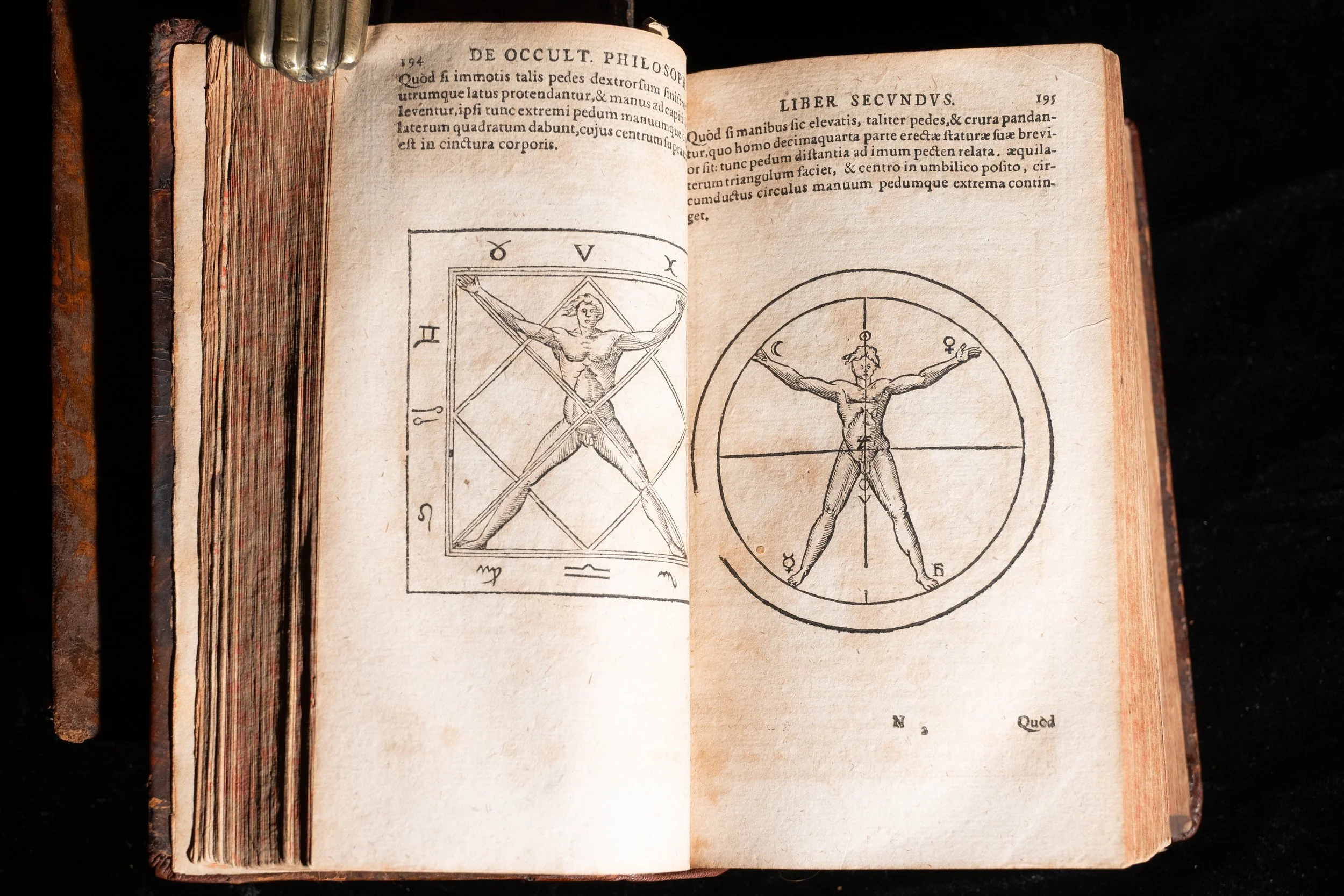 Image 15 of 58
 Image 16 of 58
 Image 17 of 58
 Image 18 of 58
 Image 19 of 58
 Image 20 of 58
 Image 21 of 58
 Image 22 of 58
 Image 23 of 58
 Image 24 of 58
 Image 25 of 58
 Image 26 of 58
 Image 27 of 58
 Image 28 of 58
 Image 29 of 58
 Image 30 of 58
 Image 31 of 58
 Image 32 of 58
 Image 33 of 58
 Image 34 of 58
 Image 35 of 58
 Image 36 of 58
 Image 37 of 58
 Image 38 of 58
 Image 39 of 58
 Image 40 of 58
 Image 41 of 58
 Image 42 of 58
 Image 43 of 58
 Image 44 of 58
 Image 45 of 58
 Image 46 of 58
 Image 47 of 58
 Image 48 of 58
 Image 49 of 58
 Image 50 of 58
 Image 51 of 58
 Image 52 of 58
 Image 53 of 58
 Image 54 of 58
 Image 55 of 58
 Image 56 of 58
 Image 57 of 58
 Image 58 of 58