
 Image 1 of 2
 Image 2 of 2
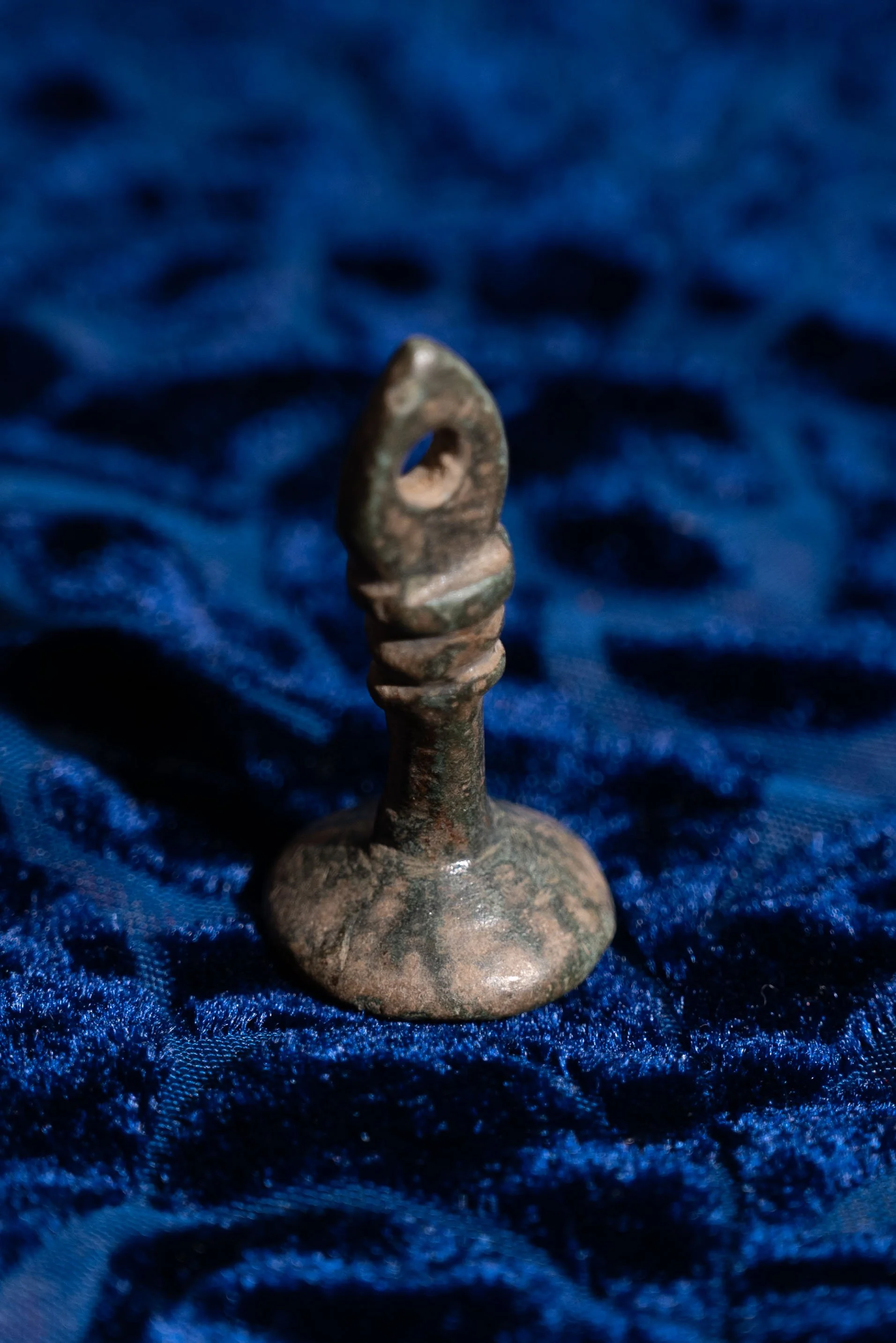
This medieval bronze signet pendant features the hexagram, the so-called Seal of Solomon, inscribed within a circle and surrounded by decorative points. Signet pendants of this kind served a practical function in the medieval world: worn around the neck and pressed into wax, they acted as a portable signature for merchants, minor officials, and others who needed to authenticate documents but did not possess a formal seal matrix. Of course, given the Solomonic imagery, one cannot entirely rule out that its owner had other signings in mind.
The hexagram's association with King Solomon derives primarily from the medieval magical tradition, in which Solomon was understood to have commanded demons by means of a sacred seal granted to him by God. This tradition is attested across a remarkable range of texts: the Greek Testament of Solomon (likely 1st–5th century CE), the various recensions of the Clavicula Salomonis (Key of Solomon) circulating from the 14th century onward, and later compilations such as the Lemegeton (Lesser Key of Solomon). The hexagram also appears as a figure of considerable cosmological significance in Heinrich Cornelius Agrippa's De Occulta Philosophia (1533), where it is associated with planetary and elemental harmonies. On the architectural side, hexagrams appear carved into medieval churches and civic buildings across Europe, where they likely served an apotropaic function, warding off evil rather than summoning it.
The hexagram's now-familiar identification as the Magen David, the symbol of Jewish communal identity, is a related but distinct development. While the figure appears in Jewish decorative contexts from late antiquity onward, its adoption as an emblem of Jewish communities gained particular momentum in the later medieval period. The Jewish community of Prague adopted it for their communal flag in the 15th century, and it appears in both Ashkenazi and Sephardic contexts well before its 19th-century consolidation as the symbol of Judaism. The overlap between the Solomonic magical tradition and Jewish self-identification through Solomon is no coincidence, but the two histories should not be collapsed into one.
The present pendant is difficult to date with precision. Bronze signet pendants of this general type were produced across a broad span of the medieval and early modern periods, and without secure provenance or associated finds, a tentative range of the 12th through 16th centuries is the most that can responsibly be offered.
Physical Description: Medieval bronze signet pendant featuring hexagram (Seal of Solomon) within circle with decorative points. 14.32 g | 36.8 × 18.4 × 17.2 mm.
This medieval bronze signet pendant features the hexagram, the so-called Seal of Solomon, inscribed within a circle and surrounded by decorative points. Signet pendants of this kind served a practical function in the medieval world: worn around the neck and pressed into wax, they acted as a portable signature for merchants, minor officials, and others who needed to authenticate documents but did not possess a formal seal matrix. Of course, given the Solomonic imagery, one cannot entirely rule out that its owner had other signings in mind.
The hexagram's association with King Solomon derives primarily from the medieval magical tradition, in which Solomon was understood to have commanded demons by means of a sacred seal granted to him by God. This tradition is attested across a remarkable range of texts: the Greek Testament of Solomon (likely 1st–5th century CE), the various recensions of the Clavicula Salomonis (Key of Solomon) circulating from the 14th century onward, and later compilations such as the Lemegeton (Lesser Key of Solomon). The hexagram also appears as a figure of considerable cosmological significance in Heinrich Cornelius Agrippa's De Occulta Philosophia (1533), where it is associated with planetary and elemental harmonies. On the architectural side, hexagrams appear carved into medieval churches and civic buildings across Europe, where they likely served an apotropaic function, warding off evil rather than summoning it.
The hexagram's now-familiar identification as the Magen David, the symbol of Jewish communal identity, is a related but distinct development. While the figure appears in Jewish decorative contexts from late antiquity onward, its adoption as an emblem of Jewish communities gained particular momentum in the later medieval period. The Jewish community of Prague adopted it for their communal flag in the 15th century, and it appears in both Ashkenazi and Sephardic contexts well before its 19th-century consolidation as the symbol of Judaism. The overlap between the Solomonic magical tradition and Jewish self-identification through Solomon is no coincidence, but the two histories should not be collapsed into one.
The present pendant is difficult to date with precision. Bronze signet pendants of this general type were produced across a broad span of the medieval and early modern periods, and without secure provenance or associated finds, a tentative range of the 12th through 16th centuries is the most that can responsibly be offered.
Physical Description: Medieval bronze signet pendant featuring hexagram (Seal of Solomon) within circle with decorative points. 14.32 g | 36.8 × 18.4 × 17.2 mm.