A complete wartime-era Tarocco Piemontese, printed by a short-lived imprint during the final years of the Second World War and not sold until the Italian Republic had replaced the monarchy. The deck belongs to the standard Piemontese pattern (IPCS Pattern Sheet 4, originally classified IT-1.211), which emerged in the early nineteenth century as Piedmontese cardmakers gradually shed the French influences that had pervaded Italian tarot production since the eighteenth century. By the time this deck was printed, the Tarocco Piemontese was already the dominant 78-card pattern in northern Italy, having outlasted its Milanese and Bolognese competitors.
The firm of Masenghini, based in Bergamo, was one of the principal manufacturers of Italian playing cards and tarot decks from the late nineteenth century onward. The present deck bears the imprint “Masenghini di R. Lombardini,” a designation used only during 1944–1945, placing the production squarely in the chaotic final phase of the war in northern Italy. That the deck was not sold until October 1949, as the date stamp on the Ace of Coins attests, suggests either warehoused stock or the disruptions of the postwar transition. The tax stamp (Regno d’Italia, Lire 100) belongs to the type used between 1949 and 1954, a small irony, as the Kingdom of Italy had formally ceased to exist in 1946, but the old stamps evidently remained in bureaucratic circulation.
The Piemontese pattern is distinguished by its double-ended court cards and trumps, Italian-language inscriptions running vertically along the card edges, Arabic numeral indices, and the characteristic interlacing of Swords and Batons in the pip cards. The deck was designed primarily for play, games such as Scarto, Mitigati, and Chiamare il Re remain popular in Piedmont and Turin. The tarot’s origins lie in card games, not cartomancy, and this is a working game deck from the tradition that gave the tarot its name. That said, the Piemontese pattern preserves the full complement of 22 trumps with their traditional iconography: L’Angelo, Il Sole, La Luna, Le Stelle, La Torre, La Morte, the whole eschatological and cosmological programme that Court de Gébelin and his successors would transform into a system of esoteric correspondence. The deck is thus a primary document for the material culture of tarot as it actually existed in everyday Italian life, before and alongside its appropriation by occultists.
The survival of a complete 78-card deck in its original box, with identifiable production and sale dates and a locatable retail provenance, makes this a particularly well-documented example. Mid-twentieth-century Italian game decks were treated as consumable goods and discarded after use; complete examples with original packaging from the wartime period are not frequently encountered.
References: S. Kaplan, The Encyclopedia of Tarot, vol. I (U.S. Games Systems, 1978), p. 263; K. Wowk, Playing Cards of the World (Lutterworth Press, 1983), pp. 133–136; S. Mann, Collecting Playing Cards (Arco Publications, 1966), pp. 31–34, 52. IPCS Pattern Sheet 4.
Tarocco Piemontese da 78 carte.
Bergamo: Masenghini di R. Lombardini, [1944–45]; sold October 1949.
Physical Description: 78 cards complete (105 × 63 mm), chromolithographically printed in colour on card stock with linen texture (“telate”). Double-ended trumps and court cards. Italian suits: Spade (Swords), Bastoni (Batons), Coppe (Cups), Denari (Coins). 56 suit cards (four court figures per suit: King, Queen, Knight, Valet; ten numeral cards), plus 21 numbered trumps (I–XXI) and Il Matto (The Fool), numbered 0. Backs with a geometric plaid pattern in red and black on cream stock; rounded corners.
Box: Original printed cardboard box, labelled “Tarocco Piemontese da 78 carte – N. 52 – Masenghini di R. Lombardini.” Front bears the designation “telate” (linen-textured). Reverse printed in red with Trump XVI, La Torre. A retailer’s sticker from a Genoese stationery shop (Vincenzo [?], Libri, Cartoleria, Articoli, Regalo, Legatoria, via [?] 155, Genova, Telef. 54326) is affixed to the front, partially obscuring the publisher’s imprint.
Condition: Cards slightly warped from handling but overall in very good condition, with strong colour and clean surfaces. Box complete and well preserved, with some wear to edges and corners consistent with age; minor losses to cardboard at extremities.
Provenance: Tax stamp: Regno d’Italia, Lire 100 (type in use 1949–1954). Date stamp: “Ott. 1949” on the Ace of Coins, indicating sale four years after production. Retailer’s sticker from a stationery and bookshop in Genova.
A complete wartime-era Tarocco Piemontese, printed by a short-lived imprint during the final years of the Second World War and not sold until the Italian Republic had replaced the monarchy. The deck belongs to the standard Piemontese pattern (IPCS Pattern Sheet 4, originally classified IT-1.211), which emerged in the early nineteenth century as Piedmontese cardmakers gradually shed the French influences that had pervaded Italian tarot production since the eighteenth century. By the time this deck was printed, the Tarocco Piemontese was already the dominant 78-card pattern in northern Italy, having outlasted its Milanese and Bolognese competitors.
The firm of Masenghini, based in Bergamo, was one of the principal manufacturers of Italian playing cards and tarot decks from the late nineteenth century onward. The present deck bears the imprint “Masenghini di R. Lombardini,” a designation used only during 1944–1945, placing the production squarely in the chaotic final phase of the war in northern Italy. That the deck was not sold until October 1949, as the date stamp on the Ace of Coins attests, suggests either warehoused stock or the disruptions of the postwar transition. The tax stamp (Regno d’Italia, Lire 100) belongs to the type used between 1949 and 1954, a small irony, as the Kingdom of Italy had formally ceased to exist in 1946, but the old stamps evidently remained in bureaucratic circulation.
The Piemontese pattern is distinguished by its double-ended court cards and trumps, Italian-language inscriptions running vertically along the card edges, Arabic numeral indices, and the characteristic interlacing of Swords and Batons in the pip cards. The deck was designed primarily for play, games such as Scarto, Mitigati, and Chiamare il Re remain popular in Piedmont and Turin. The tarot’s origins lie in card games, not cartomancy, and this is a working game deck from the tradition that gave the tarot its name. That said, the Piemontese pattern preserves the full complement of 22 trumps with their traditional iconography: L’Angelo, Il Sole, La Luna, Le Stelle, La Torre, La Morte, the whole eschatological and cosmological programme that Court de Gébelin and his successors would transform into a system of esoteric correspondence. The deck is thus a primary document for the material culture of tarot as it actually existed in everyday Italian life, before and alongside its appropriation by occultists.
The survival of a complete 78-card deck in its original box, with identifiable production and sale dates and a locatable retail provenance, makes this a particularly well-documented example. Mid-twentieth-century Italian game decks were treated as consumable goods and discarded after use; complete examples with original packaging from the wartime period are not frequently encountered.
References: S. Kaplan, The Encyclopedia of Tarot, vol. I (U.S. Games Systems, 1978), p. 263; K. Wowk, Playing Cards of the World (Lutterworth Press, 1983), pp. 133–136; S. Mann, Collecting Playing Cards (Arco Publications, 1966), pp. 31–34, 52. IPCS Pattern Sheet 4.
Tarocco Piemontese da 78 carte.
Bergamo: Masenghini di R. Lombardini, [1944–45]; sold October 1949.
Physical Description: 78 cards complete (105 × 63 mm), chromolithographically printed in colour on card stock with linen texture (“telate”). Double-ended trumps and court cards. Italian suits: Spade (Swords), Bastoni (Batons), Coppe (Cups), Denari (Coins). 56 suit cards (four court figures per suit: King, Queen, Knight, Valet; ten numeral cards), plus 21 numbered trumps (I–XXI) and Il Matto (The Fool), numbered 0. Backs with a geometric plaid pattern in red and black on cream stock; rounded corners.
Box: Original printed cardboard box, labelled “Tarocco Piemontese da 78 carte – N. 52 – Masenghini di R. Lombardini.” Front bears the designation “telate” (linen-textured). Reverse printed in red with Trump XVI, La Torre. A retailer’s sticker from a Genoese stationery shop (Vincenzo [?], Libri, Cartoleria, Articoli, Regalo, Legatoria, via [?] 155, Genova, Telef. 54326) is affixed to the front, partially obscuring the publisher’s imprint.
Condition: Cards slightly warped from handling but overall in very good condition, with strong colour and clean surfaces. Box complete and well preserved, with some wear to edges and corners consistent with age; minor losses to cardboard at extremities.
Provenance: Tax stamp: Regno d’Italia, Lire 100 (type in use 1949–1954). Date stamp: “Ott. 1949” on the Ace of Coins, indicating sale four years after production. Retailer’s sticker from a stationery and bookshop in Genova.

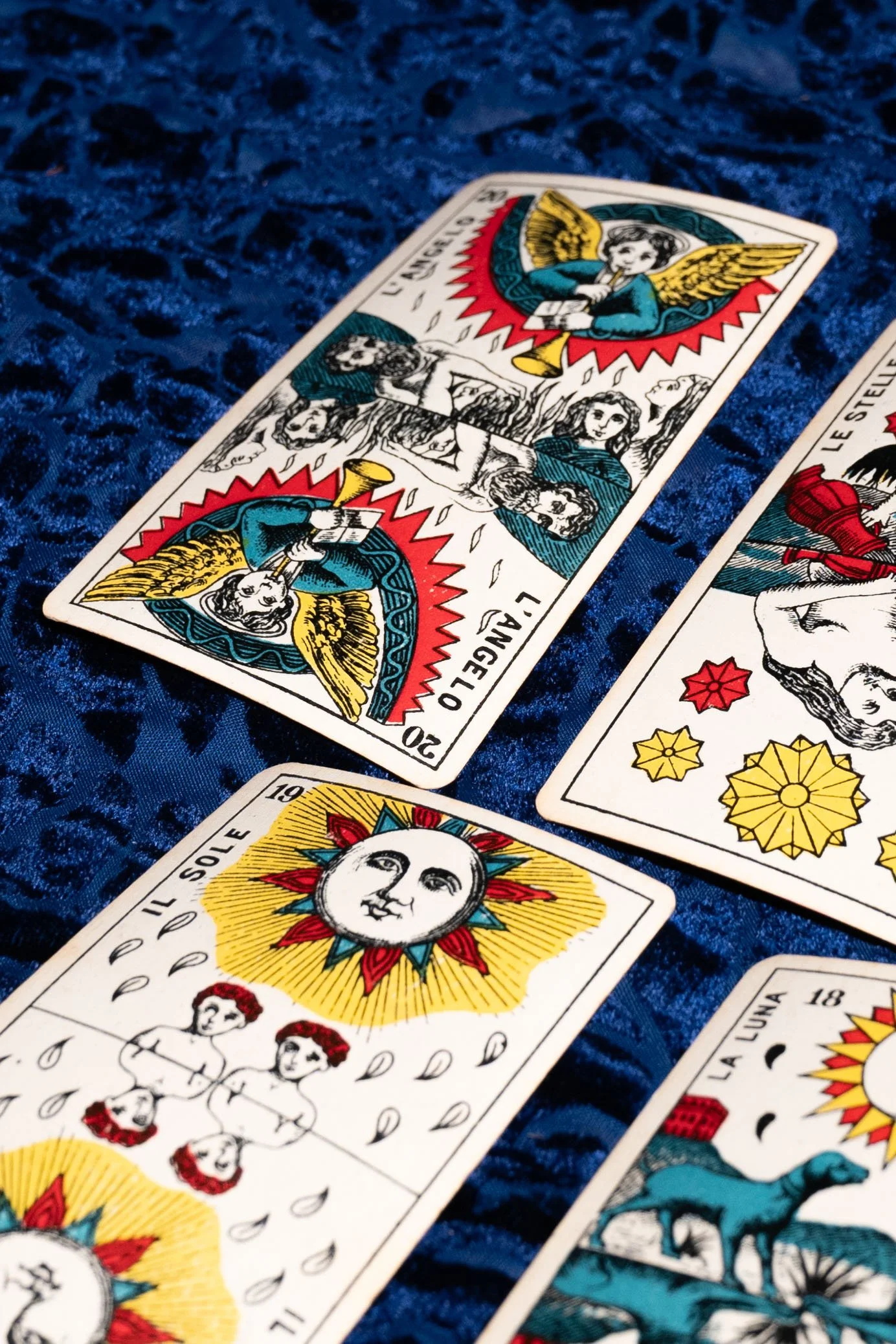 Image 1 of 6
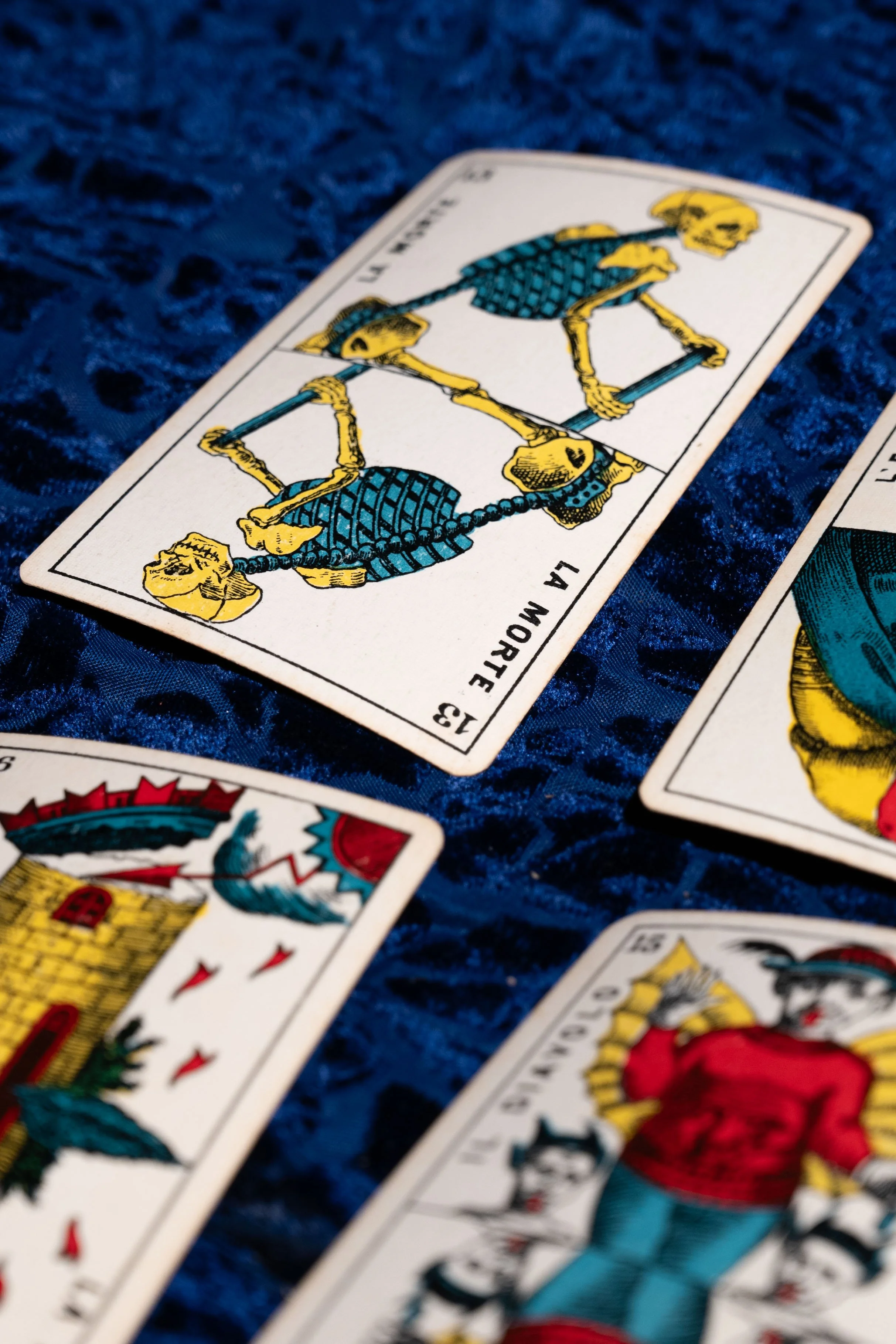 Image 2 of 6
 Image 3 of 6
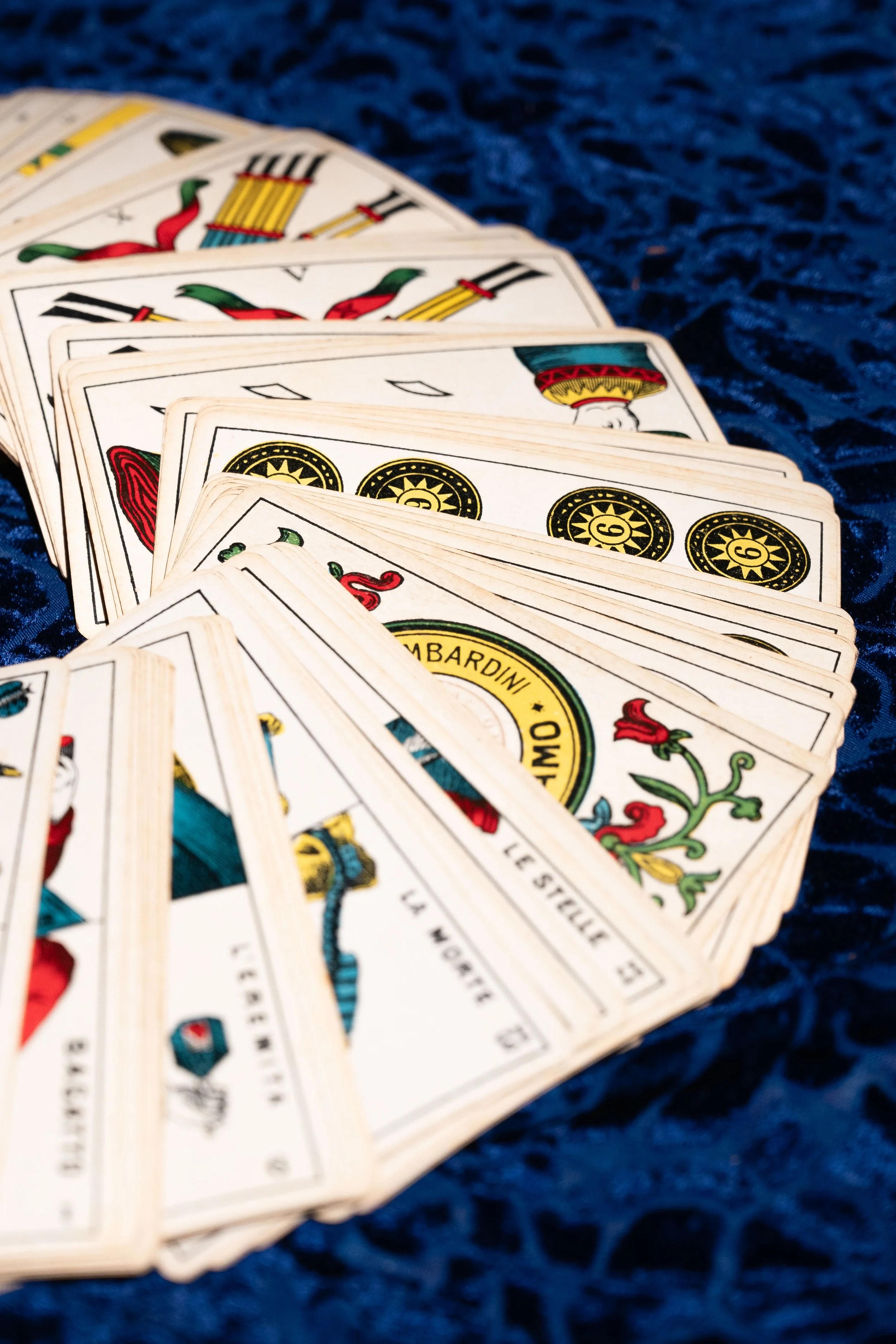 Image 4 of 6
 Image 5 of 6
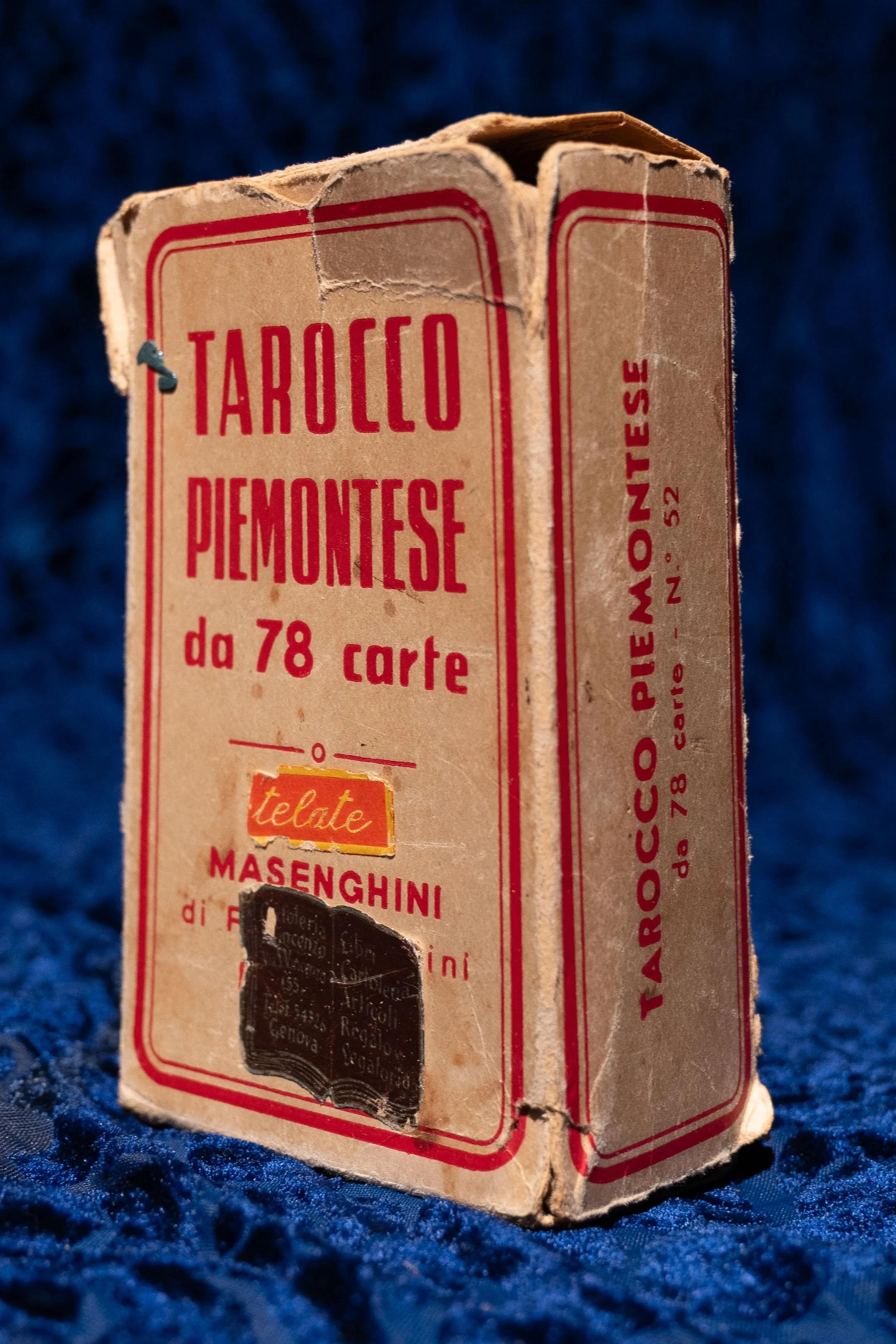 Image 6 of 6