
 Image 1 of 2
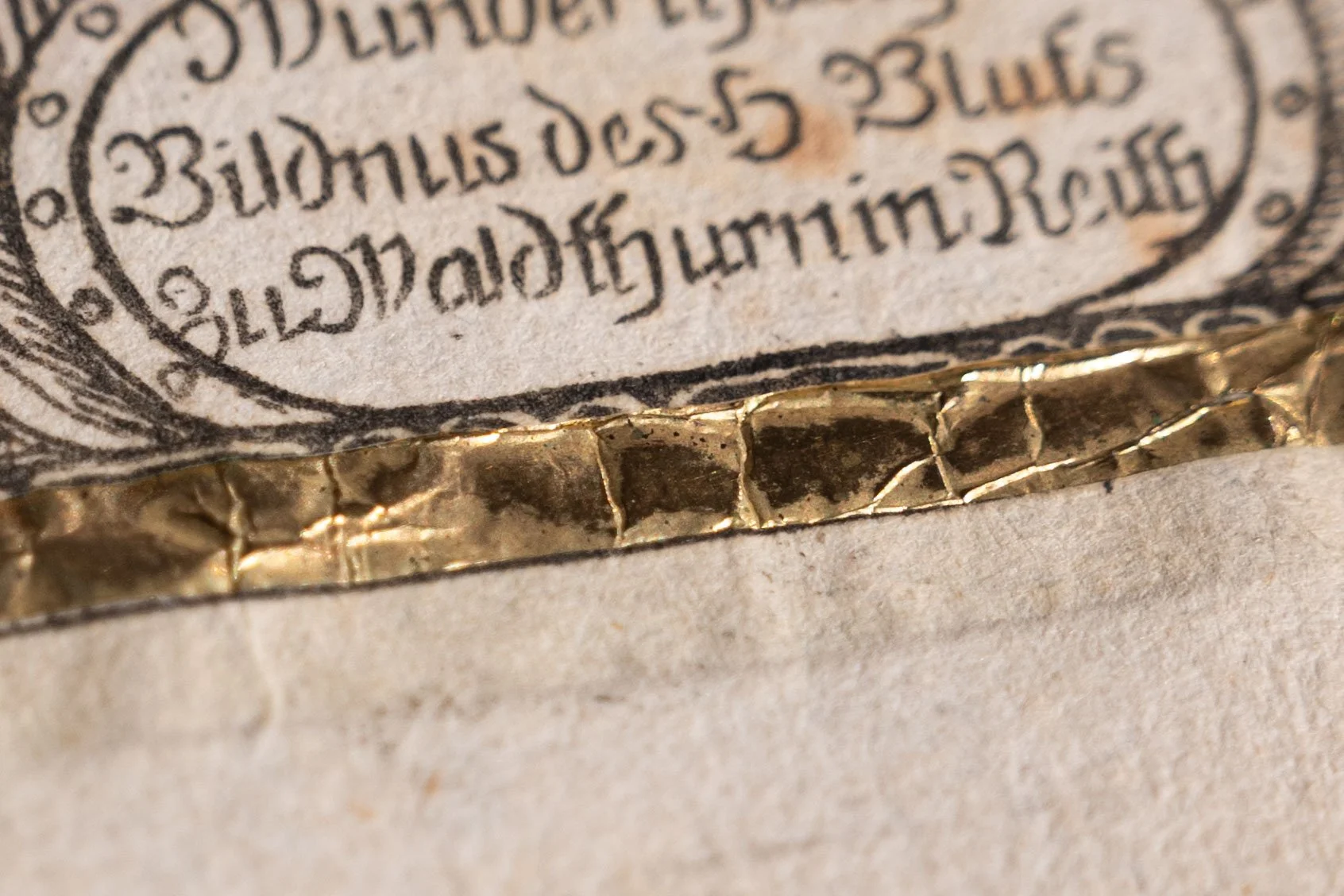 Image 2 of 2
This is a charming and genuinely rare survival: an eighteenth-century foil-enhanced pilgrimage print commemorating one of the most important Eucharistic miracle cults in German-speaking Europe. Such prints, combining line engraving with applied metallic foils in copper, gold, blue, and green, belong to a distinct tradition of devotional image-making that flourished in Southern Germany (and to a lesser extent Antwerp) during the seventeenth and eighteenth centuries. As the Metropolitan Museum notes of comparable objects in its collection, these "devotional assemblages" were typically produced by professional workshops, not amateur practitioners, and were designed to stimulate spiritual devotion through their alluring optical and tactile qualities. The application of metallic foils to the sacred image transforms the flat engraving into something more closely resembling the precious reliquaries and altarpieces the pilgrim would have encountered at the shrine itself, a portable echo of the cult site.
The Blutwunder (Blood Wonder) of Walldürn is among the oldest and most enduring Eucharistic miracle cults in Germany. According to the account first published by the Walldürn pastor Jost Hoffius in 1589, the miracle occurred in 1330, during a Mass celebrated by the priest Heinrich Otto. After the consecration, Otto accidentally overturned the chalice containing the Precious Blood. The consecrated wine spilled onto the corporal (the linen cloth covering the altar) and miraculously formed the image of the crucified Christ surrounded by eleven heads of Christ crowned with thorns, the so-called Veronicae, evoking the Veil of Veronica. Terrified, Otto concealed the cloth behind a stone in the altar, revealing its hiding place only on his deathbed some fifty years later. The discovery of the corporal inaugurated a pilgrimage that was formally recognized by the Bishop of Würzburg in 1408, authenticated by Pope Eugene IV in 1445 (who granted an indulgence after personally examining the cloth in Rome), and elevated by Pope Urban VIII in 1624. The pilgrimage survived both the Reformation and an official prohibition from 1805 to 1853, and the Walldürn basilica remains to this day the largest Eucharistic pilgrimage site in Germany, drawing over 100,000 pilgrims annually.
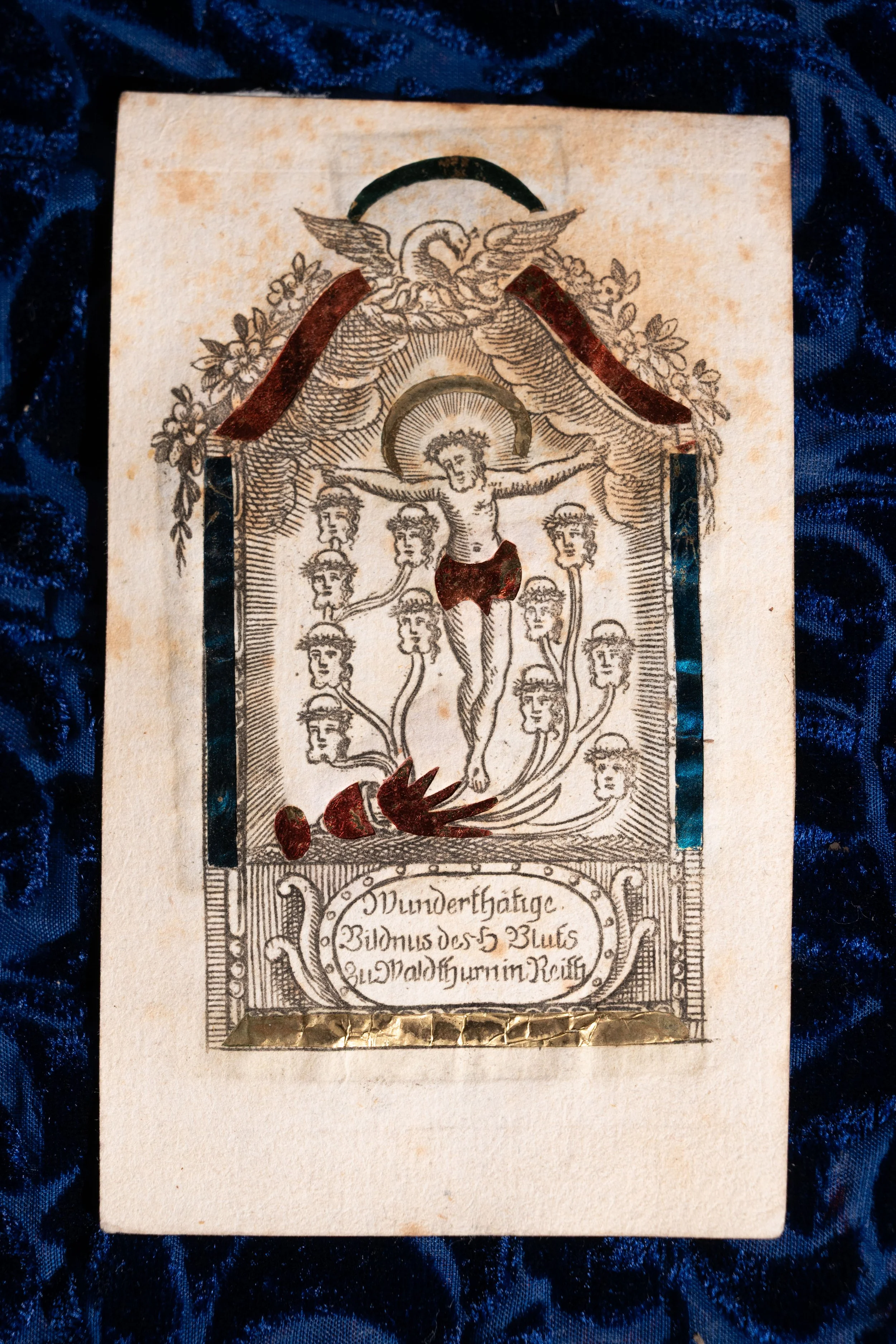
The present print reproduces the canonical iconography of the miracle with considerable fidelity: the crucified Christ at center with radiate nimbus, the eleven Veronicae distributed around him, the whole enclosed within an architectural frame suggesting the shrine itself. The title identifies the subject as "Waldthurn in Reith", an older regional orthography for Walldürn that is itself of bibliographic interest, suggesting a production context at some distance from the pilgrimage center, possibly in Bavaria or the Upper Palatinate, where the spelling "Waldthurn" was current.
Objects of this type, small-format, foil-enhanced devotional prints produced for pilgrims and the popular market, survive in far smaller numbers than one might expect. Their fragility (thin paper, delicate applied foils), their function as objects of active devotion (handled, kissed, pinned to walls, tucked into prayer books), and their low material value in the eyes of later collectors all conspire against preservation. The present example is described by the previous owner as unrecorded, and we have been unable to locate another example of this specific print in the standard literature or institutional databases.
A remarkable object at the intersection of popular devotion, printmaking history, and the material culture of pilgrimage.
[CATHOLIC DEVOTIONAL] [PILGRIMAGE EPHEMERA] [EUCHARISTIC MIRACLE] [FOLK ART]
[Metal foil devotional print]. Wunderthätige Bildnus des H Bluts zu Waldthurn in Reith. [Southern Germany]: s.n., [18th century].
Description: Single-sheet engraved devotional print with applied metallic foil embellishments, approximately 3X5 inches. Copper-plate engraving on laid paper depicting the miraculous Blutwunder (Blood Wonder) of Walldürn: the crucified Christ at center, surrounded by eleven crowned heads of Christ arranged symmetrically, reproducing the legendary image said to have appeared on the corporal in 1330. The composition is framed within an architectural border with lateral columns surmounted by winged putti amid floral garlands. Cartouche at foot with title in Fraktur. The print has been enhanced with applied metallic foils in at least four colors: copper-red foil on the banners flanking the upper composition, Christ's loincloth area, and the wound at his feet; blue-green metallic foil on the lateral columns; green foil on the arch at summit; and gold foil along the lower border. Light to moderate foxing and age-toning throughout; minor soiling. A few small losses to the foil elements, consistent with handling over centuries. Overall a well-preserved example of a fragile and ephemeral object type.
Apparently unrecorded.
This is a charming and genuinely rare survival: an eighteenth-century foil-enhanced pilgrimage print commemorating one of the most important Eucharistic miracle cults in German-speaking Europe. Such prints, combining line engraving with applied metallic foils in copper, gold, blue, and green, belong to a distinct tradition of devotional image-making that flourished in Southern Germany (and to a lesser extent Antwerp) during the seventeenth and eighteenth centuries. As the Metropolitan Museum notes of comparable objects in its collection, these "devotional assemblages" were typically produced by professional workshops, not amateur practitioners, and were designed to stimulate spiritual devotion through their alluring optical and tactile qualities. The application of metallic foils to the sacred image transforms the flat engraving into something more closely resembling the precious reliquaries and altarpieces the pilgrim would have encountered at the shrine itself, a portable echo of the cult site.
The Blutwunder (Blood Wonder) of Walldürn is among the oldest and most enduring Eucharistic miracle cults in Germany. According to the account first published by the Walldürn pastor Jost Hoffius in 1589, the miracle occurred in 1330, during a Mass celebrated by the priest Heinrich Otto. After the consecration, Otto accidentally overturned the chalice containing the Precious Blood. The consecrated wine spilled onto the corporal (the linen cloth covering the altar) and miraculously formed the image of the crucified Christ surrounded by eleven heads of Christ crowned with thorns, the so-called Veronicae, evoking the Veil of Veronica. Terrified, Otto concealed the cloth behind a stone in the altar, revealing its hiding place only on his deathbed some fifty years later. The discovery of the corporal inaugurated a pilgrimage that was formally recognized by the Bishop of Würzburg in 1408, authenticated by Pope Eugene IV in 1445 (who granted an indulgence after personally examining the cloth in Rome), and elevated by Pope Urban VIII in 1624. The pilgrimage survived both the Reformation and an official prohibition from 1805 to 1853, and the Walldürn basilica remains to this day the largest Eucharistic pilgrimage site in Germany, drawing over 100,000 pilgrims annually.
The present print reproduces the canonical iconography of the miracle with considerable fidelity: the crucified Christ at center with radiate nimbus, the eleven Veronicae distributed around him, the whole enclosed within an architectural frame suggesting the shrine itself. The title identifies the subject as "Waldthurn in Reith", an older regional orthography for Walldürn that is itself of bibliographic interest, suggesting a production context at some distance from the pilgrimage center, possibly in Bavaria or the Upper Palatinate, where the spelling "Waldthurn" was current.
Objects of this type, small-format, foil-enhanced devotional prints produced for pilgrims and the popular market, survive in far smaller numbers than one might expect. Their fragility (thin paper, delicate applied foils), their function as objects of active devotion (handled, kissed, pinned to walls, tucked into prayer books), and their low material value in the eyes of later collectors all conspire against preservation. The present example is described by the previous owner as unrecorded, and we have been unable to locate another example of this specific print in the standard literature or institutional databases.
A remarkable object at the intersection of popular devotion, printmaking history, and the material culture of pilgrimage.
[CATHOLIC DEVOTIONAL] [PILGRIMAGE EPHEMERA] [EUCHARISTIC MIRACLE] [FOLK ART]
[Metal foil devotional print]. Wunderthätige Bildnus des H Bluts zu Waldthurn in Reith. [Southern Germany]: s.n., [18th century].
Description: Single-sheet engraved devotional print with applied metallic foil embellishments, approximately 3X5 inches. Copper-plate engraving on laid paper depicting the miraculous Blutwunder (Blood Wonder) of Walldürn: the crucified Christ at center, surrounded by eleven crowned heads of Christ arranged symmetrically, reproducing the legendary image said to have appeared on the corporal in 1330. The composition is framed within an architectural border with lateral columns surmounted by winged putti amid floral garlands. Cartouche at foot with title in Fraktur. The print has been enhanced with applied metallic foils in at least four colors: copper-red foil on the banners flanking the upper composition, Christ's loincloth area, and the wound at his feet; blue-green metallic foil on the lateral columns; green foil on the arch at summit; and gold foil along the lower border. Light to moderate foxing and age-toning throughout; minor soiling. A few small losses to the foil elements, consistent with handling over centuries. Overall a well-preserved example of a fragile and ephemeral object type.
Apparently unrecorded.