
 Image 1 of 3
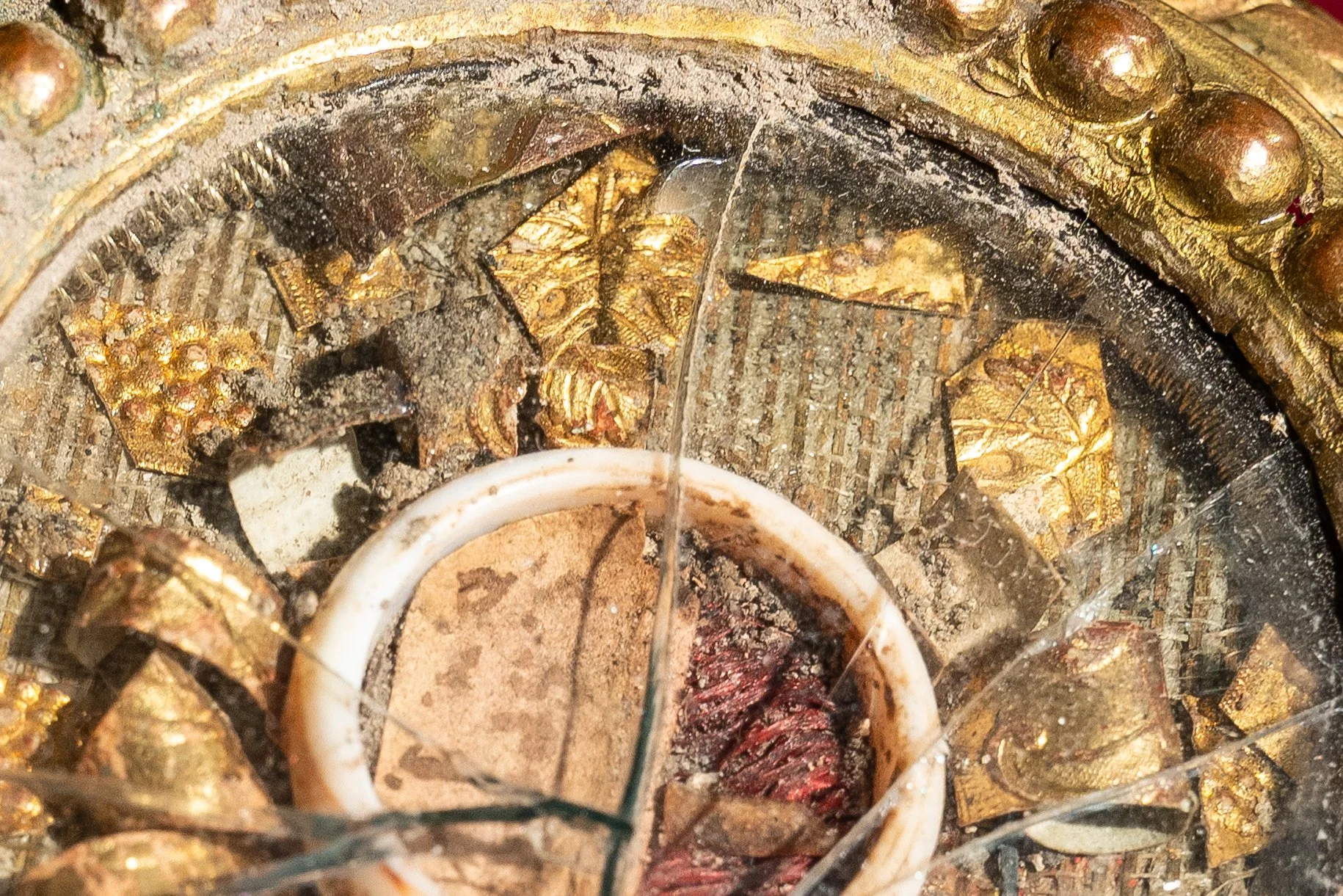 Image 2 of 3
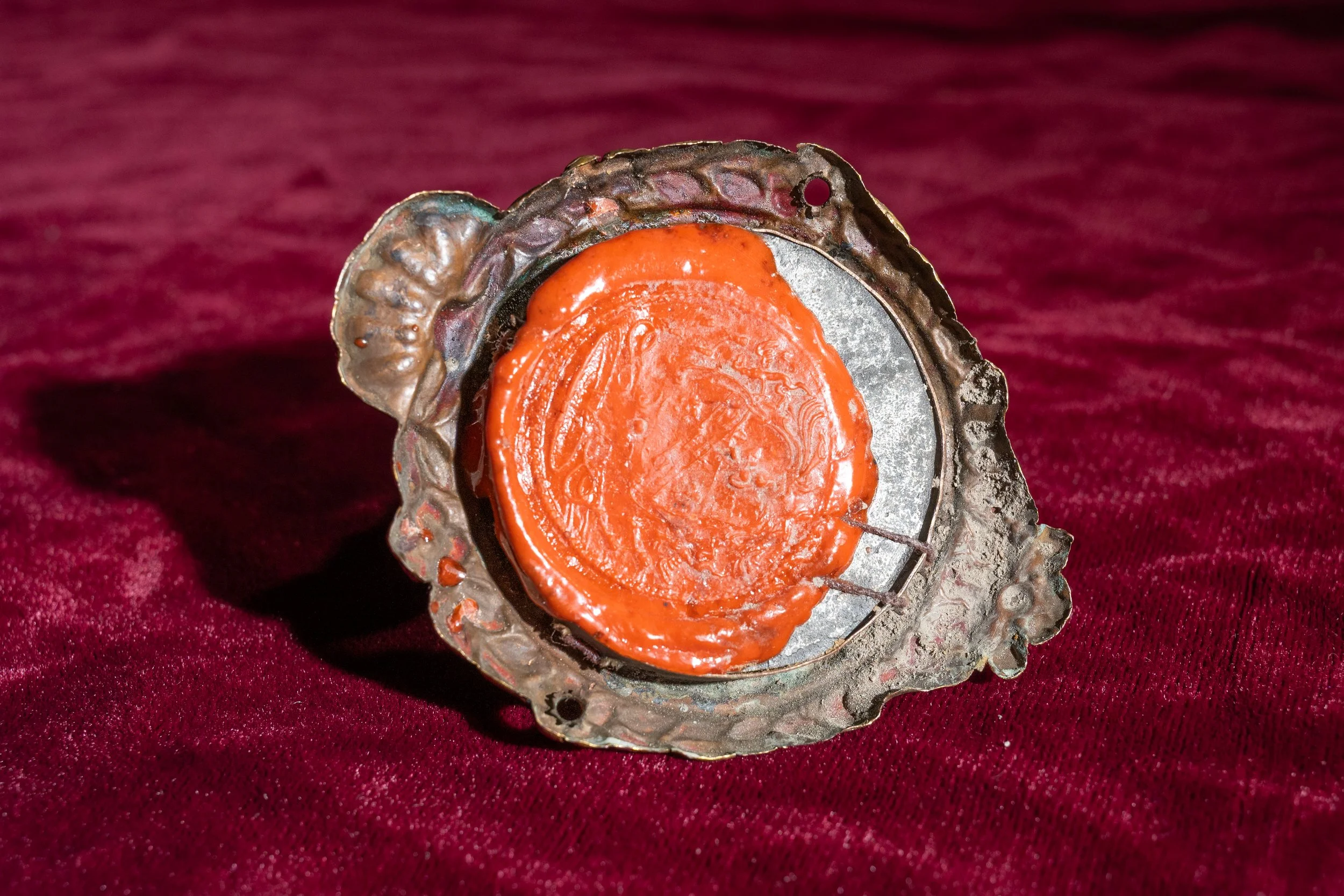 Image 3 of 3
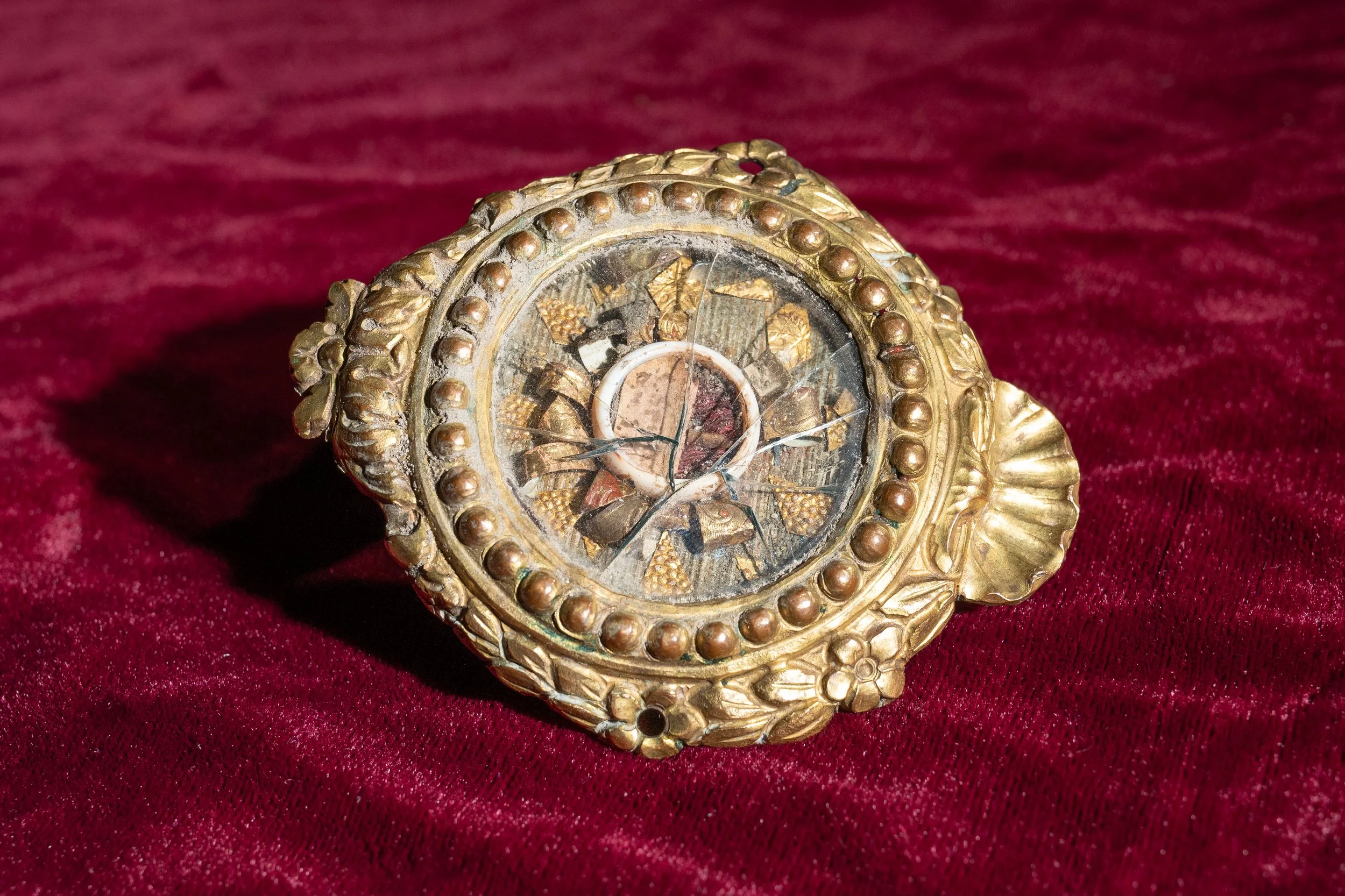
Behind a pane of old, now shattered glass lies one of the most charged subjects in the whole repertoire of Christian relics: a small fragment, bedded on red silk and ringed in turned bone. This is a Holy Thorn of Our Lord Jesus Christ…. or so the label reads, more specifically, in Latin: S. Spina D.N.J.C., that is Sancta Spina Domini Nostri Jesu Christi, and it places this little gilt case within the long devotion to the Crown of Thorns of the Passion. The object is a reliquary of the kind the Italians call a theca, an oval frame of gilt copper alloy with a bold border of beaded ornament and a repoussé wreath of leaves and flowers, finished at the sides with a scallop shell and a rosette and pierced for mounting. The interior is a small confection of devotional craft: cut gold foil and metallic thread, snipped into leaves, clusters and a star, are arranged in rays around a central ring of bone that both frames and protects the relic. This is the patient handwork associated with the cloistered convents of Catholic Europe, where nuns built such glittering settings, sometimes called paperolle, to dignify a relic no larger than a splinter. What gives the piece its evidential interest is the back. The theca is closed not by a modern fastening but by a disc of red wax bearing a coat of arms, held by threads that pass through the case. This was the whole point of the seal: once the relic and its label were enclosed, a churchman impressed his arms in wax so that the contents could not be disturbed without breaking it, and so that anyone later could trace the authority who had vouched for the enclosure.
Here the seal is rubbed but intact and the case still closed. The arms have been read as those of the Alfieri, a name that would, if confirmed, point to the cardinal or prelate who authorized it; the reading is not yet secure, and is best treated as a promising line of inquiry rather than a settled fact. Thorns said to come from the Crown of the Passion have been venerated since late antiquity, multiplied and dispersed across Christendom from the great relic that reached Paris and the Sainte-Chapelle in the thirteenth century, and by the eighteenth century such relics, sealed into glazed thecae with a Latin cartouche and an armorial wax seal, were the ordinary furniture of Roman Catholic devotion.
OBJECT Reliquary (theca) of the Holy Thorn (Sacra Spina), the relic labelled “S. Spina D.N.J.C.” for Sancta Spina Domini Nostri Jesu Christi. Italy, 18th century (the construction and wax seal consistent with circa 1700–1750).
Physical Description: Oval glazed reliquary. Gilt copper-alloy frame with a beaded border and a repoussé wreath of leaves and flowers, a scallop shell to one side and a rosette to the other, pierced at top and bottom for mounting. Beneath the (original) glass, a composition of cut gold-foil and metal-thread ornaments arranged as rays around a central turned-bone ring enclosing the relic on red silk with its paper cartouche. The reverse closed with a red armorial wax seal secured by threads. Materials: Gilt copper alloy, glass, bone, textile (silk), sealing wax, paper. Dimensions: 10.5 x 8.5 x 1.5 cm.
Condition: Fair, commensurate with long devotional use. The original glass is cracked and partly shattered but retained in place; some wear, surface loss and verdigris to the gilt metal; minor losses possible among the interior ornaments. The red wax seal is rubbed but intact and the theca remains closed and unopened. Stable.
Provenance: Acquired from a private collector in central Italy; in the present private collection for twelve years (per the source). The closing wax seal bears a coat of arms read by the source as that of the Alfieri.
Behind a pane of old, now shattered glass lies one of the most charged subjects in the whole repertoire of Christian relics: a small fragment, bedded on red silk and ringed in turned bone. This is a Holy Thorn of Our Lord Jesus Christ…. or so the label reads, more specifically, in Latin: S. Spina D.N.J.C., that is Sancta Spina Domini Nostri Jesu Christi, and it places this little gilt case within the long devotion to the Crown of Thorns of the Passion. The object is a reliquary of the kind the Italians call a theca, an oval frame of gilt copper alloy with a bold border of beaded ornament and a repoussé wreath of leaves and flowers, finished at the sides with a scallop shell and a rosette and pierced for mounting. The interior is a small confection of devotional craft: cut gold foil and metallic thread, snipped into leaves, clusters and a star, are arranged in rays around a central ring of bone that both frames and protects the relic. This is the patient handwork associated with the cloistered convents of Catholic Europe, where nuns built such glittering settings, sometimes called paperolle, to dignify a relic no larger than a splinter. What gives the piece its evidential interest is the back. The theca is closed not by a modern fastening but by a disc of red wax bearing a coat of arms, held by threads that pass through the case. This was the whole point of the seal: once the relic and its label were enclosed, a churchman impressed his arms in wax so that the contents could not be disturbed without breaking it, and so that anyone later could trace the authority who had vouched for the enclosure.
Here the seal is rubbed but intact and the case still closed. The arms have been read as those of the Alfieri, a name that would, if confirmed, point to the cardinal or prelate who authorized it; the reading is not yet secure, and is best treated as a promising line of inquiry rather than a settled fact. Thorns said to come from the Crown of the Passion have been venerated since late antiquity, multiplied and dispersed across Christendom from the great relic that reached Paris and the Sainte-Chapelle in the thirteenth century, and by the eighteenth century such relics, sealed into glazed thecae with a Latin cartouche and an armorial wax seal, were the ordinary furniture of Roman Catholic devotion.
OBJECT Reliquary (theca) of the Holy Thorn (Sacra Spina), the relic labelled “S. Spina D.N.J.C.” for Sancta Spina Domini Nostri Jesu Christi. Italy, 18th century (the construction and wax seal consistent with circa 1700–1750).
Physical Description: Oval glazed reliquary. Gilt copper-alloy frame with a beaded border and a repoussé wreath of leaves and flowers, a scallop shell to one side and a rosette to the other, pierced at top and bottom for mounting. Beneath the (original) glass, a composition of cut gold-foil and metal-thread ornaments arranged as rays around a central turned-bone ring enclosing the relic on red silk with its paper cartouche. The reverse closed with a red armorial wax seal secured by threads. Materials: Gilt copper alloy, glass, bone, textile (silk), sealing wax, paper. Dimensions: 10.5 x 8.5 x 1.5 cm.
Condition: Fair, commensurate with long devotional use. The original glass is cracked and partly shattered but retained in place; some wear, surface loss and verdigris to the gilt metal; minor losses possible among the interior ornaments. The red wax seal is rubbed but intact and the theca remains closed and unopened. Stable.
Provenance: Acquired from a private collector in central Italy; in the present private collection for twelve years (per the source). The closing wax seal bears a coat of arms read by the source as that of the Alfieri.