After the tarot, no set of cards has been consulted more widely for fortune-telling than the deck that carries the name of Marie-Anne Adelaide Lenormand, the Parisian seer who read for Josephine, for Napoleon, and, the legend goes, for Robespierre and the Tsar of Russia besides. She never made this deck herself; she died in 1843, and it was issued in her memory and under her famous name from 1845 onward, becoming the grand showpiece of nineteenth-century French cartomancy. This is a complete fifty-four-card example from the great Paris maker B.P. Grimaud, printed around 1890 in rich chromolithographed color on stout card.
To turn the cards over is to page through the whole imaginative furniture of the nineteenth-century occult revival at once. Europa rides her bull across the water; the wooden horse is wheeled through the gates of Troy while soldiers hide within; an alchemist in a long robe tends a glass alembic over the furnace in his study; gods and goddesses recline on painted clouds; and on one card a triumphal chariot races past a willow-shaded tomb lettered "CI GIT," with a skull and crossbones laid in the foreground, the old reminder that every triumph ends. There is no single tradition behind these scenes. Greek myth, classical allegory, alchemy, astrology, folk legend, and the Victorian "language of flowers" are all crowded together, less because they form a system than because each one drew in another kind of customer, and the result is a deck of genuine, slightly delirious richness.
The structure rewards a closer look, because every card is really several oracles stacked into one frame. In the upper left sits a miniature French-suited playing card, so the deck can be read by ordinary card-divination; in the upper right is a single letter of the alphabet, used to spell out names and answers; across the top runs a star-map of a constellation; the large central panel carries the principal mythological scene; two smaller vignettes occupy the lower corners; and a spray of flowers blooms at the foot. The reader takes the central image and the two small scenes as the heart of the message, and lets the playing card, the letter, the stars, and the flowers add their shades of meaning. Two further cards stand apart from the rest: the Querent cards, a man and a woman in seventeenth-century dress, who represent the person asking the question. The cards measure roughly 128 by 90 mm, with rounded corners and an allover small blue geometric pattern on the backs.
These astro-mythological Lenormand decks were printed in quantity across many decades, so the design itself is familiar, but complete nineteenth-century examples in clean condition are another matter, and they are the ones collectors of cartomancy and the Western esoteric tradition actually compete for. The present set is complete at fifty-four cards and shows only light handling, the color still fresh and the surfaces sound. It is a handsome and genuinely usable survival from the golden age of French fortune-telling, equally at home in a collection of playing cards, of divination, or of the broader nineteenth-century occult.
[DIVINATION DECK]. Grand Jeu de Mlle Le Normand (Grand jeu de société; cartes astro-mytho-hermétiques). Paris: B.P. Grimaud, ca. 1890. Named for Marie-Anne Adelaide Lenormand (1772-1843); deck first issued 1845, after her death.
Physical Description: 54 cards (52 illustrated divination cards plus 2 Querent cards depicting a man and a woman in 17th-century dress), complete. Chromolithographed on thick card stock, approx. 128 x 90 mm, rounded corners. Each card (except the Querents) combines a miniature French-suited playing-card index (upper left), a letter of the alphabet (upper right), a constellation/astrological diagram, a central mythological scene, two corner vignettes, and a flower motif. Card backs printed with an allover small blue geometric pattern.
Condition: Light marks of use; overall excellent.
After the tarot, no set of cards has been consulted more widely for fortune-telling than the deck that carries the name of Marie-Anne Adelaide Lenormand, the Parisian seer who read for Josephine, for Napoleon, and, the legend goes, for Robespierre and the Tsar of Russia besides. She never made this deck herself; she died in 1843, and it was issued in her memory and under her famous name from 1845 onward, becoming the grand showpiece of nineteenth-century French cartomancy. This is a complete fifty-four-card example from the great Paris maker B.P. Grimaud, printed around 1890 in rich chromolithographed color on stout card.
To turn the cards over is to page through the whole imaginative furniture of the nineteenth-century occult revival at once. Europa rides her bull across the water; the wooden horse is wheeled through the gates of Troy while soldiers hide within; an alchemist in a long robe tends a glass alembic over the furnace in his study; gods and goddesses recline on painted clouds; and on one card a triumphal chariot races past a willow-shaded tomb lettered "CI GIT," with a skull and crossbones laid in the foreground, the old reminder that every triumph ends. There is no single tradition behind these scenes. Greek myth, classical allegory, alchemy, astrology, folk legend, and the Victorian "language of flowers" are all crowded together, less because they form a system than because each one drew in another kind of customer, and the result is a deck of genuine, slightly delirious richness.
The structure rewards a closer look, because every card is really several oracles stacked into one frame. In the upper left sits a miniature French-suited playing card, so the deck can be read by ordinary card-divination; in the upper right is a single letter of the alphabet, used to spell out names and answers; across the top runs a star-map of a constellation; the large central panel carries the principal mythological scene; two smaller vignettes occupy the lower corners; and a spray of flowers blooms at the foot. The reader takes the central image and the two small scenes as the heart of the message, and lets the playing card, the letter, the stars, and the flowers add their shades of meaning. Two further cards stand apart from the rest: the Querent cards, a man and a woman in seventeenth-century dress, who represent the person asking the question. The cards measure roughly 128 by 90 mm, with rounded corners and an allover small blue geometric pattern on the backs.
These astro-mythological Lenormand decks were printed in quantity across many decades, so the design itself is familiar, but complete nineteenth-century examples in clean condition are another matter, and they are the ones collectors of cartomancy and the Western esoteric tradition actually compete for. The present set is complete at fifty-four cards and shows only light handling, the color still fresh and the surfaces sound. It is a handsome and genuinely usable survival from the golden age of French fortune-telling, equally at home in a collection of playing cards, of divination, or of the broader nineteenth-century occult.
[DIVINATION DECK]. Grand Jeu de Mlle Le Normand (Grand jeu de société; cartes astro-mytho-hermétiques). Paris: B.P. Grimaud, ca. 1890. Named for Marie-Anne Adelaide Lenormand (1772-1843); deck first issued 1845, after her death.
Physical Description: 54 cards (52 illustrated divination cards plus 2 Querent cards depicting a man and a woman in 17th-century dress), complete. Chromolithographed on thick card stock, approx. 128 x 90 mm, rounded corners. Each card (except the Querents) combines a miniature French-suited playing-card index (upper left), a letter of the alphabet (upper right), a constellation/astrological diagram, a central mythological scene, two corner vignettes, and a flower motif. Card backs printed with an allover small blue geometric pattern.
Condition: Light marks of use; overall excellent.

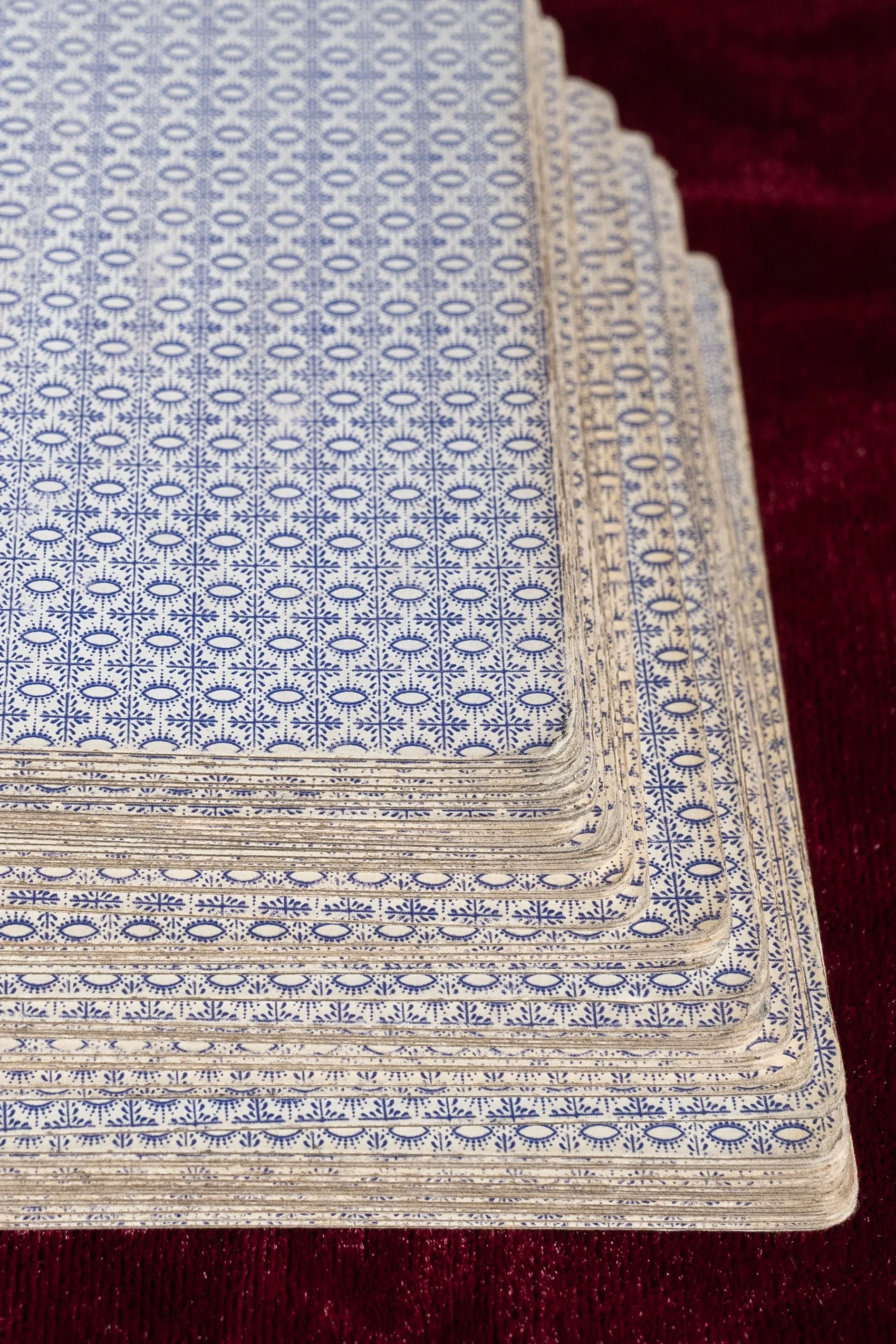 Image 1 of 6
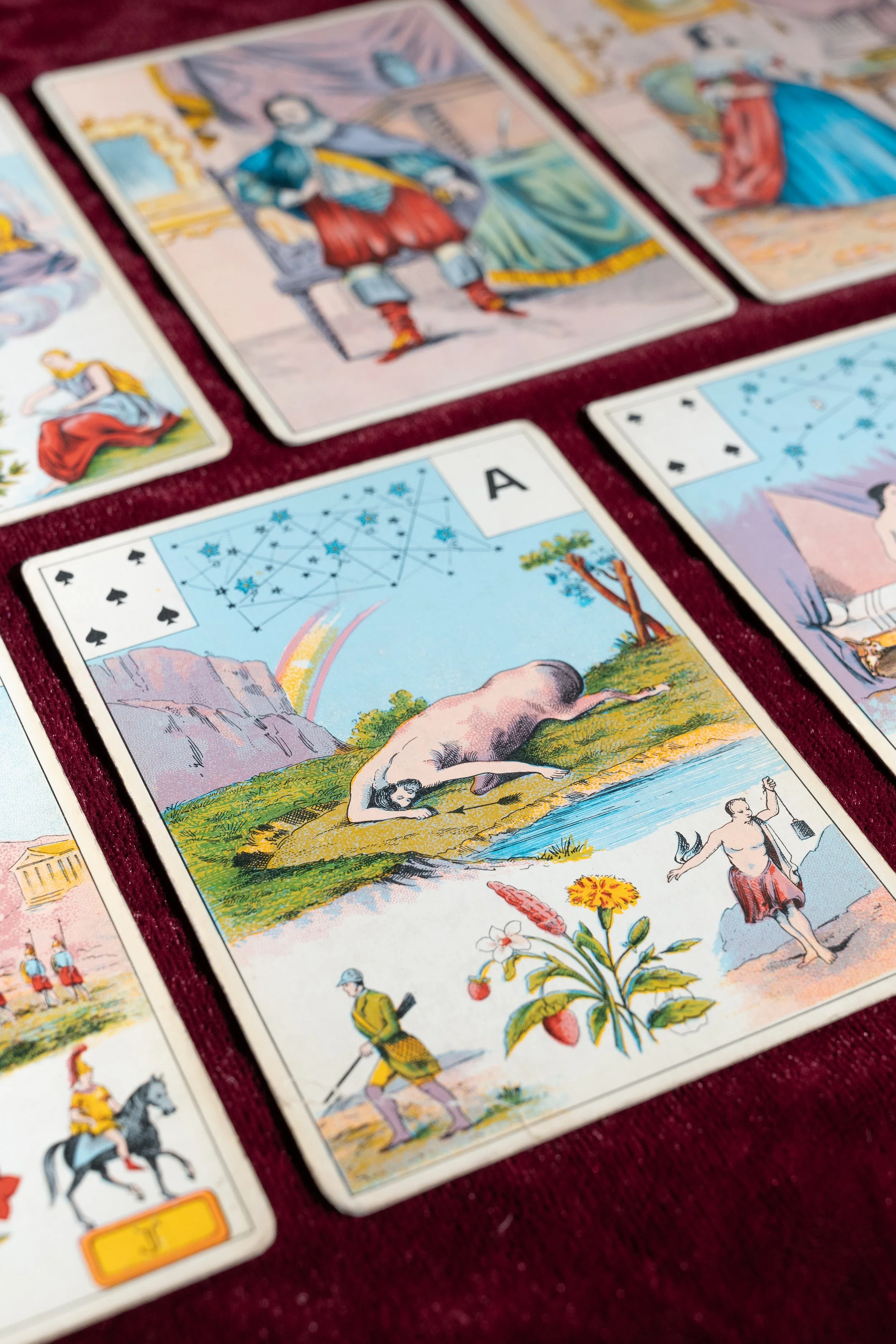 Image 2 of 6
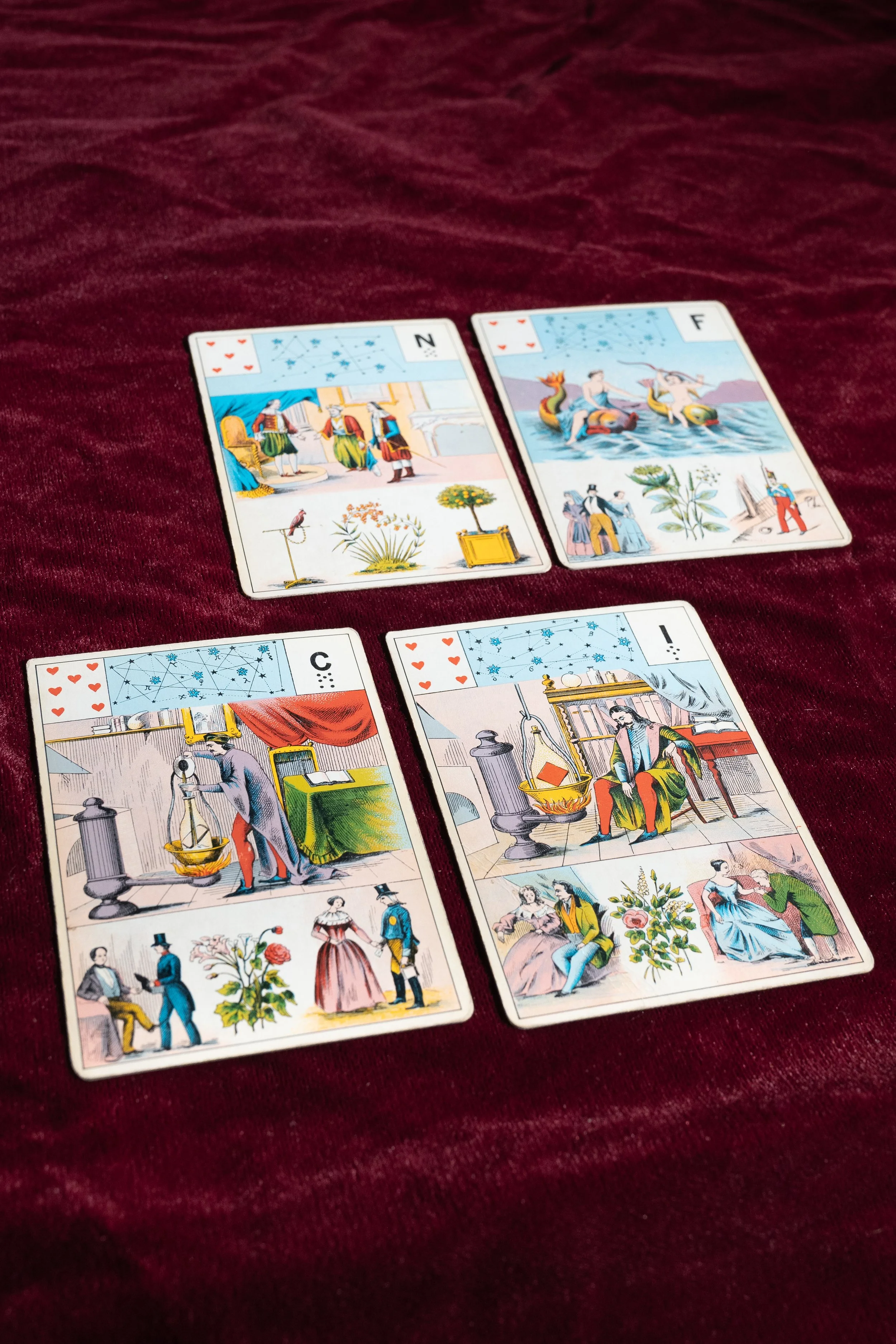 Image 3 of 6
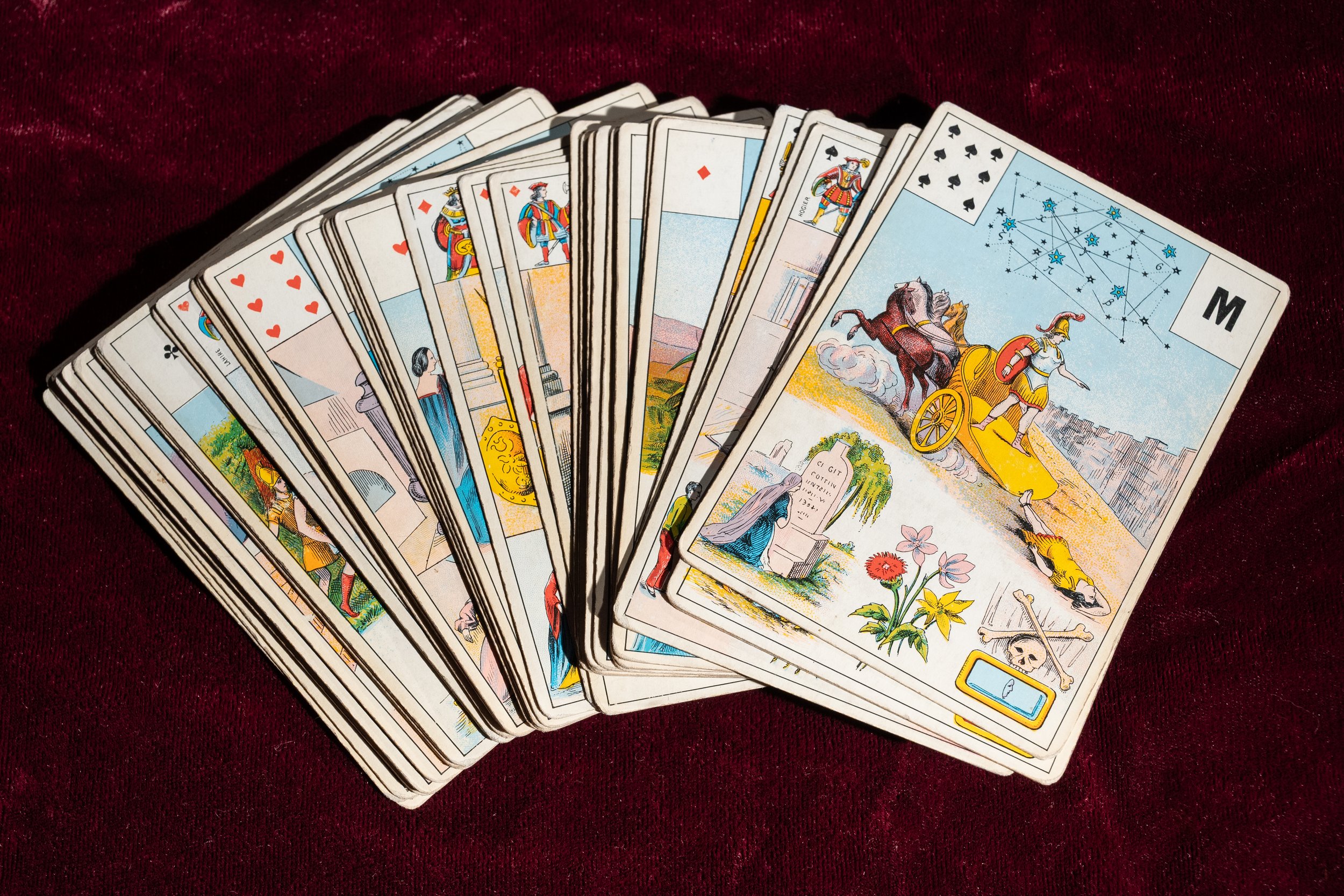 Image 4 of 6
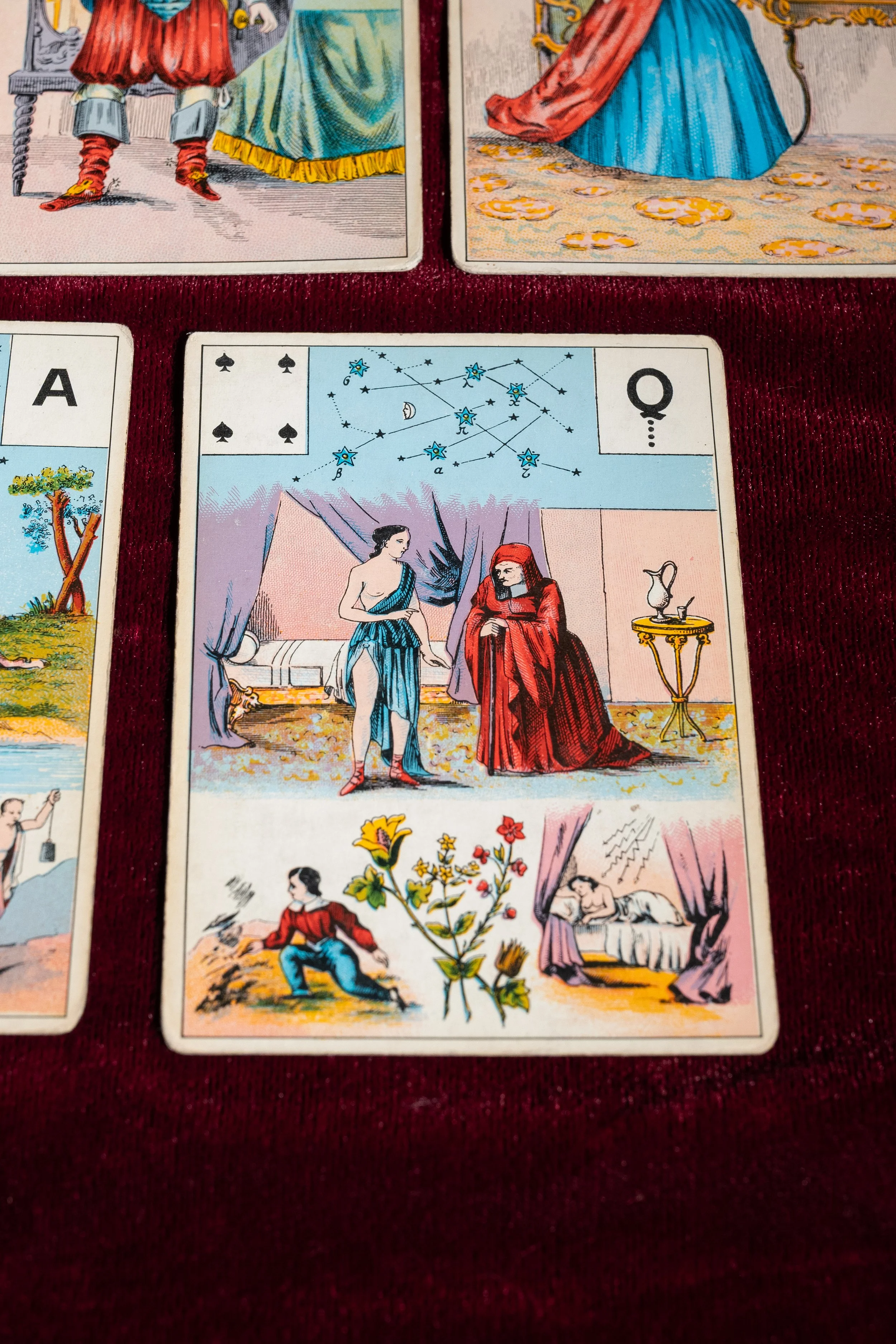 Image 5 of 6
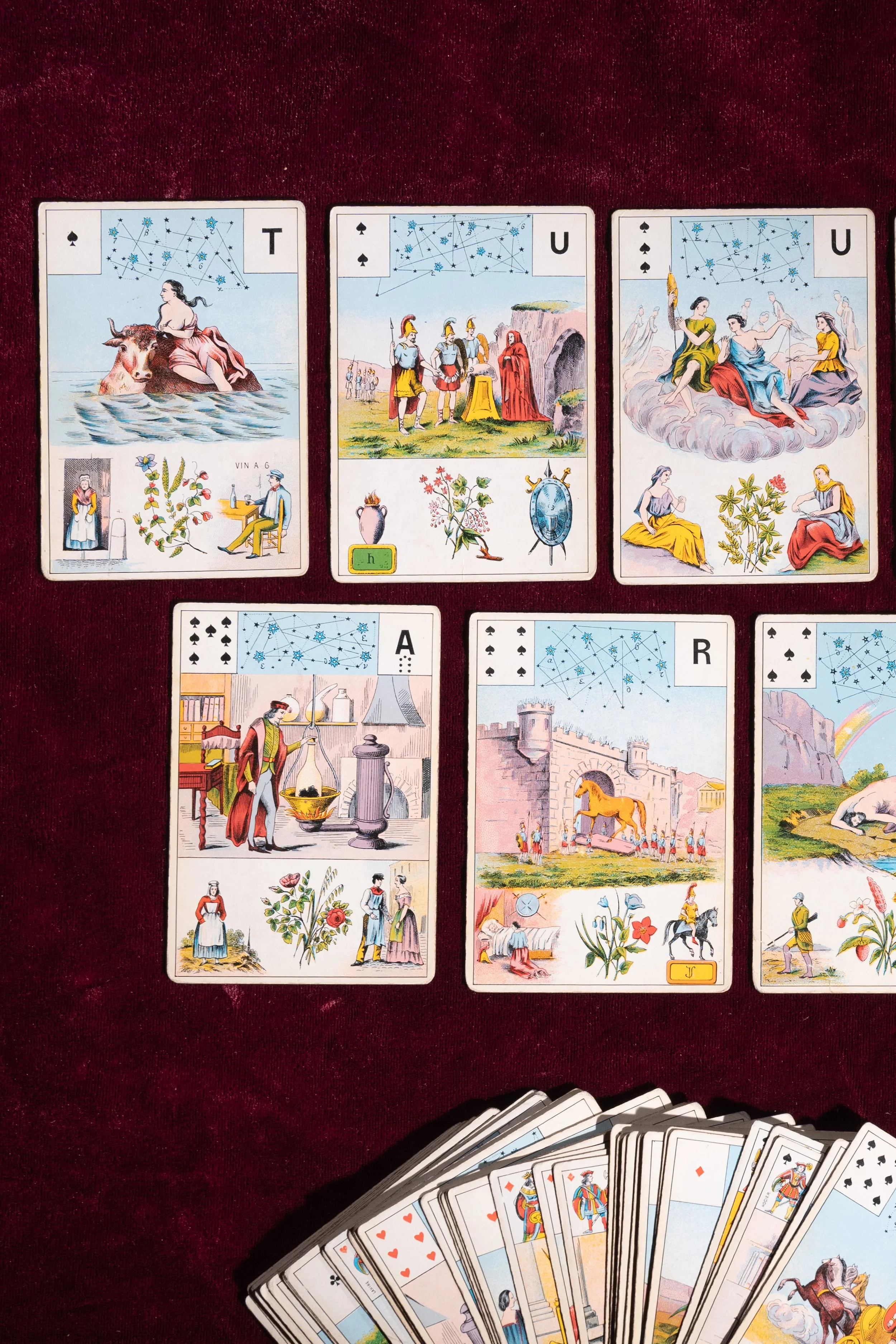 Image 6 of 6