On 2 January 1871 a clerk in Rome filled in a printed form to certify a relic. The relic was a scrap of cloth “ex Veste S. Teresiae Virg.,” from the clothing of Saint Teresa, Virgin, and it had been sealed into a small silvered case. On 20 September 1870 Italian troops had breached the wall at Porta Pia and taken Rome from the pope. Pius IX withdrew into the Vatican and called himself a prisoner. Three and a half months later the office that gave out relics in his name was still open, and this is one of the things it did.
Teresa of Ávila (1515–1582) was a Carmelite nun who reformed her order, founded seventeen convents across Spain and wrote some of the most exact accounts of prayer we have. In her Life she describes an angel driving a golden spear into her heart, the scene Bernini carved for a church in Rome. She was canonized in 1622. Six years after her death, doctors from the University of Salamanca had taken out her heart to look for the wound the angel made.
The certificate describes the case it was issued with: “theca deargentata oval. formae un. cryst. munita,” an oval silvered case fitted with one crystal, tied with red silk cord and sealed. Our case answers to that. Behind the glass a paper label reads “S. Teresiae V.” in a small hand. On the back the red wax still holds the cord, and the wax carries a cardinal’s arms. The form is headed with the name and arms of Cardinal Costantino Patrizi, Bishop of Ostia and Velletri, Dean of the College of Cardinals and the pope’s Vicar General. It is signed for him by his deputy, Giuseppe Angelini, titular Archbishop of Corinth, and countersigned by the keeper of relics. The holder is allowed to keep the relic, give it away or send it out of Rome. One word is printed at the foot in capitals: GRATIS.
Church law forbids the sale of relics, and we follow it: the price here is for the theca and its certificate, and the relic goes with them as a gift, for preservation and study.
SAINT TERESA OF ÁVILA (1515–1582). Sealed theca containing a relic of her clothing, with the certificate of authenticity issued in the name of Cardinal Costantino Patrizi, Vicar General of Rome. Rome, 2 January 1871.
Physical Description: Oval theca of silvered metal with a glass front. Behind the glass, on a ground of red cloth within a stamped metal border, a small fragment of pale cloth and a manuscript paper label reading “S. Teresiae V.” The back is closed with red wax, impressed with a cardinal’s arms, over the ends of a cord. Certificate: one sheet, printed in letterpress within an ornamental border, with the cardinal’s engraved arms at the head, completed in ink, signed twice, with a blind-embossed seal at the lower left.
Condition: Wax seal and cord intact. The silvering is worn, with some tarnish. The certificate has been folded and has light foxing; the ink of the manuscript entries has faded to brown but is legible.

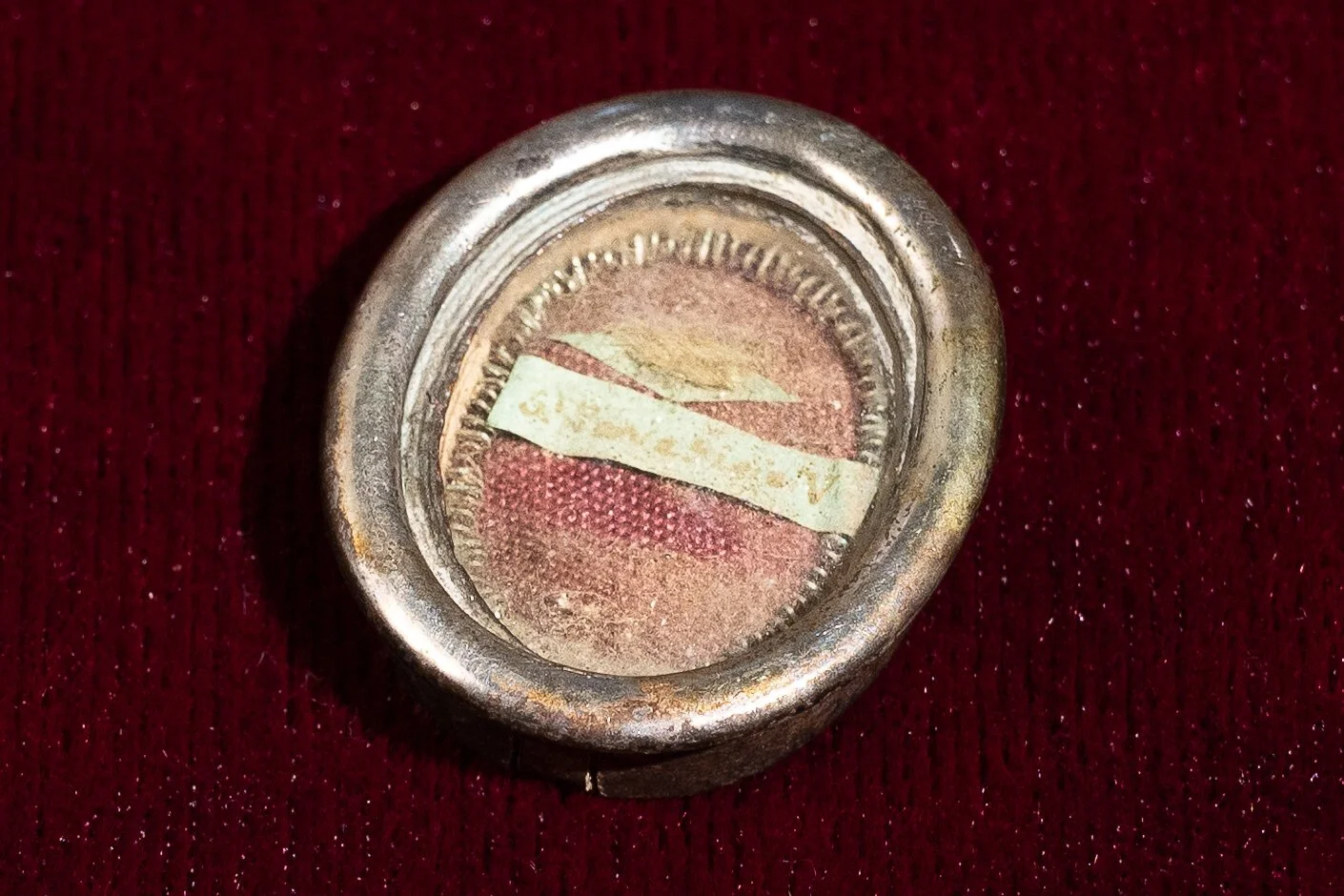 Image 1 of 8
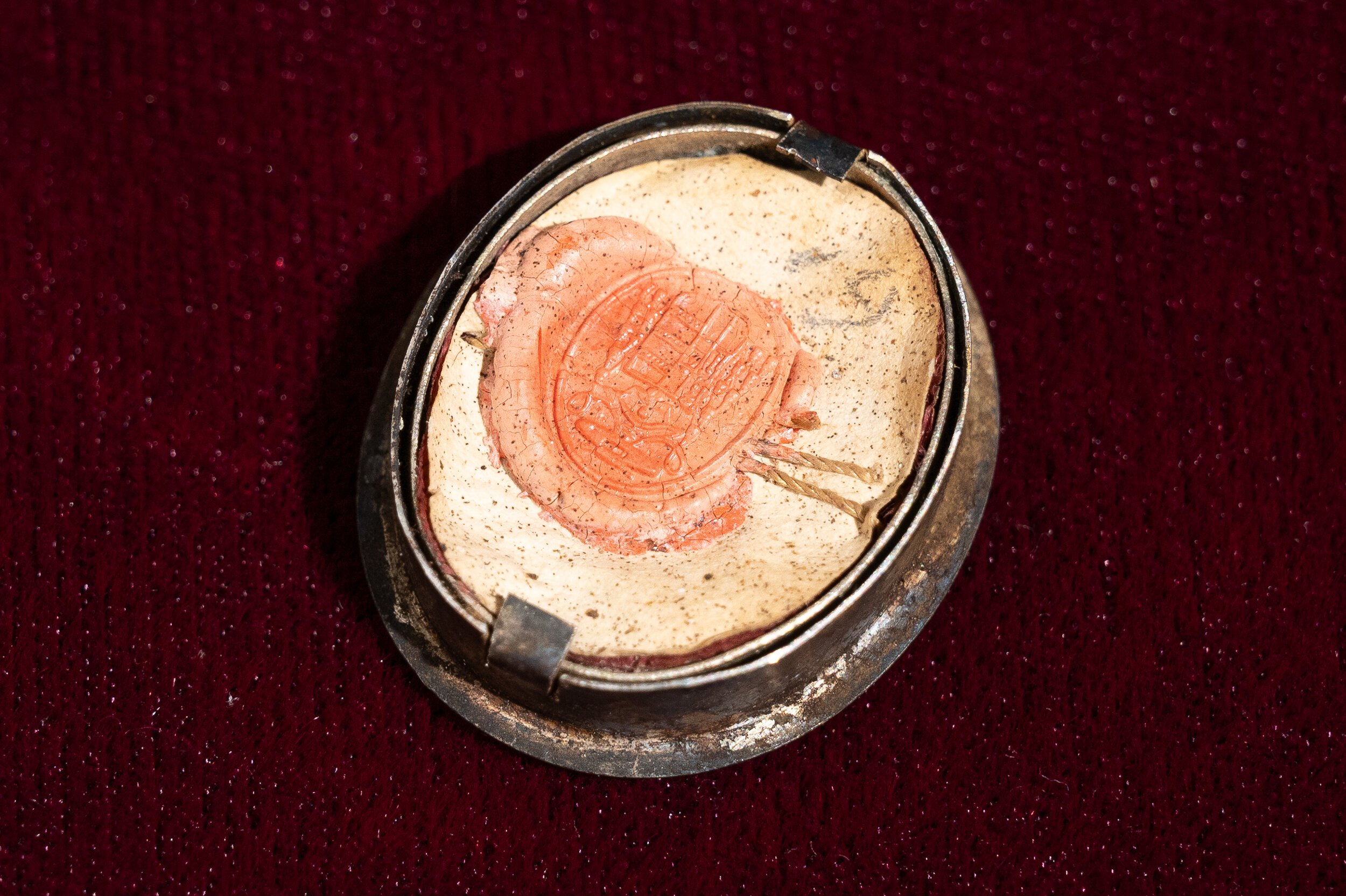 Image 2 of 8
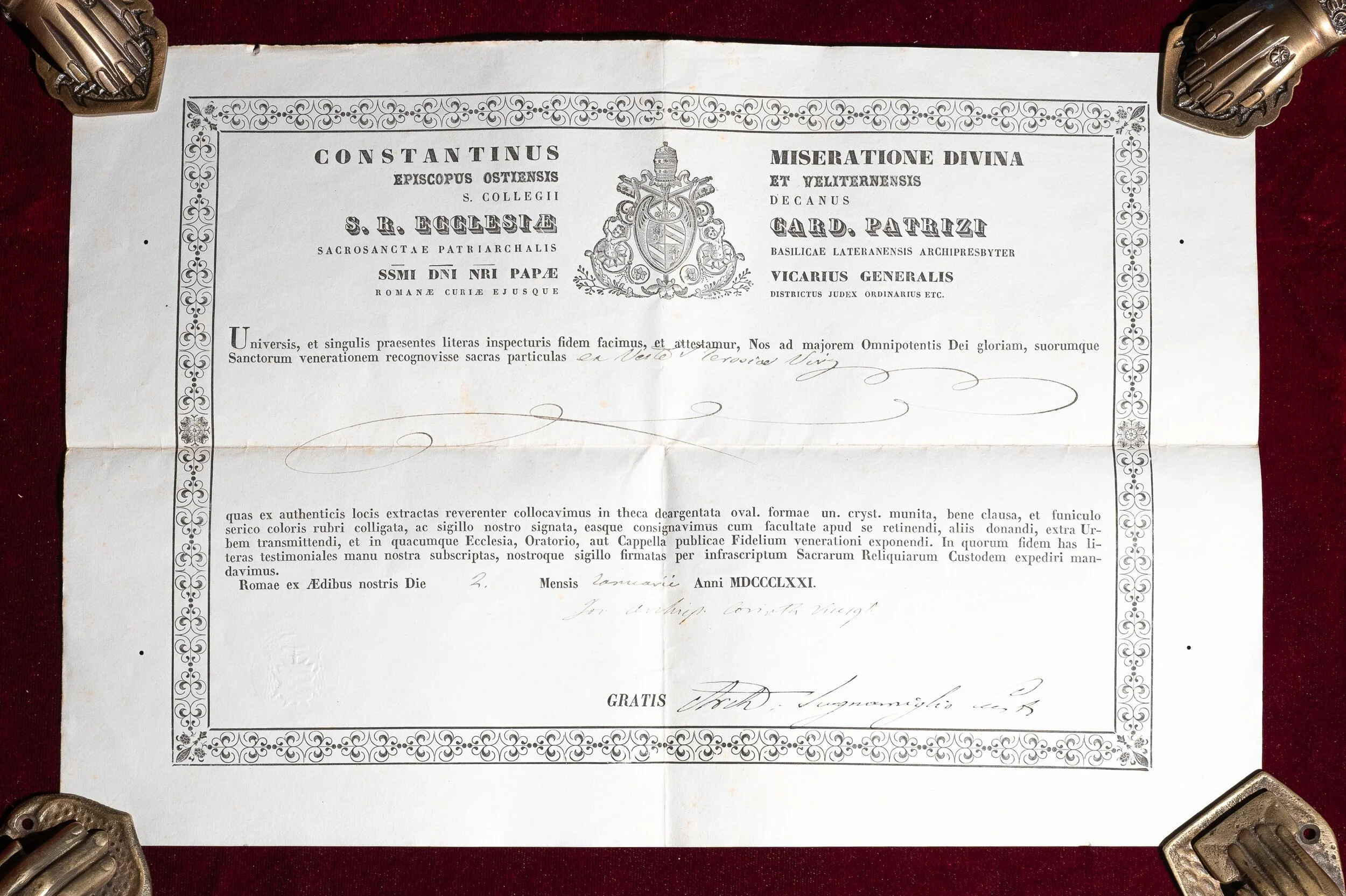 Image 3 of 8
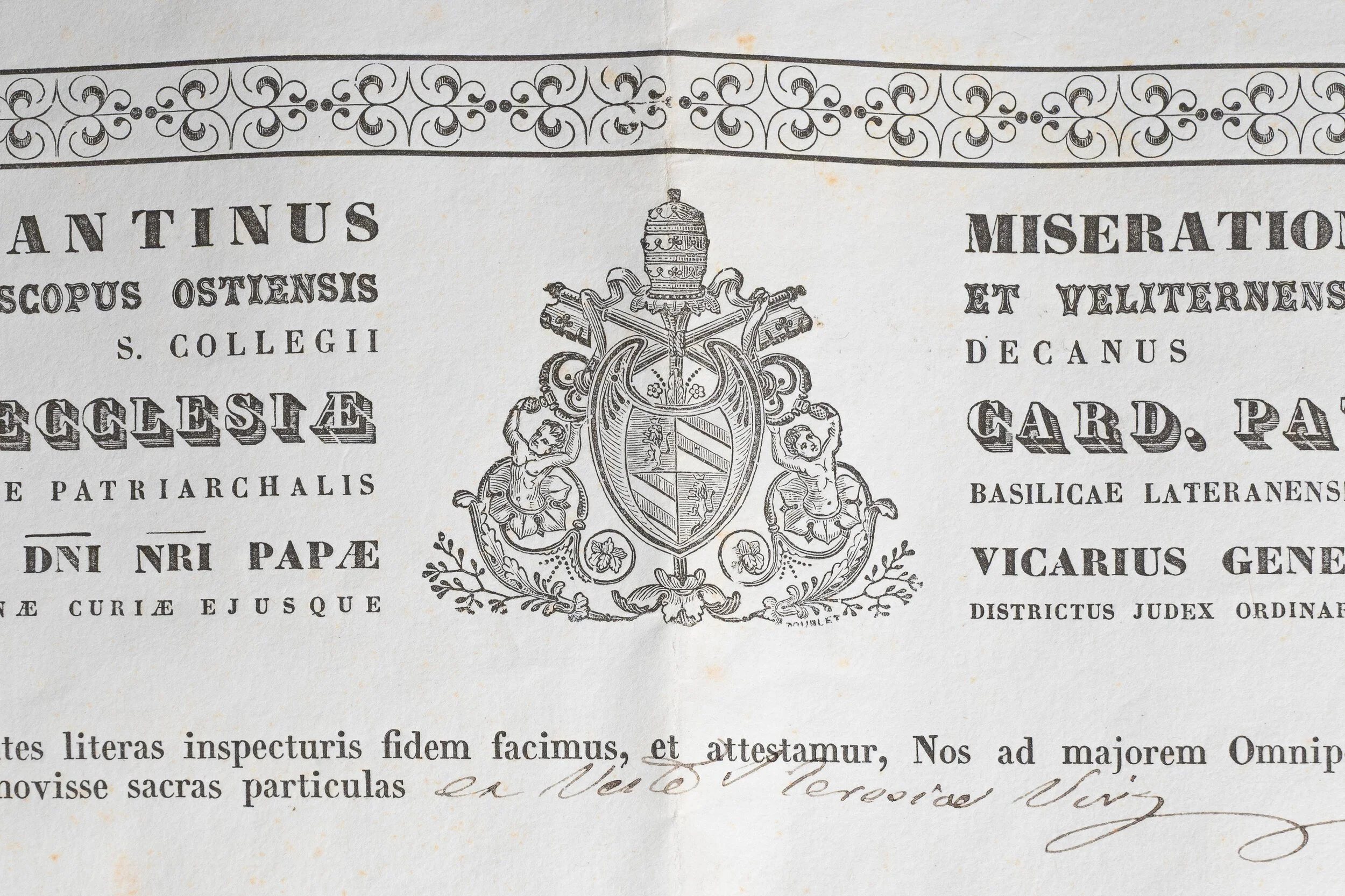 Image 4 of 8
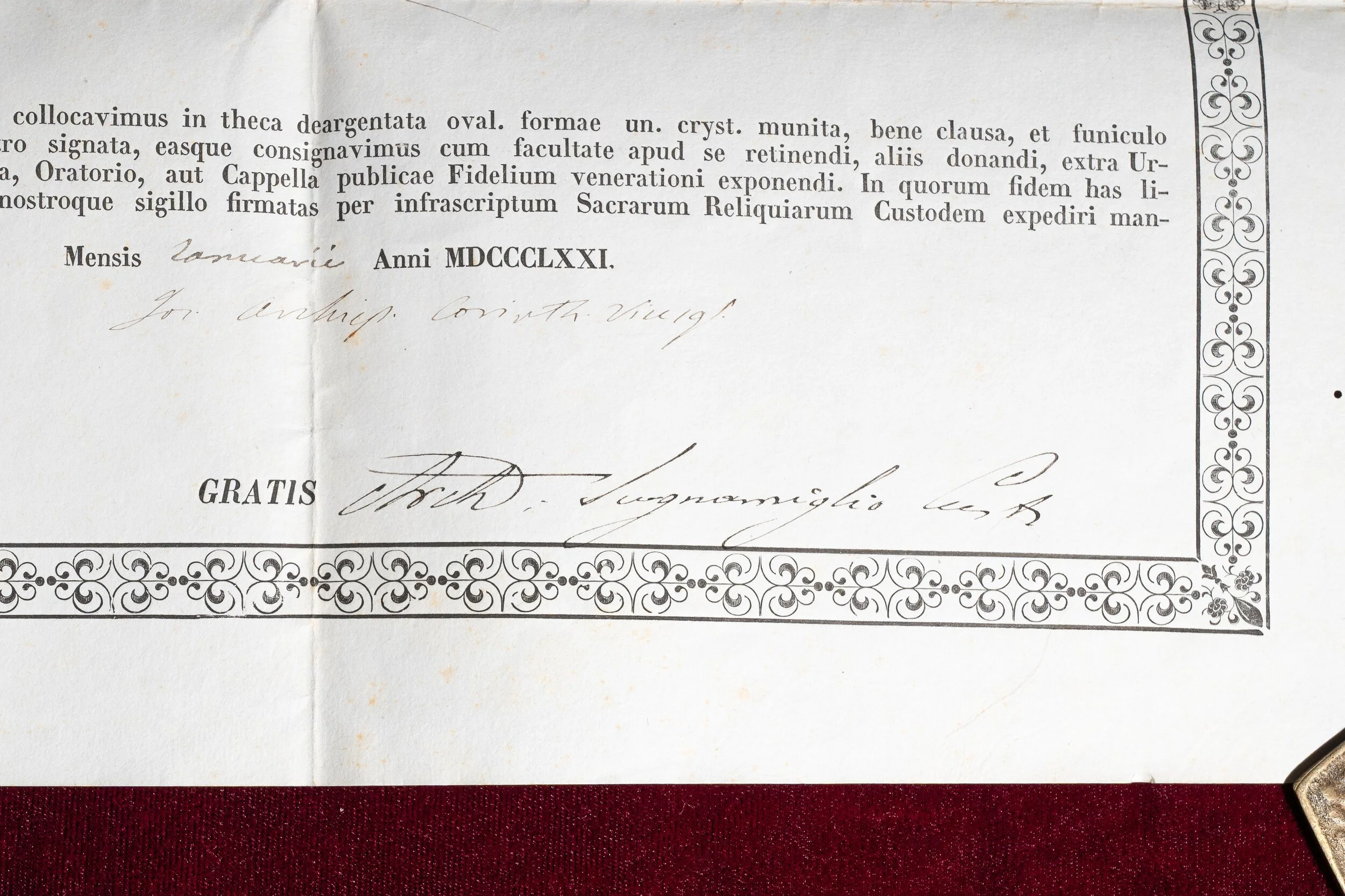 Image 5 of 8
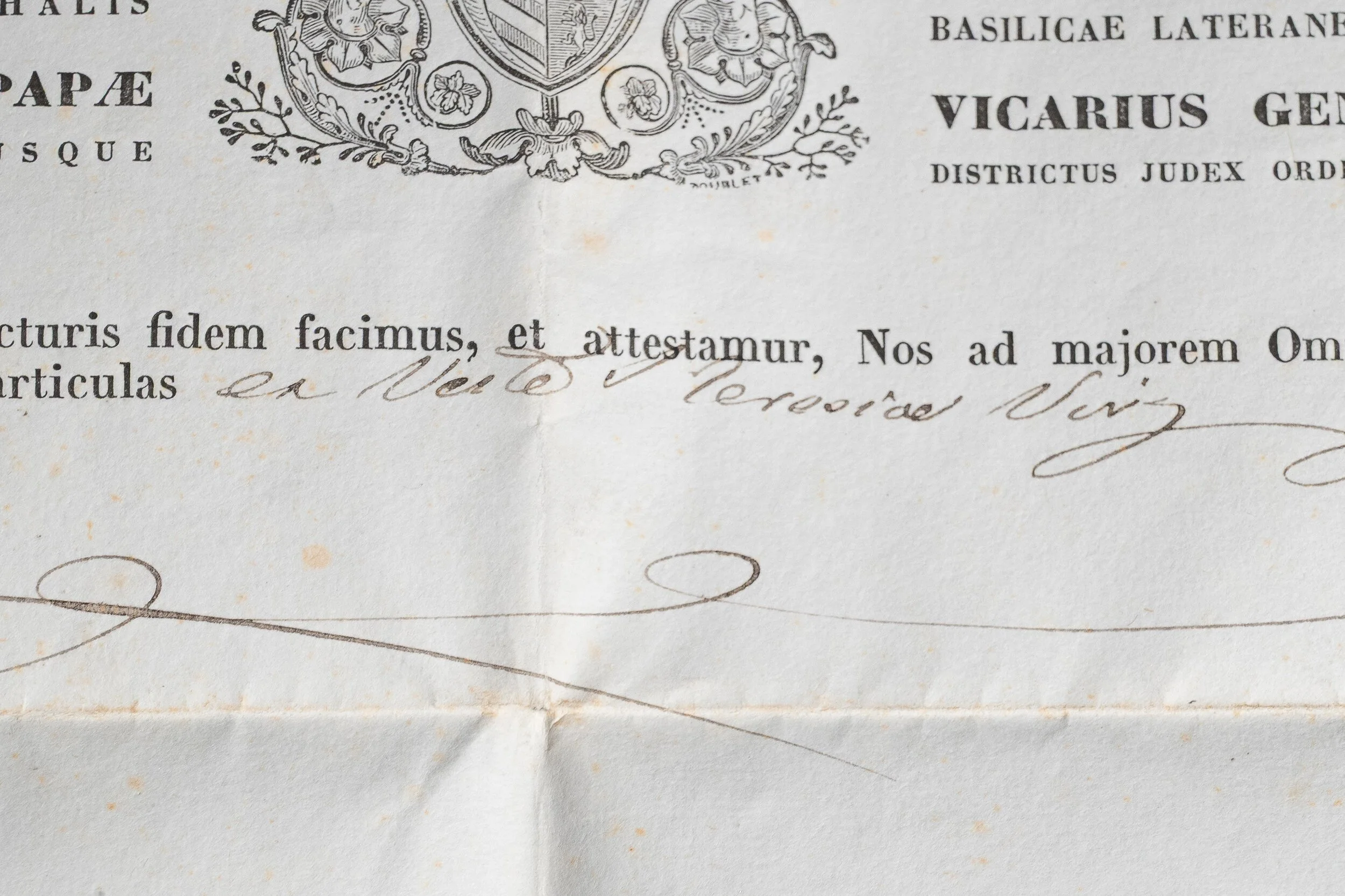 Image 6 of 8
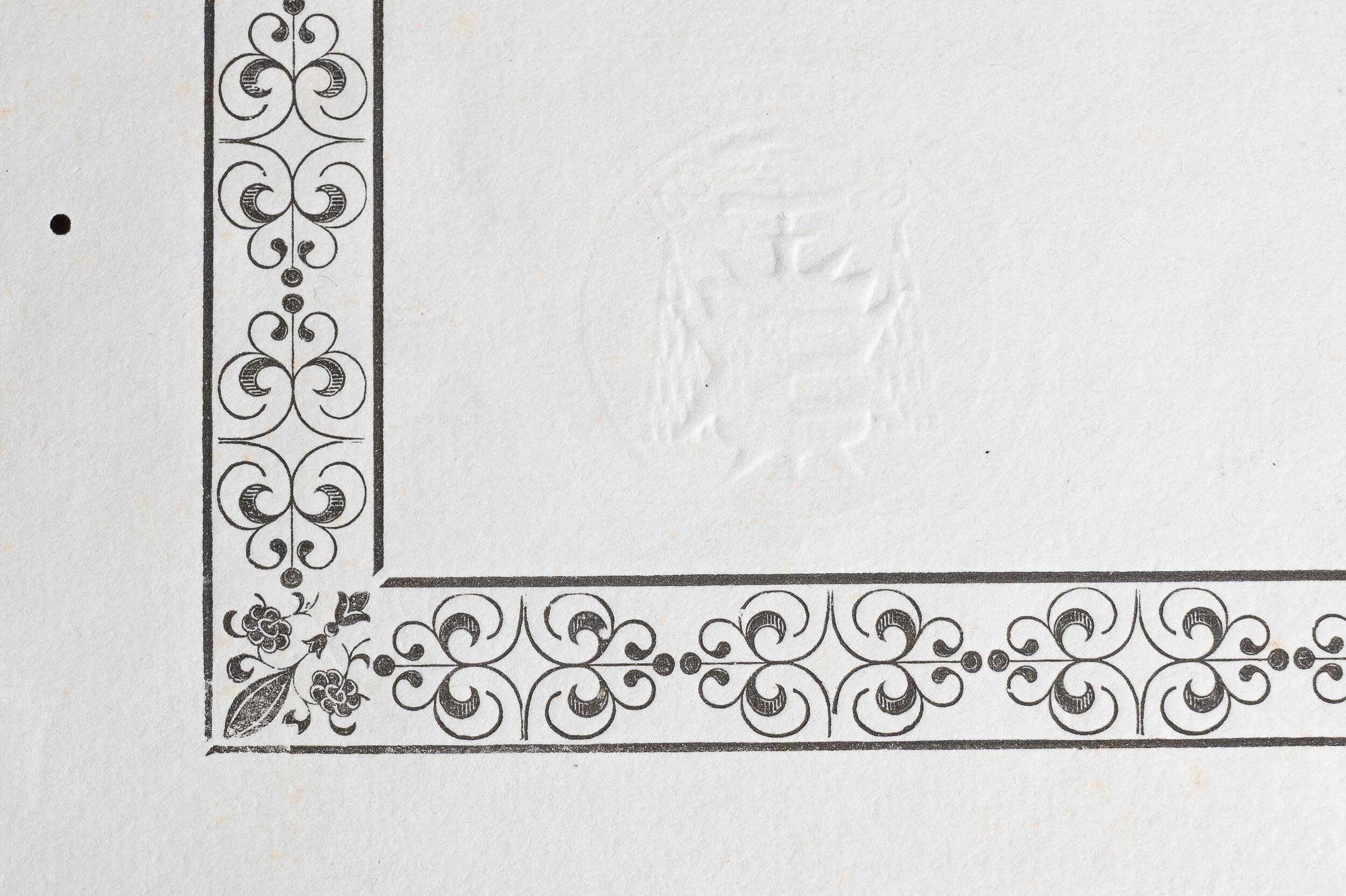 Image 7 of 8
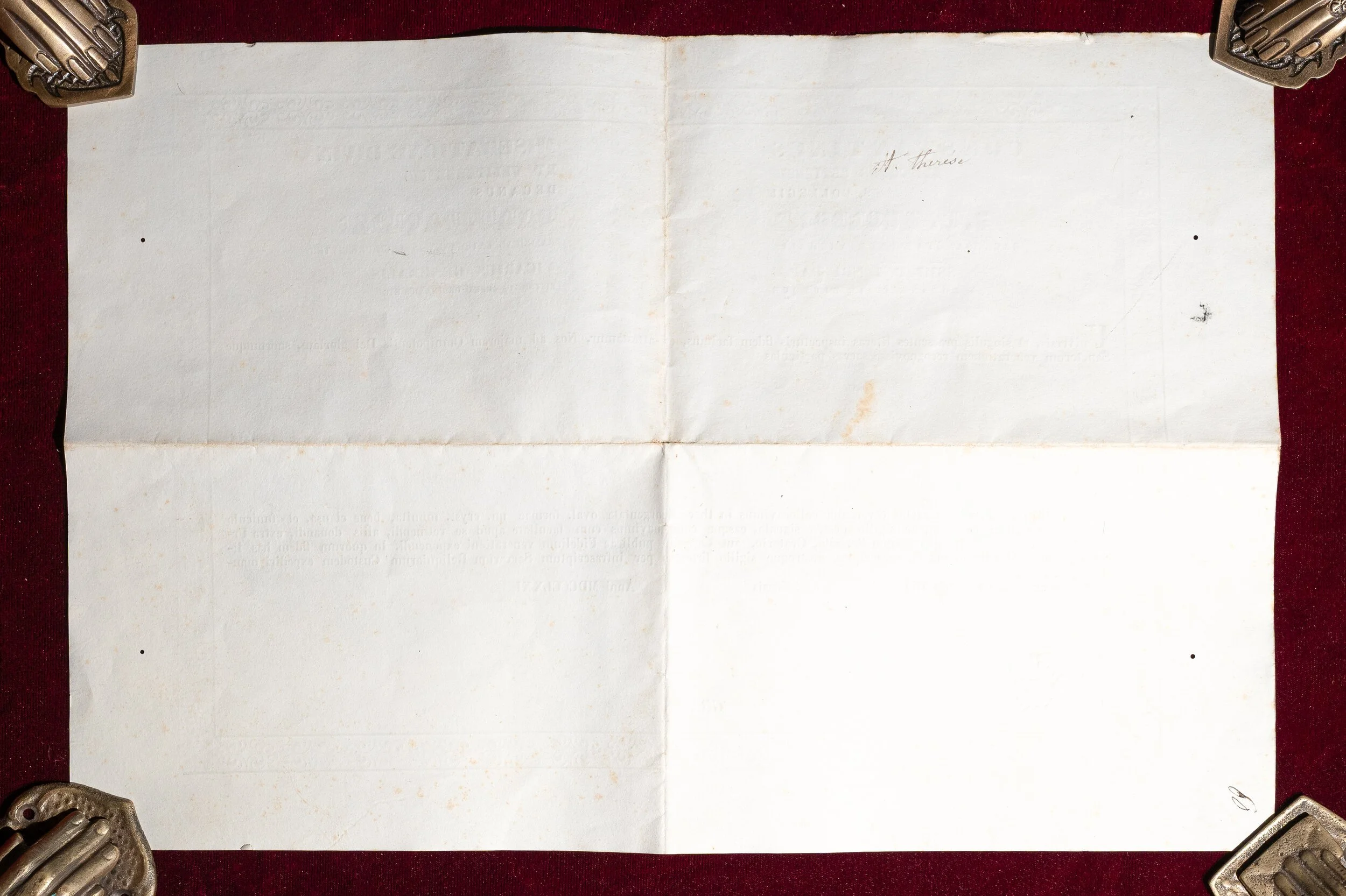 Image 8 of 8