The frontispiece of this book shows the absolute key of the occult sciences, given by Guillaume Postel and completed by Éliphas Lévi. Lévi had been promising this key for years. Dogme et Rituel de la Haute Magie set out the doctrine of magic in the 1850s. Histoire de la Magie gave its history in 1860. La Clef des Grands Mystères, published in 1861, is the final delivery. This is the first edition.
Éliphas Lévi was born Alphonse-Louis Constant, a Paris shoemaker's son who trained for the priesthood at Saint-Sulpice and left before ordination. In middle age he remade himself as a magician under a Hebrew version of his name, and he helped shape modern occultism: the conviction that kabbalah, alchemy and the tarot were one science wearing different masks. There is, Lévi says, a universal agent, at once a substance and a vibration, which he calls the astral light. He borrowed the term from the French mystics of the previous century.
The Clef is maximum Lévi. He answers questions like ‘What is truth?’ and ‘What is reality?’ He takes on Proudhon by name: "Yes, Proudhon, God is a hypothesis; but a hypothesis so necessary that without it every theorem becomes absurd or doubtful." Then the book descends, quite deliberately, from religion into practice. The final section prints prayers and conjurations from a manuscript called the Grimoire des Bergers, the shepherds' grimoire; a treatise of kabbalistic alchemy on the metals; an account of Saint Patrick's Purgatory; and the demons who govern the days of the week. Lucifer, the book notes, has Monday.
The plates are a good part of why collectors want this edition. Lévi drew his doctrines. The ten Sephiroth appear with the divine names, the tenth key of the tarot with its wheel and sphinx, the mysteries of the temple of Solomon, and three great star pantacles: a white star, a black star and a red star. The black one, la mauvaise étoile, is an inverted pentagram, solid black, with SATAN EST LA HAINE, Satan is hatred, at its center. Ideas that the Golden Dawn would later systematize and teach start here as pictures. Aleister Crowley thought enough of the book to translate it into English himself, as The Key of the Mysteries.
Our copy had an interesting reader. An early hand went through in pencil, cross-referencing text to plates: under the frontispiece key they wrote "V. p. 312," where Lévi explains Postel's key, and beside the passage on the flaming star they wrote "V. pentagramme rouge 312," pointing at the red pantacle, with a little star sketched in the margin for good measure. The annotations show a reader following the connections between text and illustrations. It comes in a vellum-backed binding with a gilt morocco label. Foxing and wear are detailed below.
LÉVI, ÉLIPHAS (Alphonse-Louis Constant). La Clef des Grands Mystères, suivant Hénoch, Abraham, Hermès Trismégiste, et Salomon. Paris: Germer Baillière, 1861. First edition.
Physical Description: Octavo, about 21 cm. iv, 598 pages, the printed numbering an error for 498: the pagination leaps by a hundred and no text is missing. Lithographed frontispiece and plates and figures throughout, the plates printed by Lemercier of Paris, the text by L. Martinet. Half-title present, its verso carrying the publisher's list of works by the same author, which gives the second edition of Dogme et Rituel de la Haute Magie as then in press.
References: BnF catalogue général, notice FRBNF30265157. Library of Congress, LCCN 68036955. HathiTrust record 000586017.
Binding: Vellum-backed boards, the spine with a red morocco label lettered in gilt. The vellum is soiled and rubbed, with wear at the head of the spine and along the front joint.
Condition: Scattered foxing throughout, heavier on some leaves; a closed tear at the fore-edge of the half-title; early pencil annotations as described above. The text block is sound.
Provenance: A small green bookseller's ticket of Jarvis & Foster, Lorne House, Bangor, is affixed at the gutter of the pastedown. The firm was active as printers, publishers and booksellers in Bangor, North Wales, around the turn of the twentieth century; the ticket places the book in Wales within a generation or two of publication.
The frontispiece of this book shows the absolute key of the occult sciences, given by Guillaume Postel and completed by Éliphas Lévi. Lévi had been promising this key for years. Dogme et Rituel de la Haute Magie set out the doctrine of magic in the 1850s. Histoire de la Magie gave its history in 1860. La Clef des Grands Mystères, published in 1861, is the final delivery. This is the first edition.
Éliphas Lévi was born Alphonse-Louis Constant, a Paris shoemaker's son who trained for the priesthood at Saint-Sulpice and left before ordination. In middle age he remade himself as a magician under a Hebrew version of his name, and he helped shape modern occultism: the conviction that kabbalah, alchemy and the tarot were one science wearing different masks. There is, Lévi says, a universal agent, at once a substance and a vibration, which he calls the astral light. He borrowed the term from the French mystics of the previous century.
The Clef is maximum Lévi. He answers questions like ‘What is truth?’ and ‘What is reality?’ He takes on Proudhon by name: "Yes, Proudhon, God is a hypothesis; but a hypothesis so necessary that without it every theorem becomes absurd or doubtful." Then the book descends, quite deliberately, from religion into practice. The final section prints prayers and conjurations from a manuscript called the Grimoire des Bergers, the shepherds' grimoire; a treatise of kabbalistic alchemy on the metals; an account of Saint Patrick's Purgatory; and the demons who govern the days of the week. Lucifer, the book notes, has Monday.
The plates are a good part of why collectors want this edition. Lévi drew his doctrines. The ten Sephiroth appear with the divine names, the tenth key of the tarot with its wheel and sphinx, the mysteries of the temple of Solomon, and three great star pantacles: a white star, a black star and a red star. The black one, la mauvaise étoile, is an inverted pentagram, solid black, with SATAN EST LA HAINE, Satan is hatred, at its center. Ideas that the Golden Dawn would later systematize and teach start here as pictures. Aleister Crowley thought enough of the book to translate it into English himself, as The Key of the Mysteries.
Our copy had an interesting reader. An early hand went through in pencil, cross-referencing text to plates: under the frontispiece key they wrote "V. p. 312," where Lévi explains Postel's key, and beside the passage on the flaming star they wrote "V. pentagramme rouge 312," pointing at the red pantacle, with a little star sketched in the margin for good measure. The annotations show a reader following the connections between text and illustrations. It comes in a vellum-backed binding with a gilt morocco label. Foxing and wear are detailed below.
LÉVI, ÉLIPHAS (Alphonse-Louis Constant). La Clef des Grands Mystères, suivant Hénoch, Abraham, Hermès Trismégiste, et Salomon. Paris: Germer Baillière, 1861. First edition.
Physical Description: Octavo, about 21 cm. iv, 598 pages, the printed numbering an error for 498: the pagination leaps by a hundred and no text is missing. Lithographed frontispiece and plates and figures throughout, the plates printed by Lemercier of Paris, the text by L. Martinet. Half-title present, its verso carrying the publisher's list of works by the same author, which gives the second edition of Dogme et Rituel de la Haute Magie as then in press.
References: BnF catalogue général, notice FRBNF30265157. Library of Congress, LCCN 68036955. HathiTrust record 000586017.
Binding: Vellum-backed boards, the spine with a red morocco label lettered in gilt. The vellum is soiled and rubbed, with wear at the head of the spine and along the front joint.
Condition: Scattered foxing throughout, heavier on some leaves; a closed tear at the fore-edge of the half-title; early pencil annotations as described above. The text block is sound.
Provenance: A small green bookseller's ticket of Jarvis & Foster, Lorne House, Bangor, is affixed at the gutter of the pastedown. The firm was active as printers, publishers and booksellers in Bangor, North Wales, around the turn of the twentieth century; the ticket places the book in Wales within a generation or two of publication.

 Image 1 of 22
 Image 2 of 22
 Image 3 of 22
 Image 4 of 22
 Image 5 of 22
 Image 6 of 22
 Image 7 of 22
 Image 8 of 22
 Image 9 of 22
 Image 10 of 22
 Image 11 of 22
 Image 12 of 22
 Image 13 of 22
 Image 14 of 22
 Image 15 of 22
 Image 16 of 22
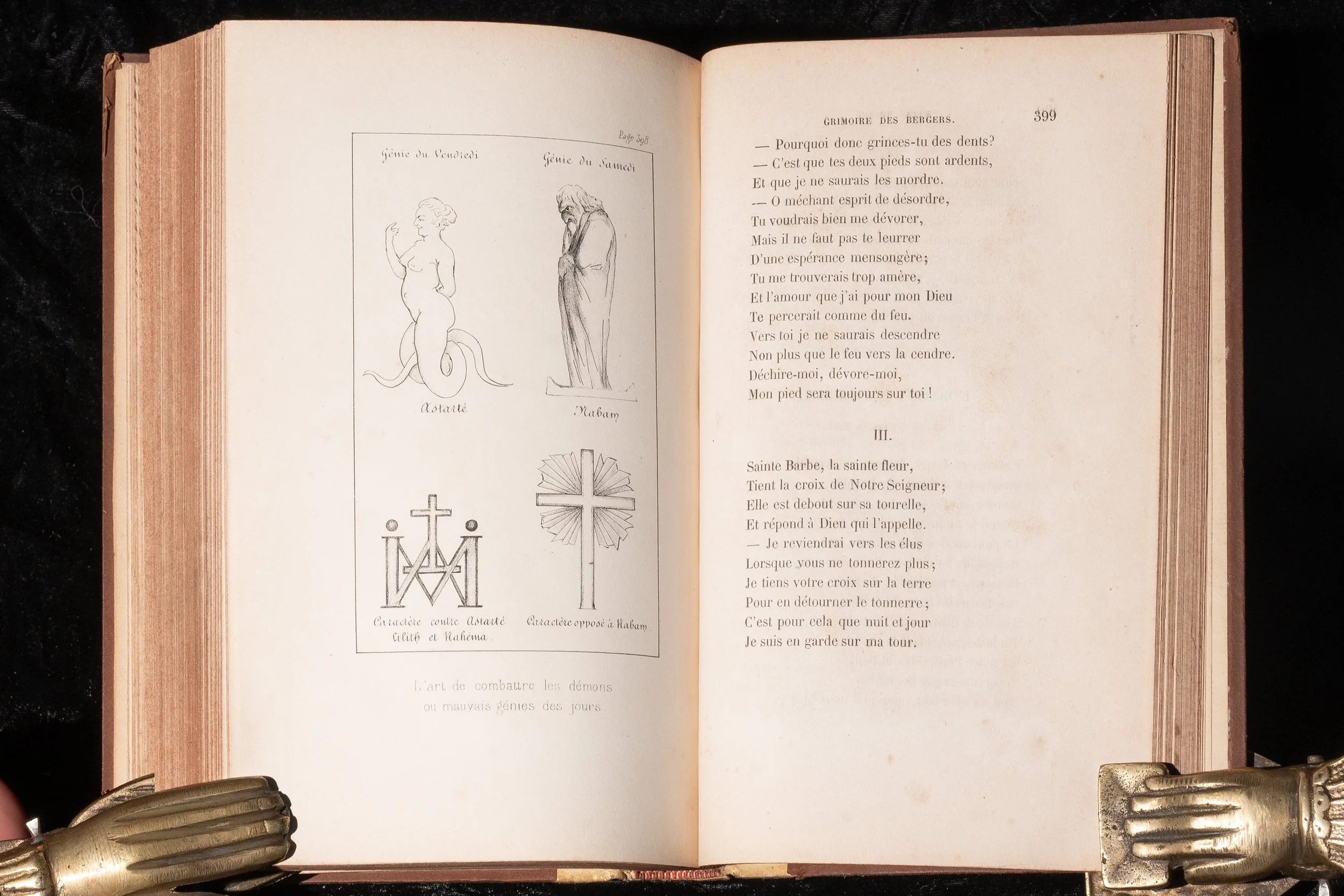 Image 17 of 22
 Image 18 of 22
 Image 19 of 22
 Image 20 of 22
 Image 21 of 22
 Image 22 of 22