Every catalog we issue is full of books about the soul: how to save it, how to follow it beyond the grave. Here is the century's great book against it. Ludwig Büchner's Kraft und Stoff, "Force and Matter," published at Frankfurt in 1855, is the manifesto of scientific materialism. It told the nineteenth century that there is nothing but matter and its forces, eternal and indestructible. The chapter list reads like a deliberate inversion of a devotional manual: the Immortality of Matter, the Dignity of Matter, the Immutability of Natural Law, Brain and Soul, the God-Idea, Personal Continuation, the Animal Soul, Free Will. Büchner treats thought as a function of the brain, while criticizing Carl Vogt’s comparison of thought with bodily secretions. The soul of the séance room and the philosopher's study dissolves, chapter by chapter, into chemistry.
The scandal was immediate. Büchner was a young physician lecturing at Tübingen — the title page styles him "Privatdocent in Tübingen." He was forced from his post within the year. He retreated to medical practice in Darmstadt and spent the rest of his life there, tending patients and stoking the fire. The book became one of the most read and most denounced works in Europe: numerous German editions and translations into seventeen languages. It was the standard armament of freethinkers and rebellious students everywhere. When Turgenev needed a single object to signify the new generation in Fathers and Sons, he had his young nihilists press Büchner's book on their elders. The historians of the book have canonized it as well. This is Printing and the Mind of Man 338, one of the select few hundred books judged to have shaped the modern mind. Its author, incidentally, came from a family with a talent for scandal: he was the younger brother of Georg Büchner, the playwright of Woyzeck, whose works he edited.
The first edition of 1855 is the one to have, printed before the title page dropped the Tübingen credential that Büchner lost for writing the book. This copy has substantial binding wear. The dark cloth is rubbed through at the extremities. On the flyleaf are the ink inscriptions of its nineteenth-century Czech owners, one signature struck through. The latest, dated 1874, reads Jos. Vinc. Bureš.
Provenance: Ink ownership inscriptions of nineteenth-century Czech owners to the front flyleaf: an earlier signature struck through, and "Jos. Vinc. Bureš," with a place-name (a Bohemian or Moravian town, the reading uncertain), dated 18 April 1874.
BÜCHNER, Ludwig (Louis) (1824-1899). Kraft und Stoff. Empirisch-naturphilosophische Studien. In allgemein-verständlicher Darstellung. Frankfurt am Main: Verlag von Meidinger Sohn & Cie., 1855. First edition. Printing and the Mind of Man 338.
Physical Description: Octavo. xvi, 269, [3] pp. (the concluding section, Schlußbetrachtungen, beginning at p. 259).
Binding: Publisher's cloth, spine lettered in gilt ("Büchner's Kraft und Stoff").
Condition: A worn, well-used copy: cloth heavily rubbed with losses to the surface, spine ends and corners frayed, hinges strained but holding; internally toned with scattered spotting, contents complete and legible throughout. Sold as a reading copy of a landmark book.
Every catalog we issue is full of books about the soul: how to save it, how to follow it beyond the grave. Here is the century's great book against it. Ludwig Büchner's Kraft und Stoff, "Force and Matter," published at Frankfurt in 1855, is the manifesto of scientific materialism. It told the nineteenth century that there is nothing but matter and its forces, eternal and indestructible. The chapter list reads like a deliberate inversion of a devotional manual: the Immortality of Matter, the Dignity of Matter, the Immutability of Natural Law, Brain and Soul, the God-Idea, Personal Continuation, the Animal Soul, Free Will. Büchner treats thought as a function of the brain, while criticizing Carl Vogt’s comparison of thought with bodily secretions. The soul of the séance room and the philosopher's study dissolves, chapter by chapter, into chemistry.
The scandal was immediate. Büchner was a young physician lecturing at Tübingen — the title page styles him "Privatdocent in Tübingen." He was forced from his post within the year. He retreated to medical practice in Darmstadt and spent the rest of his life there, tending patients and stoking the fire. The book became one of the most read and most denounced works in Europe: numerous German editions and translations into seventeen languages. It was the standard armament of freethinkers and rebellious students everywhere. When Turgenev needed a single object to signify the new generation in Fathers and Sons, he had his young nihilists press Büchner's book on their elders. The historians of the book have canonized it as well. This is Printing and the Mind of Man 338, one of the select few hundred books judged to have shaped the modern mind. Its author, incidentally, came from a family with a talent for scandal: he was the younger brother of Georg Büchner, the playwright of Woyzeck, whose works he edited.
The first edition of 1855 is the one to have, printed before the title page dropped the Tübingen credential that Büchner lost for writing the book. This copy has substantial binding wear. The dark cloth is rubbed through at the extremities. On the flyleaf are the ink inscriptions of its nineteenth-century Czech owners, one signature struck through. The latest, dated 1874, reads Jos. Vinc. Bureš.
Provenance: Ink ownership inscriptions of nineteenth-century Czech owners to the front flyleaf: an earlier signature struck through, and "Jos. Vinc. Bureš," with a place-name (a Bohemian or Moravian town, the reading uncertain), dated 18 April 1874.
BÜCHNER, Ludwig (Louis) (1824-1899). Kraft und Stoff. Empirisch-naturphilosophische Studien. In allgemein-verständlicher Darstellung. Frankfurt am Main: Verlag von Meidinger Sohn & Cie., 1855. First edition. Printing and the Mind of Man 338.
Physical Description: Octavo. xvi, 269, [3] pp. (the concluding section, Schlußbetrachtungen, beginning at p. 259).
Binding: Publisher's cloth, spine lettered in gilt ("Büchner's Kraft und Stoff").
Condition: A worn, well-used copy: cloth heavily rubbed with losses to the surface, spine ends and corners frayed, hinges strained but holding; internally toned with scattered spotting, contents complete and legible throughout. Sold as a reading copy of a landmark book.

 Image 1 of 7
 Image 2 of 7
 Image 3 of 7
 Image 4 of 7
 Image 5 of 7
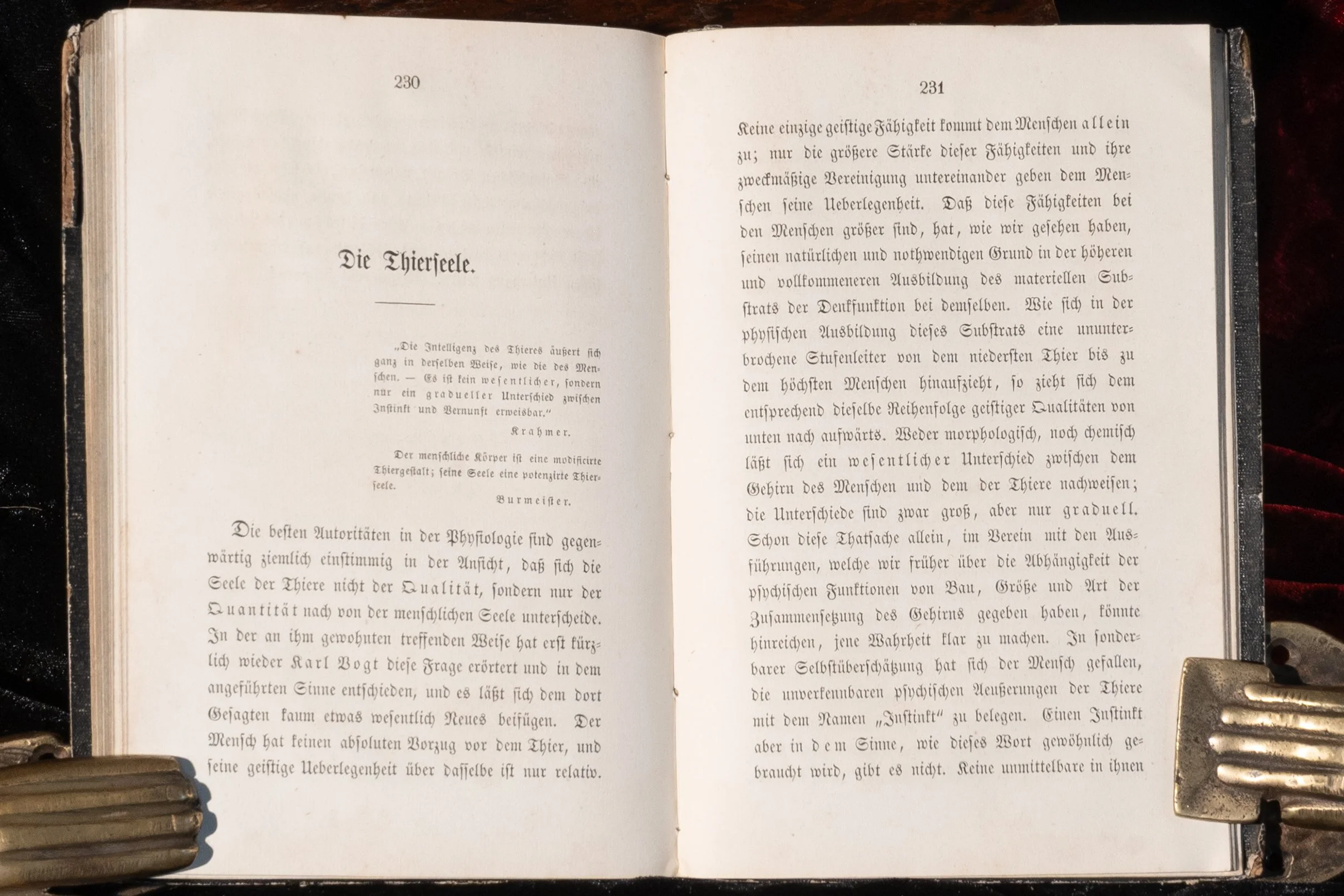 Image 6 of 7
 Image 7 of 7