This is the real thing: a working handbook of Pennsylvania German folk magic, the tradition the Pennsylvania Dutch called powwow or Braucherei, printed in German in Pennsylvania in 1847 for farmers and healers who used it at the kitchen table and the barn door. Its title promises a "long-hidden treasure and house-friend," a "faithful and Christian instruction for everyone," and it delivers more than three hundred charms, cures, and arts for "the ailments of people and of cattle." Books like this one are the closest thing American folk culture produced to a printed grimoire, and they were read nearly to pieces, which is part of what makes an honest survival like this worth having.
Open it almost anywhere and the world of the braucher comes to life. To stop a fever you write out the old magical diminishing-charm, ABAXACATABAX, line by line until it dwindles letter by letter to a single A, sew it into a rag, and hang it at the throat. To heal a burn you command the fire itself: "Weich aus, Brand," begone, be you cold or hot, in the name of the Father, the Son, and the Holy Ghost. Against witchcraft and the Devil's work in livestock you give the beast the most famous word-square in Western magic, the Roman SATOR / AREPO / TENET / OPERA / ROTAS palindrome, which reads the same in every direction. To win your case before a judge you carry the letters of the Cross, "Jesus Nazarenus, Rex Judeorum," and recite a charm of three dead men at the courthouse window. There are remedies to staunch blood, to bind thieves so they cannot move, to keep dogs from barking, to make a divining rod, to render a man's gun unable to fire, and the strange tender charm in which the Virgin walks the land holding three worms, one white, one black, one red, to drive the worms from a sick child or a sick cow.
The book belongs to the most important strand of American folk magic in print. It descends directly from Johann Georg Hohman's celebrated Der lange verborgene Freund, the "Long Lost Friend" first issued near Reading in 1820, the single most influential corpus of charms among the Pennsylvania Germans. This is its expanded cousin, the Schatz und Haus-Freund, which dressed the same body of spells in an exotic pedigree, claiming on its title page to have been translated "from the Arabic writings of the wise alchemist Omar Arey, Emir Chemir Tschasmir," a wholly invented authority first attached to the text in a Skippacksville, Pennsylvania printing of 1837. This copy is the "second enlarged and improved American edition," its editor's name discreetly blanked on the title as was the custom with such slightly disreputable books, printed in Pennsylvania in 1847.
The binding is its own small marvel and the reason it stands out among surviving powwow books. Rather than the usual printed wrappers, this copy is bound in plain drab boards with a humble parchment-paper spine, and the binder lined it with waste paper, the rear pastedown taken from a wrapper of Godey's Lady's Book, the most genteel and fashionable American magazine of its day. The collision is delightful: the polite parlor world of Godey's fashion plates pressed directly against three hundred barnyard spells and devil-binding charms. The boards carry a few period pencil scrawls, the doodles of an early owner. Condition is honest and complete, the leaves toned and lightly foxed as always with this cheaply made paper, the boards rubbed and worn, the text sound. German-language powwow imprints of this date are uncommon in commerce, and one in untouched original state, with so vivid a binding, is the kind of folk-magic object that rarely turns up twice.
[POWWOW / BRAUCHEREI FOLK MAGIC]. Der lange verborgene Schatz und Haus-Freund, oder getreuer und christlicher Unterricht für Jedermann. Enthaltend wunderbare und erprobte Mittel und Künste, für die Gebrechen der Menschen und am Vieh. Aus den arabischen Schriften des weisen Alchymisten Omar Arey, Emir Chemir Tschasmir, ins Deutsche übersetzt und mit noch vielen andern Künsten vermehrt. Zweite vermehrte und verbesserte amerikanische Auflage. Herausgegeben von J. H[......]s. Gedruckt in Pennsylvanien, A.D. 1847.
Physical Description: Small 8vo / 12mo. Text in German (Fraktur), comprising over 300 numbered charms, cures, and arts ("Mittel und Künste"), with a closing alphabetical index of remedies; pagination to at least p.127 (text concludes with the index and the note that the book "contains in all over 300 remedies and recipes").
Binding: Original plain drab paper-covered boards with a parchment-paper (vellum-paper) spine; bound with printer's/binder's waste, the rear pastedown a leaf from a wrapper of Godey's Lady's Book. Period pencil markings to the boards.
Condition: Good and complete, honestly worn. Leaves toned and lightly foxed (typical of the cheap stock); boards rubbed, soiled, and edge-worn; spine paper chipped. A sound, untouched survival in original state.
References: Atwater 1674 (per source dealer). In the tradition of Hohman, Der lange verborgene Freund (Reading, 1820); cf. the Omar Arey recension first printed at Skippacksville, Pa., 1837.
This is the real thing: a working handbook of Pennsylvania German folk magic, the tradition the Pennsylvania Dutch called powwow or Braucherei, printed in German in Pennsylvania in 1847 for farmers and healers who used it at the kitchen table and the barn door. Its title promises a "long-hidden treasure and house-friend," a "faithful and Christian instruction for everyone," and it delivers more than three hundred charms, cures, and arts for "the ailments of people and of cattle." Books like this one are the closest thing American folk culture produced to a printed grimoire, and they were read nearly to pieces, which is part of what makes an honest survival like this worth having.
Open it almost anywhere and the world of the braucher comes to life. To stop a fever you write out the old magical diminishing-charm, ABAXACATABAX, line by line until it dwindles letter by letter to a single A, sew it into a rag, and hang it at the throat. To heal a burn you command the fire itself: "Weich aus, Brand," begone, be you cold or hot, in the name of the Father, the Son, and the Holy Ghost. Against witchcraft and the Devil's work in livestock you give the beast the most famous word-square in Western magic, the Roman SATOR / AREPO / TENET / OPERA / ROTAS palindrome, which reads the same in every direction. To win your case before a judge you carry the letters of the Cross, "Jesus Nazarenus, Rex Judeorum," and recite a charm of three dead men at the courthouse window. There are remedies to staunch blood, to bind thieves so they cannot move, to keep dogs from barking, to make a divining rod, to render a man's gun unable to fire, and the strange tender charm in which the Virgin walks the land holding three worms, one white, one black, one red, to drive the worms from a sick child or a sick cow.
The book belongs to the most important strand of American folk magic in print. It descends directly from Johann Georg Hohman's celebrated Der lange verborgene Freund, the "Long Lost Friend" first issued near Reading in 1820, the single most influential corpus of charms among the Pennsylvania Germans. This is its expanded cousin, the Schatz und Haus-Freund, which dressed the same body of spells in an exotic pedigree, claiming on its title page to have been translated "from the Arabic writings of the wise alchemist Omar Arey, Emir Chemir Tschasmir," a wholly invented authority first attached to the text in a Skippacksville, Pennsylvania printing of 1837. This copy is the "second enlarged and improved American edition," its editor's name discreetly blanked on the title as was the custom with such slightly disreputable books, printed in Pennsylvania in 1847.
The binding is its own small marvel and the reason it stands out among surviving powwow books. Rather than the usual printed wrappers, this copy is bound in plain drab boards with a humble parchment-paper spine, and the binder lined it with waste paper, the rear pastedown taken from a wrapper of Godey's Lady's Book, the most genteel and fashionable American magazine of its day. The collision is delightful: the polite parlor world of Godey's fashion plates pressed directly against three hundred barnyard spells and devil-binding charms. The boards carry a few period pencil scrawls, the doodles of an early owner. Condition is honest and complete, the leaves toned and lightly foxed as always with this cheaply made paper, the boards rubbed and worn, the text sound. German-language powwow imprints of this date are uncommon in commerce, and one in untouched original state, with so vivid a binding, is the kind of folk-magic object that rarely turns up twice.
[POWWOW / BRAUCHEREI FOLK MAGIC]. Der lange verborgene Schatz und Haus-Freund, oder getreuer und christlicher Unterricht für Jedermann. Enthaltend wunderbare und erprobte Mittel und Künste, für die Gebrechen der Menschen und am Vieh. Aus den arabischen Schriften des weisen Alchymisten Omar Arey, Emir Chemir Tschasmir, ins Deutsche übersetzt und mit noch vielen andern Künsten vermehrt. Zweite vermehrte und verbesserte amerikanische Auflage. Herausgegeben von J. H[......]s. Gedruckt in Pennsylvanien, A.D. 1847.
Physical Description: Small 8vo / 12mo. Text in German (Fraktur), comprising over 300 numbered charms, cures, and arts ("Mittel und Künste"), with a closing alphabetical index of remedies; pagination to at least p.127 (text concludes with the index and the note that the book "contains in all over 300 remedies and recipes").
Binding: Original plain drab paper-covered boards with a parchment-paper (vellum-paper) spine; bound with printer's/binder's waste, the rear pastedown a leaf from a wrapper of Godey's Lady's Book. Period pencil markings to the boards.
Condition: Good and complete, honestly worn. Leaves toned and lightly foxed (typical of the cheap stock); boards rubbed, soiled, and edge-worn; spine paper chipped. A sound, untouched survival in original state.
References: Atwater 1674 (per source dealer). In the tradition of Hohman, Der lange verborgene Freund (Reading, 1820); cf. the Omar Arey recension first printed at Skippacksville, Pa., 1837.

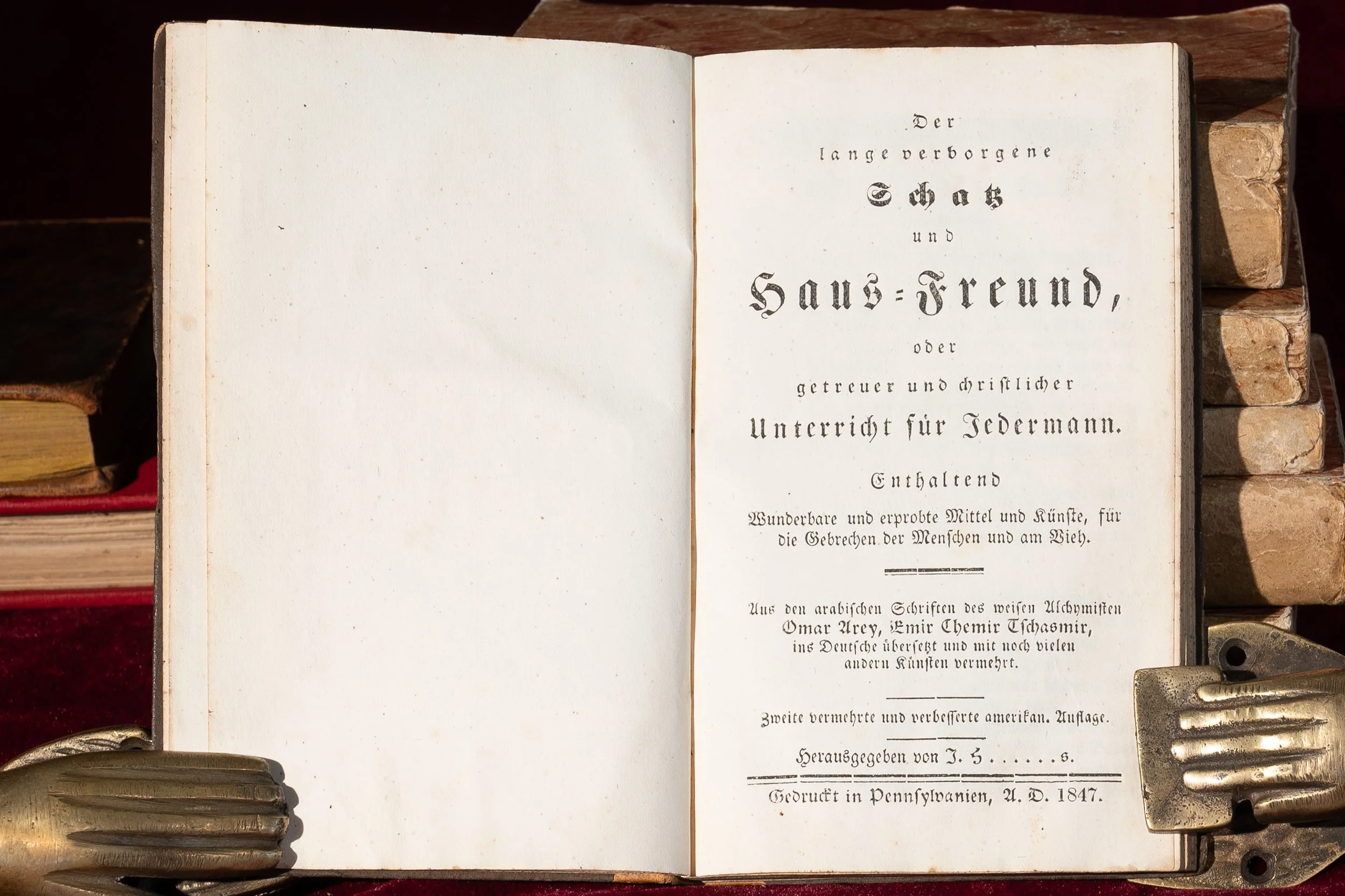 Image 1 of 7
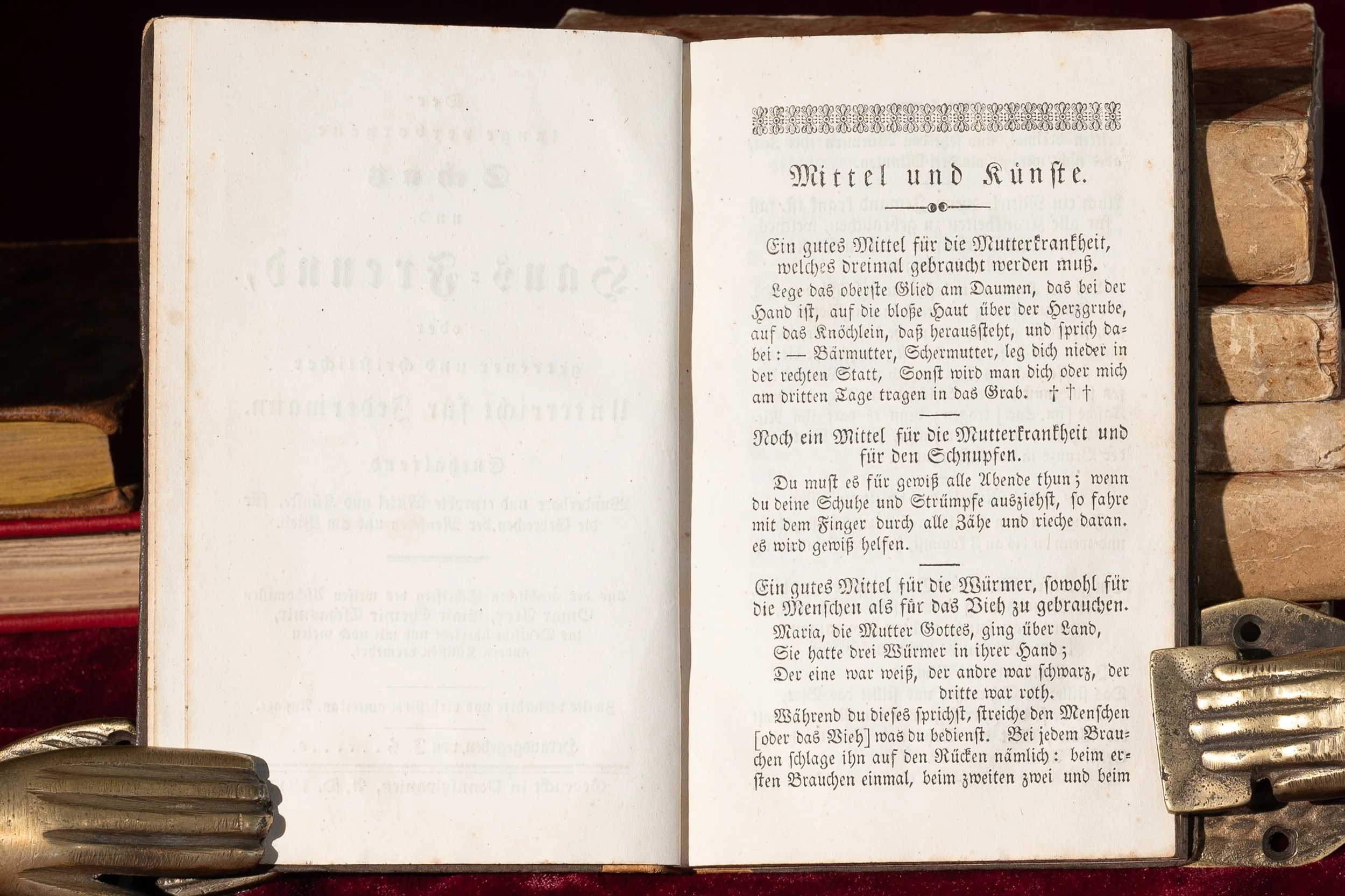 Image 2 of 7
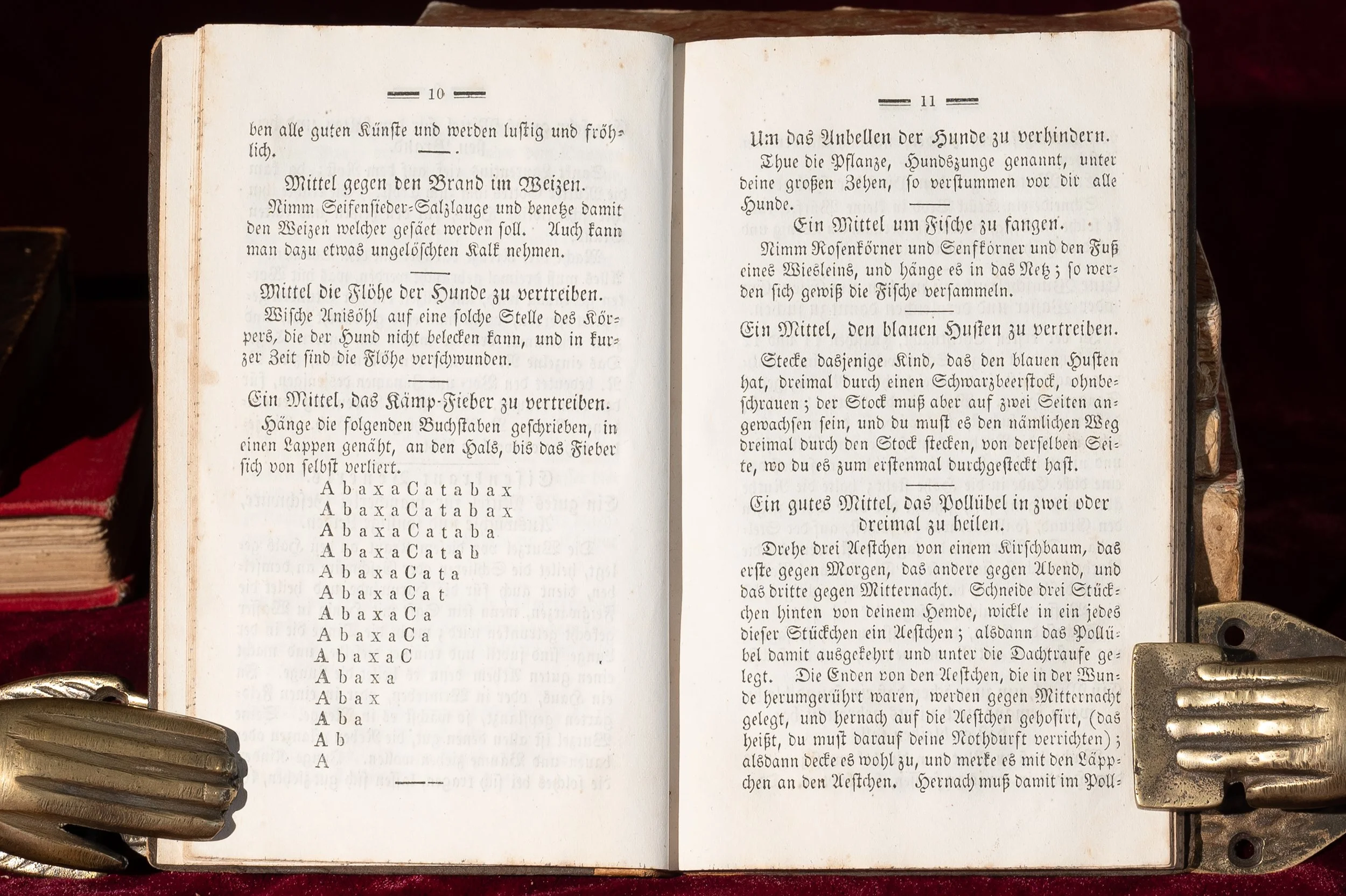 Image 3 of 7
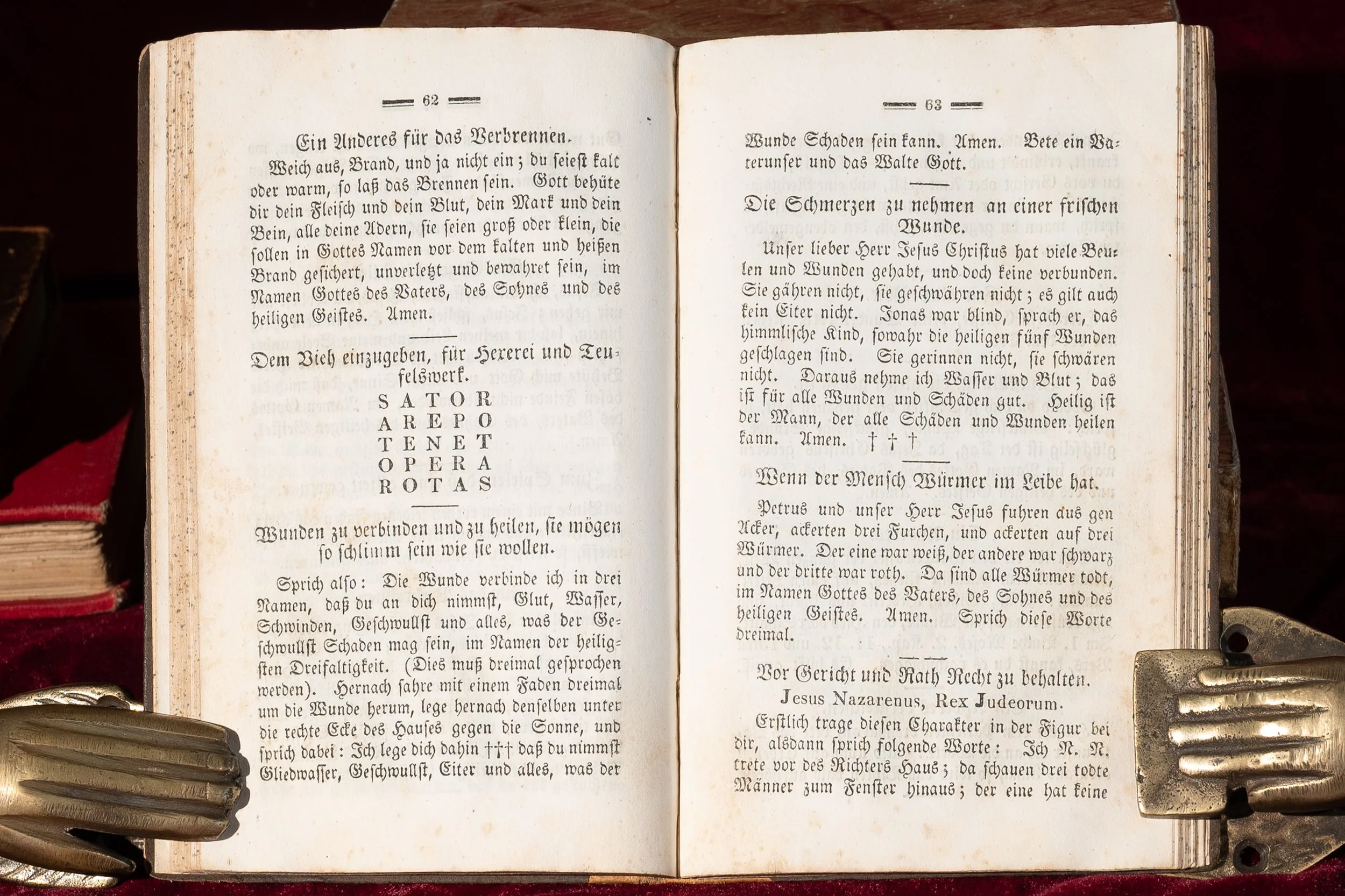 Image 4 of 7
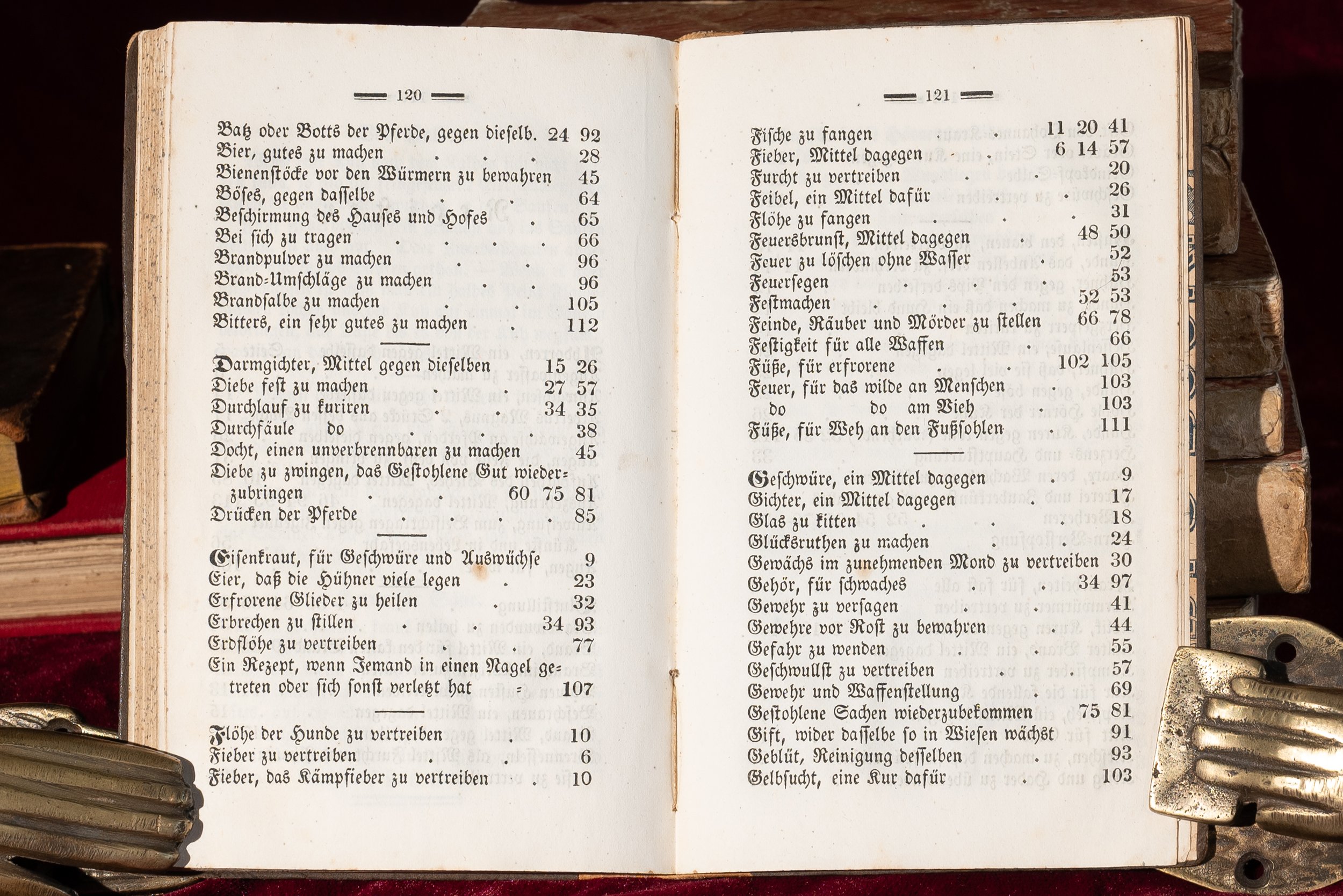 Image 5 of 7
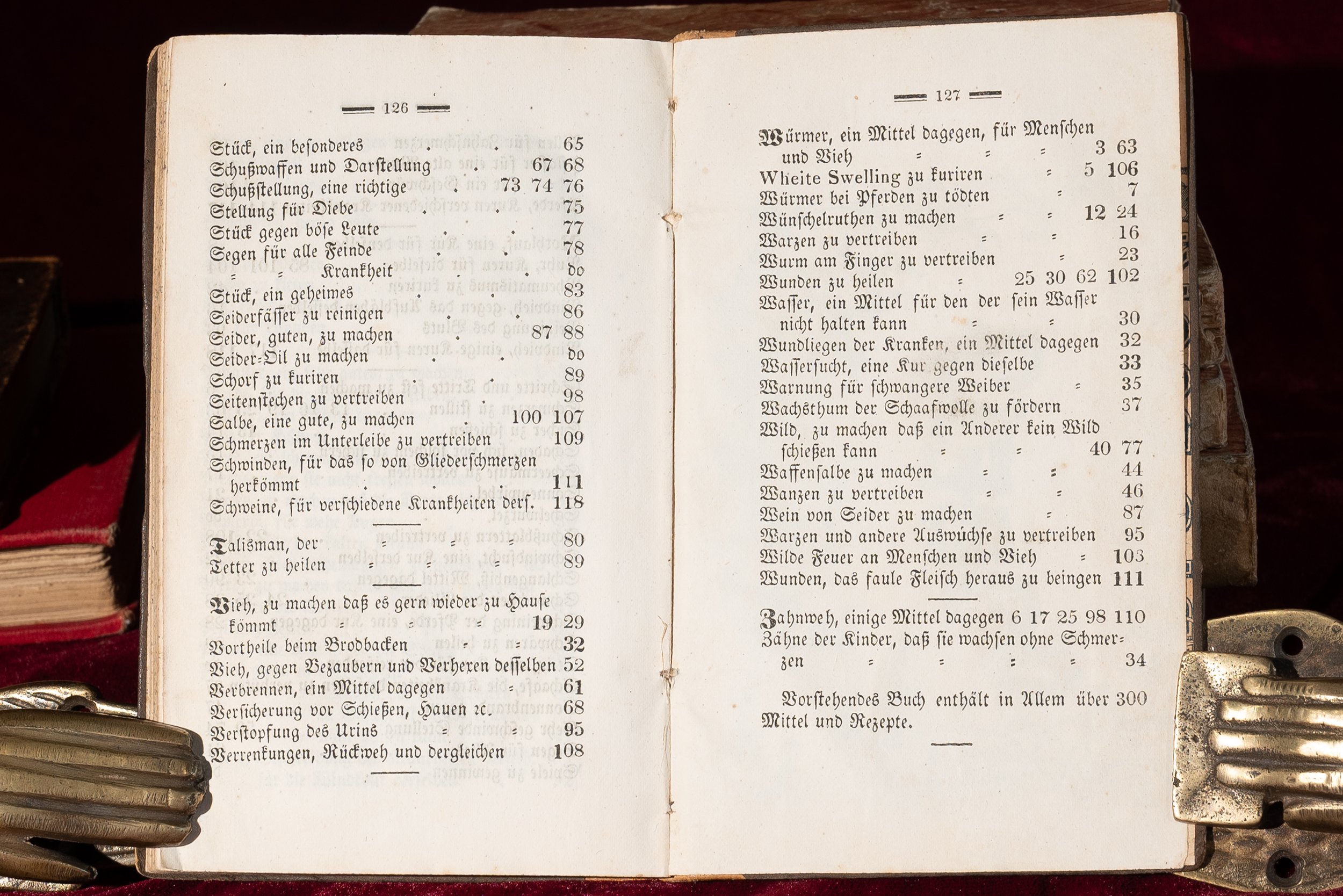 Image 6 of 7
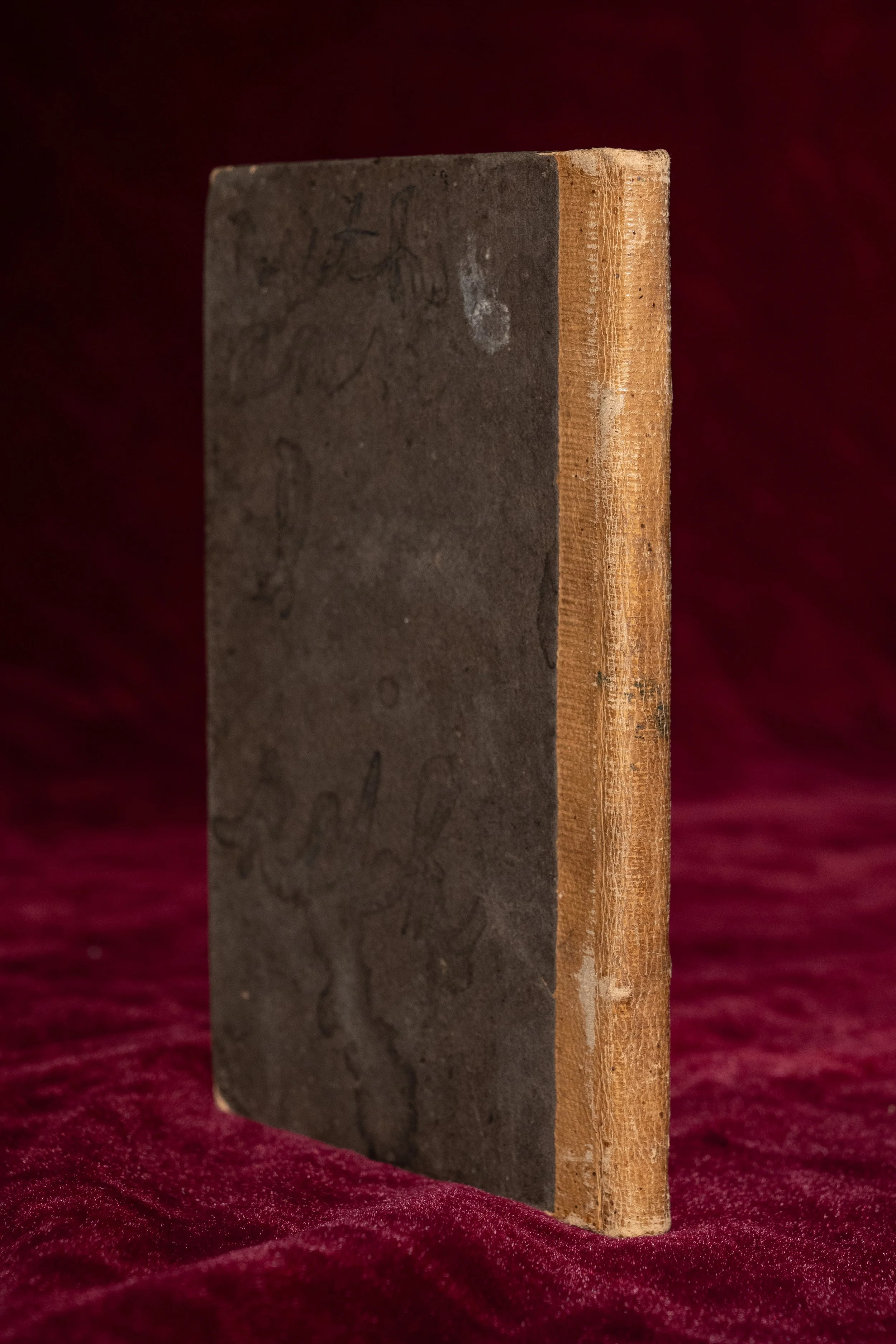 Image 7 of 7