This is one of the stranger and more moving religious autobiographies of the early American republic: the full life-story of Eleazer Sherman, a poor cabinetmaker turned wandering preacher who walked the roads of New England and Georgia in the 1810s and 1820s, certain that God spoke to him through dreams. The Christian Connection, the loose and radically lay denomination he served, was one of the era's most enthusiastic, and Sherman's pages are full of exactly the kind of visionary experience the polite churches were beginning to distrust: the inward voice, the prophetic dream, the swoon before God. He preaches by impulse, refusing even a prayer-book ("I did not pray from the prayer-book," he tells a puzzled stranger, since "that outward vail" of the temple was rent at the crucifixion), and he reads the future in his sleep.
The dreams are the heart of it. Sherman is "forewarned in a dream of the death of my brother," and describes following the coffin up a windswept hill before waking to find the vision had "seemed as though it had been a reality." Elsewhere he dreams his furniture-shop and all his property destroyed by fire, and within days a messenger arrives to tell him his business partner has failed and everything is gone. He sits on a coroner's jury over a body pulled from the river, buries a pauper out of his own pocket, and records revival after revival in Newport, Troy, Providence, and Fall River, often in the company of the legendary eccentric itinerant Lorenzo Dow. The prose is plain to the point of starkness and all the more powerful for it.
The volume gathers the complete narrative, here printed for the first time as a single continuous work in three parts, and closes with an appendix of hymns and a remarkable piece of trance-poetry attributed to the Quaker Job Scott, composed at sea, in which the divine voice itself speaks in the first person: "I hold the helm, in awfulness preside, I rule the storm and on the ocean ride." Bound in at the end is Sherman's separately-issued sermon, A Discourse Addressed to Christians of all Denominations, in its second edition, with concluding remarks on the cholera then sweeping the country in 1832. Among the most pointed passages is Sherman's attack on a hireling, seminary-trained clergy: no man, he insists, "ought to enter the ministry to preach, because he has been taught by man," for Paul "did not receive his commission from man," and the educated preacher who feels no true call "must prove a curse, instead of a blessing."
Sherman has lately drawn fresh attention from historians of gender and sexuality in early America. He is the subject of scholarship by the historian Bruce Dorsey, who treats him as a rare and revealing case in the study of intimacy, desire, and the policing of male pleasure within the antebellum evangelical revival, an episode that has made this otherwise obscure preacher a touchstone in the recovery of a queer religious past. The book is likewise catalogued among the Library Company of Philadelphia's Afro-Americana Imprints, placing it within the bibliography of early African American and African-descended authorship, a point a serious buyer will want to weigh for themselves. Either way it is a scarce primary source that rewards more than one kind of reader.
The copy is housed in its original tree-calf binding with a red morocco spine label lettered "LIFE OF SHERMAN," honestly worn, and is internally clean apart from the expected foxing and damp-staining of a hard-used New England devotional book. It is an uncommon survival of grass-roots American visionary religion, and a book that several different collections, of early American religious enthusiasm, of the Western visionary and mystical tradition, of queer history, and of Afro-Americana, can each lay claim to.
SHERMAN, Eleazer (b. 1795). The Narrative of Eleazer Sherman, Giving an Account of His Life, Experience, Call to the Ministry of the Gospel, and Travels as Such to the Present Time. Three volumes in one (first complete edition). Providence: Printed by H. H. Brown, 1832. [Bound with:] A Discourse Addressed to Christians of all Denominations. Second edition. Providence, 1832 [1833], with concluding remarks on the cholera.
Physical Description: 12mo. The Narrative in three parts, paginated 83; 57; 107 pp., the third part concluding with an Appendix of hymns and poetry; followed by the bound-in second edition of the Discourse. Church-membership certificate (Middleborough, 1828) and copyright notice (District of Rhode-Island, 1832) at front.
Binding: Contemporary American tree calf, spine with raised bands ruled in gilt, red morocco lettering-piece gilt "LIFE OF SHERMAN," edges stained yellow.
Condition: Good, honestly worn. Leather rubbed, scuffed, and chipped at the spine ends and joints, corners worn; internally with scattered foxing and damp-staining (notably to the lower margins), the text otherwise sound and complete. Early ink and later pencil bibliographical notes to the endpapers.
This is one of the stranger and more moving religious autobiographies of the early American republic: the full life-story of Eleazer Sherman, a poor cabinetmaker turned wandering preacher who walked the roads of New England and Georgia in the 1810s and 1820s, certain that God spoke to him through dreams. The Christian Connection, the loose and radically lay denomination he served, was one of the era's most enthusiastic, and Sherman's pages are full of exactly the kind of visionary experience the polite churches were beginning to distrust: the inward voice, the prophetic dream, the swoon before God. He preaches by impulse, refusing even a prayer-book ("I did not pray from the prayer-book," he tells a puzzled stranger, since "that outward vail" of the temple was rent at the crucifixion), and he reads the future in his sleep.
The dreams are the heart of it. Sherman is "forewarned in a dream of the death of my brother," and describes following the coffin up a windswept hill before waking to find the vision had "seemed as though it had been a reality." Elsewhere he dreams his furniture-shop and all his property destroyed by fire, and within days a messenger arrives to tell him his business partner has failed and everything is gone. He sits on a coroner's jury over a body pulled from the river, buries a pauper out of his own pocket, and records revival after revival in Newport, Troy, Providence, and Fall River, often in the company of the legendary eccentric itinerant Lorenzo Dow. The prose is plain to the point of starkness and all the more powerful for it.
The volume gathers the complete narrative, here printed for the first time as a single continuous work in three parts, and closes with an appendix of hymns and a remarkable piece of trance-poetry attributed to the Quaker Job Scott, composed at sea, in which the divine voice itself speaks in the first person: "I hold the helm, in awfulness preside, I rule the storm and on the ocean ride." Bound in at the end is Sherman's separately-issued sermon, A Discourse Addressed to Christians of all Denominations, in its second edition, with concluding remarks on the cholera then sweeping the country in 1832. Among the most pointed passages is Sherman's attack on a hireling, seminary-trained clergy: no man, he insists, "ought to enter the ministry to preach, because he has been taught by man," for Paul "did not receive his commission from man," and the educated preacher who feels no true call "must prove a curse, instead of a blessing."
Sherman has lately drawn fresh attention from historians of gender and sexuality in early America. He is the subject of scholarship by the historian Bruce Dorsey, who treats him as a rare and revealing case in the study of intimacy, desire, and the policing of male pleasure within the antebellum evangelical revival, an episode that has made this otherwise obscure preacher a touchstone in the recovery of a queer religious past. The book is likewise catalogued among the Library Company of Philadelphia's Afro-Americana Imprints, placing it within the bibliography of early African American and African-descended authorship, a point a serious buyer will want to weigh for themselves. Either way it is a scarce primary source that rewards more than one kind of reader.
The copy is housed in its original tree-calf binding with a red morocco spine label lettered "LIFE OF SHERMAN," honestly worn, and is internally clean apart from the expected foxing and damp-staining of a hard-used New England devotional book. It is an uncommon survival of grass-roots American visionary religion, and a book that several different collections, of early American religious enthusiasm, of the Western visionary and mystical tradition, of queer history, and of Afro-Americana, can each lay claim to.
SHERMAN, Eleazer (b. 1795). The Narrative of Eleazer Sherman, Giving an Account of His Life, Experience, Call to the Ministry of the Gospel, and Travels as Such to the Present Time. Three volumes in one (first complete edition). Providence: Printed by H. H. Brown, 1832. [Bound with:] A Discourse Addressed to Christians of all Denominations. Second edition. Providence, 1832 [1833], with concluding remarks on the cholera.
Physical Description: 12mo. The Narrative in three parts, paginated 83; 57; 107 pp., the third part concluding with an Appendix of hymns and poetry; followed by the bound-in second edition of the Discourse. Church-membership certificate (Middleborough, 1828) and copyright notice (District of Rhode-Island, 1832) at front.
Binding: Contemporary American tree calf, spine with raised bands ruled in gilt, red morocco lettering-piece gilt "LIFE OF SHERMAN," edges stained yellow.
Condition: Good, honestly worn. Leather rubbed, scuffed, and chipped at the spine ends and joints, corners worn; internally with scattered foxing and damp-staining (notably to the lower margins), the text otherwise sound and complete. Early ink and later pencil bibliographical notes to the endpapers.

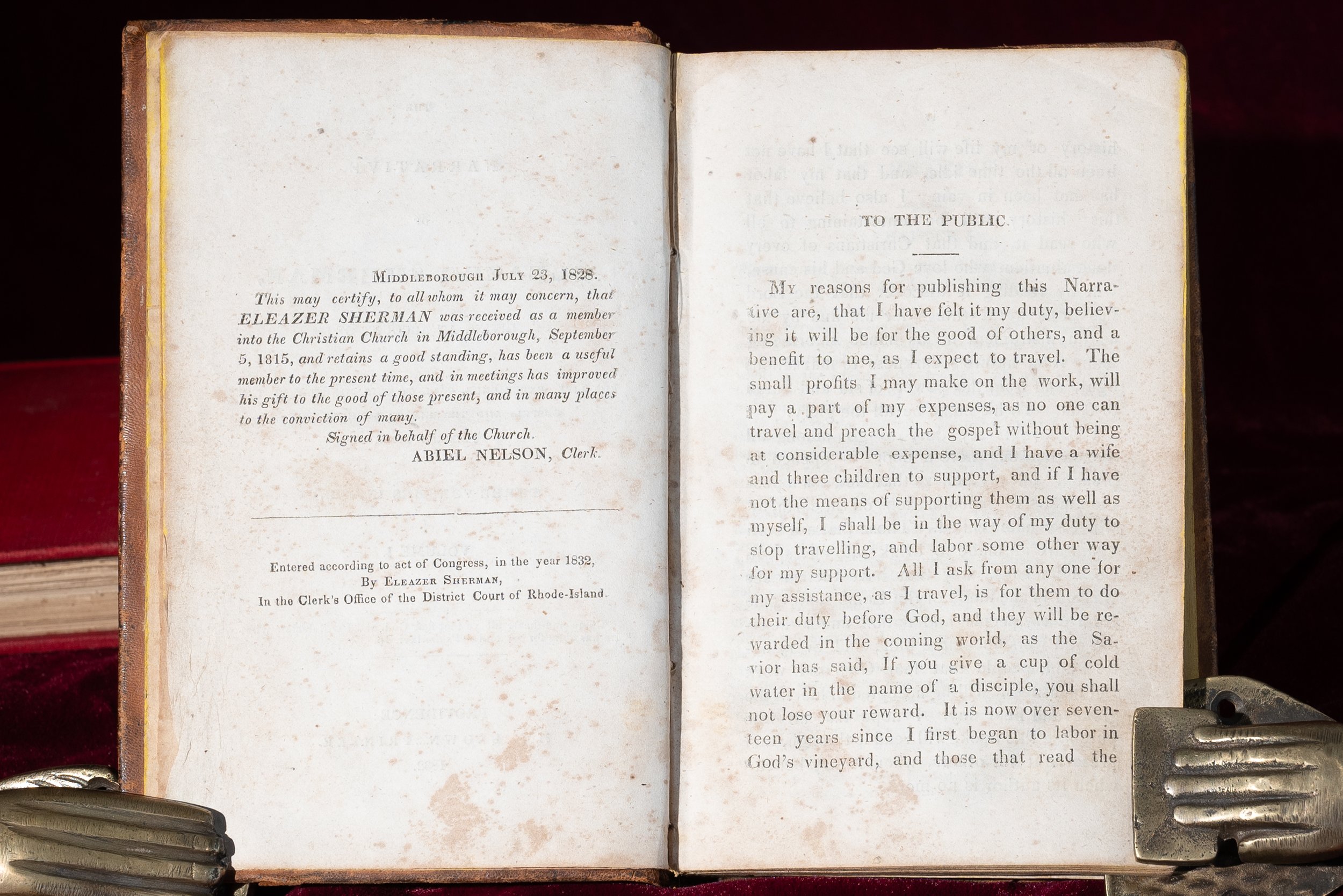 Image 1 of 9
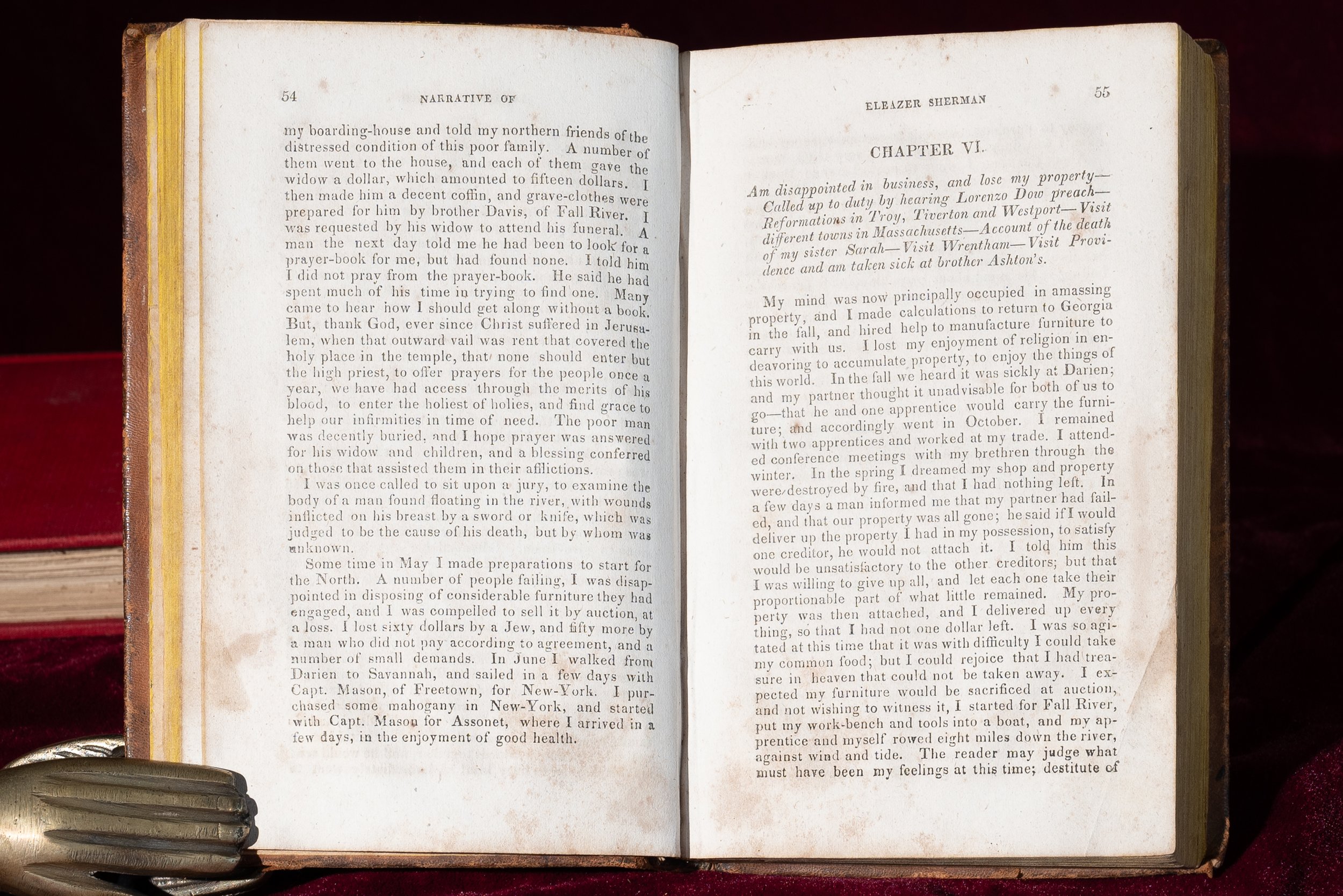 Image 2 of 9
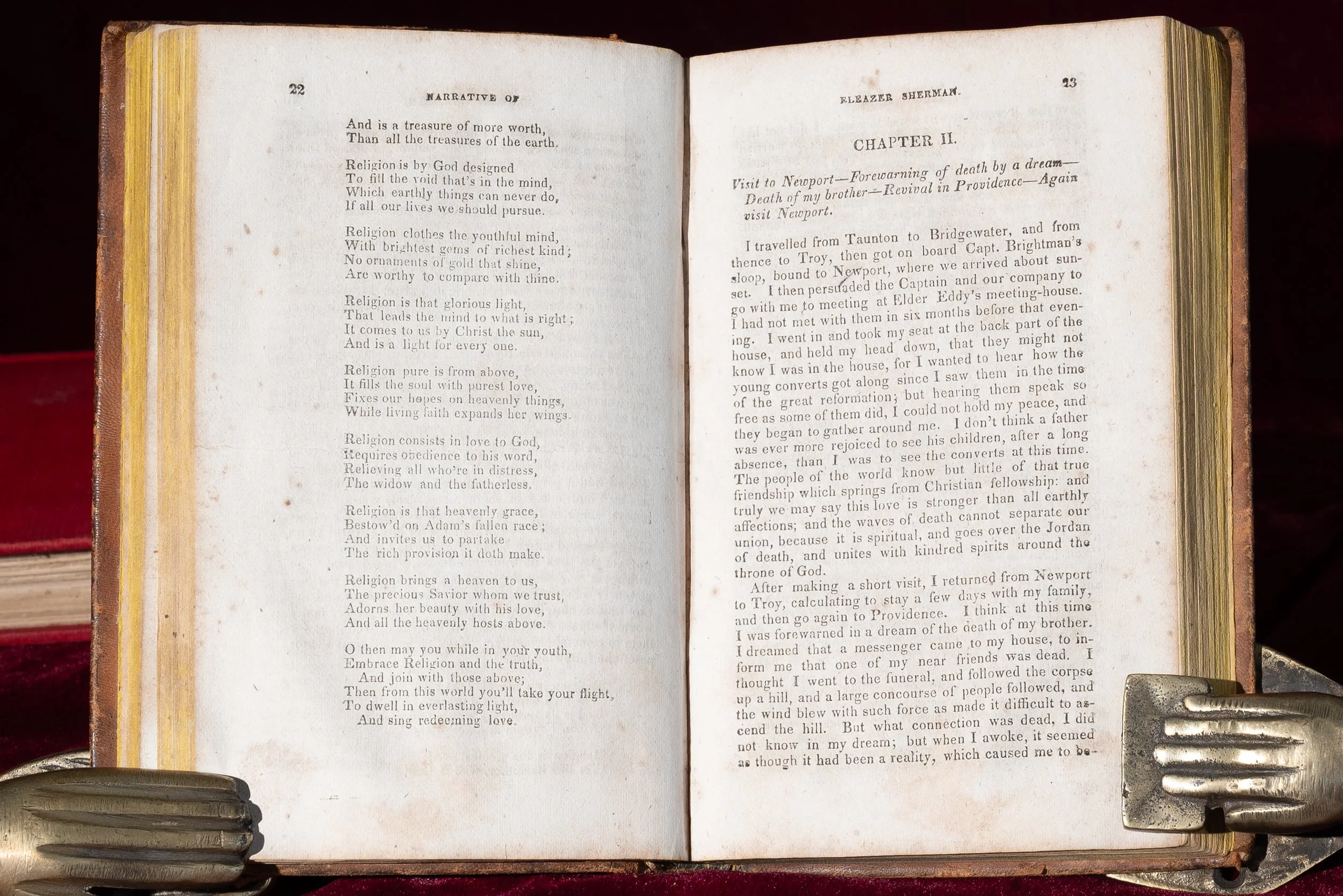 Image 3 of 9
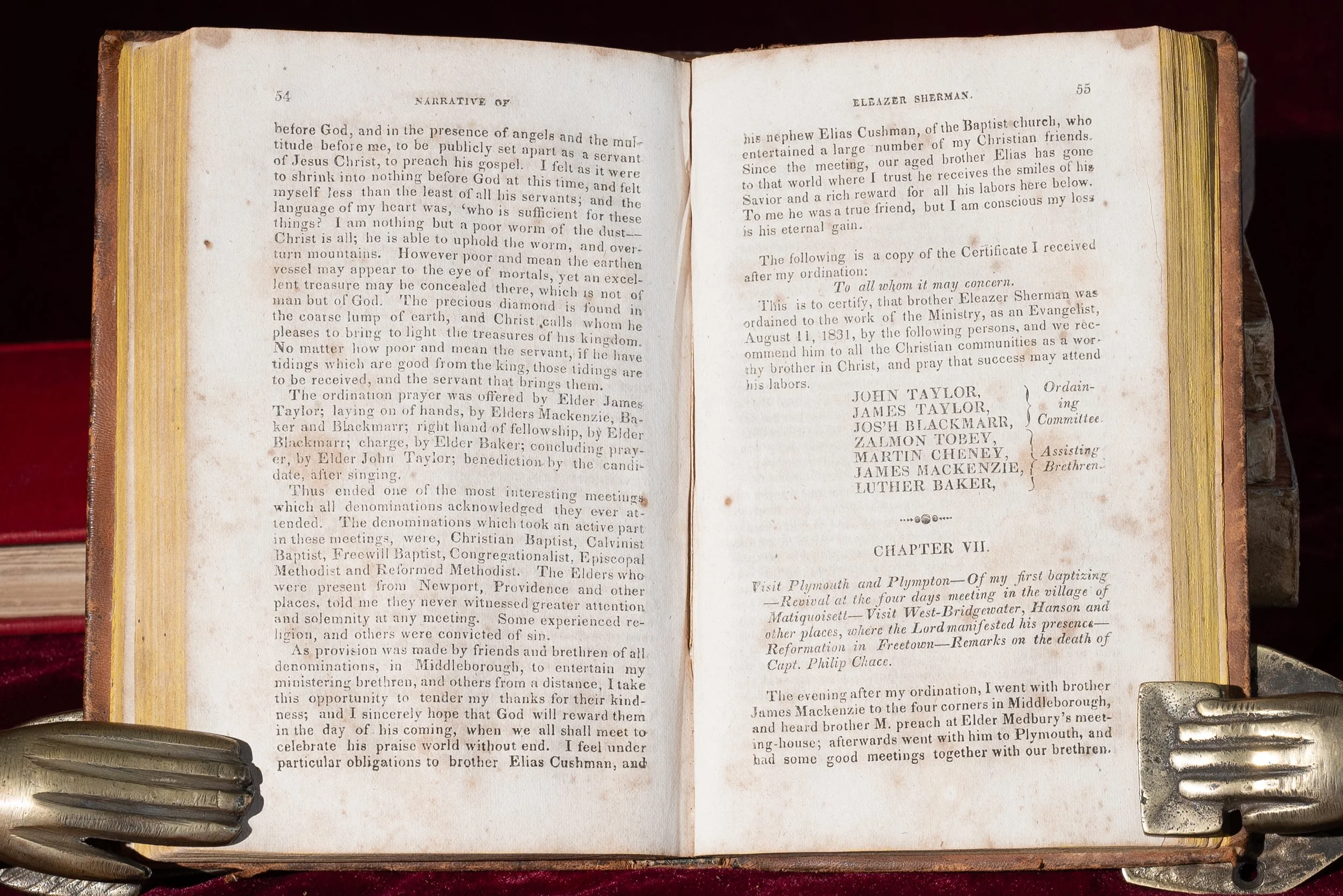 Image 4 of 9
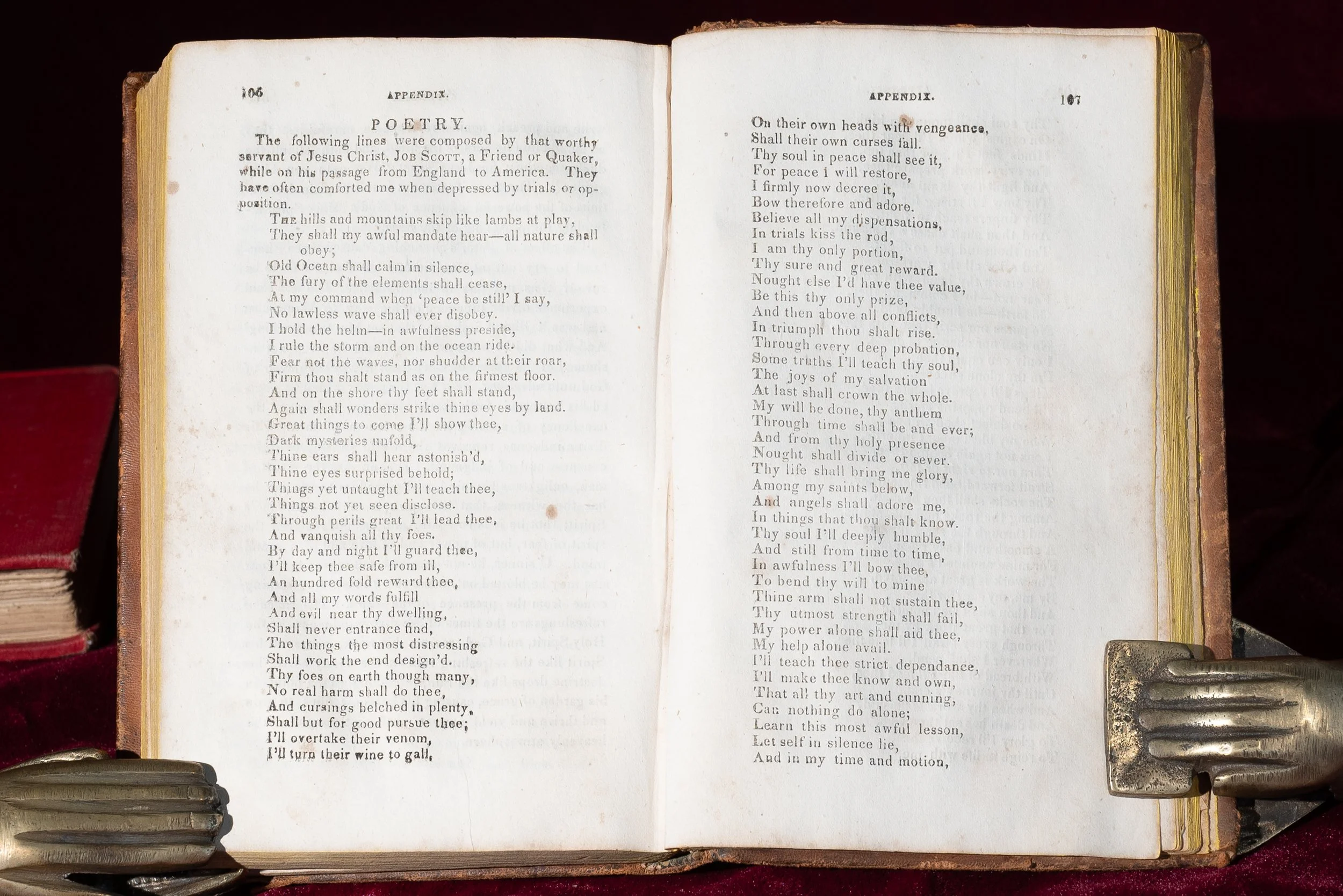 Image 5 of 9
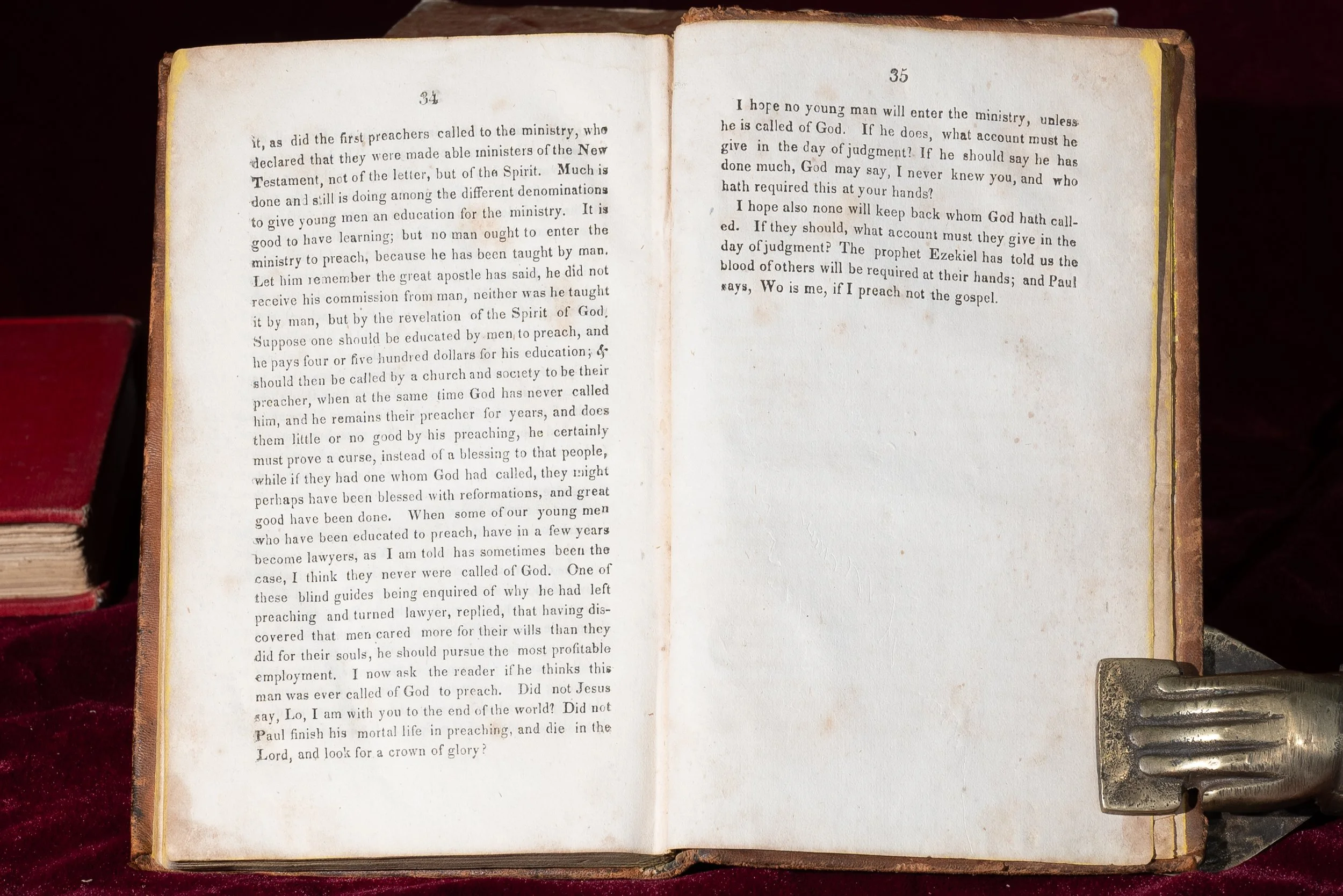 Image 6 of 9
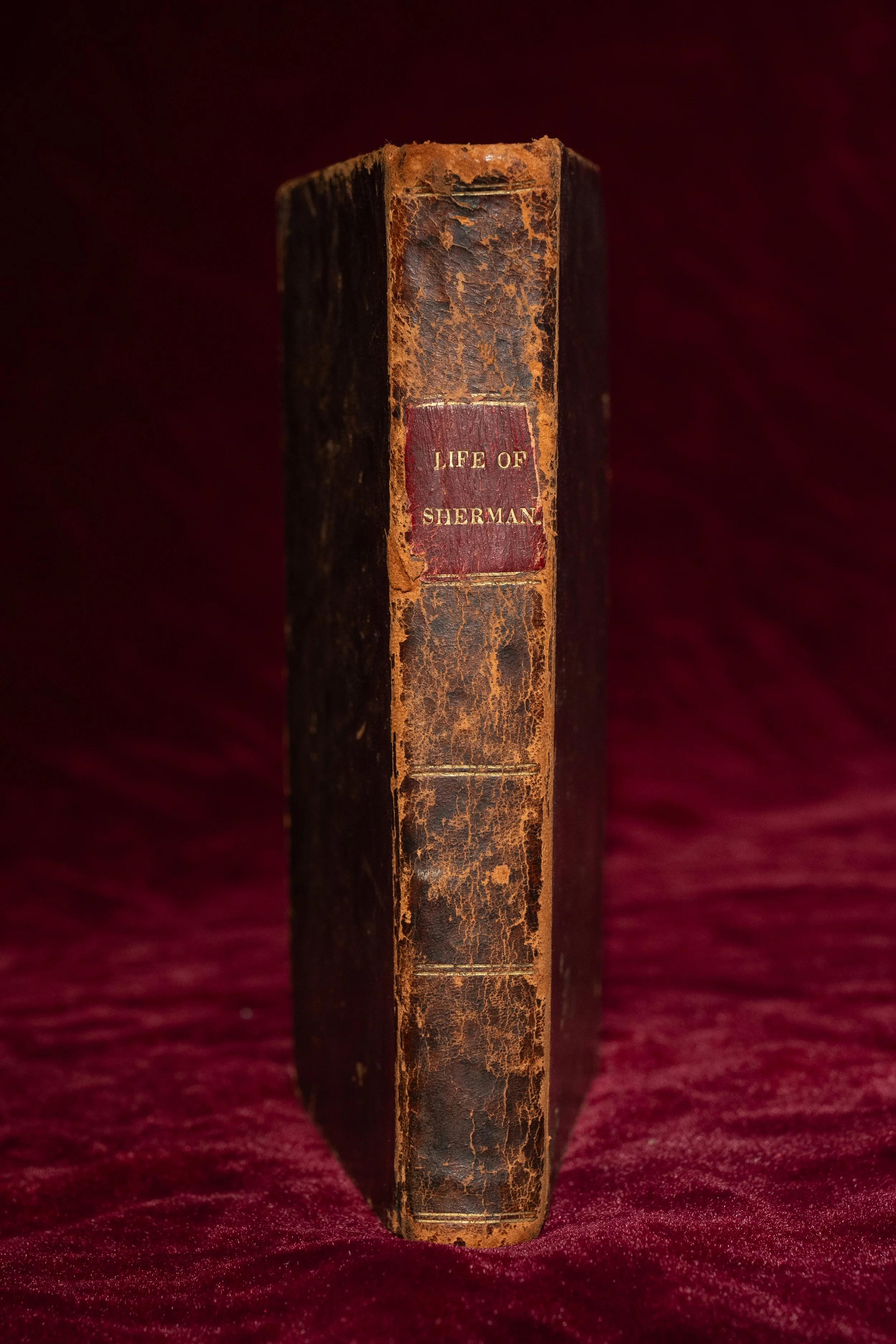 Image 7 of 9
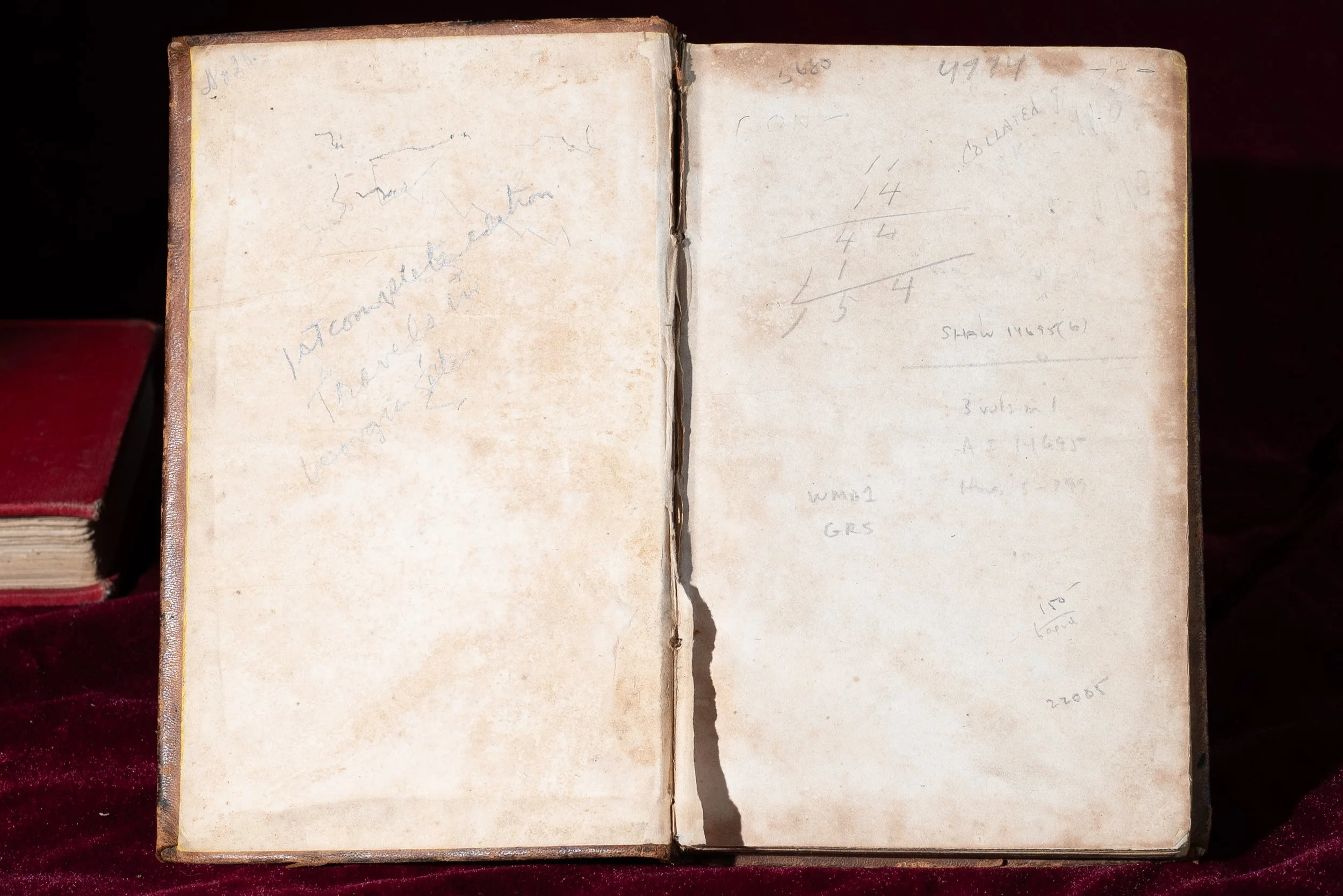 Image 8 of 9
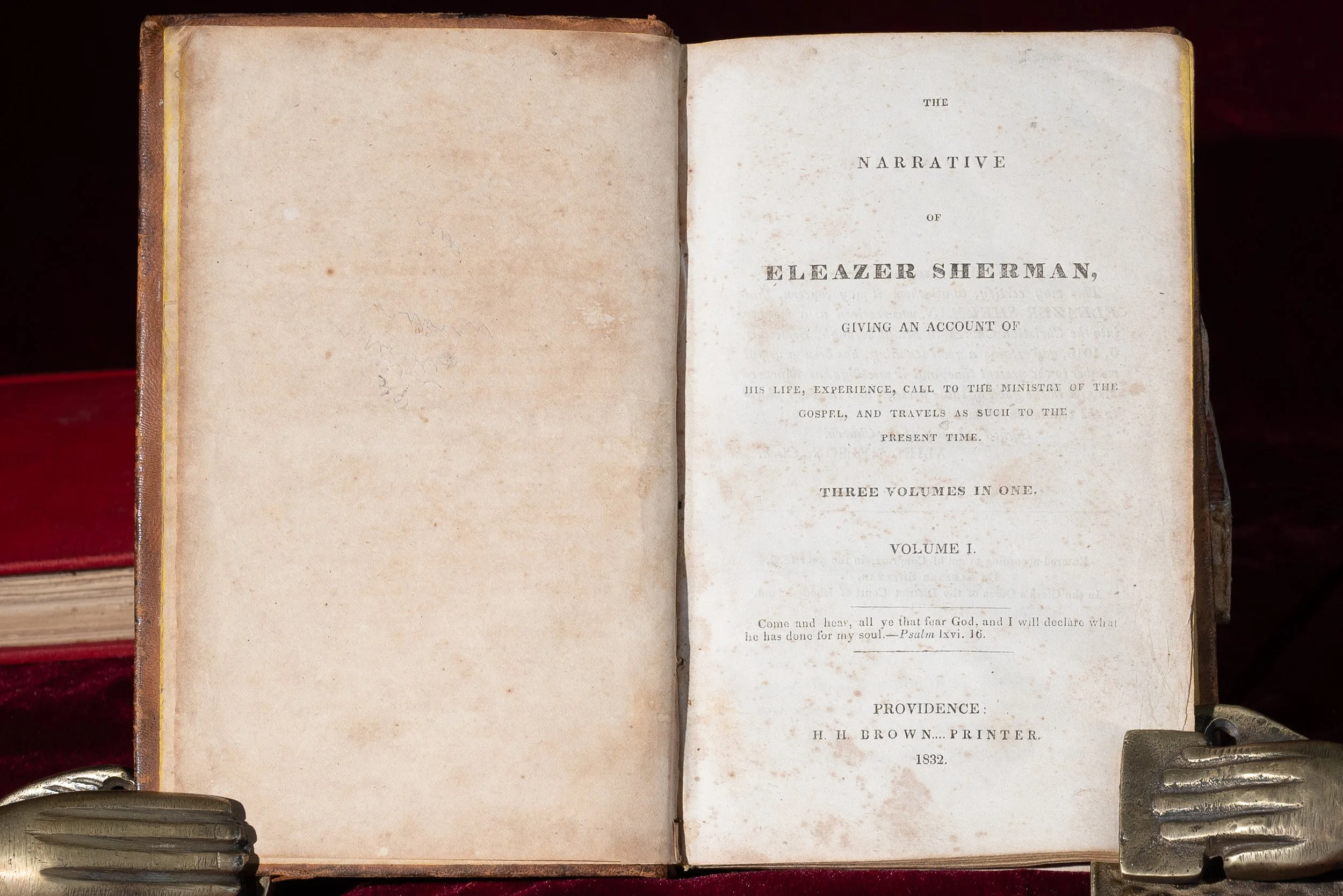 Image 9 of 9