David Webster’s 1820 collection brings the paperwork of Scotland’s witch persecutions into one volume: trial records and eyewitness letters, with extracts from King James’s Daemonologie. The Edinburgh bookseller prints accounts of prosecutions at Pittenweem and Torryburn, then turns to the Highland second sight. Alongside the accusations are the voices of people beginning to question them.
Among the documents are the town and church accounts for the 1633 execution of William Coke and Alison Dick of Kirkcaldy, set down with the same flat bookkeeping a burgh would use for road repairs. “For ten loads of coals to burn them, 5 merks, £3 6 8.” “For a tar barrel, 14s.” There is even a payment “To the executioner for his pains, 8 14 0.” The expenses are totaled at the foot of the page, the town’s part and the church’s part: “Both, 34 11 0 Scots.”
Webster opens with his own “Original Essay on Witchcraft,” explaining the persecutions as a product of ignorance. He then reprints the 1591 “News from Scotland,” on the North Berwick affair and the “damnable life of Doctor Fian.” The extracts from Daemonologie describe the Devil’s recruitment of the desperate and vengeful, including the supposed mark that “remaines soare unhealed” and “ever insensible.” The Pittenweem letters of 1705 take a different view of the accused. One protests the “barbarous and illegal treatment these poor women accused of witchcraft met with,” in the case that ended in the mob murder of Janet Cornfoot.
The closing tracts concern second sight, the involuntary foreknowledge of deaths and distant events reported among Gaelic-speaking Highlanders. The author of the “Brief Discourse” had “observed many honest men, free of all scandal” who possessed the faculty and doubted that every vision should be blamed on evil spirits. He submits his “weak conceptions on this sublime theme” to “the judgment of my betters.” After the trial accounts, the hesitation is welcome.
This is a complete copy of the first edition, with the constituent tracts’ divisional titles and largely untrimmed sheets. It retains its contemporary half-leather binding, though the front board is nearly detached and the margins are brittle and frayed. Original copies are uncommon in commerce; the text is also held by institutions and available in digitized form.
WEBSTER, David, of Edinburgh, compiler (fl. early 19th century). A Collection of Rare and Curious Tracts on Witchcraft and the Second Sight; with an Original Essay on Witchcraft. Edinburgh: Printed for D. Webster, 35, West College Street, 1820. First edition. (Colophon: Edinburgh, Printed by Thomas Webster.)
Physical Description: 8vo (approx. 22 cm). iv, [5]-183 pp. Several of the constituent tracts carry their own divisional title-pages or half-titles as issued. Largely untrimmed with deckle edges.
Binding: Contemporary half leather over marbled (shell-pattern) boards; spine with raised bands and gilt rules, lettered in gilt "Tracts on Witchcraft."
Condition: Worn. Front board nearly detached; spine ends chipped with loss; corners rubbed. Text block sound but margins brittle and frayed with some edge chipping; scattered foxing and toning throughout. Complete.
David Webster’s 1820 collection brings the paperwork of Scotland’s witch persecutions into one volume: trial records and eyewitness letters, with extracts from King James’s Daemonologie. The Edinburgh bookseller prints accounts of prosecutions at Pittenweem and Torryburn, then turns to the Highland second sight. Alongside the accusations are the voices of people beginning to question them.
Among the documents are the town and church accounts for the 1633 execution of William Coke and Alison Dick of Kirkcaldy, set down with the same flat bookkeeping a burgh would use for road repairs. “For ten loads of coals to burn them, 5 merks, £3 6 8.” “For a tar barrel, 14s.” There is even a payment “To the executioner for his pains, 8 14 0.” The expenses are totaled at the foot of the page, the town’s part and the church’s part: “Both, 34 11 0 Scots.”
Webster opens with his own “Original Essay on Witchcraft,” explaining the persecutions as a product of ignorance. He then reprints the 1591 “News from Scotland,” on the North Berwick affair and the “damnable life of Doctor Fian.” The extracts from Daemonologie describe the Devil’s recruitment of the desperate and vengeful, including the supposed mark that “remaines soare unhealed” and “ever insensible.” The Pittenweem letters of 1705 take a different view of the accused. One protests the “barbarous and illegal treatment these poor women accused of witchcraft met with,” in the case that ended in the mob murder of Janet Cornfoot.
The closing tracts concern second sight, the involuntary foreknowledge of deaths and distant events reported among Gaelic-speaking Highlanders. The author of the “Brief Discourse” had “observed many honest men, free of all scandal” who possessed the faculty and doubted that every vision should be blamed on evil spirits. He submits his “weak conceptions on this sublime theme” to “the judgment of my betters.” After the trial accounts, the hesitation is welcome.
This is a complete copy of the first edition, with the constituent tracts’ divisional titles and largely untrimmed sheets. It retains its contemporary half-leather binding, though the front board is nearly detached and the margins are brittle and frayed. Original copies are uncommon in commerce; the text is also held by institutions and available in digitized form.
WEBSTER, David, of Edinburgh, compiler (fl. early 19th century). A Collection of Rare and Curious Tracts on Witchcraft and the Second Sight; with an Original Essay on Witchcraft. Edinburgh: Printed for D. Webster, 35, West College Street, 1820. First edition. (Colophon: Edinburgh, Printed by Thomas Webster.)
Physical Description: 8vo (approx. 22 cm). iv, [5]-183 pp. Several of the constituent tracts carry their own divisional title-pages or half-titles as issued. Largely untrimmed with deckle edges.
Binding: Contemporary half leather over marbled (shell-pattern) boards; spine with raised bands and gilt rules, lettered in gilt "Tracts on Witchcraft."
Condition: Worn. Front board nearly detached; spine ends chipped with loss; corners rubbed. Text block sound but margins brittle and frayed with some edge chipping; scattered foxing and toning throughout. Complete.

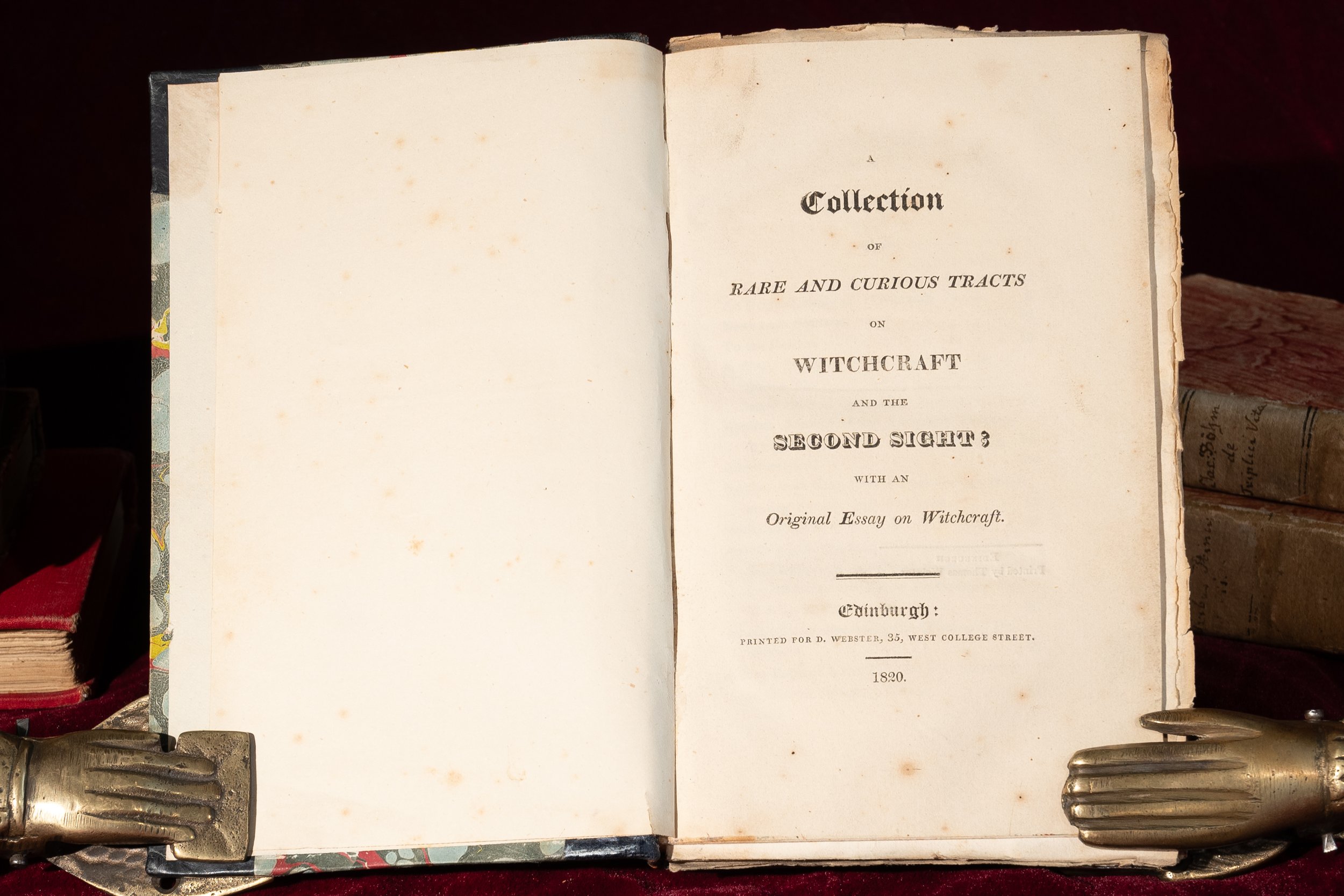 Image 1 of 7
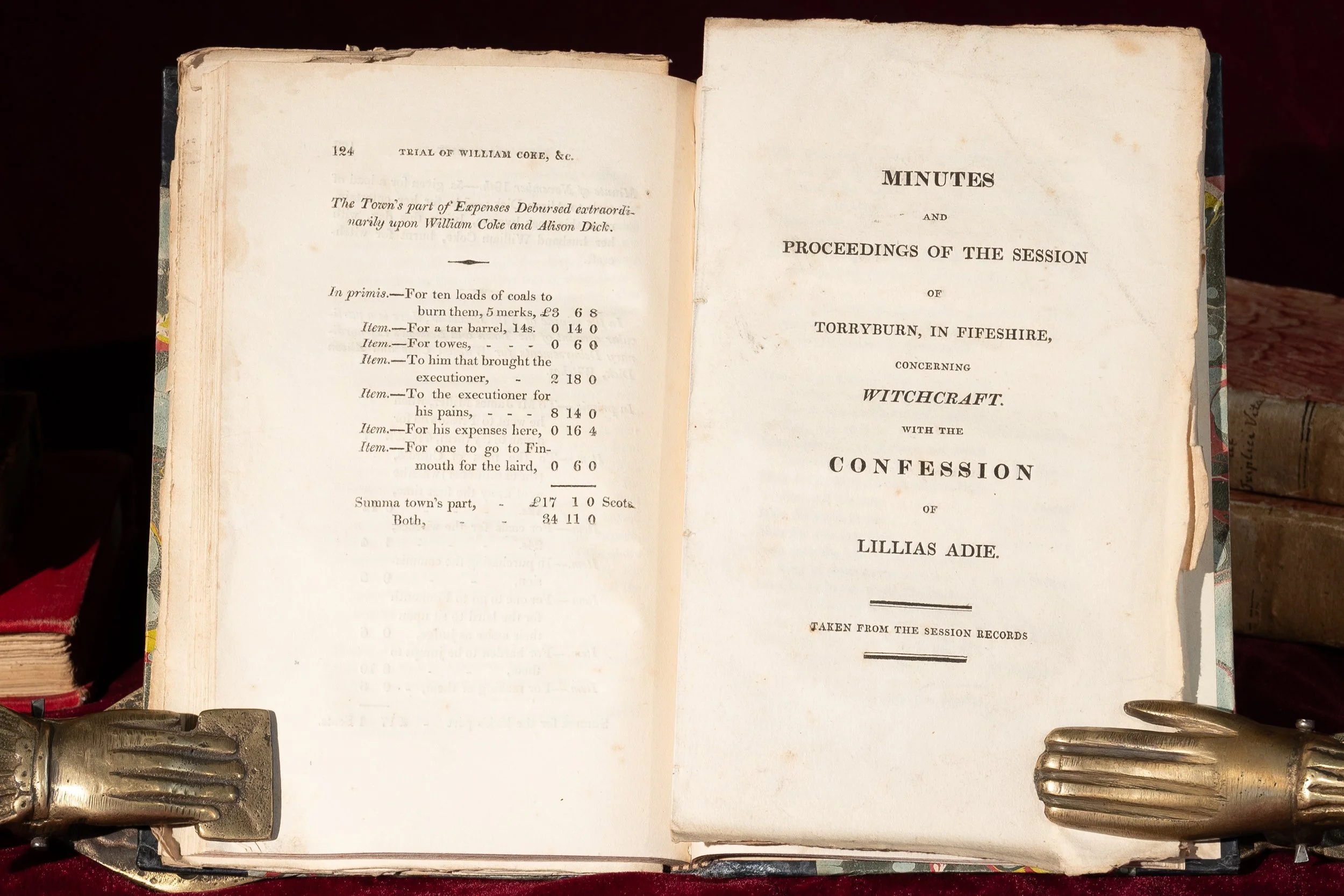 Image 2 of 7
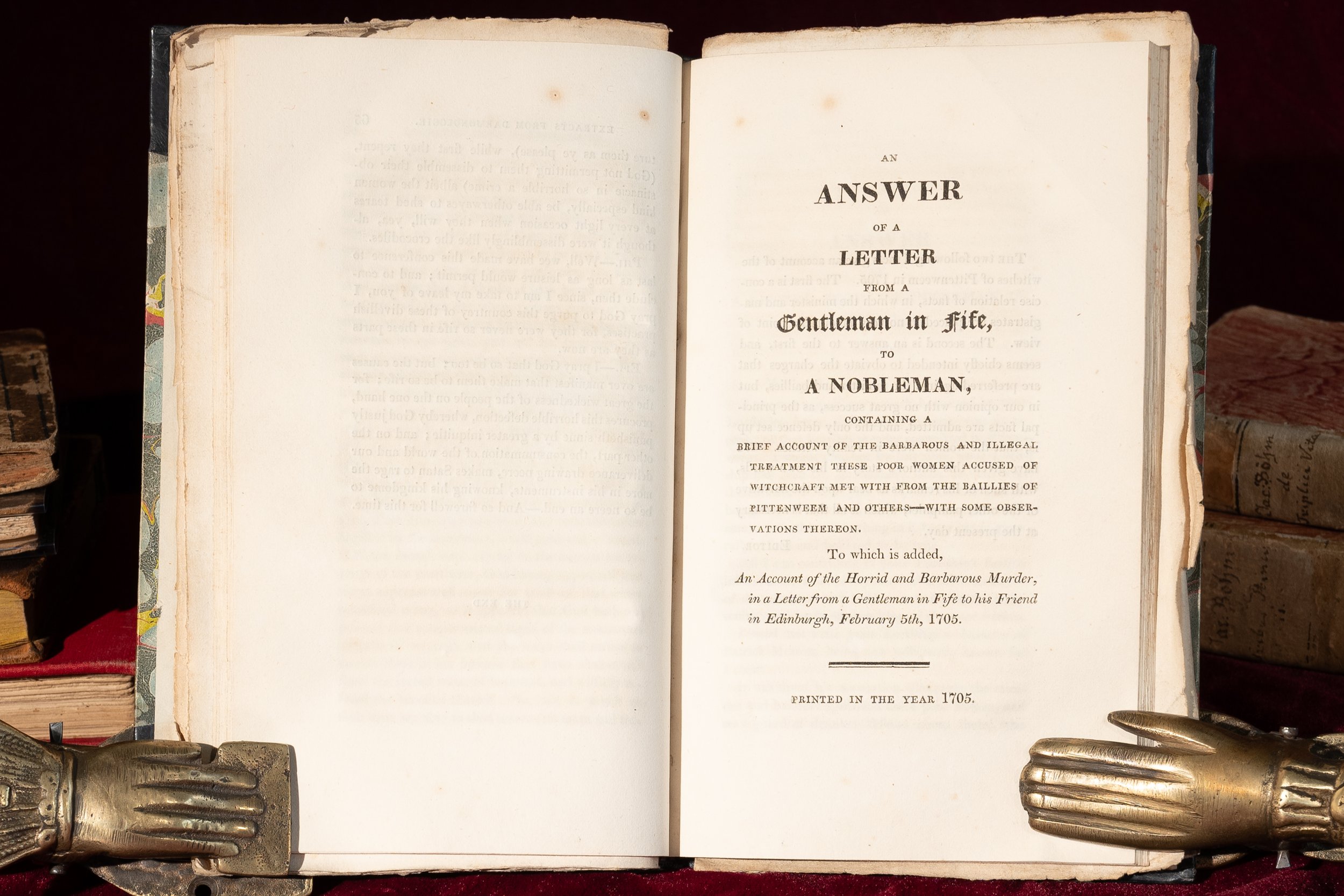 Image 3 of 7
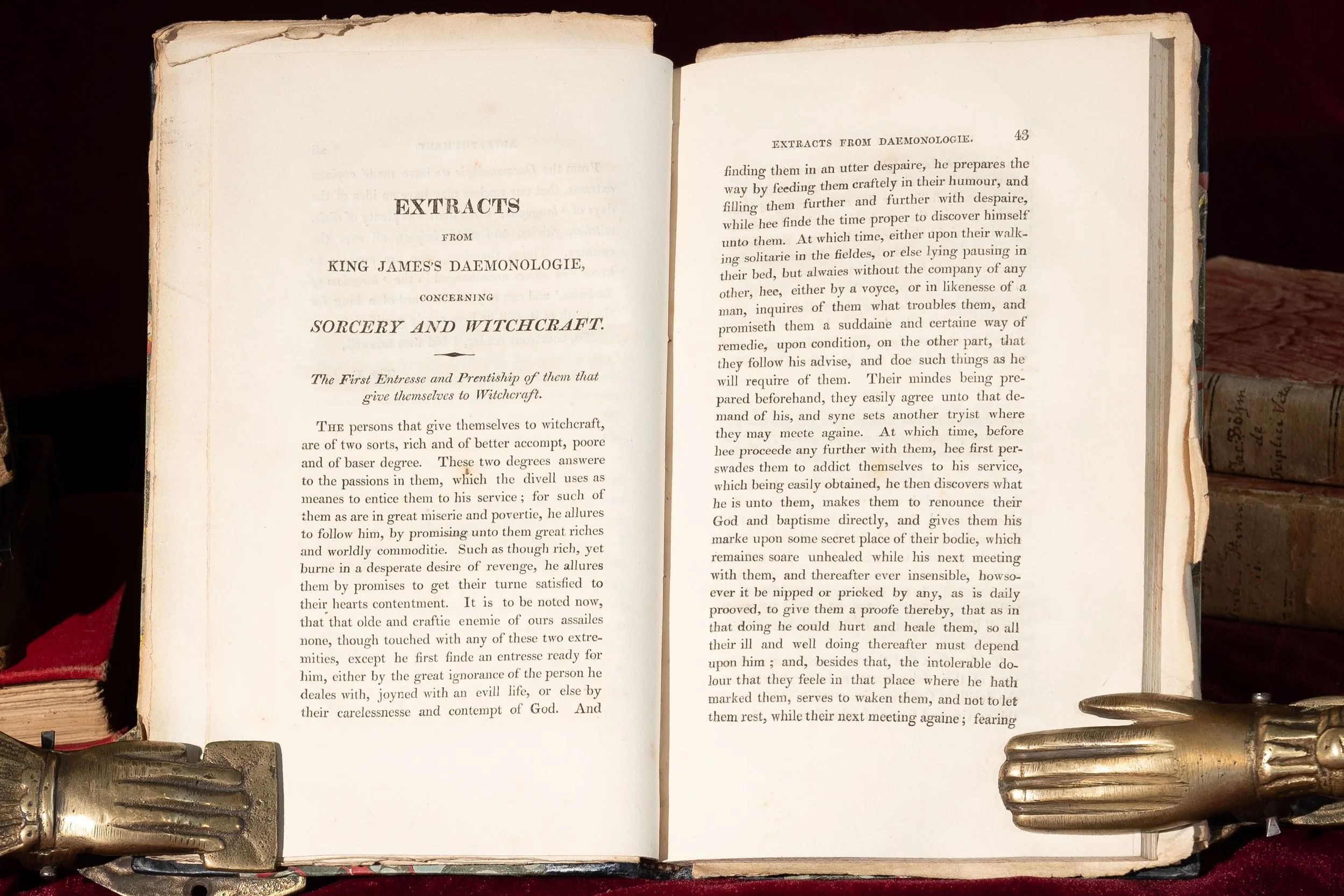 Image 4 of 7
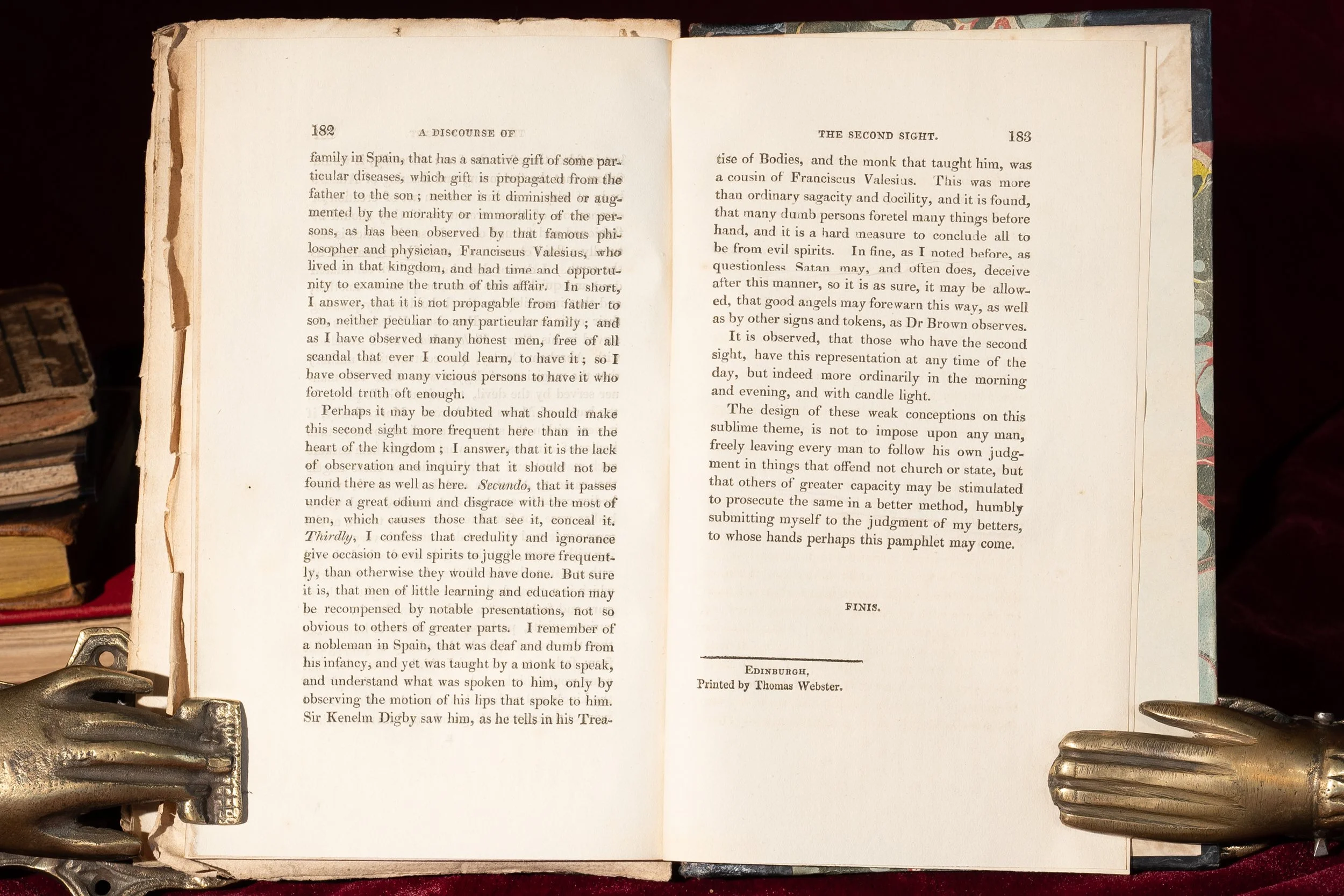 Image 5 of 7
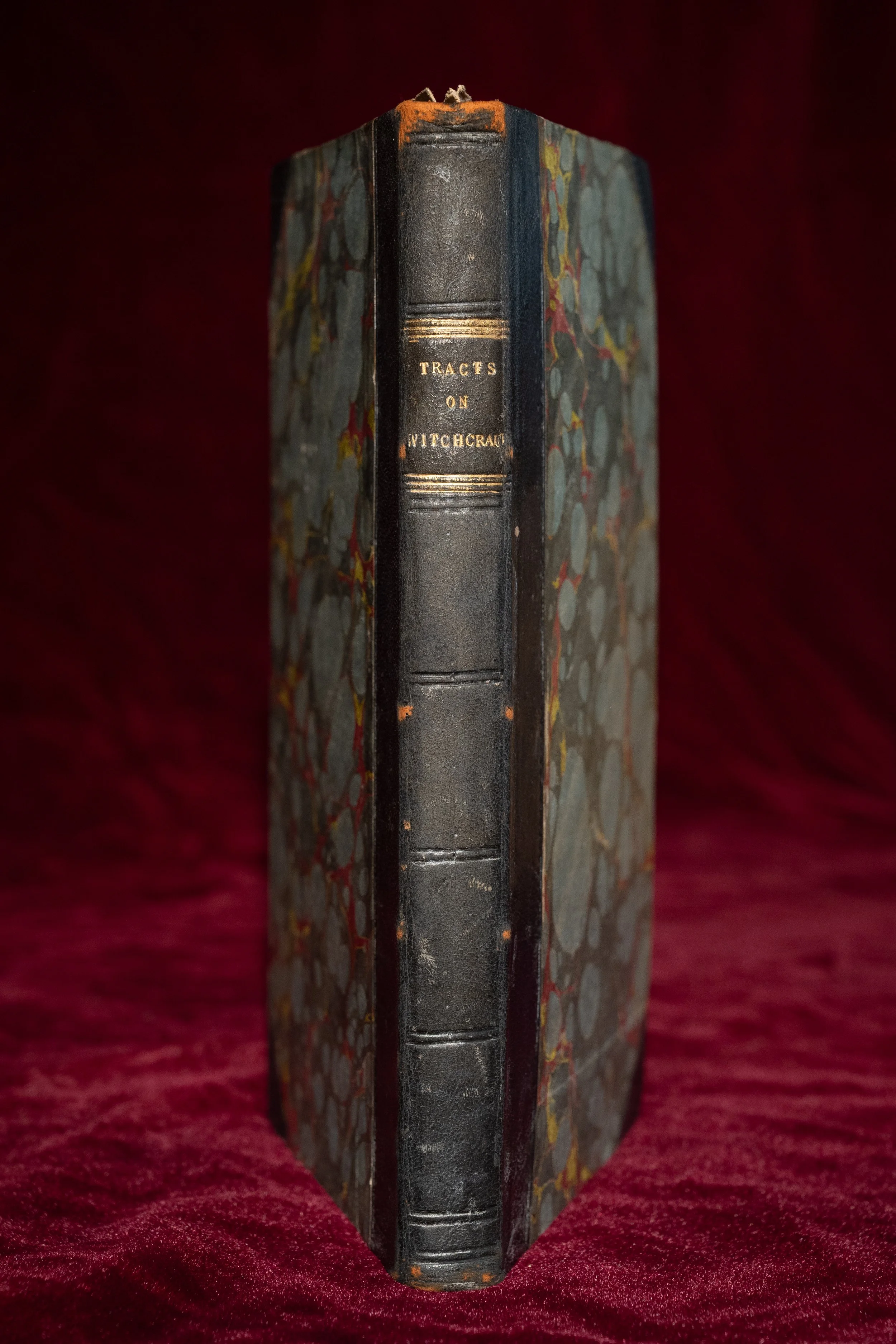 Image 6 of 7
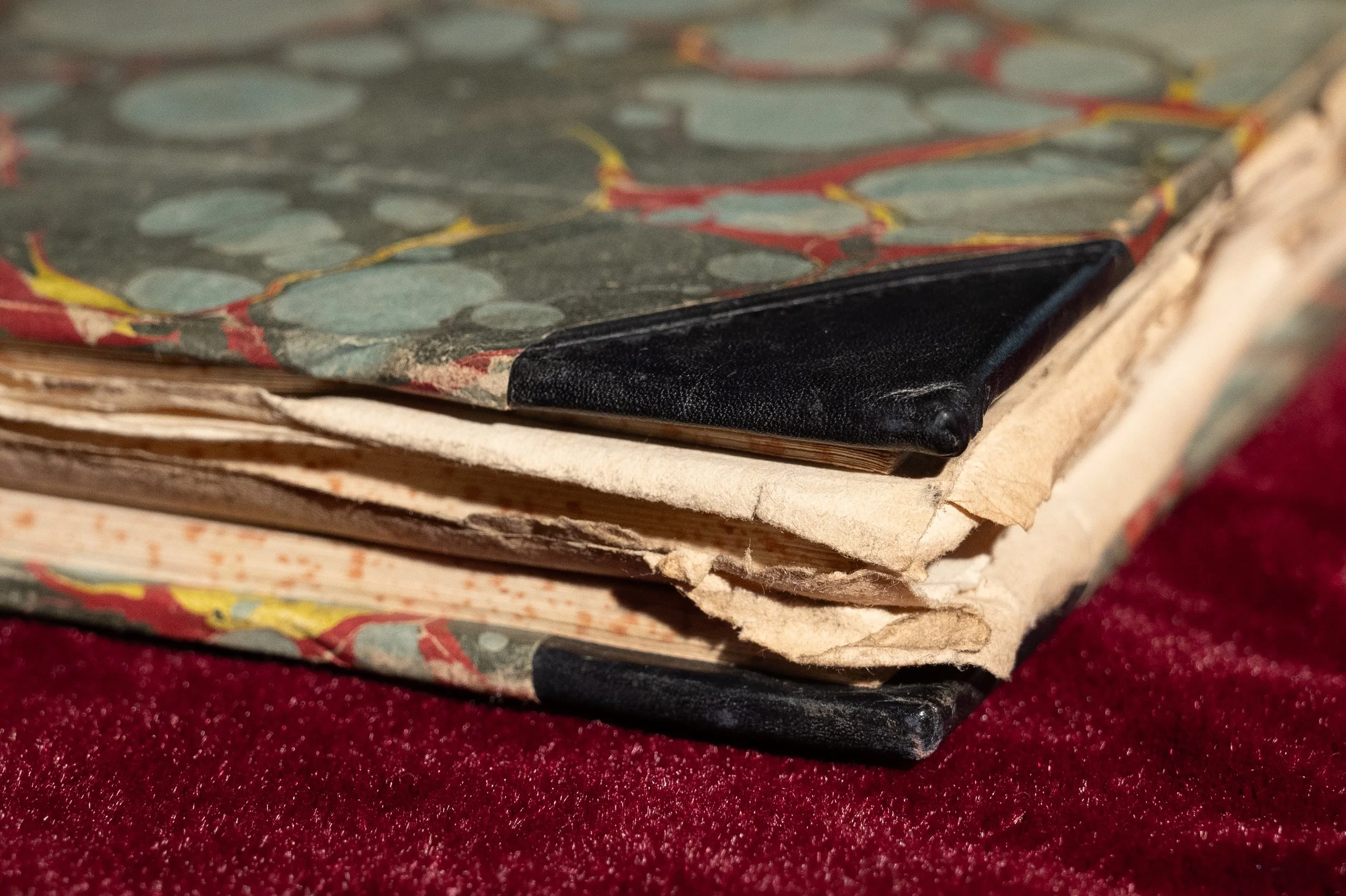 Image 7 of 7