In 1820 a press in Reading, Pennsylvania issued this pocket-sized handbook of the apocalypse for the German-speaking farm country around it, and the book wastes no time on suspense. The seven trumpets of Revelation, it announces, began sounding in 1816 and will follow one another "in quick succession" until 1837: "Bis 1837 haben wir das allerhöchste Ziel zu gewarten," by 1837 we must await the final goal, when the Lord "will sweep his threshing floor and gather the wheat into his barn." Facing the title page stands the book's great visual flourish, a full-page woodcut of "Der Antichrist, in Gestalt eines Thiers mit 7 Köpfen und 10 Hörnern": the Antichrist in the shape of a beast with seven heads and ten horns, a folk-art dragon flapping over a steepled town while sinners flee below.
What makes the book so engaging is the hard, apocalyptic work. The author proves the end times by arithmetic, page after page of printed sums. The number of the beast, 666, multiplied by the six working days of the week yields 3996 days, which is eleven years less nineteen days, the allotted reign of the beast. Write out the words "König von Rom," King of Rome, the title Napoleon gave his infant heir, number the letters one through eleven, and "this number comes out exactly: here is wisdom." The 153 fishes of the miraculous draught in John, multiplied by the 12 of the verse beneath them, give 1836, the very year of Christ's return. This is the numerological imagination of the Napoleonic wars in full cry. The tract was first published in Germany in 1813, as the wars against the self-evident Antichrist reached their climax, and its anonymous author, the German visionary Christian Armbrüster, read Daniel's weeks and the trumpets of John against the headlines of his day. When the text crossed the Atlantic, the American printers placed a more famous and more I'm name on the title page: Heinrich Jung-Stilling, the celebrated Pietist mystic and friend of Goethe whose prophetic writings had primed two continents to expect the Second Coming. The attribution is false, and that is part of the story: this is a book sold on the authority of a brand name, two centuries before the practice acquired its modern vocabulary.
The Reading imprint gives the book its American flavor. It was printed for Charles M'Williams, with the colophon of C. A. Bruckman's Reading press on the final page, for the same Pennsylvania Dutch audience that bought powwow charm-books and Himmelsbriefe from the region's German presses. To readers who had just survived 1816, the famine "year without a summer" when frost killed the corn in July, a prophecy that the trumpets began sounding that very year would not have seemed abstract. And the book ends less in terror than in song: the final section gathers hymns, one "schön geistlich Lied" to be sung to the melody "Seelen Bräutigam," closing with the promise that the misery will vanish and there will surely come "noch ein Paradies (bis 1837)," yet another Paradise, by 1837.
This copy carries the kind of provenance that brings such an object to life. On the front blank an early Pennsylvania German hand has written, in ink, "Dieses Buch gehört mir, Adam M..., und habe es gekauft in dem gnadenreichen Jahr unsers Herrn und Heilandes Jesu Christi 1820": this book belongs to me, Adam M., and I bought it in the grace-rich year of our Lord and Savior Jesus Christ 1820. The surname is only partly legible, but the date is not; the first owner bought his copy of the end of the world the same year it came off the press, sixteen years before the appointed hour. The book survives in its original humble dress, a quarter sheep binding over boards covered in patterned paper printed with black rules and rows of ornaments, honestly worn from use. German-language American apocalyptica of this period is held institutionally but turns up only occasionally in commerce, and copies in contemporary bindings with dated period inscriptions are the ones worth keeping.
[ARMBRÜSTER, Christian, attributed; issued under the name of Heinrich JUNG-STILLING]. Die sieben lezten Posaunen oder Wehen, wann sie anfangen und aufhören, und von den 70 Danielischen Wochen und 42 prophetischen Monaten: von der Zahl 666 als das Mahlzeichen des Thiers; von dem gläßernen Meer; von den zwey Zeugen; von der Zukunft Christi, in welchem Jahr und Monat dieselbe erfolgen soll; von dem tausendjährigen Reich und ewigen Evangelium; Gog und Magog und jüngstem Gericht; aus der Heil. Schrift bewiesen. Von Heinrich Jung Stilling. Reading [Pennsylvania]: Gedruckt für Charles M'Williams, 1820 (colophon: Gedruckt bey C. A. Bruckman). Evidently the first American edition; first published in Germany, 1813.
Physical Description: Small format (12mo). 142 pp., with full-page woodcut frontispiece of the seven-headed Antichrist beast captioned "Der Antichrist, in Gestalt eines Thiers mit 7 Köpfen und 10 Hörnern, Offenbarung St. Johannes im 13. Capitel." Text in German (Fraktur), with printed calculations throughout and a concluding section of hymns; "ENDE" within a typographic border and the Bruckman colophon on p. 142.
Binding: Contemporary quarter sheep over boards covered in patterned paper printed with black rules and rows of ornaments, a characteristic Pennsylvania German trade binding.
Condition: Honest and well used. Boards heavily rubbed and soiled with surface loss to the paper; leather spine worn but holding. Internally toned with scattered foxing and staining, heavier to the frontispiece and title; the text remains clear and the volume complete.
Provenance: (1) Adam M[...] (surname only partly legible), German ink ownership inscription on the front blank, dated 1820, recording his purchase of the book in the year of publication.
In 1820 a press in Reading, Pennsylvania issued this pocket-sized handbook of the apocalypse for the German-speaking farm country around it, and the book wastes no time on suspense. The seven trumpets of Revelation, it announces, began sounding in 1816 and will follow one another "in quick succession" until 1837: "Bis 1837 haben wir das allerhöchste Ziel zu gewarten," by 1837 we must await the final goal, when the Lord "will sweep his threshing floor and gather the wheat into his barn." Facing the title page stands the book's great visual flourish, a full-page woodcut of "Der Antichrist, in Gestalt eines Thiers mit 7 Köpfen und 10 Hörnern": the Antichrist in the shape of a beast with seven heads and ten horns, a folk-art dragon flapping over a steepled town while sinners flee below.
What makes the book so engaging is the hard, apocalyptic work. The author proves the end times by arithmetic, page after page of printed sums. The number of the beast, 666, multiplied by the six working days of the week yields 3996 days, which is eleven years less nineteen days, the allotted reign of the beast. Write out the words "König von Rom," King of Rome, the title Napoleon gave his infant heir, number the letters one through eleven, and "this number comes out exactly: here is wisdom." The 153 fishes of the miraculous draught in John, multiplied by the 12 of the verse beneath them, give 1836, the very year of Christ's return. This is the numerological imagination of the Napoleonic wars in full cry. The tract was first published in Germany in 1813, as the wars against the self-evident Antichrist reached their climax, and its anonymous author, the German visionary Christian Armbrüster, read Daniel's weeks and the trumpets of John against the headlines of his day. When the text crossed the Atlantic, the American printers placed a more famous and more I'm name on the title page: Heinrich Jung-Stilling, the celebrated Pietist mystic and friend of Goethe whose prophetic writings had primed two continents to expect the Second Coming. The attribution is false, and that is part of the story: this is a book sold on the authority of a brand name, two centuries before the practice acquired its modern vocabulary.
The Reading imprint gives the book its American flavor. It was printed for Charles M'Williams, with the colophon of C. A. Bruckman's Reading press on the final page, for the same Pennsylvania Dutch audience that bought powwow charm-books and Himmelsbriefe from the region's German presses. To readers who had just survived 1816, the famine "year without a summer" when frost killed the corn in July, a prophecy that the trumpets began sounding that very year would not have seemed abstract. And the book ends less in terror than in song: the final section gathers hymns, one "schön geistlich Lied" to be sung to the melody "Seelen Bräutigam," closing with the promise that the misery will vanish and there will surely come "noch ein Paradies (bis 1837)," yet another Paradise, by 1837.
This copy carries the kind of provenance that brings such an object to life. On the front blank an early Pennsylvania German hand has written, in ink, "Dieses Buch gehört mir, Adam M..., und habe es gekauft in dem gnadenreichen Jahr unsers Herrn und Heilandes Jesu Christi 1820": this book belongs to me, Adam M., and I bought it in the grace-rich year of our Lord and Savior Jesus Christ 1820. The surname is only partly legible, but the date is not; the first owner bought his copy of the end of the world the same year it came off the press, sixteen years before the appointed hour. The book survives in its original humble dress, a quarter sheep binding over boards covered in patterned paper printed with black rules and rows of ornaments, honestly worn from use. German-language American apocalyptica of this period is held institutionally but turns up only occasionally in commerce, and copies in contemporary bindings with dated period inscriptions are the ones worth keeping.
[ARMBRÜSTER, Christian, attributed; issued under the name of Heinrich JUNG-STILLING]. Die sieben lezten Posaunen oder Wehen, wann sie anfangen und aufhören, und von den 70 Danielischen Wochen und 42 prophetischen Monaten: von der Zahl 666 als das Mahlzeichen des Thiers; von dem gläßernen Meer; von den zwey Zeugen; von der Zukunft Christi, in welchem Jahr und Monat dieselbe erfolgen soll; von dem tausendjährigen Reich und ewigen Evangelium; Gog und Magog und jüngstem Gericht; aus der Heil. Schrift bewiesen. Von Heinrich Jung Stilling. Reading [Pennsylvania]: Gedruckt für Charles M'Williams, 1820 (colophon: Gedruckt bey C. A. Bruckman). Evidently the first American edition; first published in Germany, 1813.
Physical Description: Small format (12mo). 142 pp., with full-page woodcut frontispiece of the seven-headed Antichrist beast captioned "Der Antichrist, in Gestalt eines Thiers mit 7 Köpfen und 10 Hörnern, Offenbarung St. Johannes im 13. Capitel." Text in German (Fraktur), with printed calculations throughout and a concluding section of hymns; "ENDE" within a typographic border and the Bruckman colophon on p. 142.
Binding: Contemporary quarter sheep over boards covered in patterned paper printed with black rules and rows of ornaments, a characteristic Pennsylvania German trade binding.
Condition: Honest and well used. Boards heavily rubbed and soiled with surface loss to the paper; leather spine worn but holding. Internally toned with scattered foxing and staining, heavier to the frontispiece and title; the text remains clear and the volume complete.
Provenance: (1) Adam M[...] (surname only partly legible), German ink ownership inscription on the front blank, dated 1820, recording his purchase of the book in the year of publication.

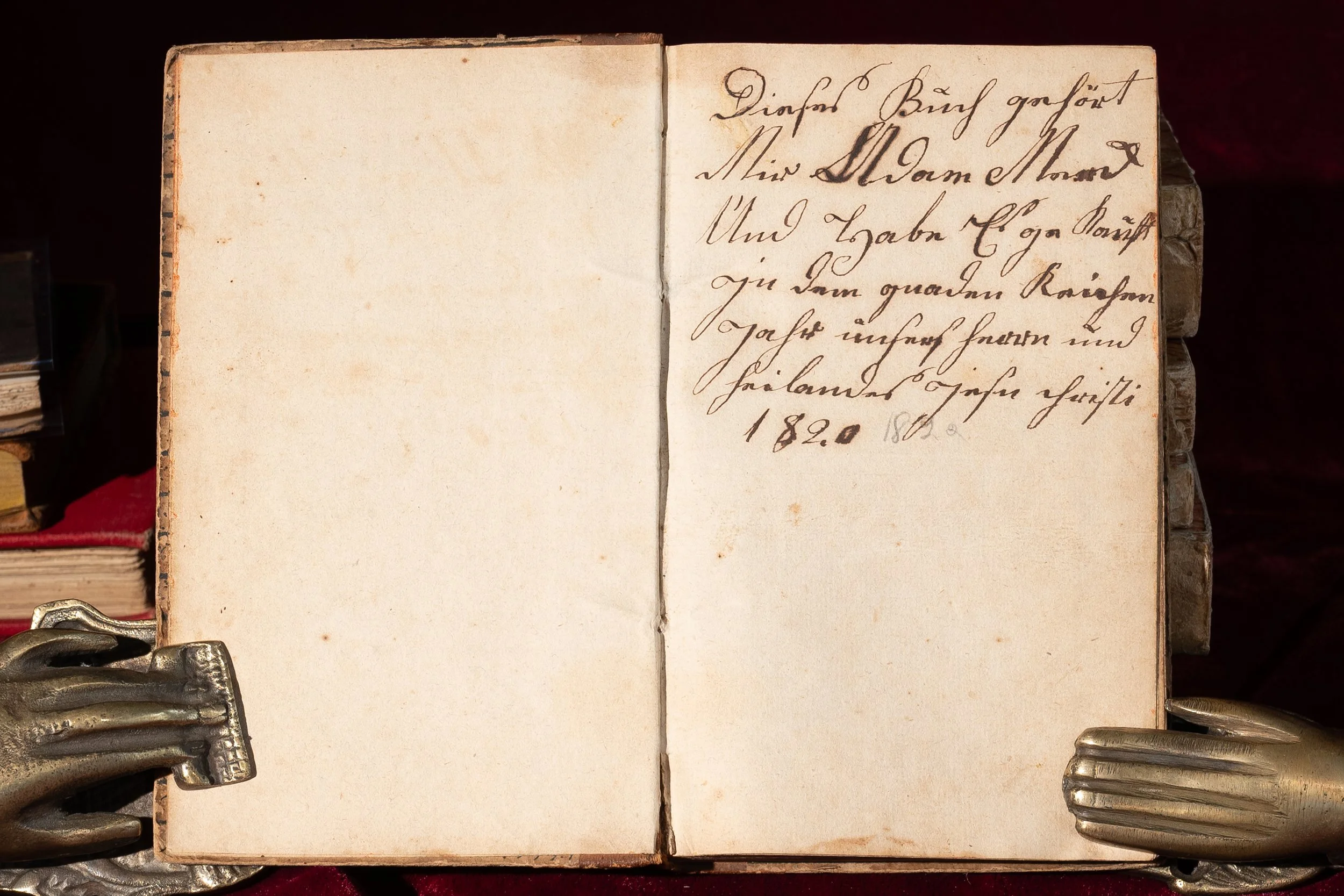 Image 1 of 9
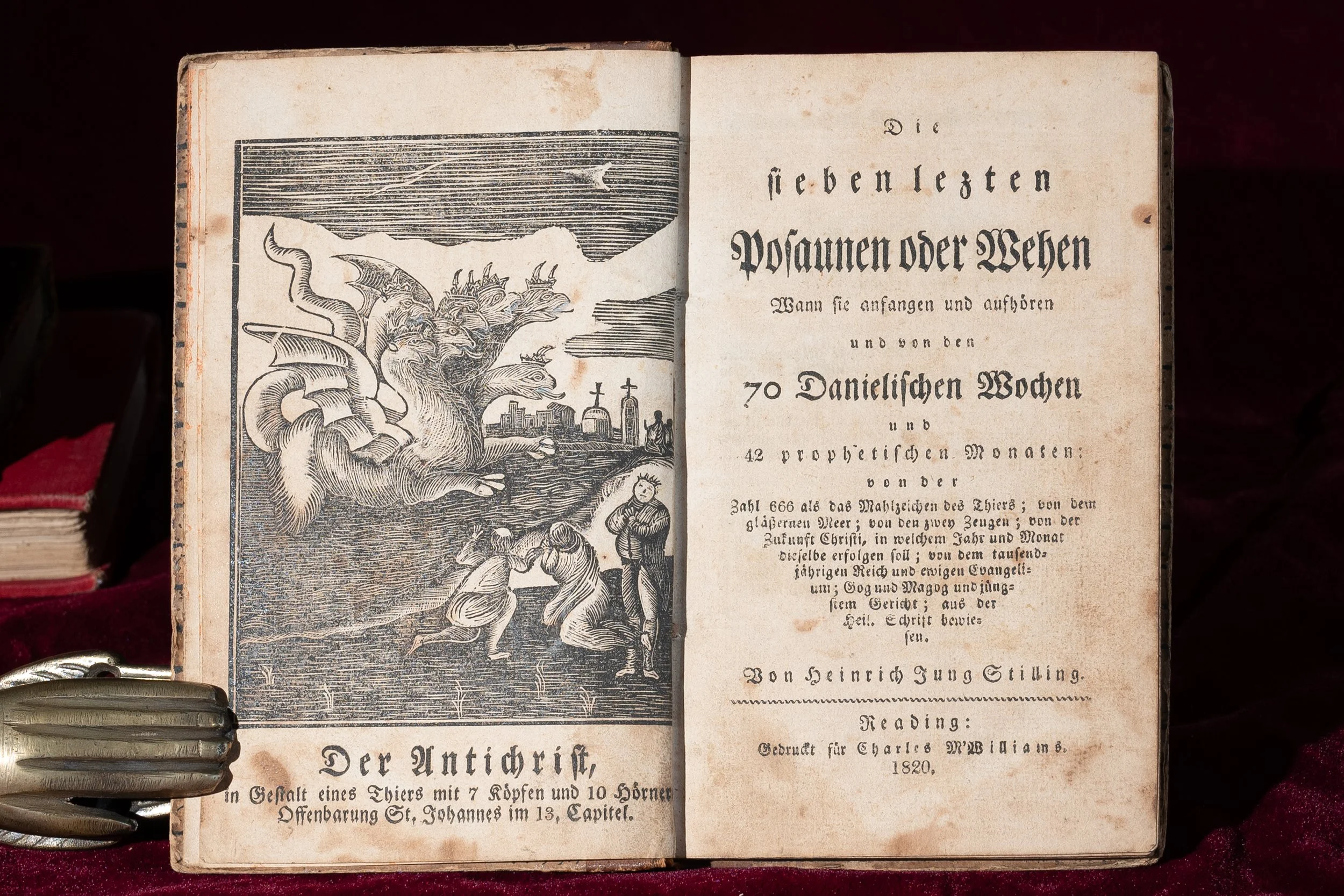 Image 2 of 9
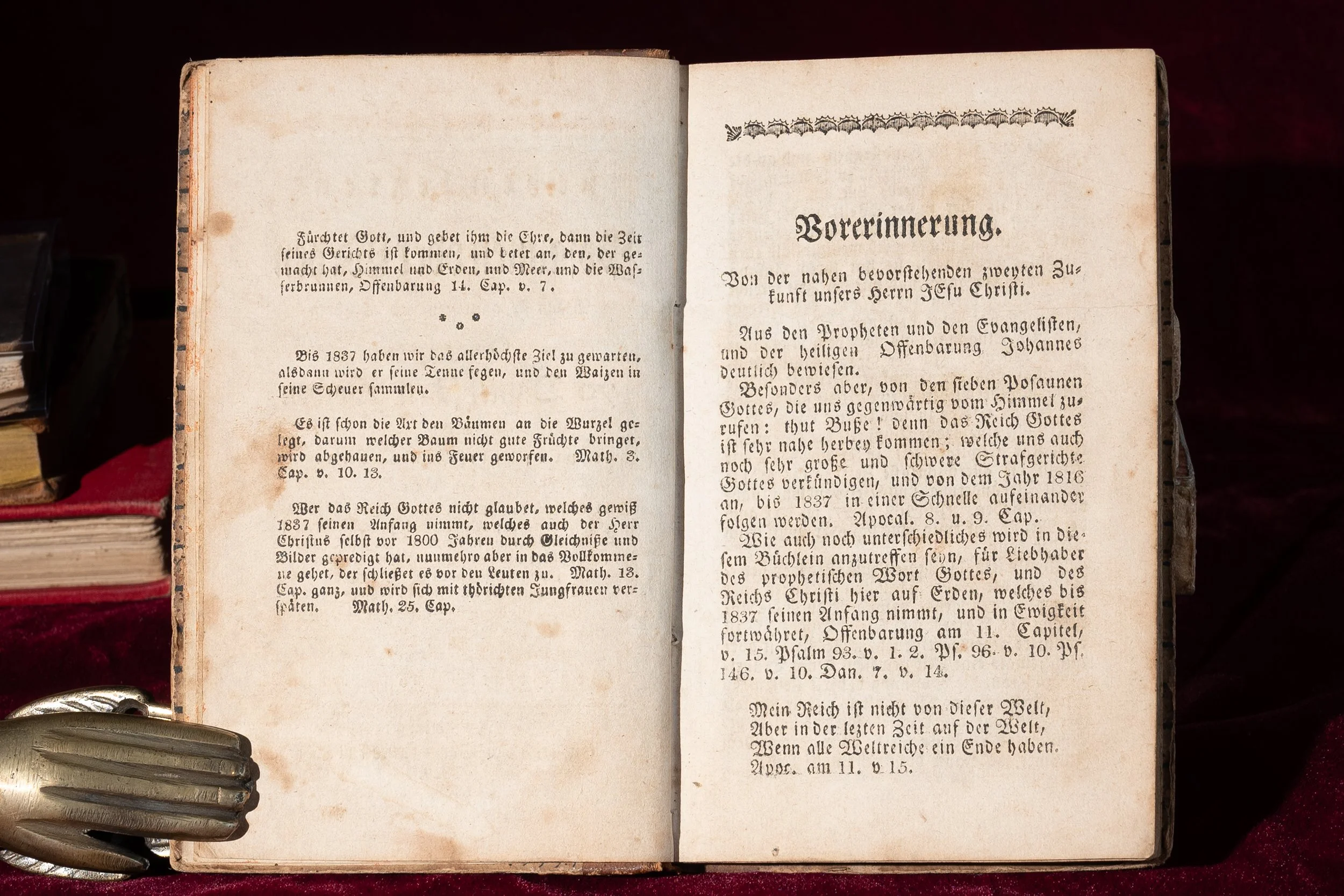 Image 3 of 9
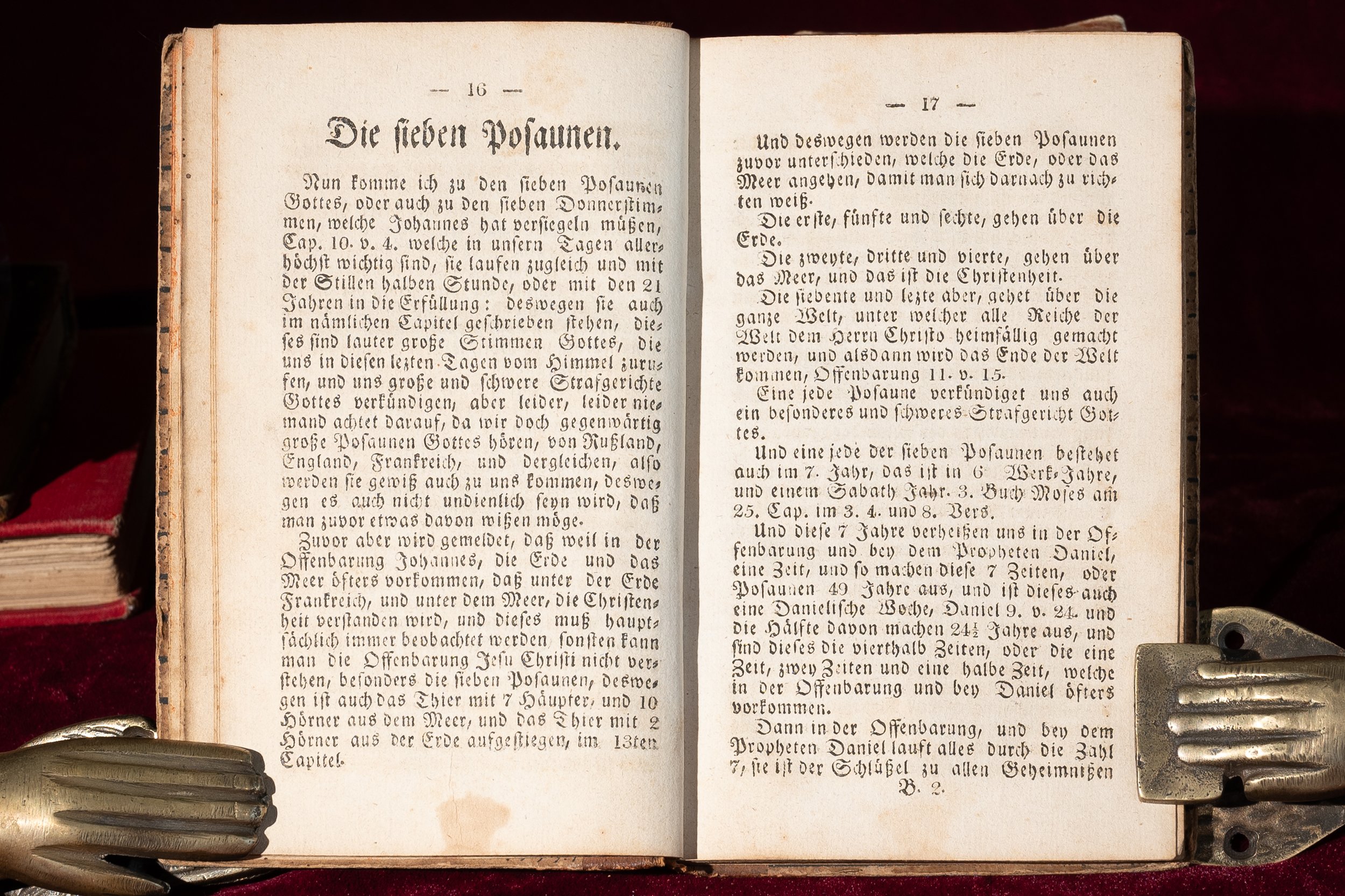 Image 4 of 9
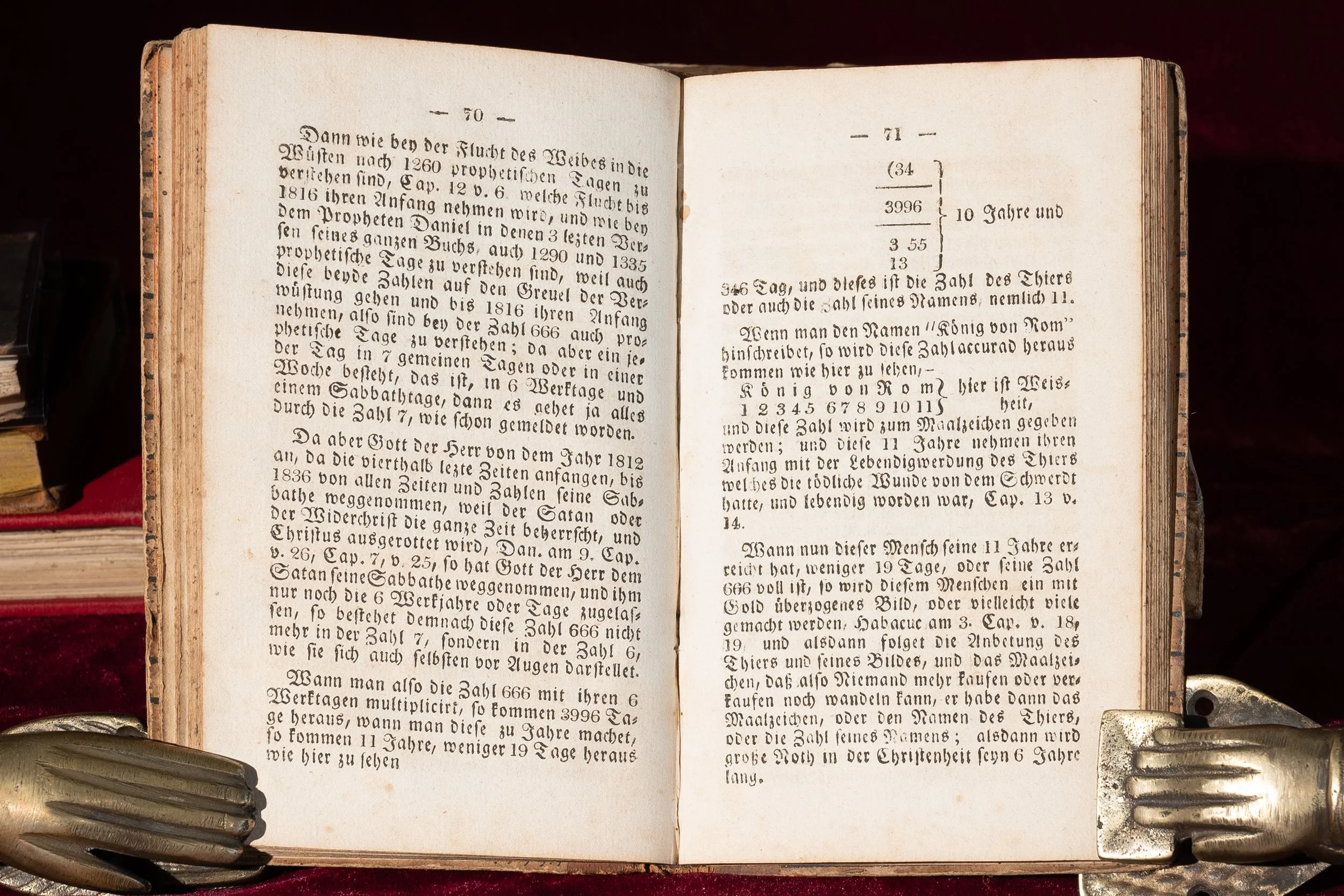 Image 5 of 9
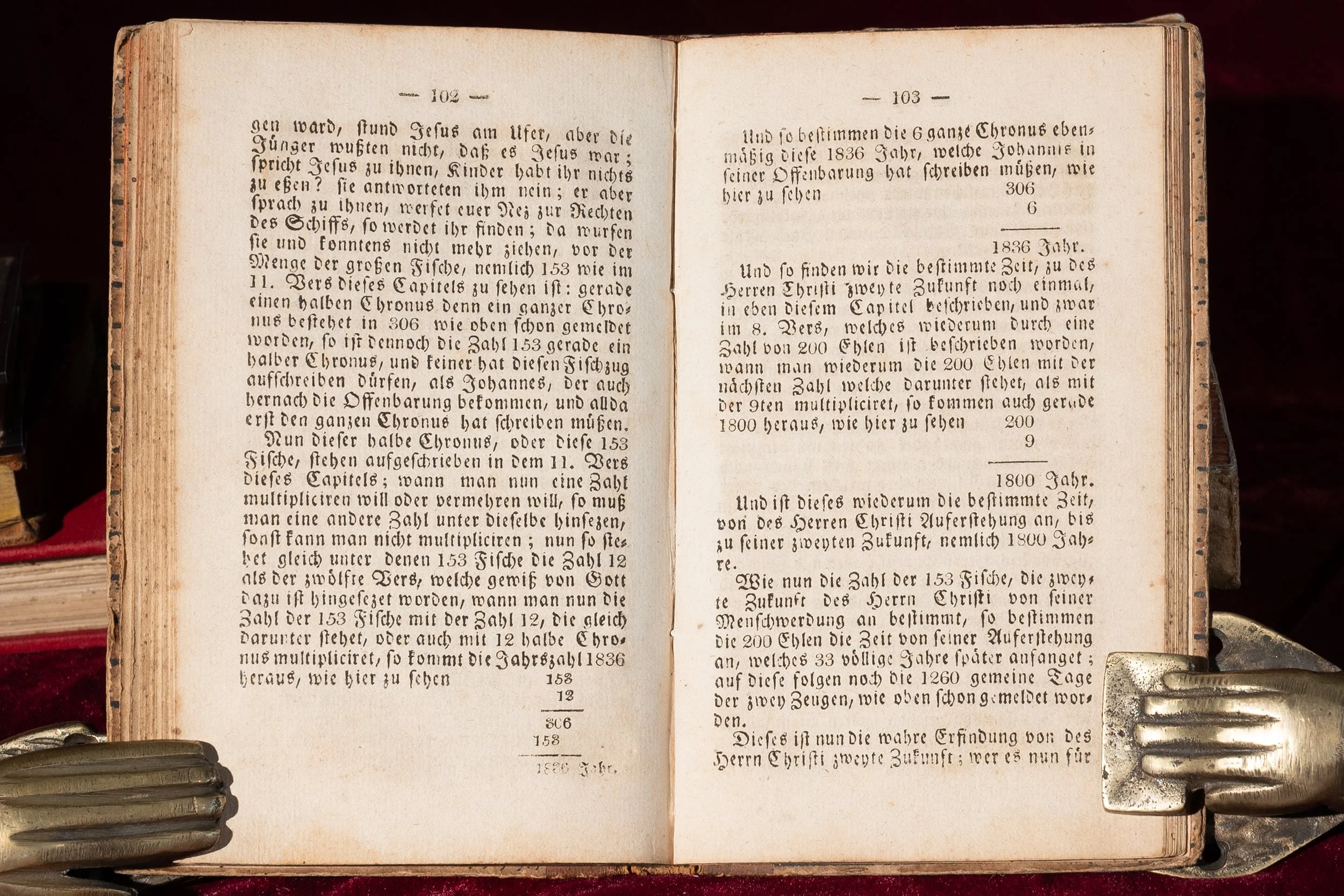 Image 6 of 9
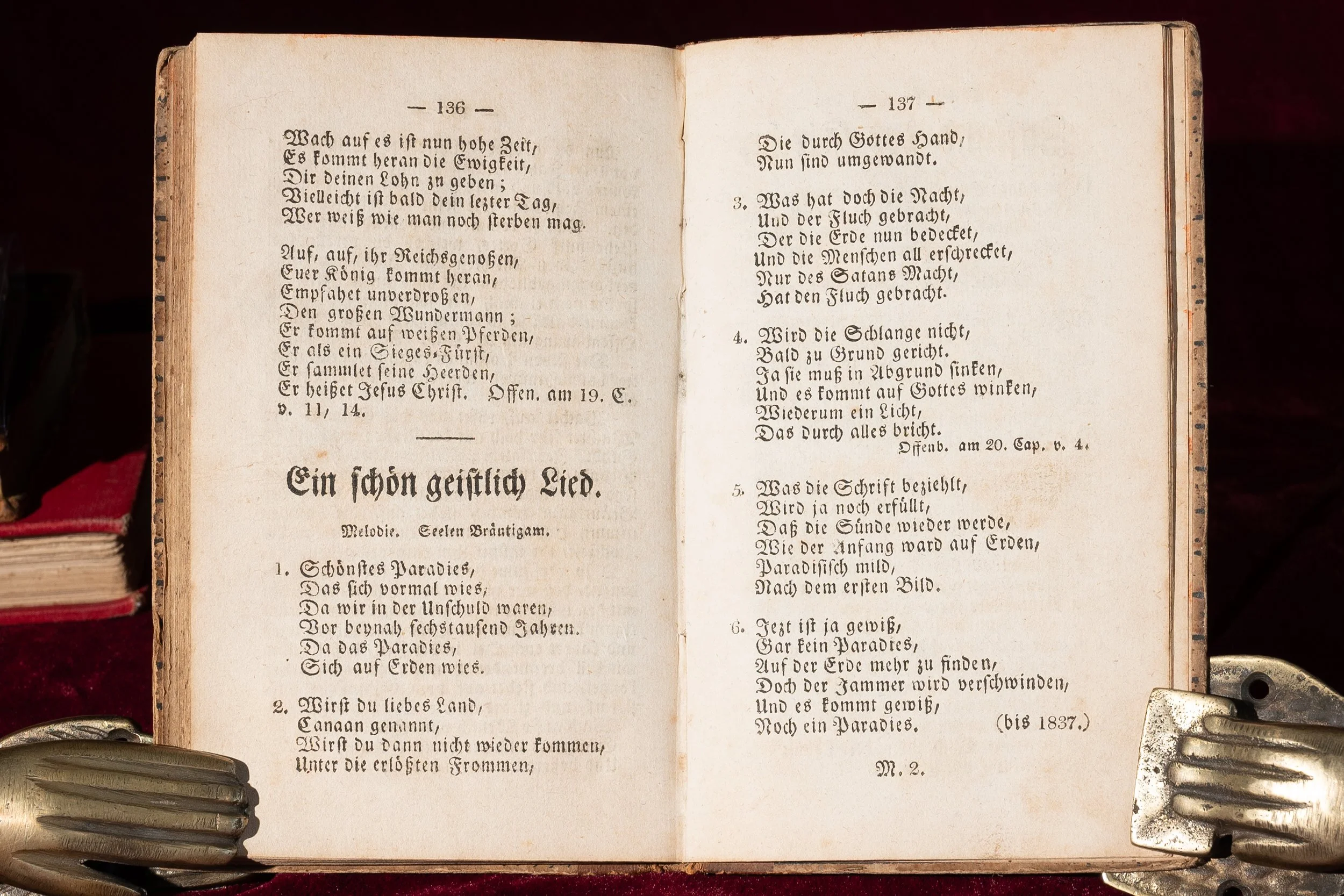 Image 7 of 9
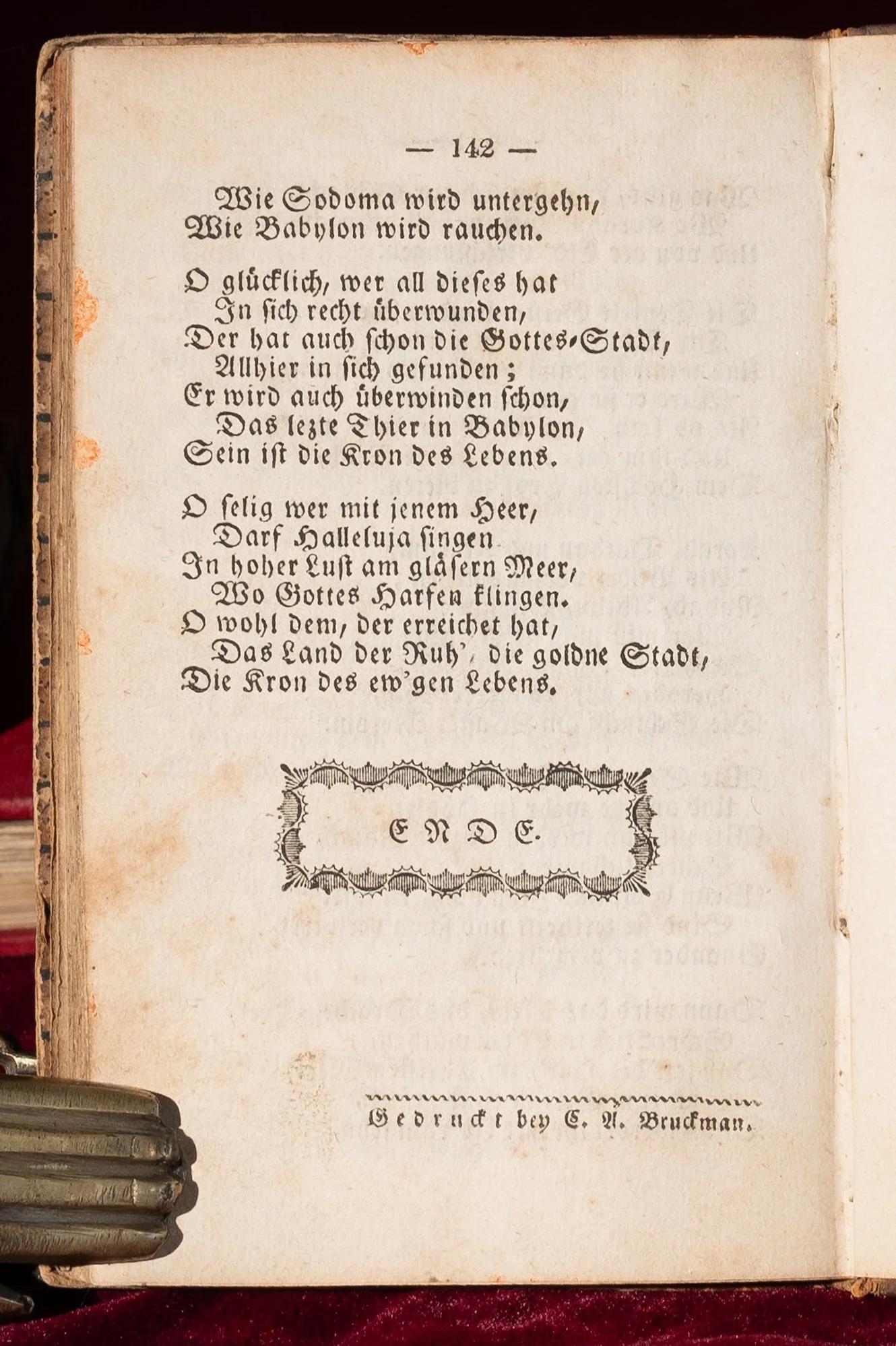 Image 8 of 9
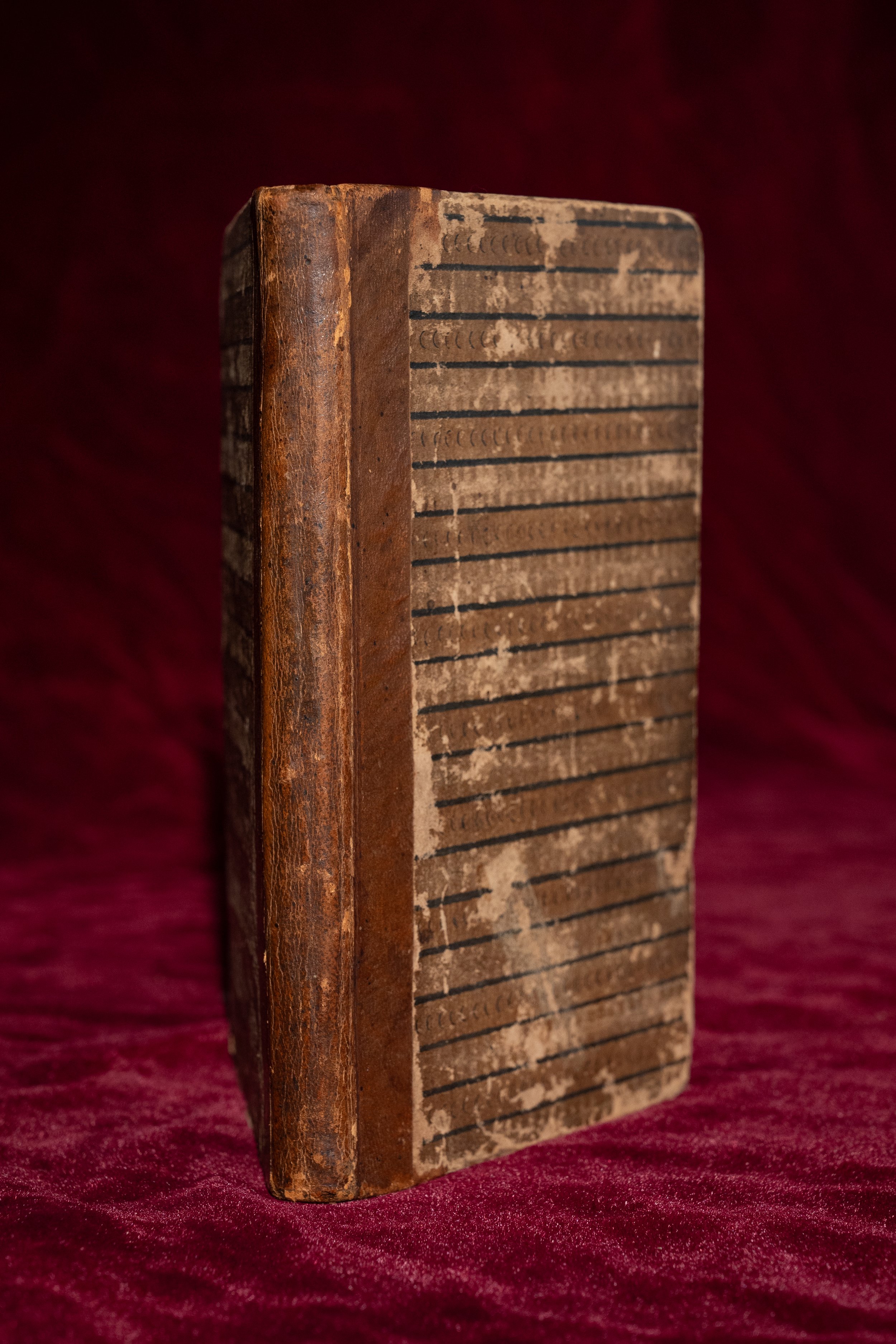 Image 9 of 9