Open the table of contents of this little chemistry course and you can watch a scientific revolution happening in real time. Here is "Brennstoff," the old combustible principle descended from phlogiston, the invisible fire-stuff that eighteenth-century chemists believed escaped from everything that burns. A few lines below it stands its executioner: "Lebensluft oder Sauerstoffgas," the air of life — oxygen, central to Lavoisier’s new chemistry. With it comes a new "Theorie des Feuers und Verbrennens," a theory of fire and combustion that was dismantling the phlogiston world as this book went to press. The author, Friedrich Albrecht Carl Gren of Halle, had been one of phlogiston’s fiercest German defenders. He once argued that phlogiston must have negative weight. By 1796 he had retreated to an ingenious compromise, and his textbooks, written mid-surrender, taught German students both chemistries at once. Historians credit exactly these books with preparing Germany’s acceptance of the new French chemistry.
The contents read like a cabinet of the decade’s novelties. Among the earths are Strontionerde and Zirkonerde — strontia and zirconia, both identified only a few years earlier. Then comes something stranger: "Australerde," the Australian earth, a brand-new chemical element reported from the sands of Botany Bay and named Sydneia for the infant colony at Sydney. It does not exist. Charles Hatchett analyzed the stuff for the Royal Society in 1798 and found it to be nothing but silica, alumina and a little iron. The Australian element vanished from chemistry, surviving only in period documents like this one. The first volume runs from the practical arts of the laboratory — distilling, subliming, the pneumatic apparatus, the balance — through the mineral acids to the chemistry of the plant kingdom: sugar, camphor, indigo, litmus, the dyer’s art, bleaching. The second volume carries the course to its conclusion and ends with a set of letterpress chemical tables, the working reference matter a student of the 1790s kept at his fingertips.
Gren himself is one of the poignant figures of the chemical revolution. He began as a pharmacist’s apprentice and clawed his way to a double doctorate and the chair of physics and chemistry at Halle. In 1790 he founded the Journal der Physik, the periodical that would become the Annalen der Physik (the journal in which Einstein would one day publish). He died at thirty-eight, shortly after these volumes appeared. This is his Grundriß der Chemie complete in both parts, in first edition, printed at Halle by the famous Orphanage press. The two volumes come in matching contemporary half-leather bindings with tree-patterned marbled sides, with red morocco labels reading "Grens Chemie." A crossed-out Czech library stamp of the municipal library of Olomouc, the old Moravian capital, records a later chapter of the set’s life. This one has been reunited on our shelves.
Provenance: Municipal library of Olomouc, Moravia ("Baugartnerova knihovna hlavn. města Olomouce"), inked circular stamp to the title of volume I, struck through, with inked shelfmark ("c. 404").
GREN, Friedrich Albrecht Carl (1760-1798). Grundriß der Chemie. Nach den neuesten Entdeckungen entworfen und zum Gebrauch akademischer Vorlesungen eingerichtet. Erster [-Zweyter] Theil. Halle: im Verlage der Waisenhaus-Buchhandlung, 1796-1797. First edition, the two volumes complete.
Physical Description: Two octavo volumes. Volume I with contents leaves (Inhalt) covering the introduction, the doctrine of heat, light and combustion, salts, earths (including strontia, zirconia, and the spurious "Australerde"), the mineral acids, and the constituents of the plant kingdom through dyeing and bleaching; volume II concluding the course, with letterpress chemical tables at the end. Without engraved plates, as issued.
Binding: Uniform contemporary half leather, the spines gilt in compartments with decorative tools, red morocco lettering pieces ("Grens Chemie"), gilt oval volume numerals in a lower compartment, tree-patterned marbled sides, edges stained yellow.
Condition: Bindings rubbed with small chips at the spine ends, corners worn; internally with scattered foxing and light dampstaining to the preliminary leaves of volume I, the text otherwise clean and sound in a pleasing period state, the two volumes in matching condition.
Open the table of contents of this little chemistry course and you can watch a scientific revolution happening in real time. Here is "Brennstoff," the old combustible principle descended from phlogiston, the invisible fire-stuff that eighteenth-century chemists believed escaped from everything that burns. A few lines below it stands its executioner: "Lebensluft oder Sauerstoffgas," the air of life — oxygen, central to Lavoisier’s new chemistry. With it comes a new "Theorie des Feuers und Verbrennens," a theory of fire and combustion that was dismantling the phlogiston world as this book went to press. The author, Friedrich Albrecht Carl Gren of Halle, had been one of phlogiston’s fiercest German defenders. He once argued that phlogiston must have negative weight. By 1796 he had retreated to an ingenious compromise, and his textbooks, written mid-surrender, taught German students both chemistries at once. Historians credit exactly these books with preparing Germany’s acceptance of the new French chemistry.
The contents read like a cabinet of the decade’s novelties. Among the earths are Strontionerde and Zirkonerde — strontia and zirconia, both identified only a few years earlier. Then comes something stranger: "Australerde," the Australian earth, a brand-new chemical element reported from the sands of Botany Bay and named Sydneia for the infant colony at Sydney. It does not exist. Charles Hatchett analyzed the stuff for the Royal Society in 1798 and found it to be nothing but silica, alumina and a little iron. The Australian element vanished from chemistry, surviving only in period documents like this one. The first volume runs from the practical arts of the laboratory — distilling, subliming, the pneumatic apparatus, the balance — through the mineral acids to the chemistry of the plant kingdom: sugar, camphor, indigo, litmus, the dyer’s art, bleaching. The second volume carries the course to its conclusion and ends with a set of letterpress chemical tables, the working reference matter a student of the 1790s kept at his fingertips.
Gren himself is one of the poignant figures of the chemical revolution. He began as a pharmacist’s apprentice and clawed his way to a double doctorate and the chair of physics and chemistry at Halle. In 1790 he founded the Journal der Physik, the periodical that would become the Annalen der Physik (the journal in which Einstein would one day publish). He died at thirty-eight, shortly after these volumes appeared. This is his Grundriß der Chemie complete in both parts, in first edition, printed at Halle by the famous Orphanage press. The two volumes come in matching contemporary half-leather bindings with tree-patterned marbled sides, with red morocco labels reading "Grens Chemie." A crossed-out Czech library stamp of the municipal library of Olomouc, the old Moravian capital, records a later chapter of the set’s life. This one has been reunited on our shelves.
Provenance: Municipal library of Olomouc, Moravia ("Baugartnerova knihovna hlavn. města Olomouce"), inked circular stamp to the title of volume I, struck through, with inked shelfmark ("c. 404").
GREN, Friedrich Albrecht Carl (1760-1798). Grundriß der Chemie. Nach den neuesten Entdeckungen entworfen und zum Gebrauch akademischer Vorlesungen eingerichtet. Erster [-Zweyter] Theil. Halle: im Verlage der Waisenhaus-Buchhandlung, 1796-1797. First edition, the two volumes complete.
Physical Description: Two octavo volumes. Volume I with contents leaves (Inhalt) covering the introduction, the doctrine of heat, light and combustion, salts, earths (including strontia, zirconia, and the spurious "Australerde"), the mineral acids, and the constituents of the plant kingdom through dyeing and bleaching; volume II concluding the course, with letterpress chemical tables at the end. Without engraved plates, as issued.
Binding: Uniform contemporary half leather, the spines gilt in compartments with decorative tools, red morocco lettering pieces ("Grens Chemie"), gilt oval volume numerals in a lower compartment, tree-patterned marbled sides, edges stained yellow.
Condition: Bindings rubbed with small chips at the spine ends, corners worn; internally with scattered foxing and light dampstaining to the preliminary leaves of volume I, the text otherwise clean and sound in a pleasing period state, the two volumes in matching condition.

 Image 1 of 14
 Image 2 of 14
 Image 3 of 14
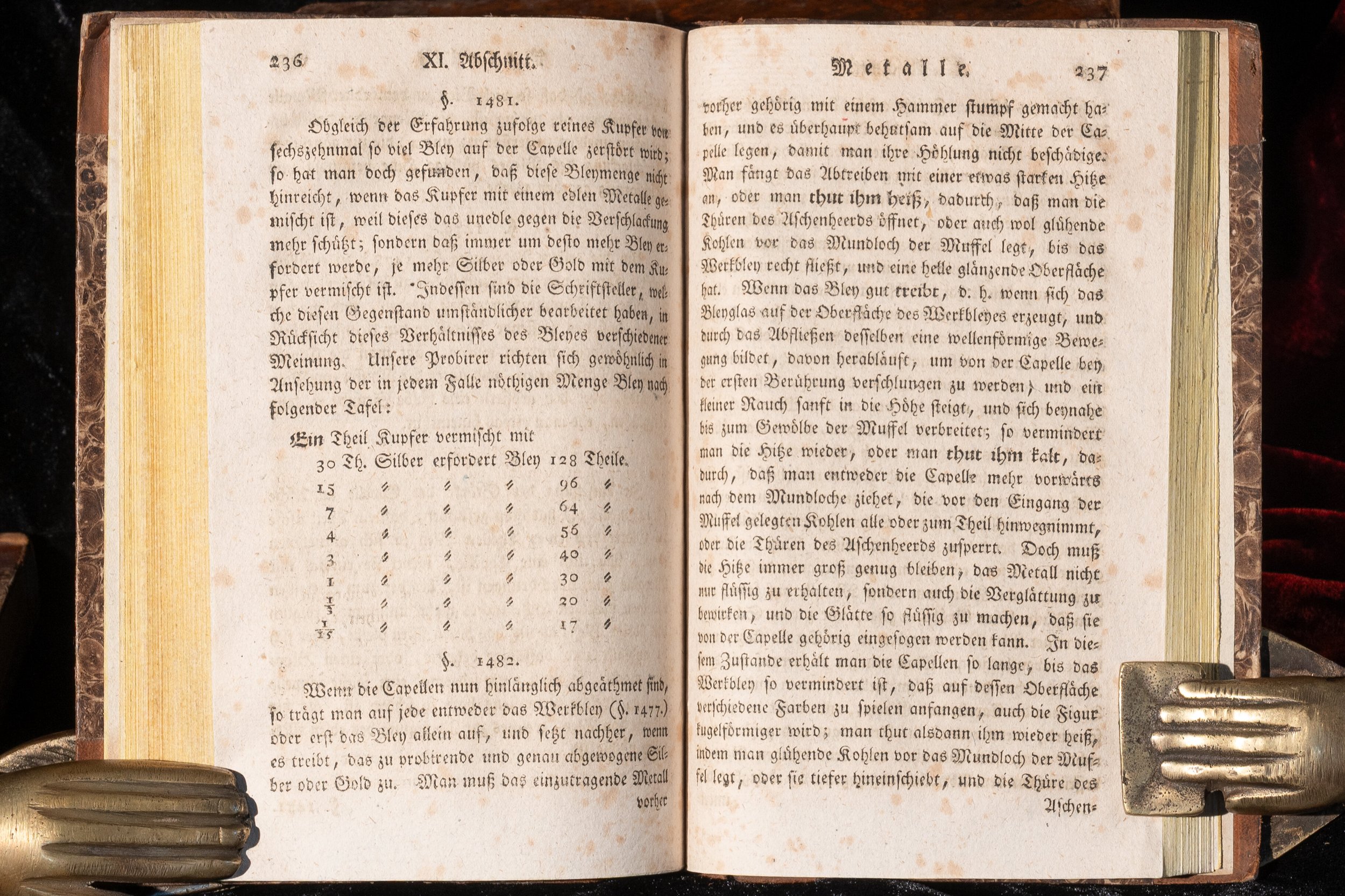 Image 4 of 14
 Image 5 of 14
 Image 6 of 14
 Image 7 of 14
 Image 8 of 14
 Image 9 of 14
 Image 10 of 14
 Image 11 of 14
 Image 12 of 14
 Image 13 of 14
 Image 14 of 14