Two Göttingen physicists share this title page. The first is Johann Christian Polykarp Erxleben, the Göttingen professor who wrote the book and died at thirty-three. His mother, Dorothea Erxleben, was the first woman in Germany to take a medical doctorate, defending her degree at Halle against furious opposition and practicing to the end of her life. Her son's Anfangsgründe der Naturlehre became the standard physics textbook of the German Enlightenment. When he died young, the book passed to the second name, one of the most beloved figures in German letters: Georg Christoph Lichtenberg. Lichtenberg was a hunchback and the most famous lecturer on experimental physics in Germany. The branching electrical figures he discovered still bear his name. Lichtenberg kept his dead colleague's textbook in print through edition after edition, stuffing it with his own "improvements and many additions." This edition is the last one that Lichtenberg himself prepared (five years before his death), printed at Göttingen by his friend and publisher Dieterich.
The table of contents is a portrait of physics at the moment it was becoming modern. Lichtenberg's additions are easy to spot. Under electricity, alongside the Leyden jar and the electrophorus, stands "Hrn. Volta's Condensator": Signor Volta's condenser, reported to German students six years before Volta's pile would electrify the world. There are sections on the theory of heat "mostly after Crawford," on artificial magnets, on meteors and thunderstorms, and, at the end, on the origin of the world. The optics section moves from mirrors and prisms to a delightful cabinet of instruments: the darkened room, the telescope, the solar microscope, and the Zauberlaterne — the magic lantern, ancestor of every projected image, here classified merely as an optical tool. Nine engraved plates on five folding leaves unfold at the back, among them a full air pump on its columned stand with a specimen suspended in the bell jar.
The copy has lived in interesting company. On the pastedown, beneath a struck-through earlier ink inscription, a new owner has written "Ex libris N. Leitz 1817." Both pastedown and title bear the violet seal of the Cistercian abbey of Himmerod in the Eifel, "Sigillum Conventus Hemmenrodensis," with the crowned Madonna and Child above a shield. The stamps identify the abbey, but do not establish when it acquired the volume. The contemporary calf binding has been read hard: the spine is gilt with neoclassical urns and sprays, but the front joint is split and the headcap gone, and the price reflects that wear. The text and all the plates are sound. This is the final edition revised by Lichtenberg of a widely used Enlightenment physics textbook.
Provenance: (1) Early ink ownership inscription to the front pastedown, struck through and illegible. (2) "Ex libris N. Leitz," ink inscription dated 1817. (3) Cistercian abbey of Himmerod in the Eifel ("Sigillum Conventus Hemmenrodensis"), violet circular seal stamps to the pastedown and title. (4) Inked shelfmark at the head of the title.
ERXLEBEN, Johann Christian Polykarp (1744-1777); LICHTENBERG, Georg Christoph (1742-1799), editor. Anfangsgründe der Naturlehre... Sechste Auflage. Mit Verbesserungen und vielen Zusätzen von G. C. Lichtenberg. Göttingen: bey Johann Christian Dieterich, 1794. Sixth edition, the last edited by Lichtenberg.
Physical Description: Octavo, 773 pp. plus register ([15] leaves), with extensive Inhalt (contents) leaves; nine engraved plates numbered I-VIII and IV.B, printed on five folding leaves at the end (most leaves carrying two plates, the bis-numbered IV.B, an air pump with bell jar and receiver, on the final leaf). Lichtenberg's interpolated sections keyed with letter-suffixes (e.g. §538b-k on the electrophorus and Volta's condenser). Complete.
Binding: Contemporary calf, spine gilt in compartments with neoclassical urn and spray tools, paper spine label.
Condition: Binding heavily worn: front joint split with the cords exposed, headcap perished, surface losses to both covers, corners worn; internally toned with staining and foxing, heavier to the title and preliminary leaves; the plates clean and well-preserved. A working copy of a landmark textbook, priced with its wear in mind.
Two Göttingen physicists share this title page. The first is Johann Christian Polykarp Erxleben, the Göttingen professor who wrote the book and died at thirty-three. His mother, Dorothea Erxleben, was the first woman in Germany to take a medical doctorate, defending her degree at Halle against furious opposition and practicing to the end of her life. Her son's Anfangsgründe der Naturlehre became the standard physics textbook of the German Enlightenment. When he died young, the book passed to the second name, one of the most beloved figures in German letters: Georg Christoph Lichtenberg. Lichtenberg was a hunchback and the most famous lecturer on experimental physics in Germany. The branching electrical figures he discovered still bear his name. Lichtenberg kept his dead colleague's textbook in print through edition after edition, stuffing it with his own "improvements and many additions." This edition is the last one that Lichtenberg himself prepared (five years before his death), printed at Göttingen by his friend and publisher Dieterich.
The table of contents is a portrait of physics at the moment it was becoming modern. Lichtenberg's additions are easy to spot. Under electricity, alongside the Leyden jar and the electrophorus, stands "Hrn. Volta's Condensator": Signor Volta's condenser, reported to German students six years before Volta's pile would electrify the world. There are sections on the theory of heat "mostly after Crawford," on artificial magnets, on meteors and thunderstorms, and, at the end, on the origin of the world. The optics section moves from mirrors and prisms to a delightful cabinet of instruments: the darkened room, the telescope, the solar microscope, and the Zauberlaterne — the magic lantern, ancestor of every projected image, here classified merely as an optical tool. Nine engraved plates on five folding leaves unfold at the back, among them a full air pump on its columned stand with a specimen suspended in the bell jar.
The copy has lived in interesting company. On the pastedown, beneath a struck-through earlier ink inscription, a new owner has written "Ex libris N. Leitz 1817." Both pastedown and title bear the violet seal of the Cistercian abbey of Himmerod in the Eifel, "Sigillum Conventus Hemmenrodensis," with the crowned Madonna and Child above a shield. The stamps identify the abbey, but do not establish when it acquired the volume. The contemporary calf binding has been read hard: the spine is gilt with neoclassical urns and sprays, but the front joint is split and the headcap gone, and the price reflects that wear. The text and all the plates are sound. This is the final edition revised by Lichtenberg of a widely used Enlightenment physics textbook.
Provenance: (1) Early ink ownership inscription to the front pastedown, struck through and illegible. (2) "Ex libris N. Leitz," ink inscription dated 1817. (3) Cistercian abbey of Himmerod in the Eifel ("Sigillum Conventus Hemmenrodensis"), violet circular seal stamps to the pastedown and title. (4) Inked shelfmark at the head of the title.
ERXLEBEN, Johann Christian Polykarp (1744-1777); LICHTENBERG, Georg Christoph (1742-1799), editor. Anfangsgründe der Naturlehre... Sechste Auflage. Mit Verbesserungen und vielen Zusätzen von G. C. Lichtenberg. Göttingen: bey Johann Christian Dieterich, 1794. Sixth edition, the last edited by Lichtenberg.
Physical Description: Octavo, 773 pp. plus register ([15] leaves), with extensive Inhalt (contents) leaves; nine engraved plates numbered I-VIII and IV.B, printed on five folding leaves at the end (most leaves carrying two plates, the bis-numbered IV.B, an air pump with bell jar and receiver, on the final leaf). Lichtenberg's interpolated sections keyed with letter-suffixes (e.g. §538b-k on the electrophorus and Volta's condenser). Complete.
Binding: Contemporary calf, spine gilt in compartments with neoclassical urn and spray tools, paper spine label.
Condition: Binding heavily worn: front joint split with the cords exposed, headcap perished, surface losses to both covers, corners worn; internally toned with staining and foxing, heavier to the title and preliminary leaves; the plates clean and well-preserved. A working copy of a landmark textbook, priced with its wear in mind.

 Image 1 of 16
 Image 2 of 16
 Image 3 of 16
 Image 4 of 16
 Image 5 of 16
 Image 6 of 16
 Image 7 of 16
 Image 8 of 16
 Image 9 of 16
 Image 10 of 16
 Image 11 of 16
 Image 12 of 16
 Image 13 of 16
 Image 14 of 16
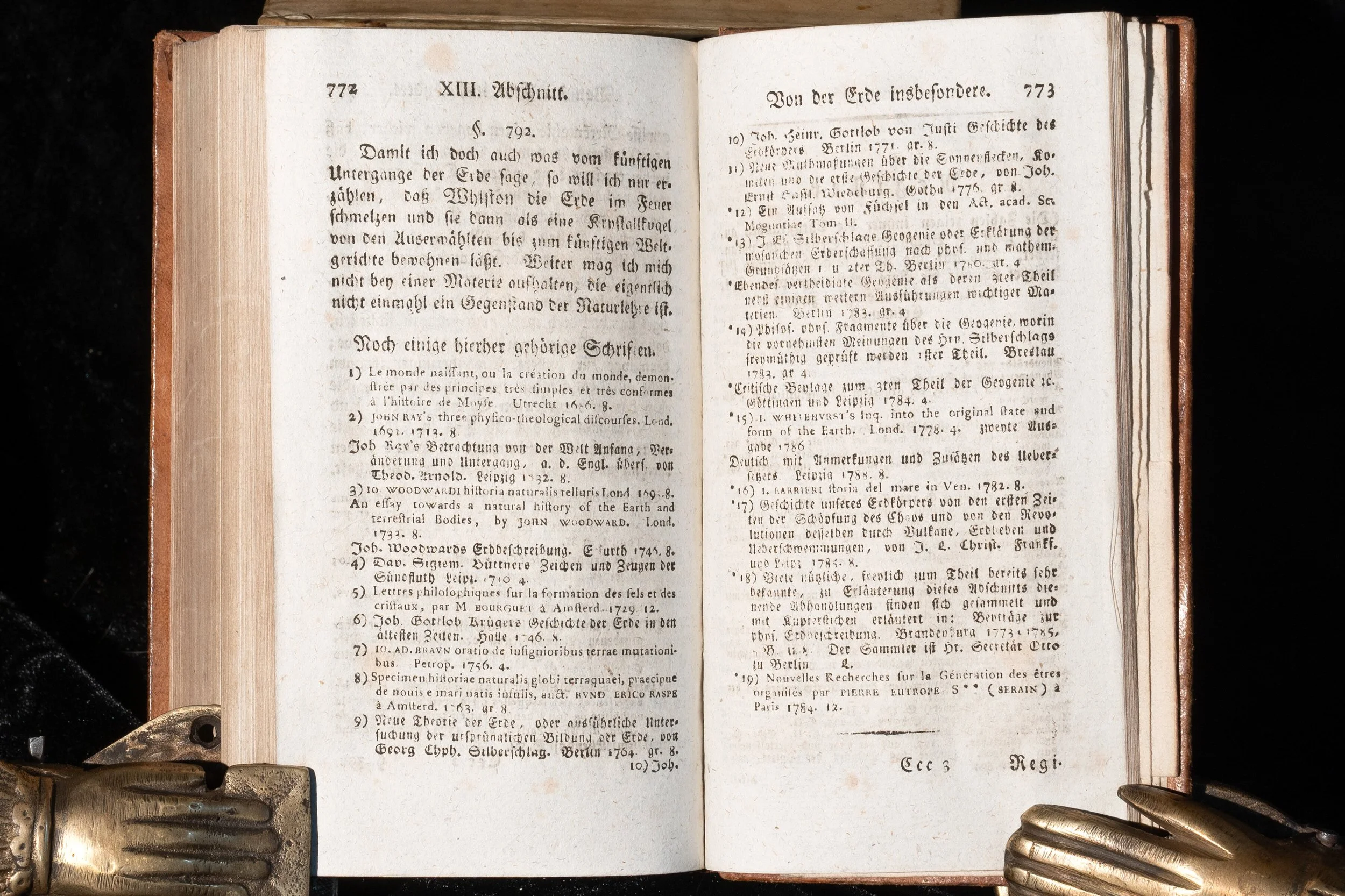 Image 15 of 16
 Image 16 of 16