Published in 1792, at the height of the German Aufklärung and just as Revolutionary anti-clericalism threatened all monastic institutions across Europe. This work captures a pivotal moment in the history of Western Esotericism: the systematic attempt to dismantle the "Magical Universe." Heinrich Ludwig Fischer, a rationalist pedagogue, wrote this "Emergency Booklet" (Noth- und Hülfsbüchlein) not to teach magic, but to destroy it.
Yet here lies the irony: Enlightenment rationalism's attempt to 'disenchant' the world inadvertently preserved the very magical worldview it sought to destroy. In his zeal to debunk specific superstitions, Fischer created a detailed encyclopedia of late 18th-century German folklore, necromancy, and vernacular magic. For modern scholars of the occult, such skeptical treatises are invaluable "shadow archives": our richest sources for magical practices that survived nowhere else.
Lycanthropy & The German Werewolf: Of particular scholarly importance is Fischer's extensive treatment "Von den Werwölfen" (On Werewolves), one of the earliest German texts to psychologize lycanthropy rather than demonize it. Writing just decades after the last werewolf trials, Fischer attempts to reframe shapeshifting not as demonic pact but as pathology of the imagination (Einbildungskraft). He documents the specific symptoms, behaviors, and folk beliefs surrounding wolf-men in the German countryside, providing a rare contemporary window into how lycanthropy was understood in the final years before Romanticism would resurrect it as metaphor. This section alone makes the work essential for anyone studying the cultural history of the werewolf.
The Proto-UFO Connection: "Fiery Balls" & Atmospheric Phenomena: Fischer devotes substantial attention to celestial anomalies and atmospheric wonders: feurige Kugeln ("fiery balls"), Northern Lights, "blood rain," and mysterious aerial phenomena. In his attempt to strip these events of their prophetic and supernatural weight, he documents exactly how rural Germans interpreted unexplained lights in the sky, making this a crucial primary source for scholars tracing the genealogy of anomalous phenomena literature from medieval prodigies through modern UFOlogy.
The Inventory of the Invisible: Beyond lycanthropy and aerial mysteries, the text functions as a compendium of the "Nightside of Nature," systematically cataloging the fears that haunted the pre-industrial mind:
Necromancy & Hauntings (Gespenstern): A detailed refutation of ghosts, arguing against the return of the dead while inadvertently documenting the specific rituals used to summon or ward them off.
The Lunar Connection: Fascinating sections on Mondsüchtigen ("Moon-addicts" or sleepwalkers) and Nachtwanderern, linking lunar cycles to altered states of consciousness, a direct precursor to the later Romantic obsession with Mesmerism and somnambulism.
Witchcraft & The Hexenmeister: A deconstruction of the Witch-master figure, marking the transition from the demonology of the Witch Trials to the psychology of modernity.
Provenance: From the library of Schlägl Abbey (Stift Schlägl), the Premonstratensian monastery in Upper Austria founded in 1218 and still active today. The title page bears the abbey's "Bibliotheca Plagensis" stamp featuring the distinctive "crossed mallets" arms. Front cover and spine retain original institutional paper shelf-mark labels.
The presence of this volume in a monastic library is itself historically significant: this wasn't shelved as heresy, but as something like a pastoral weapon. Schlägl's clergy likely used Fischer's rationalist catalog to identify and eradicate "pagan" folk practices among the rural Austrian peasantry. The Church's strategic adoption of Enlightenment reason, particularly in 1792, as the Terror executed priests across Revolutionary France, reveals rationalism serving as both intellectual position and institutional survival strategy.
The Anti-Grimoire Grimoire: Ironically, this book's survival in a monastic library, while actual grimoires were burned, means that rationalist "debunkings" now constitute our primary evidence for lost magical practices. The destroyer became the preserver. What Fischer intended as erasure, we now value as encyclopedia.
[FISCHER, Heinrich Ludwig]. Das Buch vom Aberglauben, Mißbrauch, und falschen Wahn. Ein nöthiger Beytrag zum Unterricht-, Noth- und Hülfsbüchlein. Frankfurt & Leipzig: [s.n.], 1792.
Small Octavo (18 x 11 cm). 272 pp. Bound in contemporary blue paper boards (Pappband) with original paper spine label.
Condition: Very Good. Binding remains tight and clean with original spine label (age-toned but intact). Interior is crisp with only minimal browning and occasional light foxing, exceptional for a 230+ year-old work in original boards.
References: Hayn-Gotendorf I, 489.
Significance: This is a pivotal text for understanding the "Disenchantment of the World" (Max Weber's Entzauberung); physical evidence of the exact moment when Church and State joined forces to replace the "Old Ways" with Reason, preserving the details of that magic in the very act of refutation.
Published in 1792, at the height of the German Aufklärung and just as Revolutionary anti-clericalism threatened all monastic institutions across Europe. This work captures a pivotal moment in the history of Western Esotericism: the systematic attempt to dismantle the "Magical Universe." Heinrich Ludwig Fischer, a rationalist pedagogue, wrote this "Emergency Booklet" (Noth- und Hülfsbüchlein) not to teach magic, but to destroy it.
Yet here lies the irony: Enlightenment rationalism's attempt to 'disenchant' the world inadvertently preserved the very magical worldview it sought to destroy. In his zeal to debunk specific superstitions, Fischer created a detailed encyclopedia of late 18th-century German folklore, necromancy, and vernacular magic. For modern scholars of the occult, such skeptical treatises are invaluable "shadow archives": our richest sources for magical practices that survived nowhere else.
Lycanthropy & The German Werewolf: Of particular scholarly importance is Fischer's extensive treatment "Von den Werwölfen" (On Werewolves), one of the earliest German texts to psychologize lycanthropy rather than demonize it. Writing just decades after the last werewolf trials, Fischer attempts to reframe shapeshifting not as demonic pact but as pathology of the imagination (Einbildungskraft). He documents the specific symptoms, behaviors, and folk beliefs surrounding wolf-men in the German countryside, providing a rare contemporary window into how lycanthropy was understood in the final years before Romanticism would resurrect it as metaphor. This section alone makes the work essential for anyone studying the cultural history of the werewolf.
The Proto-UFO Connection: "Fiery Balls" & Atmospheric Phenomena: Fischer devotes substantial attention to celestial anomalies and atmospheric wonders: feurige Kugeln ("fiery balls"), Northern Lights, "blood rain," and mysterious aerial phenomena. In his attempt to strip these events of their prophetic and supernatural weight, he documents exactly how rural Germans interpreted unexplained lights in the sky, making this a crucial primary source for scholars tracing the genealogy of anomalous phenomena literature from medieval prodigies through modern UFOlogy.
The Inventory of the Invisible: Beyond lycanthropy and aerial mysteries, the text functions as a compendium of the "Nightside of Nature," systematically cataloging the fears that haunted the pre-industrial mind:
Necromancy & Hauntings (Gespenstern): A detailed refutation of ghosts, arguing against the return of the dead while inadvertently documenting the specific rituals used to summon or ward them off.
The Lunar Connection: Fascinating sections on Mondsüchtigen ("Moon-addicts" or sleepwalkers) and Nachtwanderern, linking lunar cycles to altered states of consciousness, a direct precursor to the later Romantic obsession with Mesmerism and somnambulism.
Witchcraft & The Hexenmeister: A deconstruction of the Witch-master figure, marking the transition from the demonology of the Witch Trials to the psychology of modernity.
Provenance: From the library of Schlägl Abbey (Stift Schlägl), the Premonstratensian monastery in Upper Austria founded in 1218 and still active today. The title page bears the abbey's "Bibliotheca Plagensis" stamp featuring the distinctive "crossed mallets" arms. Front cover and spine retain original institutional paper shelf-mark labels.
The presence of this volume in a monastic library is itself historically significant: this wasn't shelved as heresy, but as something like a pastoral weapon. Schlägl's clergy likely used Fischer's rationalist catalog to identify and eradicate "pagan" folk practices among the rural Austrian peasantry. The Church's strategic adoption of Enlightenment reason, particularly in 1792, as the Terror executed priests across Revolutionary France, reveals rationalism serving as both intellectual position and institutional survival strategy.
The Anti-Grimoire Grimoire: Ironically, this book's survival in a monastic library, while actual grimoires were burned, means that rationalist "debunkings" now constitute our primary evidence for lost magical practices. The destroyer became the preserver. What Fischer intended as erasure, we now value as encyclopedia.
[FISCHER, Heinrich Ludwig]. Das Buch vom Aberglauben, Mißbrauch, und falschen Wahn. Ein nöthiger Beytrag zum Unterricht-, Noth- und Hülfsbüchlein. Frankfurt & Leipzig: [s.n.], 1792.
Small Octavo (18 x 11 cm). 272 pp. Bound in contemporary blue paper boards (Pappband) with original paper spine label.
Condition: Very Good. Binding remains tight and clean with original spine label (age-toned but intact). Interior is crisp with only minimal browning and occasional light foxing, exceptional for a 230+ year-old work in original boards.
References: Hayn-Gotendorf I, 489.
Significance: This is a pivotal text for understanding the "Disenchantment of the World" (Max Weber's Entzauberung); physical evidence of the exact moment when Church and State joined forces to replace the "Old Ways" with Reason, preserving the details of that magic in the very act of refutation.

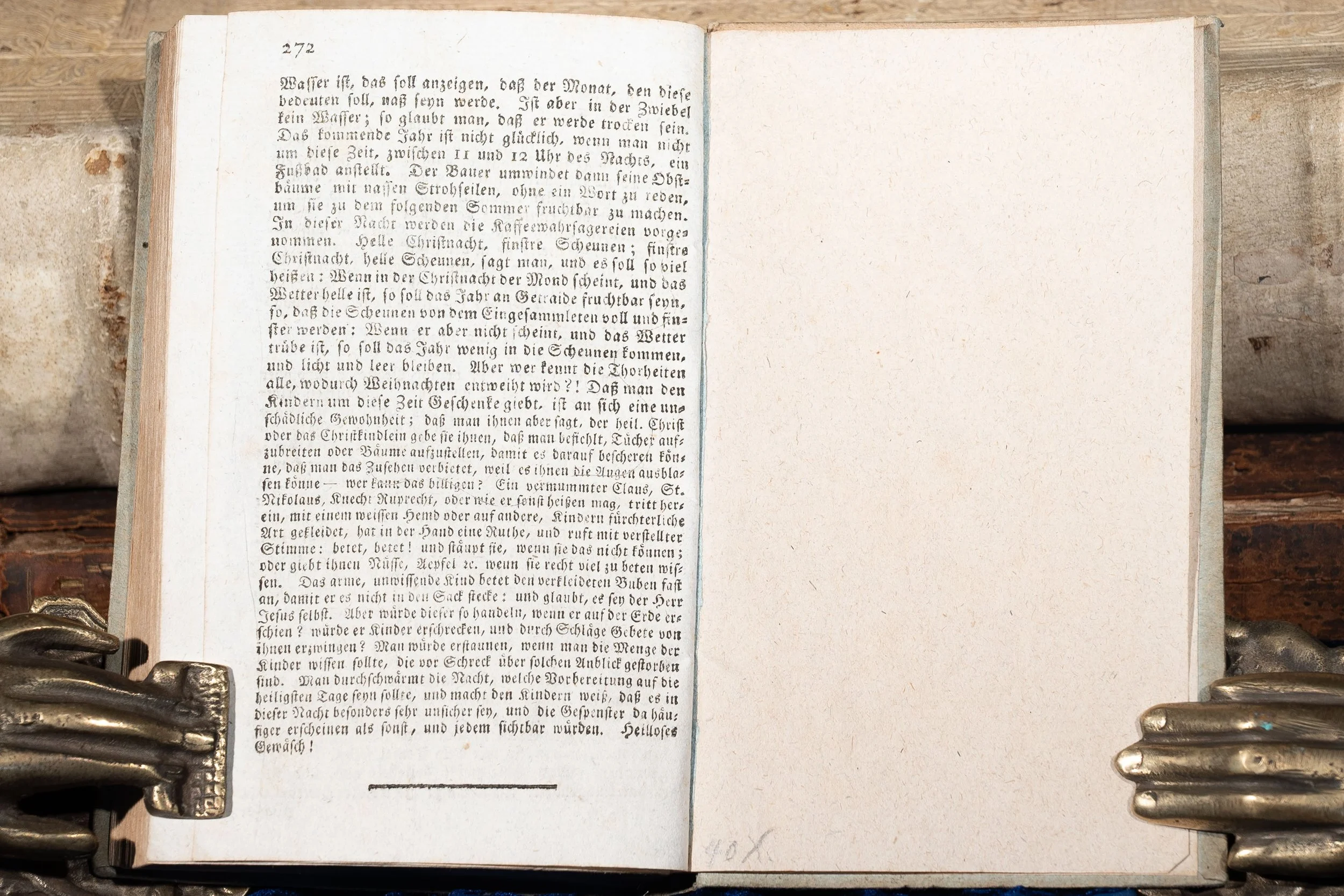 Image 1 of 7
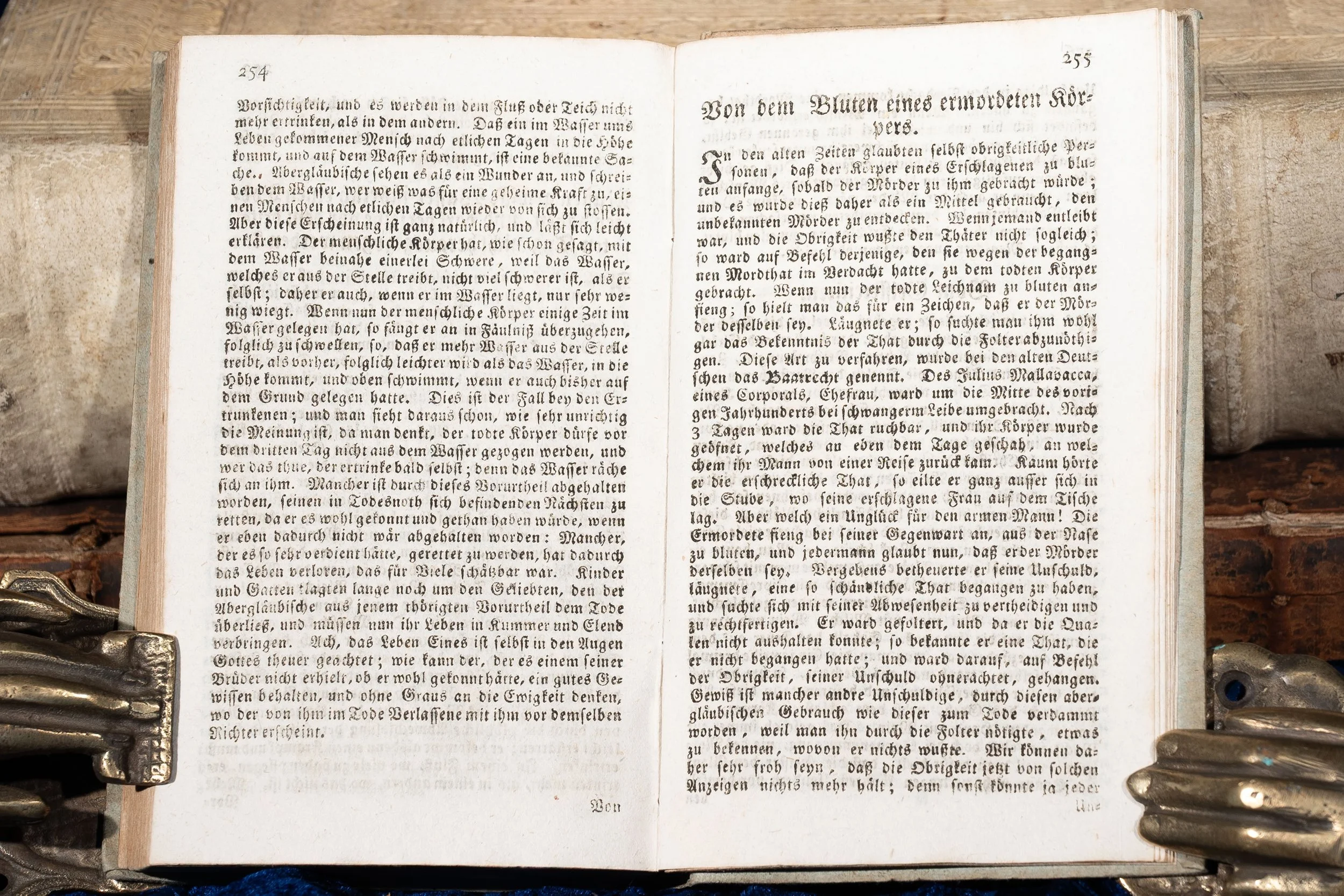 Image 2 of 7
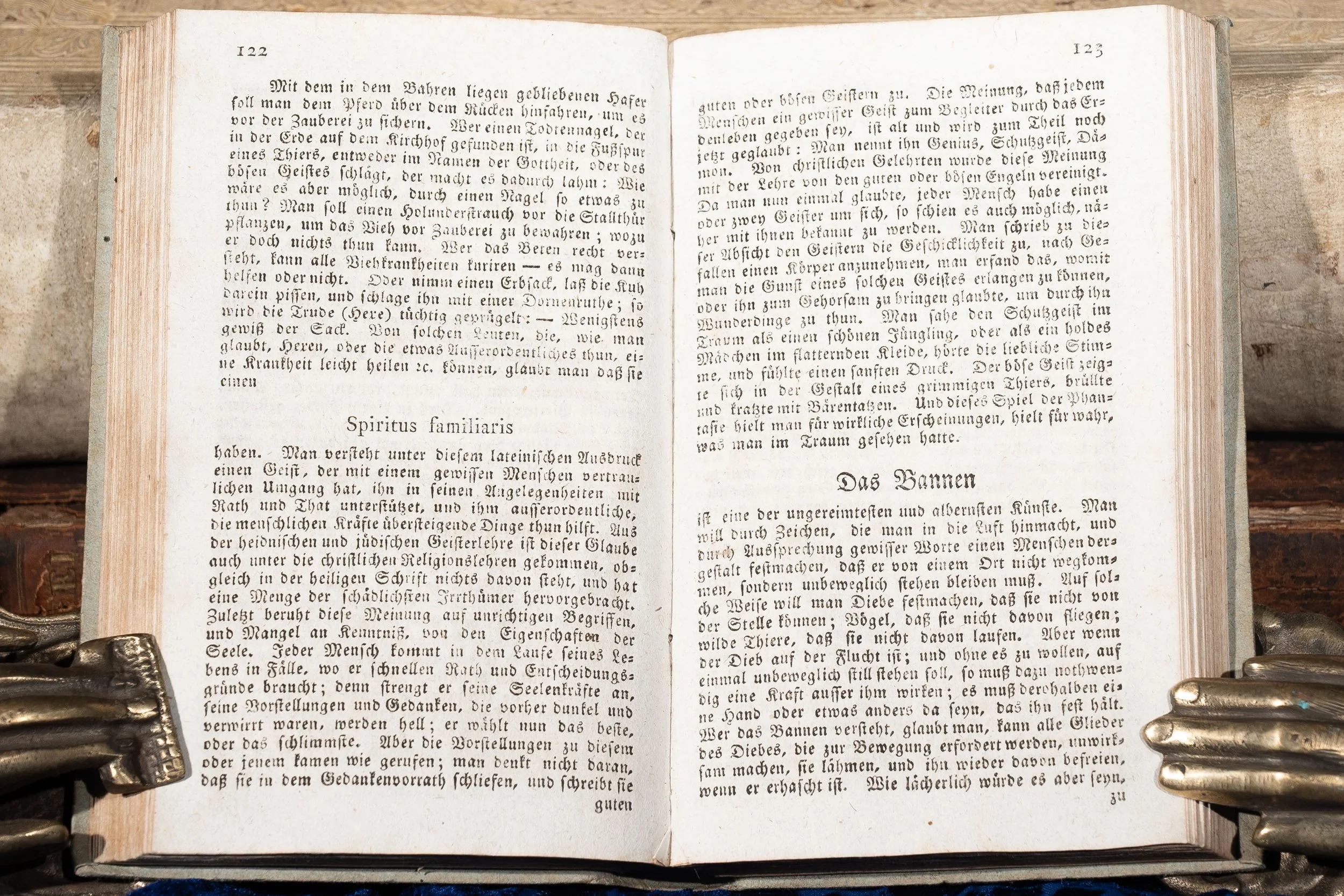 Image 3 of 7
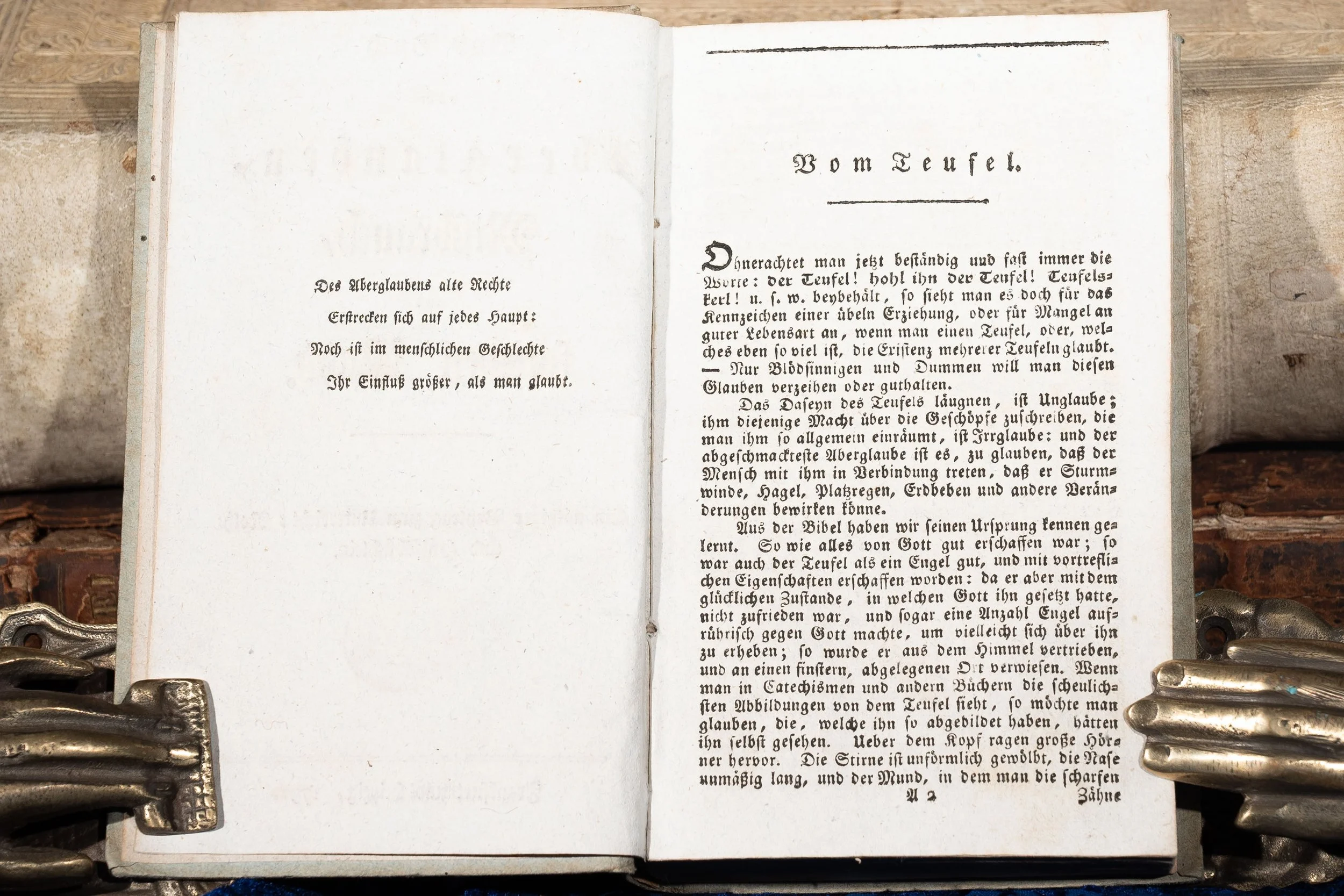 Image 4 of 7
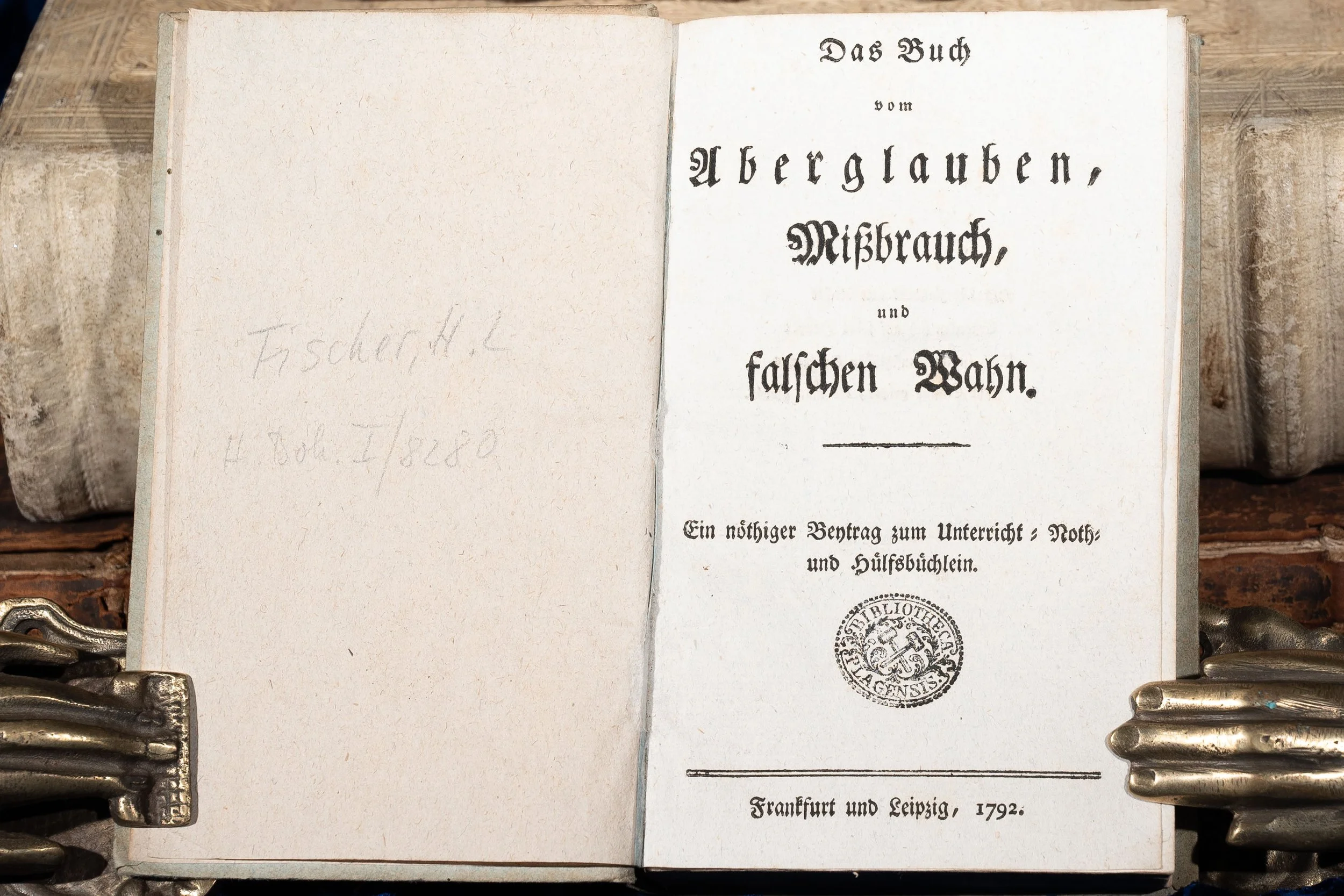 Image 5 of 7
 Image 6 of 7
 Image 7 of 7