The Grimoire du Pape Honorius occupies a singular position among the French grimoires. Where the Key of Solomon frames its operations within a broadly pious, if heterodox, cosmology, and the Grand Grimoire offers its infernal pact with a certain theatrical swagger, the Honorius is something stranger and darker: a manual of demonic conjuration designed explicitly for a Catholic priest, embedded within the structure of the Mass itself. It is this sacrilegious specificity that earned it A.E. Waite's judgment as perhaps the most frankly diabolical of the major ritual texts, and that has made it one of the most sought-after grimoires among collectors of the Western magical tradition.
Pseudepigraphically attributed to Pope Honorius III (d. 1227), the text assumes its operator already possesses sacerdotal authority and is prepared to turn it to infernal ends. The conjurations are woven into the canonical hours and the celebration of the Eucharist: one does not merely recite invocations, one says Mass and then commands Lucifer, Frimost, Astaroth, and the demons assigned to each day of the week. The ritual apparatus includes the preparation of magical circles, pentacles, and the sacrifice of a black cock (coq noir), depicted in one of the woodcut plates present in this copy. The result is, as Joseph Peterson has observed, genuinely bizarre: Catholic sacramental theology pressed into the service of demonology with a perfectly straight face.
The appended Recueil des plus rares secrets shifts register entirely, offering the practical folk magic that was the bread and butter of the bibliothèque bleue: charms for the protection of livestock, remedies against fevers and hemorrhoids, guards against wolves, and instructions for stopping runaway horses. It is this mixture of high diabolic ceremonial and agrarian folk remedy that gives these editions their distinctive character as cultural artifacts, documents of a world in which a Norman farmer and a Parisian occultist might consult the same slim volume for very different purposes. The grimoire also played a documented role in French history: copies surfaced during the Affair of the Poisons that scandalized Louis XIV's court in 1679, and in 1857 the young priest Jean-Louis Verger reportedly sought out a copy before assassinating the Archbishop of Paris, a sequence of events recounted with characteristic relish by Éliphas Lévi.
This copy bears the spurious imprint "A Rome (1787)," a less frequently encountered variant among the fictitious dates assigned to editions of the Honorius. The more commonly seen imprints read "1760" or "1670." The colophon on the final leaf, however, settles the question of origin plainly: "LILLE, -- IMPRIMERIE DE BLOCQUEL." Simon-François Blocquel (1780-1863) was Lille's most prolific printer of livres de colportage, the cheap chapbooks distributed through France's peddler networks. A Freemason, municipal councillor, and eventual Chevalier of the Légion d'Honneur, he understood that grimoires sold briskly when dressed in the trappings of antiquity and foreign provenance. His standard practice was to assign fictitious Roman imprints and antedated publication years to his occult titles, a convention that simultaneously frustrated censors and lent the books an air of venerable mystery. A previous owner of this copy arrived at the same conclusion independently, noting in a manuscript inscription on the front free endpaper that both the typefaces and the woodcuts betray a nineteenth-century hand, and correctly attributing the book to Blocquel's press.
This is the black-and-white issue, with uncolored woodcut plates throughout. The more sought-after variant features hand-colored plates and commands a significant premium. The present copy, in its honest contemporary binding and with its perceptive bibliographical provenance note, represents an accessible example of one of the essential texts of the French grimoire tradition.
[HONORIUS III, Pope, pseudo.] Grimoire du Pape Honorius, avec un recueil des plus rares secrets. A Rome (1787) [but Lille: Simon Blocquel, c. 1840]. 12mo. Woodcut frontispiece ("Garde pour les moutons, Espliquée à la page 91"), letterpress title within woodcut border, woodcut plates (including Pl. II depicting the coq noir and magical characters). Text concludes with Table ending at p. 103. Printer's colophon at foot of final leaf: "LILLE, -- IMPRIMERIE DE BLOCQUEL." Contemporary dark calf over marbled paper boards. Spine with gilt-tooled floral compartments and gilt-lettered title "GRIMOIRE." Some rubbing and wear to extremities; spine slightly darkened. Binding firm. Generally good. Some toning and occasional light foxing to leaves, as visible in images. Endpapers somewhat foxed.
Manuscript note in a neat hand on front free endpaper, in French: "Les caractères typographiques et les gravures sur bois s'opposent à ce que ce livre soit du XVIIIe siècle. C'est une réimpression (?) qui doit dater de la 1ère moitié du XIXe siècle, chez Deblocquel à Lille." Additional pencil notation: "lot 226" with what appears to be a price or code, suggesting auction provenance.
The Grimoire du Pape Honorius occupies a singular position among the French grimoires. Where the Key of Solomon frames its operations within a broadly pious, if heterodox, cosmology, and the Grand Grimoire offers its infernal pact with a certain theatrical swagger, the Honorius is something stranger and darker: a manual of demonic conjuration designed explicitly for a Catholic priest, embedded within the structure of the Mass itself. It is this sacrilegious specificity that earned it A.E. Waite's judgment as perhaps the most frankly diabolical of the major ritual texts, and that has made it one of the most sought-after grimoires among collectors of the Western magical tradition.
Pseudepigraphically attributed to Pope Honorius III (d. 1227), the text assumes its operator already possesses sacerdotal authority and is prepared to turn it to infernal ends. The conjurations are woven into the canonical hours and the celebration of the Eucharist: one does not merely recite invocations, one says Mass and then commands Lucifer, Frimost, Astaroth, and the demons assigned to each day of the week. The ritual apparatus includes the preparation of magical circles, pentacles, and the sacrifice of a black cock (coq noir), depicted in one of the woodcut plates present in this copy. The result is, as Joseph Peterson has observed, genuinely bizarre: Catholic sacramental theology pressed into the service of demonology with a perfectly straight face.
The appended Recueil des plus rares secrets shifts register entirely, offering the practical folk magic that was the bread and butter of the bibliothèque bleue: charms for the protection of livestock, remedies against fevers and hemorrhoids, guards against wolves, and instructions for stopping runaway horses. It is this mixture of high diabolic ceremonial and agrarian folk remedy that gives these editions their distinctive character as cultural artifacts, documents of a world in which a Norman farmer and a Parisian occultist might consult the same slim volume for very different purposes. The grimoire also played a documented role in French history: copies surfaced during the Affair of the Poisons that scandalized Louis XIV's court in 1679, and in 1857 the young priest Jean-Louis Verger reportedly sought out a copy before assassinating the Archbishop of Paris, a sequence of events recounted with characteristic relish by Éliphas Lévi.
This copy bears the spurious imprint "A Rome (1787)," a less frequently encountered variant among the fictitious dates assigned to editions of the Honorius. The more commonly seen imprints read "1760" or "1670." The colophon on the final leaf, however, settles the question of origin plainly: "LILLE, -- IMPRIMERIE DE BLOCQUEL." Simon-François Blocquel (1780-1863) was Lille's most prolific printer of livres de colportage, the cheap chapbooks distributed through France's peddler networks. A Freemason, municipal councillor, and eventual Chevalier of the Légion d'Honneur, he understood that grimoires sold briskly when dressed in the trappings of antiquity and foreign provenance. His standard practice was to assign fictitious Roman imprints and antedated publication years to his occult titles, a convention that simultaneously frustrated censors and lent the books an air of venerable mystery. A previous owner of this copy arrived at the same conclusion independently, noting in a manuscript inscription on the front free endpaper that both the typefaces and the woodcuts betray a nineteenth-century hand, and correctly attributing the book to Blocquel's press.
This is the black-and-white issue, with uncolored woodcut plates throughout. The more sought-after variant features hand-colored plates and commands a significant premium. The present copy, in its honest contemporary binding and with its perceptive bibliographical provenance note, represents an accessible example of one of the essential texts of the French grimoire tradition.
[HONORIUS III, Pope, pseudo.] Grimoire du Pape Honorius, avec un recueil des plus rares secrets. A Rome (1787) [but Lille: Simon Blocquel, c. 1840]. 12mo. Woodcut frontispiece ("Garde pour les moutons, Espliquée à la page 91"), letterpress title within woodcut border, woodcut plates (including Pl. II depicting the coq noir and magical characters). Text concludes with Table ending at p. 103. Printer's colophon at foot of final leaf: "LILLE, -- IMPRIMERIE DE BLOCQUEL." Contemporary dark calf over marbled paper boards. Spine with gilt-tooled floral compartments and gilt-lettered title "GRIMOIRE." Some rubbing and wear to extremities; spine slightly darkened. Binding firm. Generally good. Some toning and occasional light foxing to leaves, as visible in images. Endpapers somewhat foxed.
Manuscript note in a neat hand on front free endpaper, in French: "Les caractères typographiques et les gravures sur bois s'opposent à ce que ce livre soit du XVIIIe siècle. C'est une réimpression (?) qui doit dater de la 1ère moitié du XIXe siècle, chez Deblocquel à Lille." Additional pencil notation: "lot 226" with what appears to be a price or code, suggesting auction provenance.

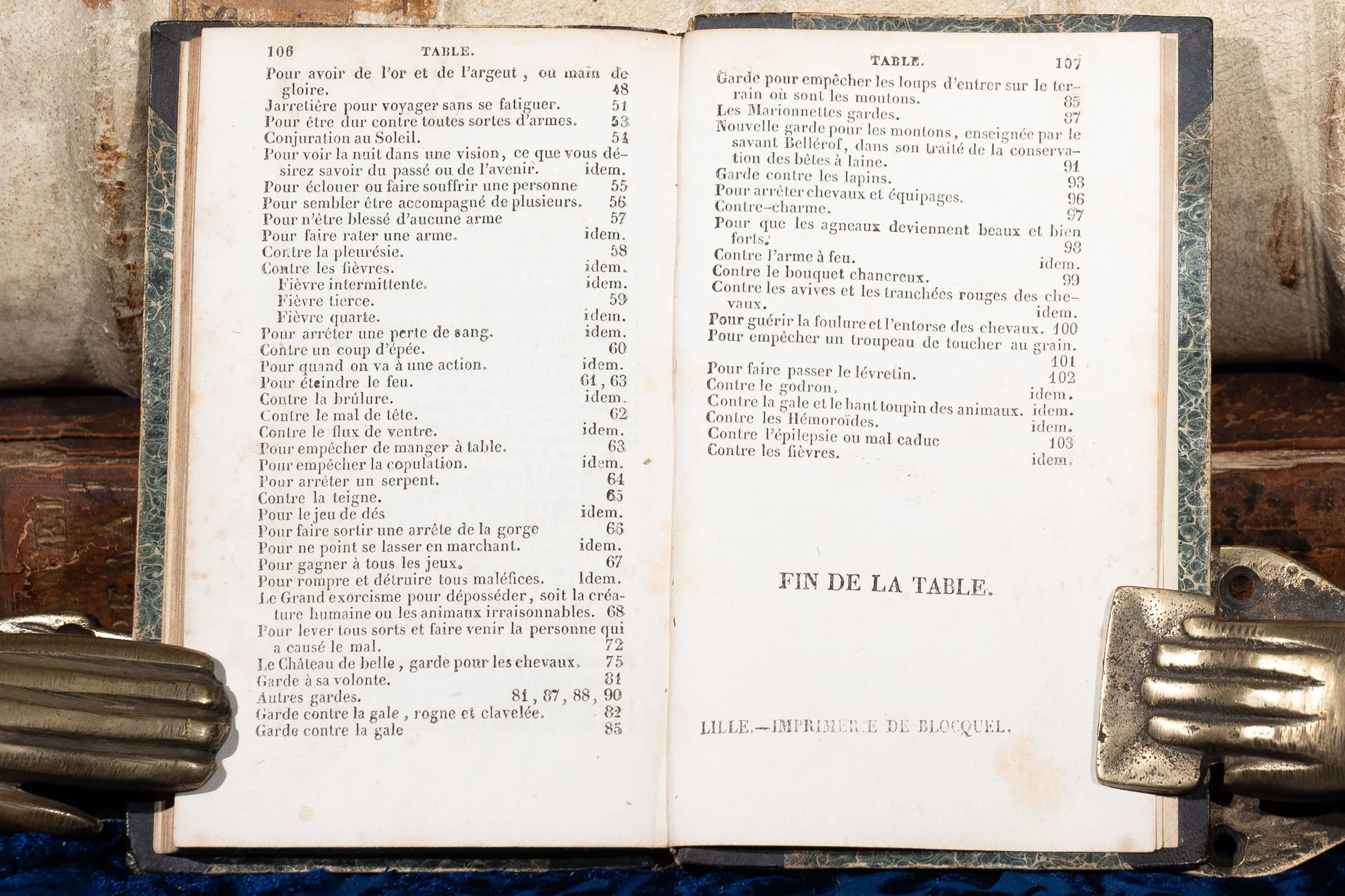 Image 1 of 12
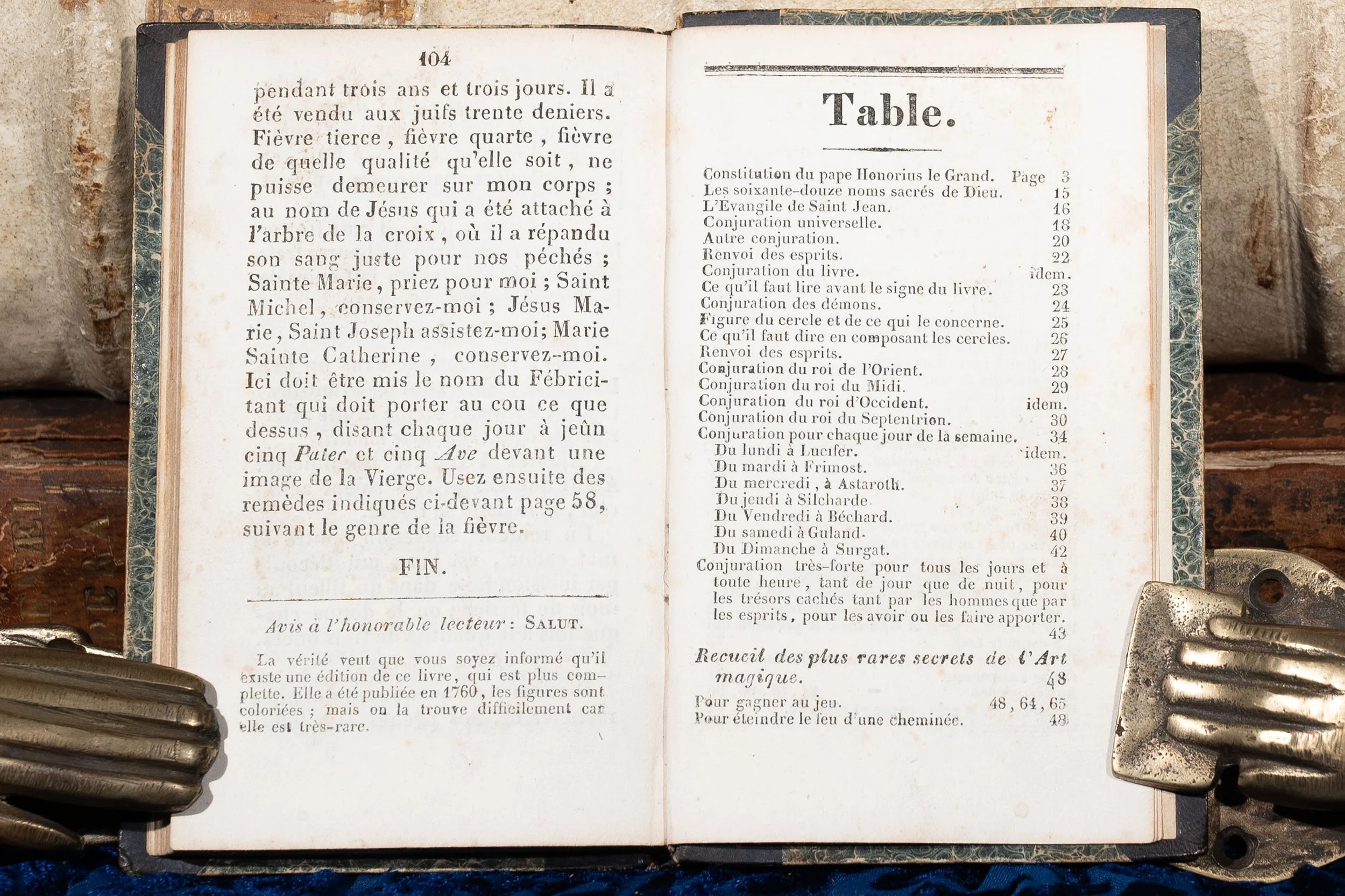 Image 2 of 12
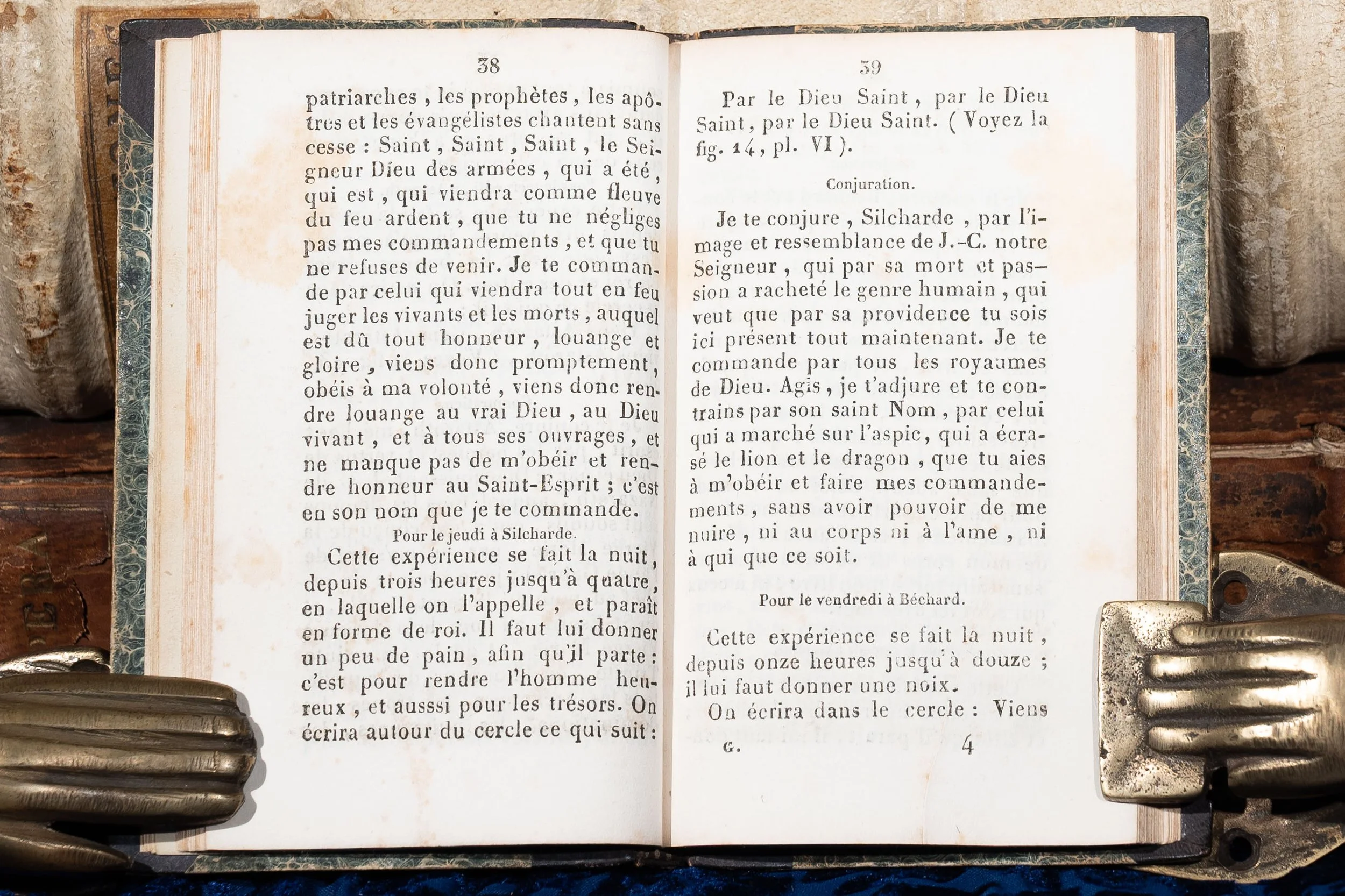 Image 3 of 12
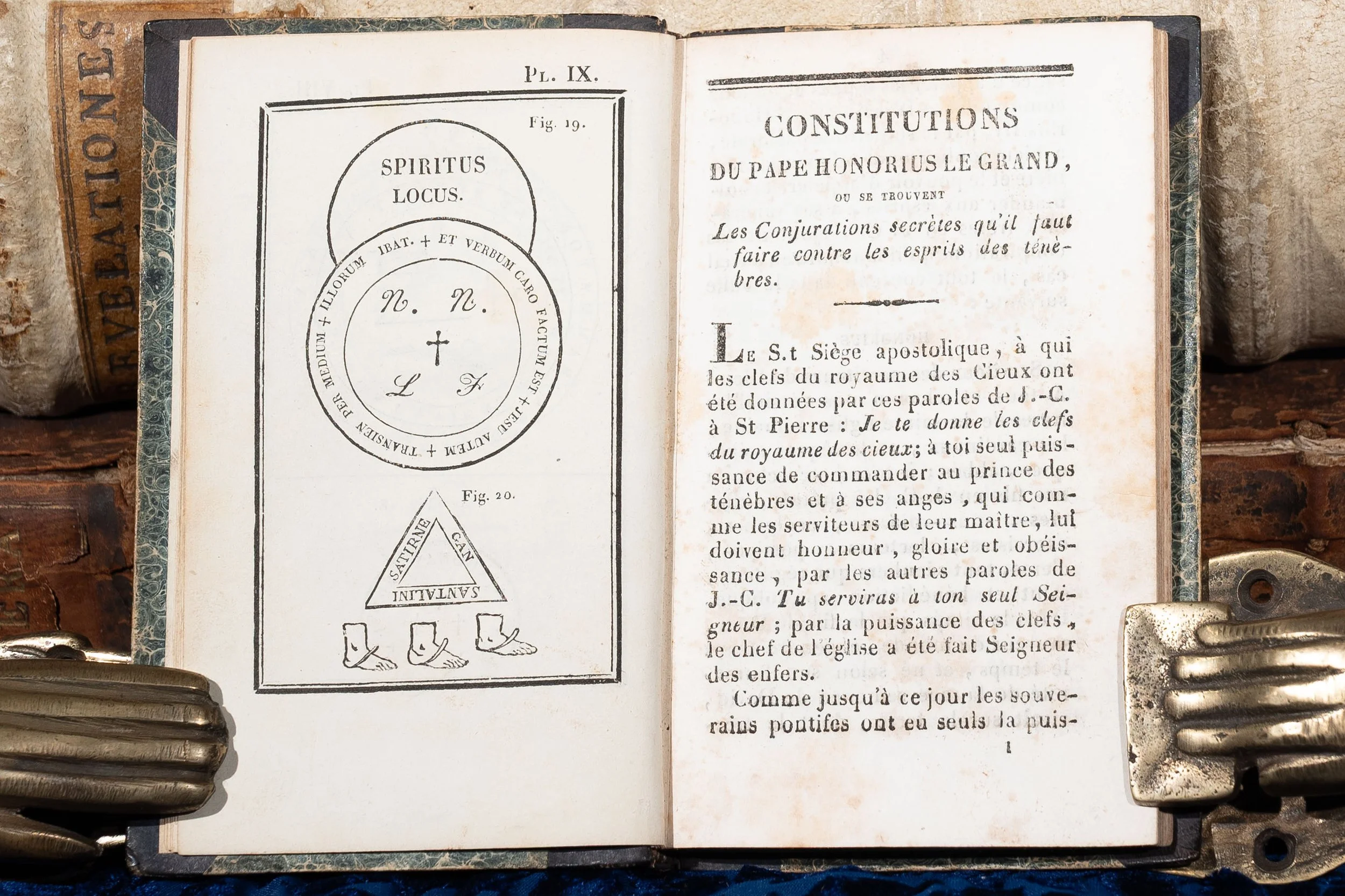 Image 4 of 12
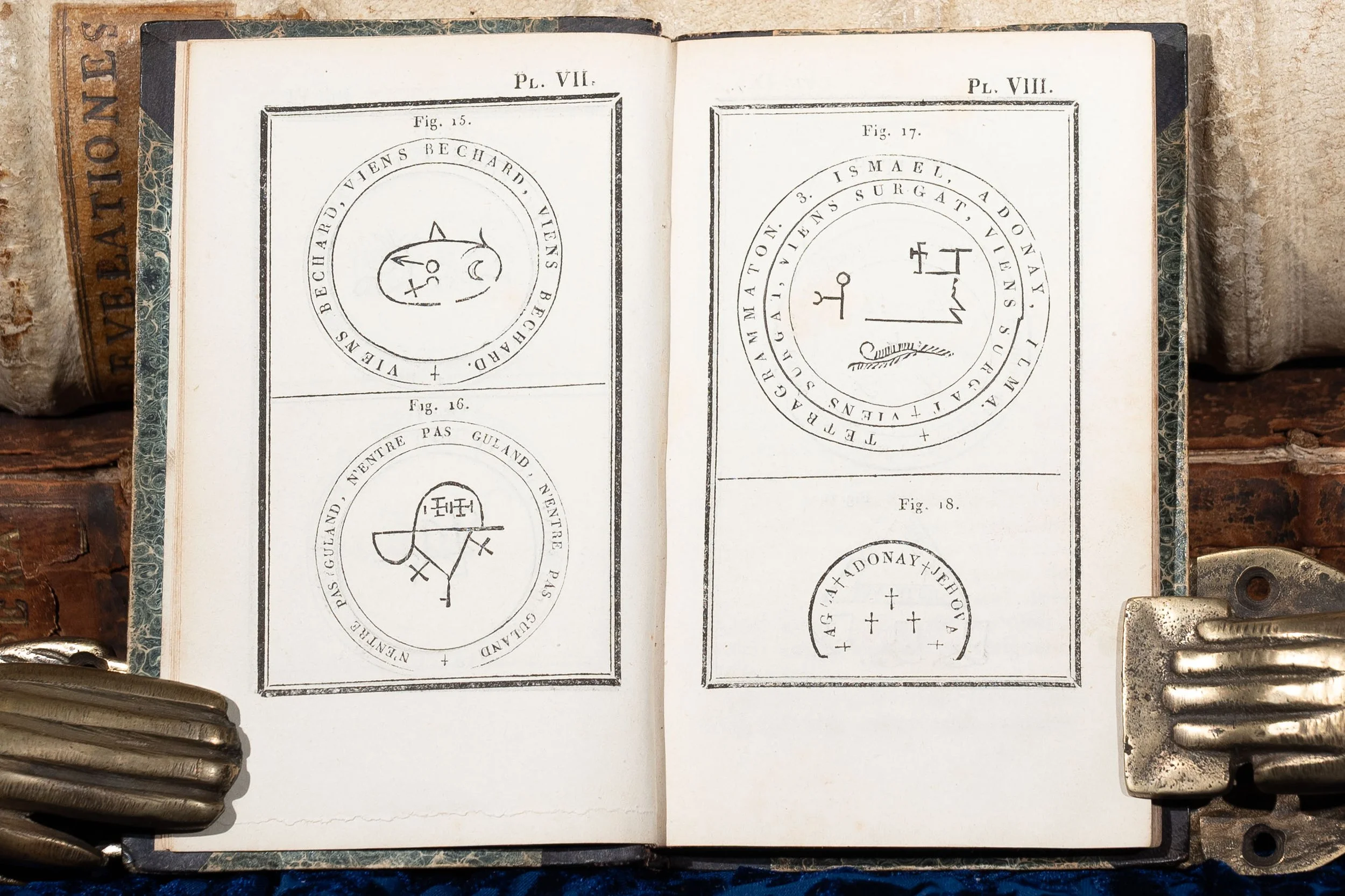 Image 5 of 12
 Image 6 of 12
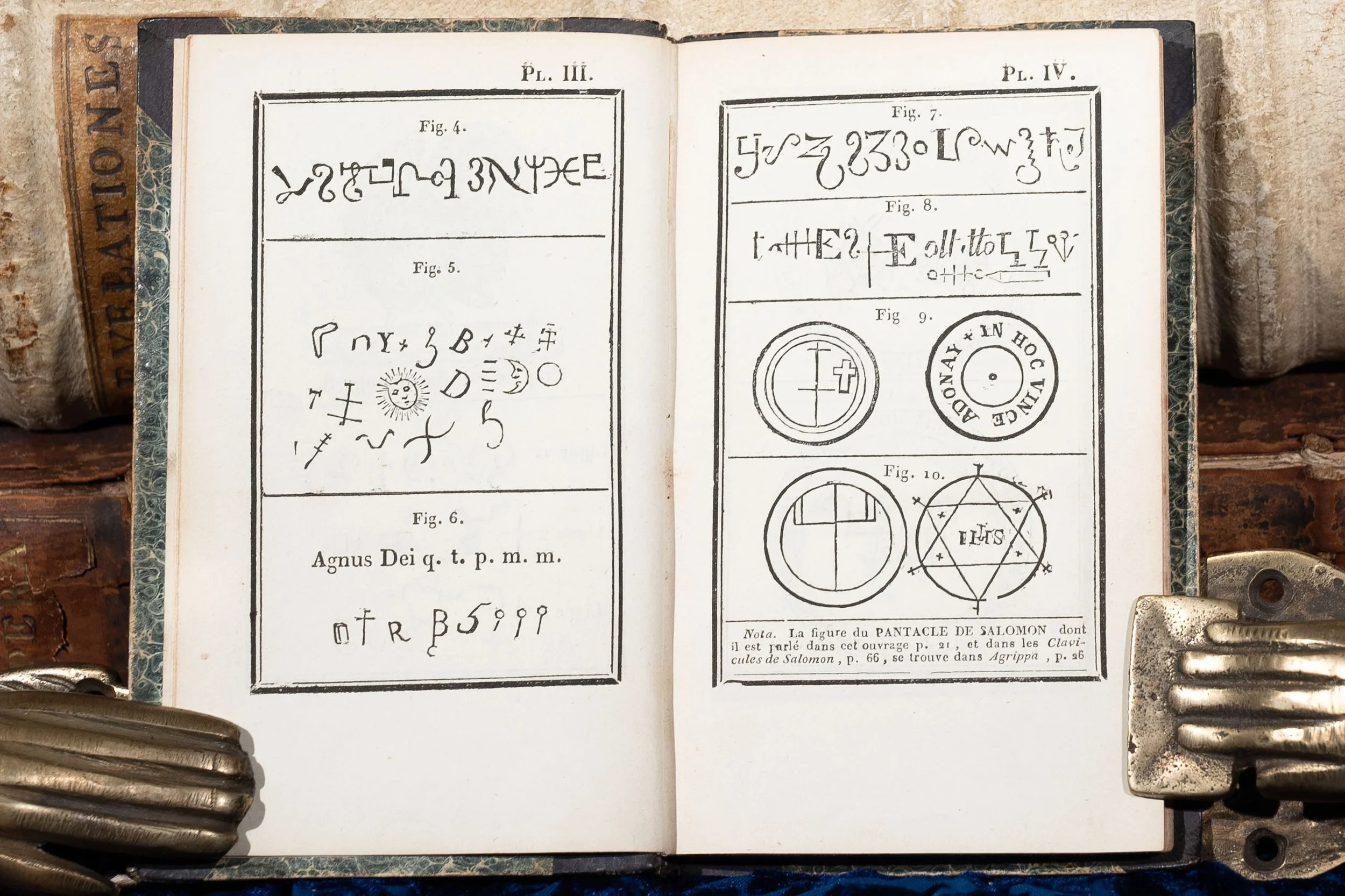 Image 7 of 12
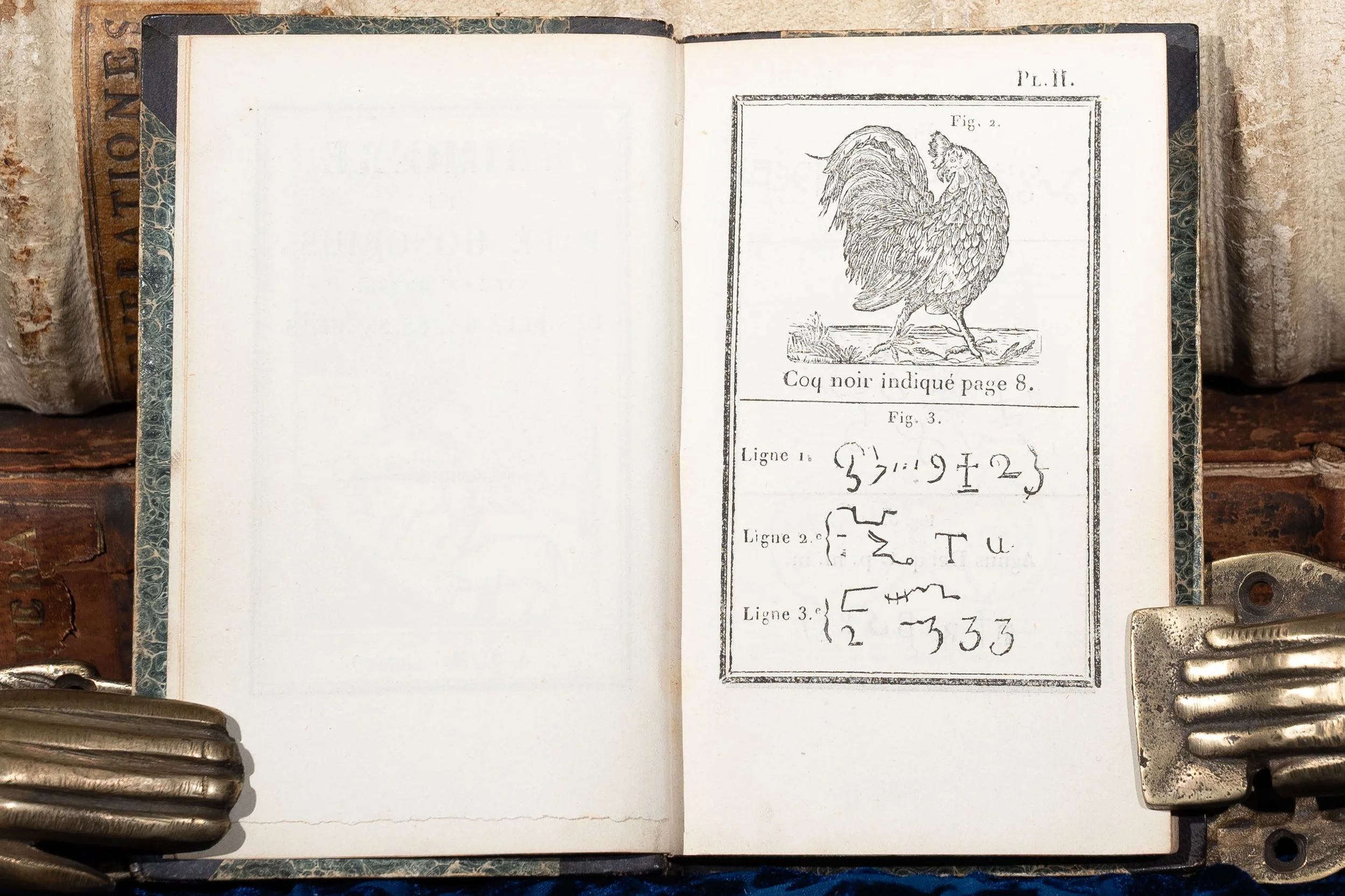 Image 8 of 12
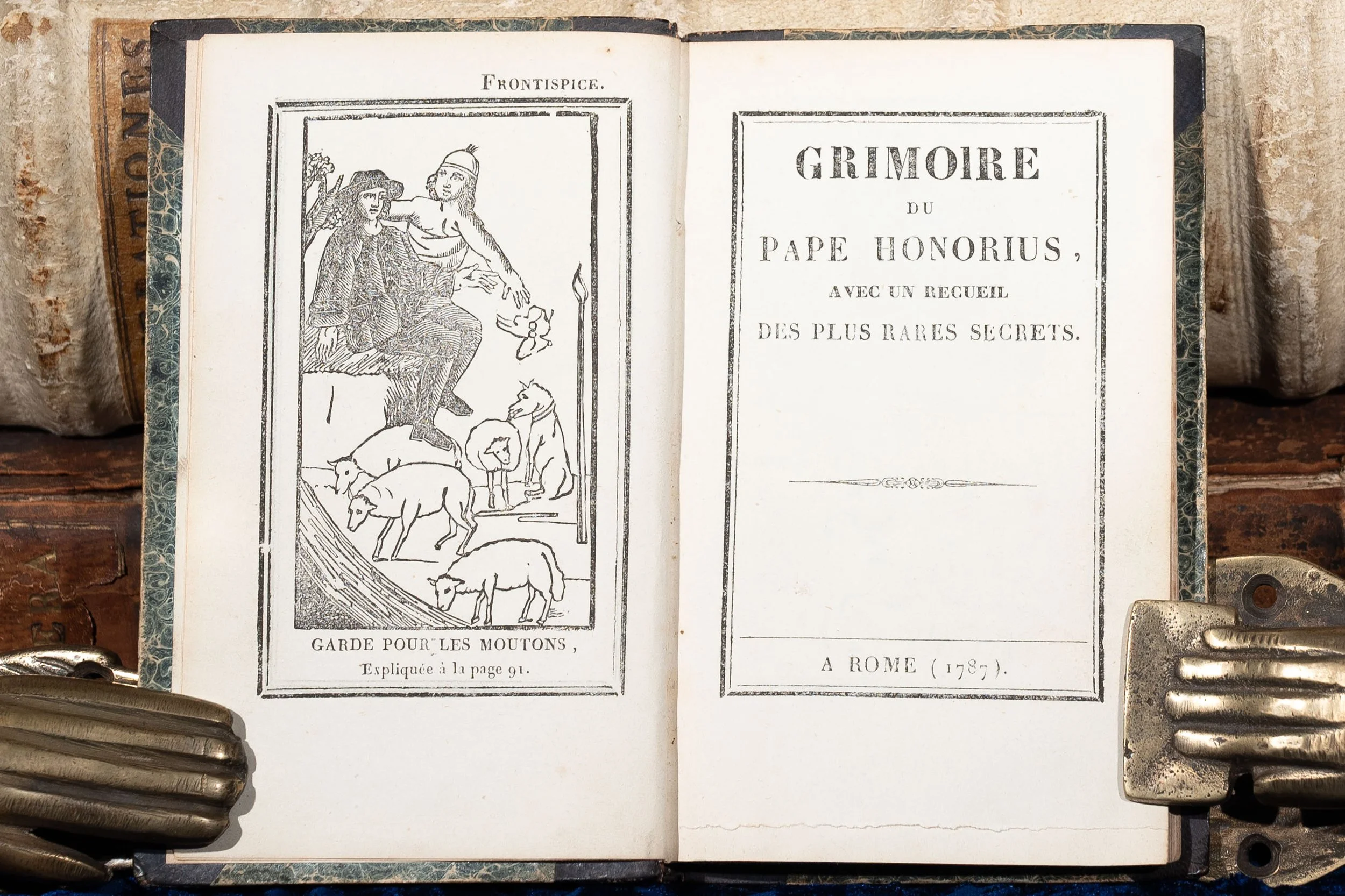 Image 9 of 12
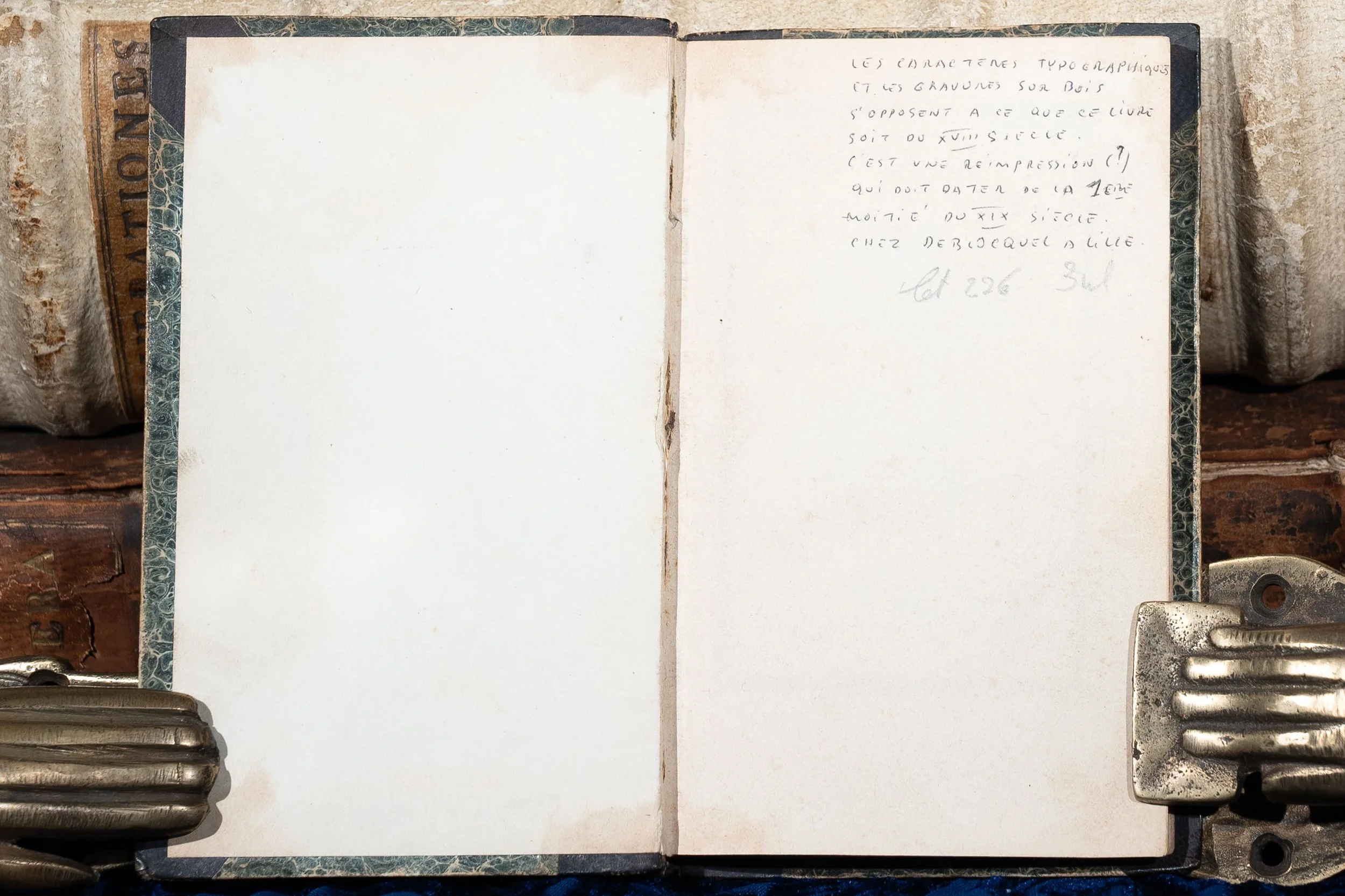 Image 10 of 12
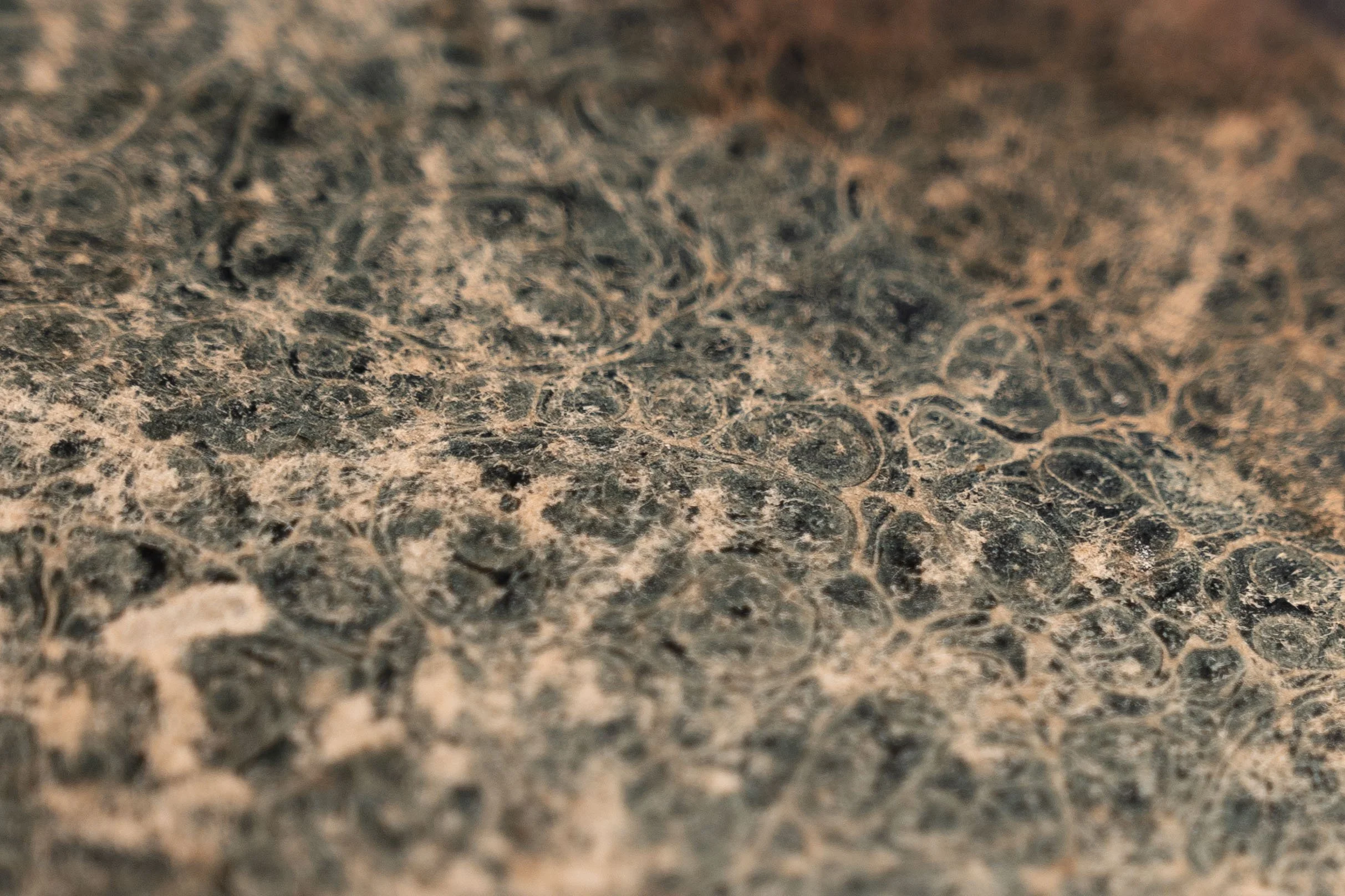 Image 11 of 12
 Image 12 of 12