Unfold one of the large engraved plates in the first part of this book and you find something unexpected in a Latin physics textbook: a night landscape. Beams of light shoot up from the horizon over dark hills. Among the beams the engraver has scattered the stars themselves — Ursa major, Cassiopeia, the bright stars of the Lyre and the Eagle — each constellation labeled in its true position. It is a picture of the aurora borealis, drawn as a scene a student might actually witness, with compass directions marked around the border. The northern lights were one of the live scientific puzzles of the age. Here they are handed to the philosophy students of Vienna as a problem in physics, the omen drained out of them.
The author was one of the men who brought the new science into the Habsburg lands. Paul Mako (Pál Makó de Kerek-Gede, 1723–1793) was born to a noble family on the Hungarian plain and entered the Jesuit order at seventeen. He rose to become professor of mathematics and experimental physics at the Theresianum, the academy Maria Theresa maintained for the empire's future officials. His compact Latin compendia of logic, metaphysics, mathematics and physics became standard classroom texts across the monarchy's academies. After the suppression of the Jesuits he was kept on at court, where he helped draft the Ratio Educationis of 1777, the decree that reorganized education across the Kingdom of Hungary. This physics course belongs to the beginning of that career. It is a physics textbook influenced by Roger Boscovich’s theory of forces, equipped with folding plates: rays pass through prisms, images invert inside the chambers of the eye (drawn in fine anatomical section, lashes and all), pendulums swing, planets trace their curves. The plates alone make the case that eighteenth-century physics was taught as a visual art.
The book is also a very Viennese object. Both title pages carry the woodcut device of Johann Thomas Trattner, printer and bookseller to the imperial court and the dominant figure of the Austrian book trade, with his motto "Labore et Favore" — by labor and by favor. The dedication is addressed in towering Roman capitals to Cardinal Christoph Anton Migazzi, Prince-Archbishop of Vienna. The whole production is Jesuit science in its final flowering, printed a decade before the Society itself was dissolved and its teaching empire broken up.
This copy has the two parts, 1762 and 1763, together in one contemporary leather binding. The spine is tooled in compartments and lettered "P. Mako Philosophia," with an old inked shelf number at the foot. Inside, on the marbled pastedown, sits a charming eighteenth-century printed book label within a floral border: Leonardus Bayrer, "Sacerd. ad S. Salvat.," a priest at a church of the Holy Savior — one more clergyman-reader of the kind this book was written to train. Early editions of Mako's compendia are held by the great European libraries but appear only seldom in commerce.
Provenance: (1) Leonardus Bayrer, priest ("Sacerd. ad S. Salvat."), eighteenth-century printed book label on the front pastedown. (2) Unidentified library, inked shelf number "483" at the spine foot.
MAKO, Paulus (MAKÓ, Pál, de Kerek-Gede, S.J.) (1723-1793). Compendiaria Physicae Institutio quam in usum auditorum philosophiae elucubratus est P. Mako e S.I. Pars I [-Pars II]. Vienna (Vindobonae): Typis Ioannis Thomae Trattner, Caes. Reg. Aulae Typogr. et Bibliop., 1762-1763. Evidently the first edition of both parts.
Physical Description: Octavo, two parts in one volume. With numerous engraved folding plates of scientific diagrams (numbered Tab. I onward within each part, the plates signed "P. Mako Physicae P.I." and "P. Mako Phys. P.II."), including mechanics, optics with prisms and the camera obscura, the anatomy and dioptrics of the human eye, and a landscape view of the aurora borealis with labeled constellations (Fig. 73); errata leaf present. Woodcut printer's device of Trattner ("Labore et Favore") on both title pages; dedication leaf to Cardinal Christoph Anton Migazzi, Archbishop of Vienna.
Binding: Contemporary leather, spine tooled in compartments between raised bands and lettered "P. Mako Philosophia," an old inked shelf number ("483") at the foot; combed marbled pastedowns; edges stained red.
Condition: Binding worn and rubbed, the spine leather cracked along the band edges with fraying and small losses, corners bumped and rounded, but the volume sound. Internally clean overall, with toning and scattered foxing, some creasing and light soiling to the Part I title, occasional spotting to the plates; the folding plates well preserved.
Unfold one of the large engraved plates in the first part of this book and you find something unexpected in a Latin physics textbook: a night landscape. Beams of light shoot up from the horizon over dark hills. Among the beams the engraver has scattered the stars themselves — Ursa major, Cassiopeia, the bright stars of the Lyre and the Eagle — each constellation labeled in its true position. It is a picture of the aurora borealis, drawn as a scene a student might actually witness, with compass directions marked around the border. The northern lights were one of the live scientific puzzles of the age. Here they are handed to the philosophy students of Vienna as a problem in physics, the omen drained out of them.
The author was one of the men who brought the new science into the Habsburg lands. Paul Mako (Pál Makó de Kerek-Gede, 1723–1793) was born to a noble family on the Hungarian plain and entered the Jesuit order at seventeen. He rose to become professor of mathematics and experimental physics at the Theresianum, the academy Maria Theresa maintained for the empire's future officials. His compact Latin compendia of logic, metaphysics, mathematics and physics became standard classroom texts across the monarchy's academies. After the suppression of the Jesuits he was kept on at court, where he helped draft the Ratio Educationis of 1777, the decree that reorganized education across the Kingdom of Hungary. This physics course belongs to the beginning of that career. It is a physics textbook influenced by Roger Boscovich’s theory of forces, equipped with folding plates: rays pass through prisms, images invert inside the chambers of the eye (drawn in fine anatomical section, lashes and all), pendulums swing, planets trace their curves. The plates alone make the case that eighteenth-century physics was taught as a visual art.
The book is also a very Viennese object. Both title pages carry the woodcut device of Johann Thomas Trattner, printer and bookseller to the imperial court and the dominant figure of the Austrian book trade, with his motto "Labore et Favore" — by labor and by favor. The dedication is addressed in towering Roman capitals to Cardinal Christoph Anton Migazzi, Prince-Archbishop of Vienna. The whole production is Jesuit science in its final flowering, printed a decade before the Society itself was dissolved and its teaching empire broken up.
This copy has the two parts, 1762 and 1763, together in one contemporary leather binding. The spine is tooled in compartments and lettered "P. Mako Philosophia," with an old inked shelf number at the foot. Inside, on the marbled pastedown, sits a charming eighteenth-century printed book label within a floral border: Leonardus Bayrer, "Sacerd. ad S. Salvat.," a priest at a church of the Holy Savior — one more clergyman-reader of the kind this book was written to train. Early editions of Mako's compendia are held by the great European libraries but appear only seldom in commerce.
Provenance: (1) Leonardus Bayrer, priest ("Sacerd. ad S. Salvat."), eighteenth-century printed book label on the front pastedown. (2) Unidentified library, inked shelf number "483" at the spine foot.
MAKO, Paulus (MAKÓ, Pál, de Kerek-Gede, S.J.) (1723-1793). Compendiaria Physicae Institutio quam in usum auditorum philosophiae elucubratus est P. Mako e S.I. Pars I [-Pars II]. Vienna (Vindobonae): Typis Ioannis Thomae Trattner, Caes. Reg. Aulae Typogr. et Bibliop., 1762-1763. Evidently the first edition of both parts.
Physical Description: Octavo, two parts in one volume. With numerous engraved folding plates of scientific diagrams (numbered Tab. I onward within each part, the plates signed "P. Mako Physicae P.I." and "P. Mako Phys. P.II."), including mechanics, optics with prisms and the camera obscura, the anatomy and dioptrics of the human eye, and a landscape view of the aurora borealis with labeled constellations (Fig. 73); errata leaf present. Woodcut printer's device of Trattner ("Labore et Favore") on both title pages; dedication leaf to Cardinal Christoph Anton Migazzi, Archbishop of Vienna.
Binding: Contemporary leather, spine tooled in compartments between raised bands and lettered "P. Mako Philosophia," an old inked shelf number ("483") at the foot; combed marbled pastedowns; edges stained red.
Condition: Binding worn and rubbed, the spine leather cracked along the band edges with fraying and small losses, corners bumped and rounded, but the volume sound. Internally clean overall, with toning and scattered foxing, some creasing and light soiling to the Part I title, occasional spotting to the plates; the folding plates well preserved.

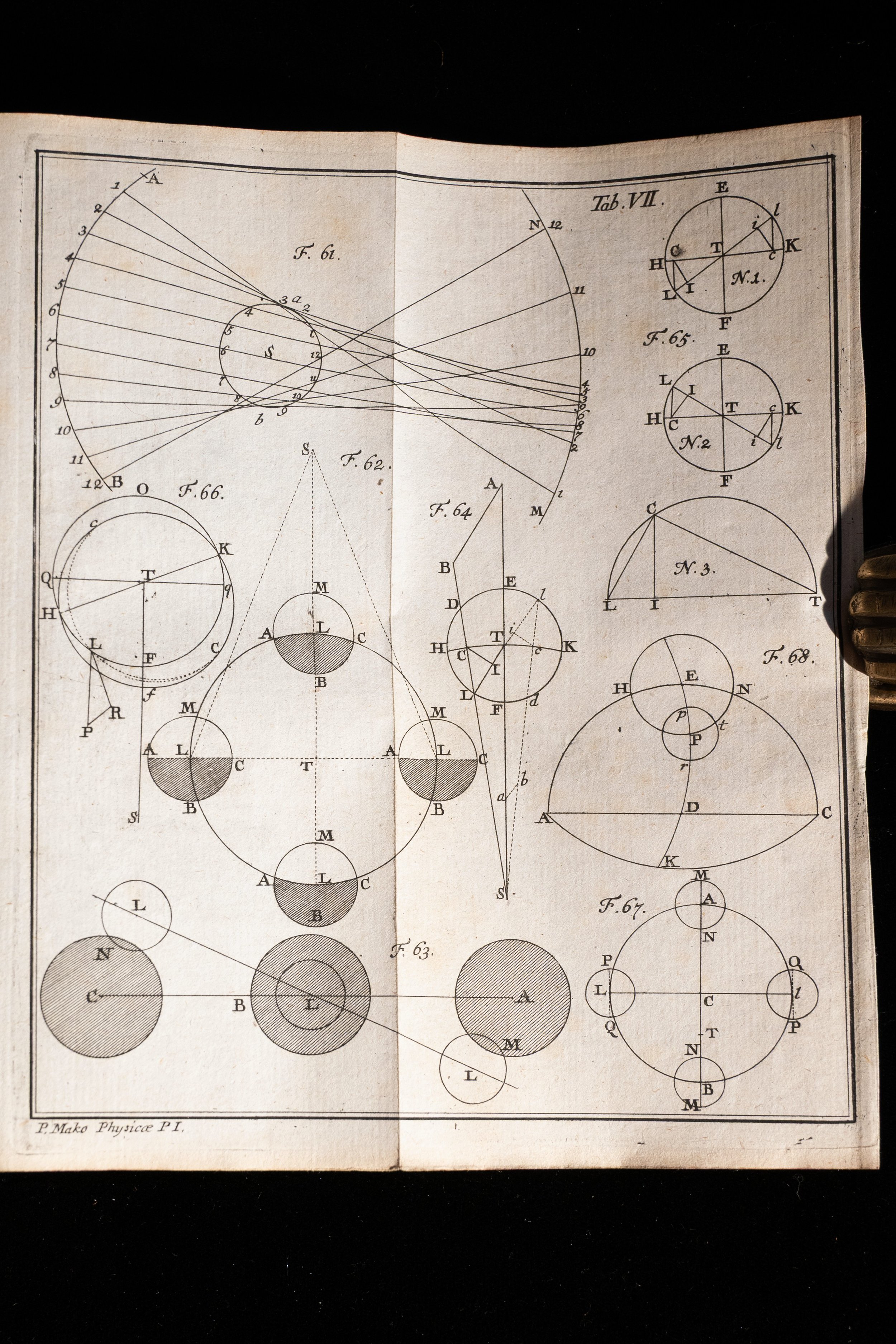 Image 1 of 20
 Image 2 of 20
 Image 3 of 20
 Image 4 of 20
 Image 5 of 20
 Image 6 of 20
 Image 7 of 20
 Image 8 of 20
 Image 9 of 20
 Image 10 of 20
 Image 11 of 20
 Image 12 of 20
 Image 13 of 20
 Image 14 of 20
 Image 15 of 20
 Image 16 of 20
 Image 17 of 20
 Image 18 of 20
 Image 19 of 20
 Image 20 of 20