Christian Wolff's Auszug was a widely used one-volume distillation of his Foundations of All the Mathematical Sciences. Kant encountered it as a schoolboy and later used it in his own mathematics lectures. This edition appeared in 1755, the year Kant began lecturing; Kant's own recorded copy of the Auszug was the 1749 edition. Wolff was the schoolmaster of the German Enlightenment. He built Leibniz's insights into a system so total that for two generations "philosophy" in Germany simply meant Wolff. He was expelled from Halle in 1723 under threat of the hangman's rope, for the offense of praising Chinese ethics. He was recalled in triumph when Frederick the Great took the throne, and he died in 1754, months before this edition went to press. The frontispiece gives him to us engraved in his full-bottomed wig. The imperial privilege, granted at Vienna in November 1753 over the names of Emperor Franz and Count Colloredo, still guards the text of a man who had once fled a kingdom one step ahead of arrest.
"All the mathematical sciences" meant something gloriously broad in 1755, and the folding engraved plates tell the story better than any syllabus. Alongside the levers, pulleys, screws and bell-ropes of the mechanics plate, the book unfolds into ordnance: a field cannon on its wheeled carriage, a squat mortar in cross-section, the cannonball with its lifting rings, the gunner's tools laid out like cutlery. Artillery, fortification, optics, astronomy, architecture, even the art of sundials — all were mathematics, and all were learned from this one fat pocket volume. The opening essay, the Short Instruction on the Mathematical Method of Teaching, marches from definitions to axioms to theorems. This is the very doctrine of method whose grip on the German mind Kant would spend his critical philosophy loosening.
The copy in hand has the kind of provenance that brings an eighteenth-century book to life. On the pastedown a friar has recorded his purchase with monastic exactness: "Fr. Josepho Maria," at Landsee, the book costing 2 florins 30 kreuzer, the binding ("Compact.") a further 12 kreuzer, total 2 florins 42, in the year 1759. The sturdy speckled leather around the book is itemized on its own flyleaf, priced separately from the text it protects. It has done its 12 kreuzers' worth of work for two and a half centuries. An early monastic ink inscription and a later blue oval stamp mark the title. A complete copy with a detailed record of its early purchase and binding costs.
Provenance: (1) Early ink inscription of a religious house to the title (partly deleted, with a later indistinct blue oval stamp). (2) "Fr. Josepho Maria," Landsee, acquisition note to the pastedown dated 1759, itemizing the cost of the book (2 fl. 30 kr.) and its binding (12 kr., total 2 fl. 42 kr.). (3) Recent continental dealer or auction lot mark (circled "3391/g") in pencil.
WOLFF, Christian, Freiherr von (1679-1754). Auszug aus den Anfangs-Gründen aller mathematischen Wissenschaften, zu bequemerem Gebrauche der Anfänger, auf Begehren verfertiget. "Neue Auflage, verbessert und mit einem Register vermehrt." Frankfurt and Leipzig: in der Rengerischen Buchhandlung, 1755.
Physical Description: Thick octavo, 740 pp. plus lengthy unpaginated register ([12] leaves), title printed in red and black. Engraved portrait frontispiece of Wolff (signed Sysang) and 45 folding engraved plates of geometrical, mechanical, optical, astronomical, architectural and artillery subjects; imperial privilege (Vienna, 6 November 1753, signed Franz, C. de Colloredo, and M. W. Haan) and Saxon/Polish privileges as called for on the title; woodcut headpiece with allegory of Mathematics at the opening of the Kurtzer Unterricht von der mathematischen Lehr-Art. Complete.
Binding: Contemporary speckled leather over boards, raised bands, old paper shelf label at the spine foot; edges sprinkled.
Condition: Binding worn and rubbed with cracking to the joints and wear at the extremities; title leaf creased with an old diagonal crease and small marginal defects; internally toned with scattered spotting and occasional creasing, the plates well-preserved with clean folds. A sound, unrestored copy with much of its original character.
Christian Wolff's Auszug was a widely used one-volume distillation of his Foundations of All the Mathematical Sciences. Kant encountered it as a schoolboy and later used it in his own mathematics lectures. This edition appeared in 1755, the year Kant began lecturing; Kant's own recorded copy of the Auszug was the 1749 edition. Wolff was the schoolmaster of the German Enlightenment. He built Leibniz's insights into a system so total that for two generations "philosophy" in Germany simply meant Wolff. He was expelled from Halle in 1723 under threat of the hangman's rope, for the offense of praising Chinese ethics. He was recalled in triumph when Frederick the Great took the throne, and he died in 1754, months before this edition went to press. The frontispiece gives him to us engraved in his full-bottomed wig. The imperial privilege, granted at Vienna in November 1753 over the names of Emperor Franz and Count Colloredo, still guards the text of a man who had once fled a kingdom one step ahead of arrest.
"All the mathematical sciences" meant something gloriously broad in 1755, and the folding engraved plates tell the story better than any syllabus. Alongside the levers, pulleys, screws and bell-ropes of the mechanics plate, the book unfolds into ordnance: a field cannon on its wheeled carriage, a squat mortar in cross-section, the cannonball with its lifting rings, the gunner's tools laid out like cutlery. Artillery, fortification, optics, astronomy, architecture, even the art of sundials — all were mathematics, and all were learned from this one fat pocket volume. The opening essay, the Short Instruction on the Mathematical Method of Teaching, marches from definitions to axioms to theorems. This is the very doctrine of method whose grip on the German mind Kant would spend his critical philosophy loosening.
The copy in hand has the kind of provenance that brings an eighteenth-century book to life. On the pastedown a friar has recorded his purchase with monastic exactness: "Fr. Josepho Maria," at Landsee, the book costing 2 florins 30 kreuzer, the binding ("Compact.") a further 12 kreuzer, total 2 florins 42, in the year 1759. The sturdy speckled leather around the book is itemized on its own flyleaf, priced separately from the text it protects. It has done its 12 kreuzers' worth of work for two and a half centuries. An early monastic ink inscription and a later blue oval stamp mark the title. A complete copy with a detailed record of its early purchase and binding costs.
Provenance: (1) Early ink inscription of a religious house to the title (partly deleted, with a later indistinct blue oval stamp). (2) "Fr. Josepho Maria," Landsee, acquisition note to the pastedown dated 1759, itemizing the cost of the book (2 fl. 30 kr.) and its binding (12 kr., total 2 fl. 42 kr.). (3) Recent continental dealer or auction lot mark (circled "3391/g") in pencil.
WOLFF, Christian, Freiherr von (1679-1754). Auszug aus den Anfangs-Gründen aller mathematischen Wissenschaften, zu bequemerem Gebrauche der Anfänger, auf Begehren verfertiget. "Neue Auflage, verbessert und mit einem Register vermehrt." Frankfurt and Leipzig: in der Rengerischen Buchhandlung, 1755.
Physical Description: Thick octavo, 740 pp. plus lengthy unpaginated register ([12] leaves), title printed in red and black. Engraved portrait frontispiece of Wolff (signed Sysang) and 45 folding engraved plates of geometrical, mechanical, optical, astronomical, architectural and artillery subjects; imperial privilege (Vienna, 6 November 1753, signed Franz, C. de Colloredo, and M. W. Haan) and Saxon/Polish privileges as called for on the title; woodcut headpiece with allegory of Mathematics at the opening of the Kurtzer Unterricht von der mathematischen Lehr-Art. Complete.
Binding: Contemporary speckled leather over boards, raised bands, old paper shelf label at the spine foot; edges sprinkled.
Condition: Binding worn and rubbed with cracking to the joints and wear at the extremities; title leaf creased with an old diagonal crease and small marginal defects; internally toned with scattered spotting and occasional creasing, the plates well-preserved with clean folds. A sound, unrestored copy with much of its original character.

 Image 1 of 26
 Image 2 of 26
 Image 3 of 26
 Image 4 of 26
 Image 5 of 26
 Image 6 of 26
 Image 7 of 26
 Image 8 of 26
 Image 9 of 26
 Image 10 of 26
 Image 11 of 26
 Image 12 of 26
 Image 13 of 26
 Image 14 of 26
 Image 15 of 26
 Image 16 of 26
 Image 17 of 26
 Image 18 of 26
 Image 19 of 26
 Image 20 of 26
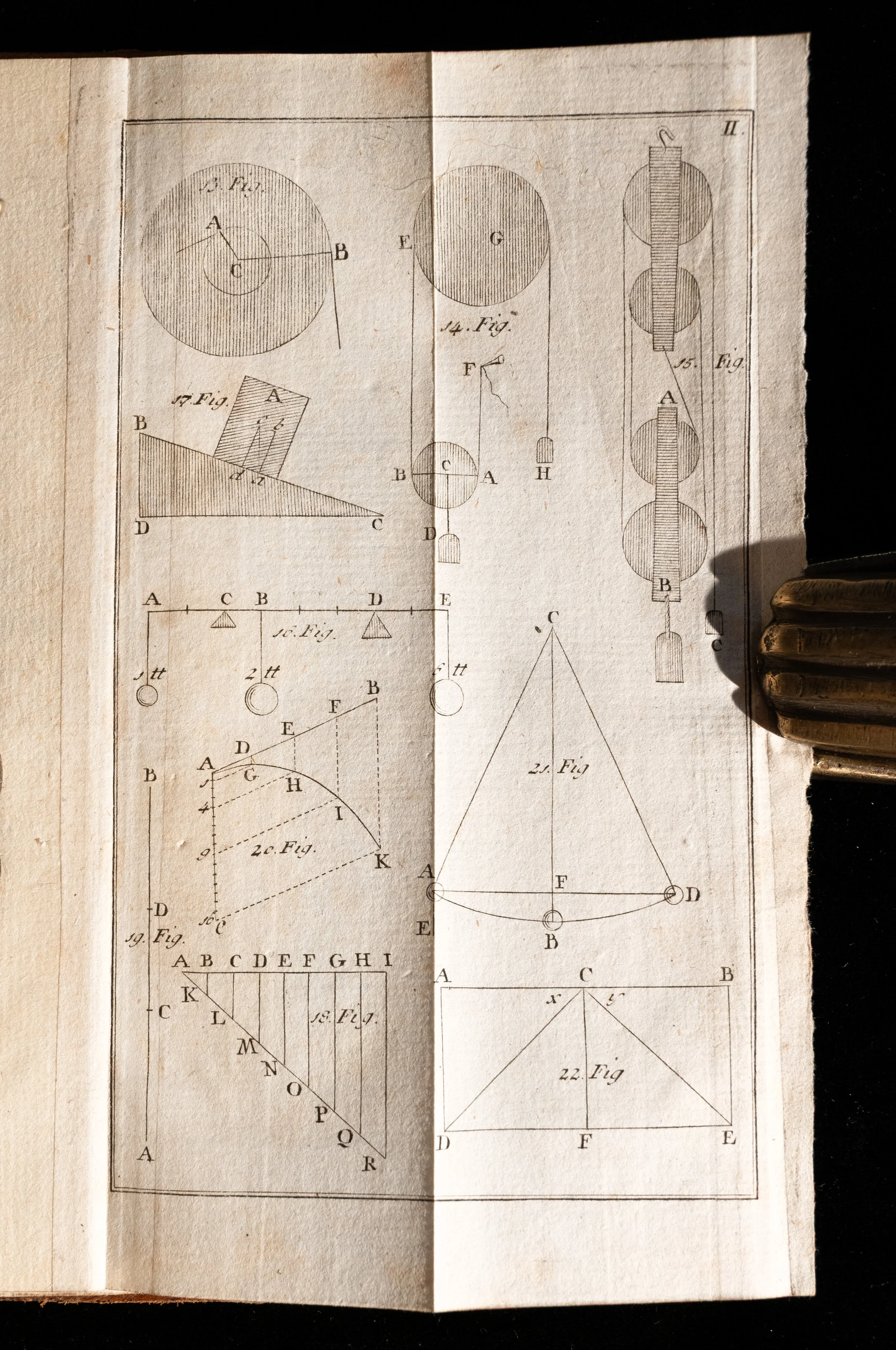 Image 21 of 26
 Image 22 of 26
 Image 23 of 26
 Image 24 of 26
 Image 25 of 26
 Image 26 of 26