Christian August Crusius of Leipzig was the most formidable German opponent the philosophy of Christian Wolff ever faced. Wolff's rationalist system dominated the German universities for two generations, deriving the whole order of nature from a handful of logical principles. Crusius, a Pietist-leaning professor at Leipzig, thought it tried to prove too much. Its principle of sufficient reason, he argued, left no room for human freedom. Across four German treatises — on ethics, metaphysics, logic, and finally this one on physics — he built the counter-system. The title is already a manifesto: a guide to thinking about natural events "ordentlich und vorsichtig," in an orderly and cautious way. The first chapter opens with "the grounds of physical probability," the claim, radical in its modesty, that most of what we know about nature rests on well-weighed likelihood, not strict proof.
The book's deepest interest is in the student who read Crusius most closely. That would be the young Immanuel Kant who worked through him for two decades. In the writings before the Critiques, Crusius stands as the great named alternative to the Wolffian method — the thinker who first pressed on Kant the doubt that the mathematical style of proof belonged in metaphysics at all. Modern Kant scholarship recognizes him as an important influence on Kant’s early philosophy.
The book itself is a handsome piece of Leipzig printing, published by Gleditsch in 1749. The dedication is to Friedrich Christian, the electoral prince of Saxony and royal prince of Poland, whose towering column of titles fills the dedication leaf. The engraved frontispiece by Bernigeroth is worth the price of admission alone: a natural philosopher's workshop in full swing, savants at the electrical machine, the grinding wheel, the globe and balance, under the motto "Ardua quia sapienter condita" — steep because wisely built. Above it runs the sign of collaborative science, "Iuncta plurium opera," the joined labors of many. Both title pages carry his engraved landscape vignette with its motto-ribbon. Three folding engraved plates of diagrams serve the first volume. The second volume opens with fire, light, heat and cold and runs the course through to a thirteen-leaf register. This is the first edition, the two volumes complete in matching contemporary half calf with sprinkled boards and green and citron spine labels, worn at the extremities but sound and unrestored.
CRUSIUS, Christian August (1715-1775). Anleitung über natürliche Begebenheiten ordentlich und vorsichtig nachzudenken. Erster [-Anderer] Theil. Leipzig: bey Johann Friedrich Gleditsch, 1749. First edition, two volumes, continuously paginated.
Physical Description: Two octavo volumes, paginated continuously: vol. I, 640 pp. with engraved frontispiece (Bernigeroth) and three folding engraved plates; vol. II (Anderer Theil, with its own title page), pp. 643-1232, plus register ([13] leaves), without plates as issued. Engraved landscape vignette with Latin motto-ribbon on both titles (signed Bernigeroth); dedication leaves to Friedrich Christian, Electoral Prince of Saxony and Royal Prince of Poland and Lithuania; marginal summaries throughout. Complete.
Binding: Uniform contemporary half calf over sprinkled paper boards, spines with gilt-ruled green and citron label panels and gilt volume numerals.
Condition: Bindings worn: spine ends chipped with small losses, labels rubbed with loss of lettering, board edges and corners worn with the sprinkled paper abraded; internally toned with scattered spotting and creasing, an old crease and short marginal tear to the vol. II title, the plates with clean folds. A sound, unrestored set.
Christian August Crusius of Leipzig was the most formidable German opponent the philosophy of Christian Wolff ever faced. Wolff's rationalist system dominated the German universities for two generations, deriving the whole order of nature from a handful of logical principles. Crusius, a Pietist-leaning professor at Leipzig, thought it tried to prove too much. Its principle of sufficient reason, he argued, left no room for human freedom. Across four German treatises — on ethics, metaphysics, logic, and finally this one on physics — he built the counter-system. The title is already a manifesto: a guide to thinking about natural events "ordentlich und vorsichtig," in an orderly and cautious way. The first chapter opens with "the grounds of physical probability," the claim, radical in its modesty, that most of what we know about nature rests on well-weighed likelihood, not strict proof.
The book's deepest interest is in the student who read Crusius most closely. That would be the young Immanuel Kant who worked through him for two decades. In the writings before the Critiques, Crusius stands as the great named alternative to the Wolffian method — the thinker who first pressed on Kant the doubt that the mathematical style of proof belonged in metaphysics at all. Modern Kant scholarship recognizes him as an important influence on Kant’s early philosophy.
The book itself is a handsome piece of Leipzig printing, published by Gleditsch in 1749. The dedication is to Friedrich Christian, the electoral prince of Saxony and royal prince of Poland, whose towering column of titles fills the dedication leaf. The engraved frontispiece by Bernigeroth is worth the price of admission alone: a natural philosopher's workshop in full swing, savants at the electrical machine, the grinding wheel, the globe and balance, under the motto "Ardua quia sapienter condita" — steep because wisely built. Above it runs the sign of collaborative science, "Iuncta plurium opera," the joined labors of many. Both title pages carry his engraved landscape vignette with its motto-ribbon. Three folding engraved plates of diagrams serve the first volume. The second volume opens with fire, light, heat and cold and runs the course through to a thirteen-leaf register. This is the first edition, the two volumes complete in matching contemporary half calf with sprinkled boards and green and citron spine labels, worn at the extremities but sound and unrestored.
CRUSIUS, Christian August (1715-1775). Anleitung über natürliche Begebenheiten ordentlich und vorsichtig nachzudenken. Erster [-Anderer] Theil. Leipzig: bey Johann Friedrich Gleditsch, 1749. First edition, two volumes, continuously paginated.
Physical Description: Two octavo volumes, paginated continuously: vol. I, 640 pp. with engraved frontispiece (Bernigeroth) and three folding engraved plates; vol. II (Anderer Theil, with its own title page), pp. 643-1232, plus register ([13] leaves), without plates as issued. Engraved landscape vignette with Latin motto-ribbon on both titles (signed Bernigeroth); dedication leaves to Friedrich Christian, Electoral Prince of Saxony and Royal Prince of Poland and Lithuania; marginal summaries throughout. Complete.
Binding: Uniform contemporary half calf over sprinkled paper boards, spines with gilt-ruled green and citron label panels and gilt volume numerals.
Condition: Bindings worn: spine ends chipped with small losses, labels rubbed with loss of lettering, board edges and corners worn with the sprinkled paper abraded; internally toned with scattered spotting and creasing, an old crease and short marginal tear to the vol. II title, the plates with clean folds. A sound, unrestored set.

 Image 1 of 16
 Image 2 of 16
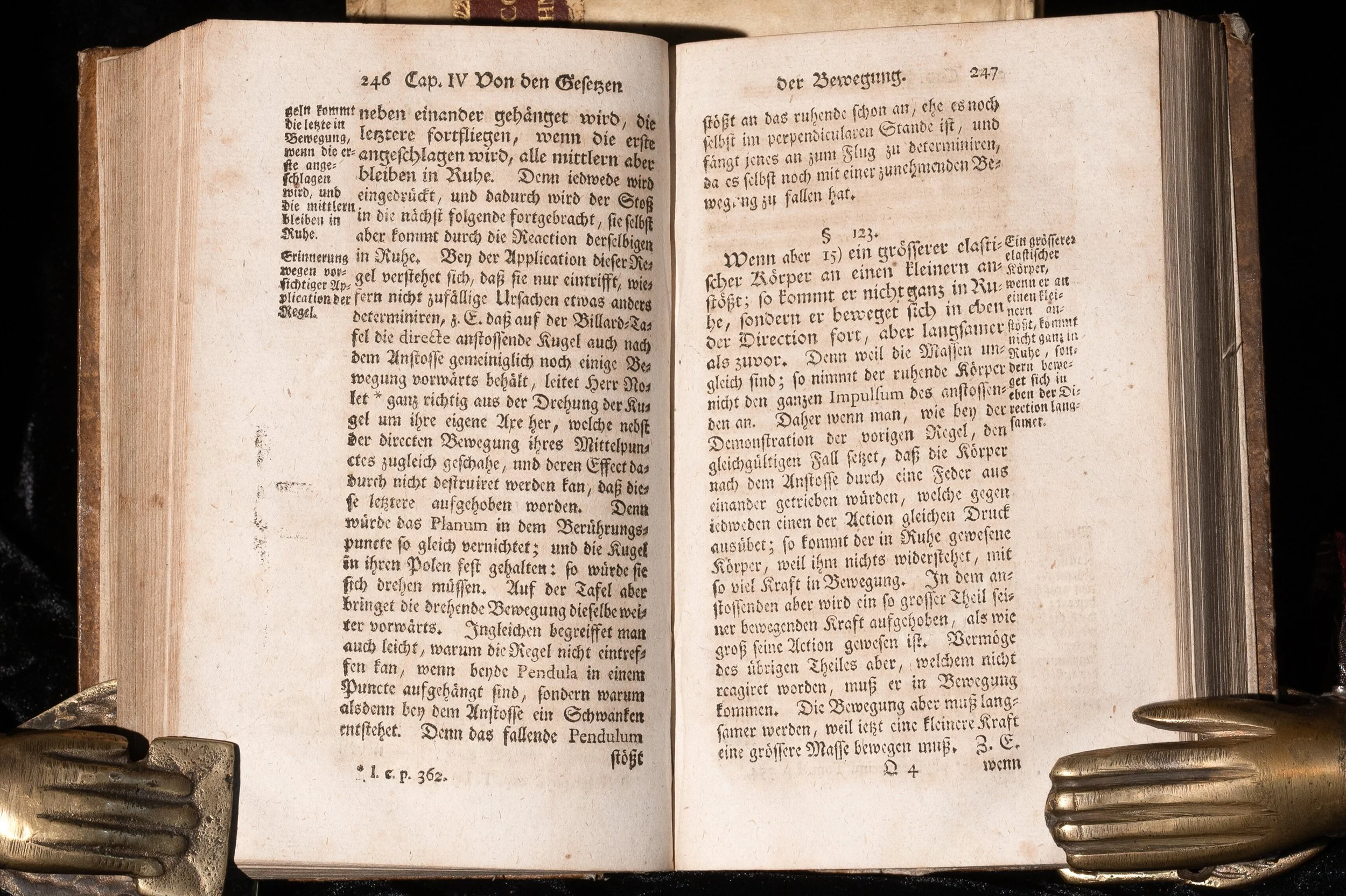 Image 3 of 16
 Image 4 of 16
 Image 5 of 16
 Image 6 of 16
 Image 7 of 16
 Image 8 of 16
 Image 9 of 16
 Image 10 of 16
 Image 11 of 16
 Image 12 of 16
 Image 13 of 16
 Image 14 of 16
 Image 15 of 16
 Image 16 of 16