Early in 1746 the physics laboratory at Leiden had a problem: how do you hold electricity? A spinning glass globe could charge a wire with what men then called the electrical fire, but the charge leaked away almost as fast as it was made. Professor Pieter van Musschenbroek decided to try and trap some of the fire in a jar of water. He ran a wire from the machine down into the water, held the jar in one hand, and reached for the wire with the other. His body closed the circuit, and the whole stored charge went through his arms and chest. He wrote to a colleague in Paris that he had thought himself a dead man and that he would not repeat the experiment "for the whole kingdom of France." The device took the name Leyden jar, after his city. It made Musschenbroek famous. One year later this book appeared: his complete course of physics.
Musschenbroek came from a Leiden family that built scientific instruments, air pumps and microscopes above all. He taught physics as an experimental science. Indeed, his Latin textbook of 1734 carried Newton’s experimental method into classrooms across Europe. The Grundlehren der Naturwissenschaft translates its enlarged second edition, with new additions from the author, and opens with a preface by Johann Christoph Gottsched, at the time the most influential man of letters in Germany. The course runs through the whole of nature: empty space, gravity, the lever, the pendulum, colliding bodies, electricity, magnetism, air, water, and the rainbow.
Readers who collect the occult sciences will be familiar with some of the ideas in this book. Electricity is still a "fire" here, magnetism a power that sweeps the whole earth. Its electrical and magnetic demonstrations belong in the history of the effects explored in earlier books of natural magic. The magnetism section includes a folding world map after Edmond Halley, better known for the comet, showing how far compass readings vary from true north. The book ends, unexpectedly, on an older and more pious note. The last chapter argues that God gave the winds so that men would sail and trade. Without them, Musschenbroek writes, man "would be an inexperienced animal, and would know little, if he remained shut up within the borders of his fatherland."
This copy retains its contemporary full-calf binding, the spine with five raised bands and gilt flowers in the compartments, the edges stained blue over a marbled pattern, the pastedowns lined with bold combed marbled paper. The twenty-six folding engravings range from pulleys and pumps to fountains and waterspouts, with even a rainbow over a town. They also contain a Halley world map, which opens to several times the width of the book. The foreleaves record the book’s first half-century of owners in German hands: inscriptions dated 1760 at Duisburg on the Rhine and 1787 by a student of medicine, another signed by a pastor. Most of these inscriptions have been struck through by the next owner. The calf is worn at the extremities and a few plates carry short tears at the folds.
Provenance: Successive eighteenth-century German ownership inscriptions on the endleaves: one dated 1760 at Duisburg am Rhein, another (a self-described student of medicine) dated 1787, a third signed by a pastor, most struck through by subsequent owners; early price or shelf code to front endleaf.
MUSSCHENBROEK, Petrus van (1692–1761). Grundlehren der Naturwissenschaft, nach der zweyten lateinischen Ausgabe, nebst einigen neuen Zusätzen des Verfassers, ins Deutsche übersetzt. Mit einer Vorrede ans Licht gestellt von Johann Christoph Gottscheden. Leipzig: Gottfried Kiesewetter (bookseller in Stockholm), 1747. First German edition.
Physical Description: Octavo. [36], 802, [28] pp., with 26 folding engraved plates gathered at the rear, among them a folding world map of magnetic declinations after Halley.
Binding: Contemporary full calf, spine with five raised bands, compartments with gilt floral tools between gilt dotted rolls, title compartment lettered in gilt; edges stained blue over a marbled design; combed marbled pastedowns.
Condition: Calf worn at extremities with some surface loss to the boards; a few plates with short tears and creasing at the folds; endleaves with early inscriptions; text clean and sound. A good, unrestored copy in original state.
Early in 1746 the physics laboratory at Leiden had a problem: how do you hold electricity? A spinning glass globe could charge a wire with what men then called the electrical fire, but the charge leaked away almost as fast as it was made. Professor Pieter van Musschenbroek decided to try and trap some of the fire in a jar of water. He ran a wire from the machine down into the water, held the jar in one hand, and reached for the wire with the other. His body closed the circuit, and the whole stored charge went through his arms and chest. He wrote to a colleague in Paris that he had thought himself a dead man and that he would not repeat the experiment "for the whole kingdom of France." The device took the name Leyden jar, after his city. It made Musschenbroek famous. One year later this book appeared: his complete course of physics.
Musschenbroek came from a Leiden family that built scientific instruments, air pumps and microscopes above all. He taught physics as an experimental science. Indeed, his Latin textbook of 1734 carried Newton’s experimental method into classrooms across Europe. The Grundlehren der Naturwissenschaft translates its enlarged second edition, with new additions from the author, and opens with a preface by Johann Christoph Gottsched, at the time the most influential man of letters in Germany. The course runs through the whole of nature: empty space, gravity, the lever, the pendulum, colliding bodies, electricity, magnetism, air, water, and the rainbow.
Readers who collect the occult sciences will be familiar with some of the ideas in this book. Electricity is still a "fire" here, magnetism a power that sweeps the whole earth. Its electrical and magnetic demonstrations belong in the history of the effects explored in earlier books of natural magic. The magnetism section includes a folding world map after Edmond Halley, better known for the comet, showing how far compass readings vary from true north. The book ends, unexpectedly, on an older and more pious note. The last chapter argues that God gave the winds so that men would sail and trade. Without them, Musschenbroek writes, man "would be an inexperienced animal, and would know little, if he remained shut up within the borders of his fatherland."
This copy retains its contemporary full-calf binding, the spine with five raised bands and gilt flowers in the compartments, the edges stained blue over a marbled pattern, the pastedowns lined with bold combed marbled paper. The twenty-six folding engravings range from pulleys and pumps to fountains and waterspouts, with even a rainbow over a town. They also contain a Halley world map, which opens to several times the width of the book. The foreleaves record the book’s first half-century of owners in German hands: inscriptions dated 1760 at Duisburg on the Rhine and 1787 by a student of medicine, another signed by a pastor. Most of these inscriptions have been struck through by the next owner. The calf is worn at the extremities and a few plates carry short tears at the folds.
Provenance: Successive eighteenth-century German ownership inscriptions on the endleaves: one dated 1760 at Duisburg am Rhein, another (a self-described student of medicine) dated 1787, a third signed by a pastor, most struck through by subsequent owners; early price or shelf code to front endleaf.
MUSSCHENBROEK, Petrus van (1692–1761). Grundlehren der Naturwissenschaft, nach der zweyten lateinischen Ausgabe, nebst einigen neuen Zusätzen des Verfassers, ins Deutsche übersetzt. Mit einer Vorrede ans Licht gestellt von Johann Christoph Gottscheden. Leipzig: Gottfried Kiesewetter (bookseller in Stockholm), 1747. First German edition.
Physical Description: Octavo. [36], 802, [28] pp., with 26 folding engraved plates gathered at the rear, among them a folding world map of magnetic declinations after Halley.
Binding: Contemporary full calf, spine with five raised bands, compartments with gilt floral tools between gilt dotted rolls, title compartment lettered in gilt; edges stained blue over a marbled design; combed marbled pastedowns.
Condition: Calf worn at extremities with some surface loss to the boards; a few plates with short tears and creasing at the folds; endleaves with early inscriptions; text clean and sound. A good, unrestored copy in original state.

 Image 1 of 26
 Image 2 of 26
 Image 3 of 26
 Image 4 of 26
 Image 5 of 26
 Image 6 of 26
 Image 7 of 26
 Image 8 of 26
 Image 9 of 26
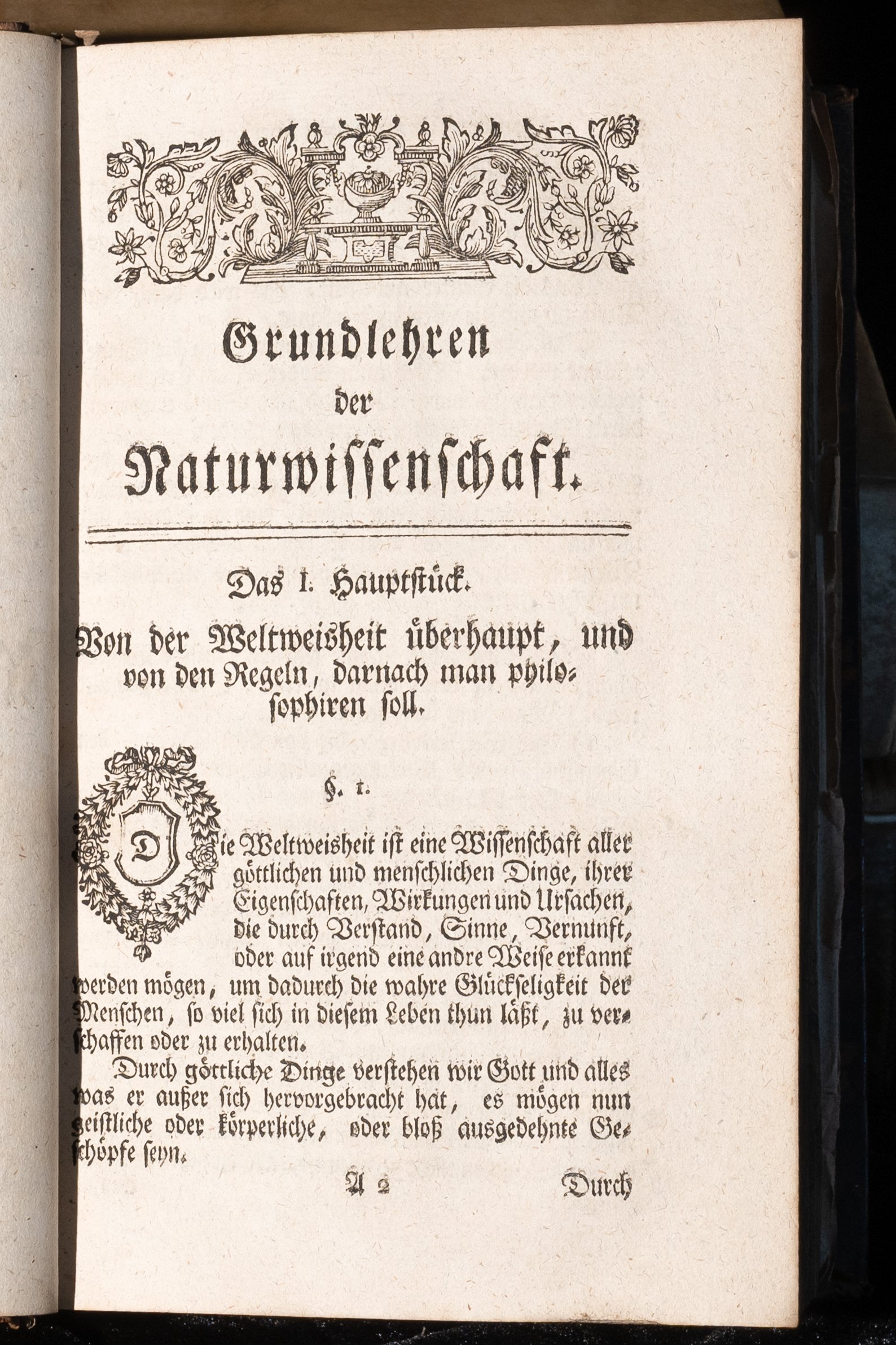 Image 10 of 26
 Image 11 of 26
 Image 12 of 26
 Image 13 of 26
 Image 14 of 26
 Image 15 of 26
 Image 16 of 26
 Image 17 of 26
 Image 18 of 26
 Image 19 of 26
 Image 20 of 26
 Image 21 of 26
 Image 22 of 26
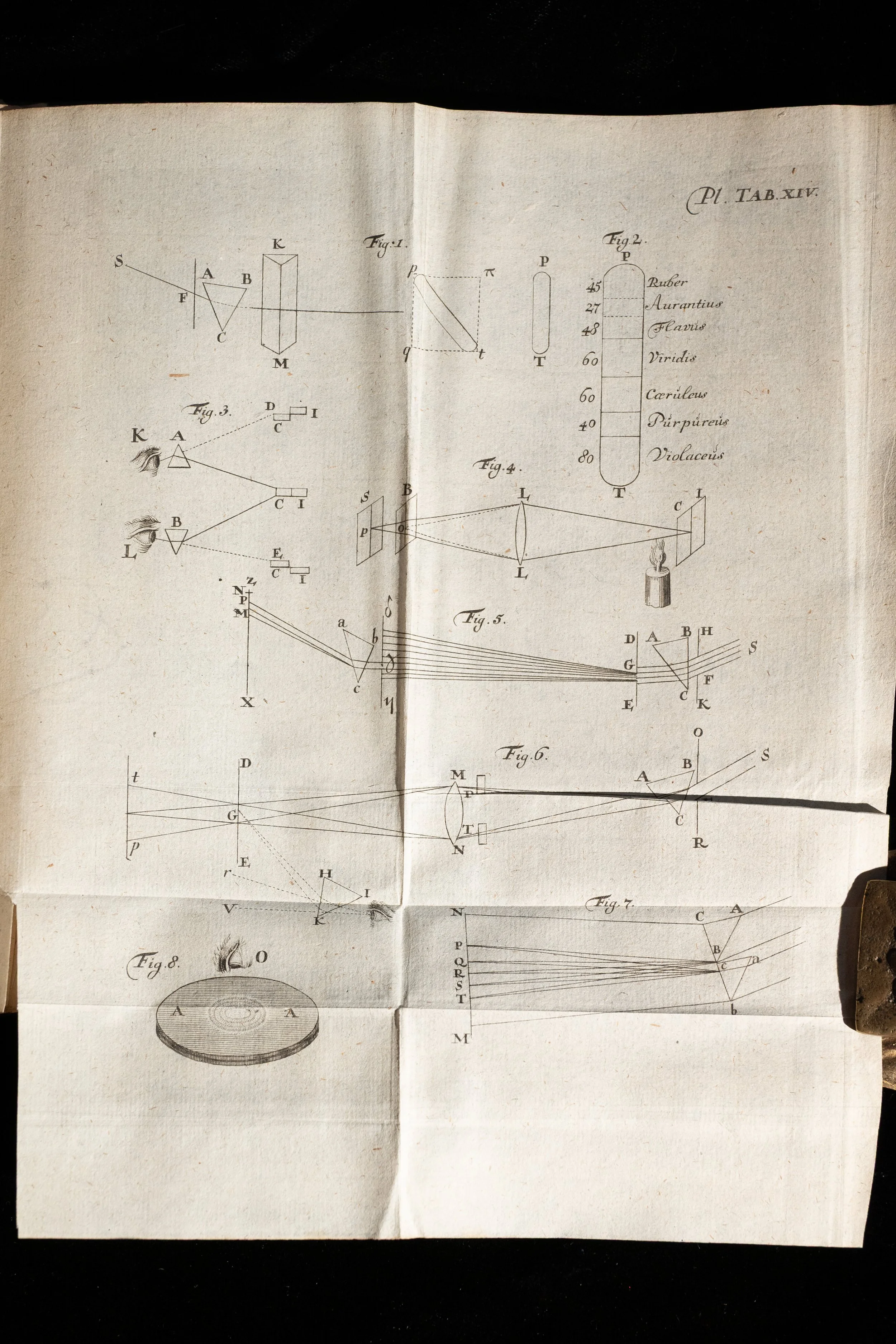 Image 23 of 26
 Image 24 of 26
 Image 25 of 26
 Image 26 of 26