Jacob Böhme, the shoemaker and religious visionary of Görlitz, devoted his Mysterium Magnum to explaining Genesis. He completed it in 1623, a year before his death. Creation, the serpent and the lives of the patriarchs become part of his account of how the eternal world gives birth to this one and how the soul finds its way home. The title sets out the double concern: the kingdom of nature and the kingdom of grace, Adam and Christ. This is the 1730 printing from his collected works, Theosophia Revelata, with the double-page engraved frontispiece of Moses and the Messiah.
Across the engraving, the haloed Messiah and hooded Moses bend toward each other over a great starry globe wound in spiral rings. A trumpet sounds between them. On the facing page, a crowned figure with a flowering branch stands above the nested circles of creation. The image brings the book’s spiritual and visible worlds together.
The edition used Johann Georg Gichtel’s editorial material and was seen through the press by Johann Wilhelm Ueberfeld. The text runs to 896 pages in Fraktur with Gichtel’s chapter summaries. The appended “Extract der hochsinnlichen Betrachtung” ends: “then the outer shell falls away, and there stands a spiritual tree of life in God’s field.” The printer follows it with ENDE and a calligraphic knot.
An early reader worked through the book in pencil, setting crosses beside passages including the alchemical chapters. There Böhme compares the image of God buried in man to gold hidden in lead, waiting for the artist. The marks show a reader attending to the place where his theology and alchemy meet.
A blind stamp reading LANCASTER, PENNA., and inked accession numbers record the ownership of an unidentified Pennsylvania institution. The circular engraved bookplate is signed by Karl Heinrich Grünler, the Leipzig engraver. This is one of five volumes of the 1730 edition in matching later half-morocco bindings, offered separately. The binding is firm; the paper is somewhat browned, with a dampstain toward the end.
A note for collectors. This volume is one of five from a uniformly bound run of the 1730 edition, each offered separately: the Aurora, the Mysterium Magnum, De Signatura Rerum, De Tribus Principiis, and the Psychologia Vera (Forty Questions of the Soul, bound with De Incarnatione Verbi). Take 10% off any two volumes, 15% off any three or four, and 20% off the complete run of five. The discounts apply to whichever volumes remain available.
Provenance: (1) Circular engraved pictorial ex libris etched by Karl Heinrich Grünler (1761–1823, Leipzig engraver, pupil of Geyser), signed “Grünler fec.”: an urn on its pedestal in a wooded garden, with serpent and owl. (2) Blind-embossed stamp reading LANCASTER, PENNA., with inked accession numbers on the frontispiece (13549) and last page (4115): an unidentified Pennsylvania institutional library. (3) Early pencil reading-marks: marginal crosses beside key passages, among them the alchemical chapters of the Genesis commentary.
Mysterium Magnum, oder Erklärung über Das Erste Buch Mosis. From the Theosophia Revelata, the collected edition of Böhme’s works, 1730. One of five uniformly bound volumes of the edition, offered separately; see the note for collectors above.
BÖHME, Jacob (1575–1624). Mysterium Magnum, oder Erklärung über Das Erste Buch Mosis (begun before 1622, completed 1623). [From the Theosophia Revelata, the revised collected edition, ed. Johann Georg Gichtel, seen through the press by Johann Wilhelm Ueberfeld.] No place or printer: “Gedruckt im Jahr des ausgebornen grossen Heils,” 1730.
Physical Description: Small 8vo. Double-page engraved frontispiece (Messias and Moses over the starry globe); special title dated 1730; 896 pp., closing with the “Extract der hochsinnlichen Betrachtung” and terminal ENDE with calligraphic knot ornament. Fraktur type, Gichtel’s chapter-summaries throughout. Early pencil reading-marks (see Provenance).
Binding: Later dark half morocco over marbled paper boards, leather corners; spine with five raised bands, gilt-tooled in the late-Baroque manner, red and tan lettering-pieces. One of five volumes uniformly bound.
Condition: Very good. Paper somewhat browned as usual with this stock; dampstain to the upper area of roughly the last twenty leaves, the final leaf more browned. Binding firm.
Jacob Böhme, the shoemaker and religious visionary of Görlitz, devoted his Mysterium Magnum to explaining Genesis. He completed it in 1623, a year before his death. Creation, the serpent and the lives of the patriarchs become part of his account of how the eternal world gives birth to this one and how the soul finds its way home. The title sets out the double concern: the kingdom of nature and the kingdom of grace, Adam and Christ. This is the 1730 printing from his collected works, Theosophia Revelata, with the double-page engraved frontispiece of Moses and the Messiah.
Across the engraving, the haloed Messiah and hooded Moses bend toward each other over a great starry globe wound in spiral rings. A trumpet sounds between them. On the facing page, a crowned figure with a flowering branch stands above the nested circles of creation. The image brings the book’s spiritual and visible worlds together.
The edition used Johann Georg Gichtel’s editorial material and was seen through the press by Johann Wilhelm Ueberfeld. The text runs to 896 pages in Fraktur with Gichtel’s chapter summaries. The appended “Extract der hochsinnlichen Betrachtung” ends: “then the outer shell falls away, and there stands a spiritual tree of life in God’s field.” The printer follows it with ENDE and a calligraphic knot.
An early reader worked through the book in pencil, setting crosses beside passages including the alchemical chapters. There Böhme compares the image of God buried in man to gold hidden in lead, waiting for the artist. The marks show a reader attending to the place where his theology and alchemy meet.
A blind stamp reading LANCASTER, PENNA., and inked accession numbers record the ownership of an unidentified Pennsylvania institution. The circular engraved bookplate is signed by Karl Heinrich Grünler, the Leipzig engraver. This is one of five volumes of the 1730 edition in matching later half-morocco bindings, offered separately. The binding is firm; the paper is somewhat browned, with a dampstain toward the end.
A note for collectors. This volume is one of five from a uniformly bound run of the 1730 edition, each offered separately: the Aurora, the Mysterium Magnum, De Signatura Rerum, De Tribus Principiis, and the Psychologia Vera (Forty Questions of the Soul, bound with De Incarnatione Verbi). Take 10% off any two volumes, 15% off any three or four, and 20% off the complete run of five. The discounts apply to whichever volumes remain available.
Provenance: (1) Circular engraved pictorial ex libris etched by Karl Heinrich Grünler (1761–1823, Leipzig engraver, pupil of Geyser), signed “Grünler fec.”: an urn on its pedestal in a wooded garden, with serpent and owl. (2) Blind-embossed stamp reading LANCASTER, PENNA., with inked accession numbers on the frontispiece (13549) and last page (4115): an unidentified Pennsylvania institutional library. (3) Early pencil reading-marks: marginal crosses beside key passages, among them the alchemical chapters of the Genesis commentary.
Mysterium Magnum, oder Erklärung über Das Erste Buch Mosis. From the Theosophia Revelata, the collected edition of Böhme’s works, 1730. One of five uniformly bound volumes of the edition, offered separately; see the note for collectors above.
BÖHME, Jacob (1575–1624). Mysterium Magnum, oder Erklärung über Das Erste Buch Mosis (begun before 1622, completed 1623). [From the Theosophia Revelata, the revised collected edition, ed. Johann Georg Gichtel, seen through the press by Johann Wilhelm Ueberfeld.] No place or printer: “Gedruckt im Jahr des ausgebornen grossen Heils,” 1730.
Physical Description: Small 8vo. Double-page engraved frontispiece (Messias and Moses over the starry globe); special title dated 1730; 896 pp., closing with the “Extract der hochsinnlichen Betrachtung” and terminal ENDE with calligraphic knot ornament. Fraktur type, Gichtel’s chapter-summaries throughout. Early pencil reading-marks (see Provenance).
Binding: Later dark half morocco over marbled paper boards, leather corners; spine with five raised bands, gilt-tooled in the late-Baroque manner, red and tan lettering-pieces. One of five volumes uniformly bound.
Condition: Very good. Paper somewhat browned as usual with this stock; dampstain to the upper area of roughly the last twenty leaves, the final leaf more browned. Binding firm.

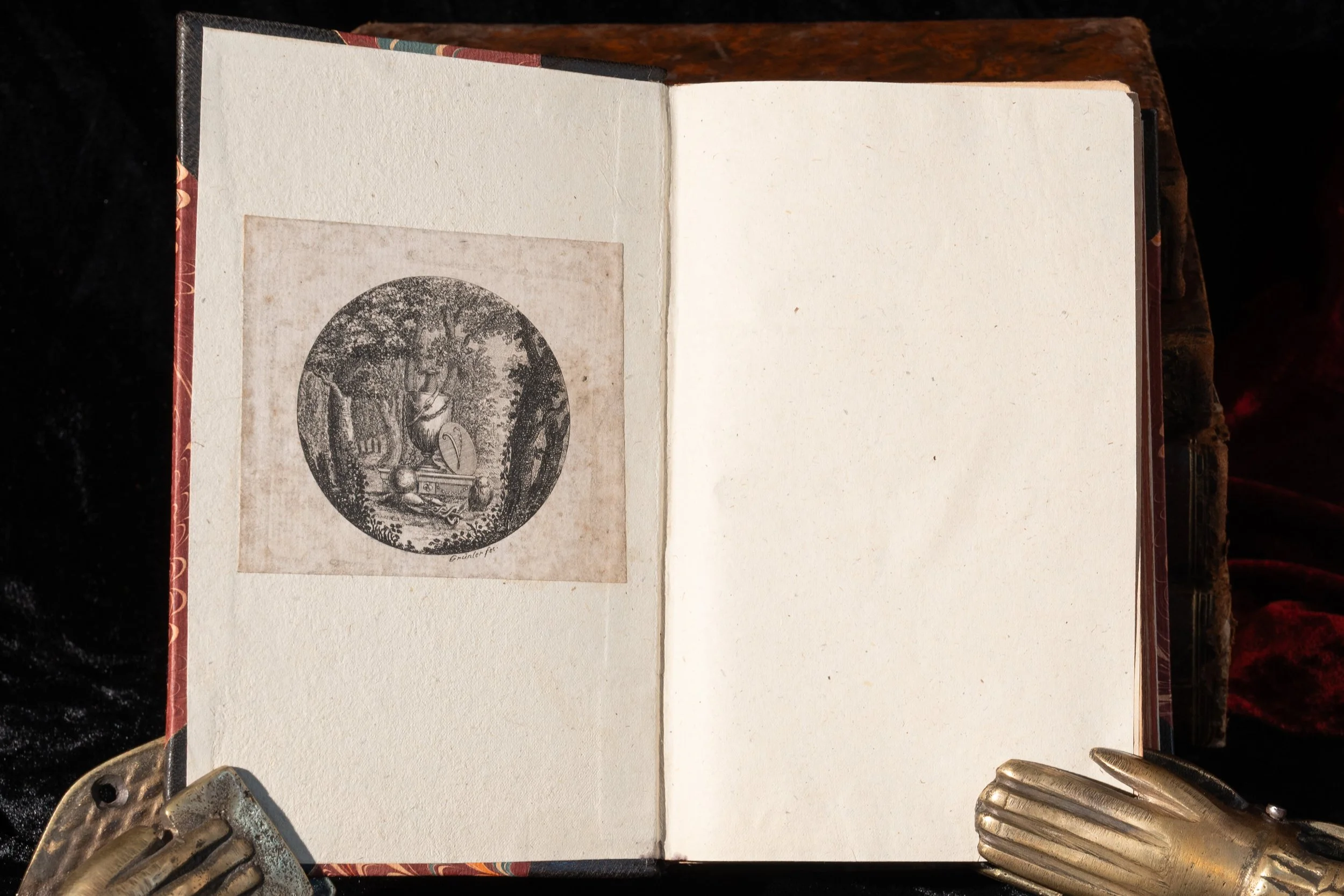 Image 1 of 8
 Image 2 of 8
 Image 3 of 8
 Image 4 of 8
 Image 5 of 8
 Image 6 of 8
 Image 7 of 8
 Image 8 of 8