Balthasar Walther, a Silesian physician and alchemist, traveled the Near East in search of kabbalistic and magical learning and came home convinced that he should have just stayed in Görlitz. That’s because a shoemaker named Jacob Böhme lived in Görlitz. Around 1620, Walther put to Jacob Böhme a list of forty questions about the soul; where it comes from, and what becomes of it after the body. Böhme answered all forty. The result, known under its Latin title as the Psychologia Vera, is the most systematic thing Böhme ever wrote, and it contains one of the most famous images in Western esotericism: his “philosophical globe,” the wonder-eye of eternity, a diagram of two circles turning through a single eye, which Böhme drew to answer the very first question. He then apologized for its obscurity, saying the reader must understand it with the mind, “for the being of God consists not in figures.” Tradition credits Walther with fixing on Böhme the title by which all Europe would know him: Philosophus Teutonicus, the Teutonic Philosopher.
Jacob Böhme (1575–1624) believed a flash of illumination had shown him the common root of God, nature, good, and evil. He spent his life writing down these insights in his own idiomatic German, against the standing prohibition of his town’s clergy. His readers over the next two centuries included the Pietists, the English Behmenists around William Law, the Romantics, and Hegel, who called him “the first German philosopher.” The two treatises appear here in the celebrated edition of 1730, the Theosophia Revelata, a revised collected edition of Böhme’s works, assembled from the editorial apparatus of Johann Georg Gichtel and carried through the press by his disciple Johann Wilhelm Ueberfeld. The Forty Questions carry their supplement as well, Das umgewandte Auge, the Reverted Eye, Böhme’s appendix to the first question. The edition is prized for its symbolic engraved plates, and this volume carries two. The frontispiece is an emblematic engraving beneath a banner reading “40 Fragen von der Seele”: the dark globe of this world below, the ring of fire and stars, and light streaming down from above. It is distinct from Böhme’s diagram of the philosophical globe. Deeper in the volume stands the second plate, “Der Baum des Glaubens,” the Tree of Faith: the name IESUS in glory at the head, an all-seeing eye at the center, and the tree rising out of the dark world through the region of the stars.
There is a second treatise in the volume, written in the same year as the Forty Questions. Von der Menschwerdung Jesu Christi, On the Incarnation of the Word, is Böhme’s account of how the eternal Word became flesh, and it runs in three parts: the incarnation, which Böhme unfolds through his doctrine of the heavenly virgin Sophia, the divine Wisdom; Christ’s suffering, dying, and resurrection; and the Tree of Christian Faith, faith figured as a living tree rooted in the believer and flowering in God. The treatise carries its own title page, dated 1730, announcing all three parts. The second plate stands at the opening of that third part, facing the treatise that gave it its name. The two treatises make a pair: the soul interrogated in the one, the Word made flesh in the other.
An early reader went through this copy with a pencil. Crosses stand in the margins beside charged passages, Böhme on the virgin Wisdom among them, and at the foot of several pages an old German hand glosses what it found there: “Verbum Domini, das Wort des Herrn,” the Word of the Lord.
The volume comes from a run of five treatises of the 1730 edition uniformly bound, at a later date, in dark half morocco over marbled boards, the spines gilt in the late-Baroque manner with red and tan lettering-pieces. Each of the five carries a circular engraved ex libris signed by Karl Heinrich Grünler (1761–1823), a Leipzig engraver of the book trade. The paper is somewhat browned; the binding is firm and handsome.
A note for collectors. This volume is one of five from a uniformly bound run of the 1730 edition, each offered separately: the Aurora, the Mysterium Magnum, De Signatura Rerum, De Tribus Principiis, and the Psychologia Vera (Forty Questions of the Soul, bound with De Incarnatione Verbi). Take 10% off any two volumes, 15% off any three or four, and 20% off the complete run of five. The discounts apply to whichever volumes remain available, and the chance to assemble the complete uniform run lasts only until the first volume finds a home.
BÖHME, Jacob (1575–1624). Psychologia Vera, oder Vierzig Fragen von der Seelen Urstand ... beantwortet (written 1620), with the supplement Das umgewandte Auge appended to the first question; bound with: De Incarnatione Verbi, oder Von der Menschwerdung Jesu Christi (written 1620). Two treatises in one volume, each with its own special title. [From the Theosophia Revelata, the revised collected edition, ed. Johann Georg Gichtel, seen through the press by Johann Wilhelm Ueberfeld. Place not given; [Amsterdam?]:] “Gedruckt im Jahr des ausgebornen grossen Heils,” the Menschwerdung title adding the date, 1730.
Physical Description: Small 8vo. Two treatises, separately paginated. Psychologia Vera: engraved frontispiece (an emblematic composition beneath a banner reading “40 Fragen von der Seele,” numbered IV. in the edition’s suite), special title, index of questions, 184 pp. (the Forty Questions ending p. 177, the supplement Das umgewandte Auge pp. 179–184). Menschwerdung: special title dated 1730, 221 pp., the second engraved plate (“Der Baum des Glaubens,” numbered V.3., with IESUS in glory above the all-seeing eye and the rooted tree) facing the opening of the third part at p. 184; final blank. Fraktur type, Gichtel’s chapter-summaries throughout. Occasional early pencil reading-marks and glosses (see Provenance). Collated complete.
Binding: Later dark half morocco over marbled paper boards, leather corners; spine with five raised bands, gilt-tooled in the late-Baroque manner, red and tan lettering-pieces. One of five volumes uniformly bound.
Condition: Very good. Paper somewhat browned as usual with this stock. Binding firm and fresh.
Provenance: (1) Circular engraved pictorial ex libris etched by Karl Heinrich Grünler (1761–1823, Leipzig engraver, pupil of Geyser), signed “Grünler fec.”, in each volume of the run. (2) Early pencil reading-marks in an old German cursive: marginal crosses beside key passages (among them Böhme on the virgin Wisdom in the first question, and the creation of Adam in the Menschwerdung), with glosses at the foot of several pages, one reading “Verbum Domini, das Wort des Herrn.”
Balthasar Walther, a Silesian physician and alchemist, traveled the Near East in search of kabbalistic and magical learning and came home convinced that he should have just stayed in Görlitz. That’s because a shoemaker named Jacob Böhme lived in Görlitz. Around 1620, Walther put to Jacob Böhme a list of forty questions about the soul; where it comes from, and what becomes of it after the body. Böhme answered all forty. The result, known under its Latin title as the Psychologia Vera, is the most systematic thing Böhme ever wrote, and it contains one of the most famous images in Western esotericism: his “philosophical globe,” the wonder-eye of eternity, a diagram of two circles turning through a single eye, which Böhme drew to answer the very first question. He then apologized for its obscurity, saying the reader must understand it with the mind, “for the being of God consists not in figures.” Tradition credits Walther with fixing on Böhme the title by which all Europe would know him: Philosophus Teutonicus, the Teutonic Philosopher.
Jacob Böhme (1575–1624) believed a flash of illumination had shown him the common root of God, nature, good, and evil. He spent his life writing down these insights in his own idiomatic German, against the standing prohibition of his town’s clergy. His readers over the next two centuries included the Pietists, the English Behmenists around William Law, the Romantics, and Hegel, who called him “the first German philosopher.” The two treatises appear here in the celebrated edition of 1730, the Theosophia Revelata, a revised collected edition of Böhme’s works, assembled from the editorial apparatus of Johann Georg Gichtel and carried through the press by his disciple Johann Wilhelm Ueberfeld. The Forty Questions carry their supplement as well, Das umgewandte Auge, the Reverted Eye, Böhme’s appendix to the first question. The edition is prized for its symbolic engraved plates, and this volume carries two. The frontispiece is an emblematic engraving beneath a banner reading “40 Fragen von der Seele”: the dark globe of this world below, the ring of fire and stars, and light streaming down from above. It is distinct from Böhme’s diagram of the philosophical globe. Deeper in the volume stands the second plate, “Der Baum des Glaubens,” the Tree of Faith: the name IESUS in glory at the head, an all-seeing eye at the center, and the tree rising out of the dark world through the region of the stars.
There is a second treatise in the volume, written in the same year as the Forty Questions. Von der Menschwerdung Jesu Christi, On the Incarnation of the Word, is Böhme’s account of how the eternal Word became flesh, and it runs in three parts: the incarnation, which Böhme unfolds through his doctrine of the heavenly virgin Sophia, the divine Wisdom; Christ’s suffering, dying, and resurrection; and the Tree of Christian Faith, faith figured as a living tree rooted in the believer and flowering in God. The treatise carries its own title page, dated 1730, announcing all three parts. The second plate stands at the opening of that third part, facing the treatise that gave it its name. The two treatises make a pair: the soul interrogated in the one, the Word made flesh in the other.
An early reader went through this copy with a pencil. Crosses stand in the margins beside charged passages, Böhme on the virgin Wisdom among them, and at the foot of several pages an old German hand glosses what it found there: “Verbum Domini, das Wort des Herrn,” the Word of the Lord.
The volume comes from a run of five treatises of the 1730 edition uniformly bound, at a later date, in dark half morocco over marbled boards, the spines gilt in the late-Baroque manner with red and tan lettering-pieces. Each of the five carries a circular engraved ex libris signed by Karl Heinrich Grünler (1761–1823), a Leipzig engraver of the book trade. The paper is somewhat browned; the binding is firm and handsome.
A note for collectors. This volume is one of five from a uniformly bound run of the 1730 edition, each offered separately: the Aurora, the Mysterium Magnum, De Signatura Rerum, De Tribus Principiis, and the Psychologia Vera (Forty Questions of the Soul, bound with De Incarnatione Verbi). Take 10% off any two volumes, 15% off any three or four, and 20% off the complete run of five. The discounts apply to whichever volumes remain available, and the chance to assemble the complete uniform run lasts only until the first volume finds a home.
BÖHME, Jacob (1575–1624). Psychologia Vera, oder Vierzig Fragen von der Seelen Urstand ... beantwortet (written 1620), with the supplement Das umgewandte Auge appended to the first question; bound with: De Incarnatione Verbi, oder Von der Menschwerdung Jesu Christi (written 1620). Two treatises in one volume, each with its own special title. [From the Theosophia Revelata, the revised collected edition, ed. Johann Georg Gichtel, seen through the press by Johann Wilhelm Ueberfeld. Place not given; [Amsterdam?]:] “Gedruckt im Jahr des ausgebornen grossen Heils,” the Menschwerdung title adding the date, 1730.
Physical Description: Small 8vo. Two treatises, separately paginated. Psychologia Vera: engraved frontispiece (an emblematic composition beneath a banner reading “40 Fragen von der Seele,” numbered IV. in the edition’s suite), special title, index of questions, 184 pp. (the Forty Questions ending p. 177, the supplement Das umgewandte Auge pp. 179–184). Menschwerdung: special title dated 1730, 221 pp., the second engraved plate (“Der Baum des Glaubens,” numbered V.3., with IESUS in glory above the all-seeing eye and the rooted tree) facing the opening of the third part at p. 184; final blank. Fraktur type, Gichtel’s chapter-summaries throughout. Occasional early pencil reading-marks and glosses (see Provenance). Collated complete.
Binding: Later dark half morocco over marbled paper boards, leather corners; spine with five raised bands, gilt-tooled in the late-Baroque manner, red and tan lettering-pieces. One of five volumes uniformly bound.
Condition: Very good. Paper somewhat browned as usual with this stock. Binding firm and fresh.
Provenance: (1) Circular engraved pictorial ex libris etched by Karl Heinrich Grünler (1761–1823, Leipzig engraver, pupil of Geyser), signed “Grünler fec.”, in each volume of the run. (2) Early pencil reading-marks in an old German cursive: marginal crosses beside key passages (among them Böhme on the virgin Wisdom in the first question, and the creation of Adam in the Menschwerdung), with glosses at the foot of several pages, one reading “Verbum Domini, das Wort des Herrn.”

 Image 1 of 6
 Image 2 of 6
 Image 3 of 6
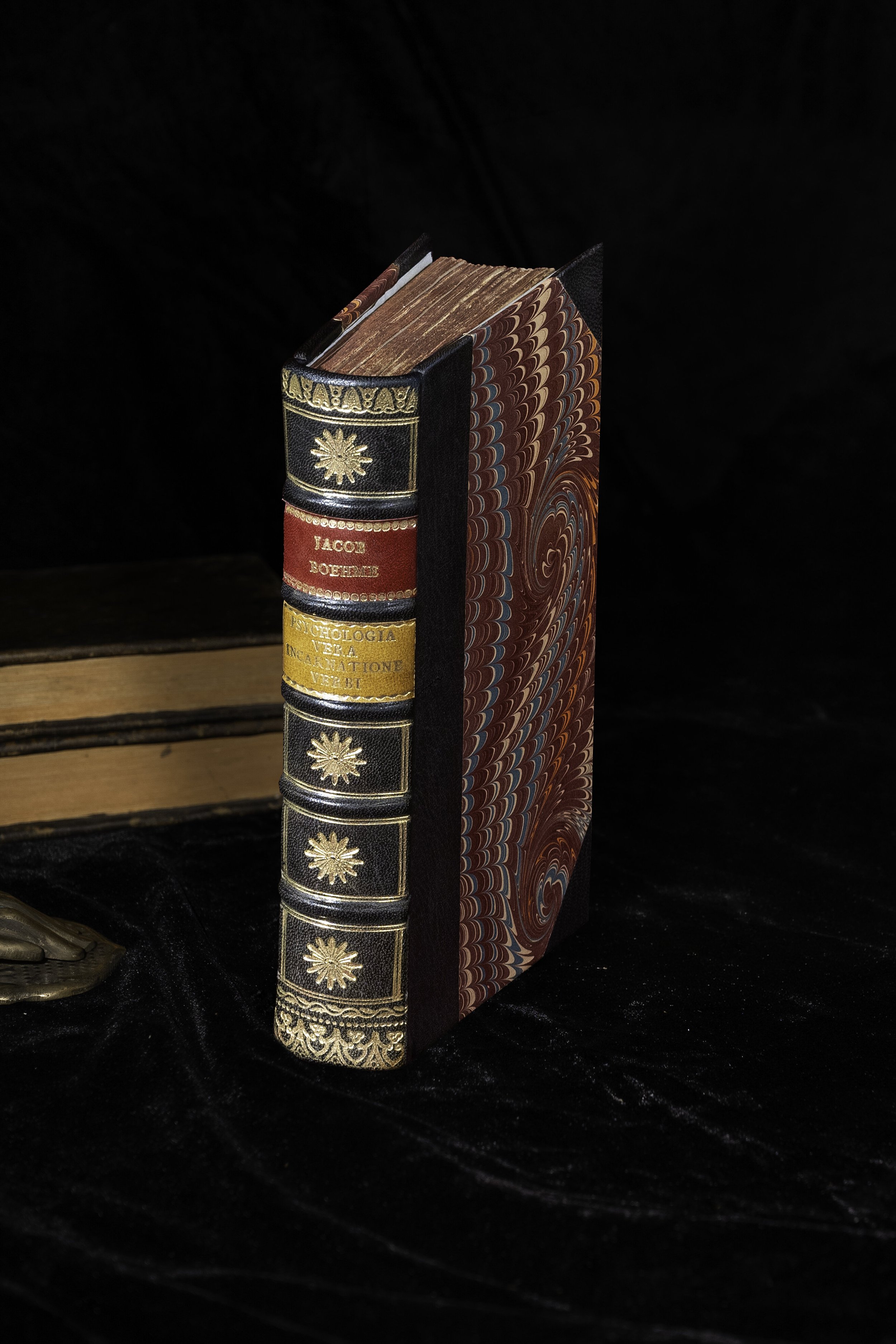 Image 4 of 6
 Image 5 of 6
 Image 6 of 6