Jacob Böhme, the shoemaker and religious visionary of Görlitz, was made to promise that he would stop writing after his first book was confiscated in 1613. In 1619 he broke the promise. De Tribus Principiis, his account of the three divine principles, was his second major work. The three principles are Böhme’s map of everything that exists: a dark world of fire and wrath, a light world of love, and this visible world between them, born of both parents. Angels, stars, metals, and men all live in one of the three, or in all of them at once. The title page promises to account for the Holy Trinity and the creation of the angels, then follows man through sin, death, devil, and hell. Böhme covers all of it in 493 pages.
The volume carries two engravings. The frontispiece, numbered II. in the edition’s suite under a banner reading “Drey Principia,” shows the dove of the Spirit descending in a triangle of light through a ring of cherub heads, the starry wheel of this world beneath it, and at the bottom the dark sphere where the dragons coil. And bound at the end stands the volume’s showpiece, a large folding plate titled Das Rad der Geburt der Bildniß Gottes im Menschen, the Wheel of the Birth of the Image of God in Man: a full circle graduated through all 360 degrees, ringed with stars and the signs of the zodiac, the divine name blazing in a triangle at the hub, FEUR and the heavenly tincture on the axis, and the planets strung along the wheel’s pole. The plate is Böhme’s cosmos drawn as an instrument, and it opens out to roughly triple the width of this small volume.
The text appears here in the celebrated edition of 1730, the Theosophia Revelata, a revised collected edition of Böhme’s works, assembled from the editorial apparatus of Johann Georg Gichtel and carried through the press by his disciple Johann Wilhelm Ueberfeld. This is the Drey Principien volume of that edition, in Fraktur with Gichtel’s chapter-summaries, the title dated 1730 and recording the year of composition, 1619.
The red-ink annotations appear to be in the same hand as those in the Aurora from this uniformly bound group. The reader underlines Böhme’s satire on the quarreling sects, where one preacher cries “Here is Christ, so Paul wrote,” and the next answers “Run this way, here is Christ, so Peter wrote.” He sets his six-pointed star beside the soul’s answer to the tempter, that man does not live by bread alone, and again, with a nota bene, beside the passage on making gold. Once he writes what appears to be a name in the margin: “Philaleth,” apparently citing the alchemical author Philalethes. A few further marks are in pencil.
The volume comes from a run of five treatises of the 1730 edition uniformly bound, at a later date, in dark half morocco over marbled boards, the spines gilt in the late-Baroque manner with red and tan lettering-pieces. Each of the five carries a circular engraved ex libris signed by Karl Heinrich Grünler (1761–1823), a Leipzig engraver of the book trade. The paper is somewhat browned; the binding is firm and handsome.
A note for collectors. This volume is one of five from a uniformly bound run of the 1730 edition, each offered separately: the Aurora, the Mysterium Magnum, De Signatura Rerum, De Tribus Principiis, and the Psychologia Vera (Forty Questions of the Soul, bound with De Incarnatione Verbi). Take 10% off any two volumes, 15% off any three or four, and 20% off the complete run of five. The discounts apply to whichever volumes remain available.
BÖHME, Jacob (1575–1624). De Tribus Principiis, oder Beschreibung der Drey Principien Göttliches Wesens (written 1619). [From the Theosophia Revelata, the collected edition, ed. Johann Georg Gichtel, seen through the press by Johann Wilhelm Ueberfeld.] No place or printer: “Gedruckt im Jahr des ausgebornen grossen Heils,” 1730.
Physical Description: Small 8vo. Engraved emblematic frontispiece (numbered II., “Drey Principia”) facing the special title, dated 1730; 493 pp.; large folding engraved plate, “Das Rad der Geburt der Bildniß Gottes im Menschen, durch die drey Principia Göttliches Wesens,” bound at the end. Fraktur type, Gichtel’s chapter-summaries throughout. Early reading-marks and glosses in red ink, a few in pencil (see Provenance).
Binding: Later dark half morocco over marbled paper boards, leather corners; spine with five raised bands, gilt-tooled in the late-Baroque manner, red and tan lettering-pieces. One of five volumes uniformly bound.
Condition: Very good. Paper somewhat browned as usual with this stock; the folding plate clean and complete. Binding firm.
Provenance: (1) Circular engraved pictorial ex libris etched by Karl Heinrich Grünler (1761–1823, Leipzig engraver, pupil of Geyser), signed “Grünler fec.”: an urn on its pedestal in a wooded garden, with serpent and owl. (2) Early annotations in red ink throughout, with a few in pencil, in an old German cursive, by all appearances the same hand as in the Aurora of this run: underscores, marginal pointing-marks, nota-bene monograms, six-pointed stars beside charged passages, and a marginal note apparently citing “Philaleth[es].”
Jacob Böhme, the shoemaker and religious visionary of Görlitz, was made to promise that he would stop writing after his first book was confiscated in 1613. In 1619 he broke the promise. De Tribus Principiis, his account of the three divine principles, was his second major work. The three principles are Böhme’s map of everything that exists: a dark world of fire and wrath, a light world of love, and this visible world between them, born of both parents. Angels, stars, metals, and men all live in one of the three, or in all of them at once. The title page promises to account for the Holy Trinity and the creation of the angels, then follows man through sin, death, devil, and hell. Böhme covers all of it in 493 pages.
The volume carries two engravings. The frontispiece, numbered II. in the edition’s suite under a banner reading “Drey Principia,” shows the dove of the Spirit descending in a triangle of light through a ring of cherub heads, the starry wheel of this world beneath it, and at the bottom the dark sphere where the dragons coil. And bound at the end stands the volume’s showpiece, a large folding plate titled Das Rad der Geburt der Bildniß Gottes im Menschen, the Wheel of the Birth of the Image of God in Man: a full circle graduated through all 360 degrees, ringed with stars and the signs of the zodiac, the divine name blazing in a triangle at the hub, FEUR and the heavenly tincture on the axis, and the planets strung along the wheel’s pole. The plate is Böhme’s cosmos drawn as an instrument, and it opens out to roughly triple the width of this small volume.
The text appears here in the celebrated edition of 1730, the Theosophia Revelata, a revised collected edition of Böhme’s works, assembled from the editorial apparatus of Johann Georg Gichtel and carried through the press by his disciple Johann Wilhelm Ueberfeld. This is the Drey Principien volume of that edition, in Fraktur with Gichtel’s chapter-summaries, the title dated 1730 and recording the year of composition, 1619.
The red-ink annotations appear to be in the same hand as those in the Aurora from this uniformly bound group. The reader underlines Böhme’s satire on the quarreling sects, where one preacher cries “Here is Christ, so Paul wrote,” and the next answers “Run this way, here is Christ, so Peter wrote.” He sets his six-pointed star beside the soul’s answer to the tempter, that man does not live by bread alone, and again, with a nota bene, beside the passage on making gold. Once he writes what appears to be a name in the margin: “Philaleth,” apparently citing the alchemical author Philalethes. A few further marks are in pencil.
The volume comes from a run of five treatises of the 1730 edition uniformly bound, at a later date, in dark half morocco over marbled boards, the spines gilt in the late-Baroque manner with red and tan lettering-pieces. Each of the five carries a circular engraved ex libris signed by Karl Heinrich Grünler (1761–1823), a Leipzig engraver of the book trade. The paper is somewhat browned; the binding is firm and handsome.
A note for collectors. This volume is one of five from a uniformly bound run of the 1730 edition, each offered separately: the Aurora, the Mysterium Magnum, De Signatura Rerum, De Tribus Principiis, and the Psychologia Vera (Forty Questions of the Soul, bound with De Incarnatione Verbi). Take 10% off any two volumes, 15% off any three or four, and 20% off the complete run of five. The discounts apply to whichever volumes remain available.
BÖHME, Jacob (1575–1624). De Tribus Principiis, oder Beschreibung der Drey Principien Göttliches Wesens (written 1619). [From the Theosophia Revelata, the collected edition, ed. Johann Georg Gichtel, seen through the press by Johann Wilhelm Ueberfeld.] No place or printer: “Gedruckt im Jahr des ausgebornen grossen Heils,” 1730.
Physical Description: Small 8vo. Engraved emblematic frontispiece (numbered II., “Drey Principia”) facing the special title, dated 1730; 493 pp.; large folding engraved plate, “Das Rad der Geburt der Bildniß Gottes im Menschen, durch die drey Principia Göttliches Wesens,” bound at the end. Fraktur type, Gichtel’s chapter-summaries throughout. Early reading-marks and glosses in red ink, a few in pencil (see Provenance).
Binding: Later dark half morocco over marbled paper boards, leather corners; spine with five raised bands, gilt-tooled in the late-Baroque manner, red and tan lettering-pieces. One of five volumes uniformly bound.
Condition: Very good. Paper somewhat browned as usual with this stock; the folding plate clean and complete. Binding firm.
Provenance: (1) Circular engraved pictorial ex libris etched by Karl Heinrich Grünler (1761–1823, Leipzig engraver, pupil of Geyser), signed “Grünler fec.”: an urn on its pedestal in a wooded garden, with serpent and owl. (2) Early annotations in red ink throughout, with a few in pencil, in an old German cursive, by all appearances the same hand as in the Aurora of this run: underscores, marginal pointing-marks, nota-bene monograms, six-pointed stars beside charged passages, and a marginal note apparently citing “Philaleth[es].”

 Image 1 of 7
 Image 2 of 7
 Image 3 of 7
 Image 4 of 7
 Image 5 of 7
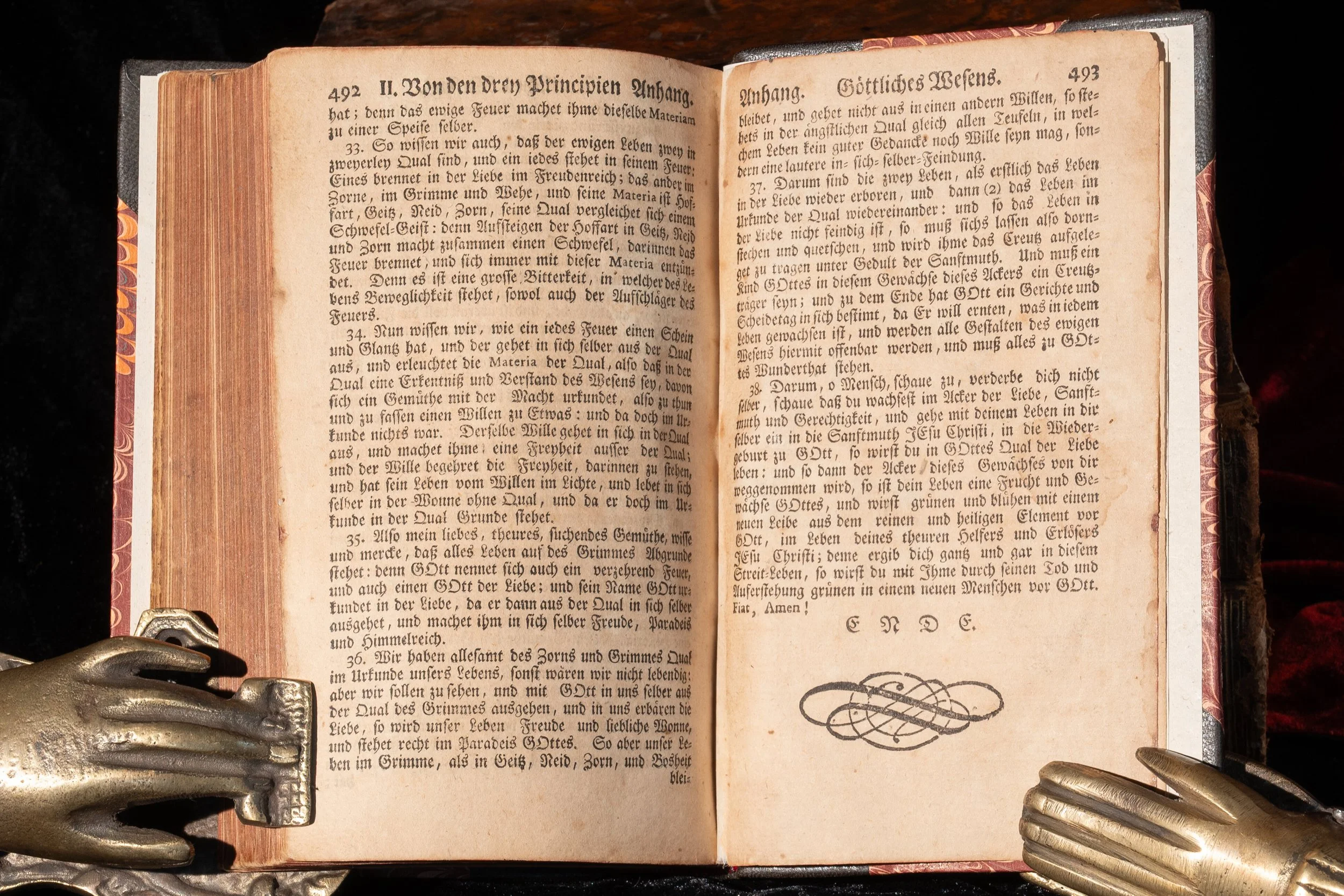 Image 6 of 7
 Image 7 of 7