There's a great publisher's note at the front of this book, which claims that young barbers and apothecaries "cannot be without their Lemery, any more than a priest without his Breviary." They read it for amusement in their idle hours, and within a few days they can reason about nature better than the old philosophers and physicians, who never had these foundations. That is a bookseller talking, so allow for the sales pitch. But it wasn't a completely crazy claim. By 1719 Lemery's chemistry course had been through more than a dozen French editions and had been translated into Latin, English, German, Spanish, Dutch and, here, Italian. It was the book from which a whole generation of surgeons and pharmacy apprentices learned what happens when you put things in a furnace.
Nicolas Lemery (1645–1715) was an apothecary from Rouen who set up a laboratory in Paris in the 1670s and gave public chemistry demonstrations there. The demonstrations drew crowds, including a good many people who were not physicians at all. The Cours de Chymie, first printed in 1675, is the written and polished version of those lectures. It works through the mineral, vegetable and animal kingdoms one preparation at a time: how to make the thing, and then a short argument about why the operation works. The argument was novel at the time. Lemery explained chemical action with particles. Acids, he said, are pointed; alkalis are porous; an acid attacks an alkali because the points drive into the pores. This happens to be wrong. It helped popularize mechanical explanations of chemical reactions, marking a shift away from Paracelsian accounts. Lemery was a Protestant. He lost his right to practice after 1685, converted, rebuilt his career, and died a member of the Académie des Sciences.
The front matter carries a short history of the Venetian edition. Hertz reprinted two censorship licenses: one from December 1696 for an earlier edition of the Italian Corso di Chimica, and a second from July 1700 granting the Hertz shop the right to print an enlarged version. The title page of this 1719 edition promises further additions, Lemery's treatise on antimony and a collection of medicinal secrets. Those made up a second volume, which this copy lacks, and the second volume was something of a publisher's trick: Hertz had unsold copies of his 1707 Italian Treatise on Antimony on hand, and he marketed them as Tomo Secondo of the 1719 Corso. What you have here is the Corso itself, complete, with its long closing section on the medicinal virtues of every preparation in the book. Giovanni Gabriele Hertz, the publisher, had one of the busier scientific and medical shops in Venice. He was also the printer of the Giornale de' Letterati d'Italia, the Republic's leading learned journal, alongside his scientific and medical books.
Readers of the occult sciences will find the old vocabulary everywhere in the "modern" Lemery. The index runs through vitriol of the Moon, of Mars, of Venus, and sugar of Saturn. The frontispiece shows a laboratory with a mortar and a furnace, and above it an allegory with the sun, a dragon and a winged figure. Best of all is the folding plate bound in before the text, an Esplicazione de' Caratteri Chimici più Communi: an engraved key to the whole symbol system of alchemy. The seven planetary metals are here (silver or the Moon, quicksilver or Mercury, tin or Jupiter, lead under Saturn's sign), and so are the zodiac signs used as operations and timings, the caput mortuum, the sulfur of the philosophers, and the marks for sublime, precipitate, calcine and purify. Lemery wanted to be done with alchemy. His readers still needed its cipher to use his book, and Hertz gave it to them on a single sheet you can unfold and read at a glance.
The copy has never been bound and never been trimmed. It is still in the plain paper wrappers it was sold in, with the sewing thread visible at the spine and the title lettered on the spine in an early hand. Every leaf keeps its deckle edge, and the book is a good deal taller and wider than the bound copies one usually sees. Books sold this way were meant to be taken to a binder, and most were; a copy that stayed in its wrappers for three hundred years is scarce. The wrappers have done their job at a cost, described below.
Provenance: Early ownership inscription in ink on the flyleaf, struck through by a later hand and now illegible.
LEMERY, Nicolas. Corso di Chimica del Signor Nicolò Lemery, ch'insegna il modo di fare l'Operazioni, che sono usuali nella Medicina, con metodo facilissimo, e raggionamenti sopra ciascuna operazione. Tradotto dall'ultima edizione Francese, la qual è stata molto aumentata dall'Autore, ed in quest'ultima edizione Veneta aggiuntovi il Trattato dell'Antimonio, e li Segreti Medicinali. Arrichita di figure in rame. Venice: Giovanni Gabriele Hertz, 1719. Tomo primo only (of two); the second volume, the Trattato dell'Antimonio, was a reissue of Hertz's 1707 sheets and is not present. Venetian edition of the Italian Corso; the preliminary matter reprints a license dated 1696.
Physical Description: Octavo. Engraved allegorical frontispiece (Chimica del Sig. Lemerij) printed on the first leaf, with the half-title for the two-volume Opere on its verso; title; Prefazione; table of chapters; publisher's Avvertimento al Lettore Ingegnoso; the two Venetian licenses of 1696 and 1700; folding engraved table, Esplicazione de' Caratteri Chimici più Communi. Text with separate pagination, 782 pp.: the Corso to p. 703, Virtù de' Rimedi descritti in questo libro pp. 703–754, Tavola delle Materie pp. 755–782. Six copper-engraved plates of furnaces and apparatus at pp. 40–51, each with letterpress explanation on the facing page; frontispiece and plates all printed on the text leaves, so integral to the gatherings.
Binding: Contemporary plain paper wrappers (carta rustica), sewn through the spine with the thread exposed, spine lettered in ink by an early hand "LEMERI CORSO CH." Entirely untrimmed, with deckle edges throughout.
Condition: Text block starting from the wrappers at the rear; the wrappers themselves soiled and worn at the extremities but sound. Dampstaining to the final leaves of the index, without loss to the text. Preserved in its contemporary wrappers.
There's a great publisher's note at the front of this book, which claims that young barbers and apothecaries "cannot be without their Lemery, any more than a priest without his Breviary." They read it for amusement in their idle hours, and within a few days they can reason about nature better than the old philosophers and physicians, who never had these foundations. That is a bookseller talking, so allow for the sales pitch. But it wasn't a completely crazy claim. By 1719 Lemery's chemistry course had been through more than a dozen French editions and had been translated into Latin, English, German, Spanish, Dutch and, here, Italian. It was the book from which a whole generation of surgeons and pharmacy apprentices learned what happens when you put things in a furnace.
Nicolas Lemery (1645–1715) was an apothecary from Rouen who set up a laboratory in Paris in the 1670s and gave public chemistry demonstrations there. The demonstrations drew crowds, including a good many people who were not physicians at all. The Cours de Chymie, first printed in 1675, is the written and polished version of those lectures. It works through the mineral, vegetable and animal kingdoms one preparation at a time: how to make the thing, and then a short argument about why the operation works. The argument was novel at the time. Lemery explained chemical action with particles. Acids, he said, are pointed; alkalis are porous; an acid attacks an alkali because the points drive into the pores. This happens to be wrong. It helped popularize mechanical explanations of chemical reactions, marking a shift away from Paracelsian accounts. Lemery was a Protestant. He lost his right to practice after 1685, converted, rebuilt his career, and died a member of the Académie des Sciences.
The front matter carries a short history of the Venetian edition. Hertz reprinted two censorship licenses: one from December 1696 for an earlier edition of the Italian Corso di Chimica, and a second from July 1700 granting the Hertz shop the right to print an enlarged version. The title page of this 1719 edition promises further additions, Lemery's treatise on antimony and a collection of medicinal secrets. Those made up a second volume, which this copy lacks, and the second volume was something of a publisher's trick: Hertz had unsold copies of his 1707 Italian Treatise on Antimony on hand, and he marketed them as Tomo Secondo of the 1719 Corso. What you have here is the Corso itself, complete, with its long closing section on the medicinal virtues of every preparation in the book. Giovanni Gabriele Hertz, the publisher, had one of the busier scientific and medical shops in Venice. He was also the printer of the Giornale de' Letterati d'Italia, the Republic's leading learned journal, alongside his scientific and medical books.
Readers of the occult sciences will find the old vocabulary everywhere in the "modern" Lemery. The index runs through vitriol of the Moon, of Mars, of Venus, and sugar of Saturn. The frontispiece shows a laboratory with a mortar and a furnace, and above it an allegory with the sun, a dragon and a winged figure. Best of all is the folding plate bound in before the text, an Esplicazione de' Caratteri Chimici più Communi: an engraved key to the whole symbol system of alchemy. The seven planetary metals are here (silver or the Moon, quicksilver or Mercury, tin or Jupiter, lead under Saturn's sign), and so are the zodiac signs used as operations and timings, the caput mortuum, the sulfur of the philosophers, and the marks for sublime, precipitate, calcine and purify. Lemery wanted to be done with alchemy. His readers still needed its cipher to use his book, and Hertz gave it to them on a single sheet you can unfold and read at a glance.
The copy has never been bound and never been trimmed. It is still in the plain paper wrappers it was sold in, with the sewing thread visible at the spine and the title lettered on the spine in an early hand. Every leaf keeps its deckle edge, and the book is a good deal taller and wider than the bound copies one usually sees. Books sold this way were meant to be taken to a binder, and most were; a copy that stayed in its wrappers for three hundred years is scarce. The wrappers have done their job at a cost, described below.
Provenance: Early ownership inscription in ink on the flyleaf, struck through by a later hand and now illegible.
LEMERY, Nicolas. Corso di Chimica del Signor Nicolò Lemery, ch'insegna il modo di fare l'Operazioni, che sono usuali nella Medicina, con metodo facilissimo, e raggionamenti sopra ciascuna operazione. Tradotto dall'ultima edizione Francese, la qual è stata molto aumentata dall'Autore, ed in quest'ultima edizione Veneta aggiuntovi il Trattato dell'Antimonio, e li Segreti Medicinali. Arrichita di figure in rame. Venice: Giovanni Gabriele Hertz, 1719. Tomo primo only (of two); the second volume, the Trattato dell'Antimonio, was a reissue of Hertz's 1707 sheets and is not present. Venetian edition of the Italian Corso; the preliminary matter reprints a license dated 1696.
Physical Description: Octavo. Engraved allegorical frontispiece (Chimica del Sig. Lemerij) printed on the first leaf, with the half-title for the two-volume Opere on its verso; title; Prefazione; table of chapters; publisher's Avvertimento al Lettore Ingegnoso; the two Venetian licenses of 1696 and 1700; folding engraved table, Esplicazione de' Caratteri Chimici più Communi. Text with separate pagination, 782 pp.: the Corso to p. 703, Virtù de' Rimedi descritti in questo libro pp. 703–754, Tavola delle Materie pp. 755–782. Six copper-engraved plates of furnaces and apparatus at pp. 40–51, each with letterpress explanation on the facing page; frontispiece and plates all printed on the text leaves, so integral to the gatherings.
Binding: Contemporary plain paper wrappers (carta rustica), sewn through the spine with the thread exposed, spine lettered in ink by an early hand "LEMERI CORSO CH." Entirely untrimmed, with deckle edges throughout.
Condition: Text block starting from the wrappers at the rear; the wrappers themselves soiled and worn at the extremities but sound. Dampstaining to the final leaves of the index, without loss to the text. Preserved in its contemporary wrappers.

 Image 1 of 23
 Image 2 of 23
 Image 3 of 23
 Image 4 of 23
 Image 5 of 23
 Image 6 of 23
 Image 7 of 23
 Image 8 of 23
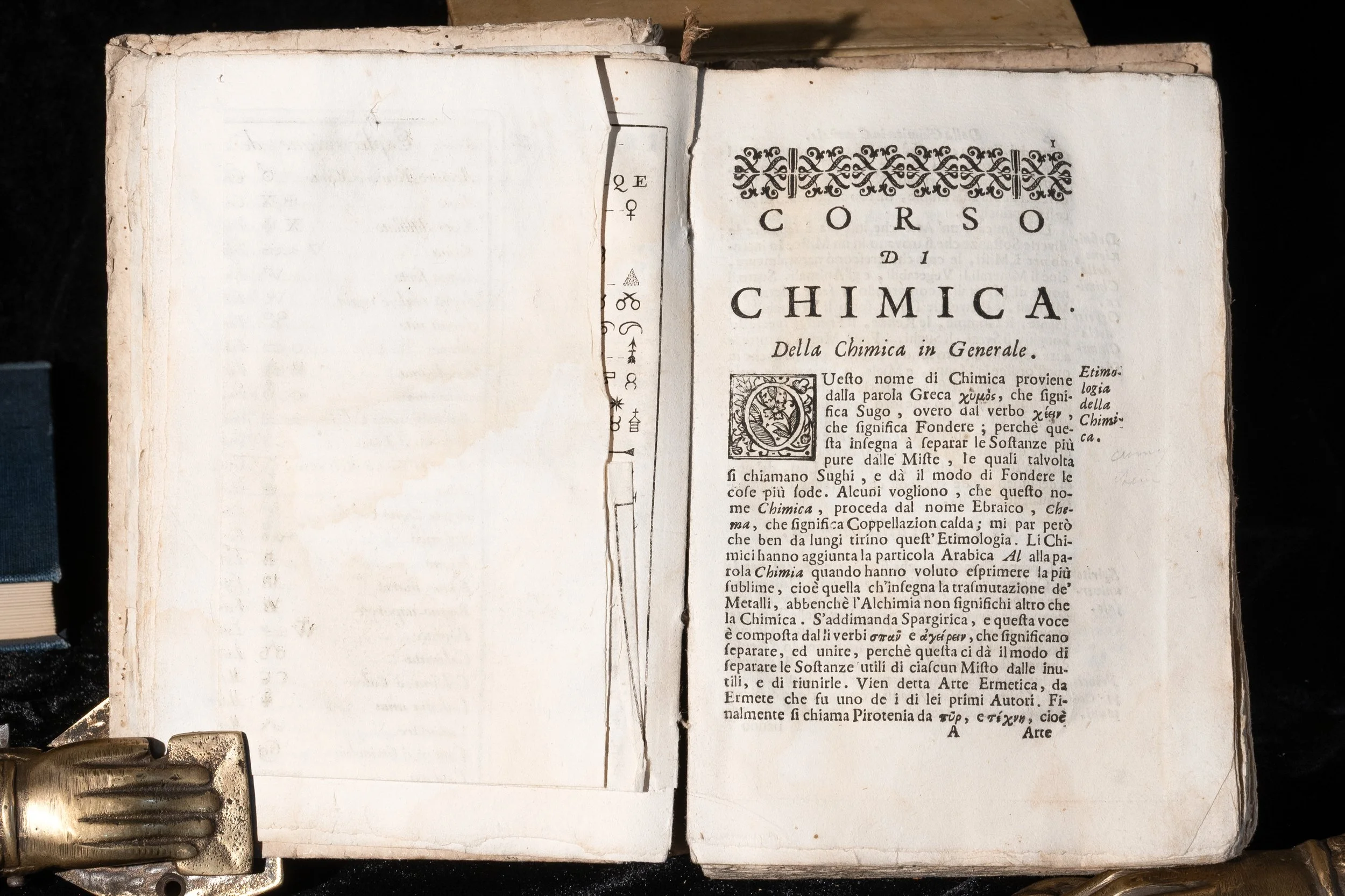 Image 9 of 23
 Image 10 of 23
 Image 11 of 23
 Image 12 of 23
 Image 13 of 23
 Image 14 of 23
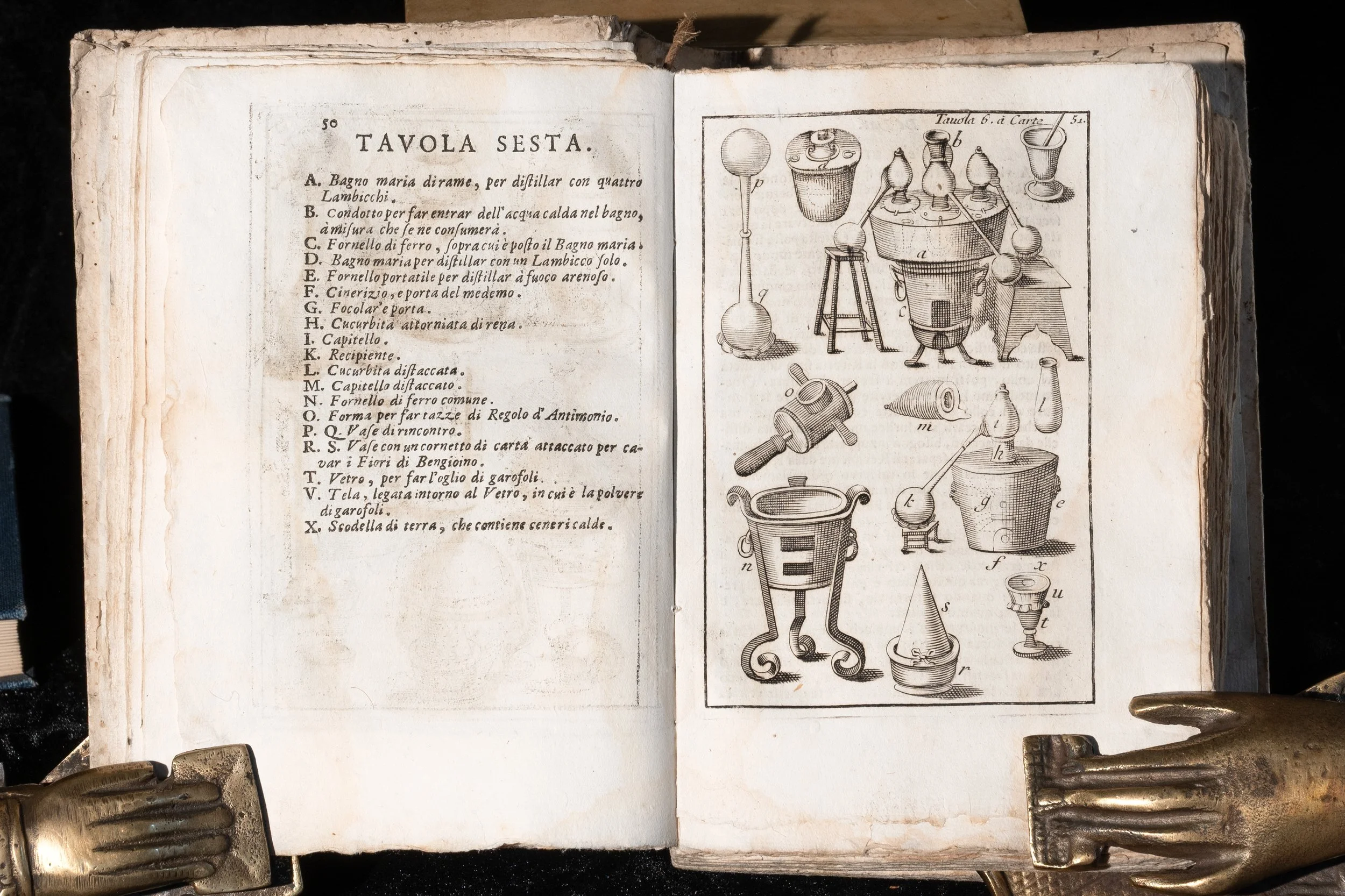 Image 15 of 23
 Image 16 of 23
 Image 17 of 23
 Image 18 of 23
 Image 19 of 23
 Image 20 of 23
 Image 21 of 23
 Image 22 of 23
 Image 23 of 23