On the front pastedown sits a bookplate shaped like a giant ring of carbon. It belonged to Franz Sondheimer (1926–1981), the German-born British chemist who fled the Third Reich as a boy and became celebrated for building enormous ring-shaped molecules, the border of his bookplate playfully drawn as one of them. Sondheimer collected the classics of his science, and it is easy to see why he wanted this one: Lémery's Cours de chymie (Paris, 1675) was the most successful chemistry book of its century. Fontenelle joked that it sold like a work of romance or satire. Lémery, a Huguenot apothecary whose Paris demonstrations drew paying crowds before religious persecution disrupted his career, explained the whole art in plain mechanical pictures. Acids sting, he reasoned, because their particles are pointed.
This third English edition, enlarged from the eighth French and with additions by the physician James Keill, catches chemistry in mid-molt. After the introductory matter comes a suite of leaves with woodcuts of furnaces and vessels and a table of the old characters of the art: the signs of the planets standing for the metals, the cryptic marks for spirits, salts, and waters, printed here as ordinary laboratory shorthand. The index runs from aurum potabile through vitriol of Mars, of Venus, and of the Moon to waters of vipers and frogs' spawn, and the publisher's terminal advertisement leaf hawks a treatise on “Mystical Chymistry,” Philosophers Gold, and the liquor Alkahest. The old language of alchemy is all still here; it has simply been put to work.
Provenance: Gilt crowned cipher, unidentified, on both covers, contemporary. Bookplate of Franz Sondheimer (1926–1981), organic chemist, F.R.S.
Lémery, A Course of Chymistry, third English edition. London: Printed by R.N. for Walter Kettilby, 1698.
LÉMERY, Nicolas (1645–1715). A Course of Chymistry, Containing an Easie Method of Preparing those Chymical Medicins which are used in Physick. With Curious Remarks and Useful Discourses upon each Preparation. London: Printed by R.N. for Walter Kettilby, at the Bishop's-Head in St. Paul's Church-yard, 1698. The Third Edition, Translated from the Eighth Edition in the French.
Physical Description: Octavo. [24], 44 pp., 10 leaves of woodcut illustrations, chemical characters, and letterpress explications, 45–815, [17] pp., with the terminal leaf of Kettilby's advertisements.
Binding: Contemporary paneled calf, spine gilt in compartments, red morocco label lettered “Lemery's Chimistry,” both covers stamped in gilt with a crowned cipher; comb-marbled endpapers.
Condition: Both covers had separated and have been reattached, with repairs along the inner hinges. Text clean and well-margined, complete.
On the front pastedown sits a bookplate shaped like a giant ring of carbon. It belonged to Franz Sondheimer (1926–1981), the German-born British chemist who fled the Third Reich as a boy and became celebrated for building enormous ring-shaped molecules, the border of his bookplate playfully drawn as one of them. Sondheimer collected the classics of his science, and it is easy to see why he wanted this one: Lémery's Cours de chymie (Paris, 1675) was the most successful chemistry book of its century. Fontenelle joked that it sold like a work of romance or satire. Lémery, a Huguenot apothecary whose Paris demonstrations drew paying crowds before religious persecution disrupted his career, explained the whole art in plain mechanical pictures. Acids sting, he reasoned, because their particles are pointed.
This third English edition, enlarged from the eighth French and with additions by the physician James Keill, catches chemistry in mid-molt. After the introductory matter comes a suite of leaves with woodcuts of furnaces and vessels and a table of the old characters of the art: the signs of the planets standing for the metals, the cryptic marks for spirits, salts, and waters, printed here as ordinary laboratory shorthand. The index runs from aurum potabile through vitriol of Mars, of Venus, and of the Moon to waters of vipers and frogs' spawn, and the publisher's terminal advertisement leaf hawks a treatise on “Mystical Chymistry,” Philosophers Gold, and the liquor Alkahest. The old language of alchemy is all still here; it has simply been put to work.
Provenance: Gilt crowned cipher, unidentified, on both covers, contemporary. Bookplate of Franz Sondheimer (1926–1981), organic chemist, F.R.S.
Lémery, A Course of Chymistry, third English edition. London: Printed by R.N. for Walter Kettilby, 1698.
LÉMERY, Nicolas (1645–1715). A Course of Chymistry, Containing an Easie Method of Preparing those Chymical Medicins which are used in Physick. With Curious Remarks and Useful Discourses upon each Preparation. London: Printed by R.N. for Walter Kettilby, at the Bishop's-Head in St. Paul's Church-yard, 1698. The Third Edition, Translated from the Eighth Edition in the French.
Physical Description: Octavo. [24], 44 pp., 10 leaves of woodcut illustrations, chemical characters, and letterpress explications, 45–815, [17] pp., with the terminal leaf of Kettilby's advertisements.
Binding: Contemporary paneled calf, spine gilt in compartments, red morocco label lettered “Lemery's Chimistry,” both covers stamped in gilt with a crowned cipher; comb-marbled endpapers.
Condition: Both covers had separated and have been reattached, with repairs along the inner hinges. Text clean and well-margined, complete.

 Image 1 of 20
 Image 2 of 20
 Image 3 of 20
 Image 4 of 20
 Image 5 of 20
 Image 6 of 20
 Image 7 of 20
 Image 8 of 20
 Image 9 of 20
 Image 10 of 20
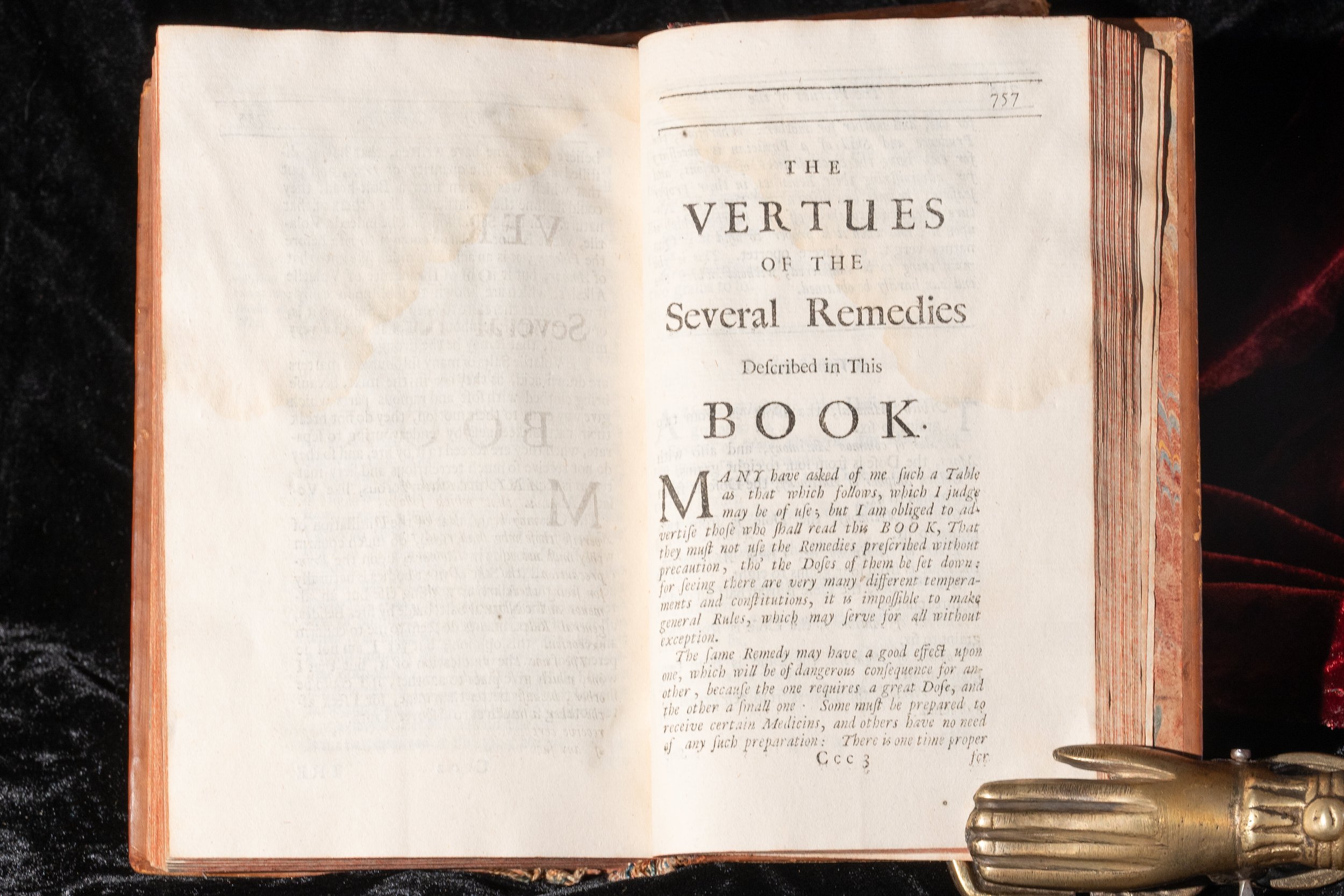 Image 11 of 20
 Image 12 of 20
 Image 13 of 20
 Image 14 of 20
 Image 15 of 20
 Image 16 of 20
 Image 17 of 20
 Image 18 of 20
 Image 19 of 20
 Image 20 of 20