This is a book of daily meditations on the Song of Songs, one for every day of the year. It was written by Carlo Casalicchio, a Jesuit preacher in Naples, where it was printed in 1694.
The Song of Songs is the Bible’s love poem. It runs to eight chapters, in which a lover and a beloved look for each other through vineyards and night streets, and God is named in it, if at all, in a single disputed word. The rabbis argued over whether it was holy. Rabbi Akiva answered that if all the Writings are holy, the Song of Songs is the Holy of Holies. Jewish and Christian readers alike came to take it as an allegory, of God’s love for Israel or of Christ’s love for the Church and the soul.
Read that way, the Song became the favorite text of the mystics. Origen wrote a ten-book commentary on it. Bernard of Clairvaux preached eighty-six sermons on it and had only reached the start of the third chapter when he died. John of the Cross built his Spiritual Canticle on it, and Thomas Aquinas, according to his early biographer William of Tocco, was expounding it to the monks of Fossanova on his deathbed. The alchemists used it as well. The late-medieval Aurora consurgens, long credited to Aquinas, retells the Song as a dialogue between lover and beloved to describe the marriage of opposites in the alchemical work. Marie-Louise von Franz, Jung’s closest collaborator, edited that text in 1957 (in English, 1966).
Casalicchio (1626–1700) was born at Sant’Angelo le Fratte in Basilicata. He entered the Jesuits at Naples in 1651 and spent the rest of his life there, preaching and writing. His most popular book was L’utile col dolce, a collection of witty sayings and moral anecdotes that was reprinted into the eighteenth century. His work of moral theology, Tuta conscientia, was placed on the Index of Forbidden Books in 1681. In 1692 he published meditations on the chief passages of the Canticle, “according to the exposition of the Holy Fathers.” The year-long set followed in 1694, printed at Naples by Giacomo Raillard, with each quarterly volume called a trimestre.
The three volumes are pocket-sized duodecimos, still in their limp vellum, with “Cantica del P. Casalicchi” lettered by hand on the spines. A Neapolitan owner, Don Alfonso Abbate, wrote on the title page that he bought the book on June 26 of a year in the 1700s, and there is an oval ink stamp beside his note. The fourth volume is lacking. Full details are below.
· · ·
CASALICCHIO, Carlo, S.J. (1626–1700). Meditationi sopra la sacra Cantica di Salomone per tutti li giorni dell’Anno... Trimestre I[–III]. Naples: Giacomo Raillard, 1694. Three of four volumes.
Physical Description: Three volumes, duodecimo, 15 x 8.5 cm (6 x 3 3/8 in.). (20), 300; 275; 247 pp. Jesuit IHS device on the title.
Binding: Contemporary limp vellum, manuscript titles on the spines.
Condition: Volume four lacking. Waterstains to the free endpapers.
Provenance: Ownership inscription on the title of Don Alfonso Abbate, dated June 26 in the 1700s; an oval ink stamp.
Further reading: Claudio Mutini, “Casalicchio, Carlo,” Dizionario Biografico degli Italiani, vol. 21 (1978), online at Treccani. E. Ann Matter, The Voice of My Beloved: The Song of Songs in Western Medieval Christianity (Philadelphia: University of Pennsylvania Press, 1990).

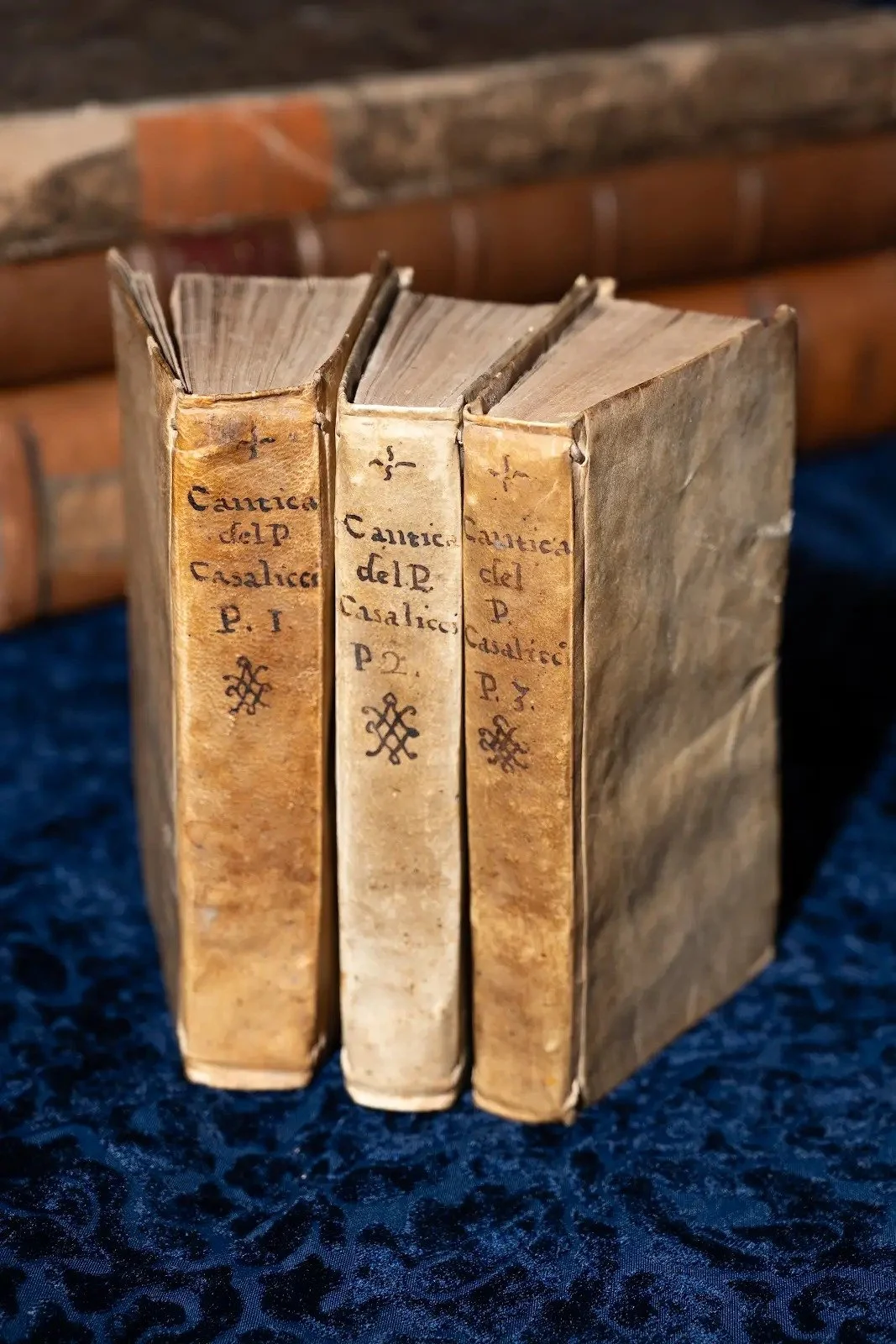 Image 1 of 30
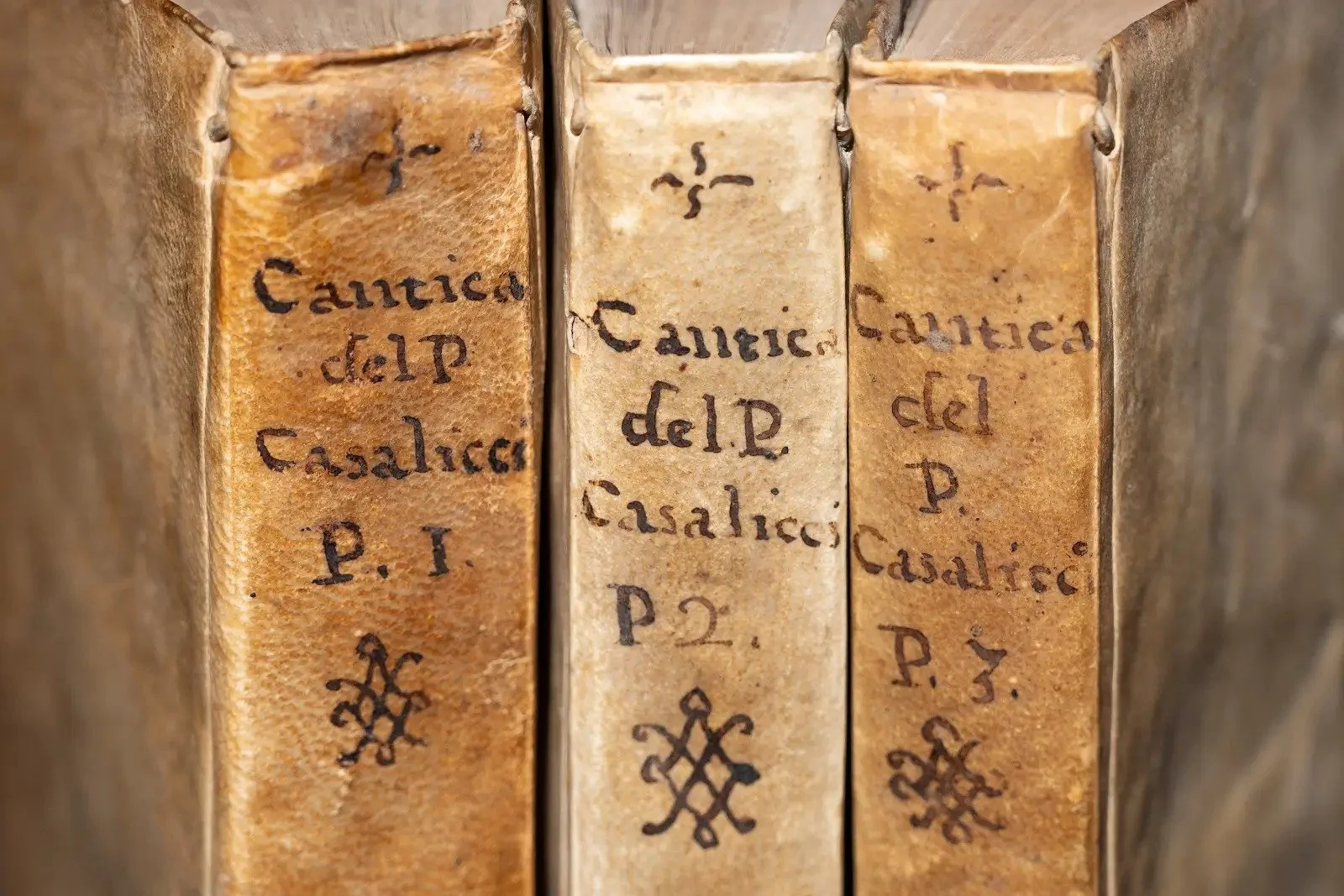 Image 2 of 30
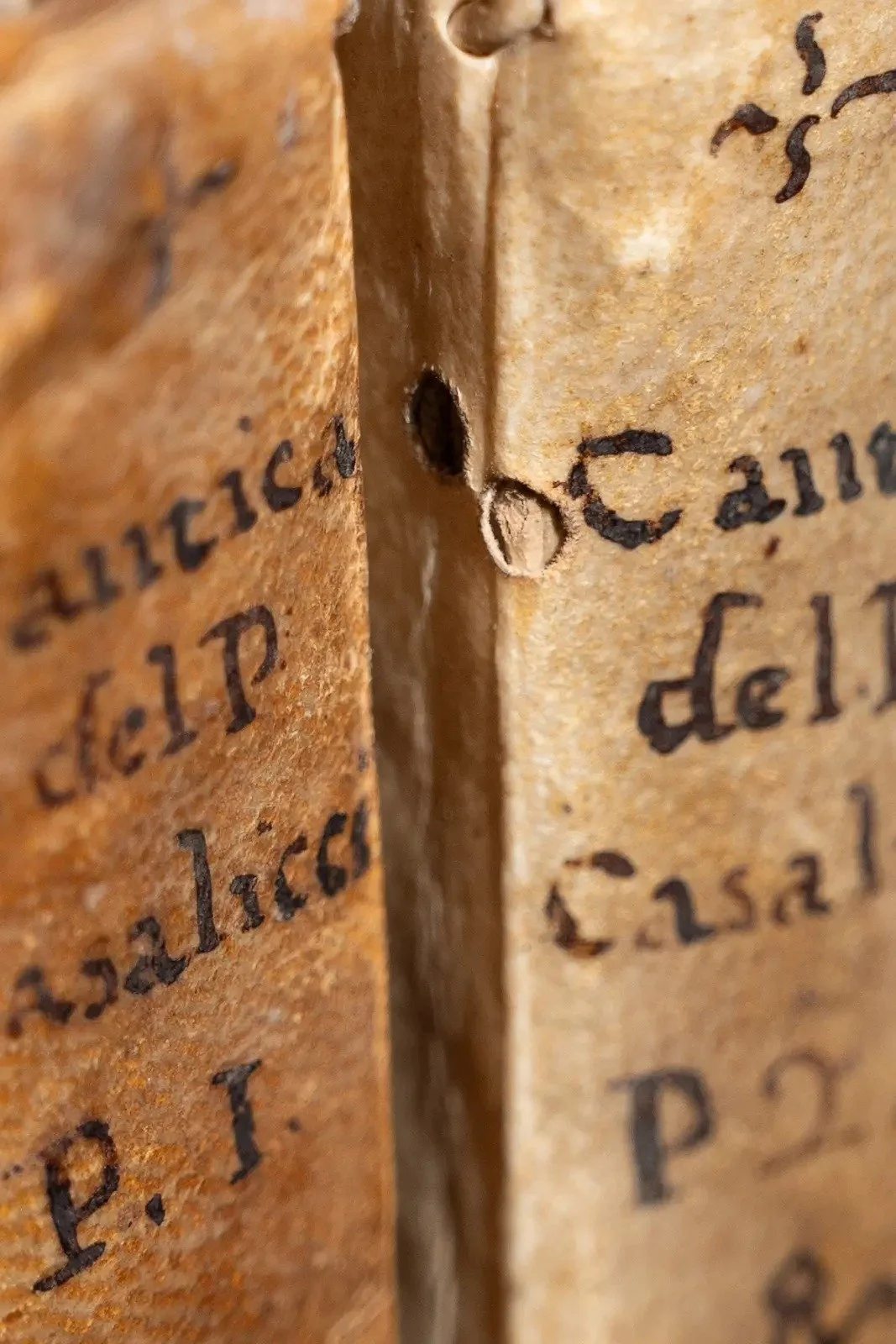 Image 3 of 30
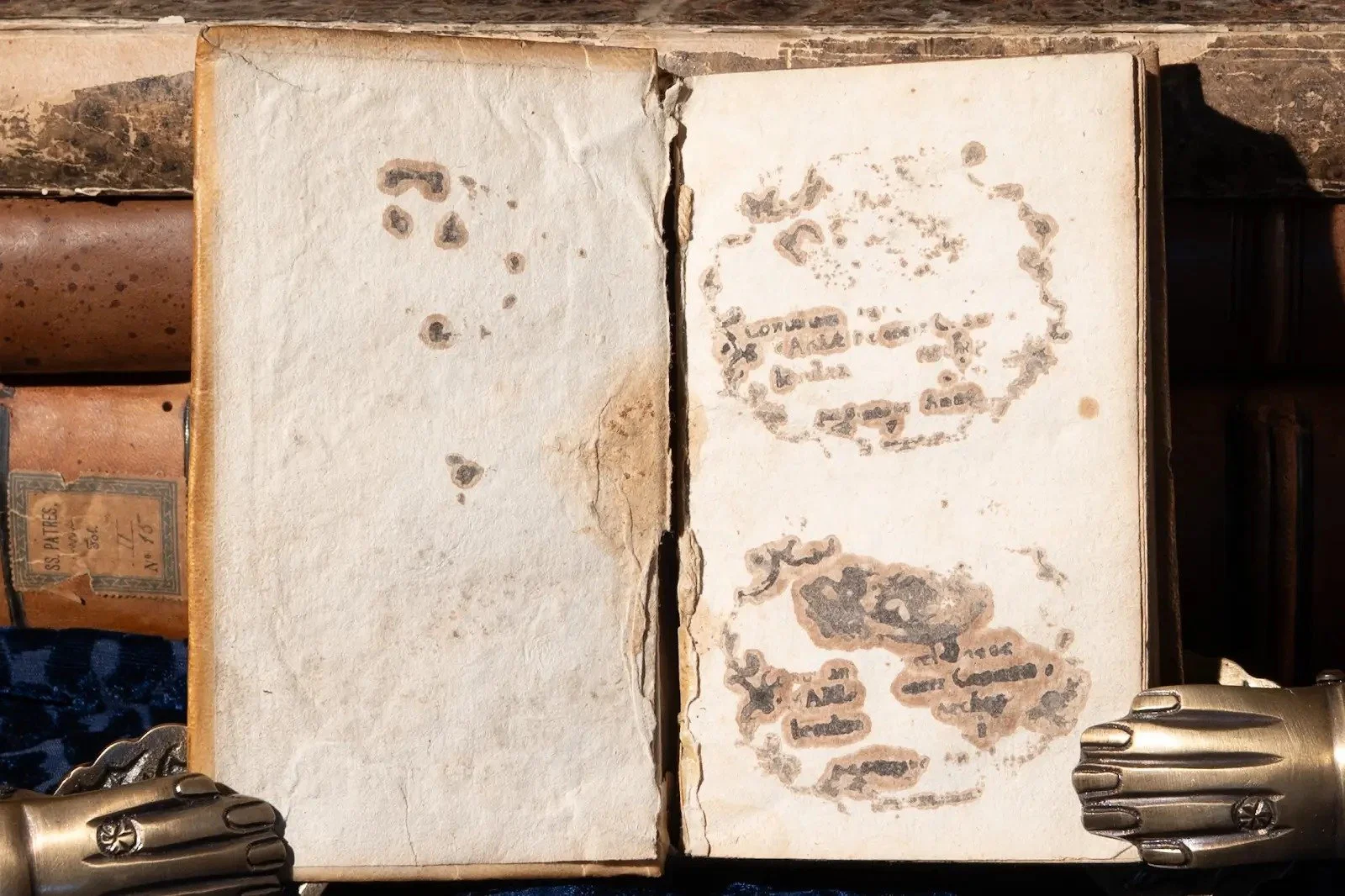 Image 4 of 30
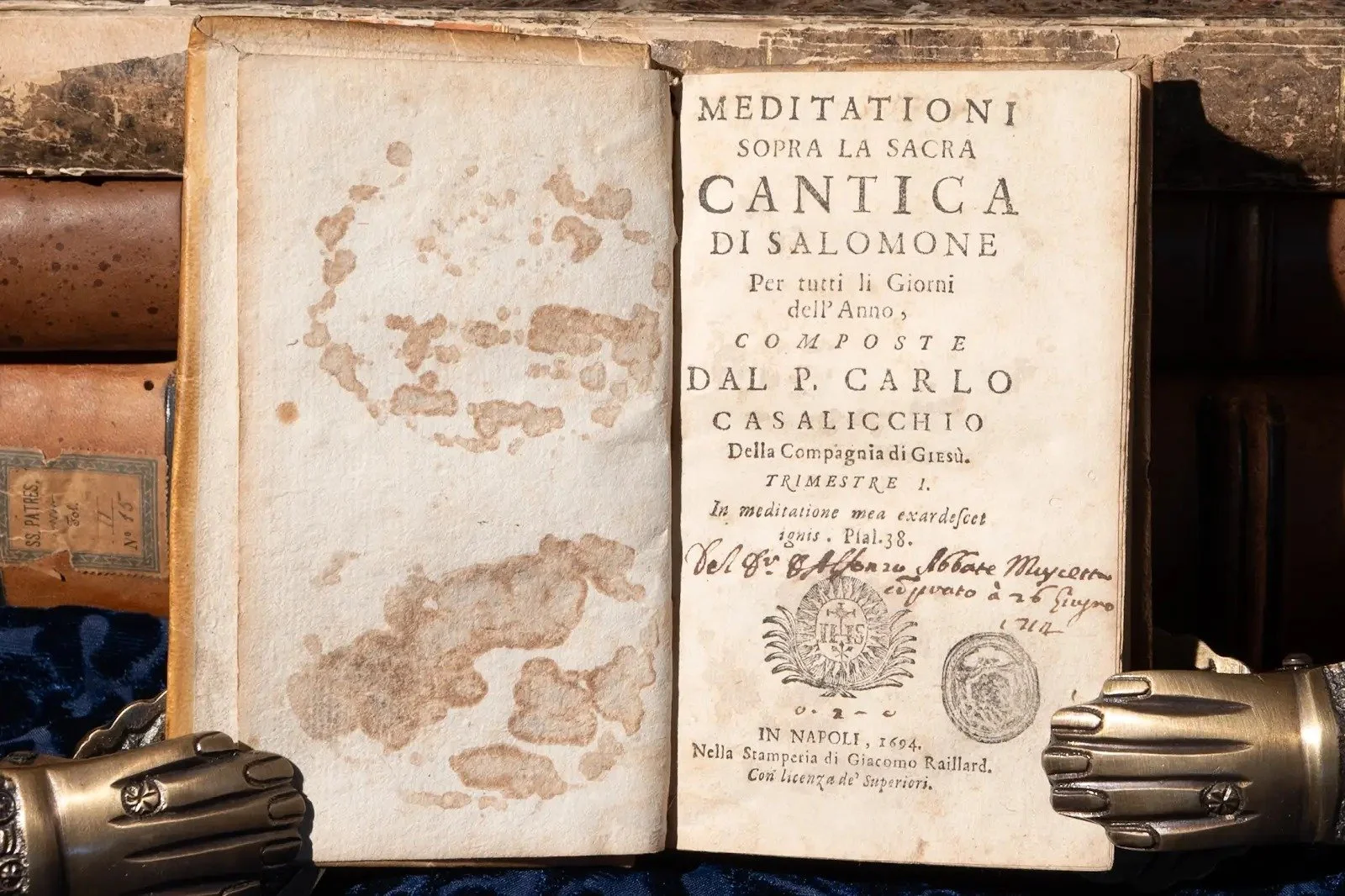 Image 5 of 30
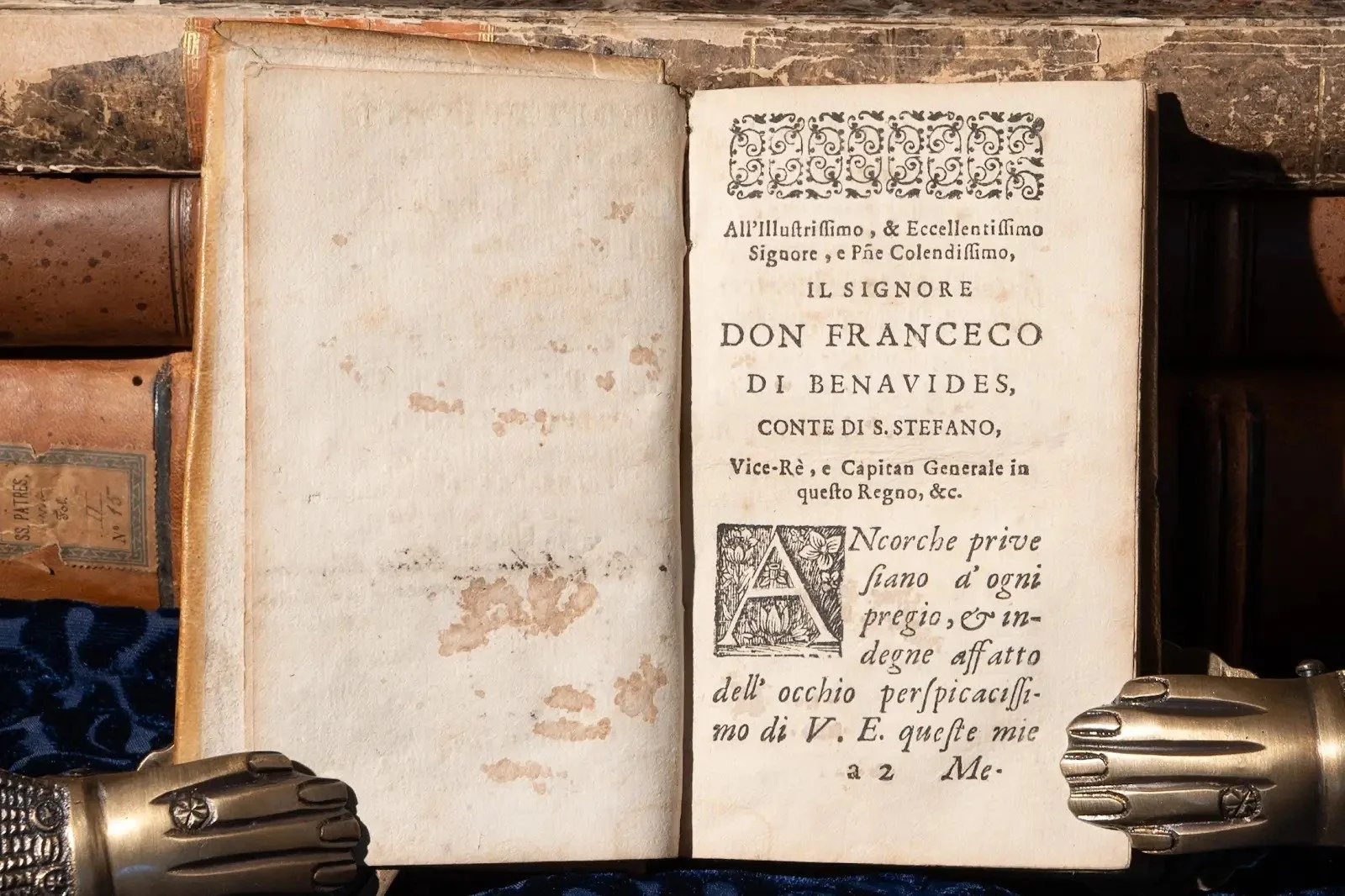 Image 6 of 30
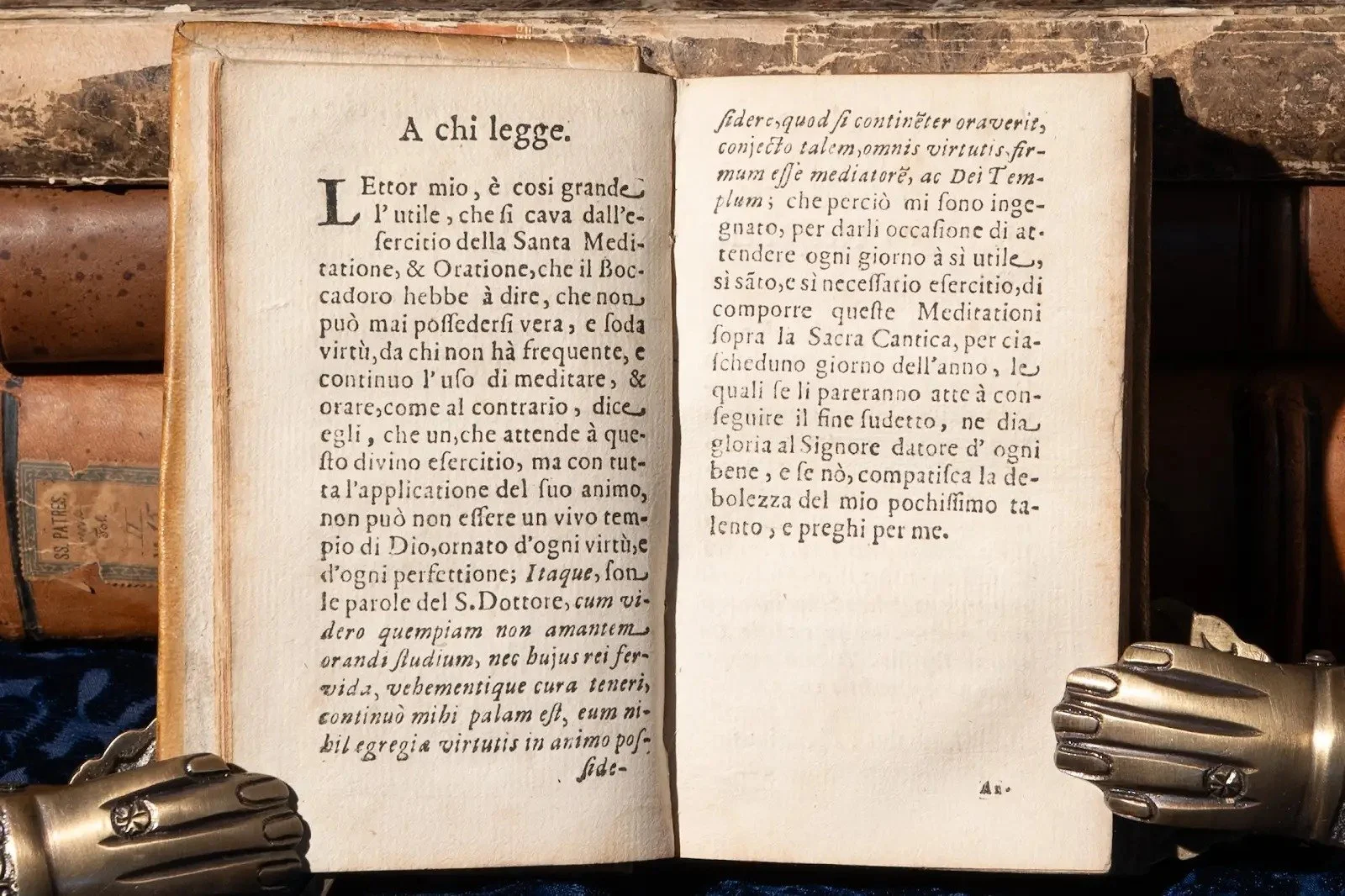 Image 7 of 30
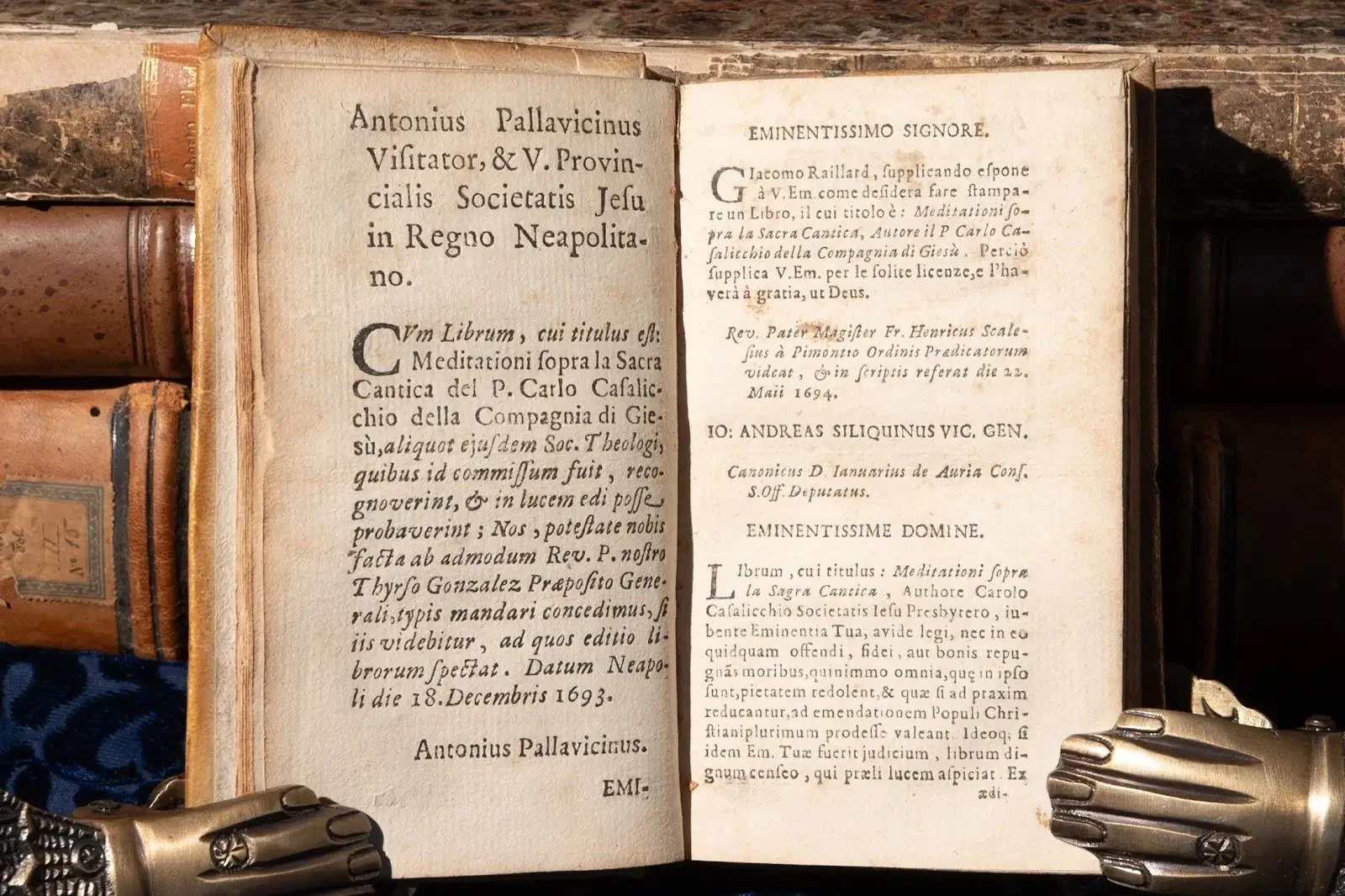 Image 8 of 30
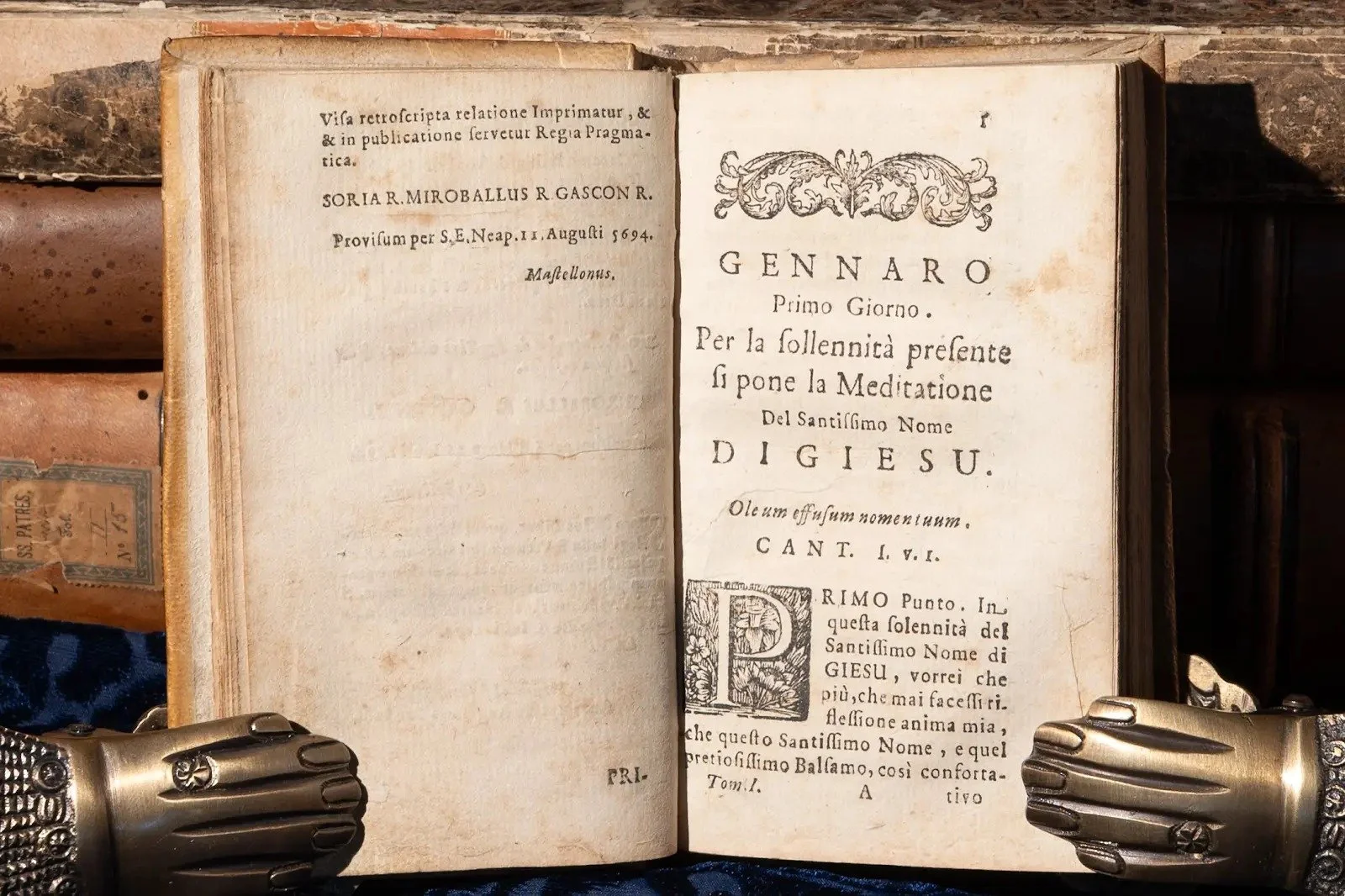 Image 9 of 30
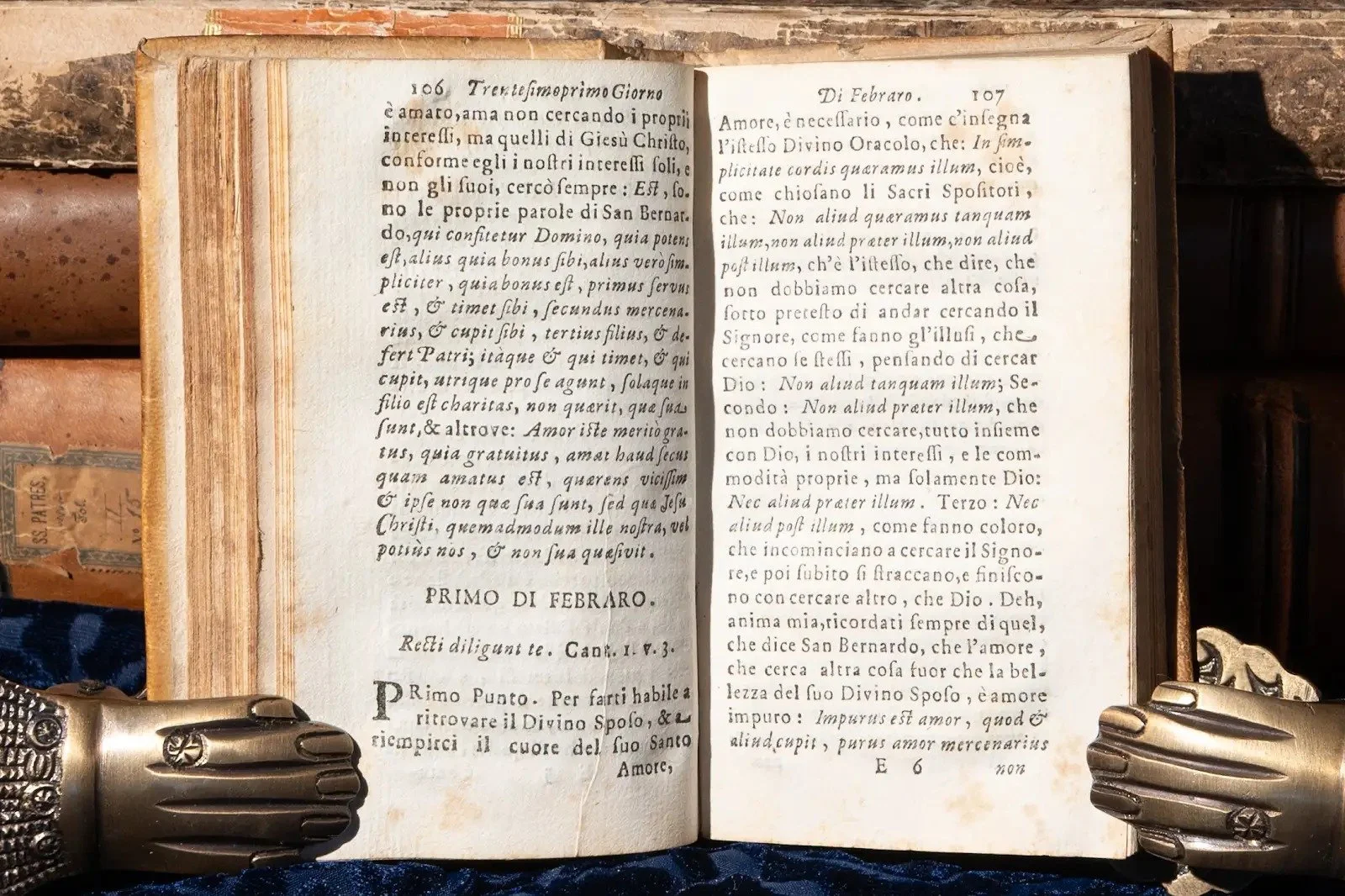 Image 10 of 30
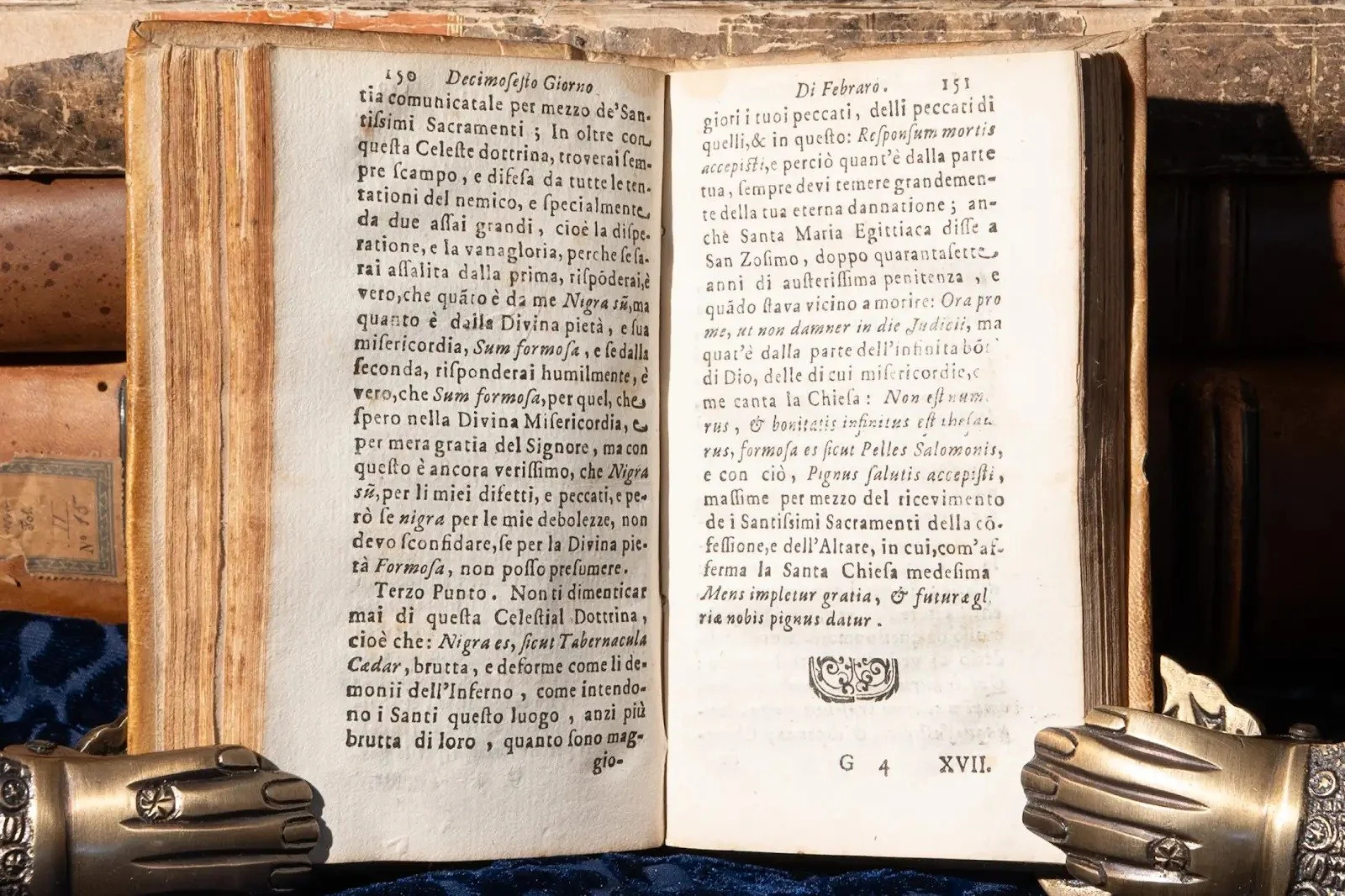 Image 11 of 30
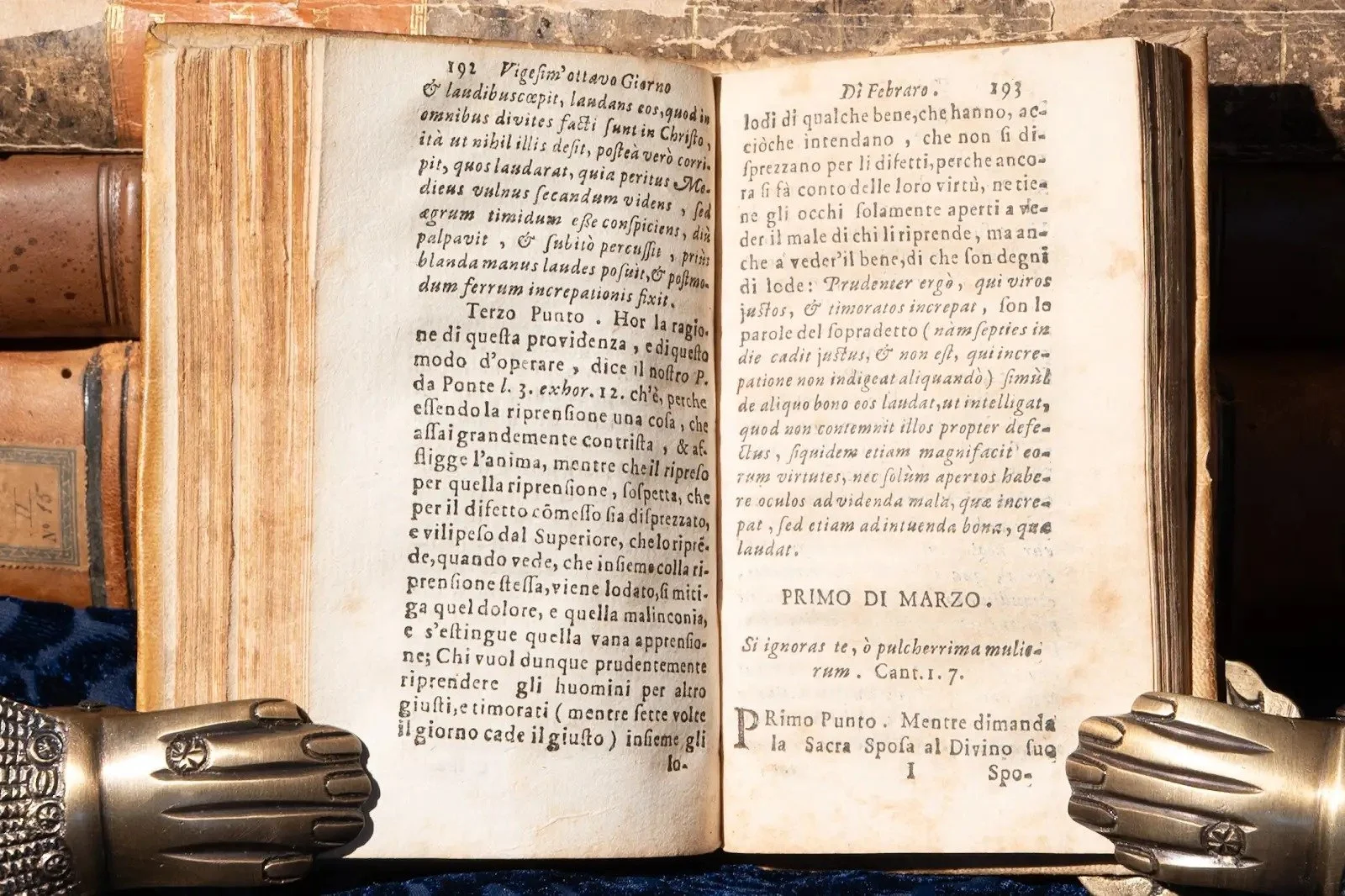 Image 12 of 30
 Image 13 of 30
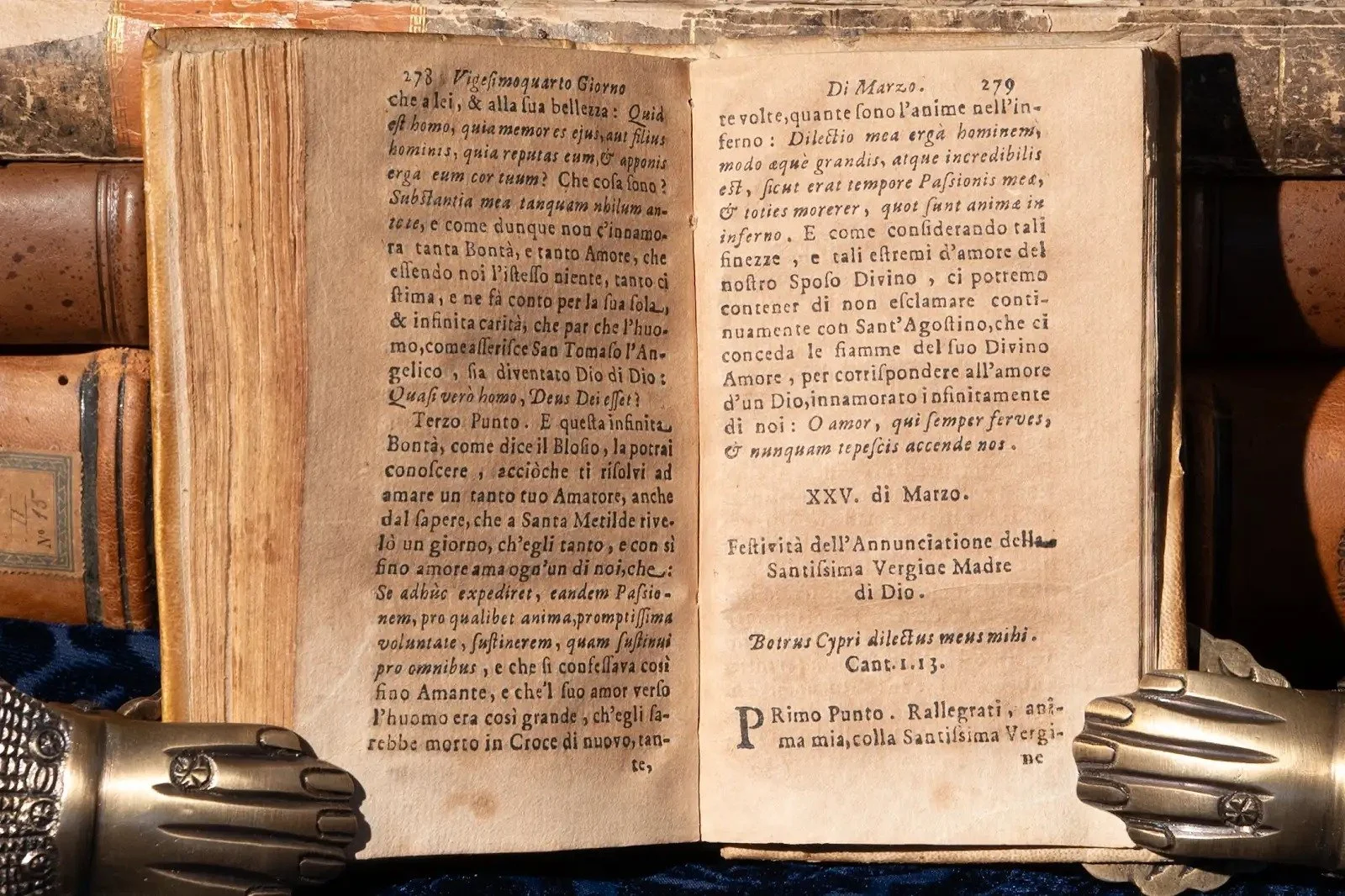 Image 14 of 30
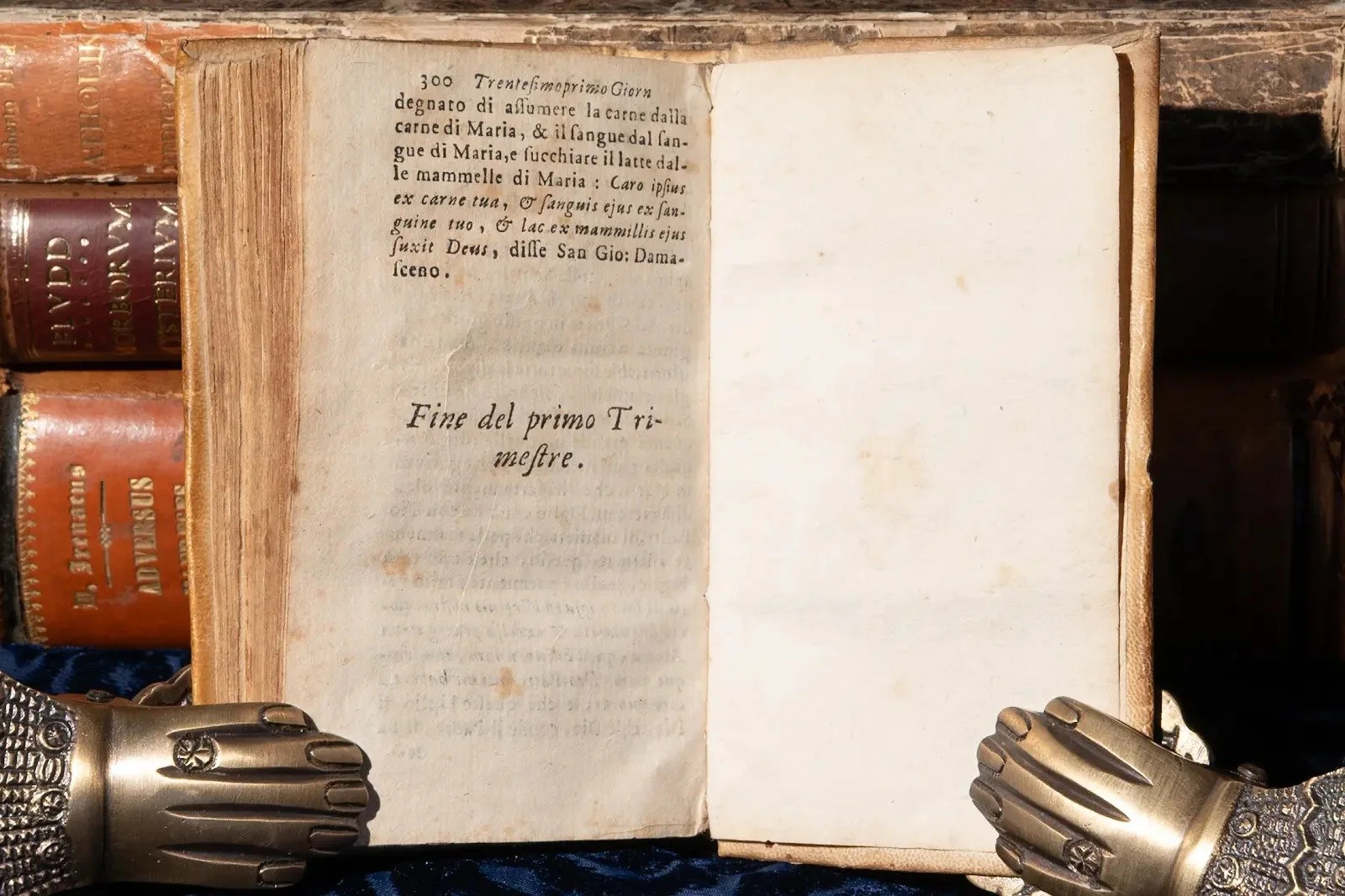 Image 15 of 30
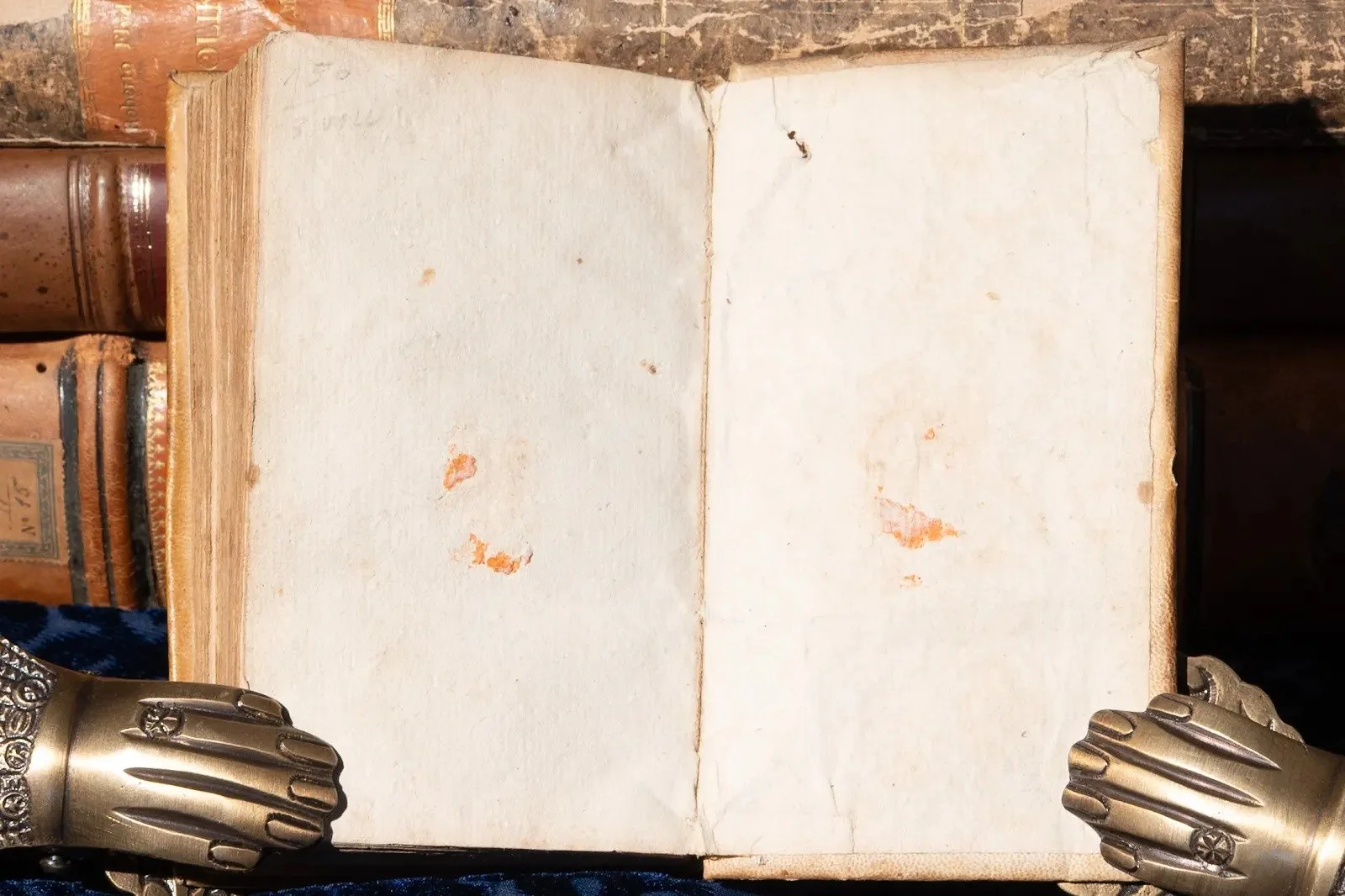 Image 16 of 30
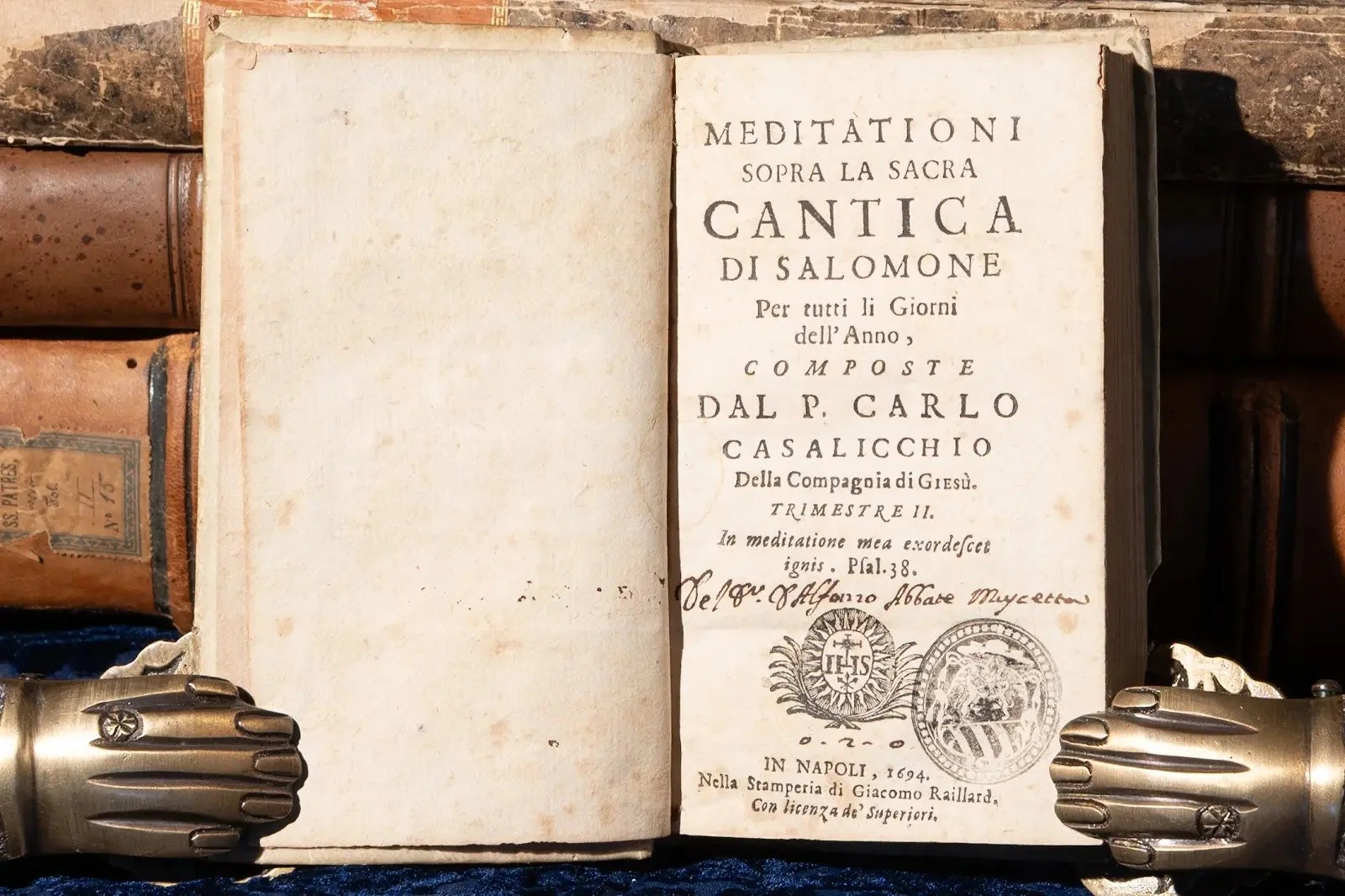 Image 17 of 30
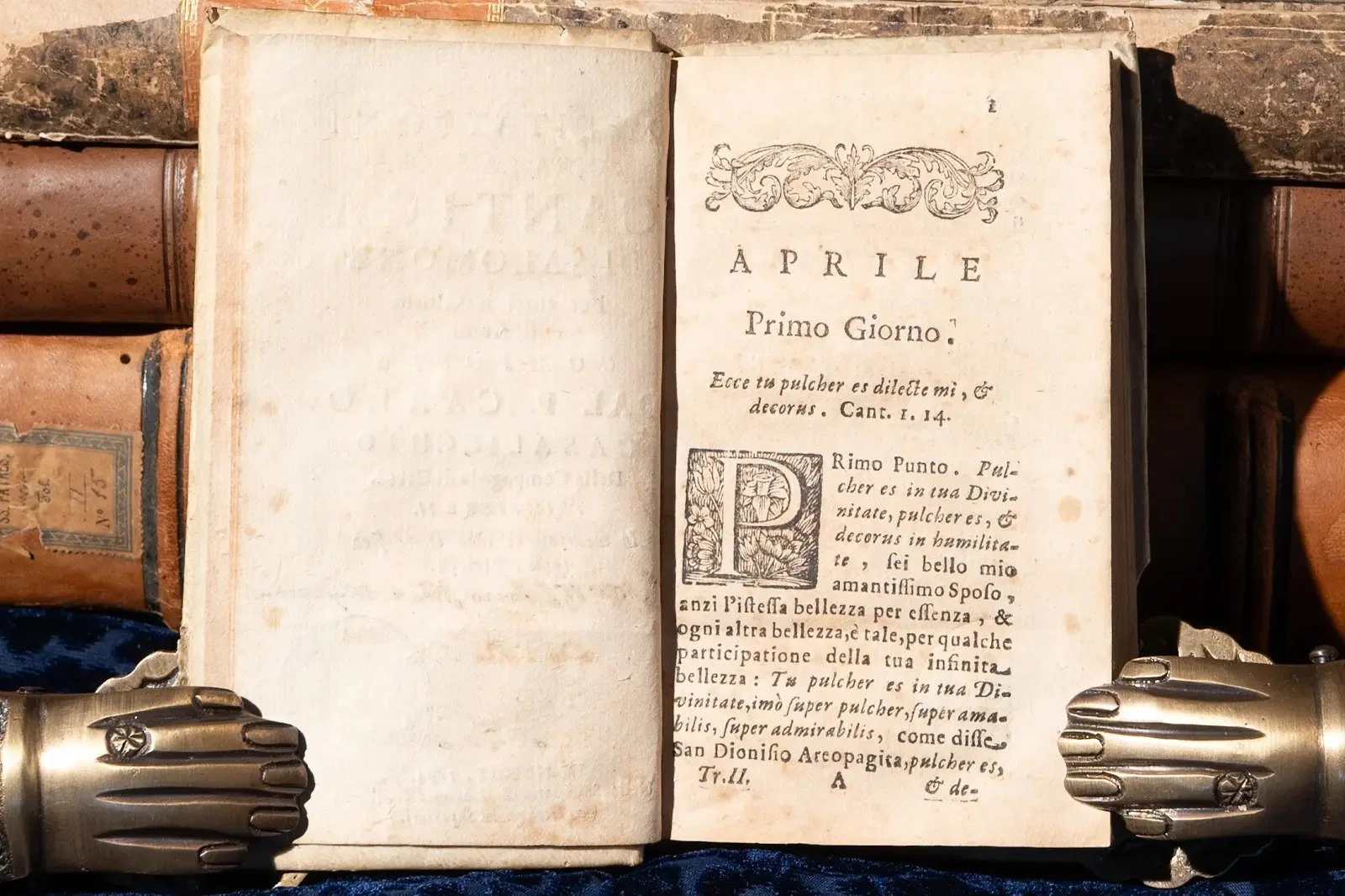 Image 18 of 30
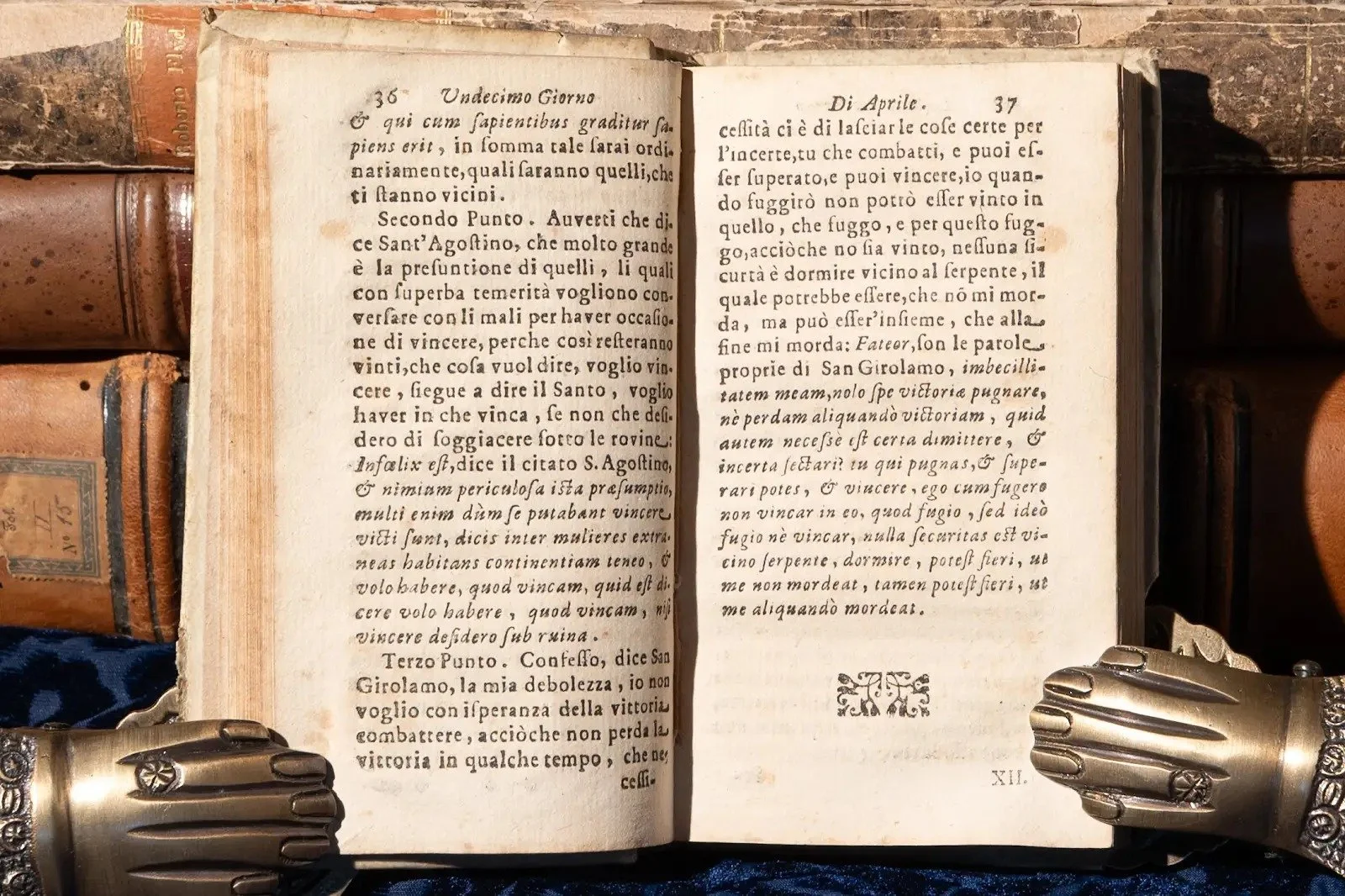 Image 19 of 30
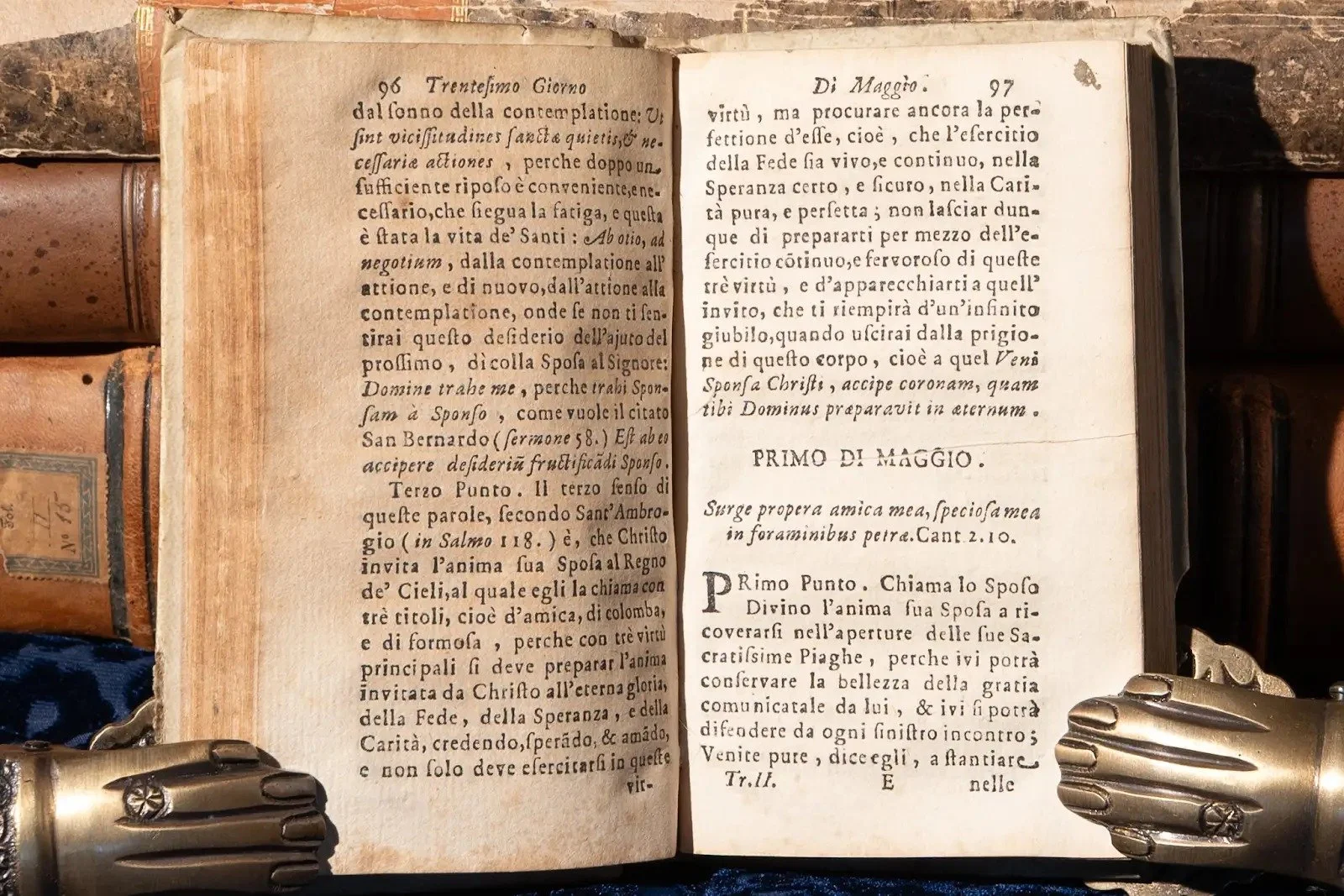 Image 20 of 30
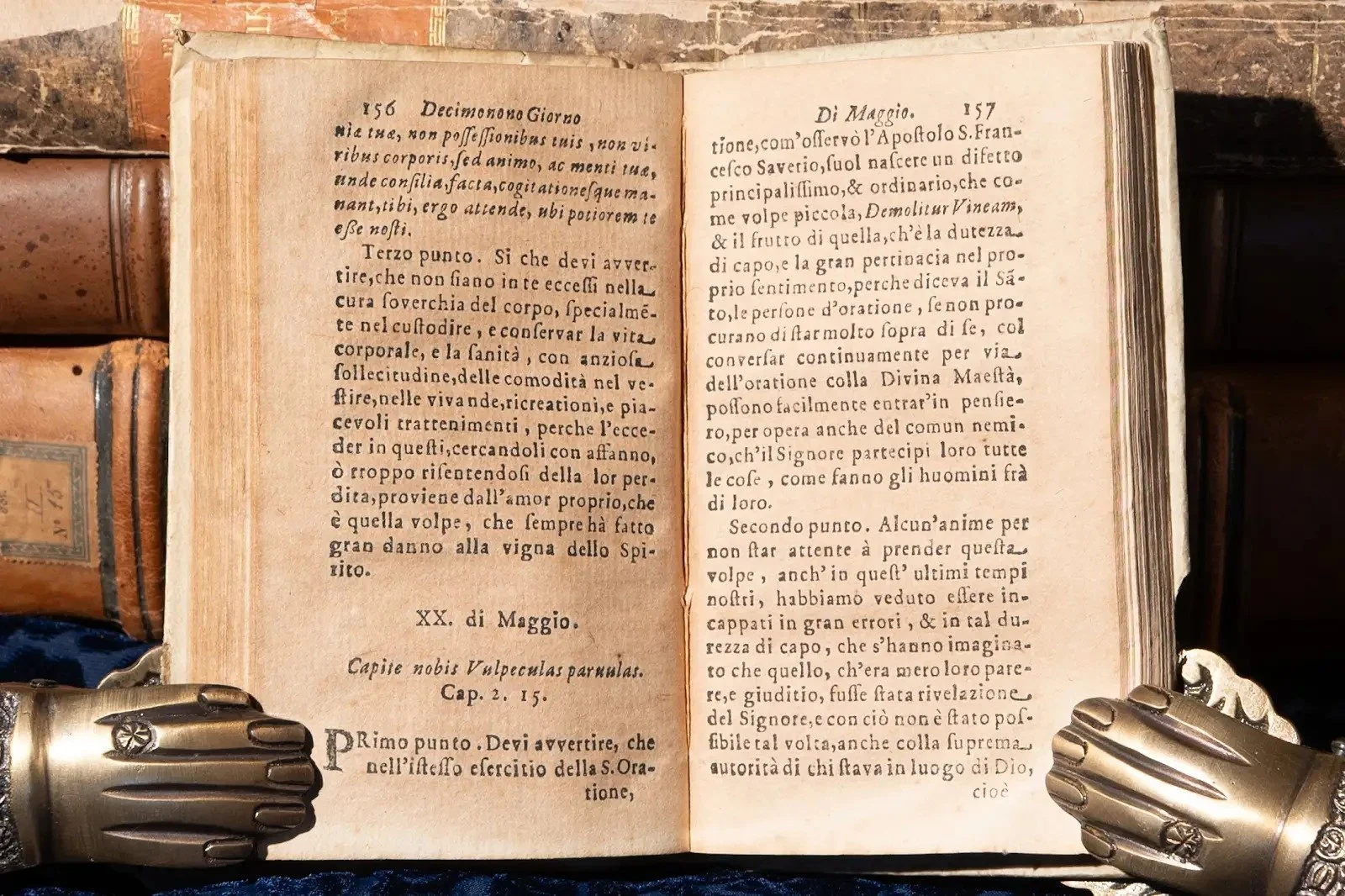 Image 21 of 30
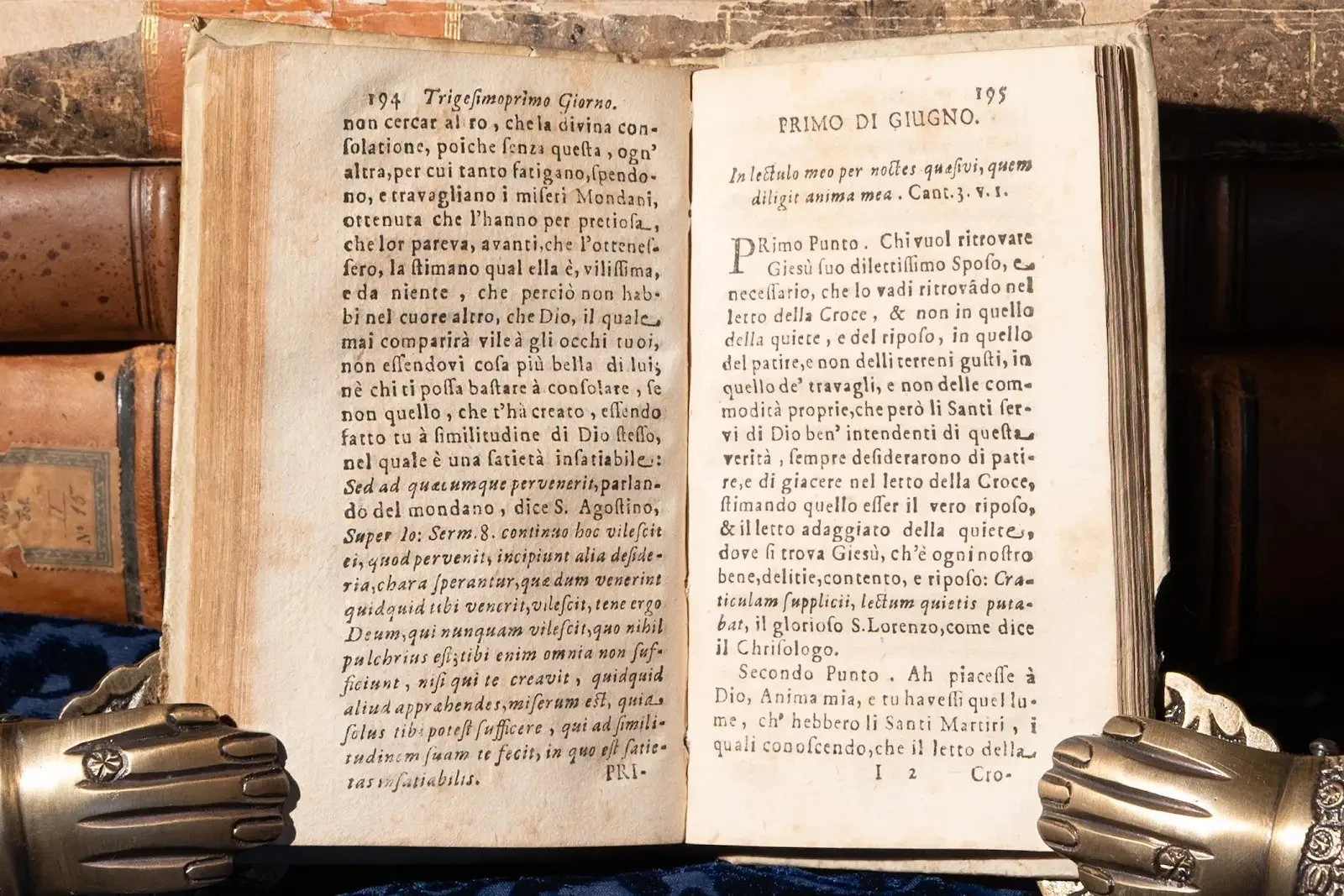 Image 22 of 30
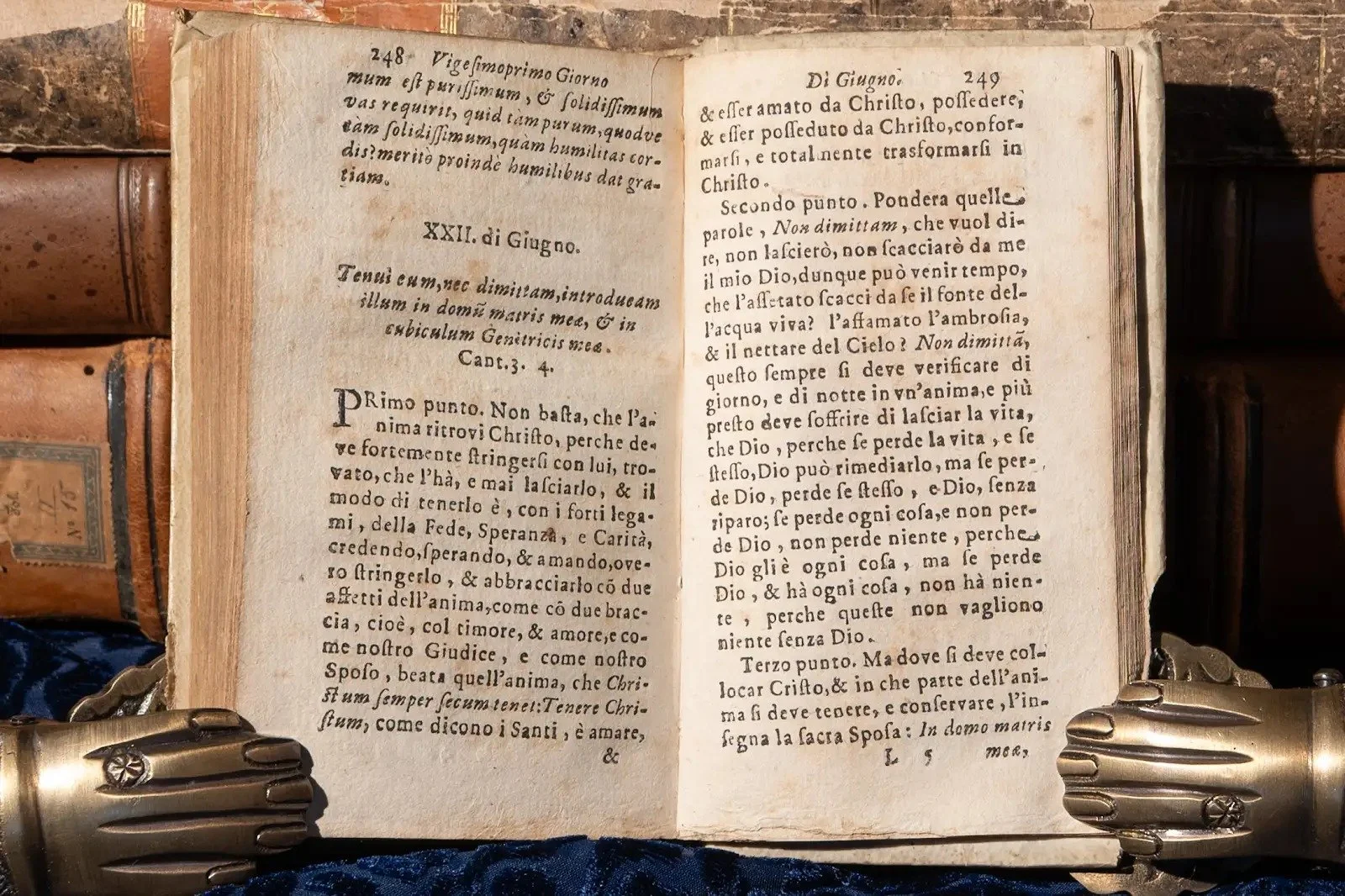 Image 23 of 30
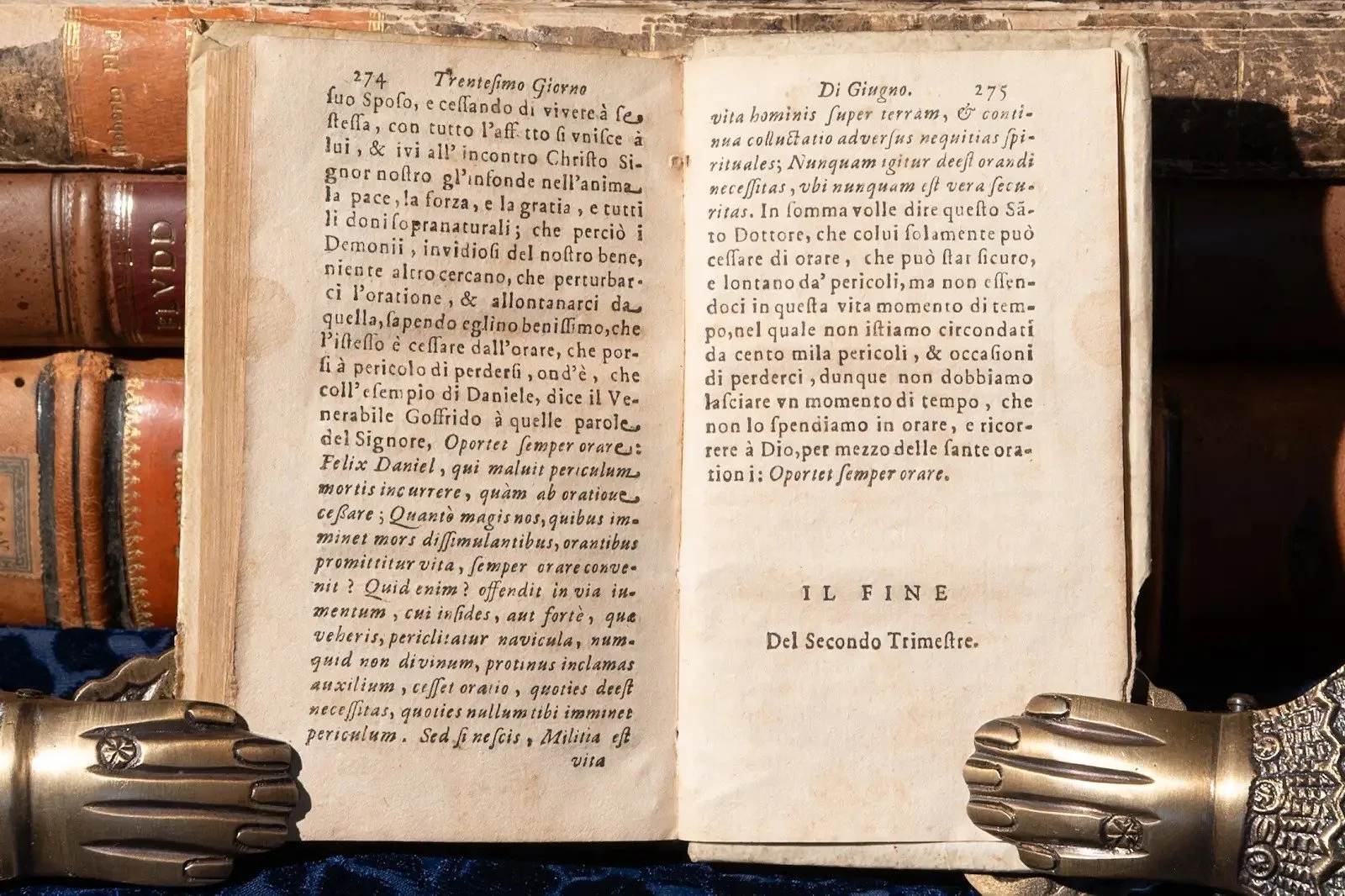 Image 24 of 30
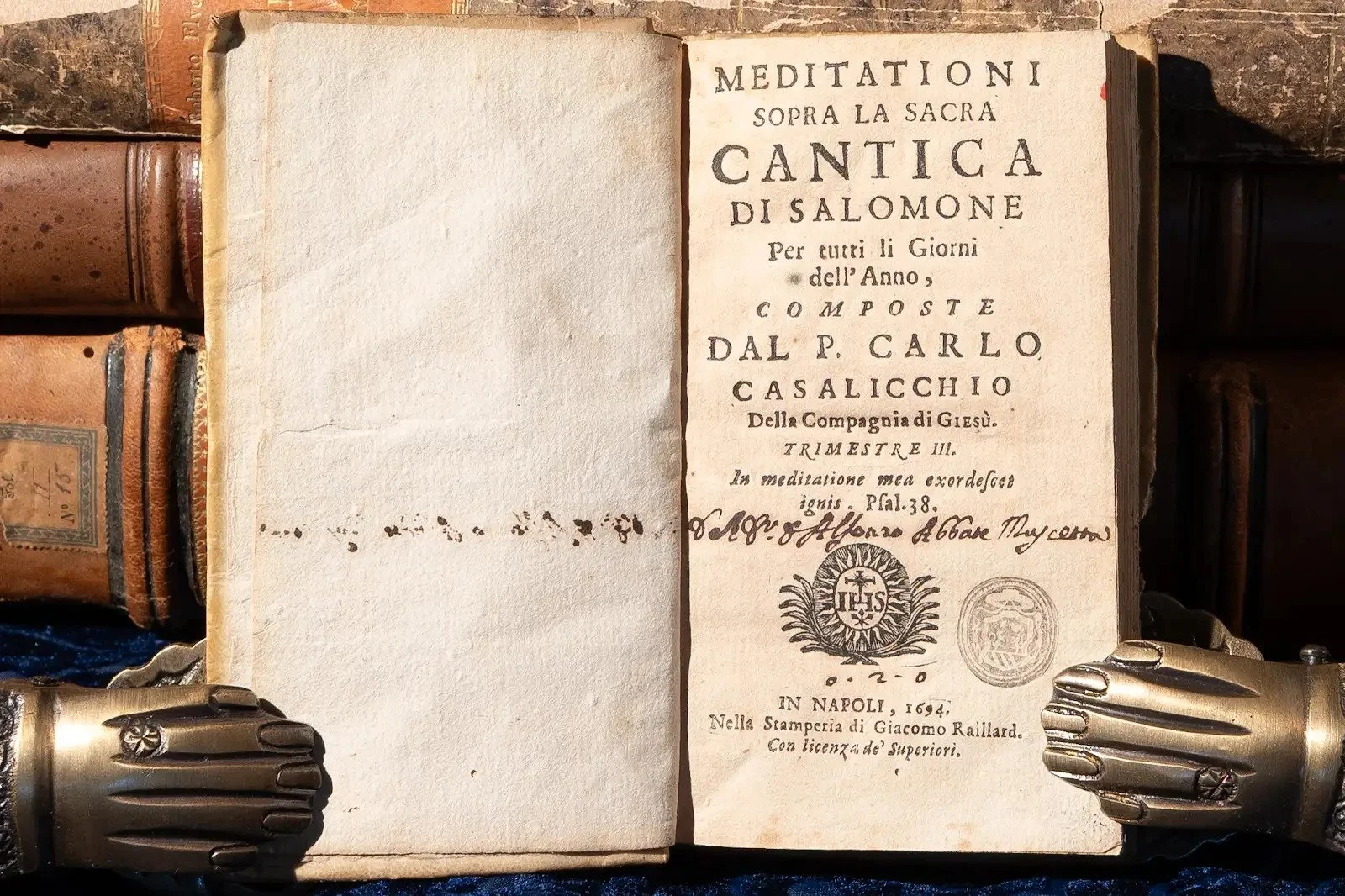 Image 25 of 30
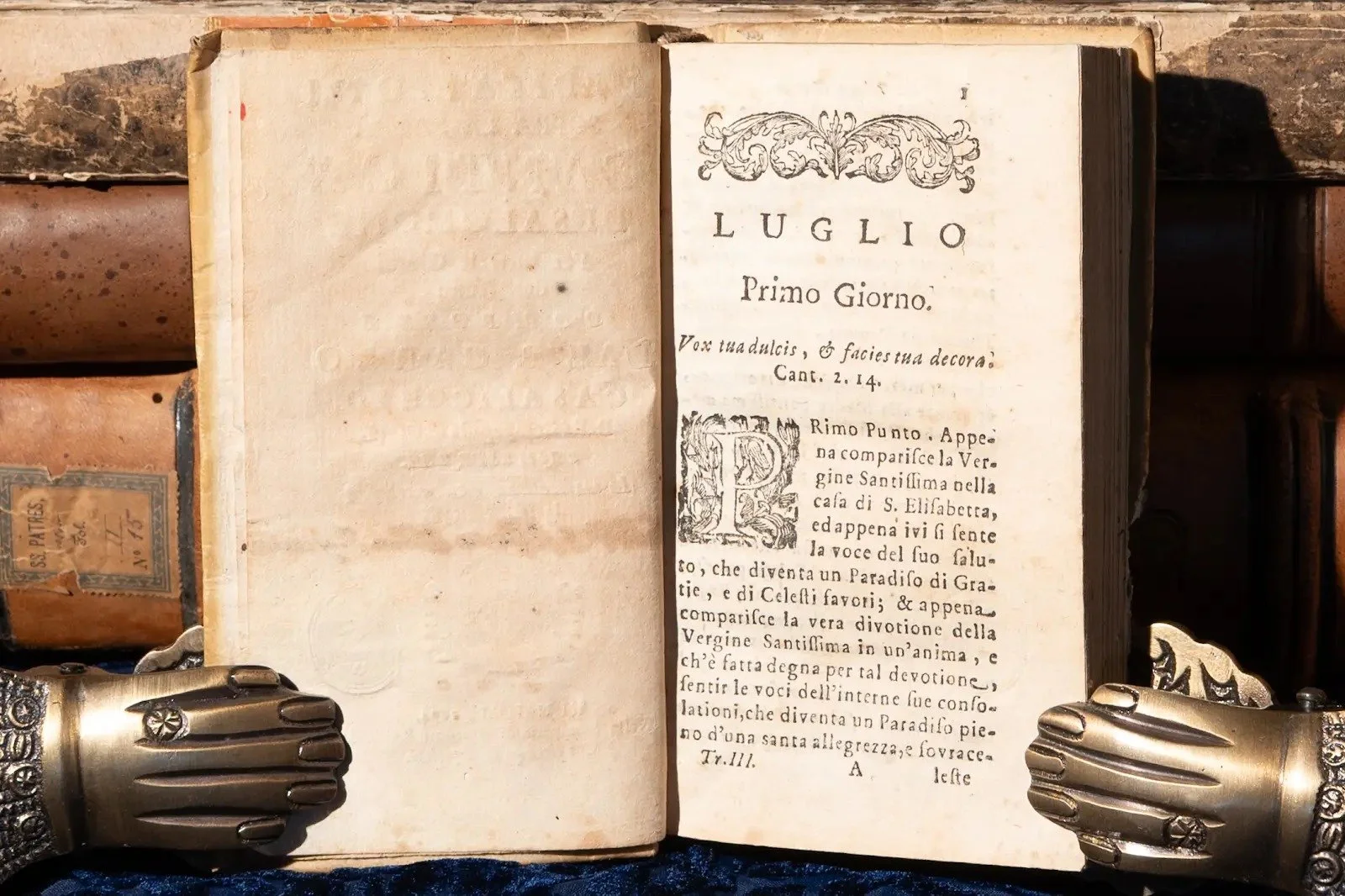 Image 26 of 30
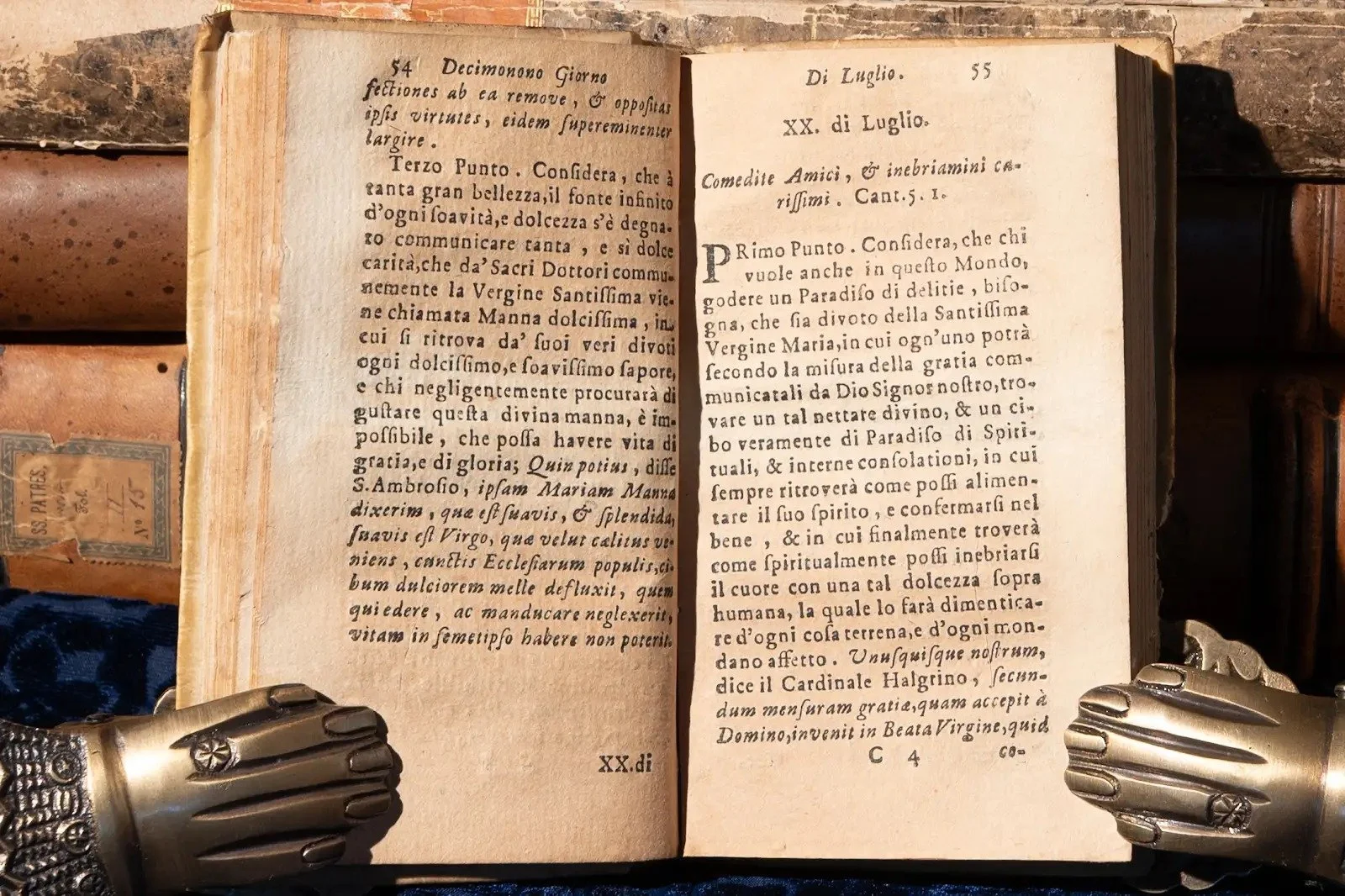 Image 27 of 30
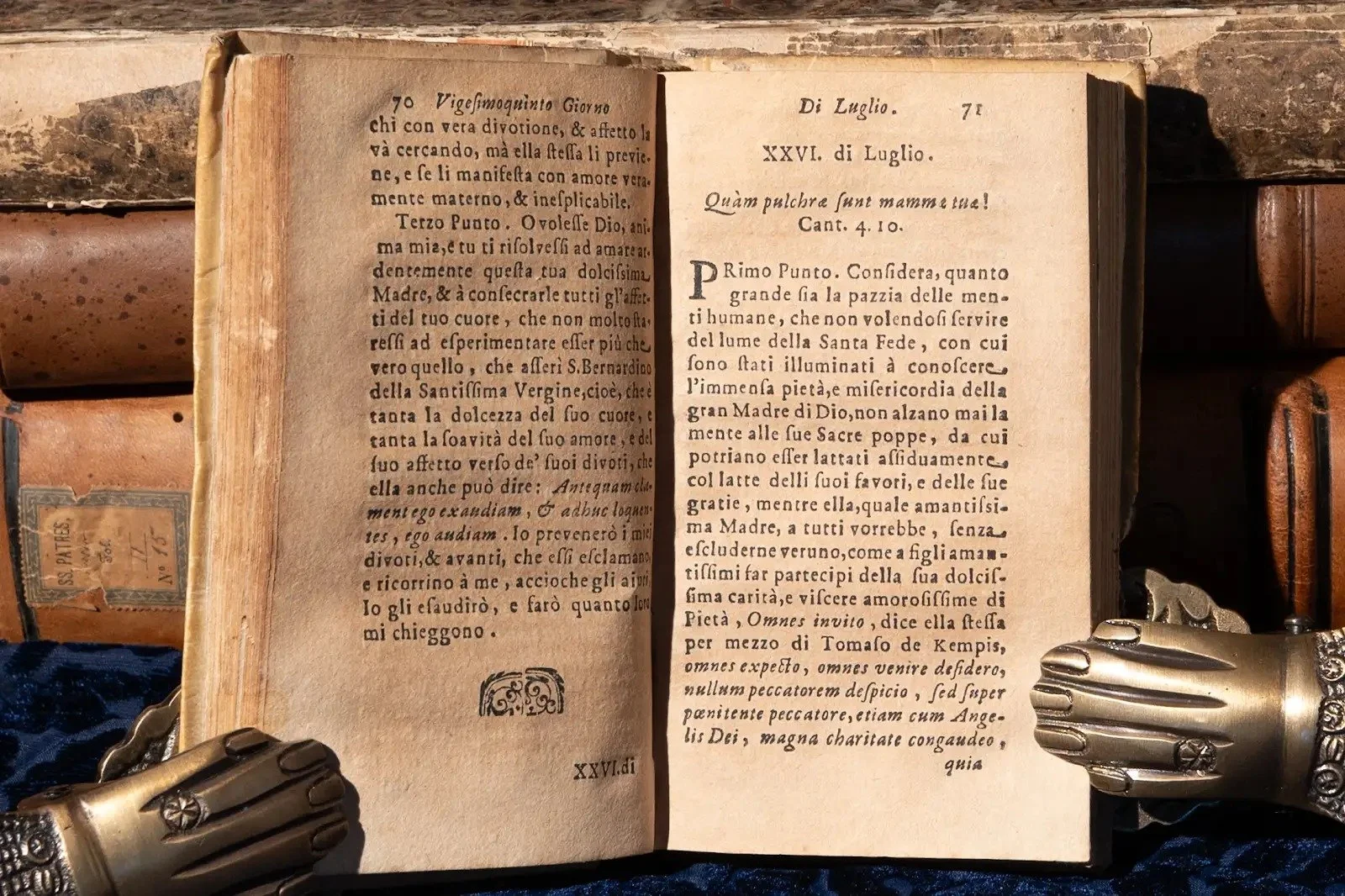 Image 28 of 30
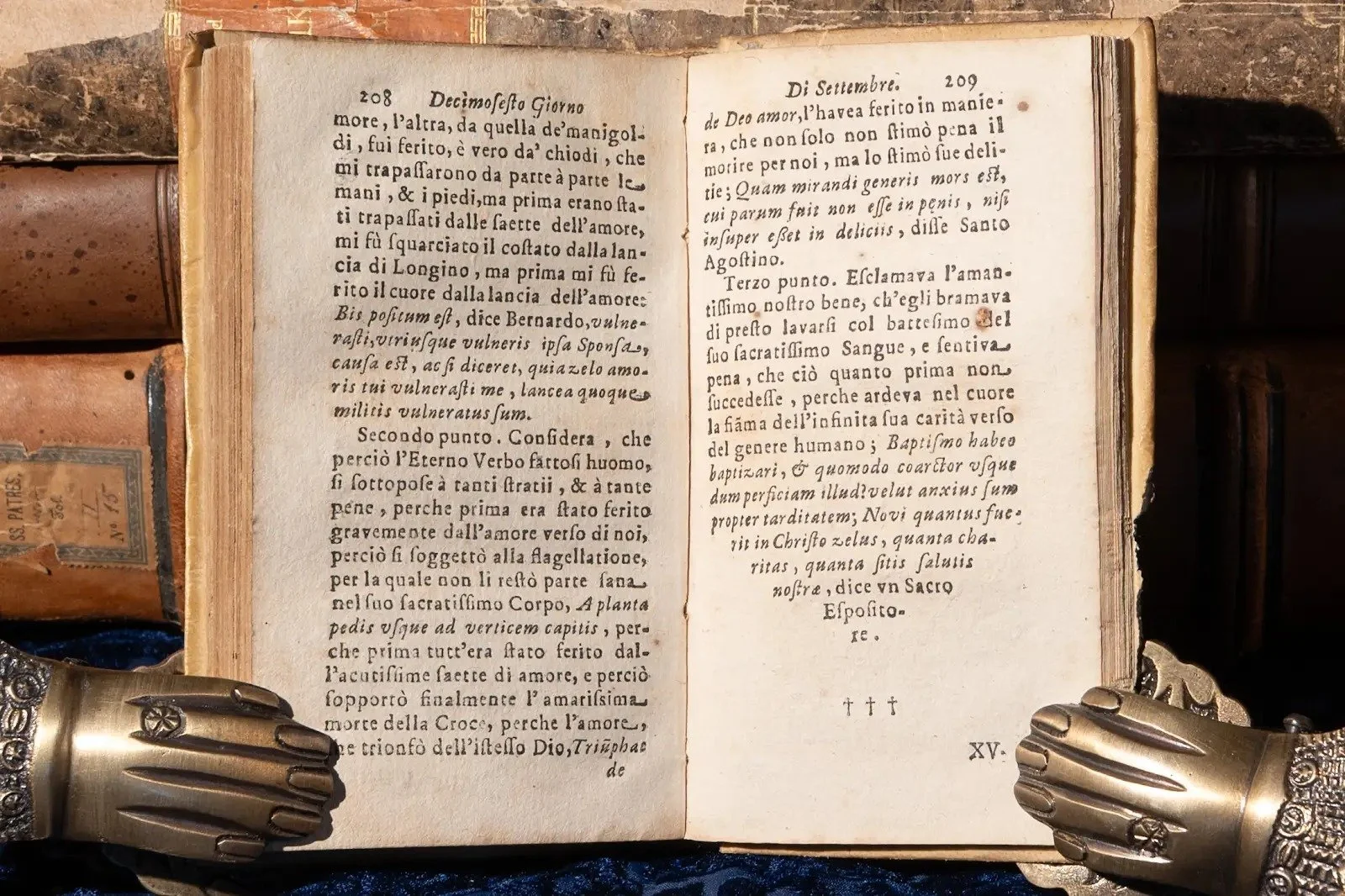 Image 29 of 30
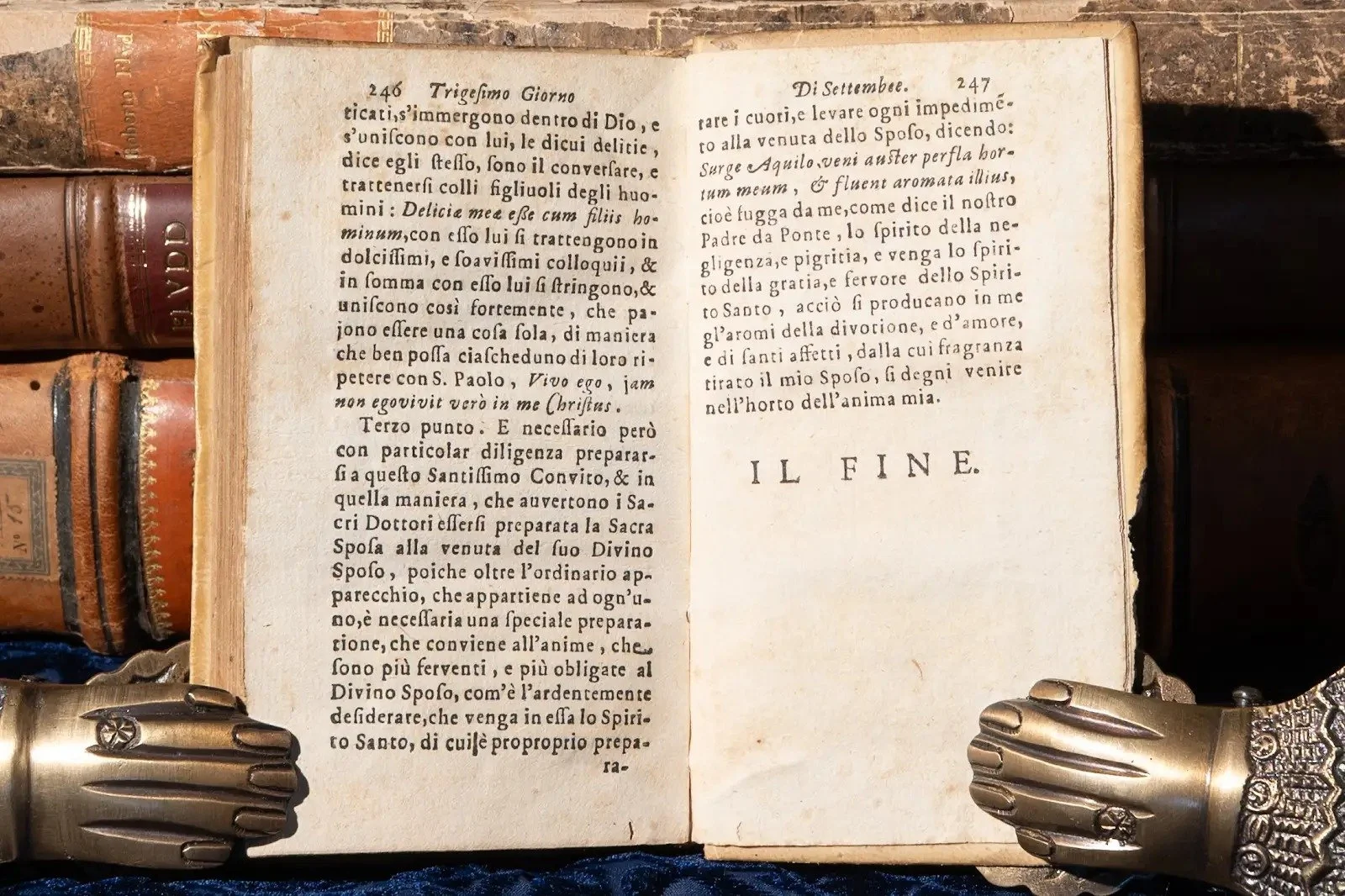 Image 30 of 30