From the Library of "The Last Viking"
Front pastedown bears the armorial bookplate of Leonard Fredrik Rääf (1786–1872), the legendary Swedish folklorist, politician, and cultural historian known as "Ydre-drotten" (The Chieftain of Ydre). The bookplate features his canting arms: a visual pun on his surname, which means "Fox" in Swedish.
Rääf was no mere antiquarian. He was a radical practitioner of cultural resurrection, zealously collecting Scandinavian folklore, magic traditions, and vernacular divination practices in an attempt to preserve, and live, the "old ways." His devotion was so extreme that he rejected Christian burial entirely, requesting instead to be interred in a constructed Viking-style burial mound on his estate at Rydboholm. And so he was: Sweden's last "pagan" burial, complete with runic inscriptions.
This volume of chiromancy, onychomancy, and moleosophy likely served as a working reference for Rääf's studies into pre-Christian Nordic divination systems. The presence of a German medical-astrological text in his library suggests he was researching the pan-European roots of body-reading traditions that survived in Scandinavian folk practice. To own a book from Rääf's collection is to own an artifact from someone who attempted to literally resurrect the pre-modern worldview.
While titled Chiromantia et Physiognomia Medica, Philipp May's 1691 treatise goes far beyond standard palmistry, attempting to systematize the diagnostic and divinatory potential of bodily signs. May blurs the line between physician and seer, arguing that markings on the body are direct indicators of humoral health, temperament, and fate.
The work's most significant contribution, and its rarity, lies in the extensive appendix on Onychomancy (von den Zeichen auff den Nägeln der Finger): the art of divination by fingernail markings. While general palmistry was ubiquitous in the 17th century, treatises specifically detailing the meaning of spots, shapes, moons, and "clouds" on the fingernails are significantly scarcer.
The copperplate engravings dedicated to this section are stunning examples of Baroque esoteric diagramming: hands with fingers outstretched, each nail marked with alchemical symbols, planetary sigils, and interpretive keys. These plates transform the mundane fingernail into a miniature cosmological map: a microcosm reflecting celestial influences.
Moleosophy & Planetary Correspondence: May also includes detailed instructions for divination by moles, warts, and facial marks (von den Wartzen und Flecken in dem Angesicht), interpreting these blemishes through planetary correspondence and astrological houses. Each mark on the body becomes a text to be read, a sign of destiny written in flesh.
The red and black title page advertises this edition as containing May's "never before printed Chiromantia curiosa" and being "newly arranged and increased," suggesting this is the preferred, expanded edition over earlier versions.
The Plates: A Gallery of Baroque Occult Anatomy
The 17 full-page copperplate engravings include:
-Chiromantic hands with detailed line systems and planetary attributions
-Physiognomic facial diagrams correlating features to temperament
-Onychomantic fingernails marked with symbols and interpretive schemas
-Moleosophy charts mapping the body's surface as divinatory terrain
These images represent the Baroque impulse to systematize and visualize the invisible: to make the occult legible through scientific-style diagrams.
Published in 1691, this work appears at a critical juncture: late enough that Cartesian mechanism was challenging the old correspondences, but early enough that medical astrology still dominated clinical practice. May's attempt to ground divination in observable bodily phenomena reflects the period's anxiety about empiricism: trying to make palmistry "scientific" even as science was abandoning such frameworks.
For students of Western Esotericism, this represents the moment when occult knowledge began its migration from medical faculties to popular grimoires and fortune-tellers' tents. What was once taught at universities would soon become "mere superstition."
MAY, Philipp (MÄYENS, Philippi). Chiromantia et Physiognomia Medica, Mit Einem Anhange von den Zeichen auff den Nägeln der Finger, it. von den Wartzen und Flecken in dem Angesicht, wie auch dessen noch nie in Druck gekommene Chiromantia curiosa. Dresden & Leipzig: Verlegts Johann Christoph Mieth, Druckts Christian Banckmann, 1691. "The Fox's Grimoire": From the Library of the Last Viking: A Baroque Manual of Body Divination. Small Octavo (17 x 11 cm). [4], 197 pp., [4 leaves, index]. Illustrated with 17 full-page copperplate engravings depicting chiromantic hands marked with planetary signs, physiognomic facial diagrams, and the rare fingernail divination charts. Title page printed in red and black. Bound in contemporary half-vellum over marbled paper boards with manuscript ink title to spine.
From the Library of "The Last Viking"
Front pastedown bears the armorial bookplate of Leonard Fredrik Rääf (1786–1872), the legendary Swedish folklorist, politician, and cultural historian known as "Ydre-drotten" (The Chieftain of Ydre). The bookplate features his canting arms: a visual pun on his surname, which means "Fox" in Swedish.
Rääf was no mere antiquarian. He was a radical practitioner of cultural resurrection, zealously collecting Scandinavian folklore, magic traditions, and vernacular divination practices in an attempt to preserve, and live, the "old ways." His devotion was so extreme that he rejected Christian burial entirely, requesting instead to be interred in a constructed Viking-style burial mound on his estate at Rydboholm. And so he was: Sweden's last "pagan" burial, complete with runic inscriptions.
This volume of chiromancy, onychomancy, and moleosophy likely served as a working reference for Rääf's studies into pre-Christian Nordic divination systems. The presence of a German medical-astrological text in his library suggests he was researching the pan-European roots of body-reading traditions that survived in Scandinavian folk practice. To own a book from Rääf's collection is to own an artifact from someone who attempted to literally resurrect the pre-modern worldview.
While titled Chiromantia et Physiognomia Medica, Philipp May's 1691 treatise goes far beyond standard palmistry, attempting to systematize the diagnostic and divinatory potential of bodily signs. May blurs the line between physician and seer, arguing that markings on the body are direct indicators of humoral health, temperament, and fate.
The work's most significant contribution, and its rarity, lies in the extensive appendix on Onychomancy (von den Zeichen auff den Nägeln der Finger): the art of divination by fingernail markings. While general palmistry was ubiquitous in the 17th century, treatises specifically detailing the meaning of spots, shapes, moons, and "clouds" on the fingernails are significantly scarcer.
The copperplate engravings dedicated to this section are stunning examples of Baroque esoteric diagramming: hands with fingers outstretched, each nail marked with alchemical symbols, planetary sigils, and interpretive keys. These plates transform the mundane fingernail into a miniature cosmological map: a microcosm reflecting celestial influences.
Moleosophy & Planetary Correspondence: May also includes detailed instructions for divination by moles, warts, and facial marks (von den Wartzen und Flecken in dem Angesicht), interpreting these blemishes through planetary correspondence and astrological houses. Each mark on the body becomes a text to be read, a sign of destiny written in flesh.
The red and black title page advertises this edition as containing May's "never before printed Chiromantia curiosa" and being "newly arranged and increased," suggesting this is the preferred, expanded edition over earlier versions.
The Plates: A Gallery of Baroque Occult Anatomy
The 17 full-page copperplate engravings include:
-Chiromantic hands with detailed line systems and planetary attributions
-Physiognomic facial diagrams correlating features to temperament
-Onychomantic fingernails marked with symbols and interpretive schemas
-Moleosophy charts mapping the body's surface as divinatory terrain
These images represent the Baroque impulse to systematize and visualize the invisible: to make the occult legible through scientific-style diagrams.
Published in 1691, this work appears at a critical juncture: late enough that Cartesian mechanism was challenging the old correspondences, but early enough that medical astrology still dominated clinical practice. May's attempt to ground divination in observable bodily phenomena reflects the period's anxiety about empiricism: trying to make palmistry "scientific" even as science was abandoning such frameworks.
For students of Western Esotericism, this represents the moment when occult knowledge began its migration from medical faculties to popular grimoires and fortune-tellers' tents. What was once taught at universities would soon become "mere superstition."
MAY, Philipp (MÄYENS, Philippi). Chiromantia et Physiognomia Medica, Mit Einem Anhange von den Zeichen auff den Nägeln der Finger, it. von den Wartzen und Flecken in dem Angesicht, wie auch dessen noch nie in Druck gekommene Chiromantia curiosa. Dresden & Leipzig: Verlegts Johann Christoph Mieth, Druckts Christian Banckmann, 1691. "The Fox's Grimoire": From the Library of the Last Viking: A Baroque Manual of Body Divination. Small Octavo (17 x 11 cm). [4], 197 pp., [4 leaves, index]. Illustrated with 17 full-page copperplate engravings depicting chiromantic hands marked with planetary signs, physiognomic facial diagrams, and the rare fingernail divination charts. Title page printed in red and black. Bound in contemporary half-vellum over marbled paper boards with manuscript ink title to spine.

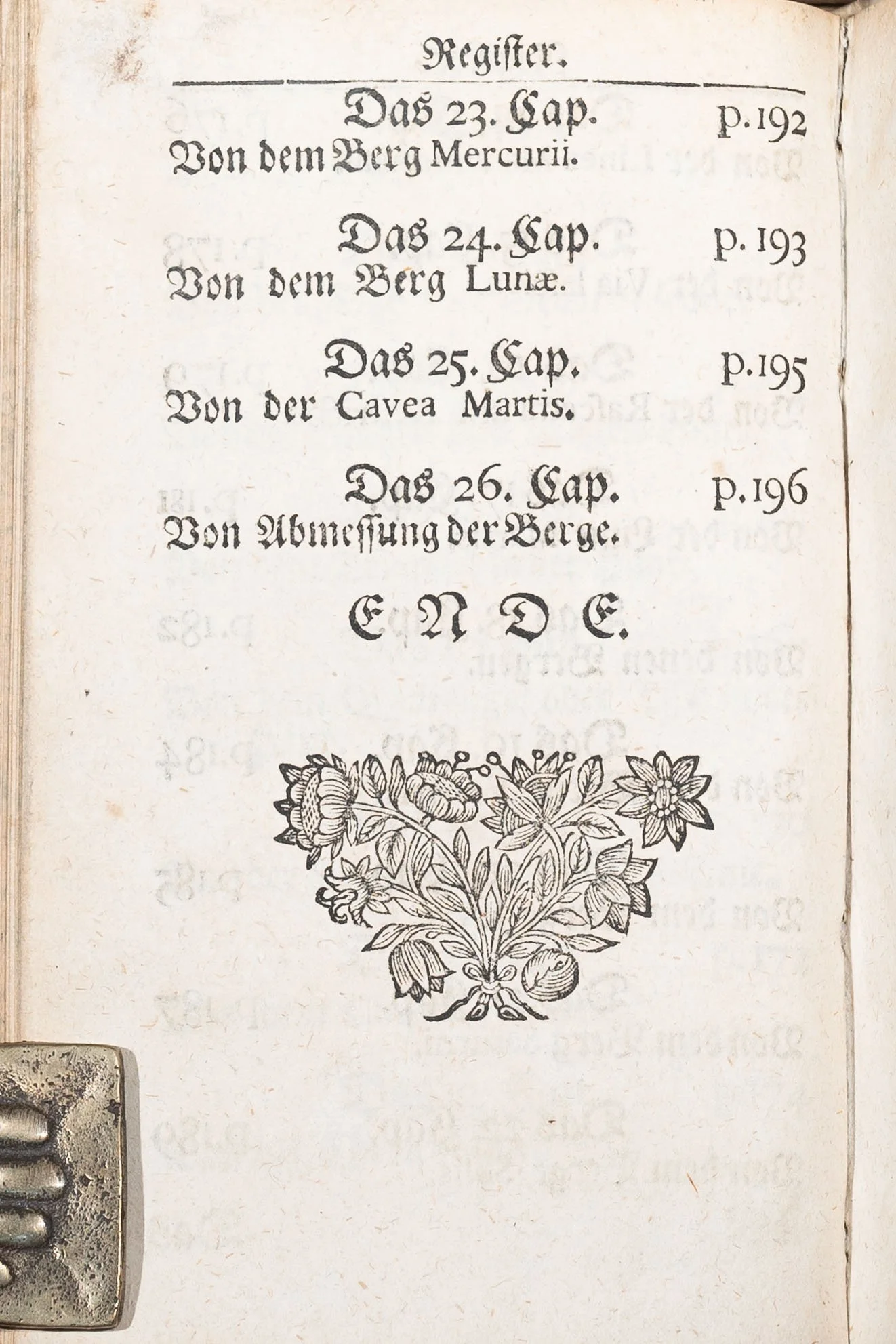 Image 1 of 9
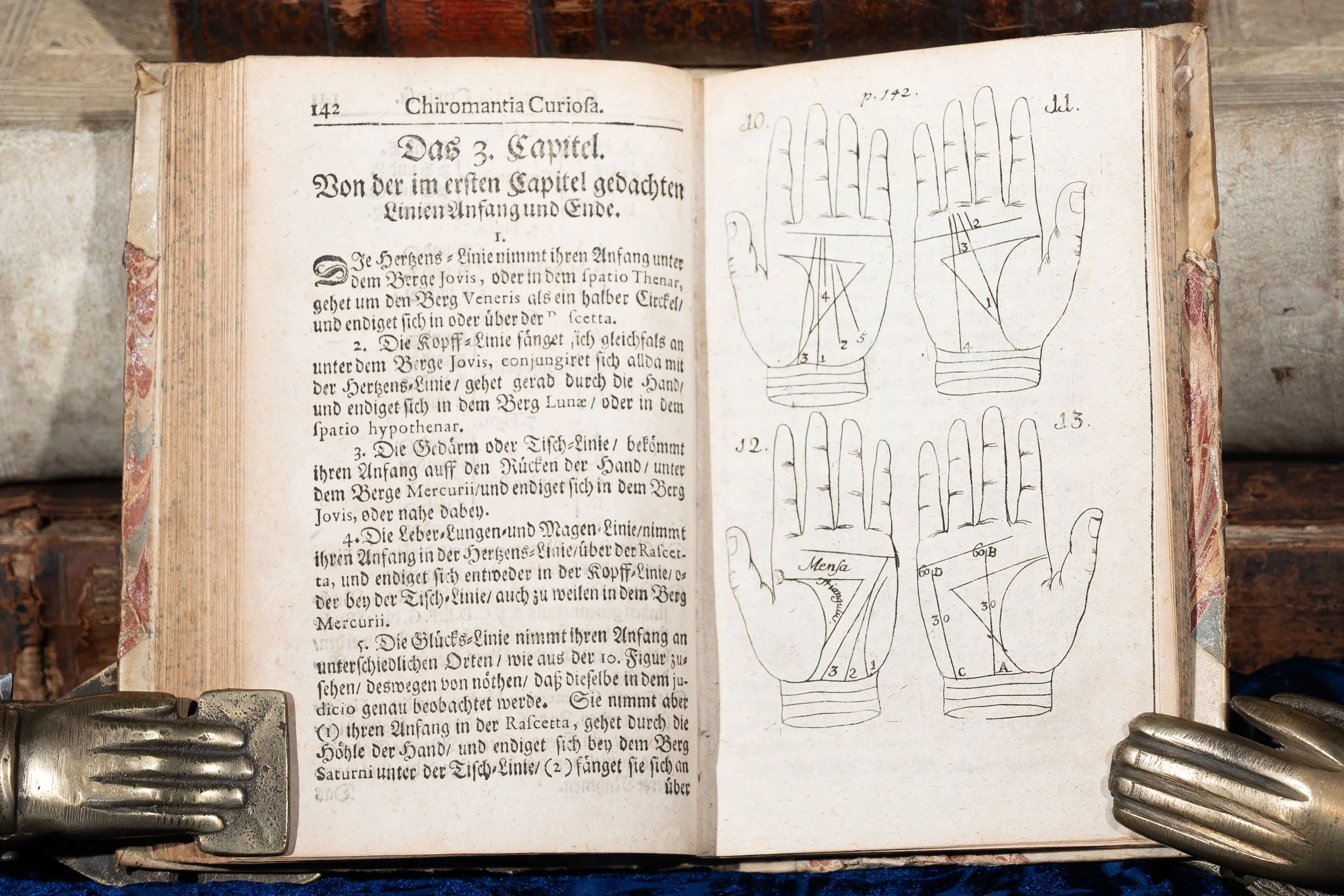 Image 2 of 9
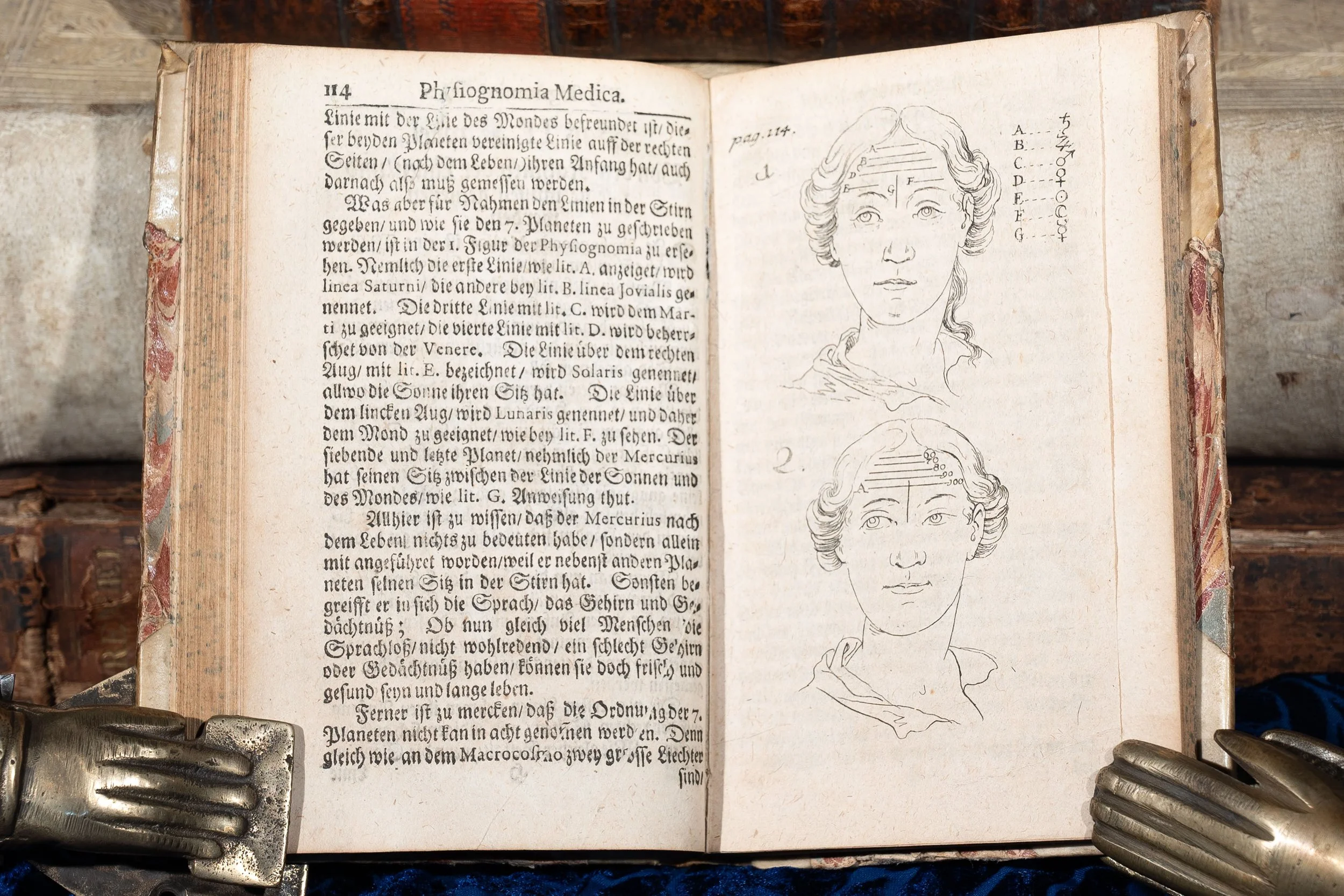 Image 3 of 9
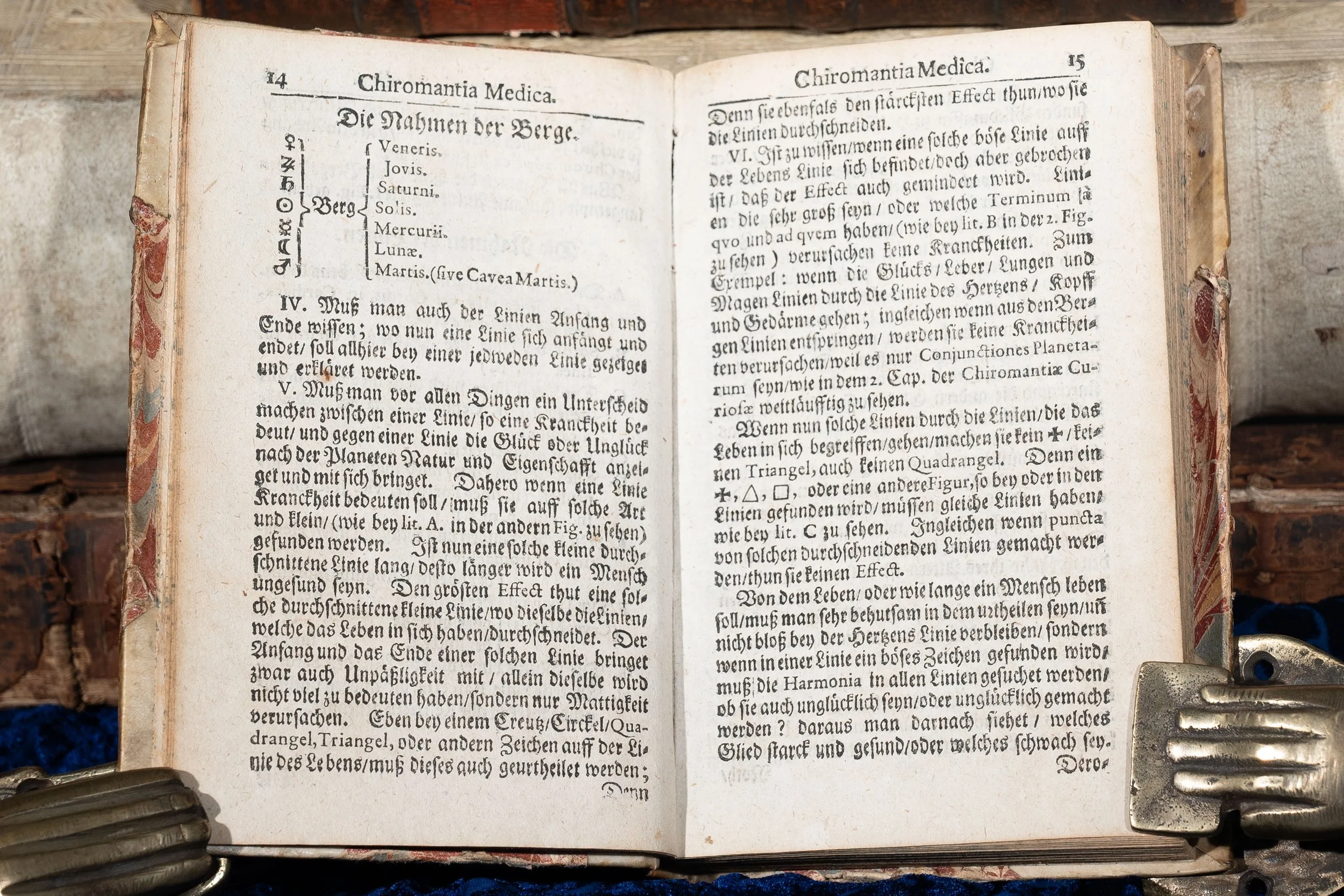 Image 4 of 9
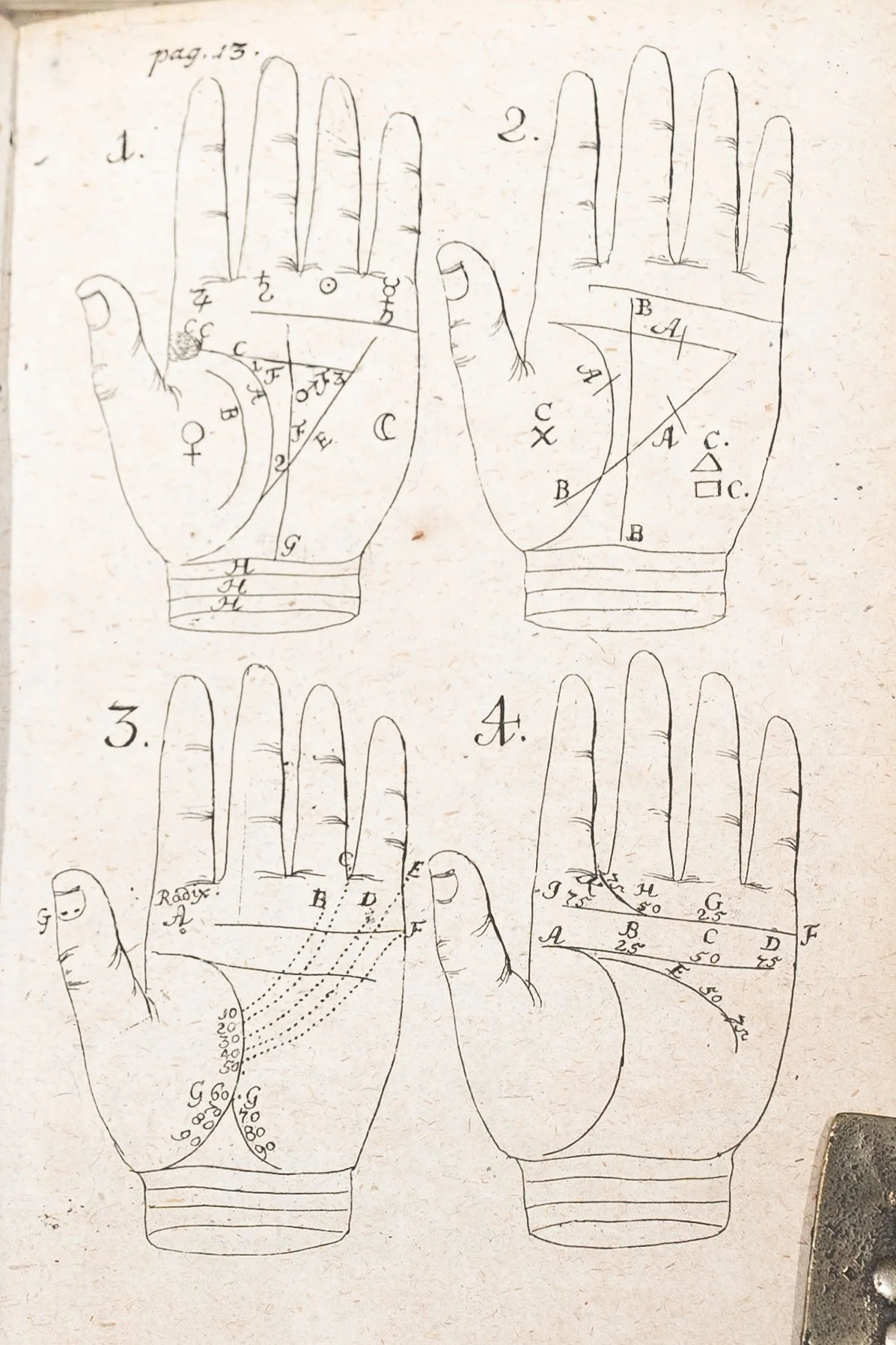 Image 5 of 9
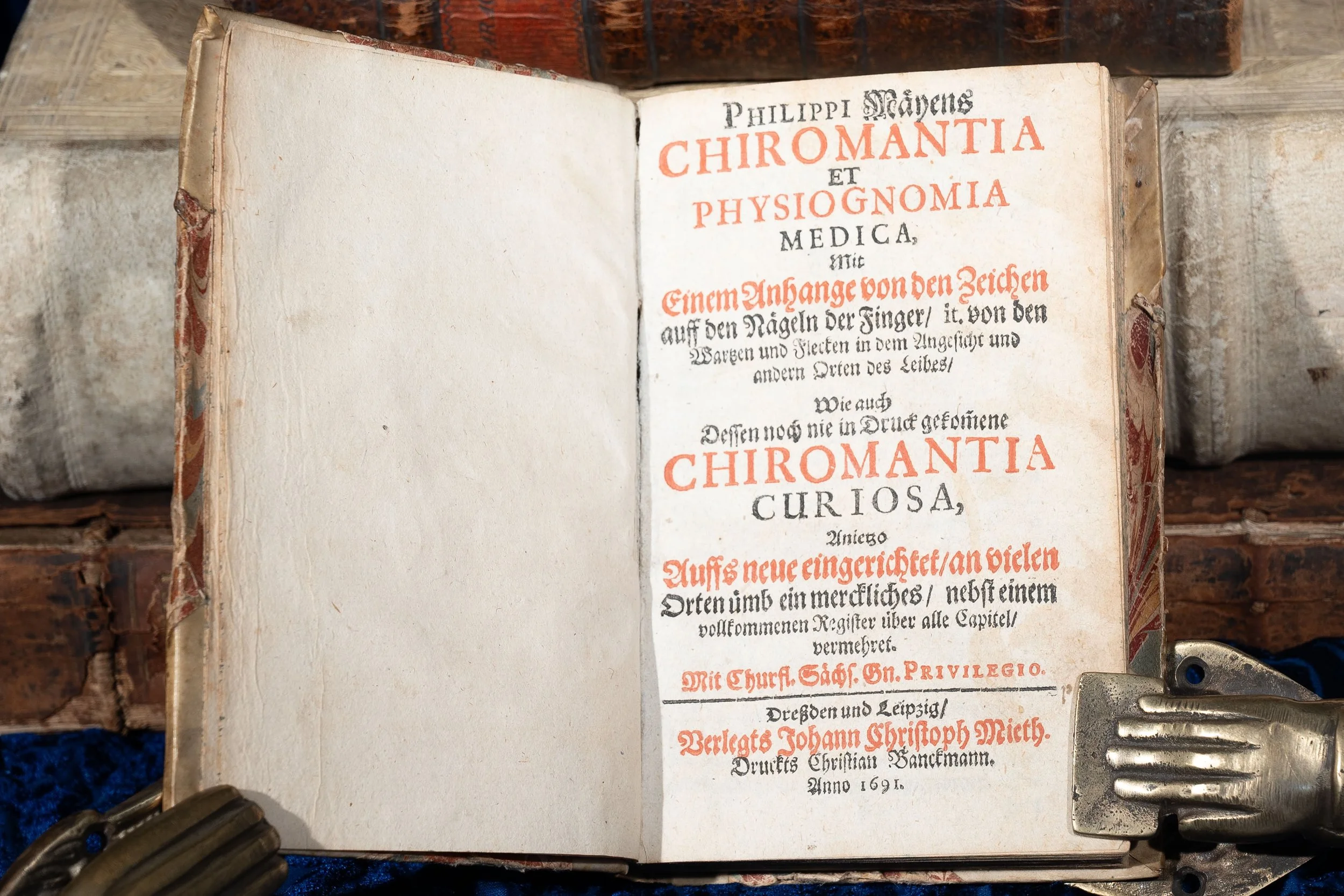 Image 6 of 9
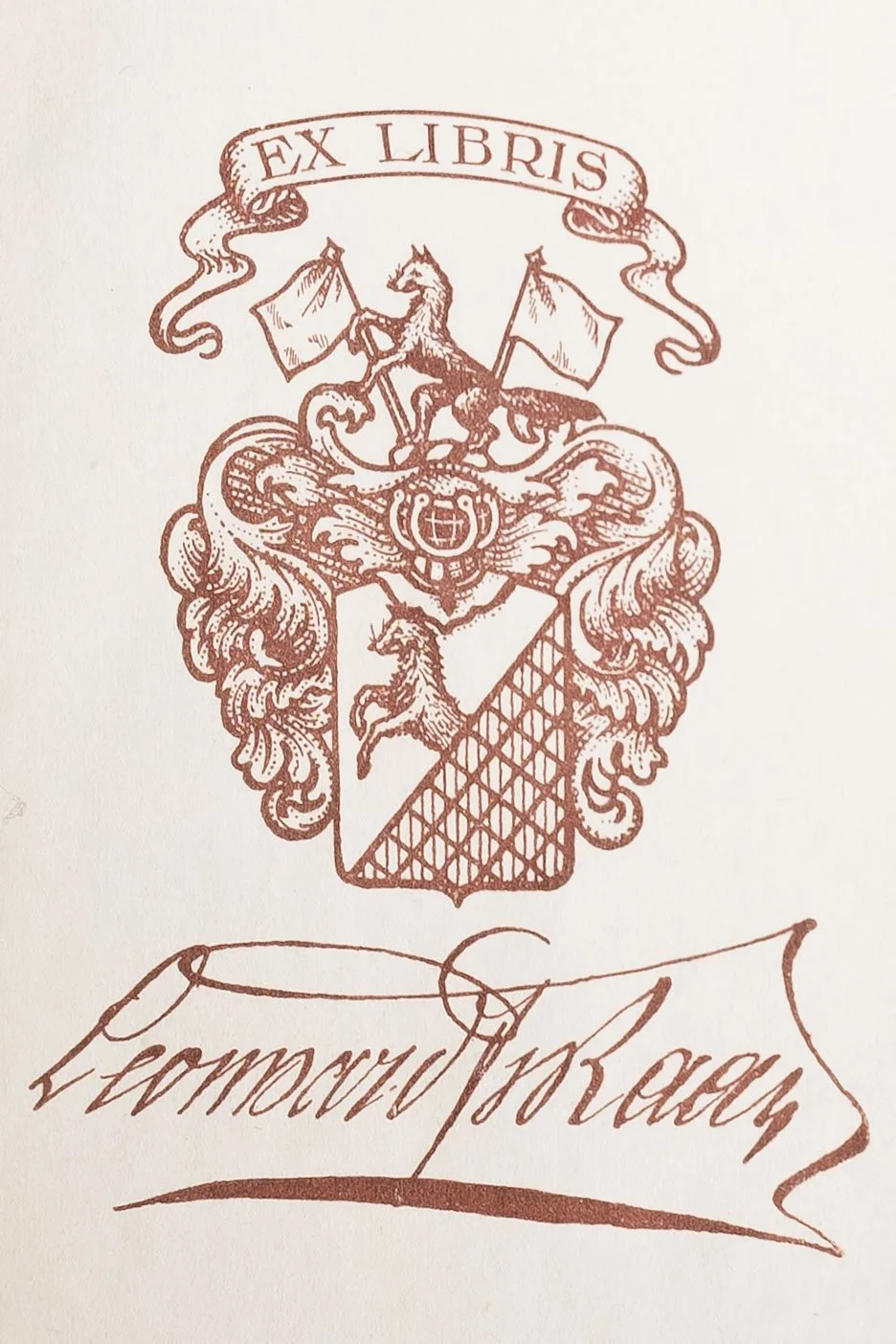 Image 7 of 9
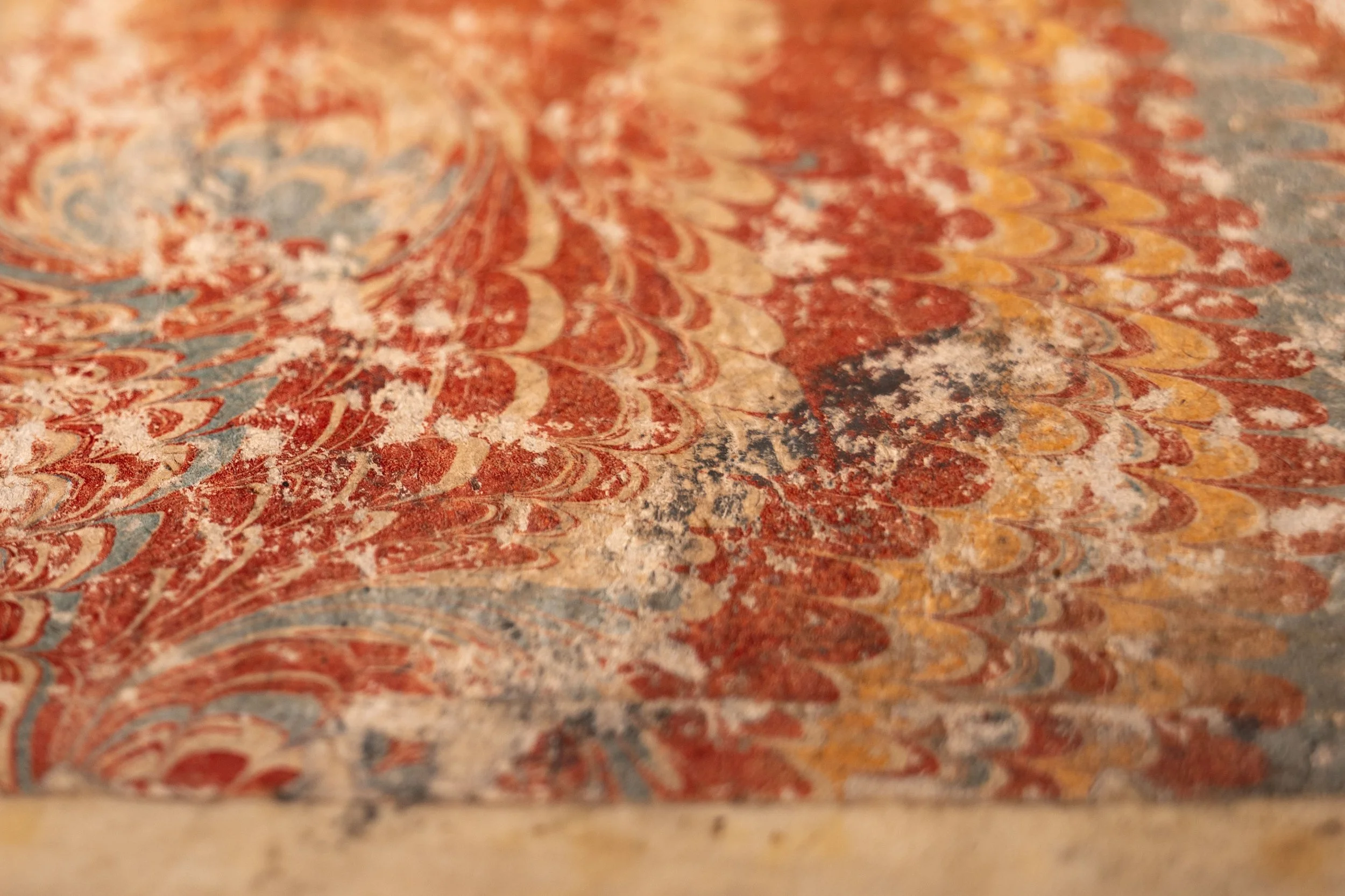 Image 8 of 9
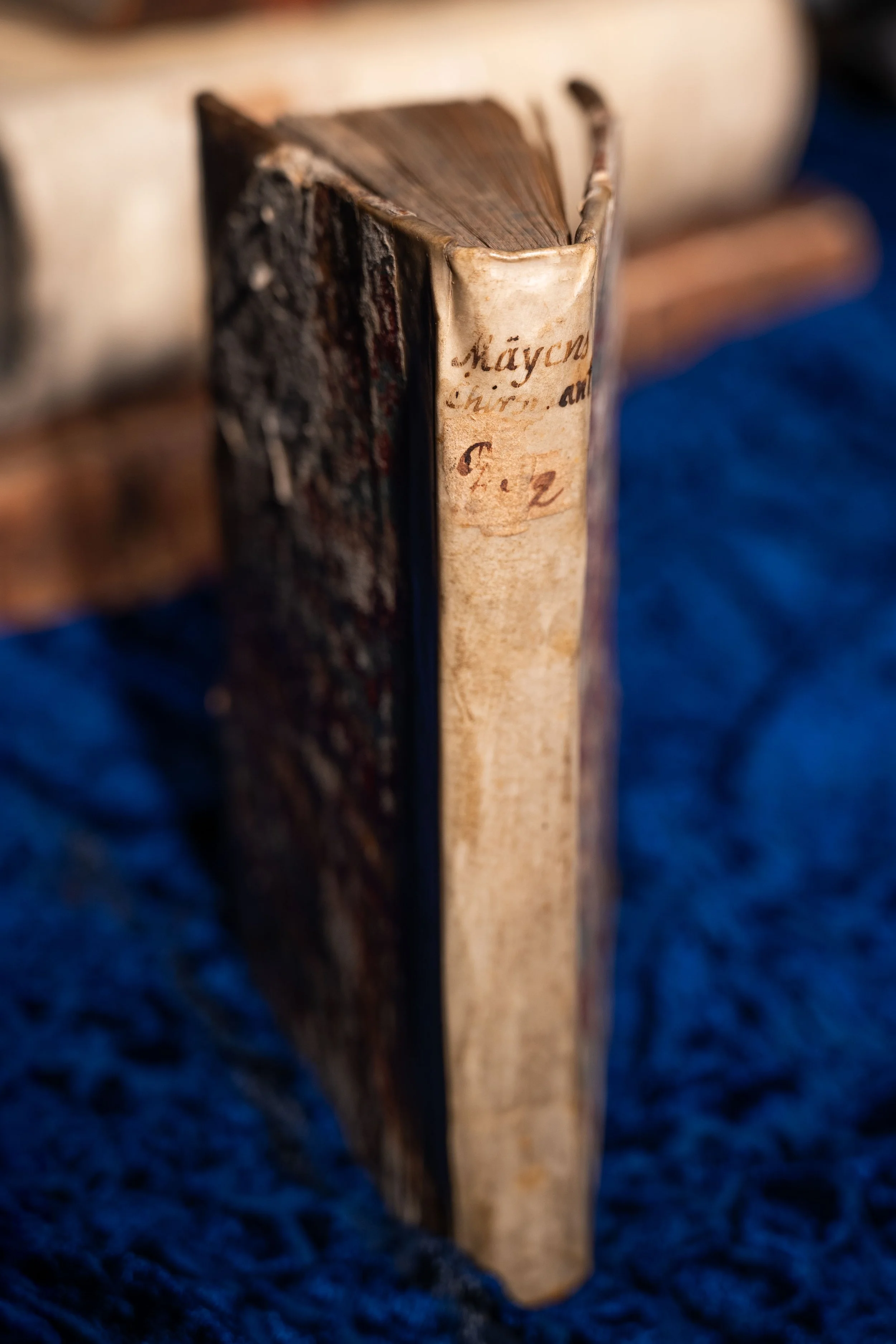 Image 9 of 9