This 1689 volume brings together the Sibylline Oracles and the Chaldean Oracles, two bodies of prophecy read by Christian scholars and students of ancient magic. At the back is a handwritten leaf headed Griechische Schriftzüge u. Abkürzungen, “Greek scripts and abbreviations.” Six neat columns work from single letters to the knotted forms for whole words. Early Greek type can be a beast: its printers kept the ligatures and contractions of Byzantine scribes. A reader of this copy supplied a key.
The Sibylline Oracles are Greek verse prophecies composed by Jewish and Christian writers in the voice of the pagan Sibyl. Their subjects include the destruction of cities, monstrous portents and the Last Judgment. Apocalypse in the grand manner. Christian readers treated the Sibyl as an ancient witness to their faith: the Dies Irae names her beside King David, “teste David cum Sibylla,” and Michelangelo placed five Sibyls among the prophets on the Sistine ceiling.
Servaas Gallé edited this collection, setting the Greek beside Sebastian Castellio’s Latin verse translation and gathering an extensive commentary beneath. He also drew fresh readings from a manuscript belonging to Edward Bernard, the Oxford scholar. The elaborate printing that required a reader’s handwritten aid carries a considerable apparatus of scholarship.
The separately paginated second part contains the Chaldean Oracles under the name of Zoroaster. These fragments of a second-century revelation concern fire, the soul and the summoning of gods. Treasured by the late Neoplatonists, they appear here with commentaries by the Byzantine writers Michael Psellus and Gemistos Plethon. W. Wynn Westcott’s much later translation brought them to readers in the Golden Dawn. They give the volume a long afterlife in the literature of ritual magic.
Other collections of oracles follow, along with the Oneirocriticon attributed to Astrampsychus, a manual for interpreting dreams edited here by Joseph Scaliger. On the engraved title, attributed to Romeyn de Hooghe, the Sibyl flings an arm skyward while scribes scramble to take down her words.
The copy bears an unidentified gilt coat of arms and stamps of the seminary library of the Christian Community, a religious movement founded in 1922 with Rudolf Steiner’s involvement. The Nazis banned the movement in 1941. The stamps establish the library’s ownership, but they do not establish when the book arrived there or whether it was present during the ban. The contemporary vellum is substantially worn, with much of its covering lost from one board. The book is complete, and the handwritten guide remains at the rear.
Provenance: Gilt armorial supralibros (unidentified) on contemporary vellum. Circular ink stamps of the Seminarbibliothek der Christengemeinschaft on title and endpapers, with classification stamp SACHWORTKARTEI and pencil shelfmark V/13.4.3 "Ora" (Oracula). Manuscript leaf of Greek ligatures and abbreviations, in German hand, preserved at rear.
ΣΙΒΥΛΛΙΑΚΟΙ ΧΡΗΣΜΟΙ, hoc est, Sibyllina Oracula... Opera & Studio Servatii Gallaei. Accedunt etiam Oracula Magica Zoroastris, Jovis, Apollinis, &c. Astrampsychi Oneiro-Criticum, &c. Amsterdam: Henric and the Widow of Theodor Boom, 1689. Quarto, contemporary vellum with gilt armorial. Greek and Latin.
GALLAEUS, Servatius (Servaas Gallé, 1627?–1709), editor. Σιβυλλιακοι Χρησμοι, hoc est, Sibyllina Oracula. Amsterdam: Henric & Widow of Theodor Boom, 1689.
Physical Description: Quarto. [13] leaves, 791 pp., [13] leaves, 127 pp. Engraved title attributed to Romeyn de Hooghe, letterpress title with woodcut device. Greek and Latin in parallel; second part (the oracle collections of Opsopoeus and the Astrampsychus dream-key) separately paginated. Collated and complete.
Binding: Contemporary vellum over boards, gilt fillets, gilt armorial supralibros (unidentified), spine lettered in ink.
Condition: Vellum worn and soiled; covering largely lost from one board; spine reinforced and repaired, one outer hinge cracked. Internally sound: some browning, scattered marginal worming, small library stamps as noted. A complete copy with substantial wear to the binding.
This 1689 volume brings together the Sibylline Oracles and the Chaldean Oracles, two bodies of prophecy read by Christian scholars and students of ancient magic. At the back is a handwritten leaf headed Griechische Schriftzüge u. Abkürzungen, “Greek scripts and abbreviations.” Six neat columns work from single letters to the knotted forms for whole words. Early Greek type can be a beast: its printers kept the ligatures and contractions of Byzantine scribes. A reader of this copy supplied a key.
The Sibylline Oracles are Greek verse prophecies composed by Jewish and Christian writers in the voice of the pagan Sibyl. Their subjects include the destruction of cities, monstrous portents and the Last Judgment. Apocalypse in the grand manner. Christian readers treated the Sibyl as an ancient witness to their faith: the Dies Irae names her beside King David, “teste David cum Sibylla,” and Michelangelo placed five Sibyls among the prophets on the Sistine ceiling.
Servaas Gallé edited this collection, setting the Greek beside Sebastian Castellio’s Latin verse translation and gathering an extensive commentary beneath. He also drew fresh readings from a manuscript belonging to Edward Bernard, the Oxford scholar. The elaborate printing that required a reader’s handwritten aid carries a considerable apparatus of scholarship.
The separately paginated second part contains the Chaldean Oracles under the name of Zoroaster. These fragments of a second-century revelation concern fire, the soul and the summoning of gods. Treasured by the late Neoplatonists, they appear here with commentaries by the Byzantine writers Michael Psellus and Gemistos Plethon. W. Wynn Westcott’s much later translation brought them to readers in the Golden Dawn. They give the volume a long afterlife in the literature of ritual magic.
Other collections of oracles follow, along with the Oneirocriticon attributed to Astrampsychus, a manual for interpreting dreams edited here by Joseph Scaliger. On the engraved title, attributed to Romeyn de Hooghe, the Sibyl flings an arm skyward while scribes scramble to take down her words.
The copy bears an unidentified gilt coat of arms and stamps of the seminary library of the Christian Community, a religious movement founded in 1922 with Rudolf Steiner’s involvement. The Nazis banned the movement in 1941. The stamps establish the library’s ownership, but they do not establish when the book arrived there or whether it was present during the ban. The contemporary vellum is substantially worn, with much of its covering lost from one board. The book is complete, and the handwritten guide remains at the rear.
Provenance: Gilt armorial supralibros (unidentified) on contemporary vellum. Circular ink stamps of the Seminarbibliothek der Christengemeinschaft on title and endpapers, with classification stamp SACHWORTKARTEI and pencil shelfmark V/13.4.3 "Ora" (Oracula). Manuscript leaf of Greek ligatures and abbreviations, in German hand, preserved at rear.
ΣΙΒΥΛΛΙΑΚΟΙ ΧΡΗΣΜΟΙ, hoc est, Sibyllina Oracula... Opera & Studio Servatii Gallaei. Accedunt etiam Oracula Magica Zoroastris, Jovis, Apollinis, &c. Astrampsychi Oneiro-Criticum, &c. Amsterdam: Henric and the Widow of Theodor Boom, 1689. Quarto, contemporary vellum with gilt armorial. Greek and Latin.
GALLAEUS, Servatius (Servaas Gallé, 1627?–1709), editor. Σιβυλλιακοι Χρησμοι, hoc est, Sibyllina Oracula. Amsterdam: Henric & Widow of Theodor Boom, 1689.
Physical Description: Quarto. [13] leaves, 791 pp., [13] leaves, 127 pp. Engraved title attributed to Romeyn de Hooghe, letterpress title with woodcut device. Greek and Latin in parallel; second part (the oracle collections of Opsopoeus and the Astrampsychus dream-key) separately paginated. Collated and complete.
Binding: Contemporary vellum over boards, gilt fillets, gilt armorial supralibros (unidentified), spine lettered in ink.
Condition: Vellum worn and soiled; covering largely lost from one board; spine reinforced and repaired, one outer hinge cracked. Internally sound: some browning, scattered marginal worming, small library stamps as noted. A complete copy with substantial wear to the binding.

 Image 1 of 22
 Image 2 of 22
 Image 3 of 22
 Image 4 of 22
 Image 5 of 22
 Image 6 of 22
 Image 7 of 22
 Image 8 of 22
 Image 9 of 22
 Image 10 of 22
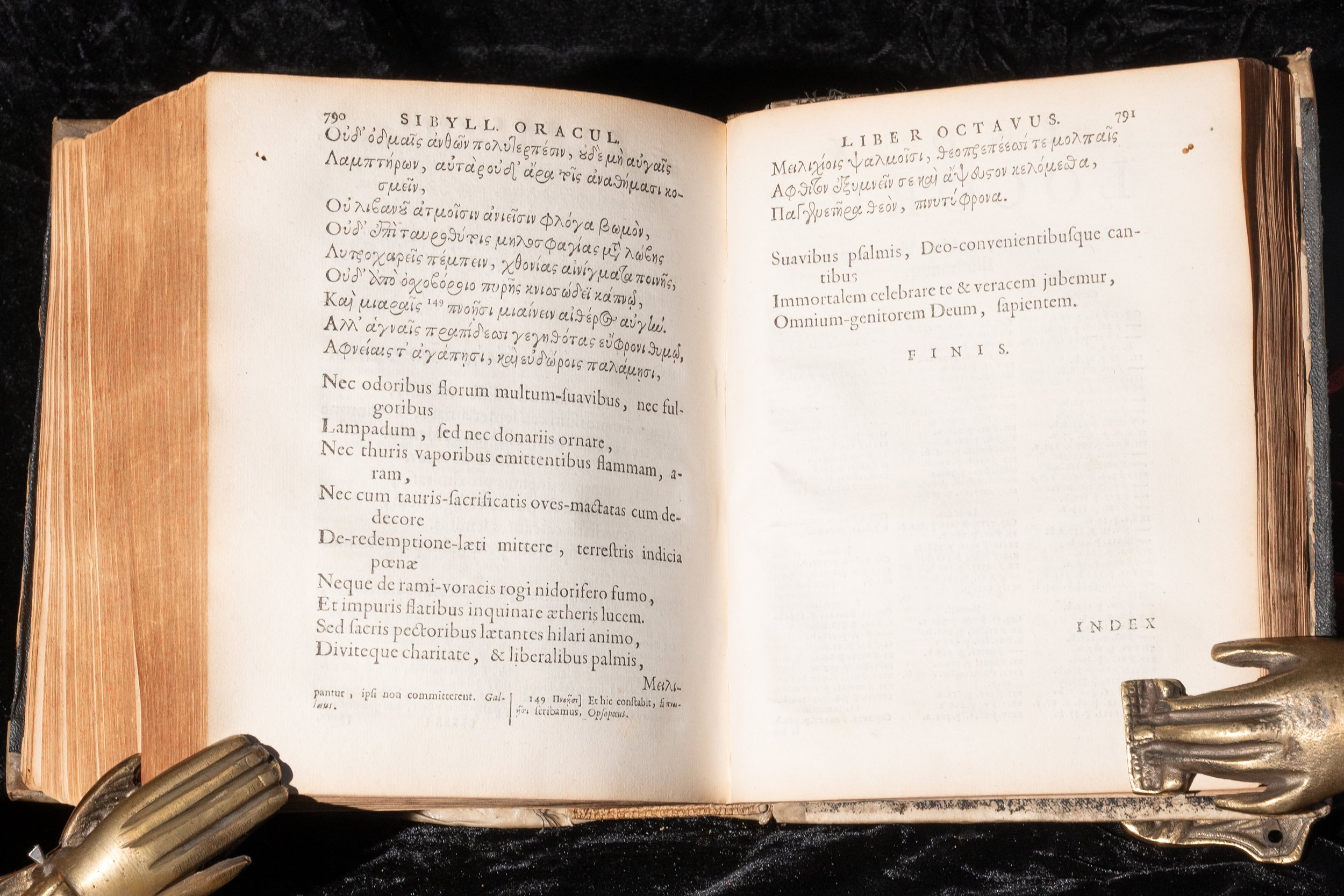 Image 11 of 22
 Image 12 of 22
 Image 13 of 22
 Image 14 of 22
 Image 15 of 22
 Image 16 of 22
 Image 17 of 22
 Image 18 of 22
 Image 19 of 22
 Image 20 of 22
 Image 21 of 22
 Image 22 of 22