The engraved portrait facing the title shows a bearded man in a philosopher’s robe, hand lifted as if mid-argument, and the verses beneath salute his double crown: one for heavenly wisdom, one for martyrdom. Justin earned both the slow way. Born a pagan in Samaria around the year 100, he worked through the philosophical schools one after another until an old man on a beach talked him into Christianity, which he called the true philosophy. He seems to have really meant it. He kept the philosopher’s cloak, taught in Rome, argued with everyone, and was beheaded around 165. He is, arguably, the first Christian thinker you can actually get to know, and this folio gathers what survives of him, in Greek with facing Latin, along with the other Greek apologists of his century: Athenagoras, Theophilus of Antioch, Tatian, and Hermias.
For readers of this catalog the volume is a foundation stone. Justin develops an early Christian account of the old gods: to wit, they were demons, the offspring of fallen angels, who took the names of Jupiter and the rest and taught men sacrifices. Later Christian demonology drew on that argument. It is also in Justin that the legend of Simon Magus gets going in earnest. His First Apology reports that the sorcerer of Samaria came to Rome, worked wonders, and was honored with a statue inscribed “Simoni Deo Sancto,” to Simon the holy god. The report launched the whole career of the arch-magician of Christian legend, the figure who haunts the tradition all the way down to Faust. Tatian, for his part, blames the demons for inventing astrology and fate; Athenagoras lays out the orders of angels with a precision the scholastics would envy.
The book ends, surprisingly, on a joke. The last work in the volume is the Mockery of the Pagan Philosophers by Hermias, and its closing pages take on Epicurus and his innumerable worlds. Hermias packs provisions for a few days and sets out to cross them all, world after world, into the hundredth and the thousandth, until everything is darkness, error, and unbounded ignorance, at which point he gives up the tour. It is a strange, funny little work, which is how the seventeenth century read it: as the punchline to the whole apologetic corpus.
This is the “editio nova” of 1686, following the standard Paris edition of 1636, published under a Cologne imprint by Jeremias Schrey and Heinrich Johann Meyer, with the title in red and black and an engraved vignette of Minerva and Hercules under the motto “usefulness joined them; labor and industry preserve.” It’s a big, serious scholar’s folio and exactly the kind of book that anchored a working theological library.
And, lo and behold, a working theological library is exactly where this copy lived. The printed ex libris within belongs to the Canonry of St Mary and St Petroc at Bodmin, with the three salmon of the medieval priory’s arms. The Canons Regular of the Lateran ran the greatest religious house in medieval Cornwall until the Dissolution closed it in 1538; in 1881 the same order returned to Bodmin, and their library plate in this volume is the mark of that second life. The front cover had parted from the book by the time it reached us, and we had it secured with a new dark spine, lettered in gilt; the early boards remain. A solid copy with its early boards retained.
Provenance: Printed ex libris of the Canonry of St Mary and St Petroc, Bodmin (the Canons Regular of the Lateran, re-established at Bodmin in 1881), with the three salmon of the medieval priory arms and ink shelfmarks.
Του εν αγιοις πατρος ημων Ιουστινου, φιλοσοφου και μαρτυρος, σωζομενα. Sancti Patris nostri Justini, Philosophi et Martyris, Opera. Item Athenagorae Atheniensis, Theophili Antiocheni, Tatiani Assyrii, & Hermiae Philosophi Tractatus aliquot. Cologne: Jeremias Schrey and Heinrich Johann Meyer, 1686. Folio, Greek and Latin in parallel columns. The Greek apologists in one volume.
JUSTIN MARTYR (c. 100-165); with ATHENAGORAS, THEOPHILUS OF ANTIOCH, TATIAN, and HERMIAS. Sancti Patris nostri Justini, Philosophi et Martyris, Opera. Item Athenagorae Atheniensis, Theophili Antiocheni, Tatiani Assyrii, & Hermiae Philosophi Tractatus aliquot... Quae omnia Graecè & Latinè emendatiora prodeunt. Editio nova juxta Parisinam anni MDCXXXVI. Cologne: Jeremias Schrey and Heinrich Johann Meyer, 1686. Following the Paris edition of 1636.
Physical Description: Folio (39.5 cm). [6] leaves, including the engraved portrait of Justin, the title printed in red and black with engraved allegorical vignette, and the half-title; Justin’s works, 539 pp., with the annotations and an index of Greek words and phrases following; then the Corollaria Justino addita (Athenagoras, Theophilus of Antioch, Tatian, and Hermias), separately paginated, ending at p. 180 with FINIS. Greek and Latin in parallel columns throughout. Collated complete.
Binding: Early paper-covered boards, rebacked with a new dark spine lettered in gilt, the once-detached front cover secured.
Condition: Title and portrait creased with some soiling and old folds; paper repairs to the first four leaves and to the final leaf; browning and scattered spotting throughout, heavier in places; edges of a few leaves frayed. A complete, sound working copy.
The engraved portrait facing the title shows a bearded man in a philosopher’s robe, hand lifted as if mid-argument, and the verses beneath salute his double crown: one for heavenly wisdom, one for martyrdom. Justin earned both the slow way. Born a pagan in Samaria around the year 100, he worked through the philosophical schools one after another until an old man on a beach talked him into Christianity, which he called the true philosophy. He seems to have really meant it. He kept the philosopher’s cloak, taught in Rome, argued with everyone, and was beheaded around 165. He is, arguably, the first Christian thinker you can actually get to know, and this folio gathers what survives of him, in Greek with facing Latin, along with the other Greek apologists of his century: Athenagoras, Theophilus of Antioch, Tatian, and Hermias.
For readers of this catalog the volume is a foundation stone. Justin develops an early Christian account of the old gods: to wit, they were demons, the offspring of fallen angels, who took the names of Jupiter and the rest and taught men sacrifices. Later Christian demonology drew on that argument. It is also in Justin that the legend of Simon Magus gets going in earnest. His First Apology reports that the sorcerer of Samaria came to Rome, worked wonders, and was honored with a statue inscribed “Simoni Deo Sancto,” to Simon the holy god. The report launched the whole career of the arch-magician of Christian legend, the figure who haunts the tradition all the way down to Faust. Tatian, for his part, blames the demons for inventing astrology and fate; Athenagoras lays out the orders of angels with a precision the scholastics would envy.
The book ends, surprisingly, on a joke. The last work in the volume is the Mockery of the Pagan Philosophers by Hermias, and its closing pages take on Epicurus and his innumerable worlds. Hermias packs provisions for a few days and sets out to cross them all, world after world, into the hundredth and the thousandth, until everything is darkness, error, and unbounded ignorance, at which point he gives up the tour. It is a strange, funny little work, which is how the seventeenth century read it: as the punchline to the whole apologetic corpus.
This is the “editio nova” of 1686, following the standard Paris edition of 1636, published under a Cologne imprint by Jeremias Schrey and Heinrich Johann Meyer, with the title in red and black and an engraved vignette of Minerva and Hercules under the motto “usefulness joined them; labor and industry preserve.” It’s a big, serious scholar’s folio and exactly the kind of book that anchored a working theological library.
And, lo and behold, a working theological library is exactly where this copy lived. The printed ex libris within belongs to the Canonry of St Mary and St Petroc at Bodmin, with the three salmon of the medieval priory’s arms. The Canons Regular of the Lateran ran the greatest religious house in medieval Cornwall until the Dissolution closed it in 1538; in 1881 the same order returned to Bodmin, and their library plate in this volume is the mark of that second life. The front cover had parted from the book by the time it reached us, and we had it secured with a new dark spine, lettered in gilt; the early boards remain. A solid copy with its early boards retained.
Provenance: Printed ex libris of the Canonry of St Mary and St Petroc, Bodmin (the Canons Regular of the Lateran, re-established at Bodmin in 1881), with the three salmon of the medieval priory arms and ink shelfmarks.
Του εν αγιοις πατρος ημων Ιουστινου, φιλοσοφου και μαρτυρος, σωζομενα. Sancti Patris nostri Justini, Philosophi et Martyris, Opera. Item Athenagorae Atheniensis, Theophili Antiocheni, Tatiani Assyrii, & Hermiae Philosophi Tractatus aliquot. Cologne: Jeremias Schrey and Heinrich Johann Meyer, 1686. Folio, Greek and Latin in parallel columns. The Greek apologists in one volume.
JUSTIN MARTYR (c. 100-165); with ATHENAGORAS, THEOPHILUS OF ANTIOCH, TATIAN, and HERMIAS. Sancti Patris nostri Justini, Philosophi et Martyris, Opera. Item Athenagorae Atheniensis, Theophili Antiocheni, Tatiani Assyrii, & Hermiae Philosophi Tractatus aliquot... Quae omnia Graecè & Latinè emendatiora prodeunt. Editio nova juxta Parisinam anni MDCXXXVI. Cologne: Jeremias Schrey and Heinrich Johann Meyer, 1686. Following the Paris edition of 1636.
Physical Description: Folio (39.5 cm). [6] leaves, including the engraved portrait of Justin, the title printed in red and black with engraved allegorical vignette, and the half-title; Justin’s works, 539 pp., with the annotations and an index of Greek words and phrases following; then the Corollaria Justino addita (Athenagoras, Theophilus of Antioch, Tatian, and Hermias), separately paginated, ending at p. 180 with FINIS. Greek and Latin in parallel columns throughout. Collated complete.
Binding: Early paper-covered boards, rebacked with a new dark spine lettered in gilt, the once-detached front cover secured.
Condition: Title and portrait creased with some soiling and old folds; paper repairs to the first four leaves and to the final leaf; browning and scattered spotting throughout, heavier in places; edges of a few leaves frayed. A complete, sound working copy.

 Image 1 of 32
 Image 2 of 32
 Image 3 of 32
 Image 4 of 32
 Image 5 of 32
 Image 6 of 32
 Image 7 of 32
 Image 8 of 32
 Image 9 of 32
 Image 10 of 32
 Image 11 of 32
 Image 12 of 32
 Image 13 of 32
 Image 14 of 32
 Image 15 of 32
 Image 16 of 32
 Image 17 of 32
 Image 18 of 32
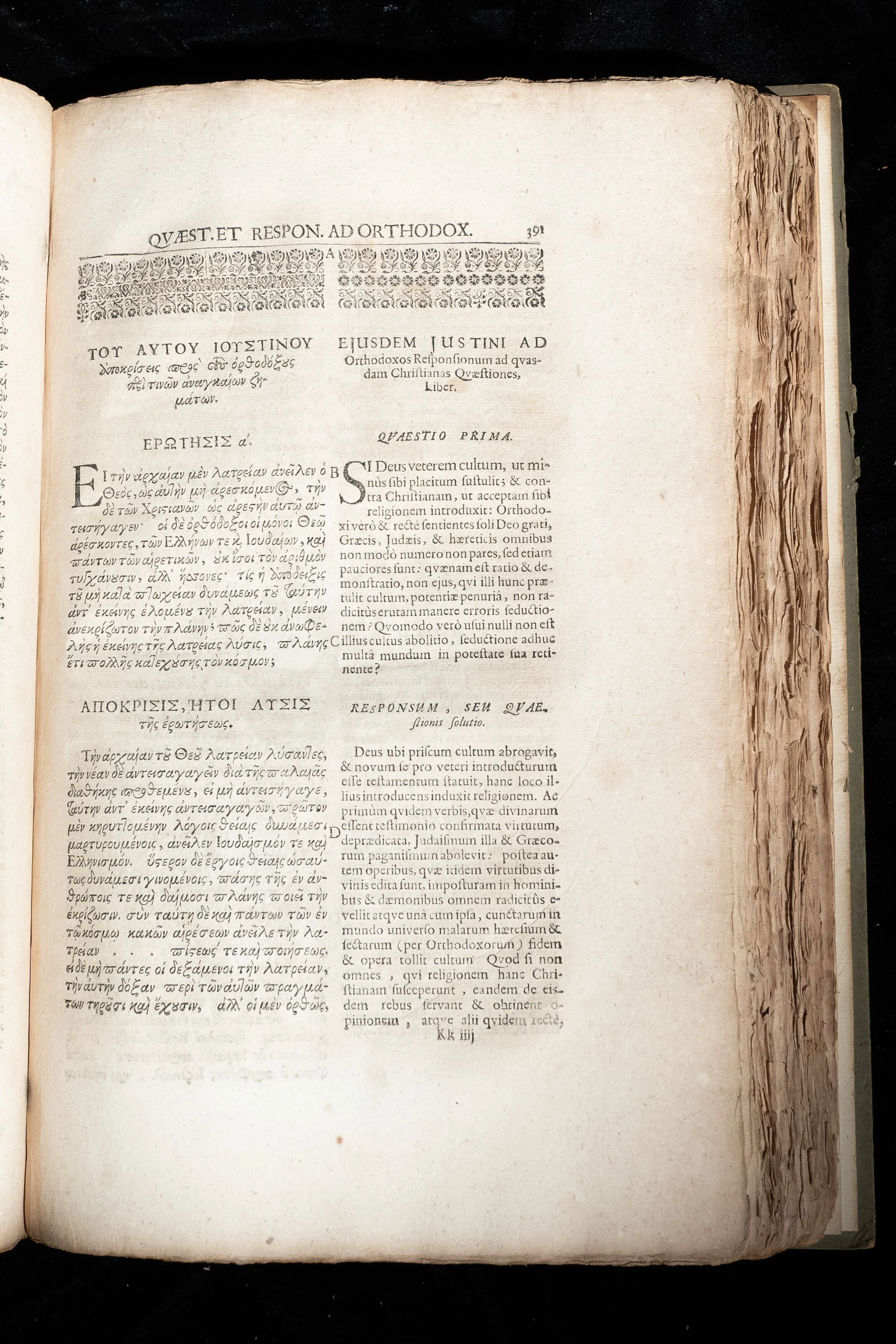 Image 19 of 32
 Image 20 of 32
 Image 21 of 32
 Image 22 of 32
 Image 23 of 32
 Image 24 of 32
 Image 25 of 32
 Image 26 of 32
 Image 27 of 32
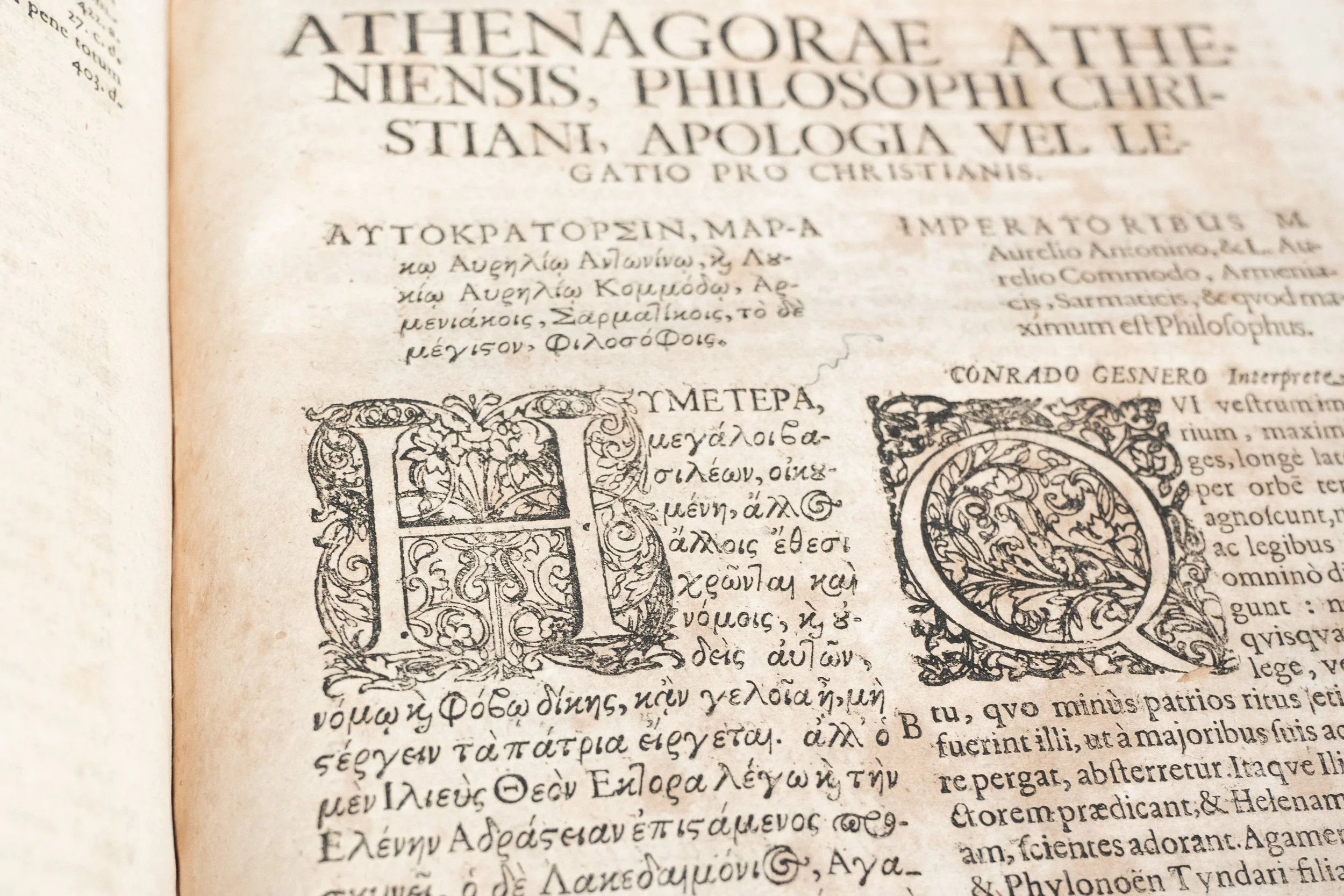 Image 28 of 32
 Image 29 of 32
 Image 30 of 32
 Image 31 of 32
 Image 32 of 32