A rare and volatile example of weaponized prophecy from the crisis year of 1683. Published in the shadow of the Rye House Plot and the apocalyptic Siege of Vienna by the Ottoman Empire, this tract utilizes the language of the occult to navigate the dangerous waters of sedition. The anonymous author invokes a potent cocktail of astrological determinism, reading the Great Comet of 1680 and Halley's Comet of 1682 as divine "Intelligencers" sent to signal the fall of tyrants, and Arthurian messianism to critique the Stuart monarchy without explicitly naming it.
Drawing on the Prophetiae Merlini of Geoffrey of Monmouth, the text resurrects the figure of the "Boar of Cornwall," traditionally King Arthur returning to purge the land of invaders. In the coded language of 1683, this is a clear, if dangerous, allusion to the Duke of Monmouth, the Protestant favorite whose power base lay in the West Country. The prophecy places the Boar's victory in the "deep of the Severn Sea," eerily foreshadowing the geography of the actual Monmouth Rebellion that would erupt two years later. The woodcut's "White Wolf" bearing a flag works a similar heraldic turn: while the wolf is typically a symbol of the Papacy or Jesuits in Protestant polemic, this text reclaims it, possibly linking the Fleur-de-lis on the flag to Monmouth's own royal (albeit illegitimate) arms and casting him as the fierce defender of the faith against the "Turk", itself a common cipher for Catholic tyranny.
Bookseller's Note: We don't often get a chance to offer something where the Western esoteric tradition, Merlin, Nostradamus, cometary astrology, stops being theoretical and becomes an active tool of political radicalism. This is an artifact of the "Paper War" that preceded the Glorious Revolution, and a genuinely scarce piece of street-level occult agitation.
Anonymous [A Lover of his Country's Peace]. The Mystery of Ambras Merlins, Standardbearer Wolf, and last Boar of Cornwal. With sundry other Misterious Prophecys, both Ancient and Modern, plainly unfolded in the following treatise... London: Printed for Benj. Billingsley, at the Printing-Press under the Piazza of the Royal Exchange, 1683.
Description: Folio (approx. 300 × 195 mm). 4 pp. (Single bifolium). Title page with drop-head title and dense text; striking woodcut illustration on page 4 depicting "a Flagg figured with a White Wolf" and the "Standardbearer Wolf" rampant. Bound in 20th-century half morocco over marbled boards.
Condition: Complete. Text is clear with age-toning typical of 17th-century street literature. Margins trimmed but text intact. Old ink manuscript pagination in upper corners (p. 1 as "116"), indicating provenance from a larger, likely contemporary, sammelband of prophecies or political tracts.
References: Wing M3182; ESTC R10135.
A rare and volatile example of weaponized prophecy from the crisis year of 1683. Published in the shadow of the Rye House Plot and the apocalyptic Siege of Vienna by the Ottoman Empire, this tract utilizes the language of the occult to navigate the dangerous waters of sedition. The anonymous author invokes a potent cocktail of astrological determinism, reading the Great Comet of 1680 and Halley's Comet of 1682 as divine "Intelligencers" sent to signal the fall of tyrants, and Arthurian messianism to critique the Stuart monarchy without explicitly naming it.
Drawing on the Prophetiae Merlini of Geoffrey of Monmouth, the text resurrects the figure of the "Boar of Cornwall," traditionally King Arthur returning to purge the land of invaders. In the coded language of 1683, this is a clear, if dangerous, allusion to the Duke of Monmouth, the Protestant favorite whose power base lay in the West Country. The prophecy places the Boar's victory in the "deep of the Severn Sea," eerily foreshadowing the geography of the actual Monmouth Rebellion that would erupt two years later. The woodcut's "White Wolf" bearing a flag works a similar heraldic turn: while the wolf is typically a symbol of the Papacy or Jesuits in Protestant polemic, this text reclaims it, possibly linking the Fleur-de-lis on the flag to Monmouth's own royal (albeit illegitimate) arms and casting him as the fierce defender of the faith against the "Turk", itself a common cipher for Catholic tyranny.
Bookseller's Note: We don't often get a chance to offer something where the Western esoteric tradition, Merlin, Nostradamus, cometary astrology, stops being theoretical and becomes an active tool of political radicalism. This is an artifact of the "Paper War" that preceded the Glorious Revolution, and a genuinely scarce piece of street-level occult agitation.
Anonymous [A Lover of his Country's Peace]. The Mystery of Ambras Merlins, Standardbearer Wolf, and last Boar of Cornwal. With sundry other Misterious Prophecys, both Ancient and Modern, plainly unfolded in the following treatise... London: Printed for Benj. Billingsley, at the Printing-Press under the Piazza of the Royal Exchange, 1683.
Description: Folio (approx. 300 × 195 mm). 4 pp. (Single bifolium). Title page with drop-head title and dense text; striking woodcut illustration on page 4 depicting "a Flagg figured with a White Wolf" and the "Standardbearer Wolf" rampant. Bound in 20th-century half morocco over marbled boards.
Condition: Complete. Text is clear with age-toning typical of 17th-century street literature. Margins trimmed but text intact. Old ink manuscript pagination in upper corners (p. 1 as "116"), indicating provenance from a larger, likely contemporary, sammelband of prophecies or political tracts.
References: Wing M3182; ESTC R10135.

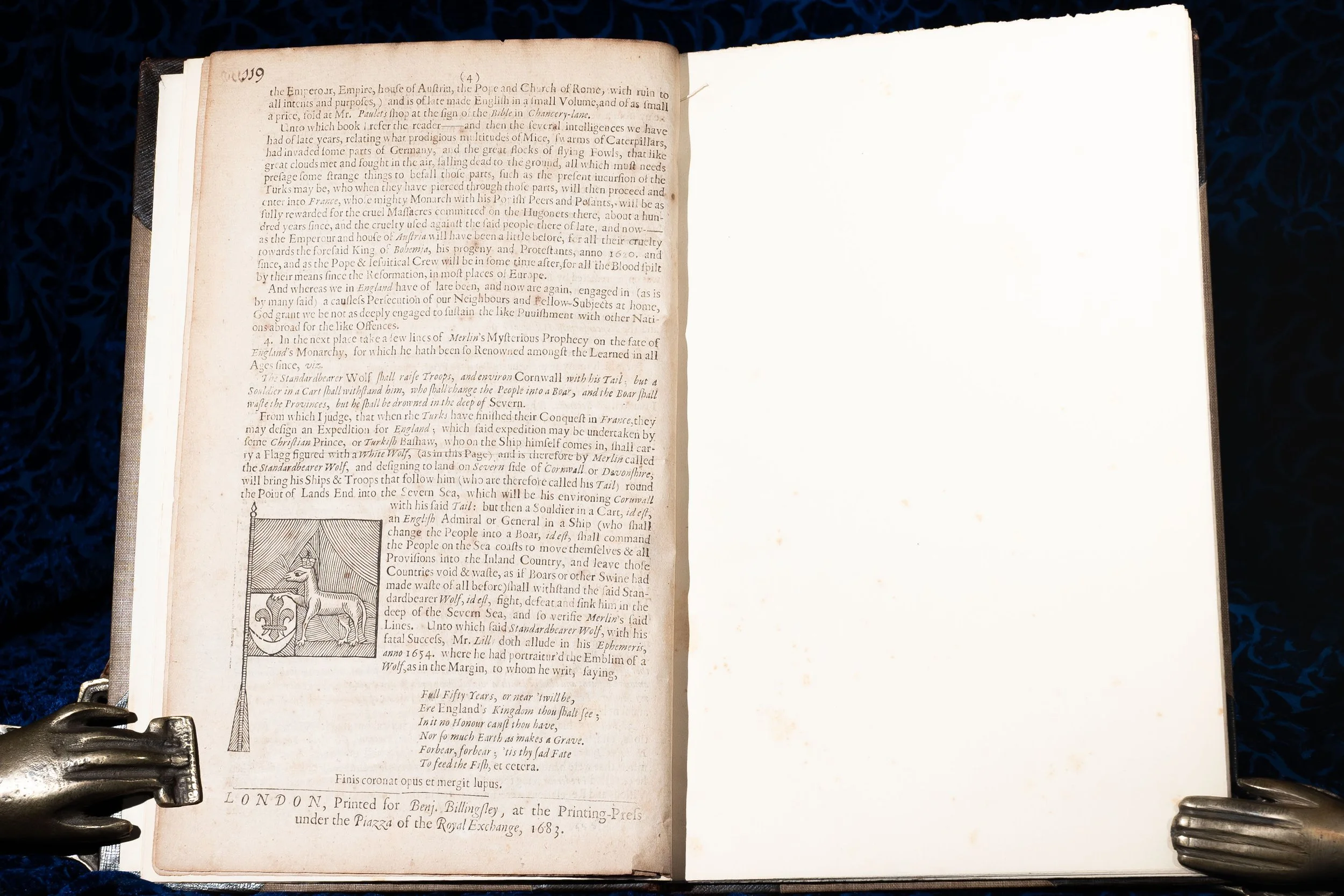 Image 1 of 6
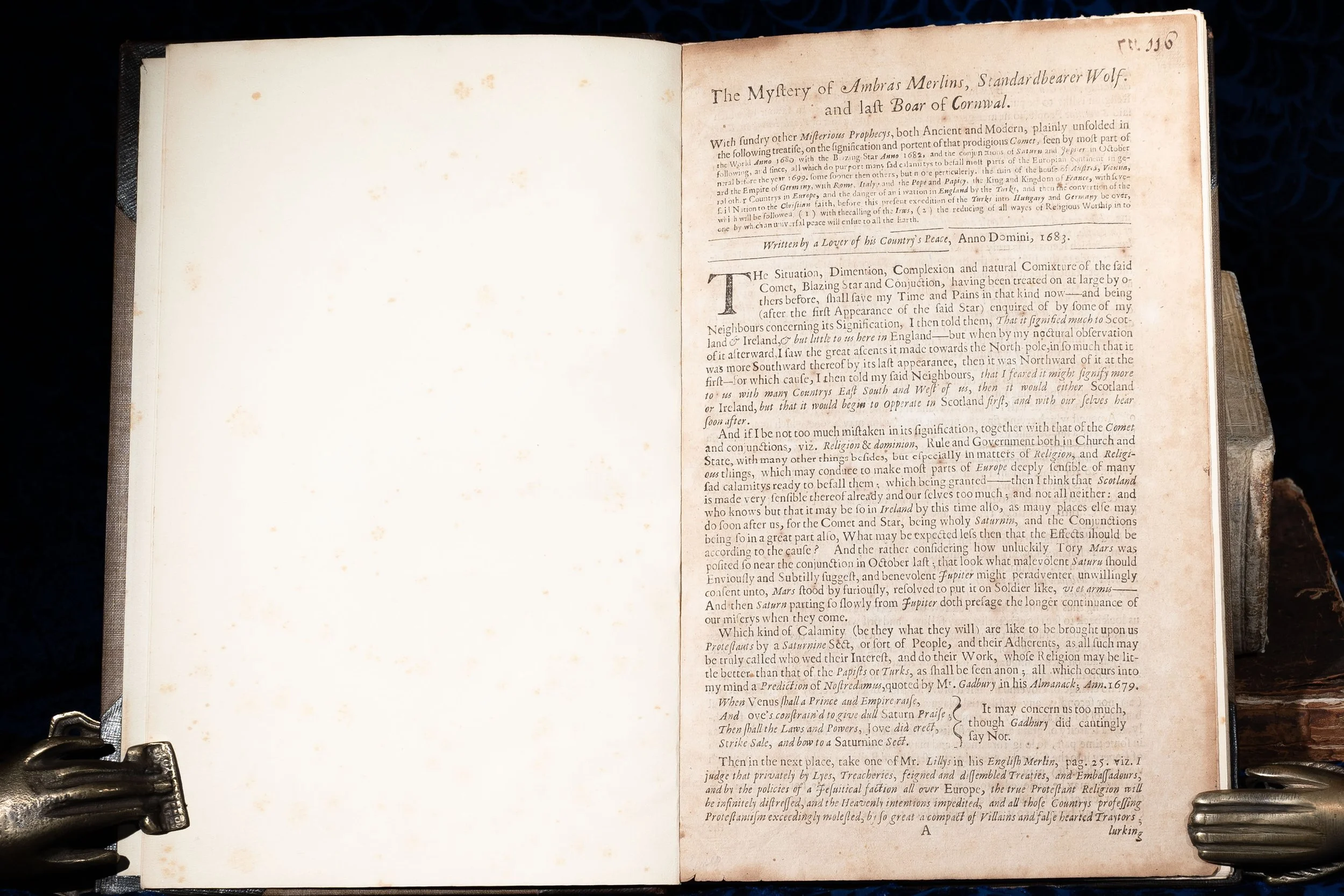 Image 2 of 6
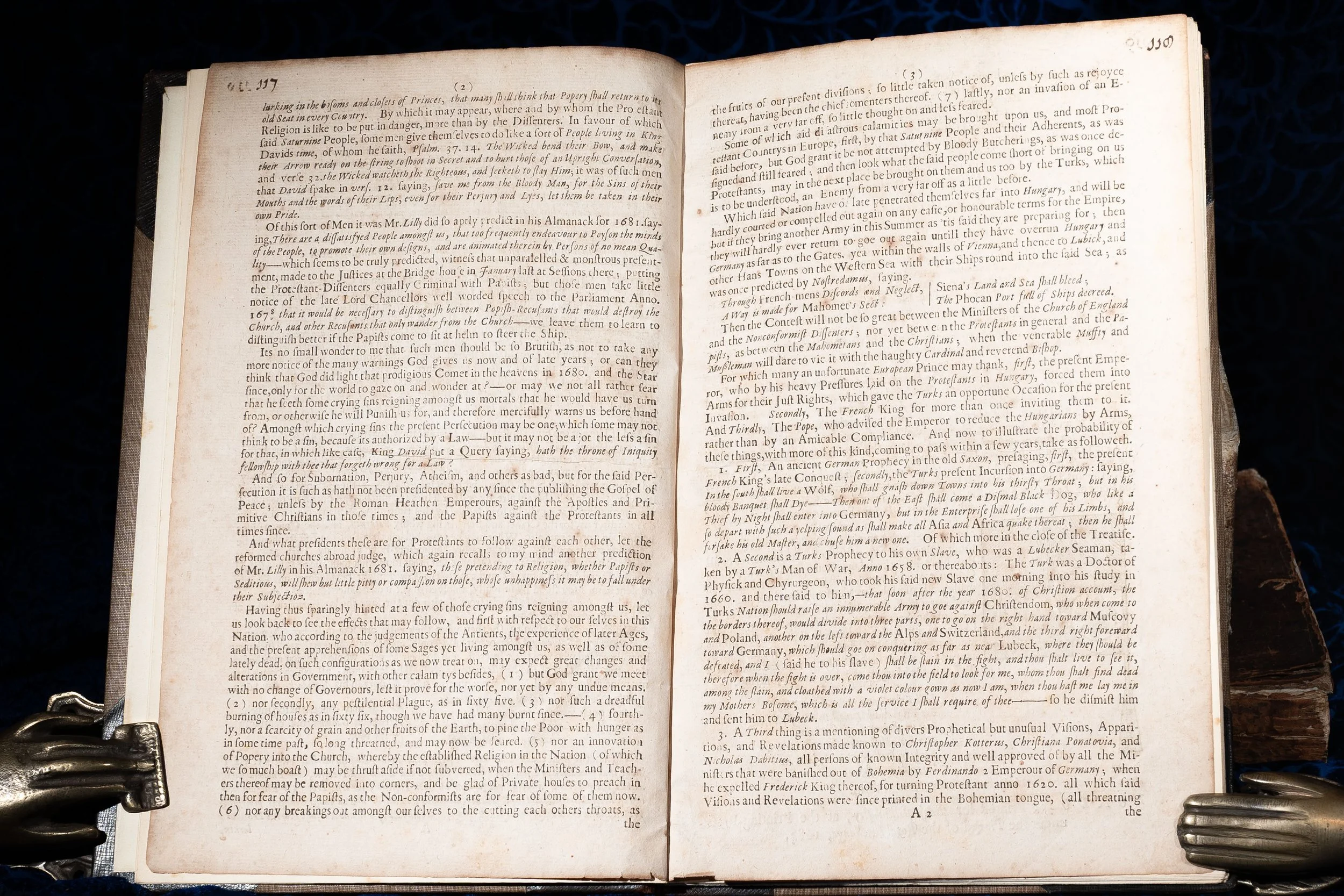 Image 3 of 6
 Image 4 of 6
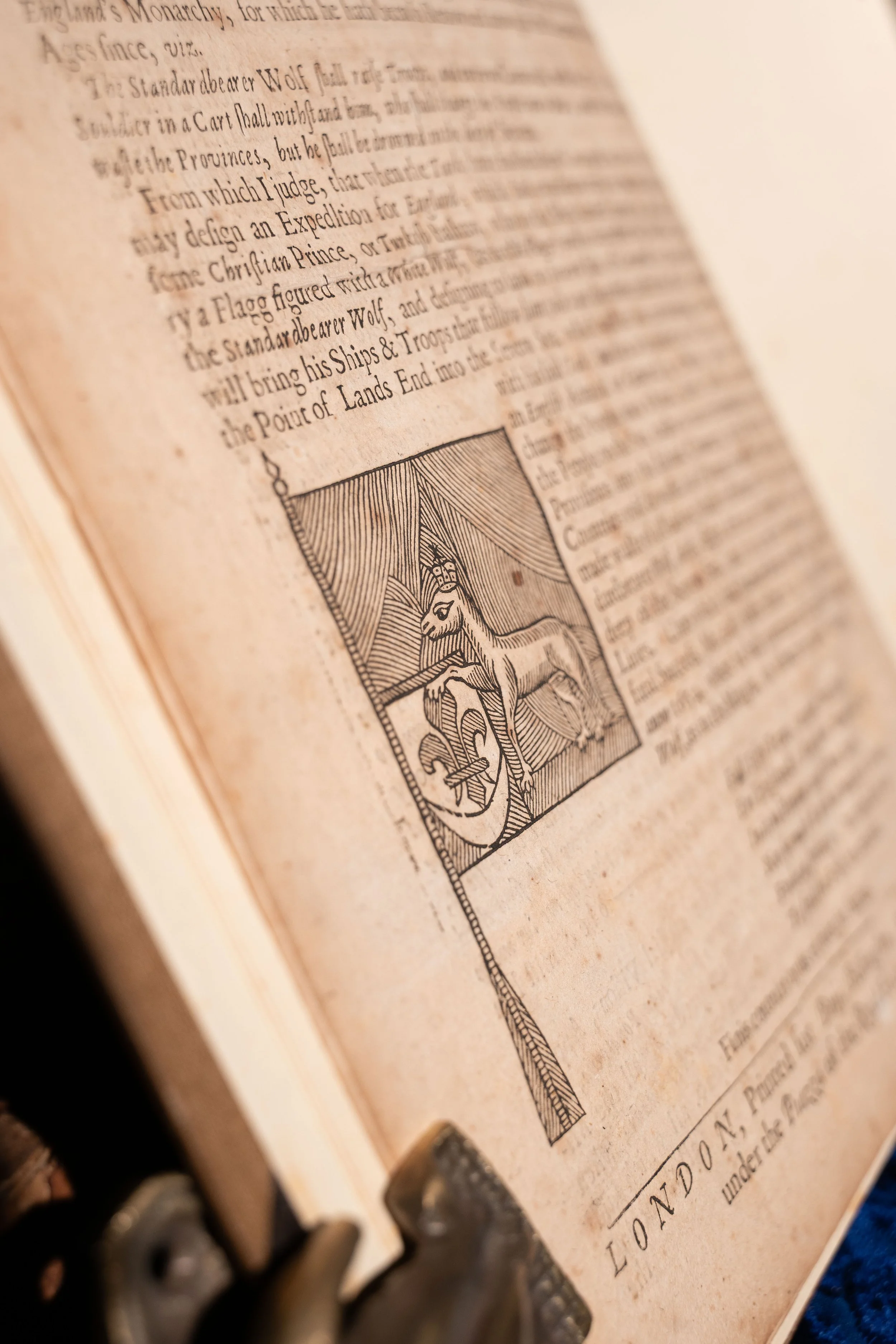 Image 5 of 6
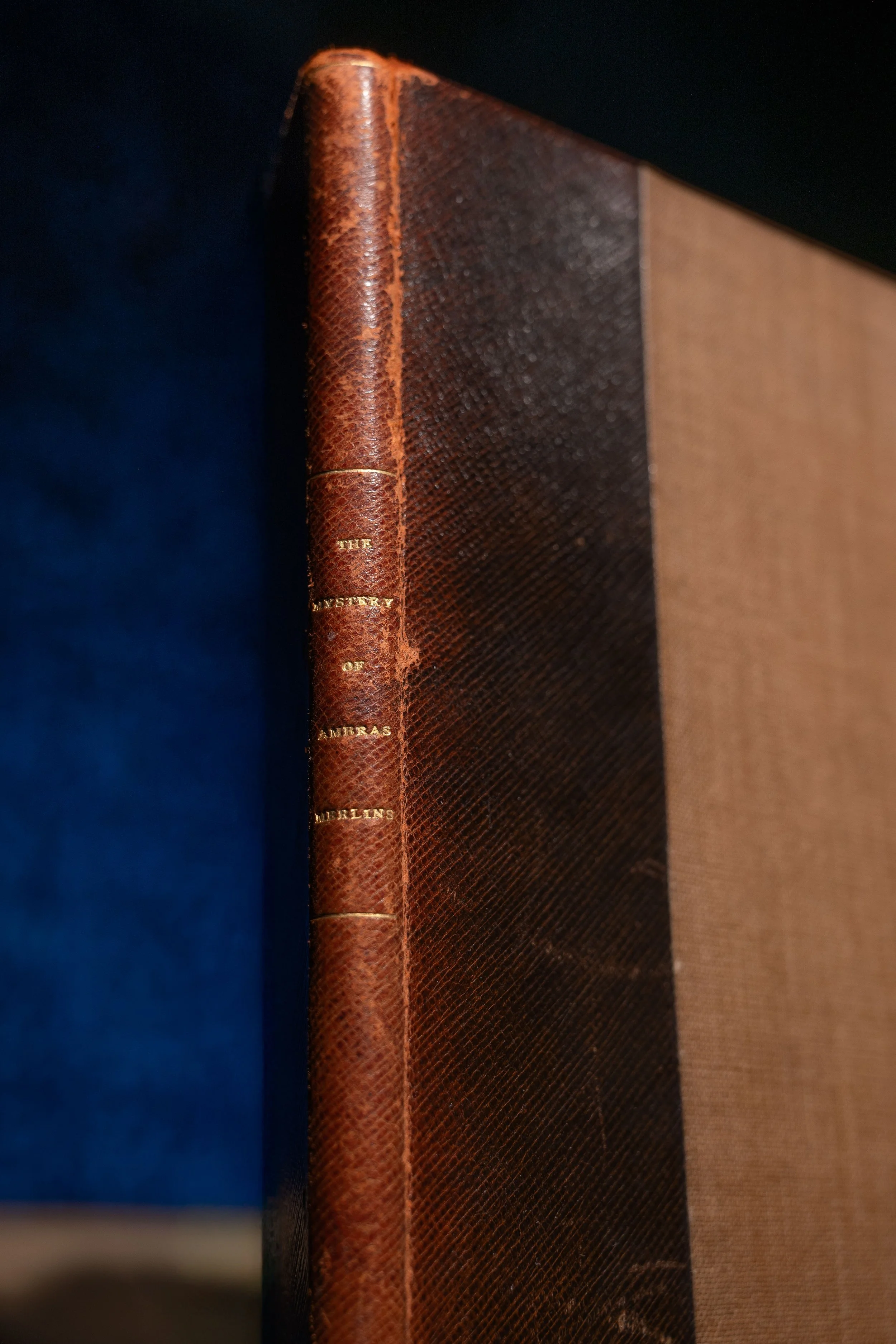 Image 6 of 6