The index to Vannoccio Biringuccio’s Pirotechnia, the fire-book of a Renaissance foundryman, promises instructions for making fire burn underwater and girandole, the spinning fireworks. Then come the secrets for making a magnet lose its power and the virtues of diamonds and rubies. First published in 1540, this is a book of mining and metallurgy with a good deal besides, written by someone who had actually done the work.
Biringuccio ran foundries, cast bells and cannon, managed mines and mints across Italy, and died around 1539 as head of the papal arsenal, just before his book reached the press at Venice in 1540. The Pirotechnia moves from ores and assaying through casting, distillation, and alum-making to the festive arts of gunpowder and fireworks, and it became the standard manual of the age; Agricola, whose grander De re metallica followed in 1556, had read him closely.
For readers of an occult catalog, the heart of the book may be its famous reckoning with alchemy. Biringuccio takes the alchemists seriously enough to spend chapters on them, grants the beauty of their theory, and then declines the whole enterprise on a foundryman's arithmetic: he had never seen transmutation pay, and the only reliable way to get gold from a furnace was to put gold into it. It is one of the earliest sustained pieces of technical skepticism in print, written by a man who still carefully records the virtues of gems and the secret sympathies of the magnet.
This is the Bologna edition printed by Gioseffo Longhi and dedicated to the Marchese Giuseppe Montecuccoli, the last edition of the book's working life, issued undated around 1678 in a handy pocket format, with the figures cut small for the text and the double table of chapters and notable things. After Longhi the Pirotechnia went out of print until its modern revival; the next editions belong to the age of historians of science. It is uncommon in commerce.
This copy is in clean contemporary vellum with a red morocco gilt label. The title bears the ink signature of one Carlo Calcagnini, in an Italian hand of around 1700; the Calcagnini were a noble house of Ferrara, though we have not pinned our man down. Better still, an early reader has left a marginal note beside the passage on the mines of the Tyrol, glossing the workings around Hall and Innsbruck, and the binder's knife has shaved it: the note was already in the margin when the book was last bound.
BIRINGUCCIO, Vannoccio (1480-c. 1539). Pirotechnia del Signor Vannuccio Biringuccio Senese, nella quale si tratta non solo della diversità delle Minere, ma anco di quanto si ricerca alla pratica di esse, e che s'appartiene all'arte della fusione, ò getto de Metalli. Far Campane, Artigliarie, fuochi artificiati, & altre diverse cose utilissime. Bologna: Gioseffo Longhi, undated [about 1678]. The last of the early editions, first published Venice, 1540.
Physical Description: Small octavo. Preliminary leaves and 630 pp., the table of notable things ending on p. 630; woodcut illustrations in the text, woodcut ornaments and initials. The date supplied on the title in an old ink hand, with a later pencil date.
Binding: Contemporary vellum, spine with red morocco label lettered in gilt within a gilt ornamental border. Clean and sound.
Condition: Crisp and fresh internally, scattered light spotting to the title and a few leaves. An excellent copy.
Provenance: (1) Ink ownership signature of Carlo Calcagnini across the foot of the title, in a hand of about 1700. (2) Early ink marginal note beside the passage on the Tyrolean mines, naming Hall and Innsbruck, shaved by the binder. (3) Small early ink numeral to the title.
The index to Vannoccio Biringuccio’s Pirotechnia, the fire-book of a Renaissance foundryman, promises instructions for making fire burn underwater and girandole, the spinning fireworks. Then come the secrets for making a magnet lose its power and the virtues of diamonds and rubies. First published in 1540, this is a book of mining and metallurgy with a good deal besides, written by someone who had actually done the work.
Biringuccio ran foundries, cast bells and cannon, managed mines and mints across Italy, and died around 1539 as head of the papal arsenal, just before his book reached the press at Venice in 1540. The Pirotechnia moves from ores and assaying through casting, distillation, and alum-making to the festive arts of gunpowder and fireworks, and it became the standard manual of the age; Agricola, whose grander De re metallica followed in 1556, had read him closely.
For readers of an occult catalog, the heart of the book may be its famous reckoning with alchemy. Biringuccio takes the alchemists seriously enough to spend chapters on them, grants the beauty of their theory, and then declines the whole enterprise on a foundryman's arithmetic: he had never seen transmutation pay, and the only reliable way to get gold from a furnace was to put gold into it. It is one of the earliest sustained pieces of technical skepticism in print, written by a man who still carefully records the virtues of gems and the secret sympathies of the magnet.
This is the Bologna edition printed by Gioseffo Longhi and dedicated to the Marchese Giuseppe Montecuccoli, the last edition of the book's working life, issued undated around 1678 in a handy pocket format, with the figures cut small for the text and the double table of chapters and notable things. After Longhi the Pirotechnia went out of print until its modern revival; the next editions belong to the age of historians of science. It is uncommon in commerce.
This copy is in clean contemporary vellum with a red morocco gilt label. The title bears the ink signature of one Carlo Calcagnini, in an Italian hand of around 1700; the Calcagnini were a noble house of Ferrara, though we have not pinned our man down. Better still, an early reader has left a marginal note beside the passage on the mines of the Tyrol, glossing the workings around Hall and Innsbruck, and the binder's knife has shaved it: the note was already in the margin when the book was last bound.
BIRINGUCCIO, Vannoccio (1480-c. 1539). Pirotechnia del Signor Vannuccio Biringuccio Senese, nella quale si tratta non solo della diversità delle Minere, ma anco di quanto si ricerca alla pratica di esse, e che s'appartiene all'arte della fusione, ò getto de Metalli. Far Campane, Artigliarie, fuochi artificiati, & altre diverse cose utilissime. Bologna: Gioseffo Longhi, undated [about 1678]. The last of the early editions, first published Venice, 1540.
Physical Description: Small octavo. Preliminary leaves and 630 pp., the table of notable things ending on p. 630; woodcut illustrations in the text, woodcut ornaments and initials. The date supplied on the title in an old ink hand, with a later pencil date.
Binding: Contemporary vellum, spine with red morocco label lettered in gilt within a gilt ornamental border. Clean and sound.
Condition: Crisp and fresh internally, scattered light spotting to the title and a few leaves. An excellent copy.
Provenance: (1) Ink ownership signature of Carlo Calcagnini across the foot of the title, in a hand of about 1700. (2) Early ink marginal note beside the passage on the Tyrolean mines, naming Hall and Innsbruck, shaved by the binder. (3) Small early ink numeral to the title.

 Image 1 of 25
 Image 2 of 25
 Image 3 of 25
 Image 4 of 25
 Image 5 of 25
 Image 6 of 25
 Image 7 of 25
 Image 8 of 25
 Image 9 of 25
 Image 10 of 25
 Image 11 of 25
 Image 12 of 25
 Image 13 of 25
 Image 14 of 25
 Image 15 of 25
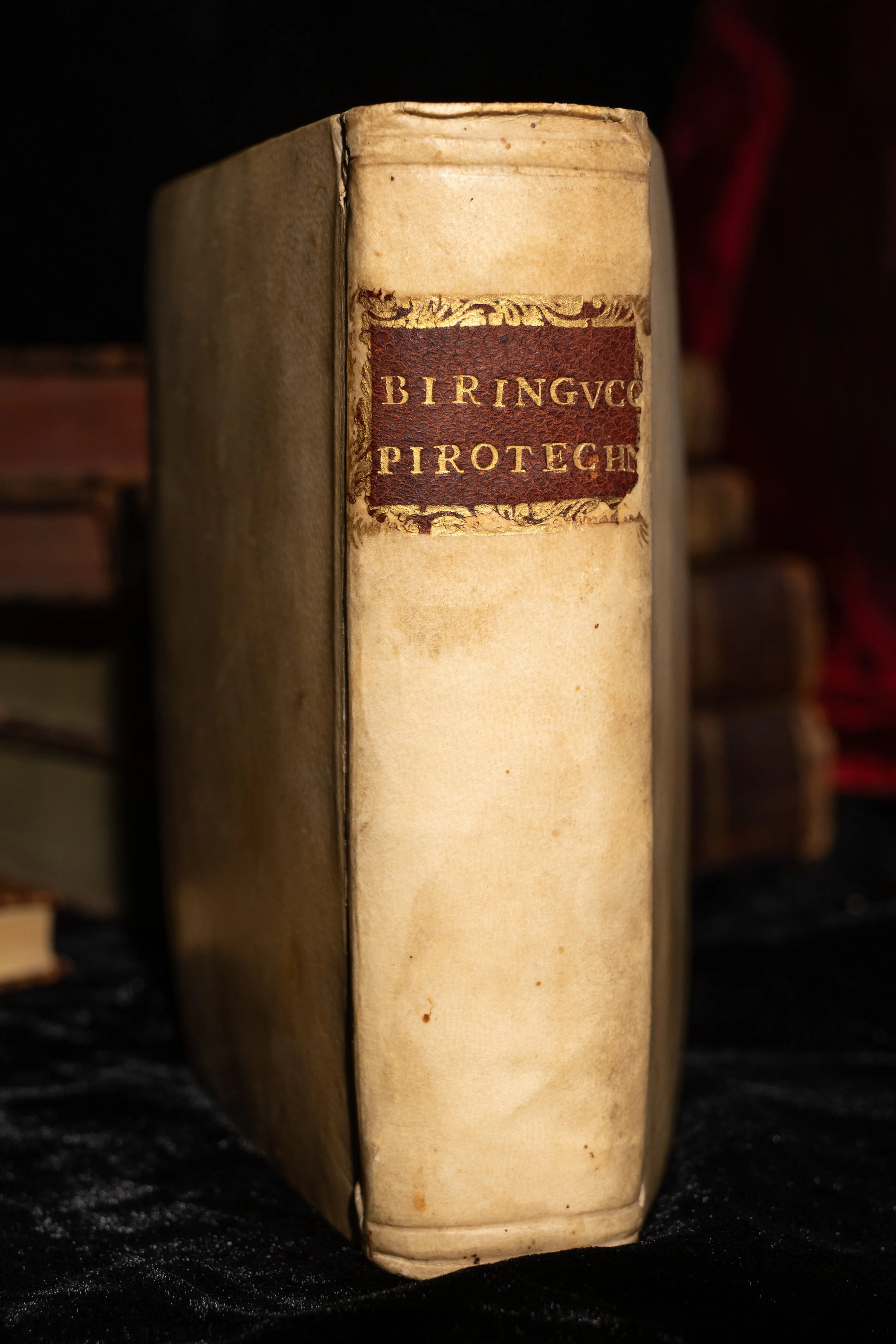 Image 16 of 25
 Image 17 of 25
 Image 18 of 25
 Image 19 of 25
 Image 20 of 25
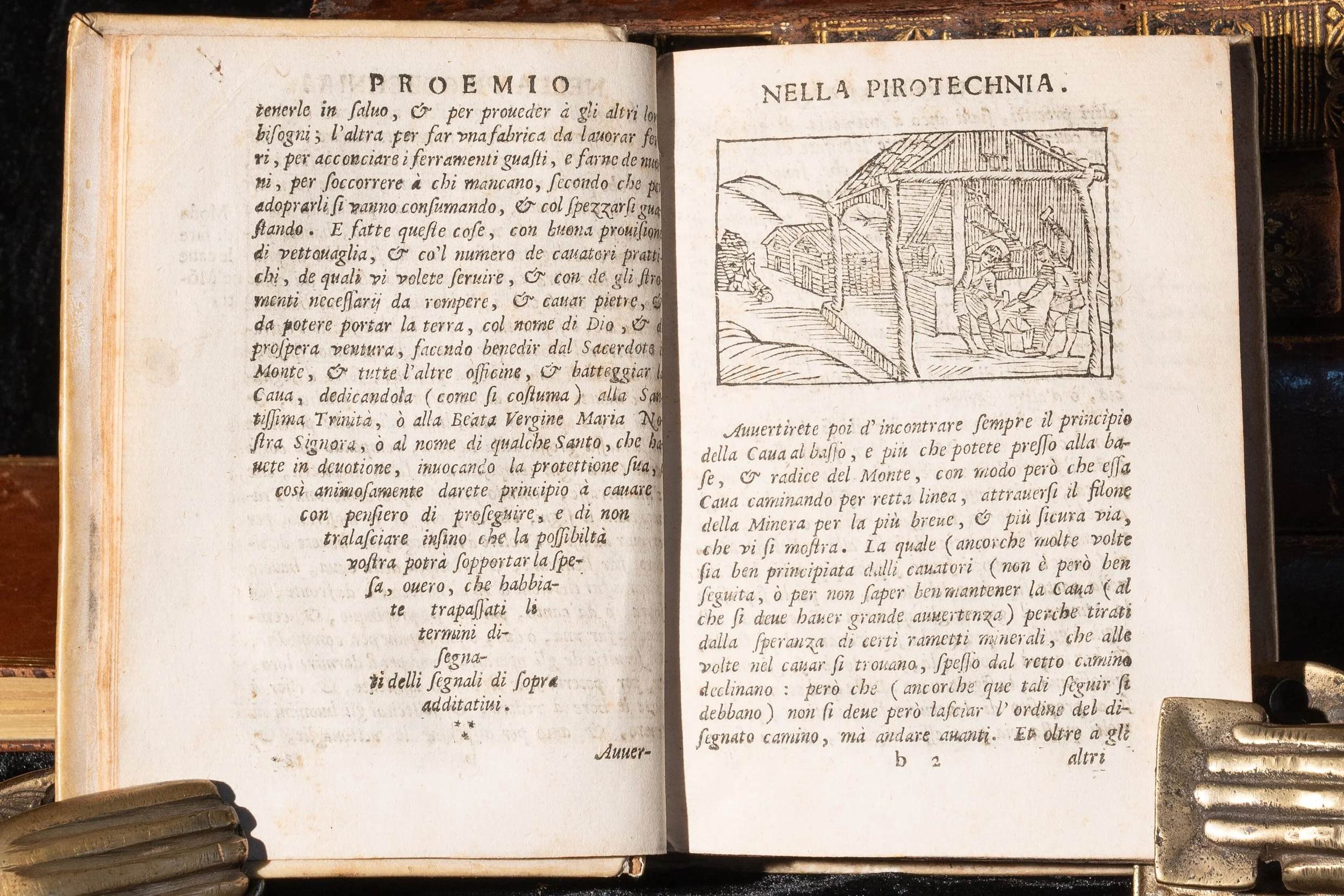 Image 21 of 25
 Image 22 of 25
 Image 23 of 25
 Image 24 of 25
 Image 25 of 25