Heidel deciphered Trithemius’s difficult third book, then printed the explanation in a cipher of his own. This is his 1676 edition, bringing the notorious text together with his defense and extensive commentary.
This 1676 edition of Johannes Trithemius’s Steganographia presents the abbot’s work on secret communication with Wolfgang Ernst Heidel’s defense and explanatory keys. The title page sets out Heidel’s case in red and black: “pernicious, magical and necromantic,” then promises that the book is “now at last vindicated, unlocked, and explained.”
Trithemius had given his readers reason for alarm. In 1499 he wrote to a Carmelite friend in Ghent about a book that would teach communication at a distance without words or a messenger. According to the preface, the friend died before the letter arrived; the prior opened it and began showing it around. Copies circulated through France and Germany, with some readers calling Trithemius a divine man and others a necromancer. The Steganographia circulated in manuscript for a century before reaching print in 1606. It entered the Index of Prohibited Books in 1609.
The text combines the language of spirit magic with systems of hidden writing, or steganography. Its conjurations call on Pamersiel, Padiel and their legions; the title page acknowledges that some readers took the names for “barbarous and meaningless words.” Conjurations also serve as cover for encoded messages. The volume gathers a life of Trithemius and Heidel’s answer to the charge of necromancy, followed by the complete Steganographia and its keys. A concluding Steganographia Illustrata surveys the art.
The chapter list promises communication with a closely guarded prisoner, “even if he sat three miles under the earth,” and conversation without words or nods while playing the organ. Book III presents tables of bare numbers beneath planetary signs, page after page. Heidel claimed to have solved them. He printed the explanation in a cipher of his own. Thomas Ernst and Jim Reeds returned to these puzzles in the 1990s; the messages they recovered included test phrases and the opening of a psalm.
This copy is rebound in later half calf in the antique style, with a gilt date of 1676 at the foot of the spine. Early owners left initials and codes on the title; beside the cipher tables of Book III a reader wrote “NB NB.” The leaves are closely trimmed without loss of text, and there is browning and foxing throughout. The text remains strong and legible.
Provenance: Early ink ownership initials in two hands, old shelf number "201," and an old price code to the title page; early ink "NB NB" beside the cipher tables of Book III.
TRITHEMIUS, Johannes (1462–1516). Steganographia: Quae hucusque à nemine intellecta, sed passim ut supposititia, perniciosa, magica & necromantica, rejecta, elusa, damnata & sententiam inquisitionis passa; nunc tandem vindicata reserata et illustrata, ed. Wolfgang Ernst Heidel of Worms. Mainz (Moguntiae): at the expense of Johann Peter Zubrodt, 1676.
Physical Description: 4to. Title in red and black; 394 pp.; [1] leaf of synopsis at the end, closing with SOLI DEO GLORIA. Comprising the Vita Trithemii, Heidel’s Steganographia Vindicata, the complete Steganographia in three books with its Clavis (introduced by a divisional title reprinting that of the Darmstadt edition of 1621), and the Steganographia Illustrata. Woodcut headpieces and tailpieces, large decorated initials, the cipher tables of Book III printed in the text. Opening and closing blanks renewed.
Binding: Later half calf in the antique style, spine with four raised bands, red morocco lettering-piece gilt, small blind ornaments in the compartments, dated 1676 in gilt at the foot; marbled paper sides with leather corners; endleaves renewed. A handsome, sound binding.
Condition: Leaves closely trimmed, without loss of text; browning, foxing, and spotting throughout, heavier in places; the text strong and legible throughout. Very good.
Heidel deciphered Trithemius’s difficult third book, then printed the explanation in a cipher of his own. This is his 1676 edition, bringing the notorious text together with his defense and extensive commentary.
This 1676 edition of Johannes Trithemius’s Steganographia presents the abbot’s work on secret communication with Wolfgang Ernst Heidel’s defense and explanatory keys. The title page sets out Heidel’s case in red and black: “pernicious, magical and necromantic,” then promises that the book is “now at last vindicated, unlocked, and explained.”
Trithemius had given his readers reason for alarm. In 1499 he wrote to a Carmelite friend in Ghent about a book that would teach communication at a distance without words or a messenger. According to the preface, the friend died before the letter arrived; the prior opened it and began showing it around. Copies circulated through France and Germany, with some readers calling Trithemius a divine man and others a necromancer. The Steganographia circulated in manuscript for a century before reaching print in 1606. It entered the Index of Prohibited Books in 1609.
The text combines the language of spirit magic with systems of hidden writing, or steganography. Its conjurations call on Pamersiel, Padiel and their legions; the title page acknowledges that some readers took the names for “barbarous and meaningless words.” Conjurations also serve as cover for encoded messages. The volume gathers a life of Trithemius and Heidel’s answer to the charge of necromancy, followed by the complete Steganographia and its keys. A concluding Steganographia Illustrata surveys the art.
The chapter list promises communication with a closely guarded prisoner, “even if he sat three miles under the earth,” and conversation without words or nods while playing the organ. Book III presents tables of bare numbers beneath planetary signs, page after page. Heidel claimed to have solved them. He printed the explanation in a cipher of his own. Thomas Ernst and Jim Reeds returned to these puzzles in the 1990s; the messages they recovered included test phrases and the opening of a psalm.
This copy is rebound in later half calf in the antique style, with a gilt date of 1676 at the foot of the spine. Early owners left initials and codes on the title; beside the cipher tables of Book III a reader wrote “NB NB.” The leaves are closely trimmed without loss of text, and there is browning and foxing throughout. The text remains strong and legible.
Provenance: Early ink ownership initials in two hands, old shelf number "201," and an old price code to the title page; early ink "NB NB" beside the cipher tables of Book III.
TRITHEMIUS, Johannes (1462–1516). Steganographia: Quae hucusque à nemine intellecta, sed passim ut supposititia, perniciosa, magica & necromantica, rejecta, elusa, damnata & sententiam inquisitionis passa; nunc tandem vindicata reserata et illustrata, ed. Wolfgang Ernst Heidel of Worms. Mainz (Moguntiae): at the expense of Johann Peter Zubrodt, 1676.
Physical Description: 4to. Title in red and black; 394 pp.; [1] leaf of synopsis at the end, closing with SOLI DEO GLORIA. Comprising the Vita Trithemii, Heidel’s Steganographia Vindicata, the complete Steganographia in three books with its Clavis (introduced by a divisional title reprinting that of the Darmstadt edition of 1621), and the Steganographia Illustrata. Woodcut headpieces and tailpieces, large decorated initials, the cipher tables of Book III printed in the text. Opening and closing blanks renewed.
Binding: Later half calf in the antique style, spine with four raised bands, red morocco lettering-piece gilt, small blind ornaments in the compartments, dated 1676 in gilt at the foot; marbled paper sides with leather corners; endleaves renewed. A handsome, sound binding.
Condition: Leaves closely trimmed, without loss of text; browning, foxing, and spotting throughout, heavier in places; the text strong and legible throughout. Very good.

 Image 1 of 20
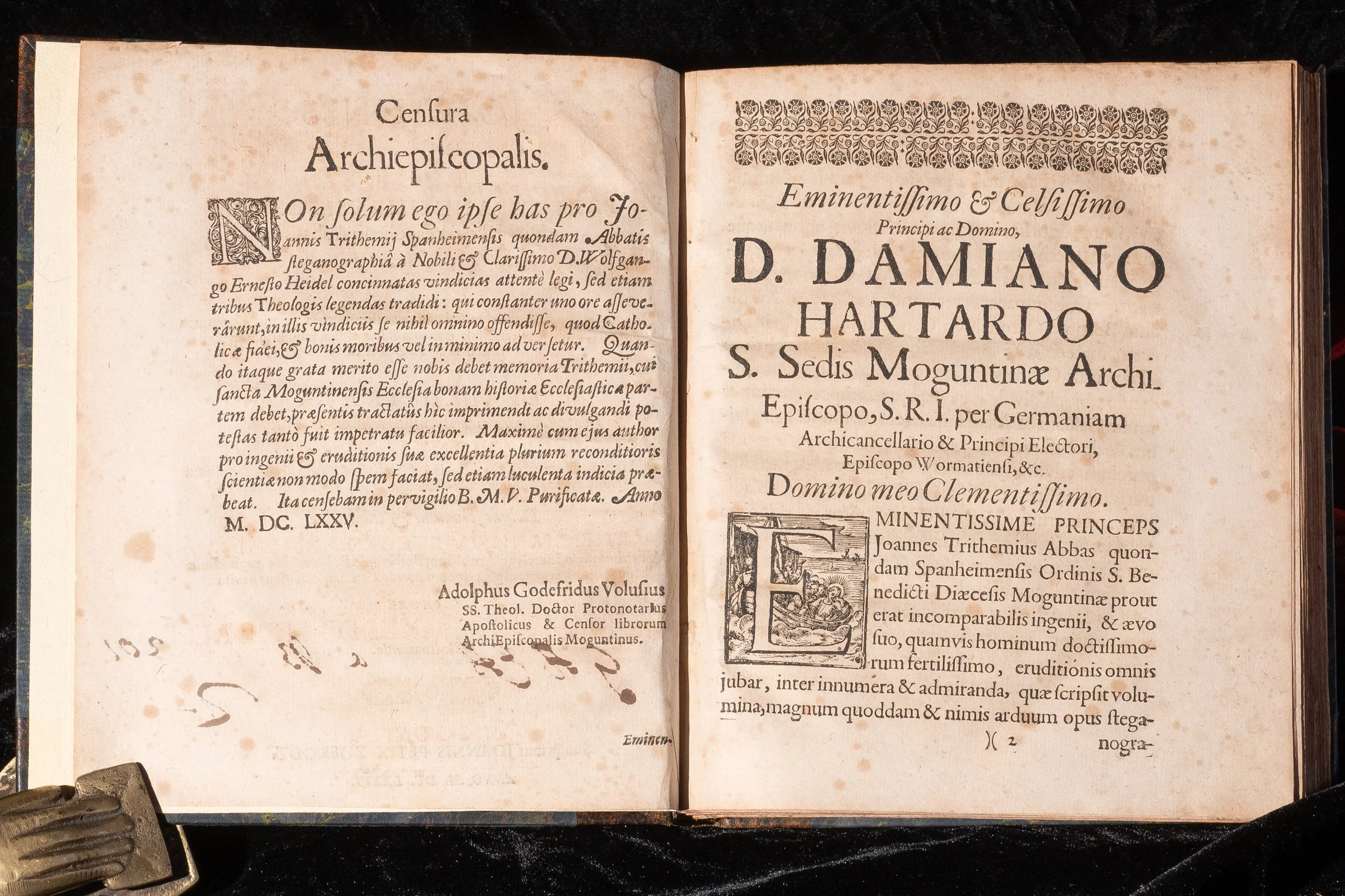 Image 2 of 20
 Image 3 of 20
 Image 4 of 20
 Image 5 of 20
 Image 6 of 20
 Image 7 of 20
 Image 8 of 20
 Image 9 of 20
 Image 10 of 20
 Image 11 of 20
 Image 12 of 20
 Image 13 of 20
 Image 14 of 20
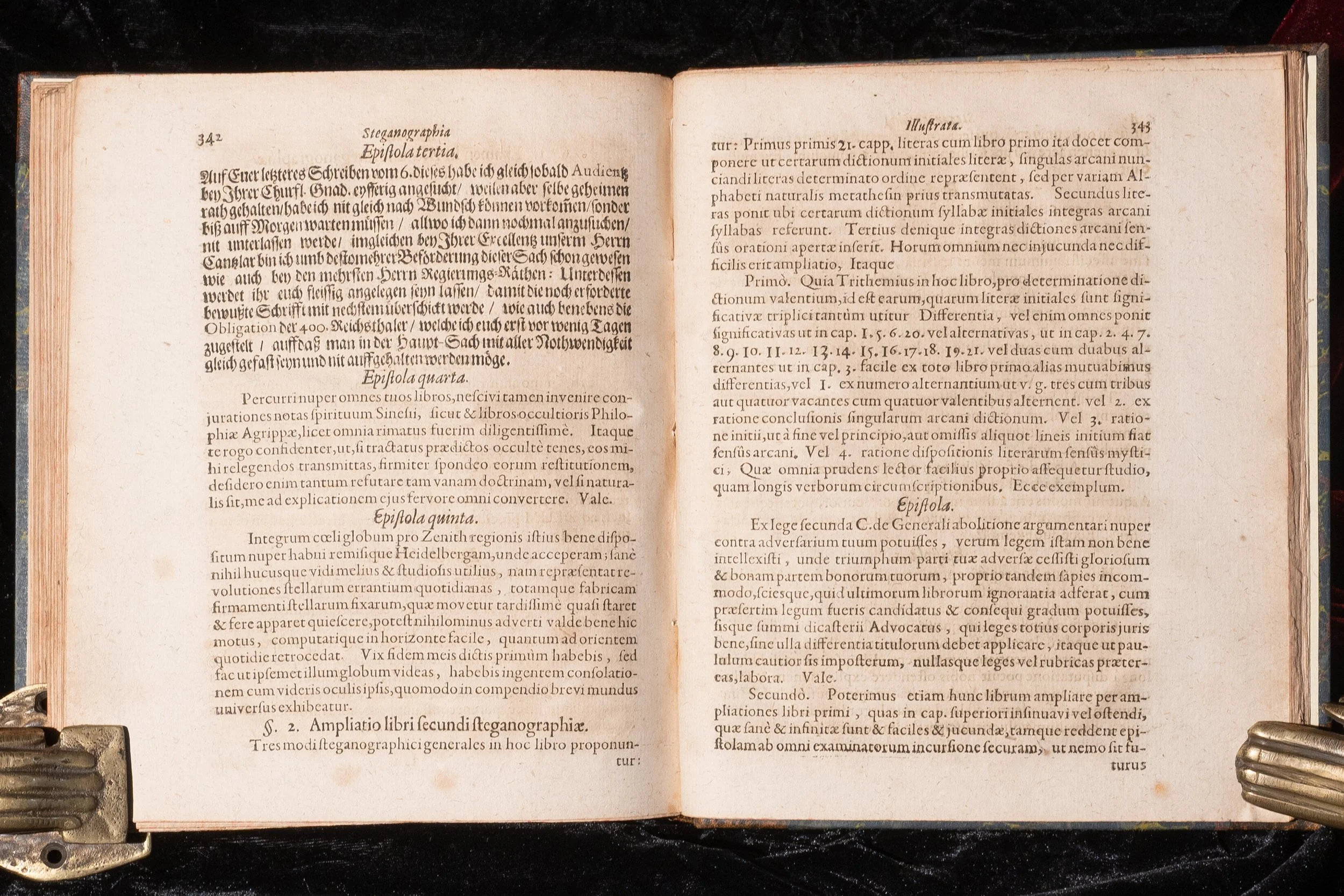 Image 15 of 20
 Image 16 of 20
 Image 17 of 20
 Image 18 of 20
 Image 19 of 20
 Image 20 of 20