The most quoted passage in the Hermetic literature is the lament in the Asclepius, where Hermes Trismegistus mourns the death of Egypt before the fact. A time will come, he says, when it will seem the Egyptians honored the gods in vain, when divinity will leave the earth for heaven and the land will be left empty. In the last chapter of this book Count Maurizio Fieschi copied that lament out and printed it with one change. Where Hermes wrote Egyptians, Fieschi wrote Romans. "A time is coming," his version runs, "when it will appear that the Romans kept the Divinity with pious mind and diligent religion in vain, and all their holy worship will come to nothing."
Fieschi came from the Genoese family that gave Rome two medieval popes. He dedicated the Decas de fato to God himself, "King of Kings, Three and One, my Redeemer and Liberator from the hands of Satan and of the powerful on earth," and signed the dedication "a worm of the earth, I, a man." The book is a treatise on fate in ten parts, one for each of the ten heavens, descending from the highest sphere to the sphere of the Moon. Each part opens with a table of correspondences in the manner of Agrippa: a number, a person of the Trinity, a divine name, an angel, a heaven. Under the eighth sphere, the fixed stars, come the nativities, more than thirty horoscopes of the famous and the unlucky printed as woodcut squares. Savonarola is there, his Moon, the count wrote, decreeing "a violent death" and marking "a despiser and deceiver of religion." So are Pico della Mirandola, Gustavus Adolphus of Sweden and Pope Clement VIII. So are lesser men whose charts came out worse: an imperial councilor named Andreas Ruttell, ambushed by an armored count on the road to Rothenburg in 1517 and shot through the flank with a poisoned crossbow bolt, and Camillo Trivulzio, who lost a whole leg to a shot in battle at thirty-six and later died, Saturn in the fourth house having required exactly that. The lower spheres take up physiognomy and palmistry, comets down to the year 1665, eclipses and climacteric years, and the fate of kingdoms reckoned by Platonic numbers. Fieschi called it a work of his youth. He knew of it, he told the reader, by the age of seventeen, when he took his degree.
This is judicial astrology of the Reuchlin and Agrippa school, steeped in kabbalah. The book ends with a hymn that calls on the ten archangels of the sephiroth by name, Metatron and Raziel among them, and closes on "Adonai Melech, whose Malkuth endures forever." Hermetic prophecy and the horoscopes of popes were both the sorts of things the Roman Index of forbidden books existed to prevent. Fieschi's preface meets the objection head on. "I lay open the sciences in circulation, and the hidden secrets of the magical arts as well," he wrote; "but hear this, that the knowledge of evil is not evil, only its use." The book was set in type three times in its one year of publication and never reprinted. Someone in the next generation wanted it badly enough to copy all 259 pages out by hand, and that manuscript has since passed through the auction rooms.
Bound in front of the Fieschi, by an owner around the year 1700, is a manual for using the celestial and terrestrial globes of Gerard Valk of Amsterdam. Valk engraved his first pair of globes in 1700, and this Latin handbook was sold alongside them, together with a planetary instrument called the planetolabium, invented by the Leiden astronomer Lothar Zumbach von Koesfeld. It is the first edition, and the Dutch national bibliography of early printing records a single copy. The four engraved plates carry Dutch captions, since they were cut for the Dutch version of the same manual, and among the quadrants and sundials they include a diagram of the twelve houses and a worked horoscope for a child born in London at six minutes past two in the morning on 3 February 1675, initials L.V. That is Leonard Valk, the publisher's son, born in London that year.
Our copy is in vellum of the period, with an early owner's ink underlinings in the Fieschi and the date 1700 supplied in an old hand on the undated Valk title page. The globe manual lacks one preliminary leaf; the Fieschi is complete, with a fine engraved portrait of the young count in a laurel wreath, with his coronet and arms below. The portrait is shaved close on three sides. The full details are below.
FIESCHI, MAURIZIO, Count (Mauritius Comes Fliscus). Comitis de Flisco Decas de Fato, Annisque Fatalibus tam Hominibus quam Regnis Mundi. Frankfurt: Johann Baptist Schönwetter, 1665. First edition, one of the two Schönwetter settings of that year. Bound with, preceding it: [ZUMBACH VON KOESFELD, LOTHAR, attributed.] Praxis Astronomiae utriusque ut et Geographiae, Exercita per Usum Globi Coelestis & Terrestris tum & Planetolabii. Amsterdam: Gerard Valk, [about 1700]. First edition.
Physical Description: Two works in one volume, small quarto, about 20 by 16 cm. Fieschi: six preliminary leaves including the engraved portrait frontispiece by Johann Philipp Thelott, the title with an engraved vignette, and 259 pages, with woodcut horoscope diagrams throughout the text. Zumbach: two preliminary leaves of three, lacking the privilege leaf, 139 pages, and four engraved plates of astronomical figures, all present. The Zumbach is bound first.
Binding: Vellum over boards of about 1700, the spine plain and unlettered. Soiled, with small losses at the ends of the spine; the front inner hinge is broken and the front free endpaper is gone.
Condition: Both works browned, with occasional light spotting. The portrait is trimmed close on three sides. Occasional early ink underlining in the Fieschi, heaviest in the chapter on Rome; the date "1700" added in an early hand to the Valk title page.
The most quoted passage in the Hermetic literature is the lament in the Asclepius, where Hermes Trismegistus mourns the death of Egypt before the fact. A time will come, he says, when it will seem the Egyptians honored the gods in vain, when divinity will leave the earth for heaven and the land will be left empty. In the last chapter of this book Count Maurizio Fieschi copied that lament out and printed it with one change. Where Hermes wrote Egyptians, Fieschi wrote Romans. "A time is coming," his version runs, "when it will appear that the Romans kept the Divinity with pious mind and diligent religion in vain, and all their holy worship will come to nothing."
Fieschi came from the Genoese family that gave Rome two medieval popes. He dedicated the Decas de fato to God himself, "King of Kings, Three and One, my Redeemer and Liberator from the hands of Satan and of the powerful on earth," and signed the dedication "a worm of the earth, I, a man." The book is a treatise on fate in ten parts, one for each of the ten heavens, descending from the highest sphere to the sphere of the Moon. Each part opens with a table of correspondences in the manner of Agrippa: a number, a person of the Trinity, a divine name, an angel, a heaven. Under the eighth sphere, the fixed stars, come the nativities, more than thirty horoscopes of the famous and the unlucky printed as woodcut squares. Savonarola is there, his Moon, the count wrote, decreeing "a violent death" and marking "a despiser and deceiver of religion." So are Pico della Mirandola, Gustavus Adolphus of Sweden and Pope Clement VIII. So are lesser men whose charts came out worse: an imperial councilor named Andreas Ruttell, ambushed by an armored count on the road to Rothenburg in 1517 and shot through the flank with a poisoned crossbow bolt, and Camillo Trivulzio, who lost a whole leg to a shot in battle at thirty-six and later died, Saturn in the fourth house having required exactly that. The lower spheres take up physiognomy and palmistry, comets down to the year 1665, eclipses and climacteric years, and the fate of kingdoms reckoned by Platonic numbers. Fieschi called it a work of his youth. He knew of it, he told the reader, by the age of seventeen, when he took his degree.
This is judicial astrology of the Reuchlin and Agrippa school, steeped in kabbalah. The book ends with a hymn that calls on the ten archangels of the sephiroth by name, Metatron and Raziel among them, and closes on "Adonai Melech, whose Malkuth endures forever." Hermetic prophecy and the horoscopes of popes were both the sorts of things the Roman Index of forbidden books existed to prevent. Fieschi's preface meets the objection head on. "I lay open the sciences in circulation, and the hidden secrets of the magical arts as well," he wrote; "but hear this, that the knowledge of evil is not evil, only its use." The book was set in type three times in its one year of publication and never reprinted. Someone in the next generation wanted it badly enough to copy all 259 pages out by hand, and that manuscript has since passed through the auction rooms.
Bound in front of the Fieschi, by an owner around the year 1700, is a manual for using the celestial and terrestrial globes of Gerard Valk of Amsterdam. Valk engraved his first pair of globes in 1700, and this Latin handbook was sold alongside them, together with a planetary instrument called the planetolabium, invented by the Leiden astronomer Lothar Zumbach von Koesfeld. It is the first edition, and the Dutch national bibliography of early printing records a single copy. The four engraved plates carry Dutch captions, since they were cut for the Dutch version of the same manual, and among the quadrants and sundials they include a diagram of the twelve houses and a worked horoscope for a child born in London at six minutes past two in the morning on 3 February 1675, initials L.V. That is Leonard Valk, the publisher's son, born in London that year.
Our copy is in vellum of the period, with an early owner's ink underlinings in the Fieschi and the date 1700 supplied in an old hand on the undated Valk title page. The globe manual lacks one preliminary leaf; the Fieschi is complete, with a fine engraved portrait of the young count in a laurel wreath, with his coronet and arms below. The portrait is shaved close on three sides. The full details are below.
FIESCHI, MAURIZIO, Count (Mauritius Comes Fliscus). Comitis de Flisco Decas de Fato, Annisque Fatalibus tam Hominibus quam Regnis Mundi. Frankfurt: Johann Baptist Schönwetter, 1665. First edition, one of the two Schönwetter settings of that year. Bound with, preceding it: [ZUMBACH VON KOESFELD, LOTHAR, attributed.] Praxis Astronomiae utriusque ut et Geographiae, Exercita per Usum Globi Coelestis & Terrestris tum & Planetolabii. Amsterdam: Gerard Valk, [about 1700]. First edition.
Physical Description: Two works in one volume, small quarto, about 20 by 16 cm. Fieschi: six preliminary leaves including the engraved portrait frontispiece by Johann Philipp Thelott, the title with an engraved vignette, and 259 pages, with woodcut horoscope diagrams throughout the text. Zumbach: two preliminary leaves of three, lacking the privilege leaf, 139 pages, and four engraved plates of astronomical figures, all present. The Zumbach is bound first.
Binding: Vellum over boards of about 1700, the spine plain and unlettered. Soiled, with small losses at the ends of the spine; the front inner hinge is broken and the front free endpaper is gone.
Condition: Both works browned, with occasional light spotting. The portrait is trimmed close on three sides. Occasional early ink underlining in the Fieschi, heaviest in the chapter on Rome; the date "1700" added in an early hand to the Valk title page.

 Image 1 of 15
 Image 2 of 15
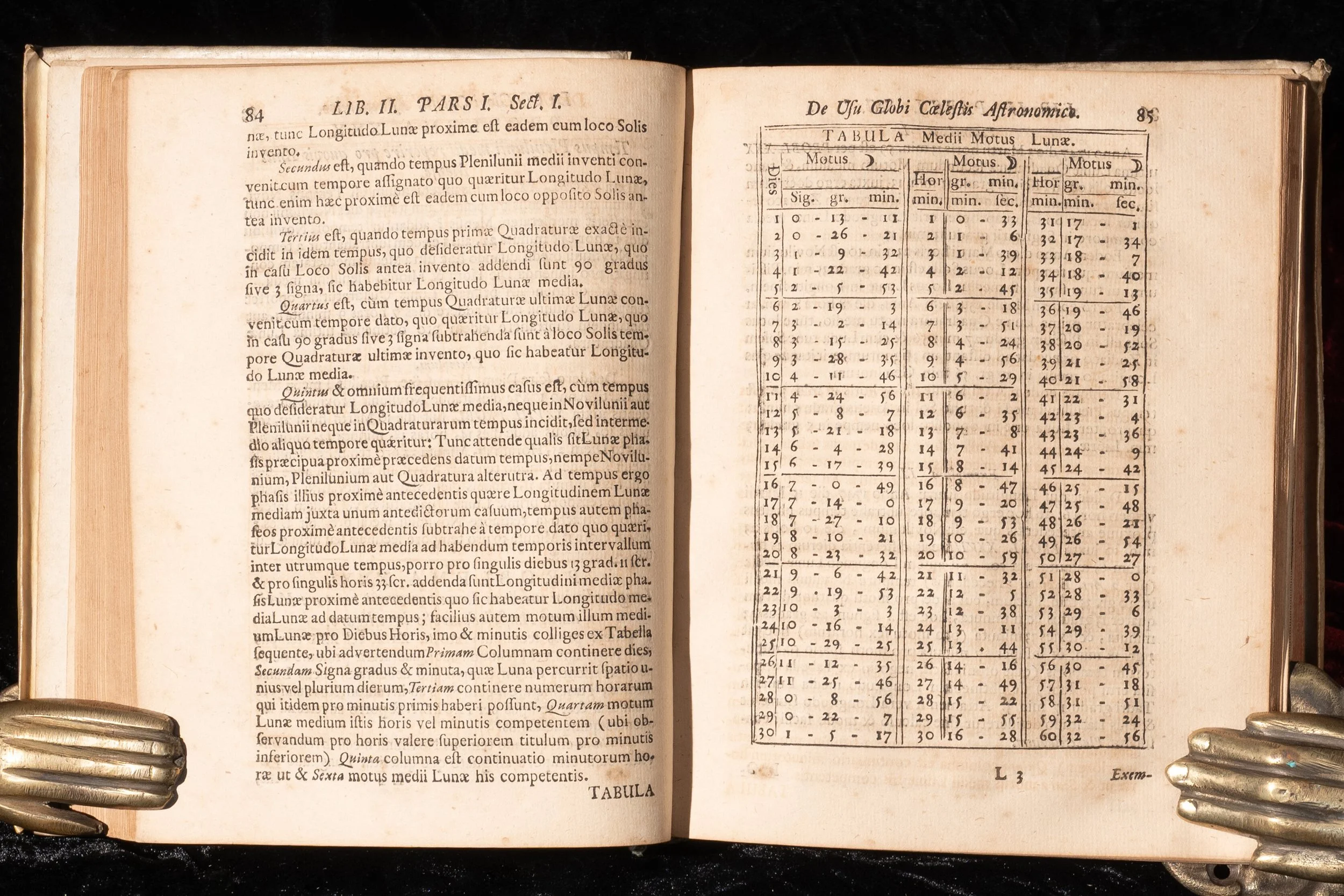 Image 3 of 15
 Image 4 of 15
 Image 5 of 15
 Image 6 of 15
 Image 7 of 15
 Image 8 of 15
 Image 9 of 15
 Image 10 of 15
 Image 11 of 15
 Image 12 of 15
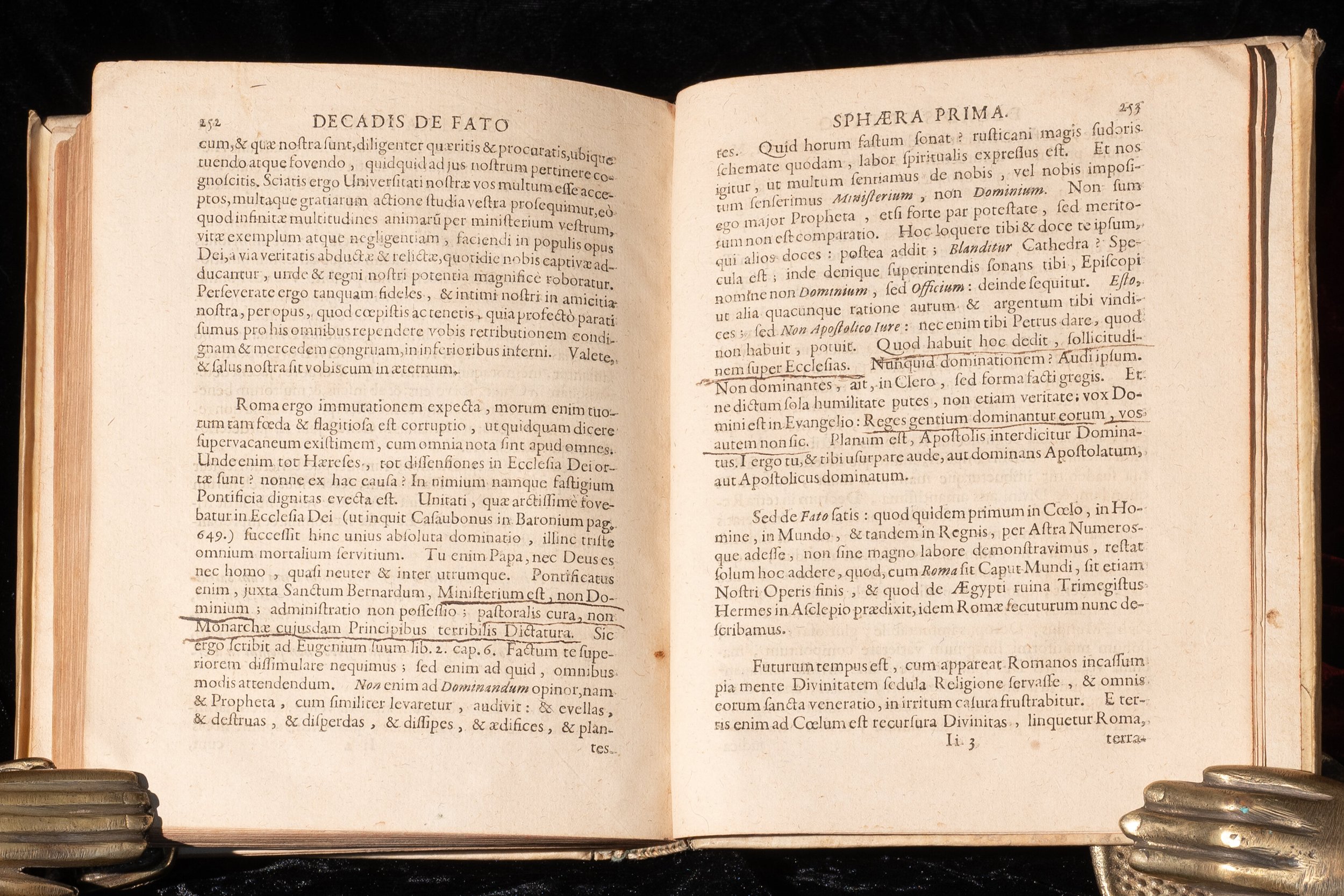 Image 13 of 15
 Image 14 of 15
 Image 15 of 15