Deep in this 1657 mining folio, Georg Agricola turns from bats and salamanders to the spirits miners reported underground. Some were deadly. Others were almost companionable: little figures the miners called cobali, clattering about the shafts, seeming busy at every task and accomplishing nothing. Agricola records them in the same measured Latin he uses for pumps.
The spirits appear in De animantibus subterraneis, one of six related treatises accompanying De re metallica. Agricola was a physician in the mining towns of Joachimsthal and Chemnitz, and his twelve books on mining, first published in 1556, follow the work from finding a vein to processing its ore. The illustrations reward a long look. Roughly 270 woodcuts show waterwheels and miners at windlasses, with furnaces opened in section so the reader can see how they work. Even the ore carts running on wooden rails are there.
In Book Two, Agricola examines the divining rod, the forked twig supposed to move above a hidden vein. He describes the practice carefully and advises miners to rely on the natural signs of the earth. Following his judgments is part of the interest. His attention to what miners did underground extends to the methods they trusted and the creatures they said they met there.
The work eventually found two particularly well-equipped English translators in Herbert and Lou Henry Hoover, whose version appeared in 1912. Herbert had been a mining engineer long before he became president. The machinery and processes gave them a good deal to explain.
This 1657 Basel printing is the fourth and last early Latin edition. Alongside the mining books, its related treatises cover subterranean fluids and minerals, with the dialogue Bermannus and the account of underground creatures. A glossary moves between Latin and the German vocabulary of the mines. This copy includes the large folding sheet of surveying figures and retains old ink inventory numerals on the title. It is in later half calf over cloth boards; the short tear to the folding sheet is recorded in the condition description.
AGRICOLA, Georg (1494-1555). De Re Metallica Libri XII. Quibus officia, instrumenta, machinae, ac omnia denique ad metallicam spectantia, non modo luculentissime describuntur... Quibus accesserunt hac ultima editione, Tractatus ejusdem argumenti... De Animantibus Subterraneis; De Ortu & Causis Subterraneorum; De Natura eorum quae effluunt ex Terra; De Natura Fossilium; De Veteribus & Novis Metallis; Bermannus sive de Re Metallica Dialogus. Basel: Emanuel König, 1657. Fourth and last early Latin edition; first published Basel, 1556.
Physical Description: Folio (about 34.5 x 20.5 cm). [1], [1 blank], [3], [3 blank], [8], 708, [58], [2 blank], [32] pp., the final section comprising the Latin-German glossary of mining terms and the indexes. Woodcut vignette to title (the assayer at his furnace, repeated at p. 176), roughly 270 woodcut illustrations in the text, many near full-page, and the folding woodcut surveying figures called for at folios 97 and 100, printed on one large folding sheet, present. Woodcut initials and ornaments. Collated complete.
Binding: Later half dark brown calf over cloth boards, gilt rules, raised bands, spine gilt in compartments, red morocco lettering label, date gilt at foot, marbled endpapers. Clean and firm.
Condition: Light browning and scattered spotting, minor fraying to the fore-margin of the title, a short tear at the lower inner corner of the folding sheet, old ink inventory numerals to title. A crisp, wide-margined copy.
Deep in this 1657 mining folio, Georg Agricola turns from bats and salamanders to the spirits miners reported underground. Some were deadly. Others were almost companionable: little figures the miners called cobali, clattering about the shafts, seeming busy at every task and accomplishing nothing. Agricola records them in the same measured Latin he uses for pumps.
The spirits appear in De animantibus subterraneis, one of six related treatises accompanying De re metallica. Agricola was a physician in the mining towns of Joachimsthal and Chemnitz, and his twelve books on mining, first published in 1556, follow the work from finding a vein to processing its ore. The illustrations reward a long look. Roughly 270 woodcuts show waterwheels and miners at windlasses, with furnaces opened in section so the reader can see how they work. Even the ore carts running on wooden rails are there.
In Book Two, Agricola examines the divining rod, the forked twig supposed to move above a hidden vein. He describes the practice carefully and advises miners to rely on the natural signs of the earth. Following his judgments is part of the interest. His attention to what miners did underground extends to the methods they trusted and the creatures they said they met there.
The work eventually found two particularly well-equipped English translators in Herbert and Lou Henry Hoover, whose version appeared in 1912. Herbert had been a mining engineer long before he became president. The machinery and processes gave them a good deal to explain.
This 1657 Basel printing is the fourth and last early Latin edition. Alongside the mining books, its related treatises cover subterranean fluids and minerals, with the dialogue Bermannus and the account of underground creatures. A glossary moves between Latin and the German vocabulary of the mines. This copy includes the large folding sheet of surveying figures and retains old ink inventory numerals on the title. It is in later half calf over cloth boards; the short tear to the folding sheet is recorded in the condition description.
AGRICOLA, Georg (1494-1555). De Re Metallica Libri XII. Quibus officia, instrumenta, machinae, ac omnia denique ad metallicam spectantia, non modo luculentissime describuntur... Quibus accesserunt hac ultima editione, Tractatus ejusdem argumenti... De Animantibus Subterraneis; De Ortu & Causis Subterraneorum; De Natura eorum quae effluunt ex Terra; De Natura Fossilium; De Veteribus & Novis Metallis; Bermannus sive de Re Metallica Dialogus. Basel: Emanuel König, 1657. Fourth and last early Latin edition; first published Basel, 1556.
Physical Description: Folio (about 34.5 x 20.5 cm). [1], [1 blank], [3], [3 blank], [8], 708, [58], [2 blank], [32] pp., the final section comprising the Latin-German glossary of mining terms and the indexes. Woodcut vignette to title (the assayer at his furnace, repeated at p. 176), roughly 270 woodcut illustrations in the text, many near full-page, and the folding woodcut surveying figures called for at folios 97 and 100, printed on one large folding sheet, present. Woodcut initials and ornaments. Collated complete.
Binding: Later half dark brown calf over cloth boards, gilt rules, raised bands, spine gilt in compartments, red morocco lettering label, date gilt at foot, marbled endpapers. Clean and firm.
Condition: Light browning and scattered spotting, minor fraying to the fore-margin of the title, a short tear at the lower inner corner of the folding sheet, old ink inventory numerals to title. A crisp, wide-margined copy.

 Image 1 of 43
 Image 2 of 43
 Image 3 of 43
 Image 4 of 43
 Image 5 of 43
 Image 6 of 43
 Image 7 of 43
 Image 8 of 43
 Image 9 of 43
 Image 10 of 43
 Image 11 of 43
 Image 12 of 43
 Image 13 of 43
 Image 14 of 43
 Image 15 of 43
 Image 16 of 43
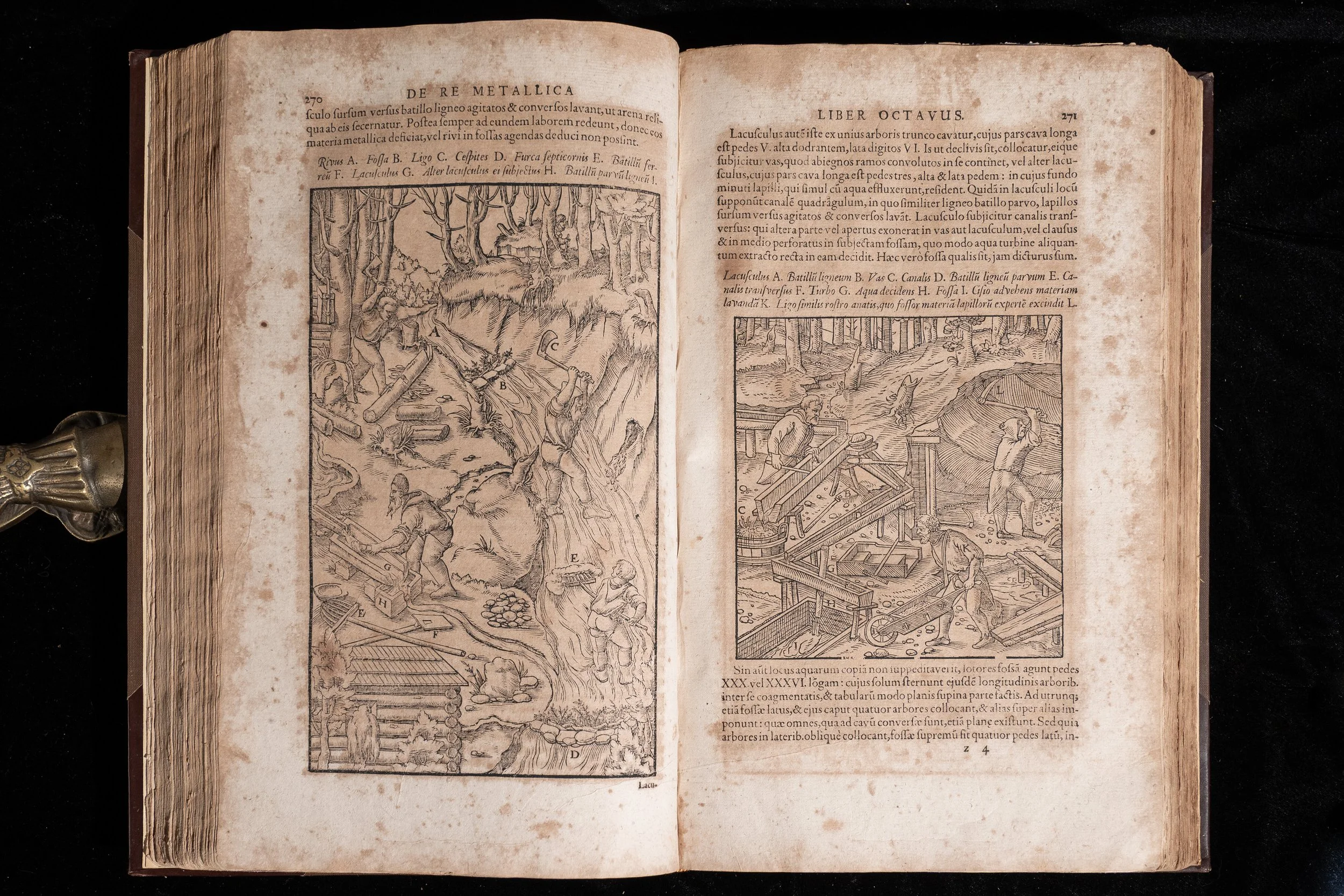 Image 17 of 43
 Image 18 of 43
 Image 19 of 43
 Image 20 of 43
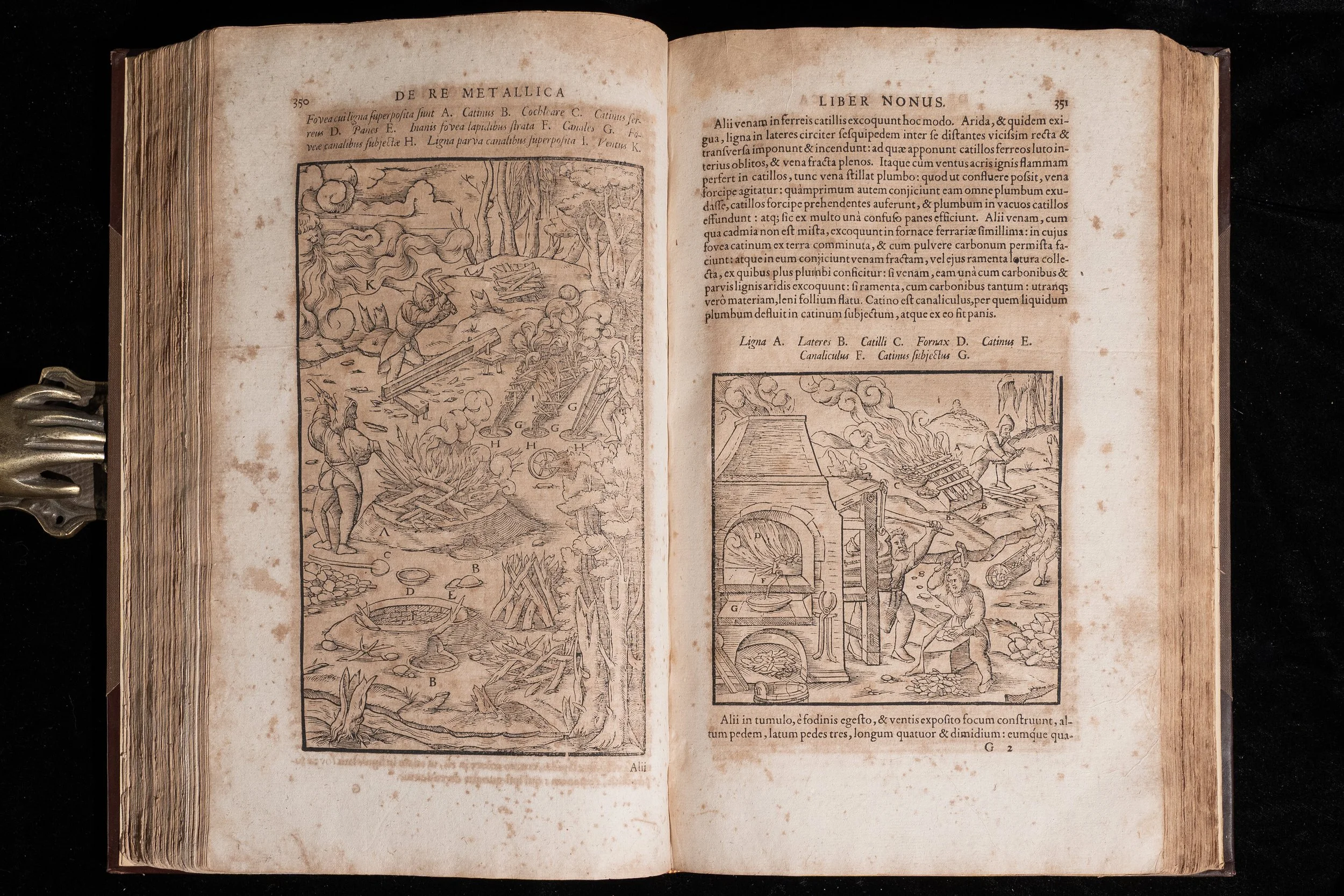 Image 21 of 43
 Image 22 of 43
 Image 23 of 43
 Image 24 of 43
 Image 25 of 43
 Image 26 of 43
 Image 27 of 43
 Image 28 of 43
 Image 29 of 43
 Image 30 of 43
 Image 31 of 43
 Image 32 of 43
 Image 33 of 43
 Image 34 of 43
 Image 35 of 43
 Image 36 of 43
 Image 37 of 43
 Image 38 of 43
 Image 39 of 43
 Image 40 of 43
 Image 41 of 43
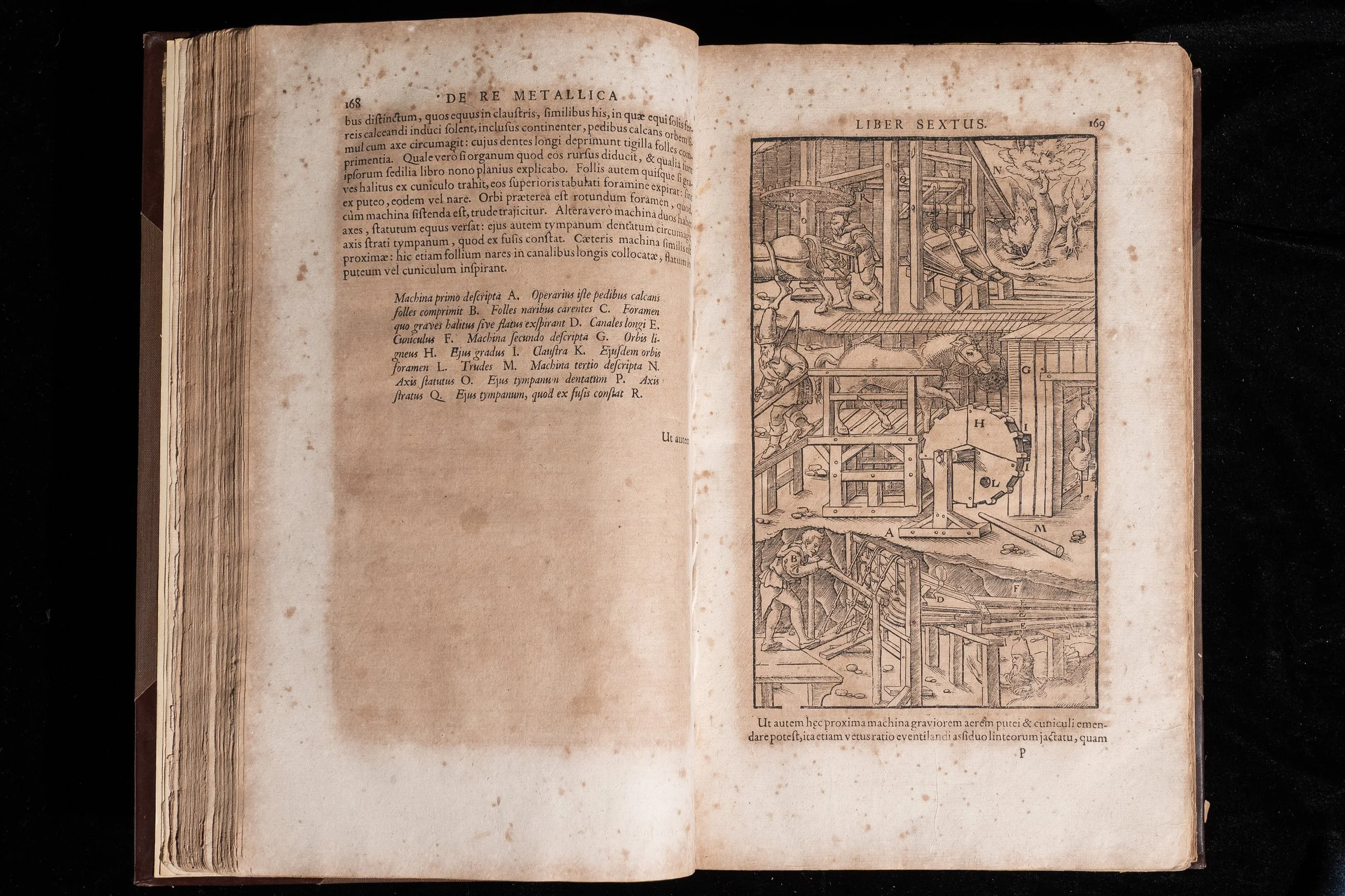 Image 42 of 43
 Image 43 of 43