This copy has sold. We currently have the 1676 Heidel edition of Steganographia, with his defense of Trithemius and extensive explanations of the ciphers, available for $3,200.
Few texts in the history of Western esotericism have generated quite so much anxious speculation as the Steganographia. Trithemius composed it around 1499, and it promptly acquired a reputation that outpaced the manuscript itself: a book of angel magic, or worse, a manual for trafficking with demons. The mere rumor of its contents was enough to alarm Charles de Bovelles, who warned that the abbot of Sponheim had been dabbling in necromancy. Trithemius spent considerable effort reassuring correspondents that the work was nothing of the sort, but he never published it, and the manuscript tradition ensured that suspicion clung to the text for over a century. When it finally appeared in print at Frankfurt in 1606, the Vatican responded by placing it on the Index Librorum Prohibitorum in 1609, where it would remain until 1900.
The three books of the Steganographia present, on their surface, a system of spirit conjuration organized by cardinal directions and planetary hours. The operator learns the names and sigils of spirits such as Pamersiel, Padiel, and Dorothiel, each governing a region of the compass and commanding legions of subordinate intelligences. Messages are to be transmitted across great distances by invoking the appropriate spirit at the appropriate hour and encoding one's intention in a prescribed verbal formula. The apparatus is elaborate, the tone earnest, and the effect deeply unsettling to early modern readers who encountered the text without its key.
The Clavis Steganographiae, here printed as the second part, reveals the game. The spirit names are mnemonics; the conjurations are cover-text; the entire system is an exercise in cryptography and steganography, the art of hiding messages in plain sight. The elaborate angel hierarchies encode a series of cipher systems of increasing sophistication, from simple substitution to polyalphabetic methods. The Clavis Generalis Triplex, forming the third part, provides additional decryption tools, including the cipher wheel visible in the present copy.
The cryptographic methods of Books I and II were already explained in the Clavis published in 1606. Book III proved harder to interpret. Heidel deciphered it in 1676, but concealed his explanation in a cipher of his own. Modern work by Thomas Ernst and, independently, Jim Reeds established its cryptographic content in the 1990s; Ernst also deciphered Heidel’s explanation.
For the historian of Western esotericism, the text is significant on several counts. Trithemius was the teacher of Agrippa, who drafted portions of De occulta philosophia while staying at Sponheim, and a correspondent of the broader humanist-magical network of the early sixteenth century. The Steganographia represents a distinctive strain of learned magic in which the manipulation of signs and symbols, rather than the coercion of spirits per se, constitutes the operative technique. Whether one reads it as a cryptographic treatise disguised as magic, or as a magical treatise that happens to work through cryptographic means, it occupies a liminal position that illuminates the unstable boundaries between natural philosophy, mathematics, and occult science in the Renaissance.
This 1621 Darmstadt edition, printed by Balthasar Hofmann for the Frankfurt bookseller Johann Berner, presents all three textual components: the Steganographia proper, Trithemius's own Clavis, and the Clavis Generalis Triplex. The woodcut diagrams are essential to the work's function and are here present and clear.
TRITHEMIUS, Johannes (1462–1516). Steganographia: Hoc est: Ars per occultam scripturam animi sui voluntatem absentibus aperiendi certa; Authore Reverendissimo et Clarissimo Viro, Ioanne Trithemio, Abbate Spanheimensi, & Magiae Naturalis Magistro perfectissimo. Praefixa est huic operi sua Clavis, seu vera introductio ab ipso Authore concinnata... [Bound with:] Clavis Steganographiae Ioannis Trithemii Abbatis Spanheimensis. Ad Serenissimum Principem Dn. Philippum, Comitem Palatinum Rheni, Ducem Bauariae, Imperii Electorem. [And:] Clavis Generalis Triplex in libros steganographicos Iohannis Trithemii Darmstadt: Ex Officina Typographica Balthasaris Aulaeandri [Balthasar Hofmann], sumptibus Ioannis Berneri, Bibliop. Francof., 1621.
Physical Description: Quarto (21 × 17 cm). Three parts in one volume: [8], 158, [2]; 64; 7, [1] pp. Woodcut printer's device to title pages of Parts II and III (Cyclopes forging the thunderbolts of Zeus, within ornamental border). Woodcut initials and typographic ornaments throughout. Numerous woodcut diagrams including directional spirit diagrams, sigils, cipher tables, and cipher wheel.
Collation: π4 A–V4; A–H4; a4.
Contemporary full calf, spine with raised bands. Boards and spine worn, with surface abrasion and cracking to leather, particularly at joints and extremities; head and tail of spine worn. Marbled endpapers. Binding sound.
Condition: Text block generally clean with the even browning typical of German paper stock of this period. Some marginal dust-soiling. Previous bookseller's pencil collation note to front free endpaper: "(8), 158 pp., 1 leaf & index, 64 pp.; 7, (1) pp. Collated." Stock number "1171X" in pencil to same leaf.
Provenance: Private European collection. No earlier ownership marks visible.
This copy has sold. We currently have the 1676 Heidel edition of Steganographia, with his defense of Trithemius and extensive explanations of the ciphers, available for $3,200.
Few texts in the history of Western esotericism have generated quite so much anxious speculation as the Steganographia. Trithemius composed it around 1499, and it promptly acquired a reputation that outpaced the manuscript itself: a book of angel magic, or worse, a manual for trafficking with demons. The mere rumor of its contents was enough to alarm Charles de Bovelles, who warned that the abbot of Sponheim had been dabbling in necromancy. Trithemius spent considerable effort reassuring correspondents that the work was nothing of the sort, but he never published it, and the manuscript tradition ensured that suspicion clung to the text for over a century. When it finally appeared in print at Frankfurt in 1606, the Vatican responded by placing it on the Index Librorum Prohibitorum in 1609, where it would remain until 1900.
The three books of the Steganographia present, on their surface, a system of spirit conjuration organized by cardinal directions and planetary hours. The operator learns the names and sigils of spirits such as Pamersiel, Padiel, and Dorothiel, each governing a region of the compass and commanding legions of subordinate intelligences. Messages are to be transmitted across great distances by invoking the appropriate spirit at the appropriate hour and encoding one's intention in a prescribed verbal formula. The apparatus is elaborate, the tone earnest, and the effect deeply unsettling to early modern readers who encountered the text without its key.
The Clavis Steganographiae, here printed as the second part, reveals the game. The spirit names are mnemonics; the conjurations are cover-text; the entire system is an exercise in cryptography and steganography, the art of hiding messages in plain sight. The elaborate angel hierarchies encode a series of cipher systems of increasing sophistication, from simple substitution to polyalphabetic methods. The Clavis Generalis Triplex, forming the third part, provides additional decryption tools, including the cipher wheel visible in the present copy.
The cryptographic methods of Books I and II were already explained in the Clavis published in 1606. Book III proved harder to interpret. Heidel deciphered it in 1676, but concealed his explanation in a cipher of his own. Modern work by Thomas Ernst and, independently, Jim Reeds established its cryptographic content in the 1990s; Ernst also deciphered Heidel’s explanation.
For the historian of Western esotericism, the text is significant on several counts. Trithemius was the teacher of Agrippa, who drafted portions of De occulta philosophia while staying at Sponheim, and a correspondent of the broader humanist-magical network of the early sixteenth century. The Steganographia represents a distinctive strain of learned magic in which the manipulation of signs and symbols, rather than the coercion of spirits per se, constitutes the operative technique. Whether one reads it as a cryptographic treatise disguised as magic, or as a magical treatise that happens to work through cryptographic means, it occupies a liminal position that illuminates the unstable boundaries between natural philosophy, mathematics, and occult science in the Renaissance.
This 1621 Darmstadt edition, printed by Balthasar Hofmann for the Frankfurt bookseller Johann Berner, presents all three textual components: the Steganographia proper, Trithemius's own Clavis, and the Clavis Generalis Triplex. The woodcut diagrams are essential to the work's function and are here present and clear.
TRITHEMIUS, Johannes (1462–1516). Steganographia: Hoc est: Ars per occultam scripturam animi sui voluntatem absentibus aperiendi certa; Authore Reverendissimo et Clarissimo Viro, Ioanne Trithemio, Abbate Spanheimensi, & Magiae Naturalis Magistro perfectissimo. Praefixa est huic operi sua Clavis, seu vera introductio ab ipso Authore concinnata... [Bound with:] Clavis Steganographiae Ioannis Trithemii Abbatis Spanheimensis. Ad Serenissimum Principem Dn. Philippum, Comitem Palatinum Rheni, Ducem Bauariae, Imperii Electorem. [And:] Clavis Generalis Triplex in libros steganographicos Iohannis Trithemii Darmstadt: Ex Officina Typographica Balthasaris Aulaeandri [Balthasar Hofmann], sumptibus Ioannis Berneri, Bibliop. Francof., 1621.
Physical Description: Quarto (21 × 17 cm). Three parts in one volume: [8], 158, [2]; 64; 7, [1] pp. Woodcut printer's device to title pages of Parts II and III (Cyclopes forging the thunderbolts of Zeus, within ornamental border). Woodcut initials and typographic ornaments throughout. Numerous woodcut diagrams including directional spirit diagrams, sigils, cipher tables, and cipher wheel.
Collation: π4 A–V4; A–H4; a4.
Contemporary full calf, spine with raised bands. Boards and spine worn, with surface abrasion and cracking to leather, particularly at joints and extremities; head and tail of spine worn. Marbled endpapers. Binding sound.
Condition: Text block generally clean with the even browning typical of German paper stock of this period. Some marginal dust-soiling. Previous bookseller's pencil collation note to front free endpaper: "(8), 158 pp., 1 leaf & index, 64 pp.; 7, (1) pp. Collated." Stock number "1171X" in pencil to same leaf.
Provenance: Private European collection. No earlier ownership marks visible.

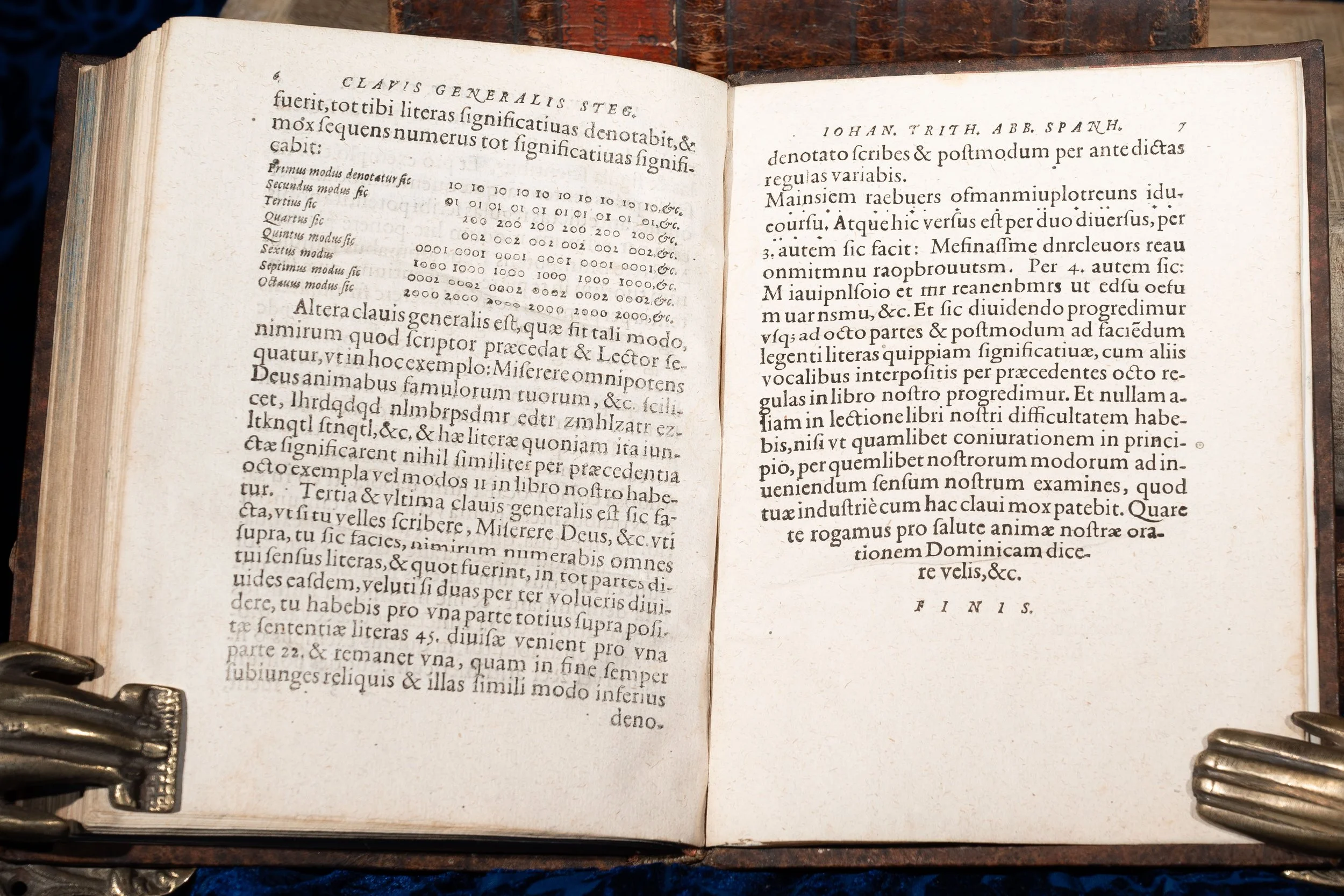 Image 1 of 14
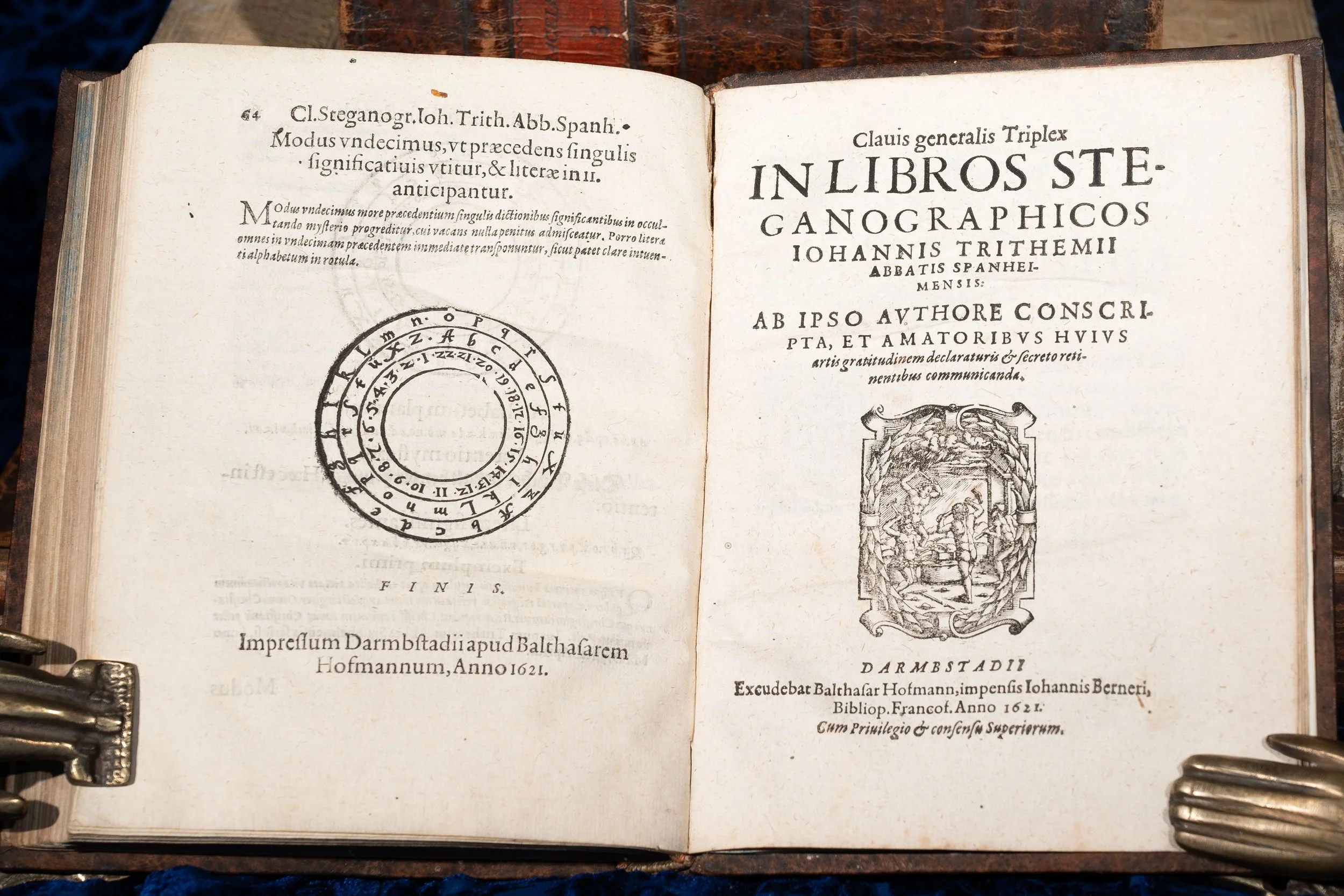 Image 2 of 14
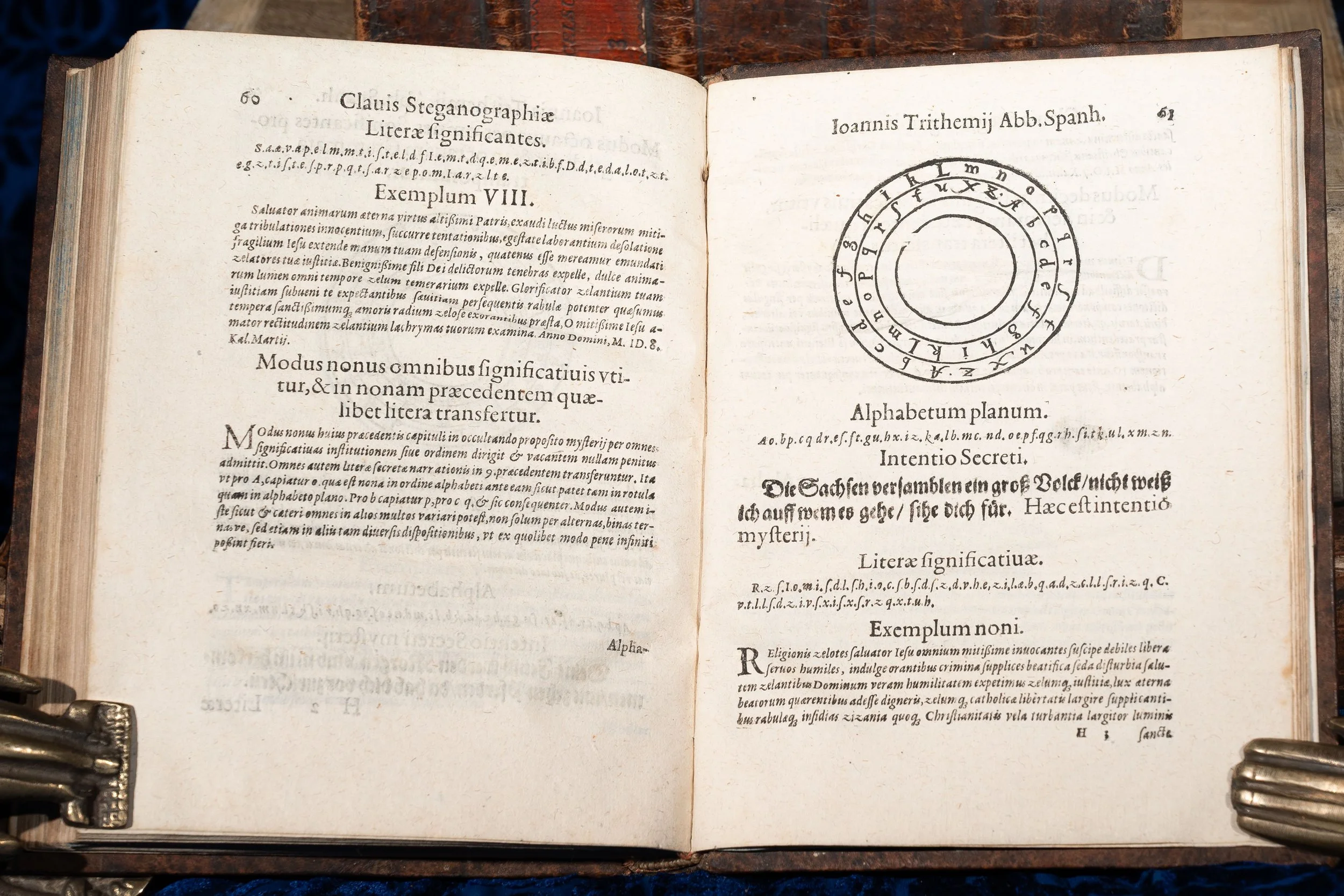 Image 3 of 14
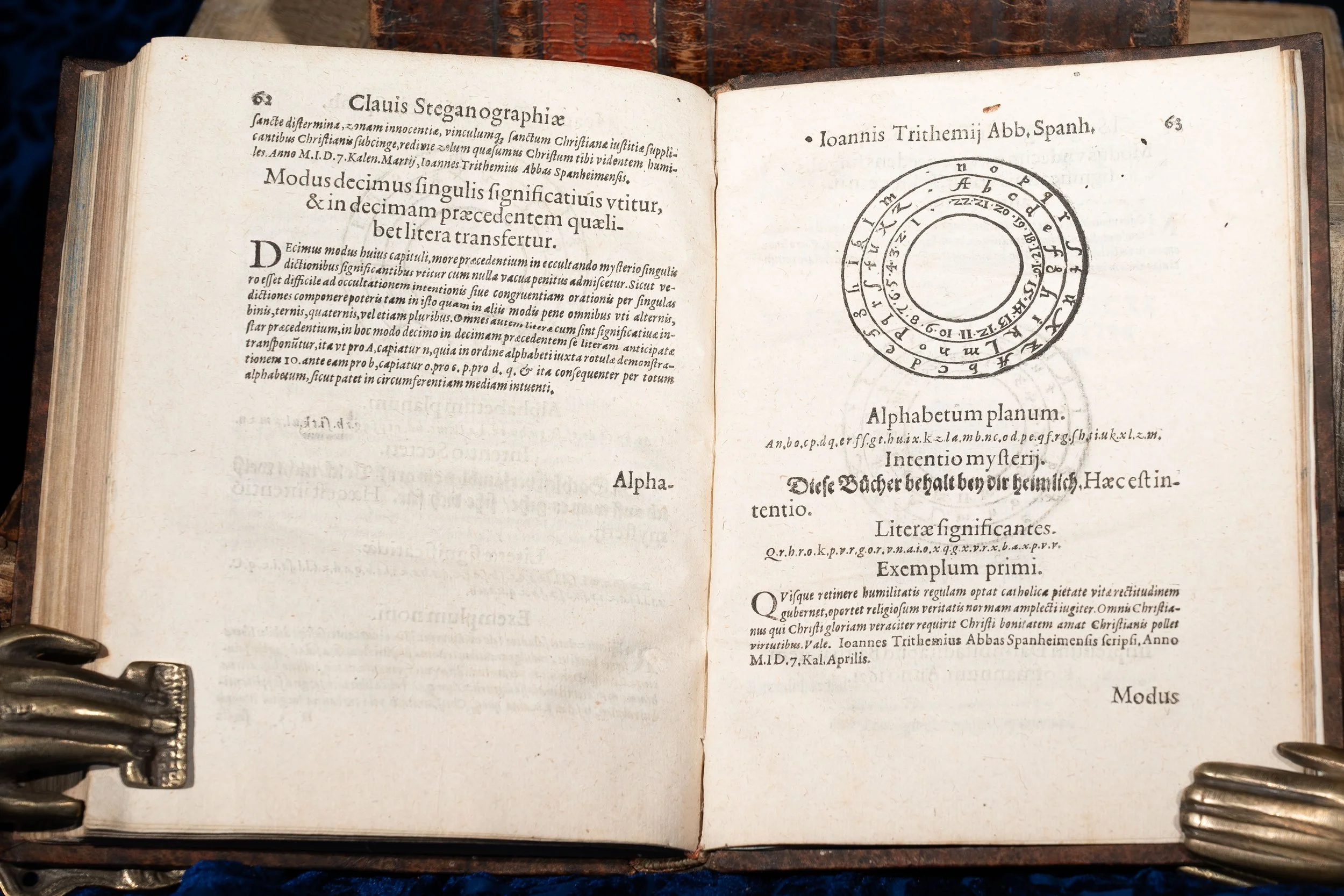 Image 4 of 14
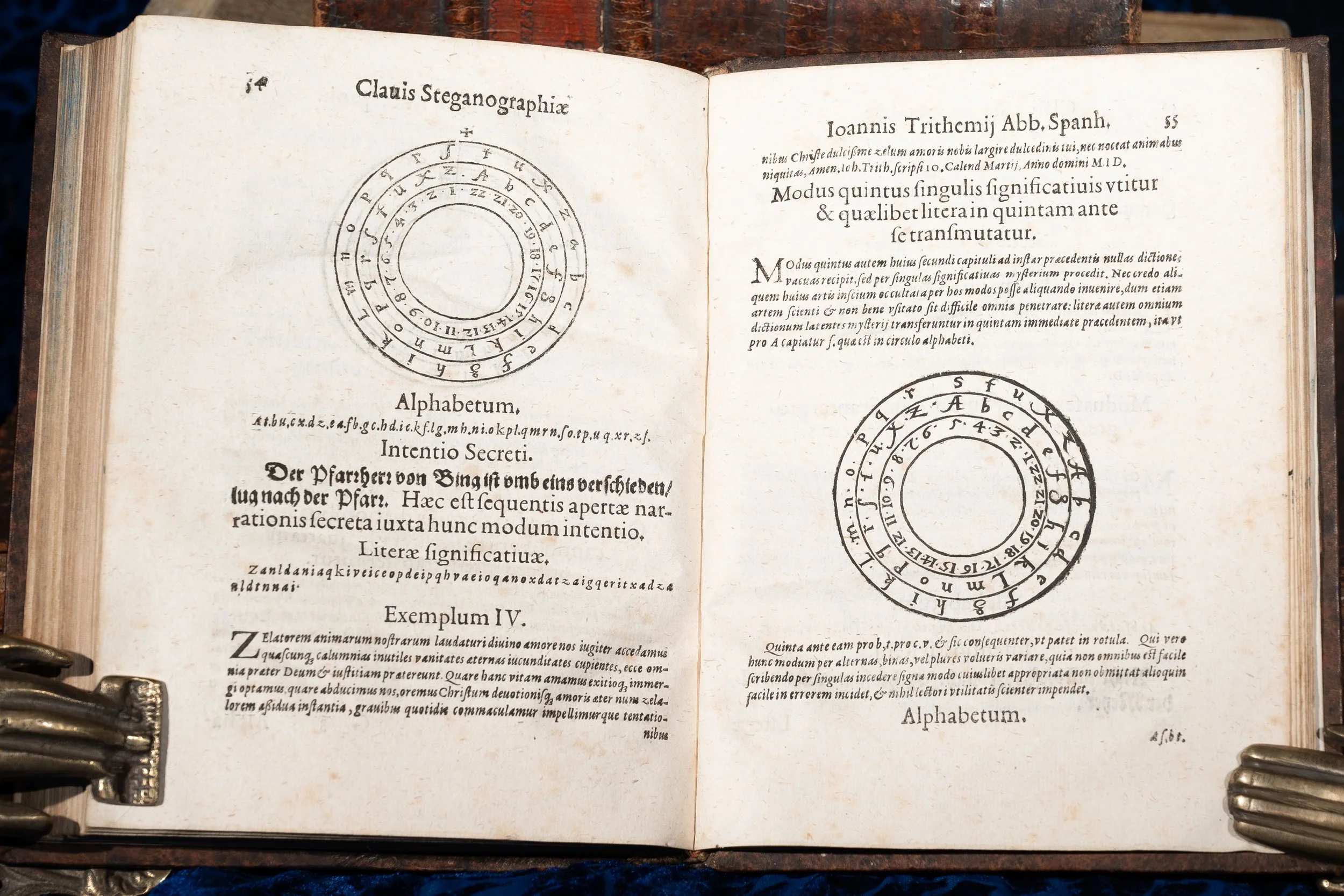 Image 5 of 14
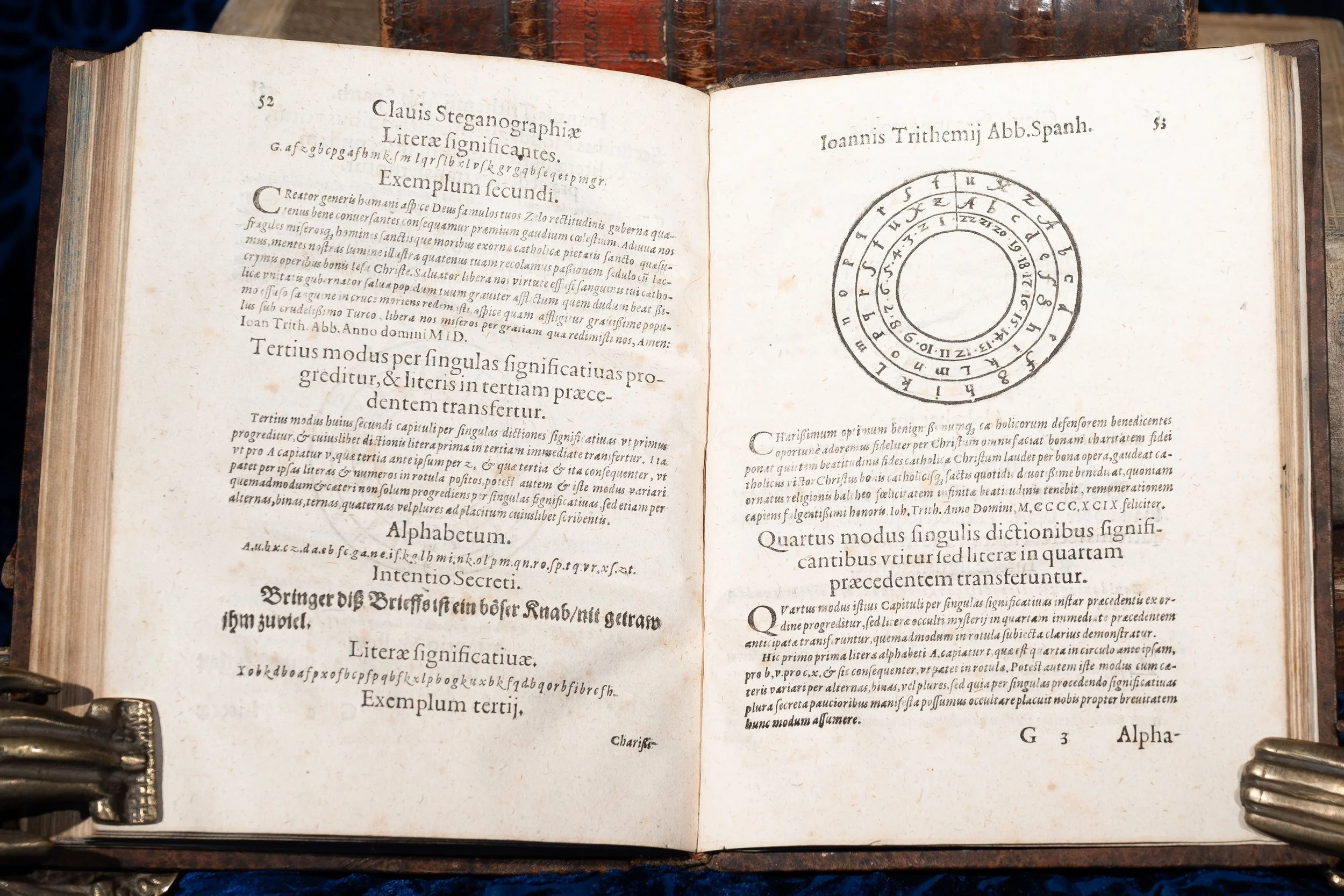 Image 6 of 14
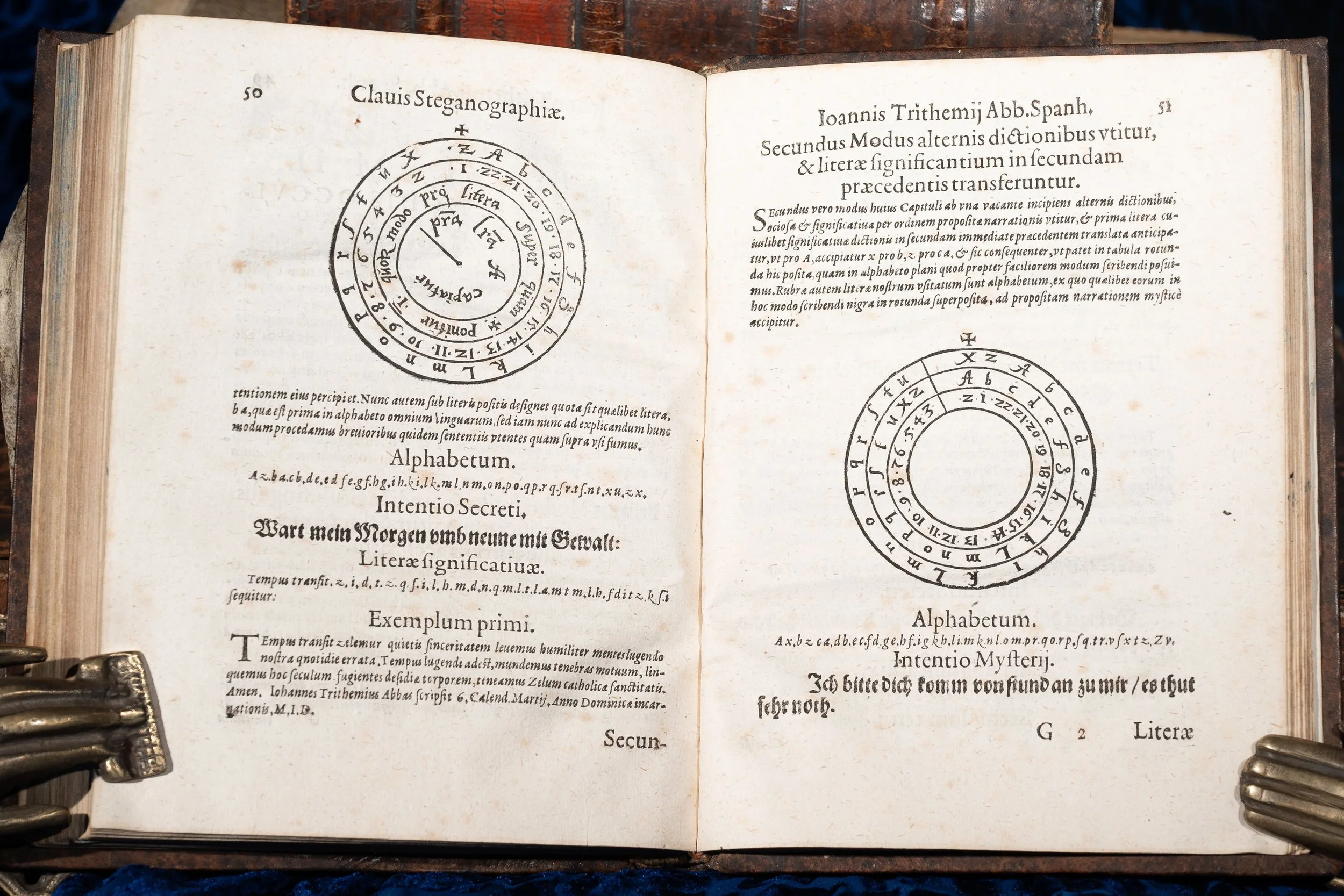 Image 7 of 14
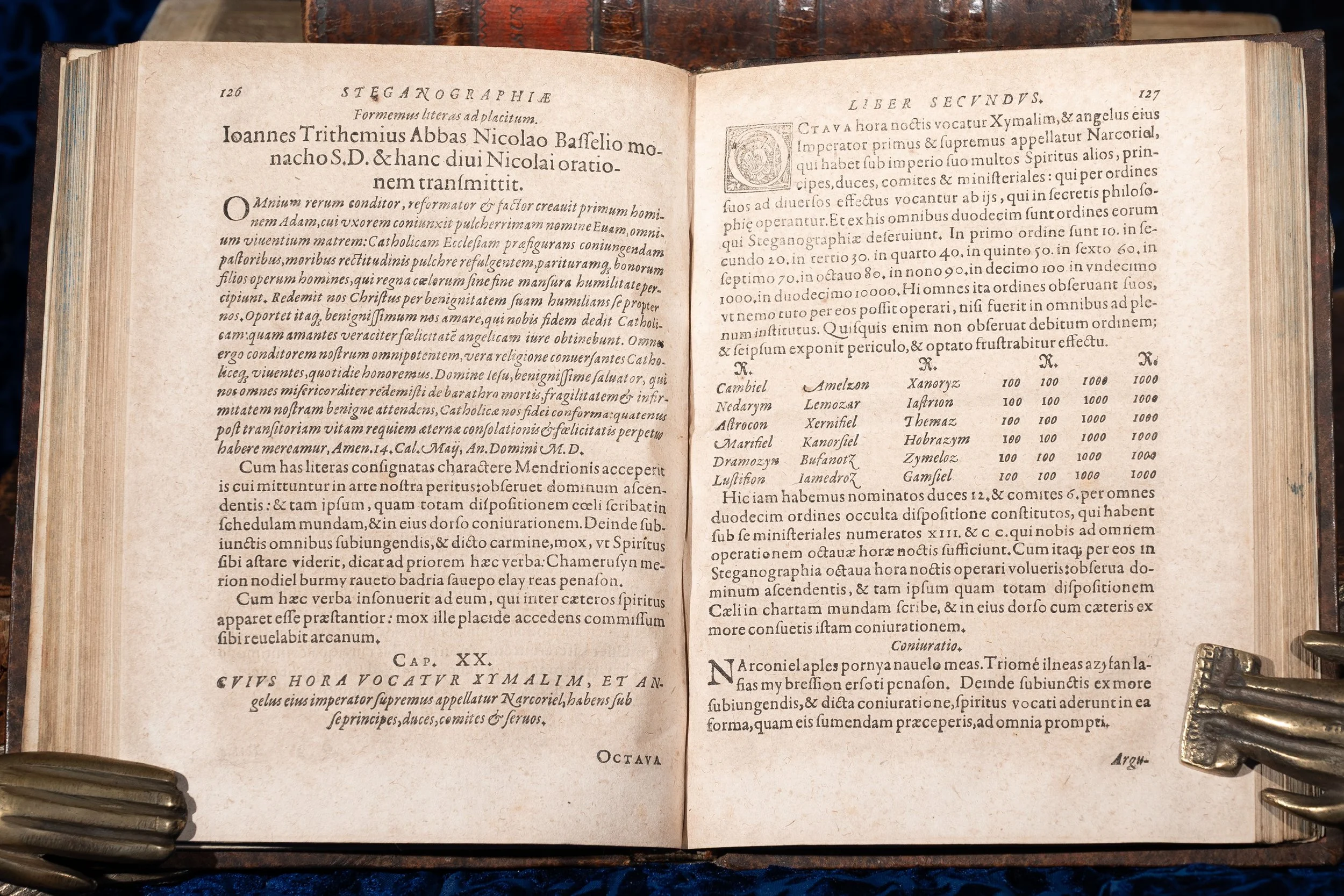 Image 8 of 14
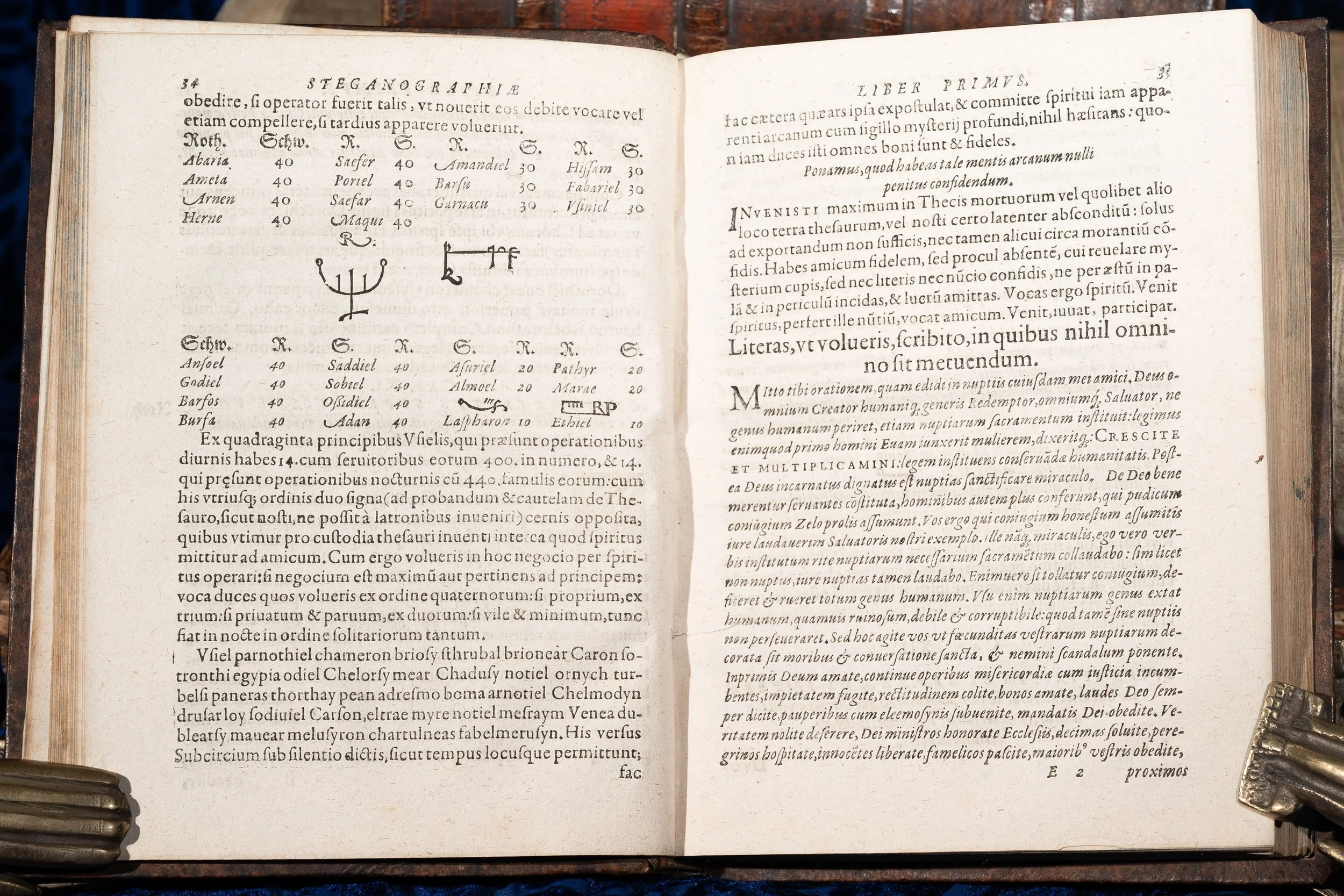 Image 9 of 14
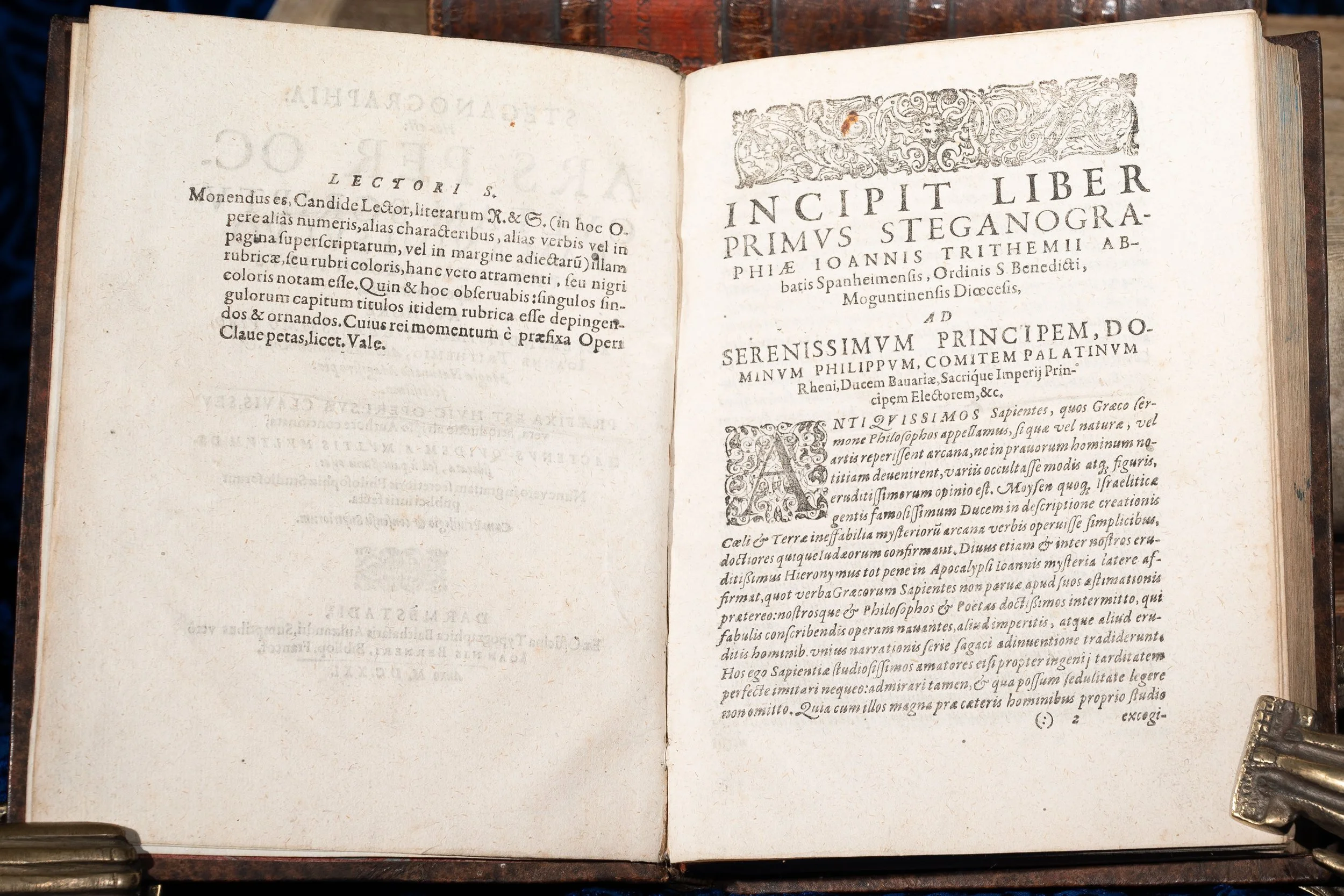 Image 10 of 14
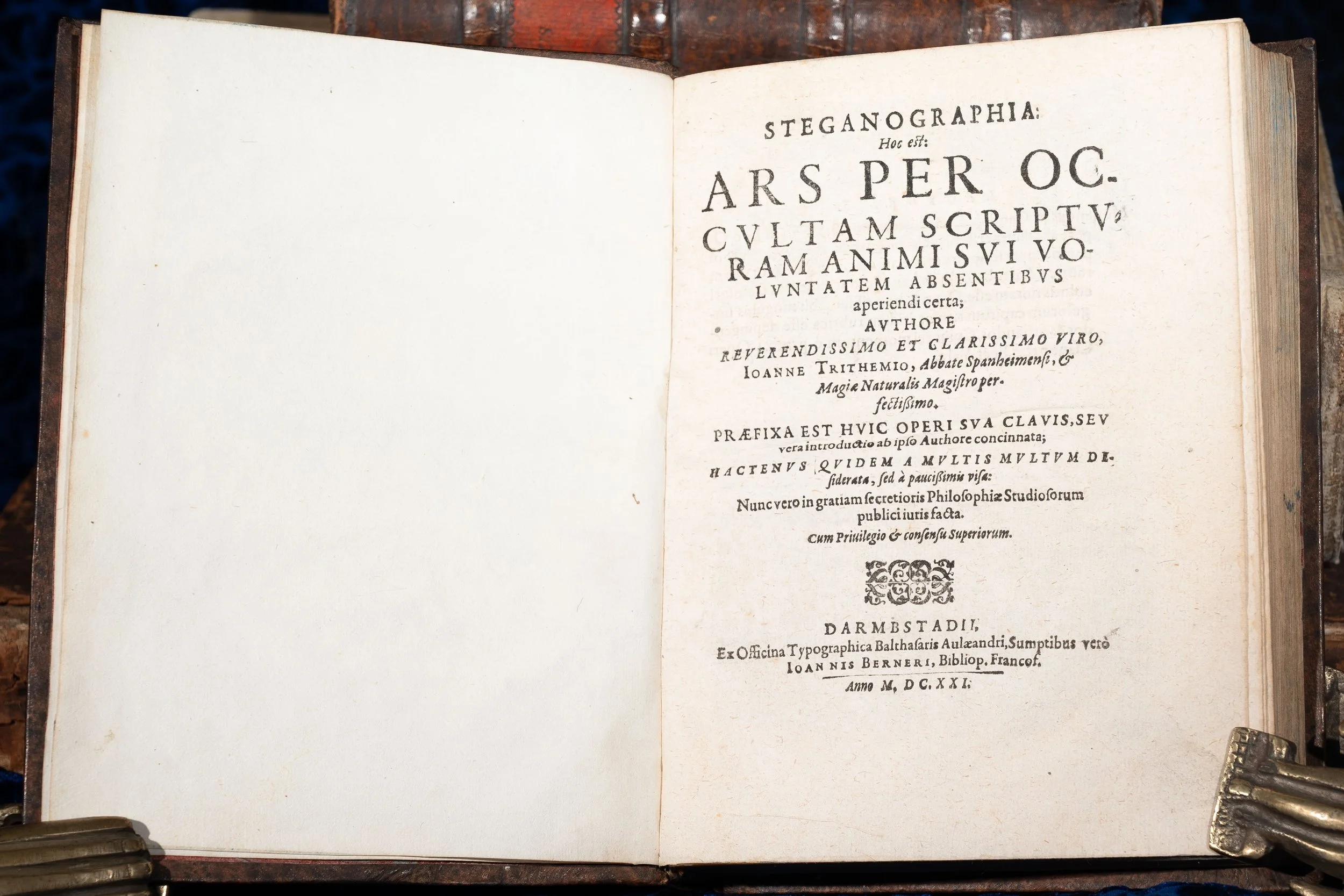 Image 11 of 14
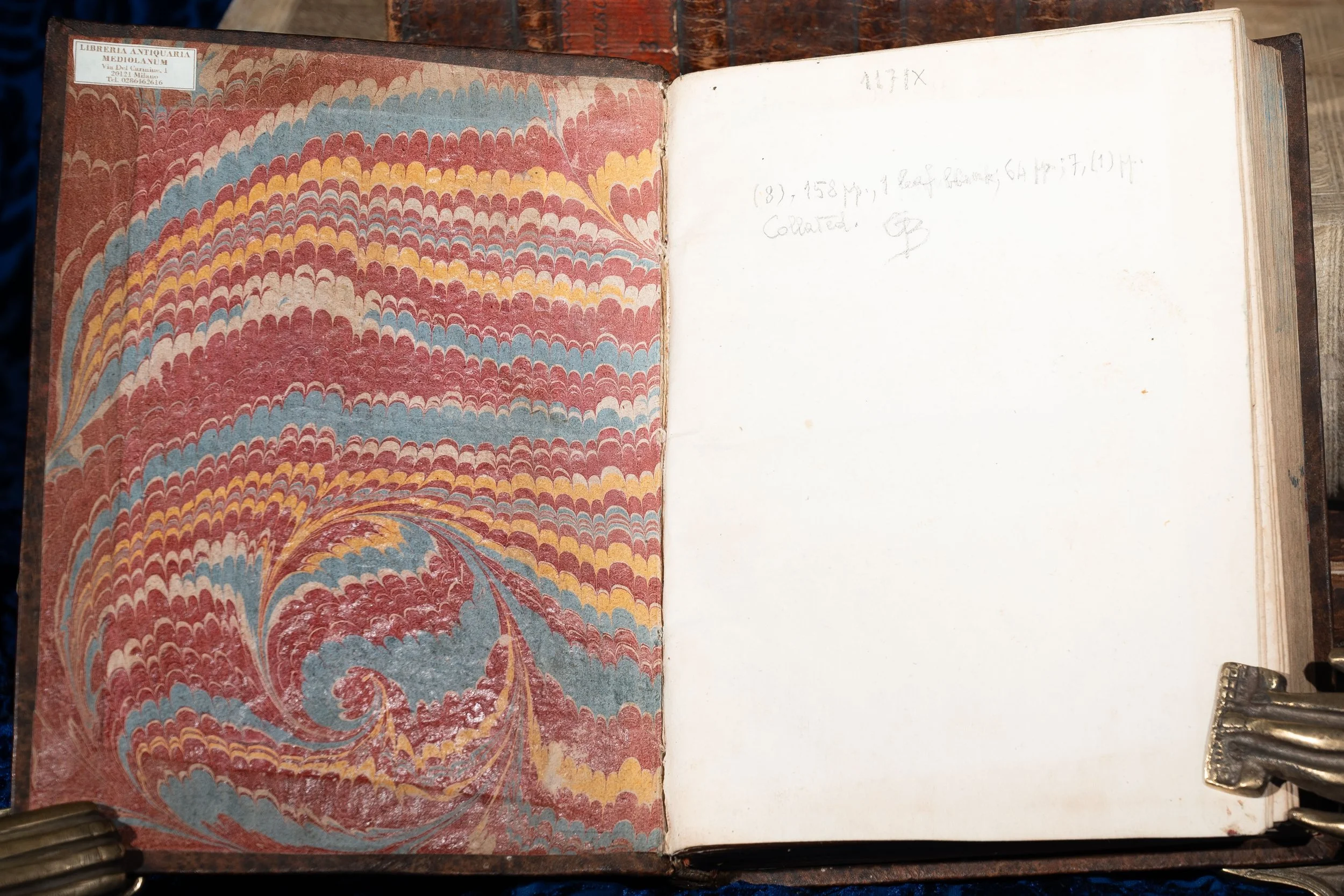 Image 12 of 14
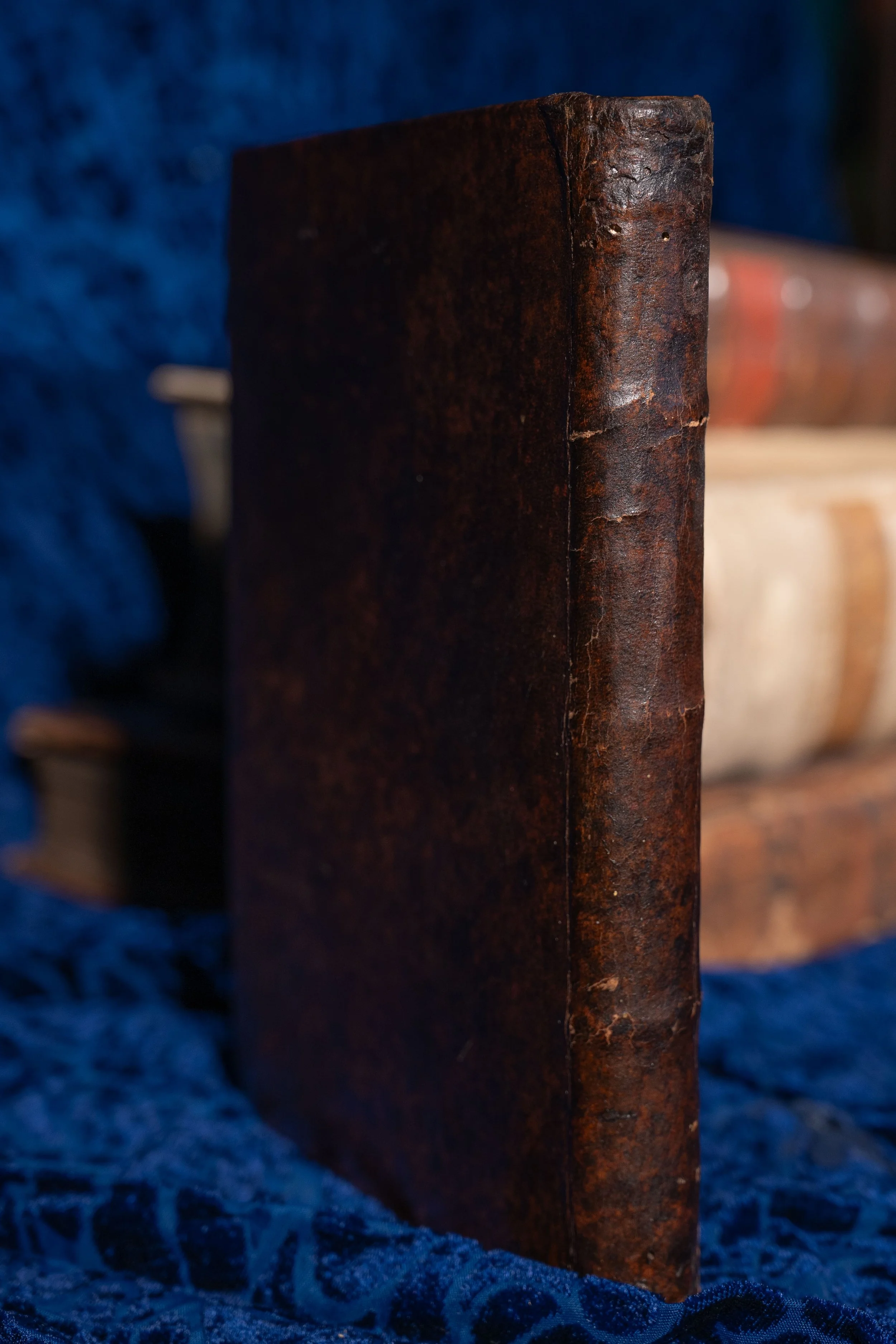 Image 13 of 14
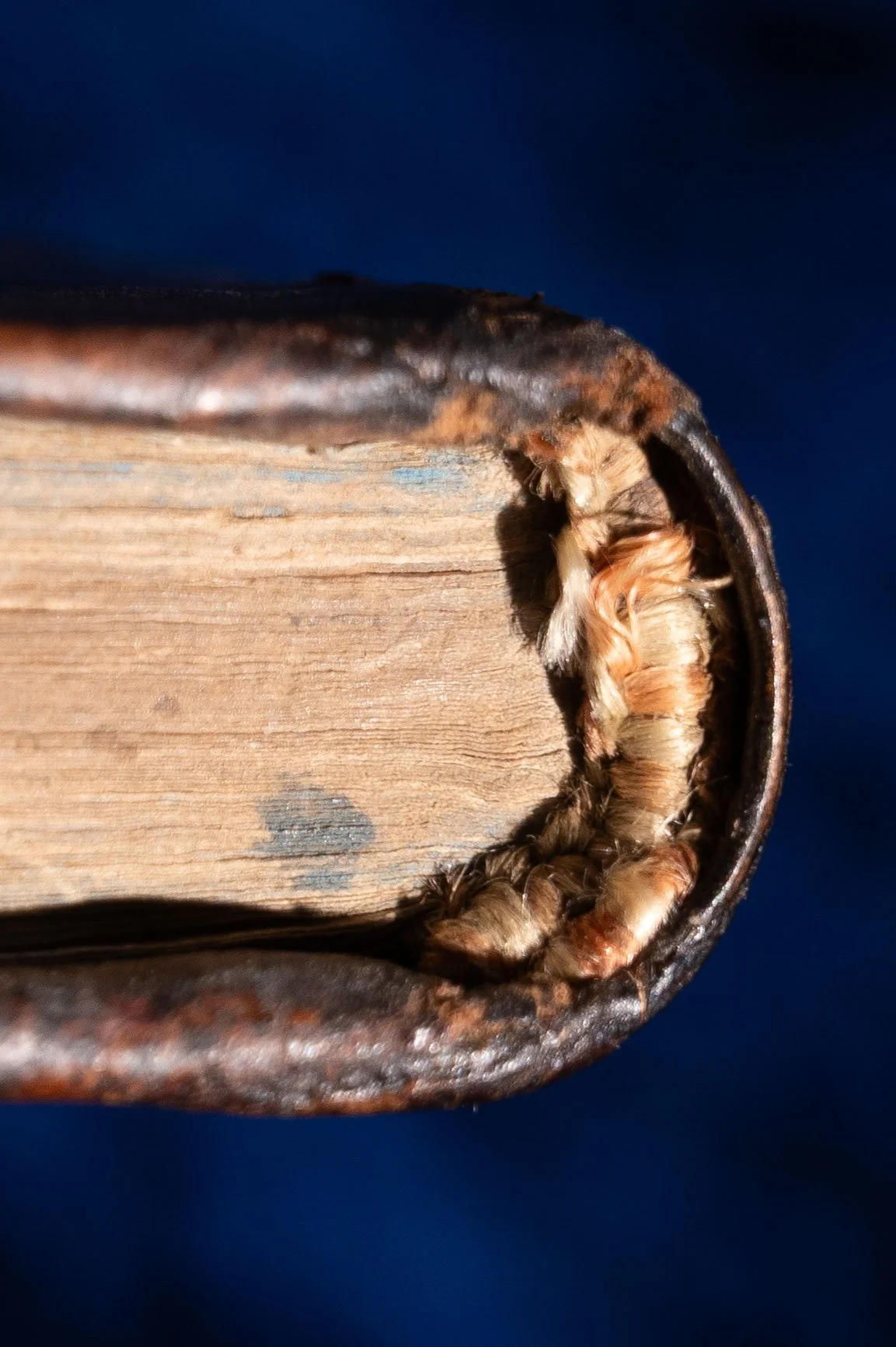 Image 14 of 14