Turn the title page of this anonymous 1613 quarto and a full-page woodcut hand confronts you, mapped like a miniature cosmos. Labeled in Latin from the girdle of Venus beneath the fingers to the restricta at the wrist, its mounts bear the sigils of the seven planets. A brief Latin verse later in the text supplies the key: Venus governs the thumb, Jupiter the index finger, Saturn the middle, the Sun the ring, and Mercury the little finger, while the Moon holds the striking edge and Mars pitches his camp in the hollow of the palm.
The rest of this slim manual, which promises to reveal a person’s constitution and fortune "now first brought to light," is built for swift consultation, distilling the art of chiromancy into a crisp sequence of bracketed tables. An opening table sets the ground rules, instructing the reader to weigh five traits in every line: its length and depth, color and shape, placement, what it cuts, and what cuts it. From there, the book moves systematically through the five principal lines (life, liver, head, fortune, and restricta) and five lesser lines not found on every palm (the way of the Sun, the Milky Way, the line of Saturn, the girdle of Venus, and the line of death).
Its verdicts are wonderfully blunt. A broad, well-colored, unbroken life line promises longevity and good health; divided along its length into seventy years, any break pinpoints the exact year of danger. Even lines on the middle finger foretell wealth in metal mines, while a line circling the thumb’s middle joint points straight to the gallows. Domestic fate is no less legible: if a man’s little finger falls short of the last joint of his ring finger, his wife will rule him in everything. Yet nothing is permanently fixed. A note observes that because the stars are always in motion, lines grow, fade, and return with age, giving the palm a changing face over time.
The second half returns to the planetary mounts. One table sorts fortunate marks—crosses, stars, ladders—from ominous ones like grids and hair-like strokes. Seven bracketed tables then take each planet in turn, from Venus to Mercury, cataloging the temperament, physique, and illnesses it governs when well or badly placed. Under a fortunate Mercury, the little finger produces orators, poets, mathematicians, and merchants; under an unfortunate one, liars, thieves, and traitors. A final table pairs both hands together: sharper lines in the right palm signal a day birth under masculine planets, while clearer lines in the left reveal a night birth under feminine ones.
The book itself remains something of a cipher. Its title page offers the year 1613 and nothing more, no author, printer, or place, and the text ends abruptly on page 23 with the single word Finis. Bibliographers have assigned it to Frankfurt and tentatively to the press of Wolfgang Richter.
[ANONYMOUS.] Tabulae chiromanticae, lineis montibus et tuberculis manus constitutionem hominum, & fortunae vires ostendentes. Nunc primum luci datae. [Frankfurt: Wolfgang Richter?], 1613. First edition.
Physical Description: Quarto. 23 pp., signatures a–c in fours. Woodcut ornament on the title, woodcut headpiece at the head of the text, and a full-page woodcut of a hand on the verso of the title. Tables set with printed braces throughout. The running head is misprinted "Chiromandicae" on pages 7 and 19.
Binding: Modern brown leather.
Condition: Stained in places; the upper edge creased. An early ink number at the head of the title page.

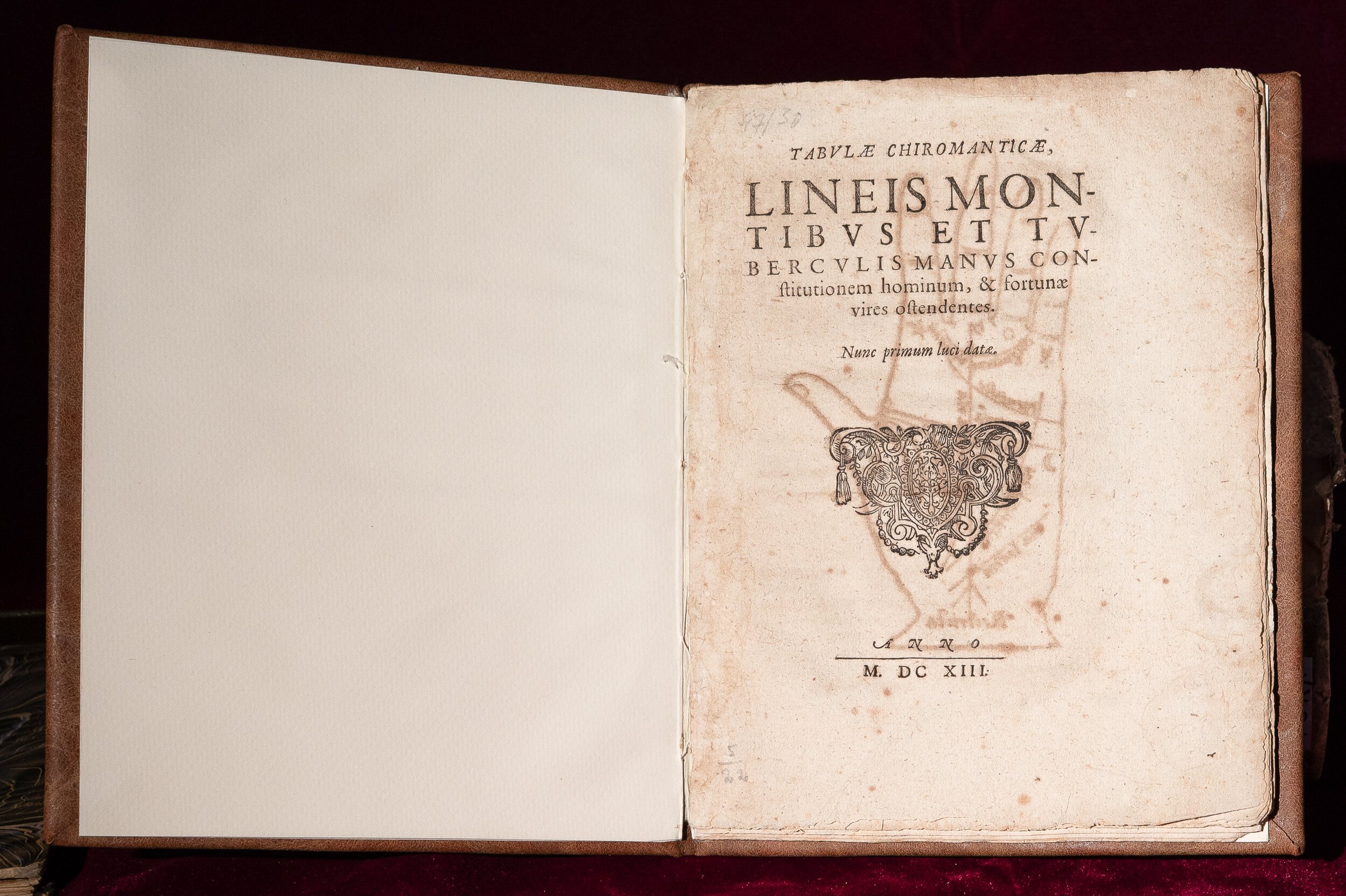 Image 1 of 8
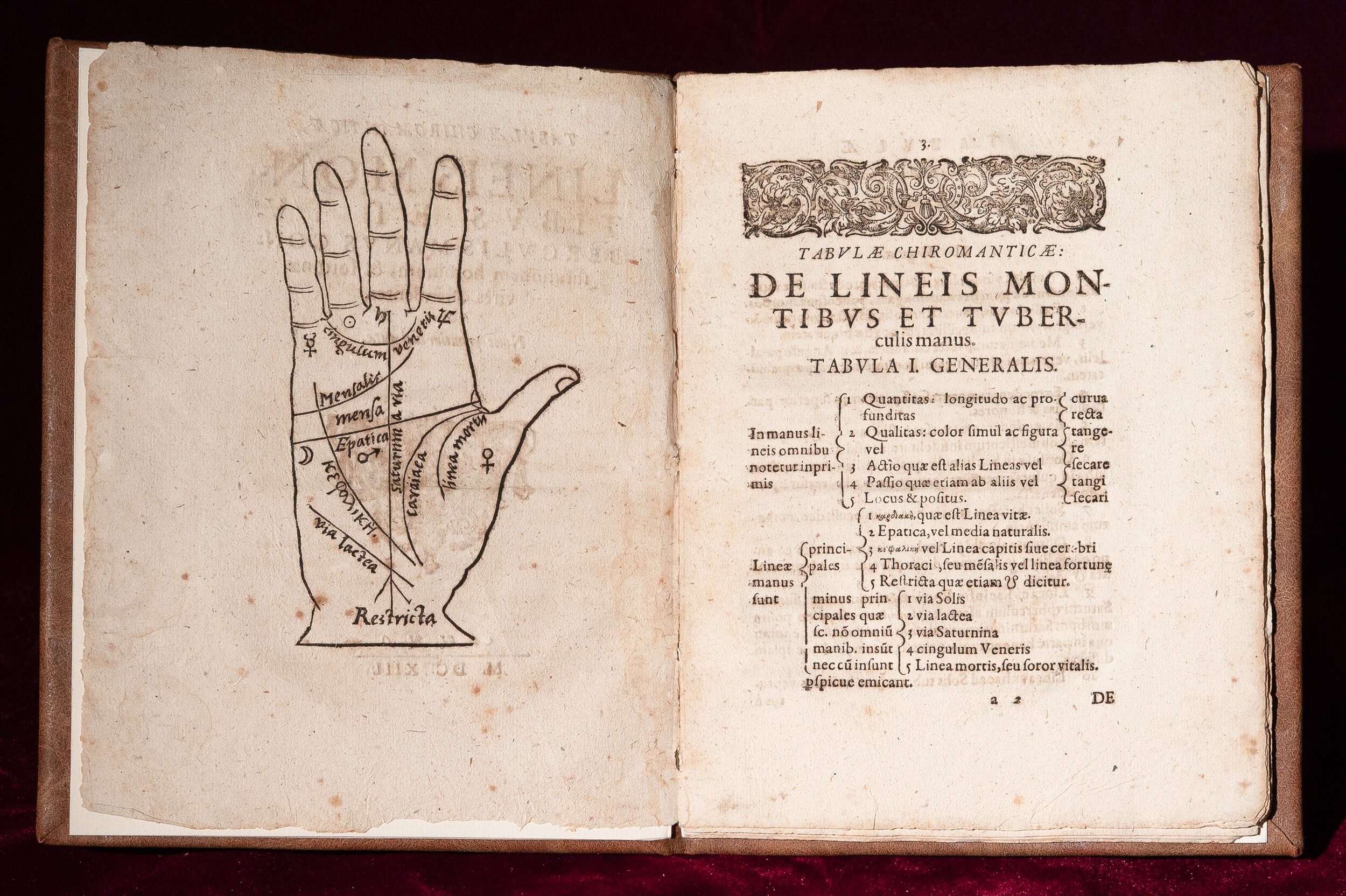 Image 2 of 8
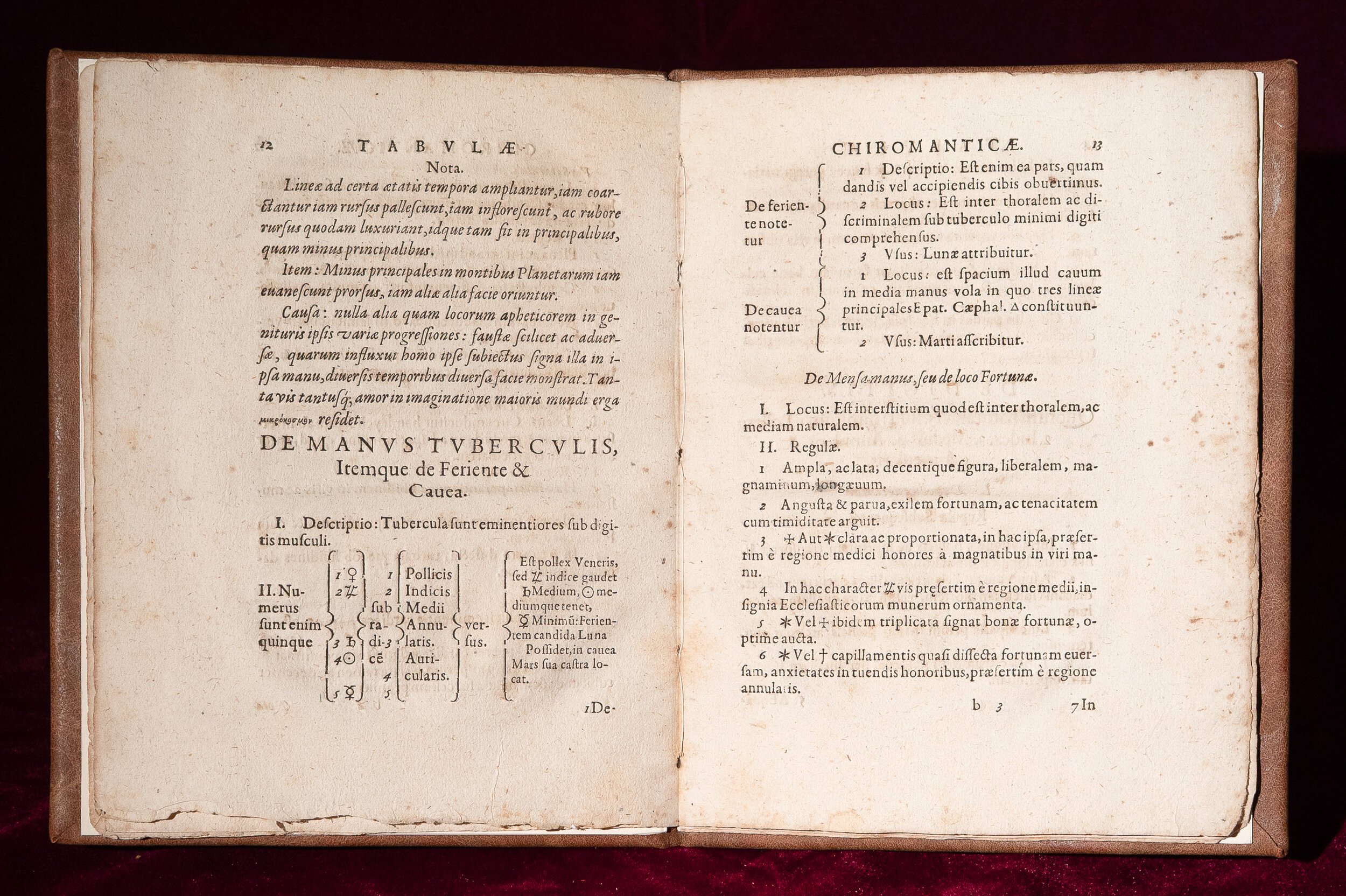 Image 3 of 8
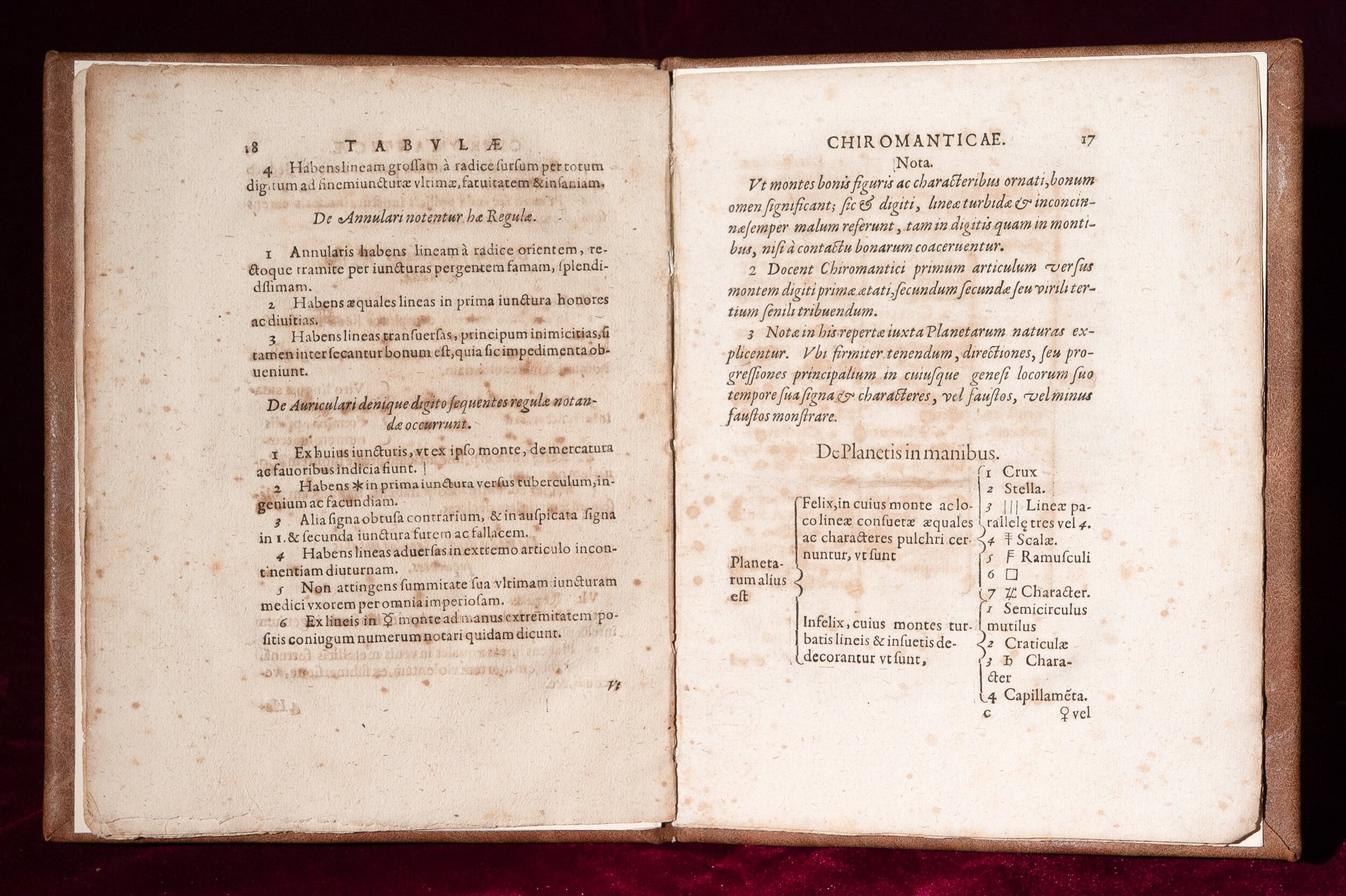 Image 4 of 8
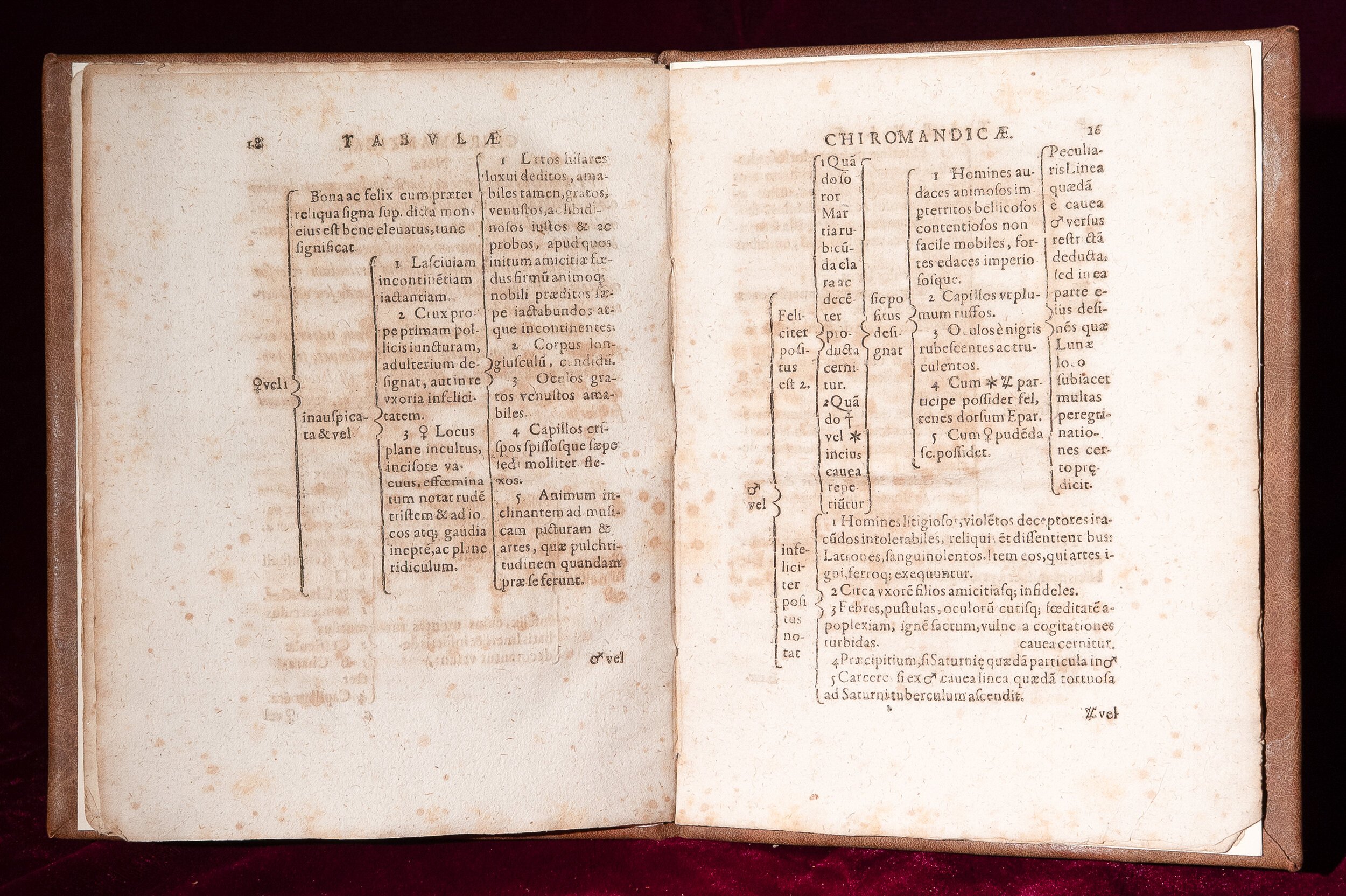 Image 5 of 8
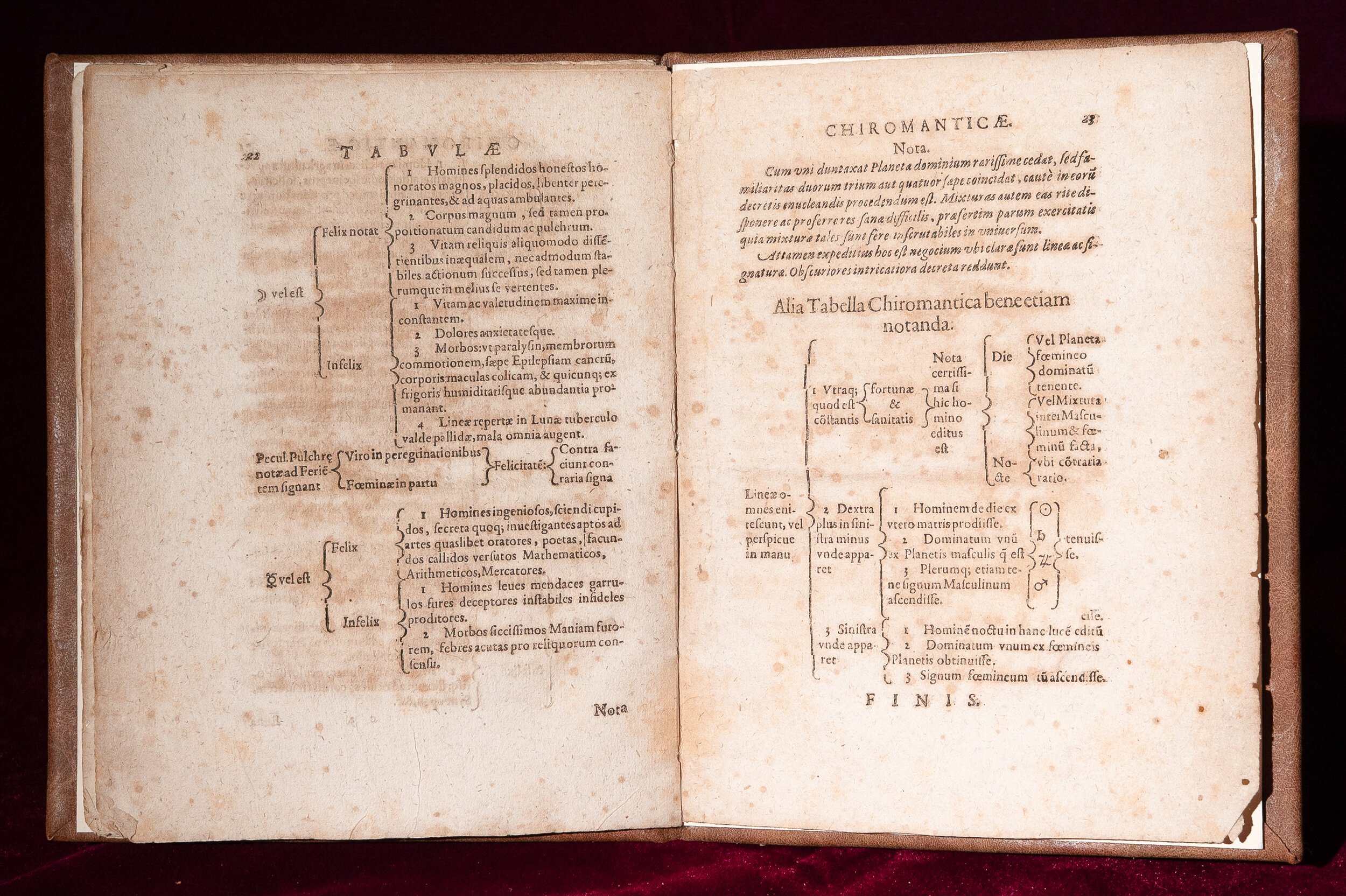 Image 6 of 8
 Image 7 of 8
 Image 8 of 8