This copy has sold. We currently have the 1676 Heidel edition of Steganographia, with his defense of Trithemius and extensive explanations of the ciphers, available for $3,200.
Few books in the history of Western esotericism have generated as much suspicion, fascination, and misunderstanding as Trithemius's Steganographia. Composed around 1499 but circulating only in manuscript for over a century, it acquired a reputation for genuine demonic magic that its author spent considerable effort attempting to dispel. The work purports to teach methods of secret communication through the invocation of spirits governing the cardinal directions and hours of the day, complete with elaborate conjurations in an invented angelic language, hierarchies of princes and dukes with their attendant ministers numbered in the thousands, and precise instructions for timing operations according to planetary hours.
The central interpretive question, which occupied both Trithemius's contemporaries and modern scholars, is whether the spirit apparatus is genuine ceremonial magic or an elaborate cipher system in which the demonic trappings serve merely as a mnemonic and encoding framework. The publication history itself suggests contemporary uncertainty: the work was placed on the Index in 1609, the year after this edition appeared, yet the Clavis (key) bound here, printed the same year at Darmstadt, explicitly promises to reveal that the conjurations are simply codes. The diagrams visible in this copy, showing cipher wheels and tables correlating spirit names with numerical values, support the cryptographic reading. The Clavis texts explain the methods of Books I and II. Heidel went further in 1676, deciphering Book III but publishing his explanation in a cipher of his own. Thomas Ernst recovered that explanation in the 1990s and confirmed that Heidel had understood the method.
This 1608 Frankfurt edition, the second printing of the complete text following the 1606 first edition, represents the work's emergence from manuscript obscurity into the contested territory of early modern print. The modest quarto format and workmanlike typography suggest a book aimed at the learned professional rather than the courtly collector. That it survives in contemporary vellum with evidence of clasps indicates an owner who valued it for consultation rather than display. The early signature "Blanchard" on the title offers a trace of reception history, though the name is too common to permit speculation about the reader's identity or purposes.
For historians of cryptography, the Steganographia stands as a foundational text in the development of polyalphabetic substitution and steganographic technique. For historians of Western Esotericism, it exemplifies the instability of categories in the early modern period: a work that is simultaneously a practical manual, a magical treatise, and a demonstration of how easily the two could be mistaken for one another. The inclusion of the Clavis texts in this volume allowed the seventeenth-century reader to have it both ways, or perhaps to suspect that the revelation of the cipher was itself another layer of concealment.
TRITHEMIUS, Johannes. Steganographia: Hoc est: Ars Per Occultam Scripturam Animi Sui Voluntatem Absentibus aperiendi certa... Praefixa est Huic Operi sua Clavis, Seu vera introductio ab ipso Authore concinnata. Frankfurt: Ex Officina Typographica Ioannis Saurii, Sumptibus Ioannis Berneri, 1608. [With:] Clavis Steganographiae. Darmstadt: Balthasar Hofmann, 1608. Quarto. COLLATION: 180 pp. + 7 pp. + 70 pp. Woodcut printer's device on title page depicting a figure in a landscape. Text contains numerous woodcut diagrams including tables of spirit names and numerical values, circular diagrams showing directional orientations and hierarchies, and cipher wheels (rotulae) for cryptographic operations. Contemporary full vellum, yapp edges. Evidence of former strap closures (insertions visible). Spine darkened and worn with some surface loss visible.
Binding sound but showing wear consistent with age; spine notably browned with areas of abrasion. Interior generally well preserved. Some gatherings browned. Title page with early ownership signature reading "Blanchard". Tear to leaf 51 affecting catchword. Edges trimmed, apparently contemporary to binding, with some marginal cropping.
Provenance: Early ownership signature "Blanchard" on title page.
This copy has sold. We currently have the 1676 Heidel edition of Steganographia, with his defense of Trithemius and extensive explanations of the ciphers, available for $3,200.
Few books in the history of Western esotericism have generated as much suspicion, fascination, and misunderstanding as Trithemius's Steganographia. Composed around 1499 but circulating only in manuscript for over a century, it acquired a reputation for genuine demonic magic that its author spent considerable effort attempting to dispel. The work purports to teach methods of secret communication through the invocation of spirits governing the cardinal directions and hours of the day, complete with elaborate conjurations in an invented angelic language, hierarchies of princes and dukes with their attendant ministers numbered in the thousands, and precise instructions for timing operations according to planetary hours.
The central interpretive question, which occupied both Trithemius's contemporaries and modern scholars, is whether the spirit apparatus is genuine ceremonial magic or an elaborate cipher system in which the demonic trappings serve merely as a mnemonic and encoding framework. The publication history itself suggests contemporary uncertainty: the work was placed on the Index in 1609, the year after this edition appeared, yet the Clavis (key) bound here, printed the same year at Darmstadt, explicitly promises to reveal that the conjurations are simply codes. The diagrams visible in this copy, showing cipher wheels and tables correlating spirit names with numerical values, support the cryptographic reading. The Clavis texts explain the methods of Books I and II. Heidel went further in 1676, deciphering Book III but publishing his explanation in a cipher of his own. Thomas Ernst recovered that explanation in the 1990s and confirmed that Heidel had understood the method.
This 1608 Frankfurt edition, the second printing of the complete text following the 1606 first edition, represents the work's emergence from manuscript obscurity into the contested territory of early modern print. The modest quarto format and workmanlike typography suggest a book aimed at the learned professional rather than the courtly collector. That it survives in contemporary vellum with evidence of clasps indicates an owner who valued it for consultation rather than display. The early signature "Blanchard" on the title offers a trace of reception history, though the name is too common to permit speculation about the reader's identity or purposes.
For historians of cryptography, the Steganographia stands as a foundational text in the development of polyalphabetic substitution and steganographic technique. For historians of Western Esotericism, it exemplifies the instability of categories in the early modern period: a work that is simultaneously a practical manual, a magical treatise, and a demonstration of how easily the two could be mistaken for one another. The inclusion of the Clavis texts in this volume allowed the seventeenth-century reader to have it both ways, or perhaps to suspect that the revelation of the cipher was itself another layer of concealment.
TRITHEMIUS, Johannes. Steganographia: Hoc est: Ars Per Occultam Scripturam Animi Sui Voluntatem Absentibus aperiendi certa... Praefixa est Huic Operi sua Clavis, Seu vera introductio ab ipso Authore concinnata. Frankfurt: Ex Officina Typographica Ioannis Saurii, Sumptibus Ioannis Berneri, 1608. [With:] Clavis Steganographiae. Darmstadt: Balthasar Hofmann, 1608. Quarto. COLLATION: 180 pp. + 7 pp. + 70 pp. Woodcut printer's device on title page depicting a figure in a landscape. Text contains numerous woodcut diagrams including tables of spirit names and numerical values, circular diagrams showing directional orientations and hierarchies, and cipher wheels (rotulae) for cryptographic operations. Contemporary full vellum, yapp edges. Evidence of former strap closures (insertions visible). Spine darkened and worn with some surface loss visible.
Binding sound but showing wear consistent with age; spine notably browned with areas of abrasion. Interior generally well preserved. Some gatherings browned. Title page with early ownership signature reading "Blanchard". Tear to leaf 51 affecting catchword. Edges trimmed, apparently contemporary to binding, with some marginal cropping.
Provenance: Early ownership signature "Blanchard" on title page.

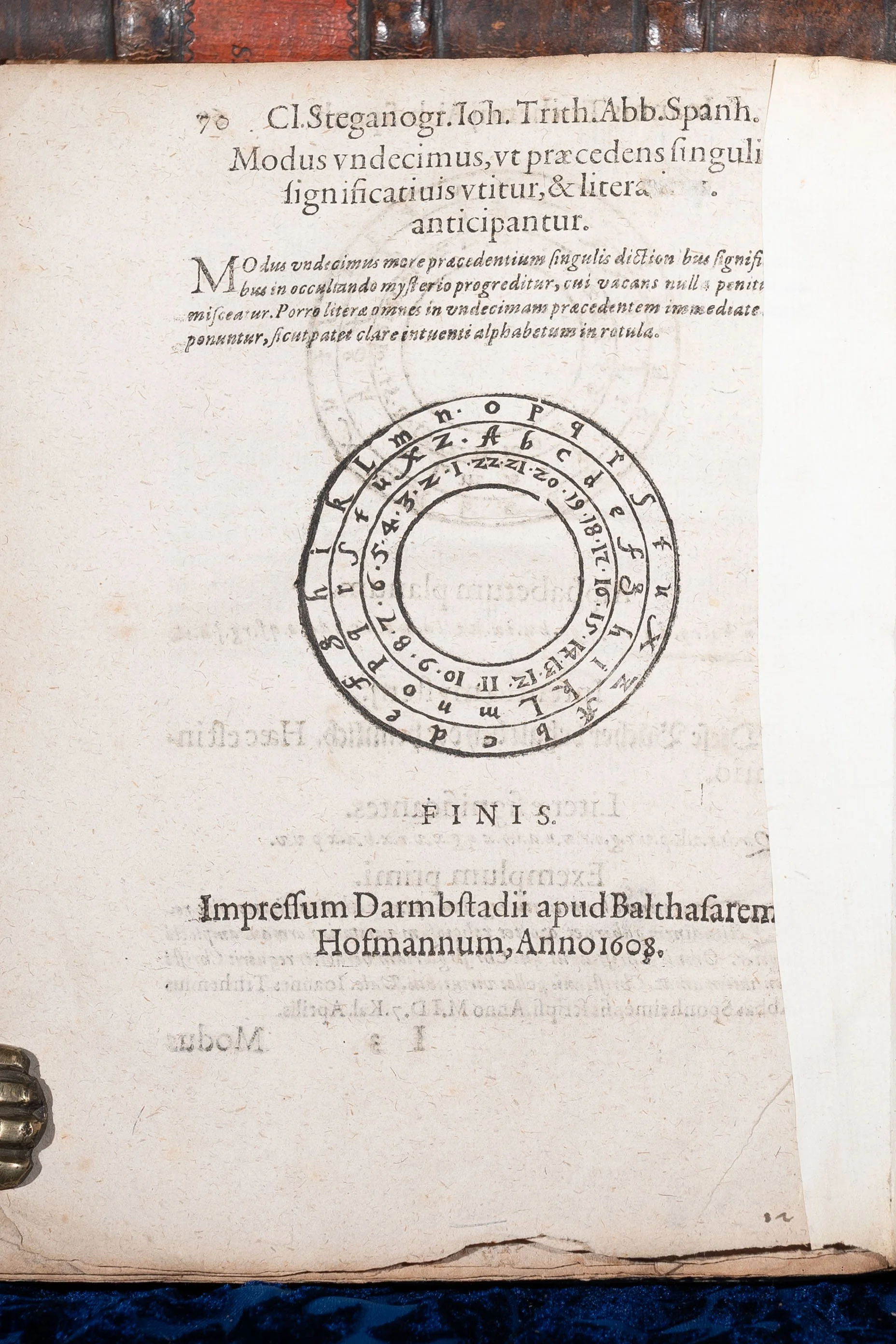 Image 1 of 18
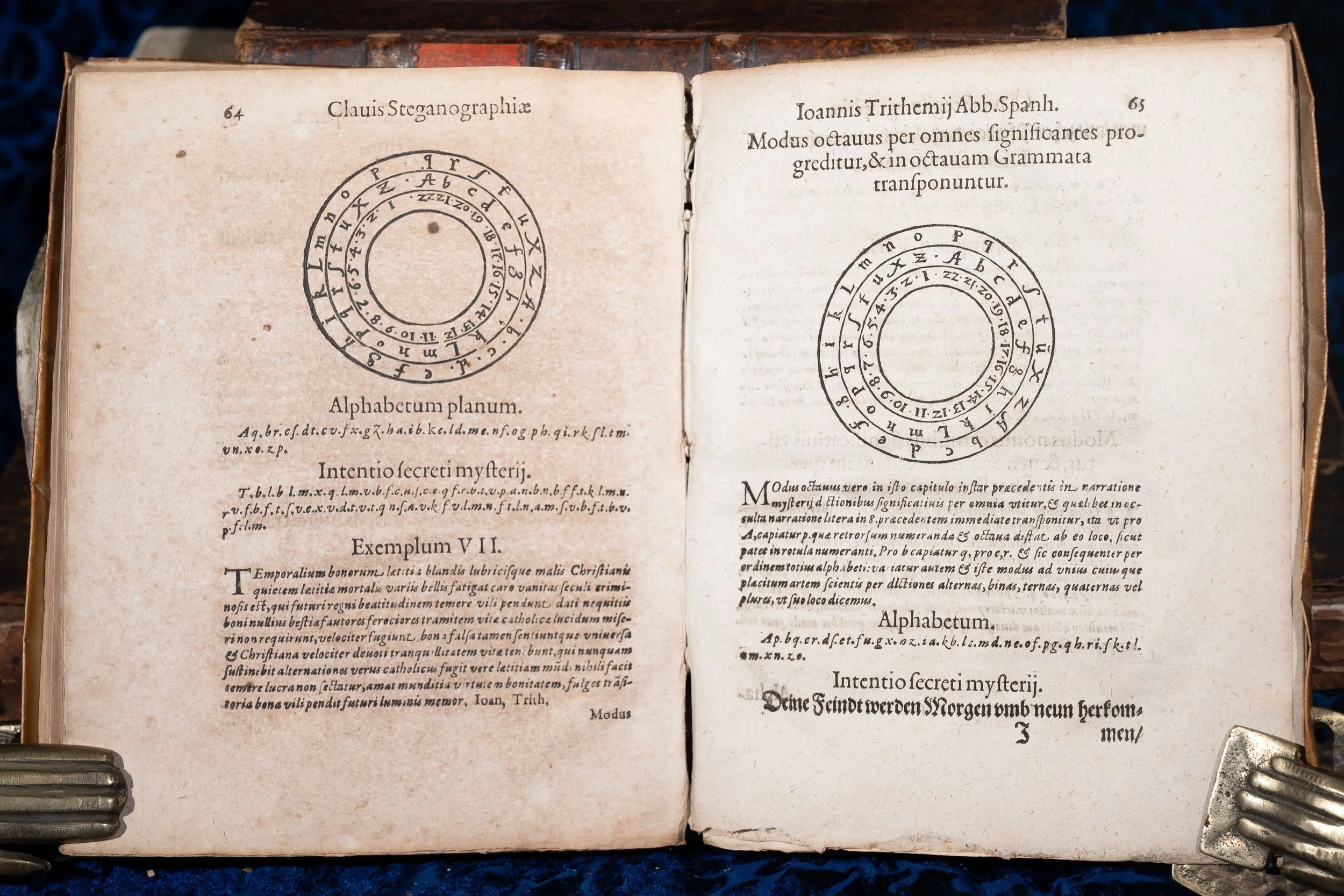 Image 2 of 18
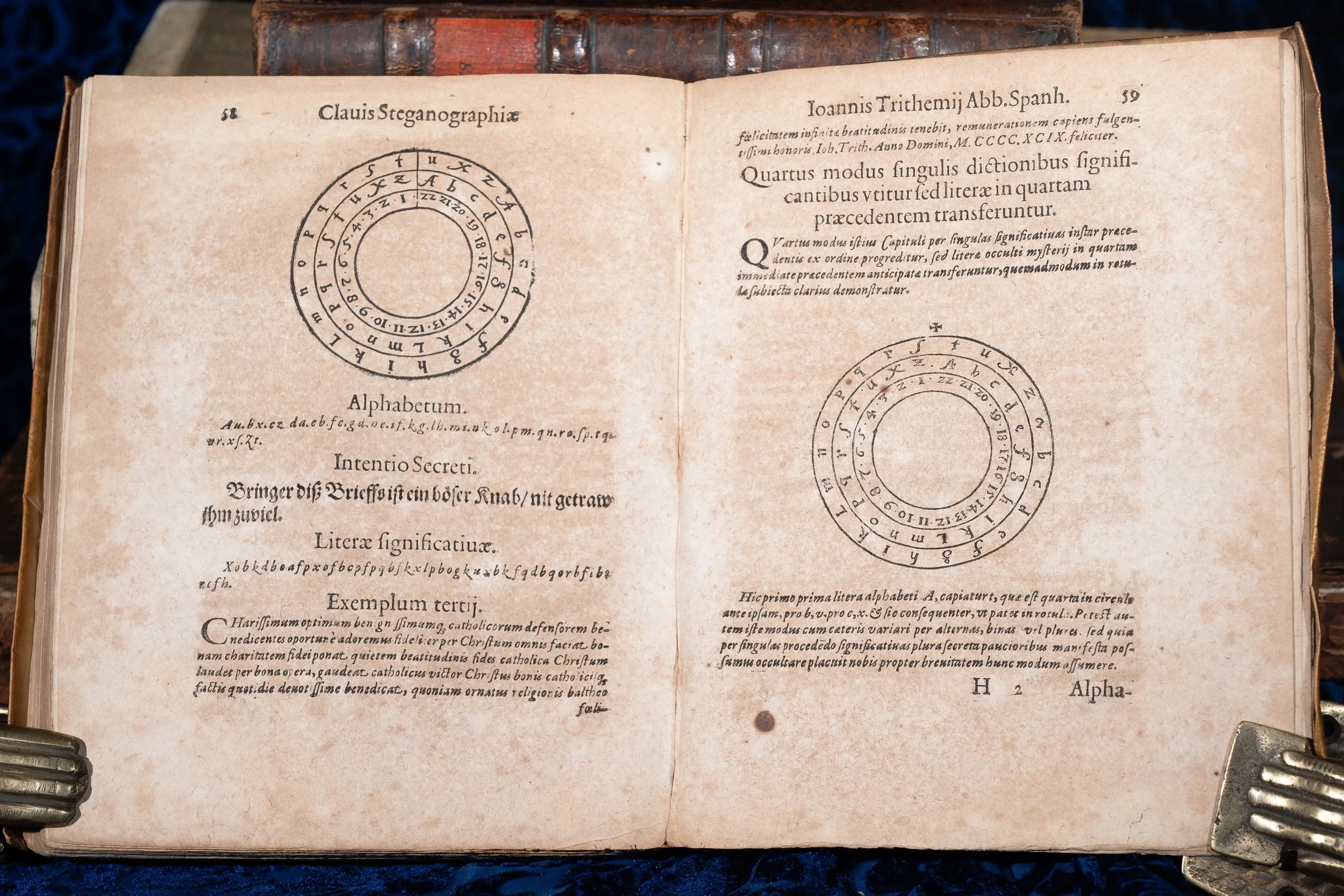 Image 3 of 18
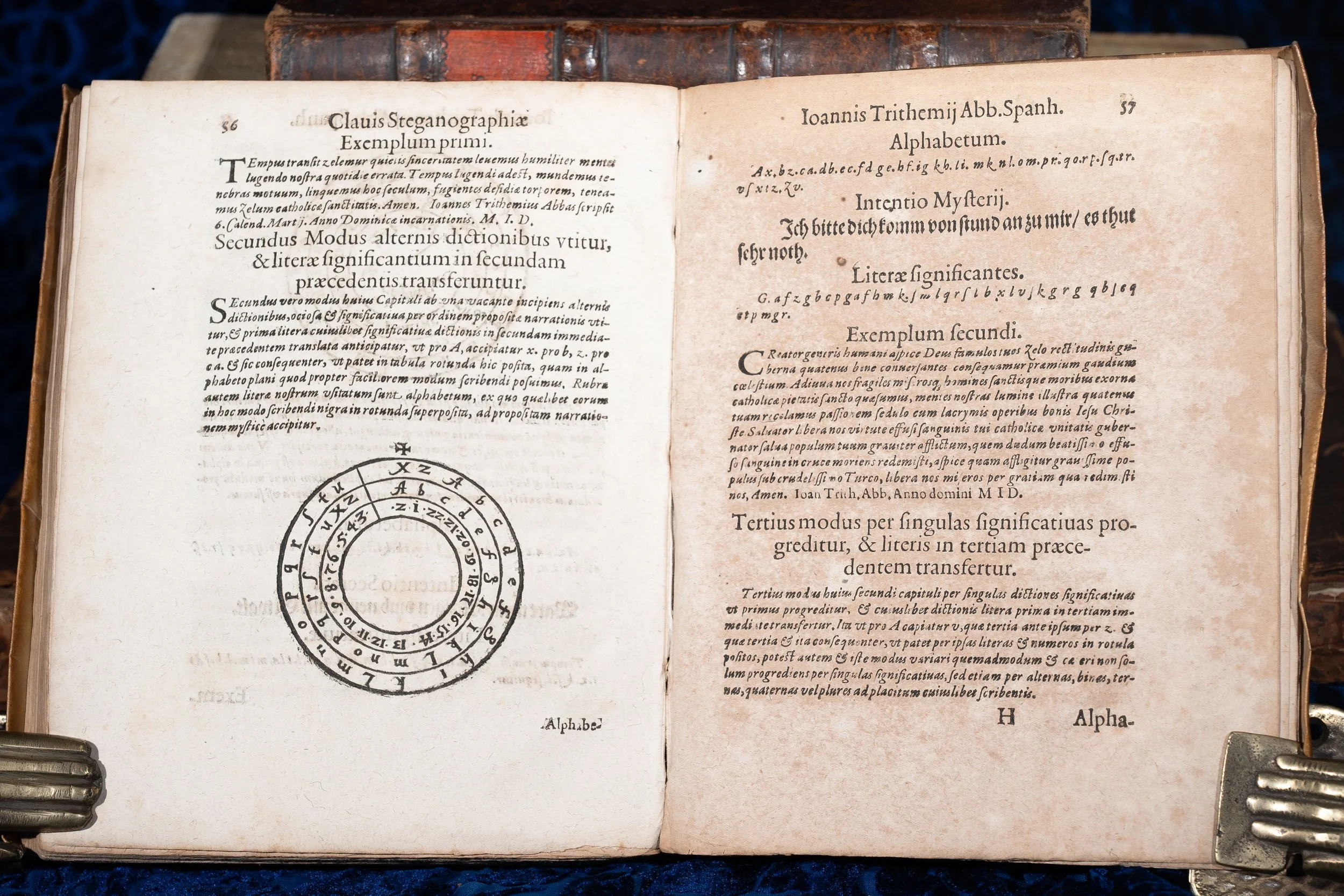 Image 4 of 18
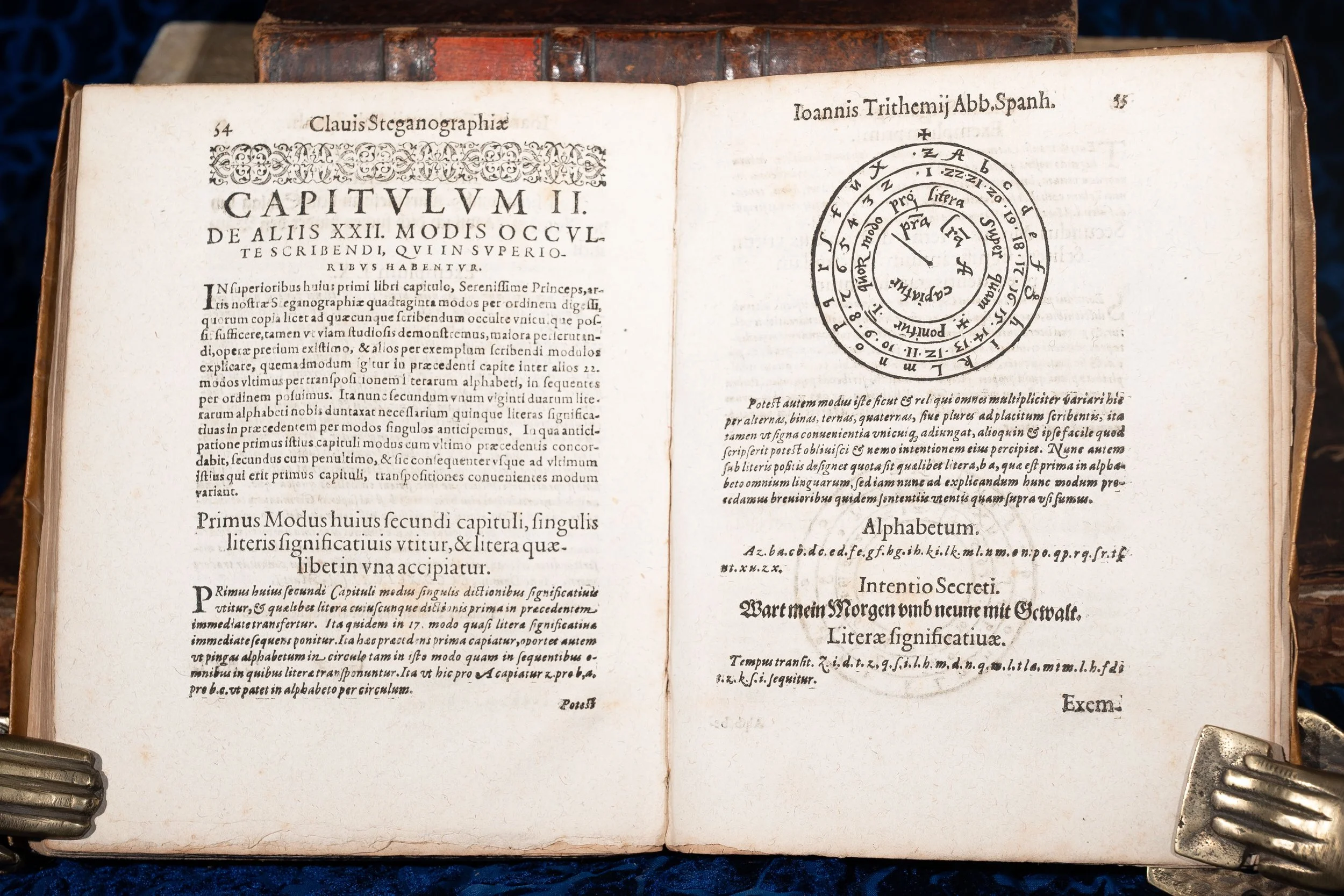 Image 5 of 18
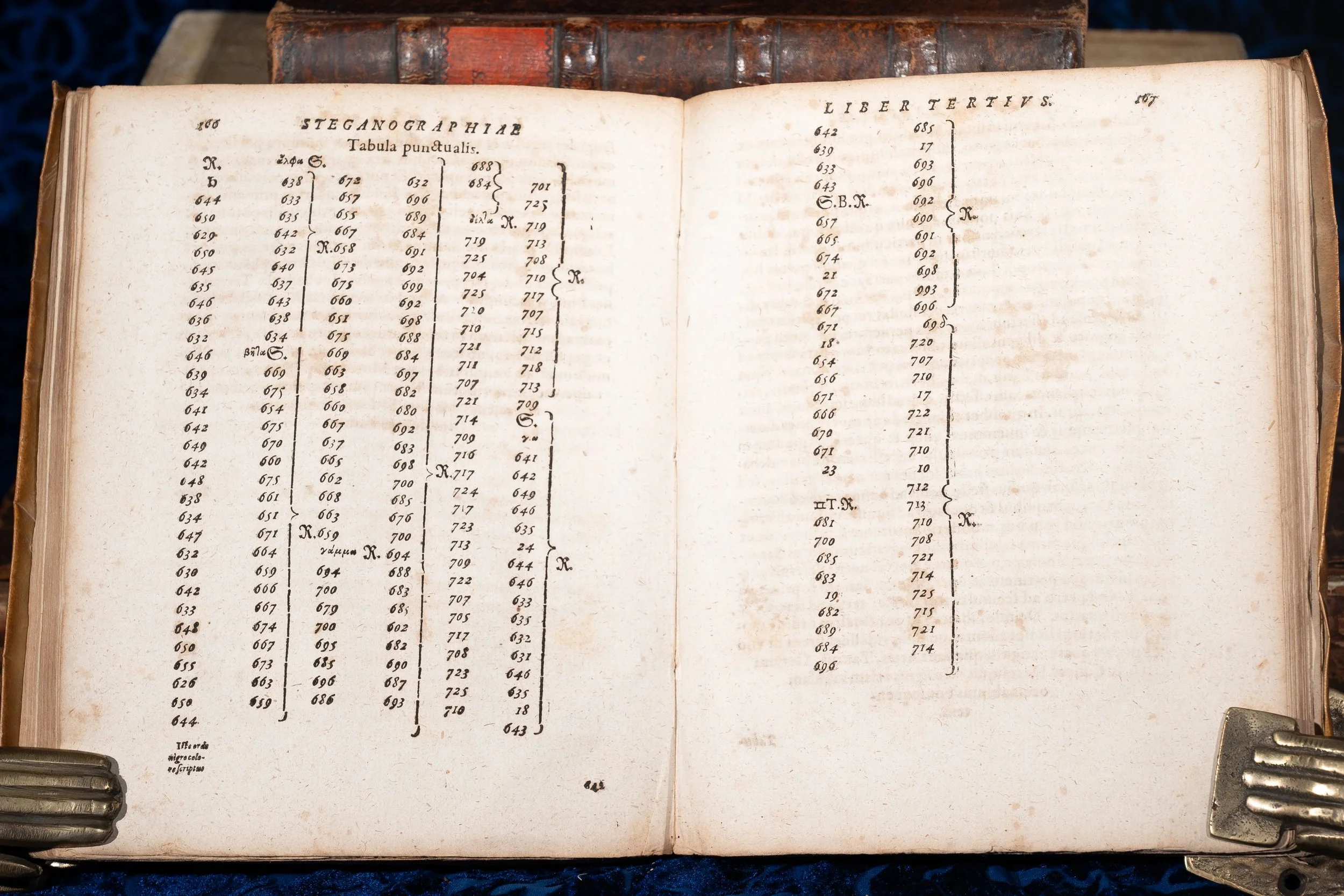 Image 6 of 18
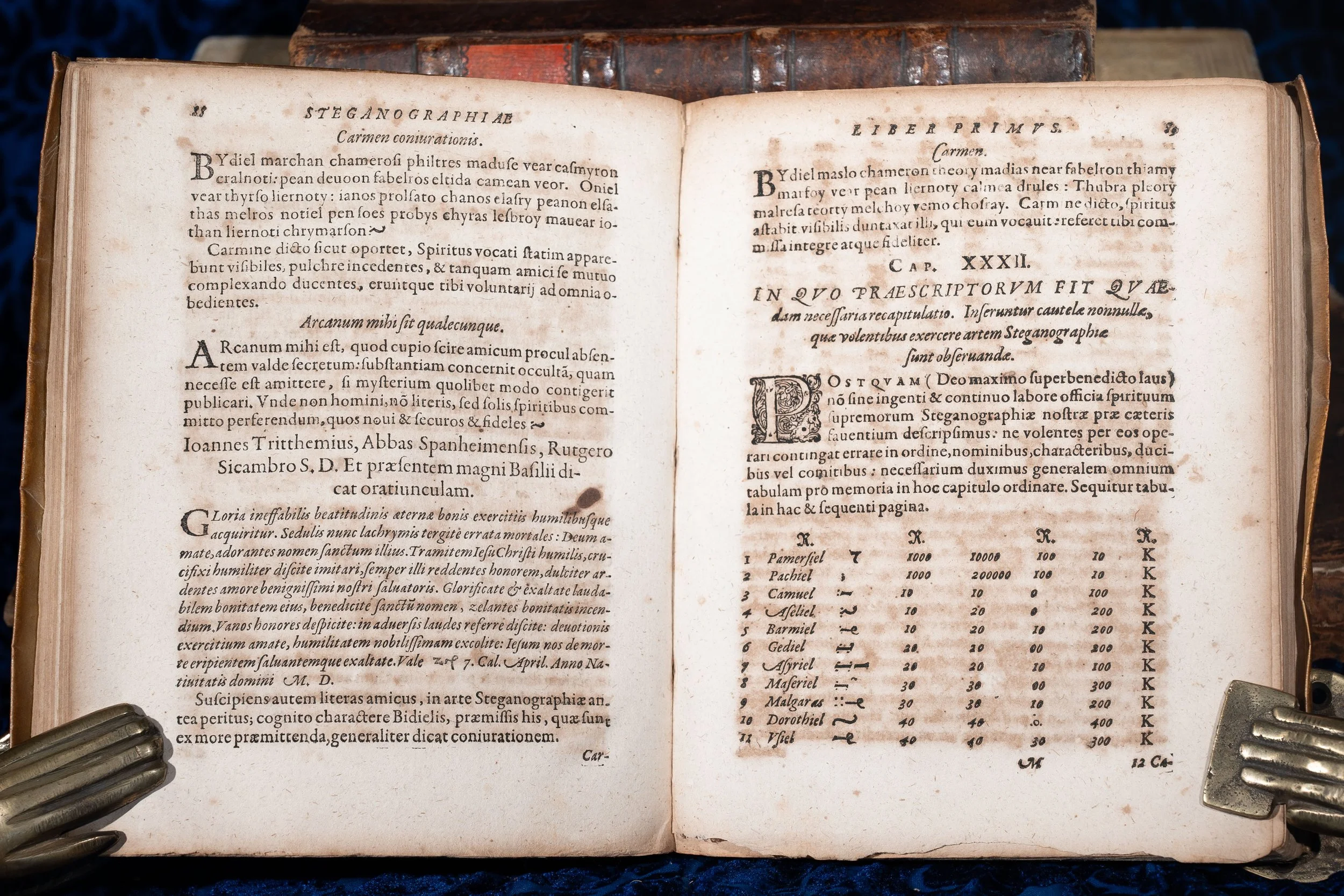 Image 7 of 18
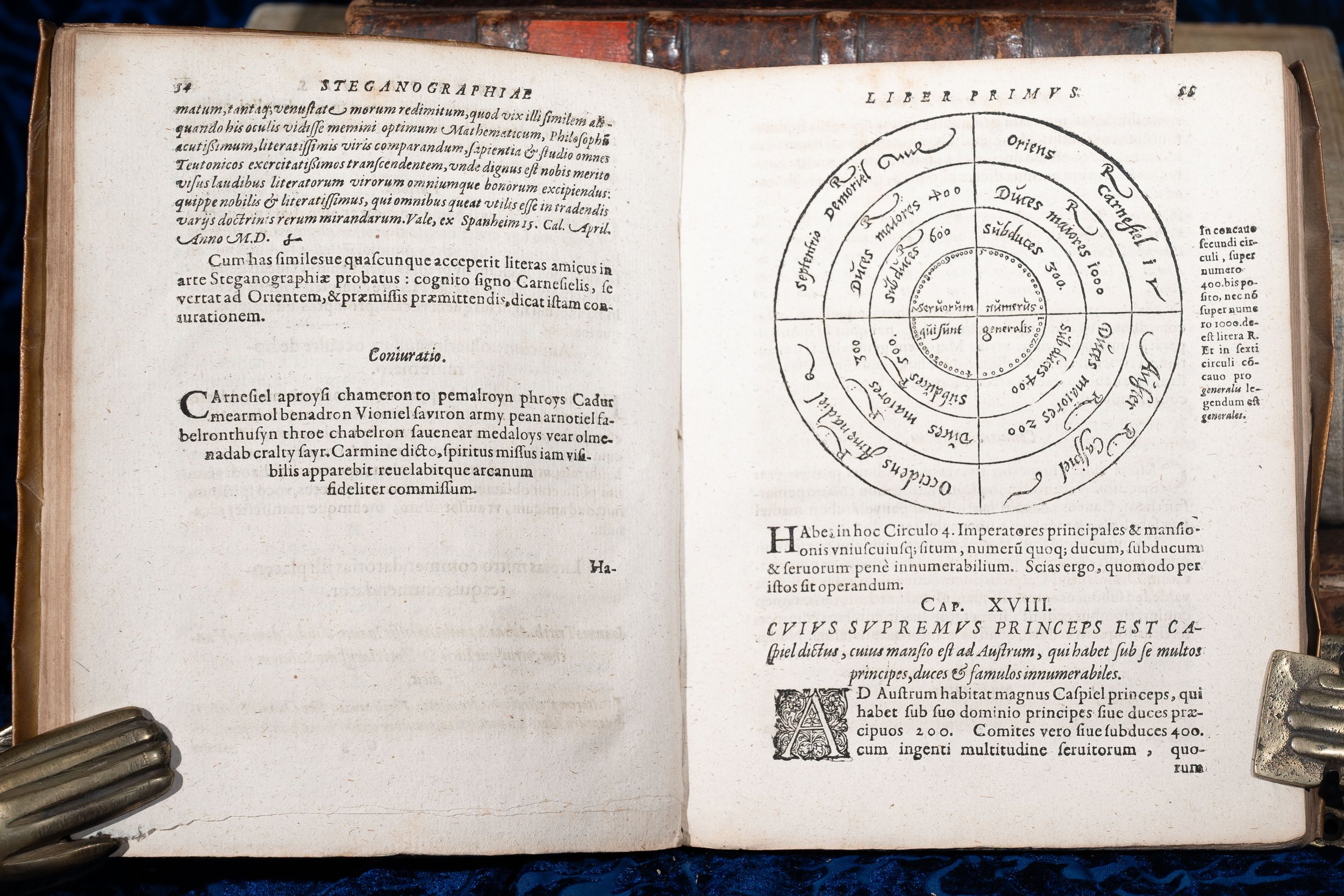 Image 8 of 18
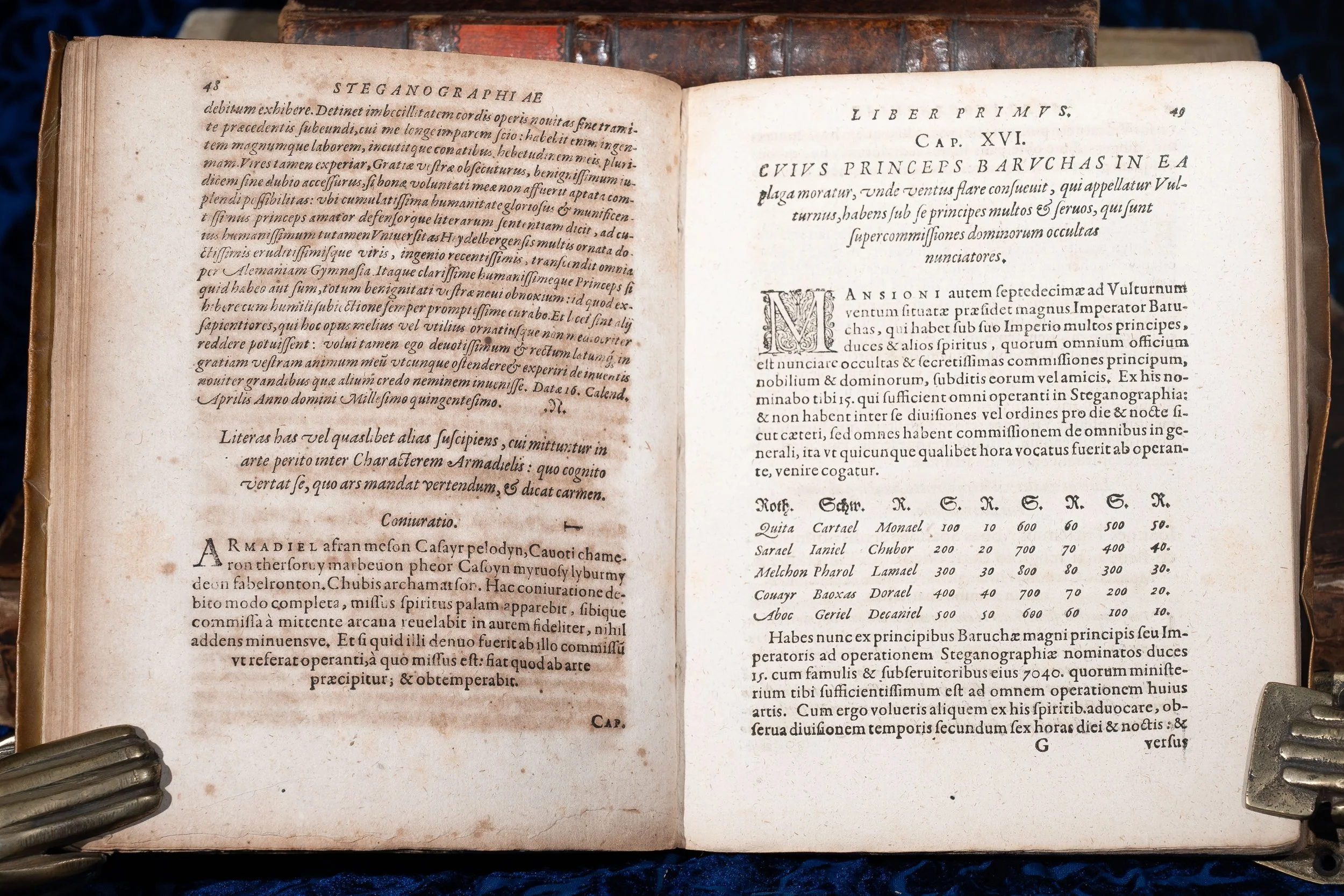 Image 9 of 18
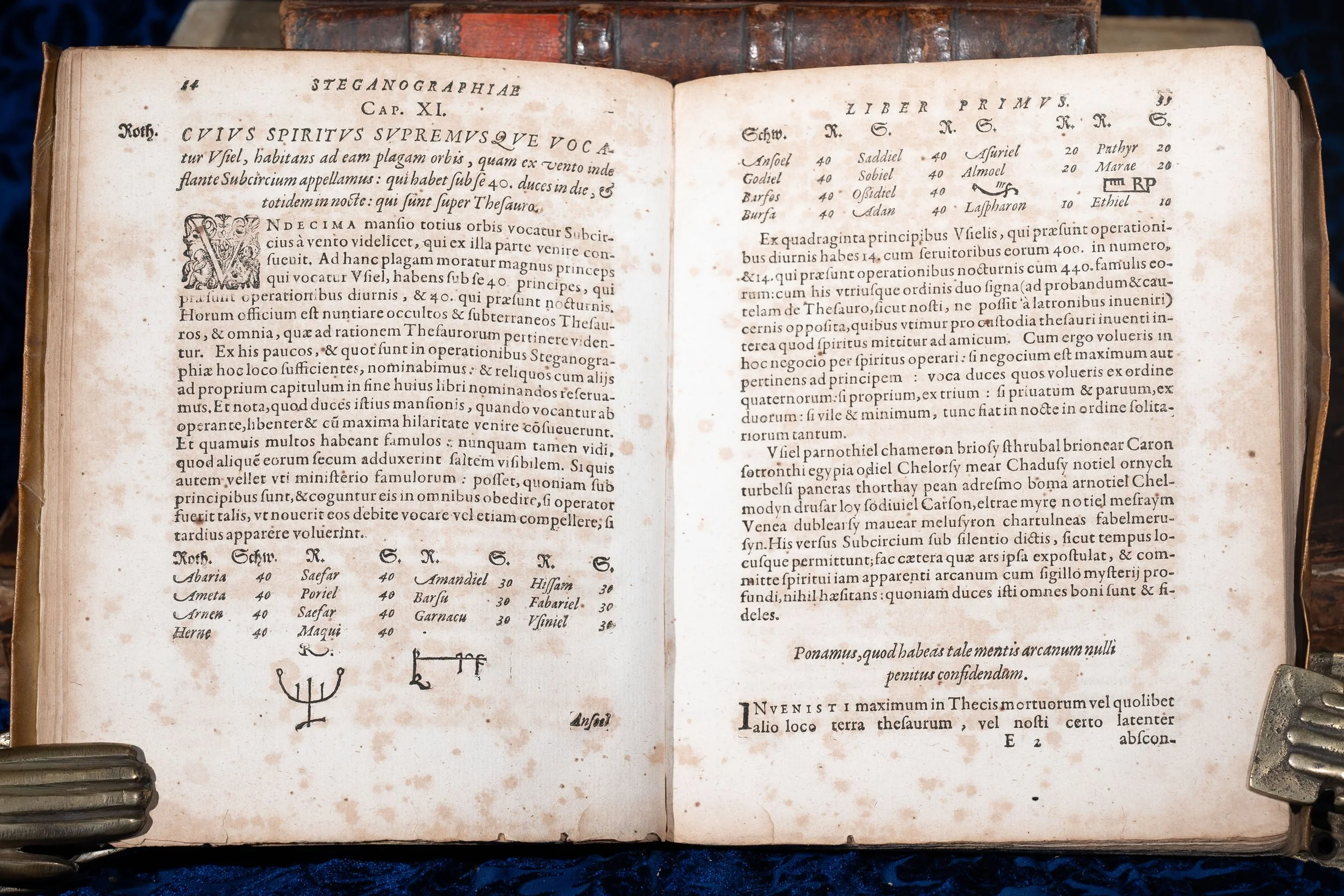 Image 10 of 18
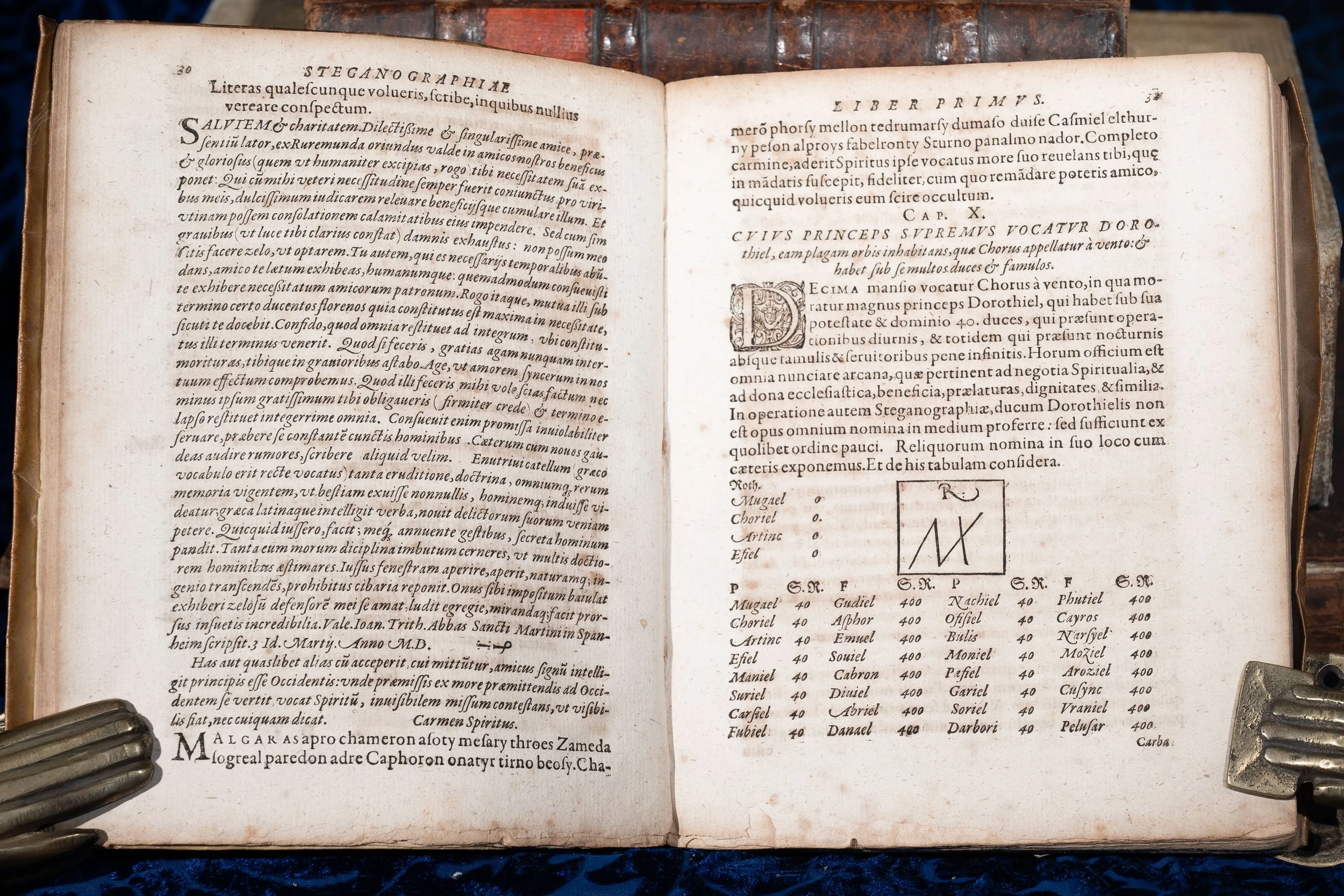 Image 11 of 18
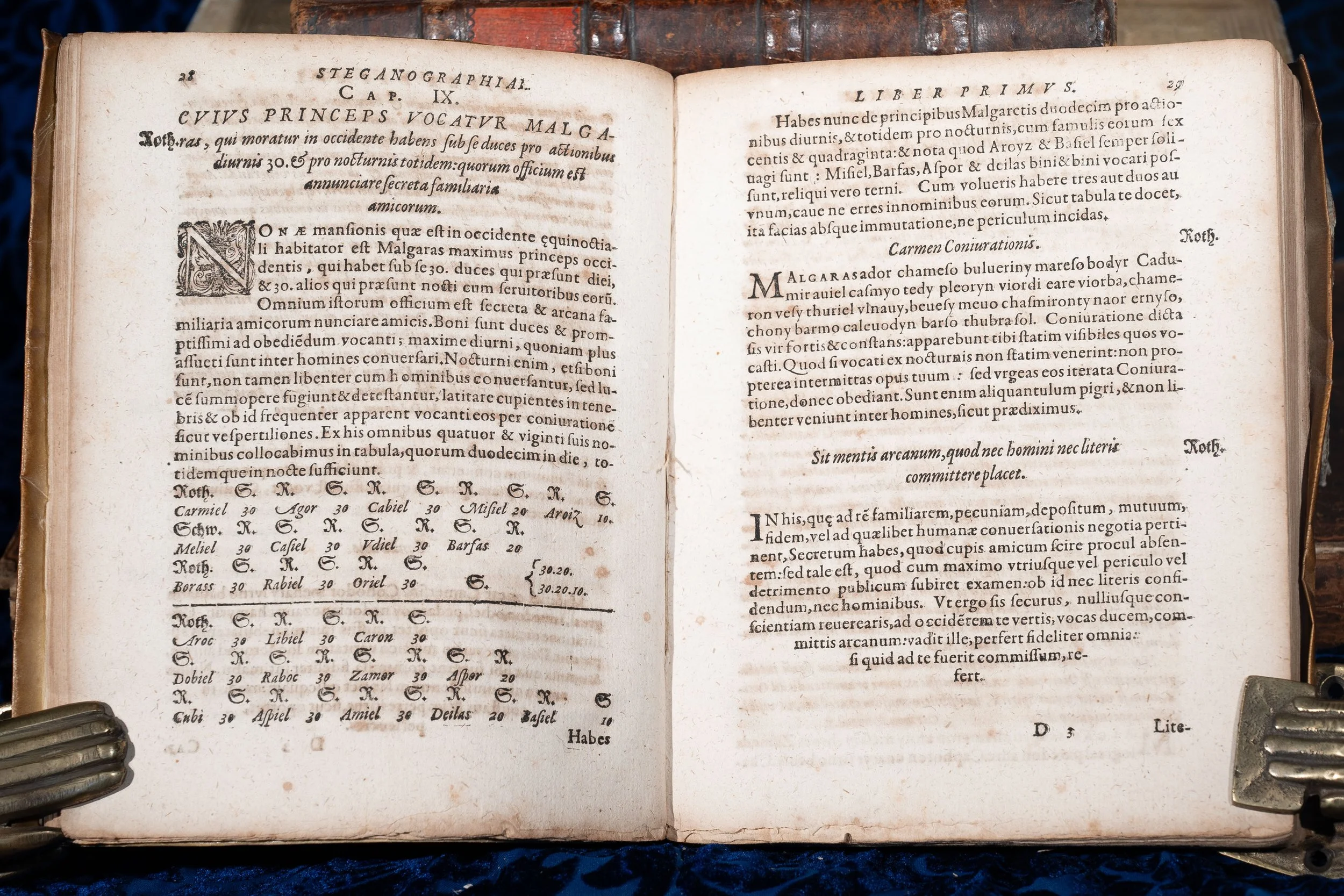 Image 12 of 18
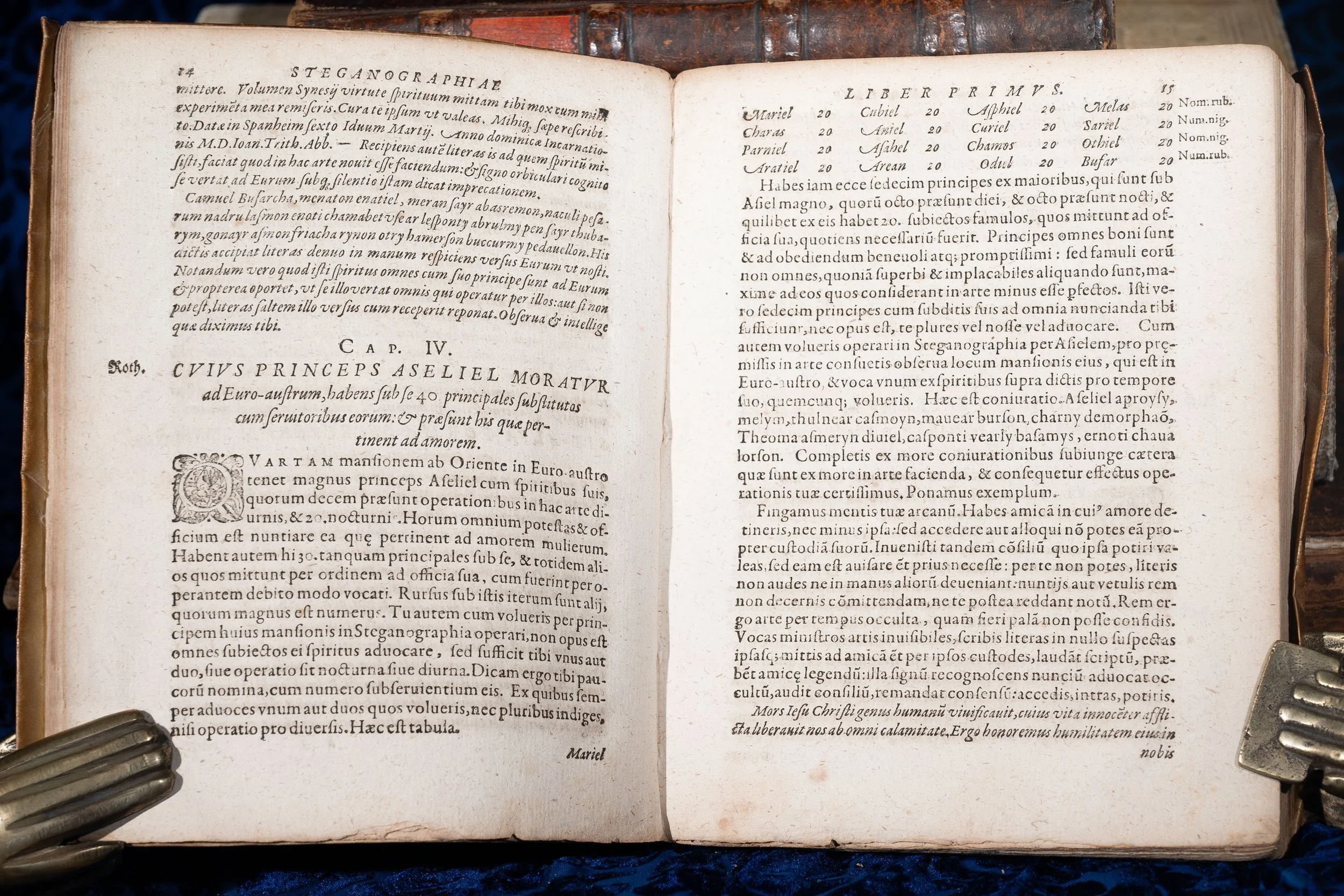 Image 13 of 18
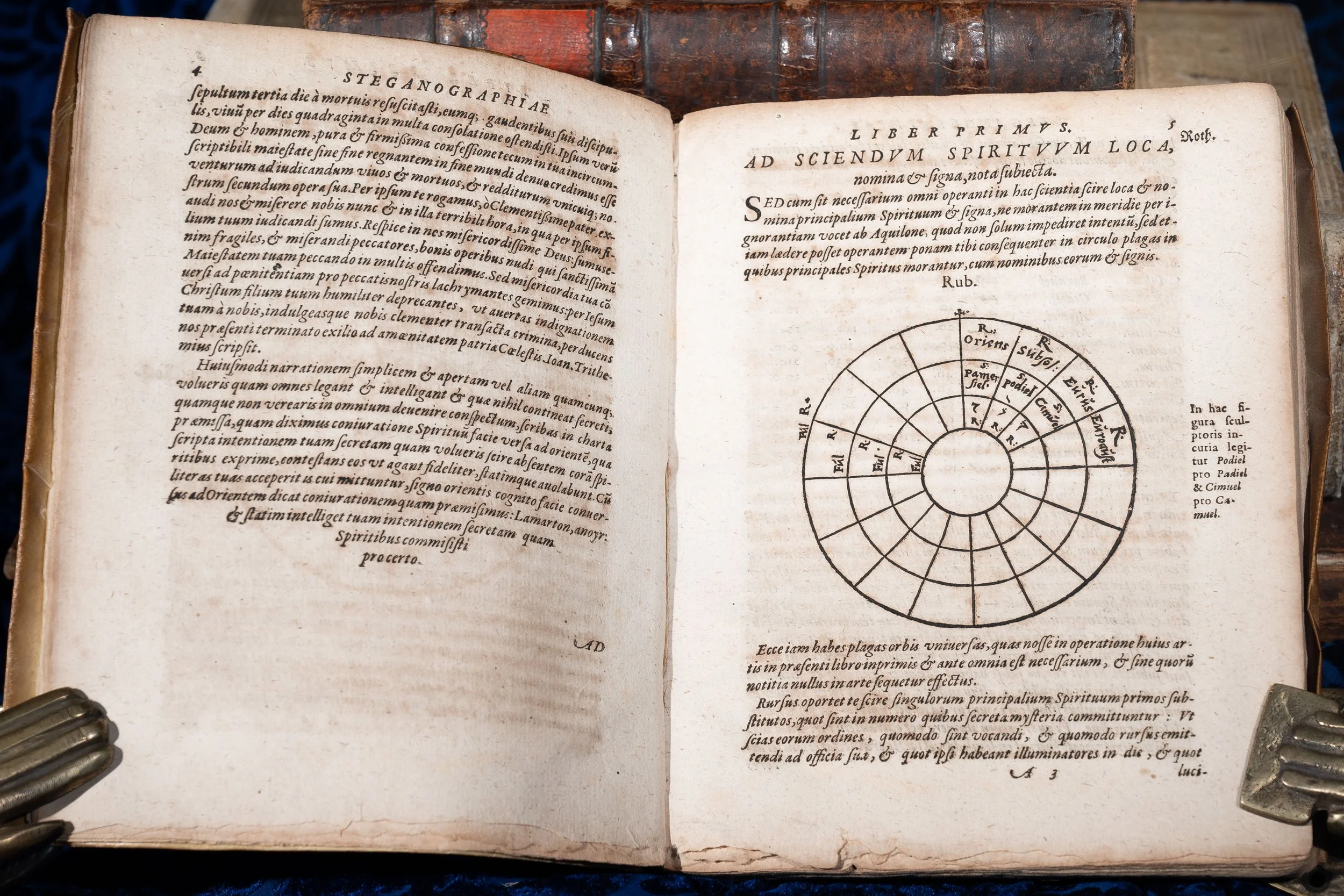 Image 14 of 18
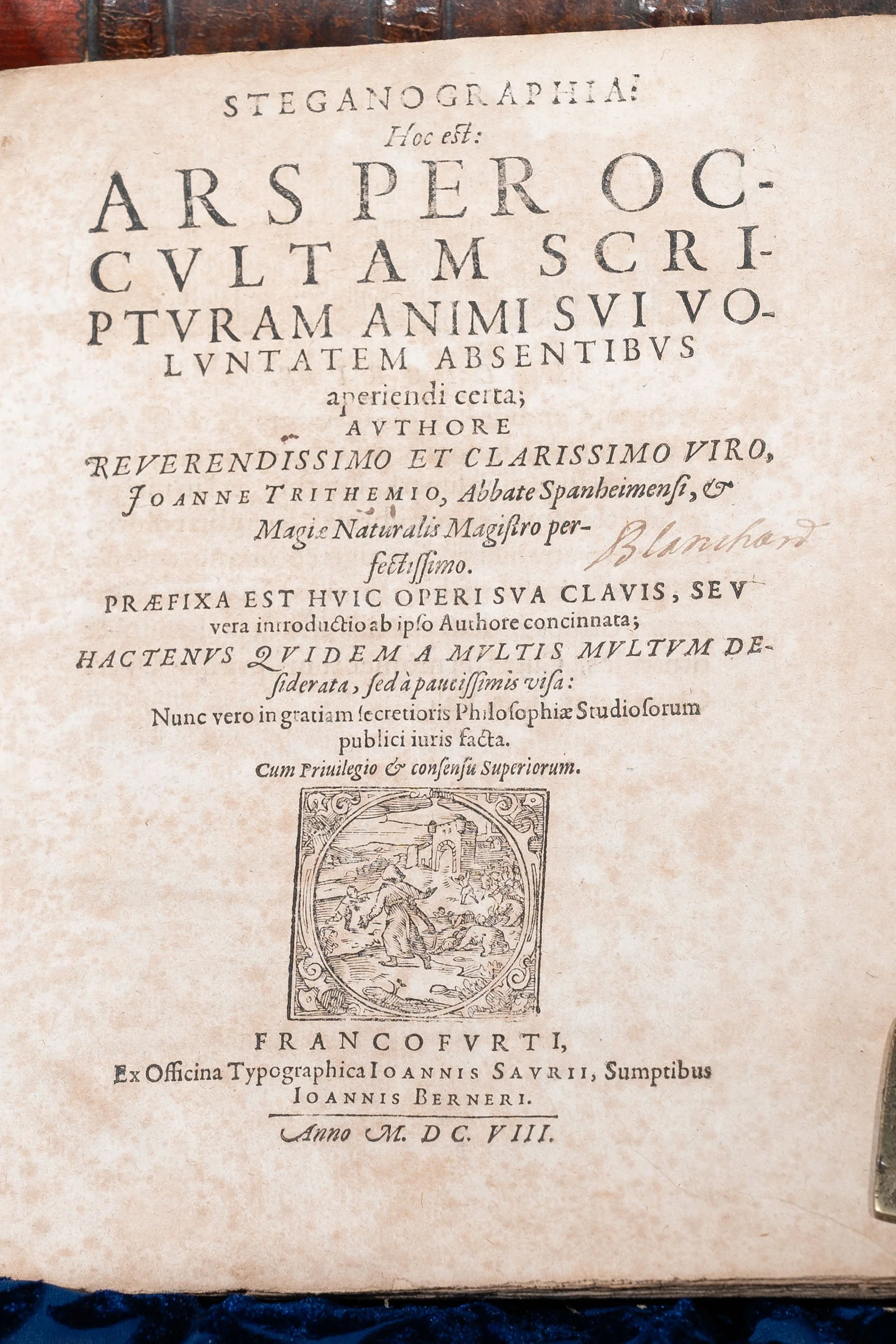 Image 15 of 18
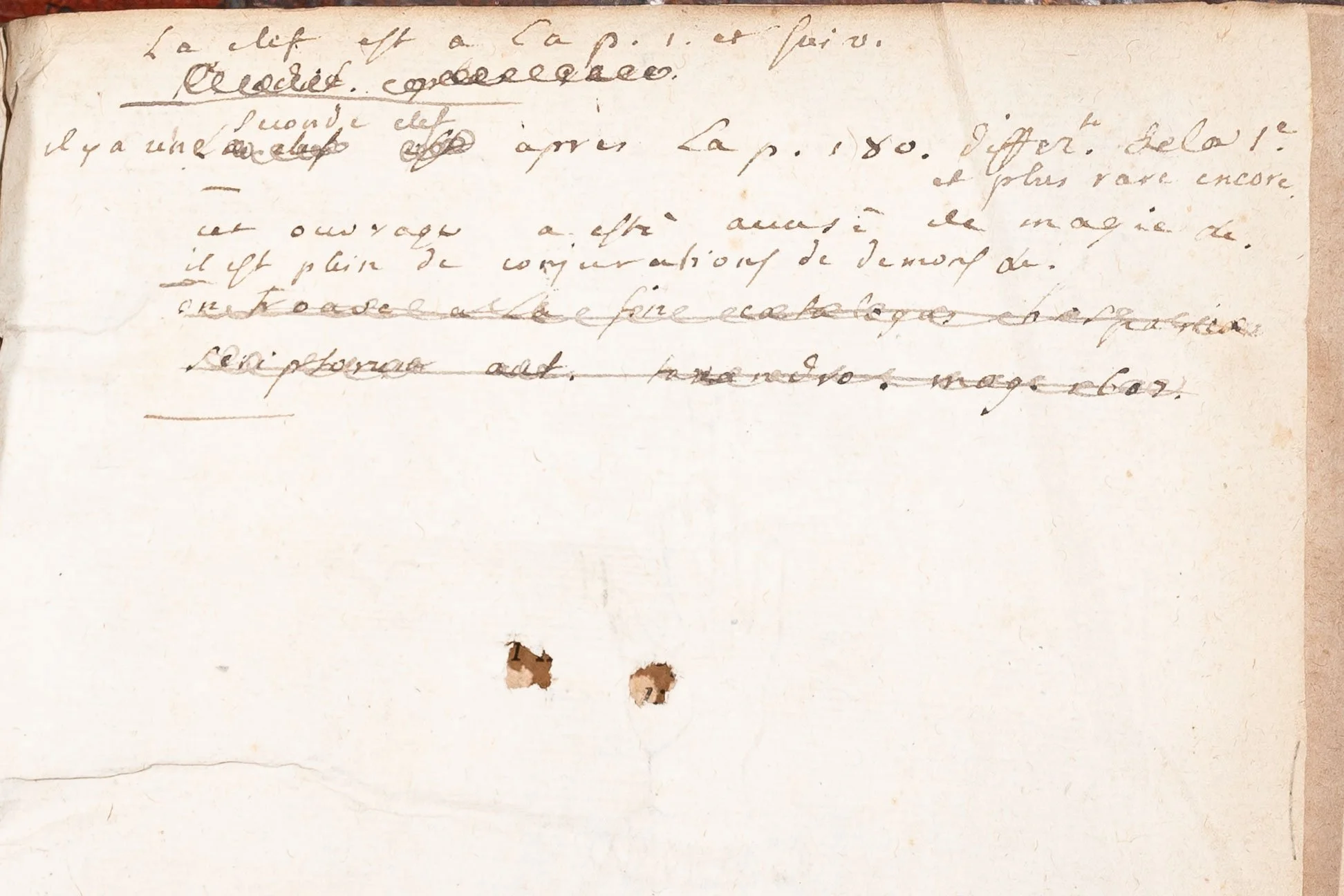 Image 16 of 18
 Image 17 of 18
 Image 18 of 18