The first edition of Consalvo Duranto’s landmark annotated text of St. Bridget’s Revelationes, printed, with deliberate symbolic weight, at the very house of St. Bridget in Rome. This is the edition that fundamentally reshaped how the Birgittine revelations were read, studied, and defended in the early modern period. Every subsequent collected edition of the Revelationes through the seventeenth century (Antwerp 1611, Cologne 1628, Rome 1628, Munich 1680) derives from this 1606 text.
Duranto’s contribution was substantial. A priest and theologian from Sant’Angelo in Vado in the Marches (later identified as the presbyter of the title page, not yet the bishop he would later become), he collated the text against manuscript sources, corrected numerous passages that had become corrupt through successive printings since the 1492 editio princeps, and furnished the revelations with extensive scholarly notes. His dual index, one for the text itself, another for the apparatus, transformed a devotional classic into a work that could be navigated as a reference tool. The whole was produced under papal privilege and dedicated to Cardinal Odoardo Farnese (1573–1626), the immensely powerful great-nephew of Paul III, patron of the Carracci, and one of the central figures of Roman cultural life in the early Seicento.
The colophon’s placement of the printing “In Aedibus Sanctae Brigittae Viduae”, at the House of St. Bridget the Widow, is more than a printer’s address. The Bridgettine house in Rome’s Piazza Farnese neighborhood had been a center of the Saint’s cult since the fourteenth century, and the decision to produce the definitive scholarly edition of her revelations there, under papal authorization, signals the Counter-Reformation Church’s careful re-appropriation of medieval mystical authority. The text was simultaneously being presented as ancient witness and modern weapon: proof that the Catholic tradition of visionary experience was both venerable and defensible.
The full-page woodcut portrait of Birgitta is a fine piece of early seventeenth-century Roman book illustration. The Saint is shown seated at her writing desk, pen in hand, books open before her, as rays of divine light descend through parted curtains. The composition is framed by an inscribed oval border quoting Judith 8: “Omnia quae loquuta es vera sunt, et in verbis tuis nulla est reprehensio”: “All that you have spoken is true, and in your words there is no fault.” The choice of text is pointed: Judith was the Hebrew widow whose words proved prophetically true despite male skepticism, and the parallel with Birgitta, a widow whose revelations were repeatedly subjected to ecclesiastical scrutiny, would not have been lost on a contemporary reader.
The present copy carries Italian aristocratic provenance: a manuscript inscription identifies the owner as “sig.re Marchese Federico” (surname partially legible), with a private library shelfmark, and a marginal annotation elsewhere in the volume referencing Novatian’s De Trinitate, suggesting a reader who engaged with the text not merely devotionally but in dialogue with the broader patristic tradition. The blue circular stamps on the dedication leaf and ownership page await identification.
For scholars of Western esotericism, the Revelationes occupy a significant if sometimes underappreciated position. Birgitta’s visions operate at the intersection of sanctioned mysticism and what the early modern period increasingly classified as “private revelation”, a category fraught with implications for the legitimacy of non-institutional spiritual authority, the epistemology of visionary experience, and the contested boundary between divine inspiration and demonic illusion. The inclusion of demonological sections, the sustained attention to the discernment of spirits throughout, and the broader framework of prophetic authority directed at popes and kings all connect the text to currents that run through the history of Western esotericism in its widest sense. Duranto’s editorial apparatus, which would later be supplemented by his full-scale treatise De Visionibus, Revelationibus, et Apparitionibus in subsequent editions, represents an important early attempt to systematize the theology of visionary experience.
A handsome, unsophisticated copy in its original Italian vellum, printed at St. Bridget’s own Roman house, of the edition that defined how Europe read these revelations for the next century and a half.
BRIDGET OF SWEDEN (Birgitta Birgersdotter, c. 1303–1373). Revelationes S. Brigittae, olim à Card. Turrecremata recognitae, Nunc à Consalvo Duranto a Sancto Angelo in Vado Presb. et Sacrae Theol. Profess. Notis Illustratae. Locis etiam quamplurimis ex Manuscriptis Codicibus restitutis, ac emendatis. Cum duplici Indice, altero Textus, altero vero Notarum. Rome: Apud Stephanum Paulinum, Sumptib. Iulij Burchionij, 1606. [Colophon: Romae, In Aedibus Sanctae Brigittae Viduae, Apud Stephanum Paulinum, MDCVI.] Cum Privilegio Summi Pontificis. Superiorum Authoritate.
Physical Description: Folio (316 × 220 mm). [36], 876, [84] leaves [i.e. pp.]. Title page printed in red and black with large woodcut armorial device (Farnese arms). Full-page woodcut portrait of St. Bridget receiving divine inspiration, seated at her writing desk with pen in hand, rays descending from heaven, within an oval border inscribed with text from Judith VIII (“Omnia quae loquuta es vera sunt, et in verbis tuis nulla est reprehensio”). Numerous woodcut headpieces, tailpieces, and historiated initials throughout. Woodcut printer’s device at end depicting a six-headed Hydra with a burning torch, motto “Vrit Veritas.” Text in double columns with Duranto’s notes. Dual index (text and notes). Errata leaf present. Collation statement (Regestum) present: all ternions.
Binding: Contemporary limp vellum with manuscript title on spine (“Reuelationes Sancte Brigitte”) and “S. Brigitte” in manuscript on lower text-block edge. Fragments of old manuscript visible inside binding. Vellum shows age-toning, surface wear, and some cracking along the spine folds, with minor losses at extremities. Binding consistent with Italian monastic or ecclesiastical use.
Condition: Good. Text block solid and largely clean, with some leaves occasionally browned or foxed and minor dampstaining to lower margins (partially caused by ink from the edge inscription “Reuelationes S. Brigitte”). Title page with lower edge showing some paper loss (not affecting text), but printing bright and well-preserved. Woodcut portrait in strong impression. A genuine, unsophisticated copy with the expected evidence of use.
Provenance: (1) Italian aristocratic ownership: manuscript inscription on front free endpaper reading “Libro del sig.re Marchese Federico [Schiavest?]” with shelfmark “N°. no41 n°. 3.” (2) Private circular stamp in blue ink, visible on dedication leaf and ownership page (3) Marginal manuscript annotations in a scholarly hand referencing Novatian, De Trinitate c. 1, suggesting a theologically literate reader.
The first edition of Consalvo Duranto’s landmark annotated text of St. Bridget’s Revelationes, printed, with deliberate symbolic weight, at the very house of St. Bridget in Rome. This is the edition that fundamentally reshaped how the Birgittine revelations were read, studied, and defended in the early modern period. Every subsequent collected edition of the Revelationes through the seventeenth century (Antwerp 1611, Cologne 1628, Rome 1628, Munich 1680) derives from this 1606 text.
Duranto’s contribution was substantial. A priest and theologian from Sant’Angelo in Vado in the Marches (later identified as the presbyter of the title page, not yet the bishop he would later become), he collated the text against manuscript sources, corrected numerous passages that had become corrupt through successive printings since the 1492 editio princeps, and furnished the revelations with extensive scholarly notes. His dual index, one for the text itself, another for the apparatus, transformed a devotional classic into a work that could be navigated as a reference tool. The whole was produced under papal privilege and dedicated to Cardinal Odoardo Farnese (1573–1626), the immensely powerful great-nephew of Paul III, patron of the Carracci, and one of the central figures of Roman cultural life in the early Seicento.
The colophon’s placement of the printing “In Aedibus Sanctae Brigittae Viduae”, at the House of St. Bridget the Widow, is more than a printer’s address. The Bridgettine house in Rome’s Piazza Farnese neighborhood had been a center of the Saint’s cult since the fourteenth century, and the decision to produce the definitive scholarly edition of her revelations there, under papal authorization, signals the Counter-Reformation Church’s careful re-appropriation of medieval mystical authority. The text was simultaneously being presented as ancient witness and modern weapon: proof that the Catholic tradition of visionary experience was both venerable and defensible.
The full-page woodcut portrait of Birgitta is a fine piece of early seventeenth-century Roman book illustration. The Saint is shown seated at her writing desk, pen in hand, books open before her, as rays of divine light descend through parted curtains. The composition is framed by an inscribed oval border quoting Judith 8: “Omnia quae loquuta es vera sunt, et in verbis tuis nulla est reprehensio”: “All that you have spoken is true, and in your words there is no fault.” The choice of text is pointed: Judith was the Hebrew widow whose words proved prophetically true despite male skepticism, and the parallel with Birgitta, a widow whose revelations were repeatedly subjected to ecclesiastical scrutiny, would not have been lost on a contemporary reader.
The present copy carries Italian aristocratic provenance: a manuscript inscription identifies the owner as “sig.re Marchese Federico” (surname partially legible), with a private library shelfmark, and a marginal annotation elsewhere in the volume referencing Novatian’s De Trinitate, suggesting a reader who engaged with the text not merely devotionally but in dialogue with the broader patristic tradition. The blue circular stamps on the dedication leaf and ownership page await identification.
For scholars of Western esotericism, the Revelationes occupy a significant if sometimes underappreciated position. Birgitta’s visions operate at the intersection of sanctioned mysticism and what the early modern period increasingly classified as “private revelation”, a category fraught with implications for the legitimacy of non-institutional spiritual authority, the epistemology of visionary experience, and the contested boundary between divine inspiration and demonic illusion. The inclusion of demonological sections, the sustained attention to the discernment of spirits throughout, and the broader framework of prophetic authority directed at popes and kings all connect the text to currents that run through the history of Western esotericism in its widest sense. Duranto’s editorial apparatus, which would later be supplemented by his full-scale treatise De Visionibus, Revelationibus, et Apparitionibus in subsequent editions, represents an important early attempt to systematize the theology of visionary experience.
A handsome, unsophisticated copy in its original Italian vellum, printed at St. Bridget’s own Roman house, of the edition that defined how Europe read these revelations for the next century and a half.
BRIDGET OF SWEDEN (Birgitta Birgersdotter, c. 1303–1373). Revelationes S. Brigittae, olim à Card. Turrecremata recognitae, Nunc à Consalvo Duranto a Sancto Angelo in Vado Presb. et Sacrae Theol. Profess. Notis Illustratae. Locis etiam quamplurimis ex Manuscriptis Codicibus restitutis, ac emendatis. Cum duplici Indice, altero Textus, altero vero Notarum. Rome: Apud Stephanum Paulinum, Sumptib. Iulij Burchionij, 1606. [Colophon: Romae, In Aedibus Sanctae Brigittae Viduae, Apud Stephanum Paulinum, MDCVI.] Cum Privilegio Summi Pontificis. Superiorum Authoritate.
Physical Description: Folio (316 × 220 mm). [36], 876, [84] leaves [i.e. pp.]. Title page printed in red and black with large woodcut armorial device (Farnese arms). Full-page woodcut portrait of St. Bridget receiving divine inspiration, seated at her writing desk with pen in hand, rays descending from heaven, within an oval border inscribed with text from Judith VIII (“Omnia quae loquuta es vera sunt, et in verbis tuis nulla est reprehensio”). Numerous woodcut headpieces, tailpieces, and historiated initials throughout. Woodcut printer’s device at end depicting a six-headed Hydra with a burning torch, motto “Vrit Veritas.” Text in double columns with Duranto’s notes. Dual index (text and notes). Errata leaf present. Collation statement (Regestum) present: all ternions.
Binding: Contemporary limp vellum with manuscript title on spine (“Reuelationes Sancte Brigitte”) and “S. Brigitte” in manuscript on lower text-block edge. Fragments of old manuscript visible inside binding. Vellum shows age-toning, surface wear, and some cracking along the spine folds, with minor losses at extremities. Binding consistent with Italian monastic or ecclesiastical use.
Condition: Good. Text block solid and largely clean, with some leaves occasionally browned or foxed and minor dampstaining to lower margins (partially caused by ink from the edge inscription “Reuelationes S. Brigitte”). Title page with lower edge showing some paper loss (not affecting text), but printing bright and well-preserved. Woodcut portrait in strong impression. A genuine, unsophisticated copy with the expected evidence of use.
Provenance: (1) Italian aristocratic ownership: manuscript inscription on front free endpaper reading “Libro del sig.re Marchese Federico [Schiavest?]” with shelfmark “N°. no41 n°. 3.” (2) Private circular stamp in blue ink, visible on dedication leaf and ownership page (3) Marginal manuscript annotations in a scholarly hand referencing Novatian, De Trinitate c. 1, suggesting a theologically literate reader.

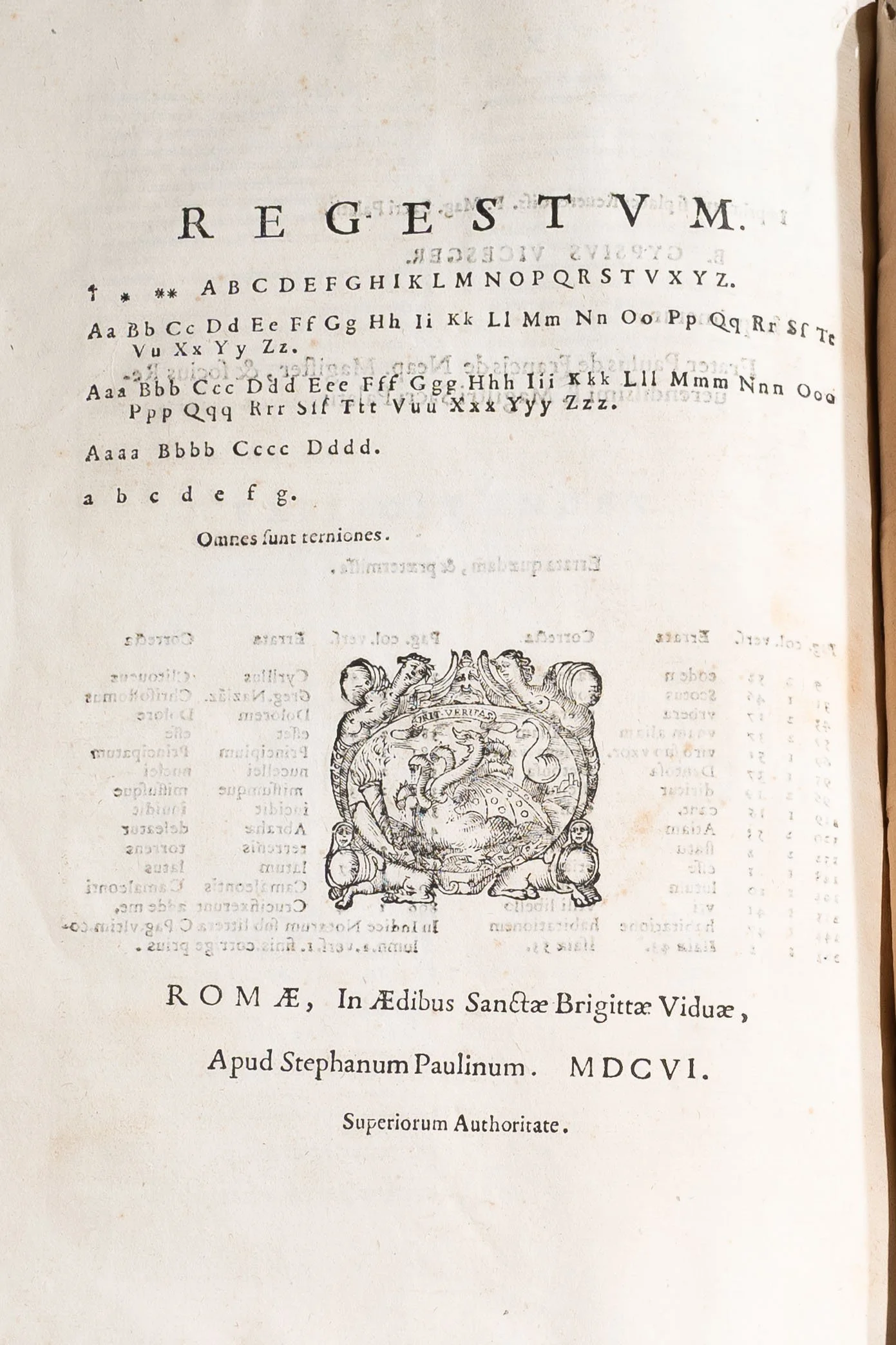 Image 1 of 15
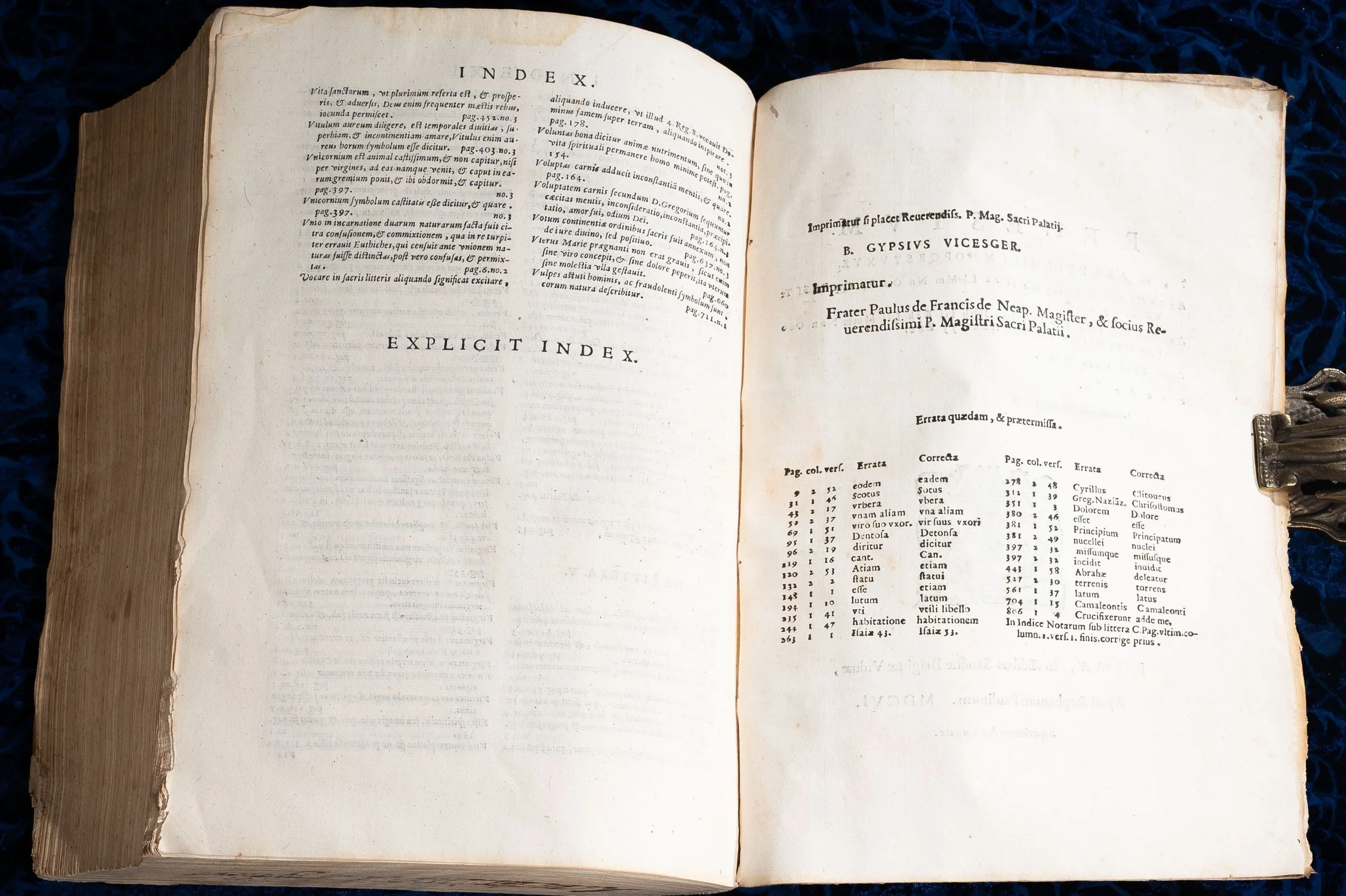 Image 2 of 15
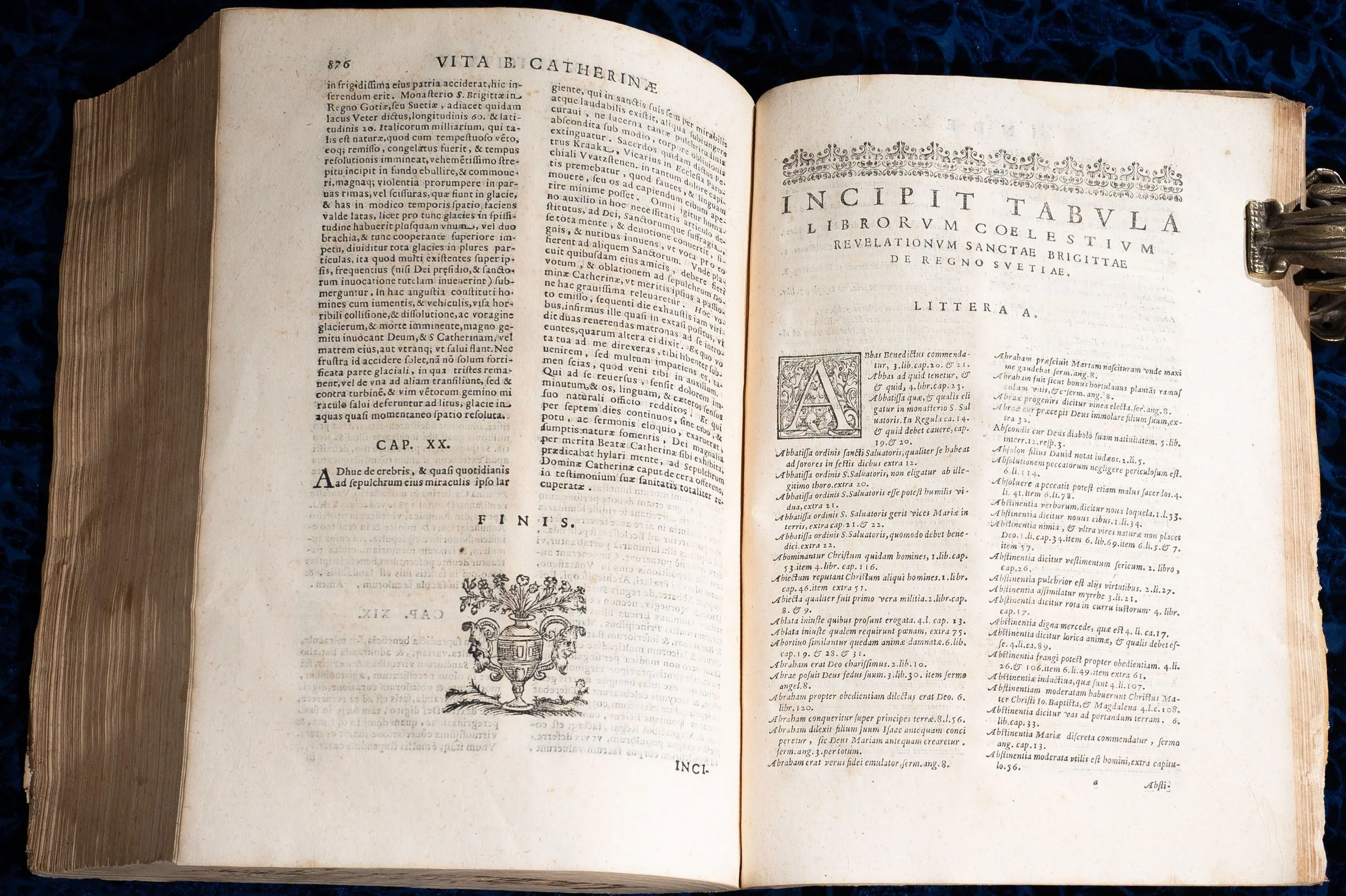 Image 3 of 15
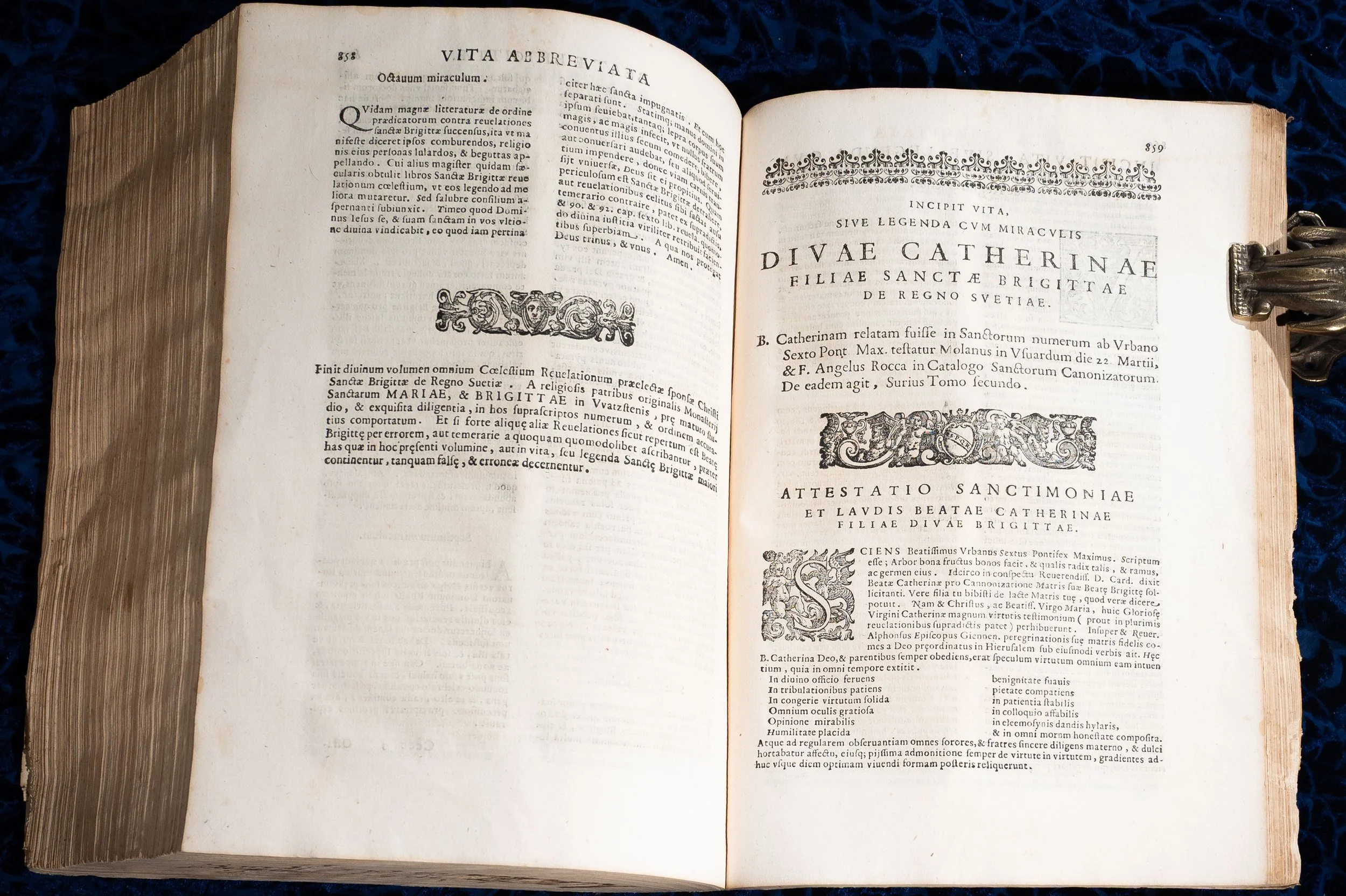 Image 4 of 15
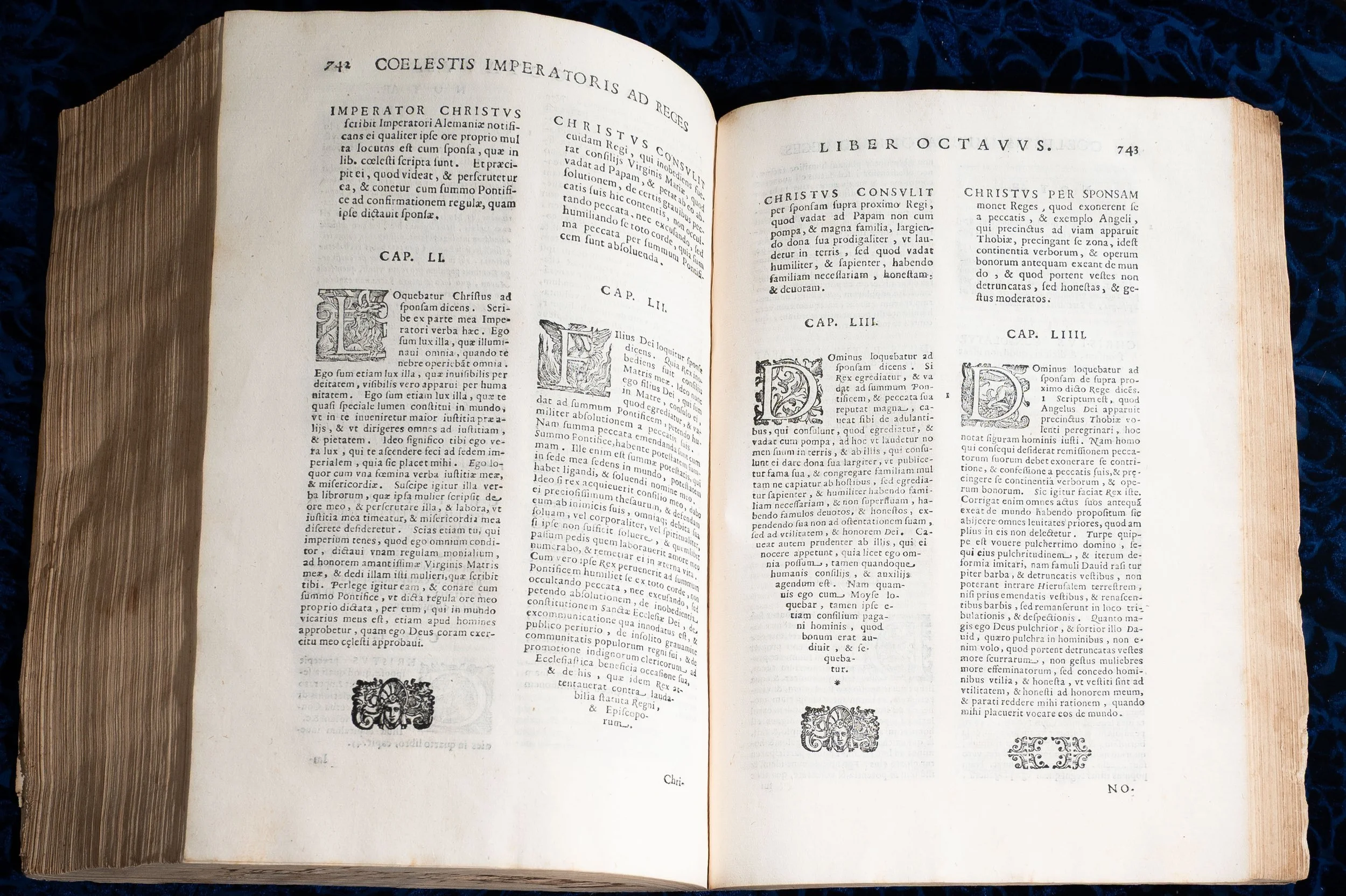 Image 5 of 15
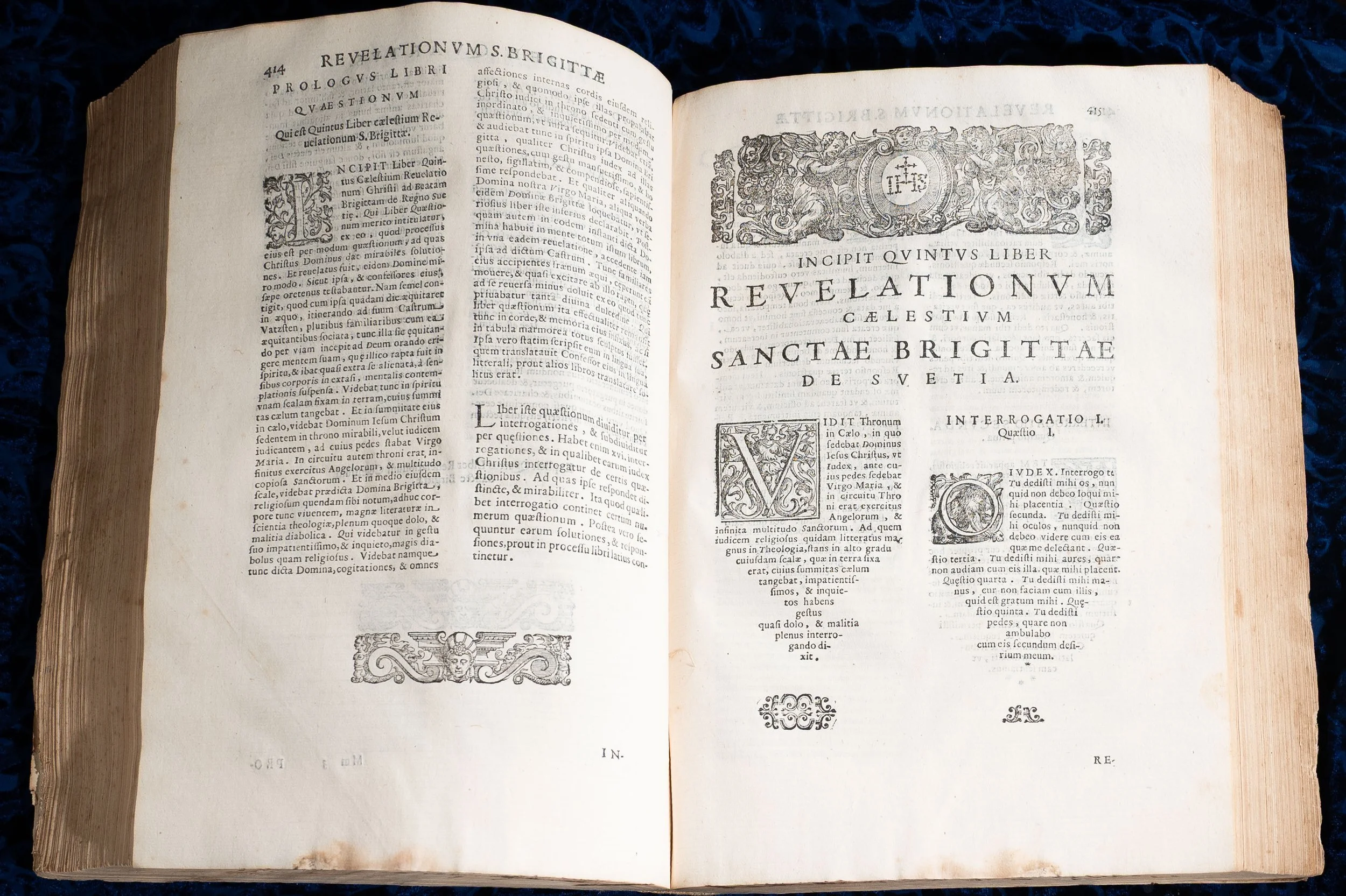 Image 6 of 15
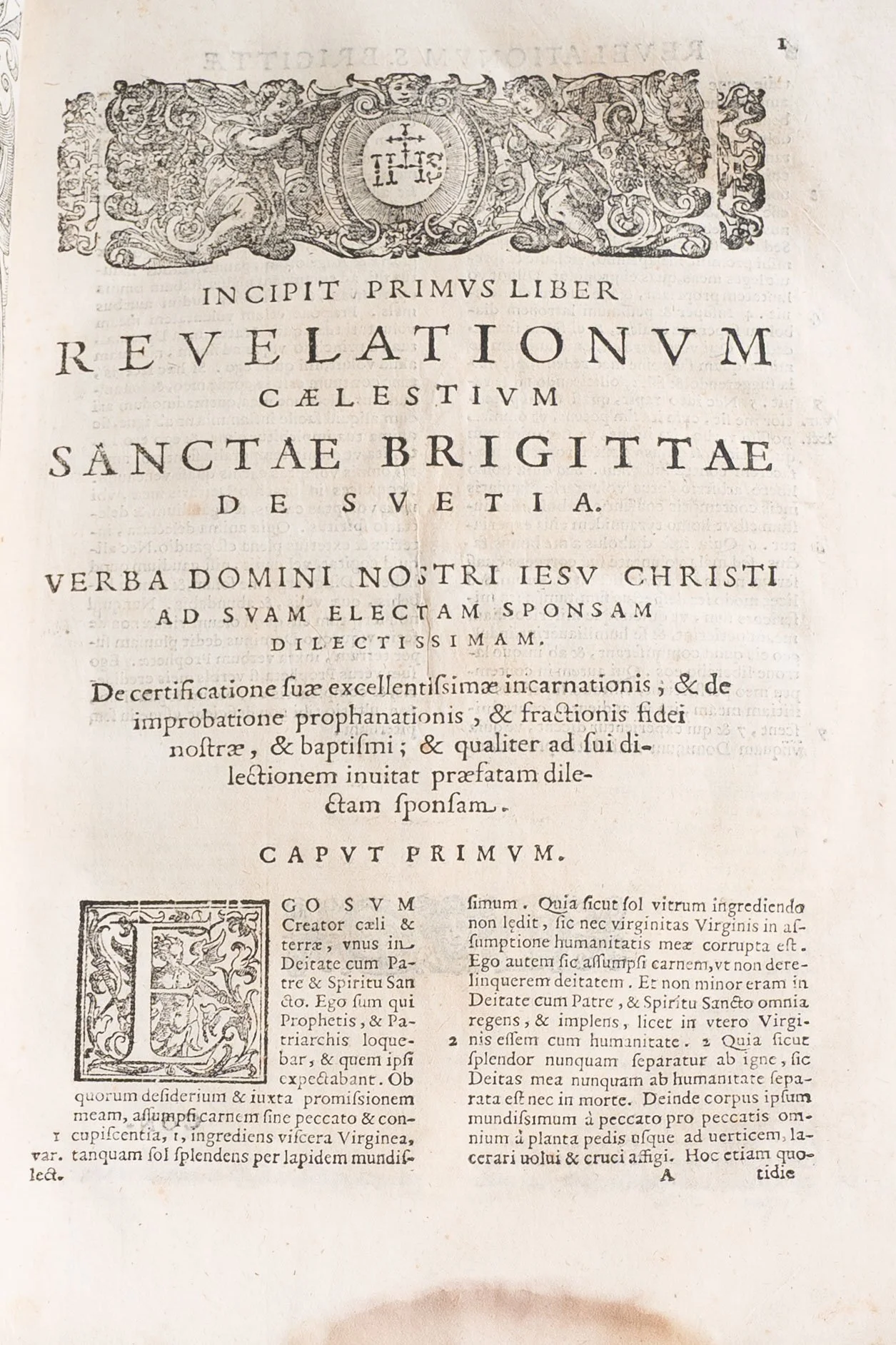 Image 7 of 15
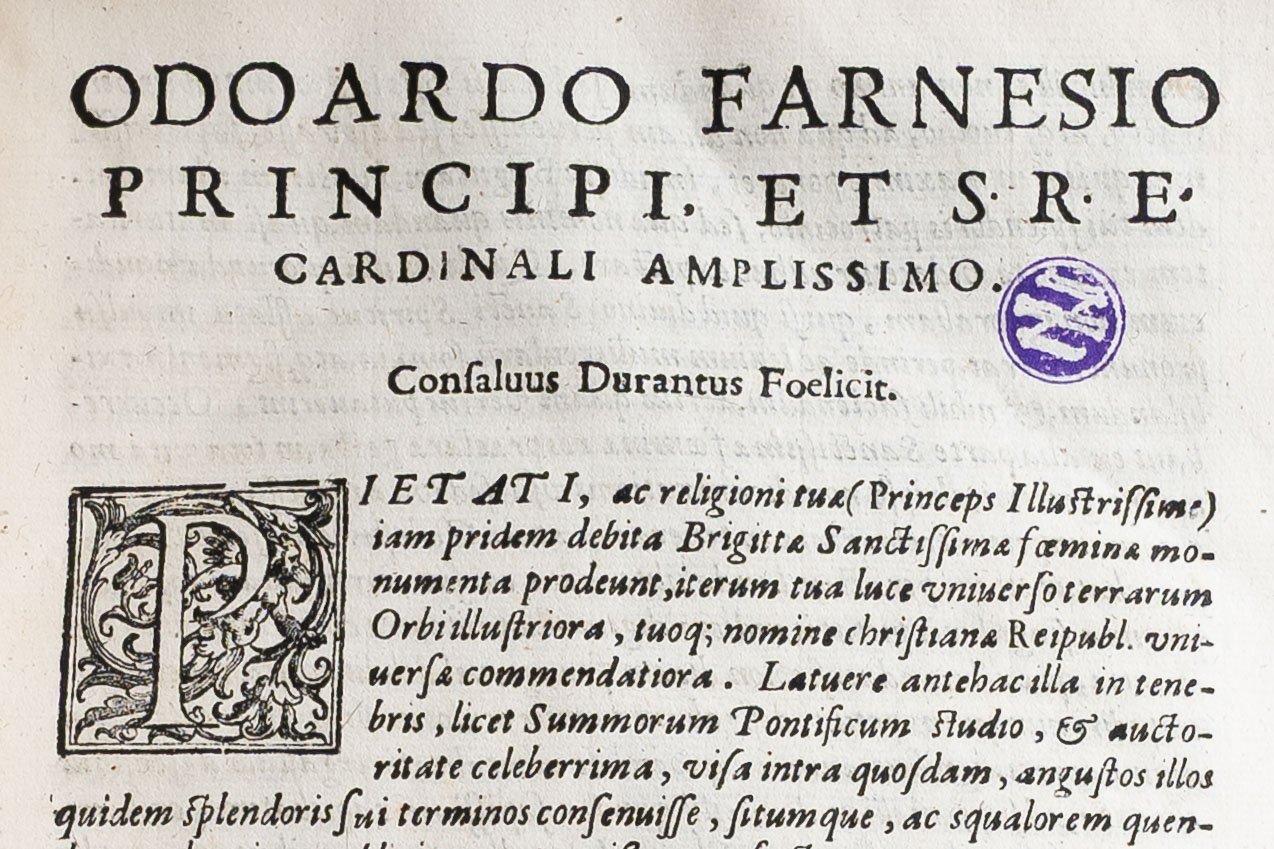 Image 8 of 15
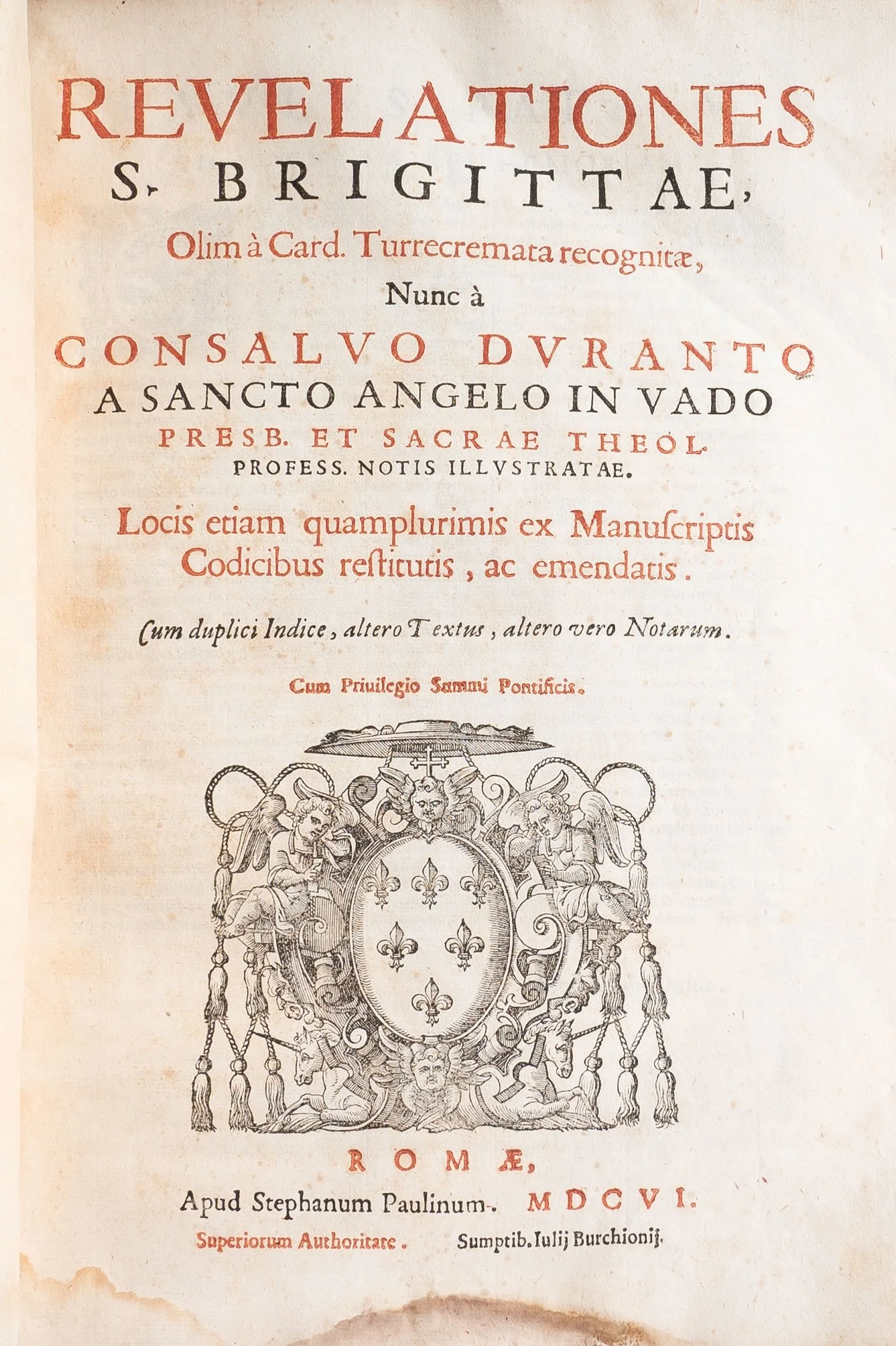 Image 9 of 15
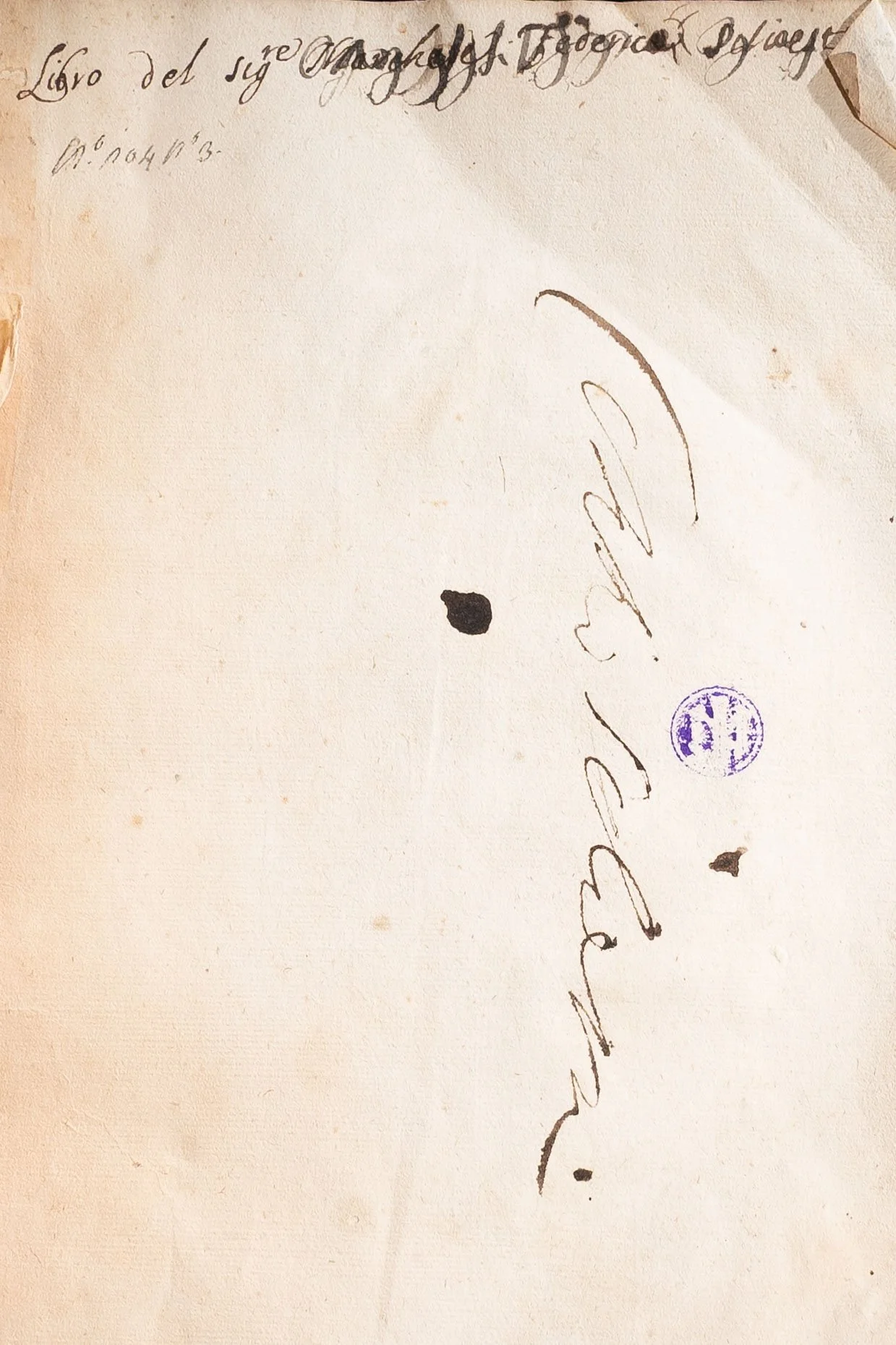 Image 10 of 15
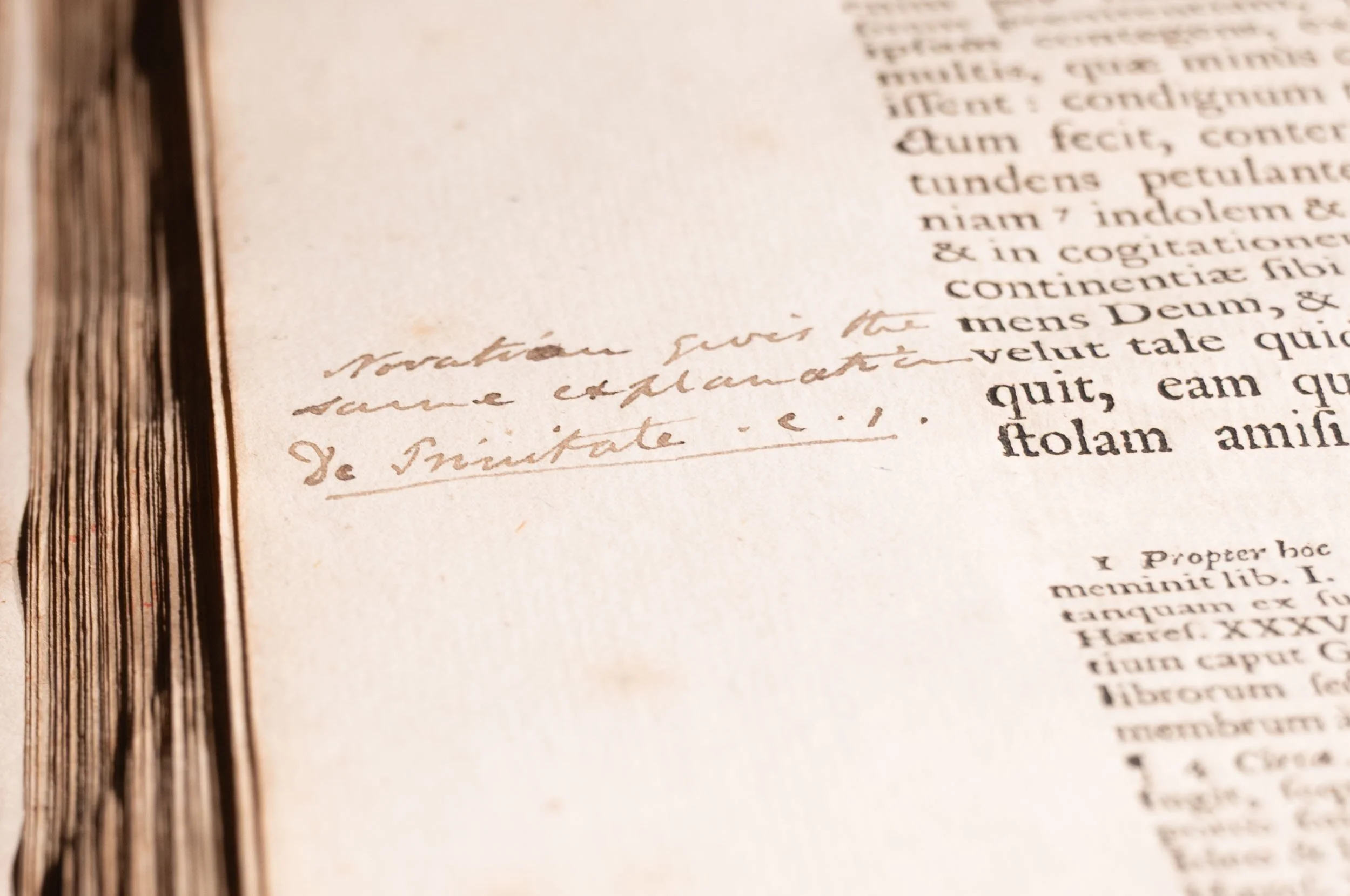 Image 11 of 15
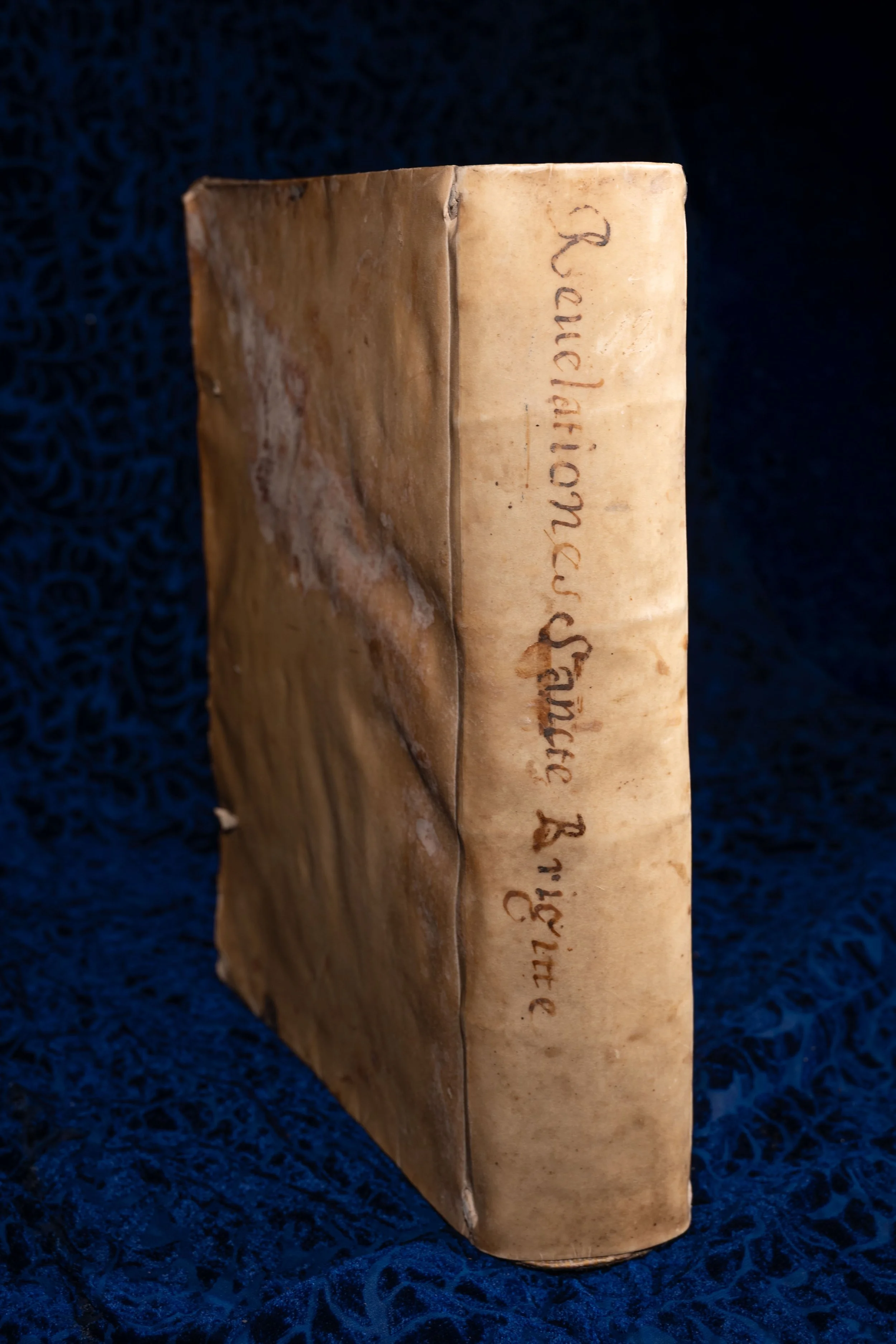 Image 12 of 15
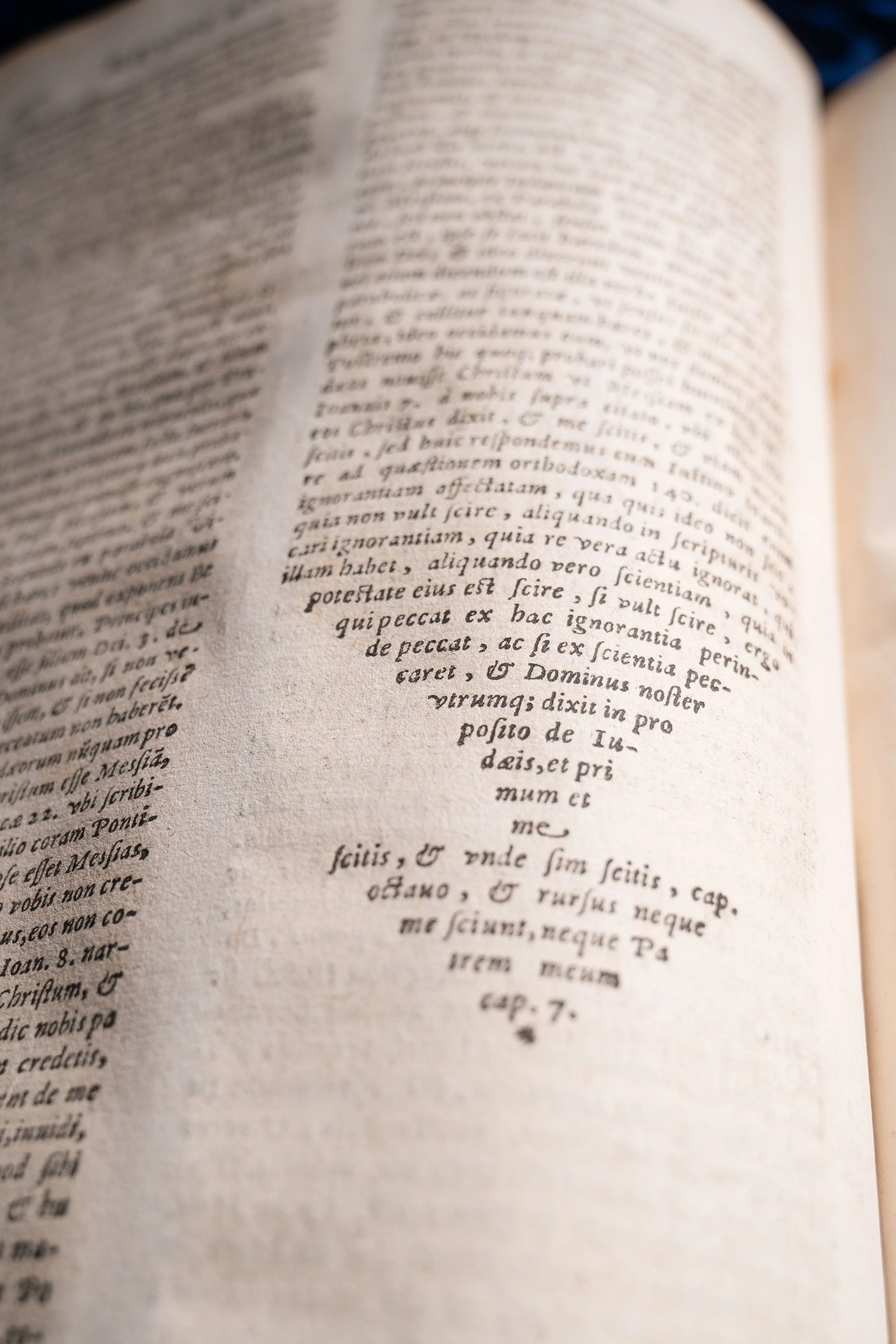 Image 13 of 15
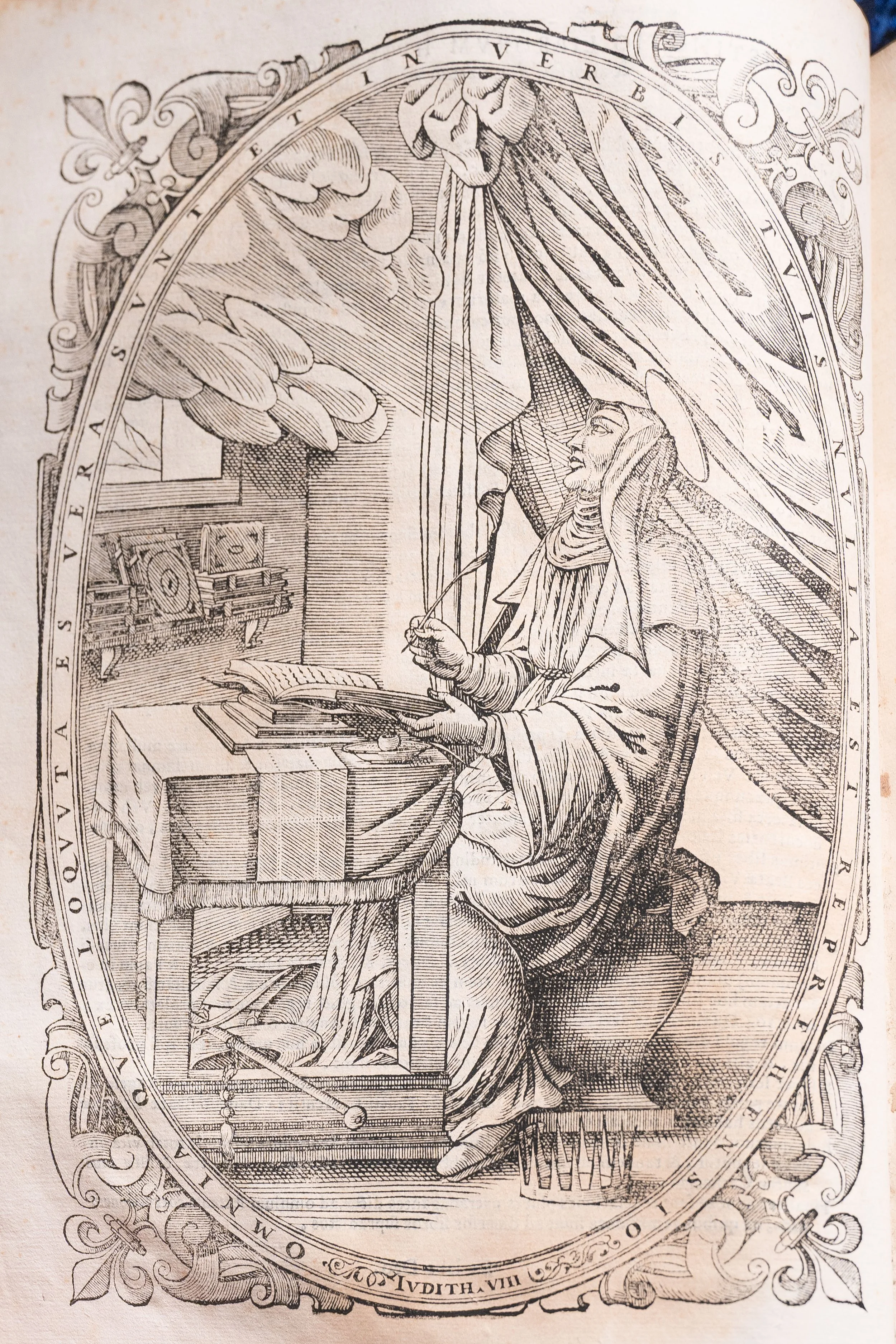 Image 14 of 15
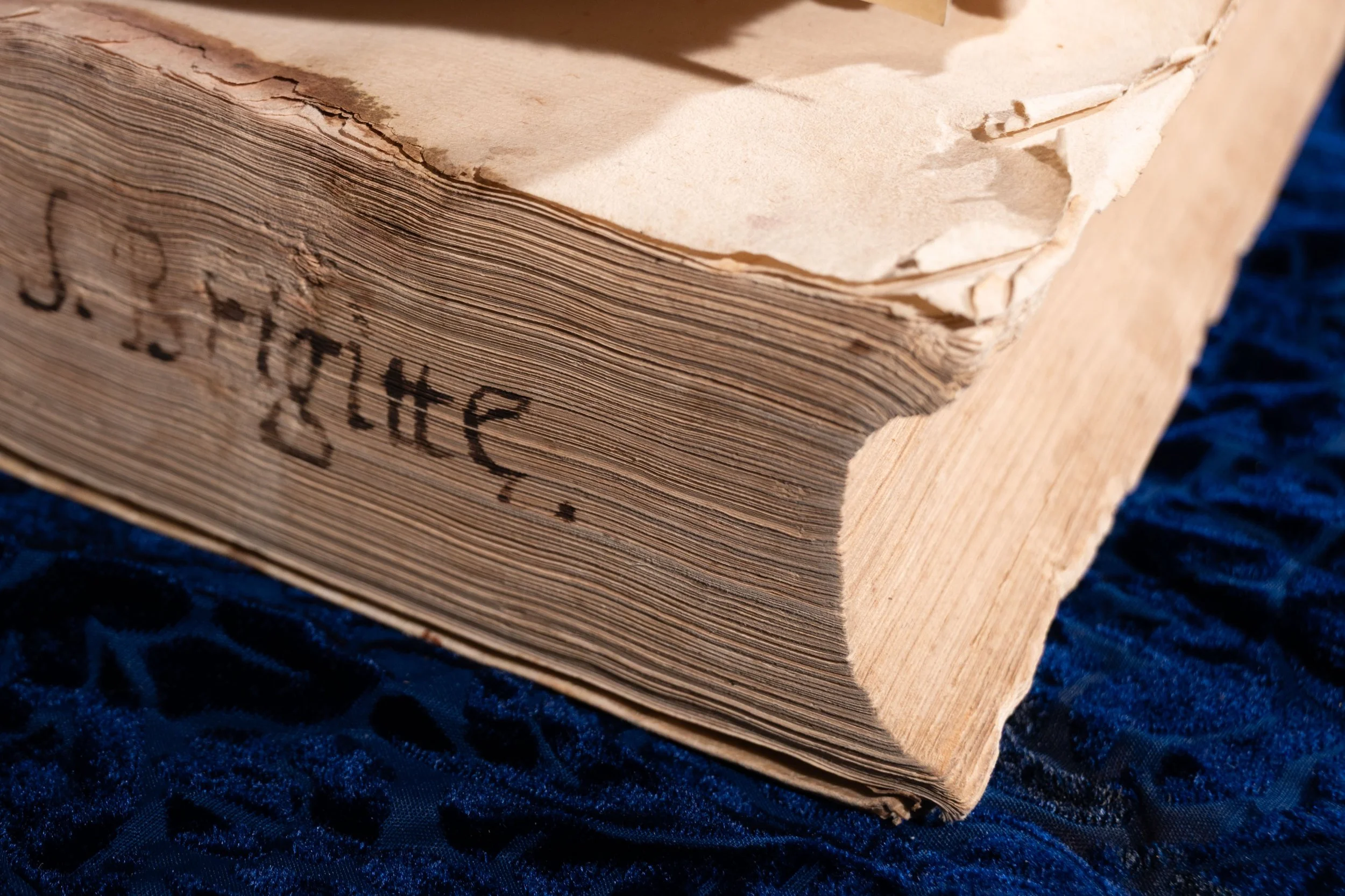 Image 15 of 15